The
Conjunction
Prepared by:
Jessa S. Gambito
CONJUNCTION
 Conjunction have one job
- to connect words, phrases, or clauses
 Their presence provides smooth transitions
from one idea to another.
 It also allows for varied sentence structure
and to create clarity.
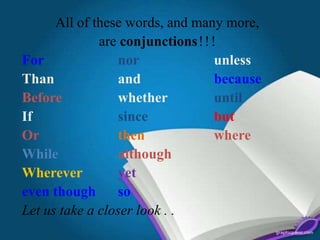
All of these words, and many more,
are conjunctions!!!
For nor unless
Than and because
Before whether until
If since but
Or then where
While although
Wherever yet
even though so
Let us take a closer look . .
There are two different types of conjunctions:
 Coordinating conjunctions
 Subordinating conjunctions
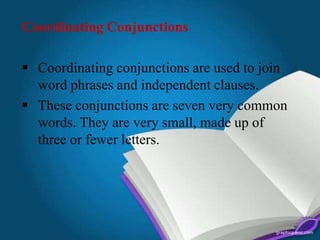
Coordinating Conjunctions
 Coordinating conjunctions are used to join
word phrases and independent clauses.
 These conjunctions are seven very common
words. They are very small, made up of
three or fewer letters.
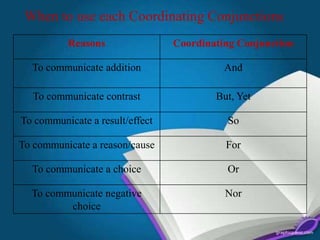
When to use each Coordinating Conjunctions
Reasons Coordinating Conjunction
To communicate addition And
To communicate contrast But, Yet
To communicate a result/effect So
To communicate a reason/cause For
To communicate a choice Or
To communicate negative
choice
Nor
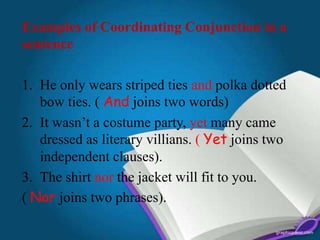
Examples of Coordinating Conjunction in a
sentence
1. He only wears striped ties and polka dotted
bow ties. ( And joins two words)
2. It wasn’t a costume party, yet many came
dressed as literary villians. ( Yet joins two
independent clauses).
3. The shirt nor the jacket will fit to you.
( Nor joins two phrases).
4. I wanted to see a scary movie, but my friend
wanted to see a comedy.( But connect two
independent clause)
5. You need to concentrate on your studies or
else you will fail in the class. ( Or it
communicate choices)
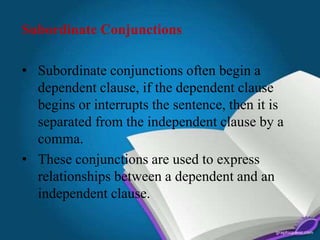
Subordinate Conjunctions
• Subordinate conjunctions often begin a
dependent clause, if the dependent clause
begins or interrupts the sentence, then it is
separated from the independent clause by a
comma.
• These conjunctions are used to express
relationships between a dependent and an
independent clause.
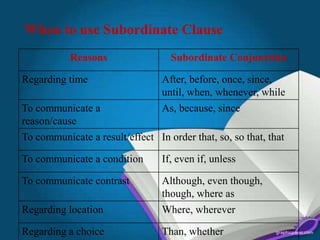
When to use Subordinate Clause
Reasons Subordinate Conjunction
Regarding time After, before, once, since,
until, when, whenever, while
To communicate a
reason/cause
As, because, since
To communicate a result/effect In order that, so, so that, that
To communicate a condition If, even if, unless
To communicate contrast Although, even though,
though, where as
Regarding location Where, wherever
Regarding a choice Than, whether
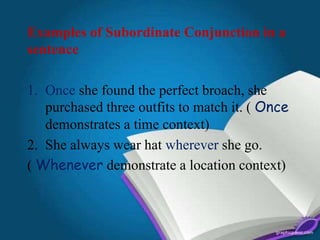
Examples of Subordinate Conjunction in a
sentence
1. Once she found the perfect broach, she
purchased three outfits to match it. ( Once
demonstrates a time context)
2. She always wear hat wherever she go.
( Whenever demonstrate a location context)
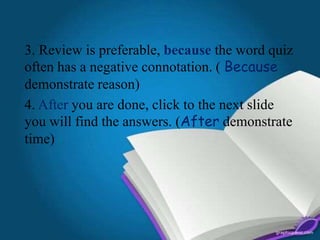
3. Review is preferable, because the word quiz
often has a negative connotation. ( Because
demonstrate reason)
4. After you are done, click to the next slide
you will find the answers. (After demonstrate
time)
Thank you For
Watching
God bless…

Conjunctions

  • 1.
  • 2.
    CONJUNCTION  Conjunction haveone job - to connect words, phrases, or clauses  Their presence provides smooth transitions from one idea to another.  It also allows for varied sentence structure and to create clarity.
  • 3.
    All of thesewords, and many more, are conjunctions!!! For nor unless Than and because Before whether until If since but Or then where While although Wherever yet even though so Let us take a closer look . .
  • 4.
    There are twodifferent types of conjunctions:  Coordinating conjunctions  Subordinating conjunctions
  • 5.
    Coordinating Conjunctions  Coordinatingconjunctions are used to join word phrases and independent clauses.  These conjunctions are seven very common words. They are very small, made up of three or fewer letters.
  • 6.
    When to useeach Coordinating Conjunctions Reasons Coordinating Conjunction To communicate addition And To communicate contrast But, Yet To communicate a result/effect So To communicate a reason/cause For To communicate a choice Or To communicate negative choice Nor
  • 7.
    Examples of CoordinatingConjunction in a sentence 1. He only wears striped ties and polka dotted bow ties. ( And joins two words) 2. It wasn’t a costume party, yet many came dressed as literary villians. ( Yet joins two independent clauses). 3. The shirt nor the jacket will fit to you. ( Nor joins two phrases).
  • 8.
    4. I wantedto see a scary movie, but my friend wanted to see a comedy.( But connect two independent clause) 5. You need to concentrate on your studies or else you will fail in the class. ( Or it communicate choices)
  • 9.
    Subordinate Conjunctions • Subordinateconjunctions often begin a dependent clause, if the dependent clause begins or interrupts the sentence, then it is separated from the independent clause by a comma. • These conjunctions are used to express relationships between a dependent and an independent clause.
  • 10.
    When to useSubordinate Clause Reasons Subordinate Conjunction Regarding time After, before, once, since, until, when, whenever, while To communicate a reason/cause As, because, since To communicate a result/effect In order that, so, so that, that To communicate a condition If, even if, unless To communicate contrast Although, even though, though, where as Regarding location Where, wherever Regarding a choice Than, whether
  • 11.
    Examples of SubordinateConjunction in a sentence 1. Once she found the perfect broach, she purchased three outfits to match it. ( Once demonstrates a time context) 2. She always wear hat wherever she go. ( Whenever demonstrate a location context)
  • 12.
    3. Review ispreferable, because the word quiz often has a negative connotation. ( Because demonstrate reason) 4. After you are done, click to the next slide you will find the answers. (After demonstrate time)
  • 13.