CONJUCTIVE ADVERDS 
Conjunctive adverbs (which are sometimes also called 
sentence connectors or transitional words) are commonly 
used in serious business, technical, and academic writing. 
Conjunctive adverbs are, similar in meaning to other types 
of connecting words such as and, but, or, etc., but they 
have one very important difference: they join sentences, 
not parts of sentences.
Conjunctive adverbs (or sentence connectors or 
transitional words) join sentences, not parts of sentences. 
In choosing a conjunctive adverb to use in connecting 
sentences, the relationship between the sentences that 
are to be connected is very important. 
When what happens in one sentence is the result of what 
happened in the preceding sentence, only a few conjunctive 
adverbs can be used. The most common ones for this 
situation are therefore, as a result, consequently, and 
accordingly. All of these mean the same thing and are 
used in the same way. 
Examples:
CONJUCTIVE ADVERBS ALSO 
HAVE SPECIAL PUNCTUATION 
Conjunctive adverbs also have special punctuation: 
with them, a semicolon or a period is used after the first 
sentence, and a comma is usually used after the conjunctive 
adverb. After the comma, the connected sentence follows. 

Following are some common conjunctive adverbs, plus 
general comments on their usage:
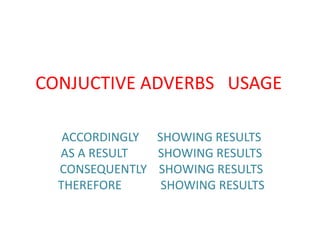
CONJUCTIVE ADVERBS USAGE 
ACCORDINGLY SHOWING RESULTS 
AS A RESULT SHOWING RESULTS 
CONSEQUENTLY SHOWING RESULTS 
THEREFORE SHOWING RESULTS
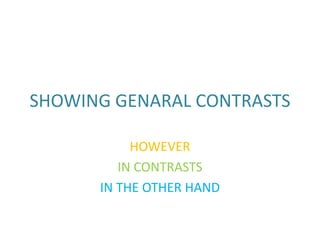
SHOWING GENARAL CONTRASTS 
HOWEVER 
IN CONTRASTS 
IN THE OTHER HAND
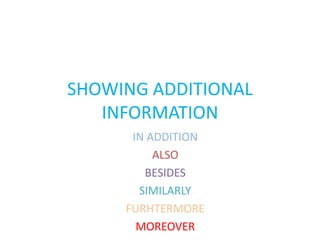
SHOWING ADDITIONAL 
INFORMATION 
IN ADDITION 
ALSO 
BESIDES 
SIMILARLY 
FURHTERMORE 
MOREOVER
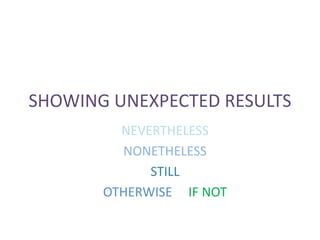
SHOWING UNEXPECTED RESULTS 
NEVERTHELESS 
NONETHELESS 
STILL 
OTHERWISE IF NOT
SPECIAL NOTE 
Conjunctive adverbs are challenging to use appropriately 
because they have special requirements for the kinds of 
ideas and information that they connect. There will be 
further information on conjunctive adverbs in the next 
several Hints of the Day.
CONJUCTIVE ADVERBS

CONJUCTIVE ADVERBS

  • 1.
    CONJUCTIVE ADVERDS Conjunctiveadverbs (which are sometimes also called sentence connectors or transitional words) are commonly used in serious business, technical, and academic writing. Conjunctive adverbs are, similar in meaning to other types of connecting words such as and, but, or, etc., but they have one very important difference: they join sentences, not parts of sentences.
  • 2.
    Conjunctive adverbs (orsentence connectors or transitional words) join sentences, not parts of sentences. In choosing a conjunctive adverb to use in connecting sentences, the relationship between the sentences that are to be connected is very important. When what happens in one sentence is the result of what happened in the preceding sentence, only a few conjunctive adverbs can be used. The most common ones for this situation are therefore, as a result, consequently, and accordingly. All of these mean the same thing and are used in the same way. Examples:
  • 3.
    CONJUCTIVE ADVERBS ALSO HAVE SPECIAL PUNCTUATION Conjunctive adverbs also have special punctuation: with them, a semicolon or a period is used after the first sentence, and a comma is usually used after the conjunctive adverb. After the comma, the connected sentence follows. Following are some common conjunctive adverbs, plus general comments on their usage:
  • 4.
    CONJUCTIVE ADVERBS USAGE ACCORDINGLY SHOWING RESULTS AS A RESULT SHOWING RESULTS CONSEQUENTLY SHOWING RESULTS THEREFORE SHOWING RESULTS
  • 5.
    SHOWING GENARAL CONTRASTS HOWEVER IN CONTRASTS IN THE OTHER HAND
  • 6.
    SHOWING ADDITIONAL INFORMATION IN ADDITION ALSO BESIDES SIMILARLY FURHTERMORE MOREOVER
  • 7.
    SHOWING UNEXPECTED RESULTS NEVERTHELESS NONETHELESS STILL OTHERWISE IF NOT
  • 8.
    SPECIAL NOTE Conjunctiveadverbs are challenging to use appropriately because they have special requirements for the kinds of ideas and information that they connect. There will be further information on conjunctive adverbs in the next several Hints of the Day.