CONJUNCTIONS
PREPARED BY: CHARLENE C. CADAO
CONJUNCTION
- are words that link words, phrases, or clauses together to provide cohesion and structure in sentences.They are classified
based on their functions and usage in language.
- often described as joining words since it combines two or more sentences and creates continuity and meaning for those
sentences.
For example :
He likes playing. He didn't clean up after coming home. (Without conjunction)
He likes playing; however, he didn't clean up after coming home. (With conjunction)
• She usually eats at home because she likes cooking.
• We listened eagerly, for he brought news about our families.
TYPES OF CONJUNCTIONS
There are four main types of conjunctions:
• Coordinating conjunctions
• Subordinating conjunctions
• Correlative conjunctions
• Conjunctive conjunctions
Each type serves a specific purpose in sentence construction and plays a vital role
in conveying relationships between words and clauses.
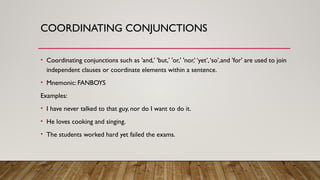
COORDINATING CONJUNCTIONS
• Coordinating conjunctions such as 'and,' 'but,' 'or,' 'nor,’ ‘yet’,‘so’,and 'for' are used to join
independent clauses or coordinate elements within a sentence.
• Mnemonic: FANBOYS
Examples:
• I have never talked to that guy, nor do I want to do it.
• He loves cooking and singing.
• The students worked hard yet failed the exams.
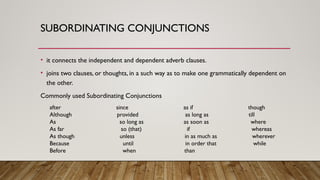
SUBORDINATING CONJUNCTIONS
• it connects the independent and dependent adverb clauses.
• joins two clauses, or thoughts, in a such way as to make one grammatically dependent on
the other.
Commonly used Subordinating Conjunctions
after since as if though
Although provided as long as till
As so long as as soon as where
As far so (that) if whereas
As though unless in as much as wherever
Because until in order that while
Before when than
SUBORDINATING CONJUNCTIONS
• EXAMPLES:
• Jessica completed his tasks before the scheduled time.
• He likes cooking as much as singing.
• He behaved as if he were a judge.
• The kids fed the strays whenever they had time.
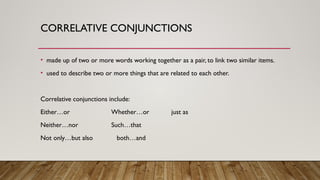
CORRELATIVE CONJUNCTIONS
• made up of two or more words working together as a pair, to link two similar items.
• used to describe two or more things that are related to each other.
Correlative conjunctions include:
Either…or Whether…or just as
Neither…nor Such…that
Not only…but also both…and
CORRELATIVE CONJUNCTIONS
• Examples:
• Either you learn how to do it or you will have to face the consequences.
• Neither did Rachel nor her friends make it to the event.
• Not only did they block the road but they also kept shouting slogans.
• Kevin was saying that he is not sure whether he should stay back tonight or leave home
immediately.
CONJUNCTIVE CONJUNCTIONS
• are one or more words used to join two independent clauses.
• these words are technically adverbs, but perform the same linking function as conjunctions.
• they are a type of sentence adverb used in order to express a particular relationship
between a first clause and a second clause that follows.
What to watch for when using conjunctive adverbs?
-when a conjunctive adverb unites two independent clauses in one sentence, it’s preceded by
a semicolon and followed by a comma.
CONJUNCTIVE CONJUNCTIONS
• Conjunctive adverbs have many uses, as the following examples show.
• To replace and – also, besides, furthermore, moreover
• To replace but – however, nevertheless, nonetheless, still
• To state a result – accordingly, consequently, then, therefore, thus
• To state equality – equally, likewise, similarity
• To introduce examples - for example, for instance
CONJUNCTIVE CONJUNCTIONS
• LIST OF
• Also Accordingly Additionally Again
• Anyway As a result Besides ConverselyConsequently
• Contrarily Comparatively Certainly Eventually Equally
• Elsewhere Further Finally Furthermore
• Hence However In fact In contrast In comparison
• In addition Incidentally Instead Indeed Just as
• Likewise Moreover Meanwhile Next Nevertheless
• Namely Nonetheless Now Notably Otherwise
• On the other hand Rather Still Subsequently
CONJUNCTIVE CONJUNCTIONS
• Example:
Coordinating:The weather app said it would rain today, but no clouds are in the sky.
Conjunctive: The weather app said it would rain today; however, no clouds are in the
sky.)

Conjunction/Grade-8..........///...,pptx

  • 1.
  • 2.
    CONJUNCTION - are wordsthat link words, phrases, or clauses together to provide cohesion and structure in sentences.They are classified based on their functions and usage in language. - often described as joining words since it combines two or more sentences and creates continuity and meaning for those sentences. For example : He likes playing. He didn't clean up after coming home. (Without conjunction) He likes playing; however, he didn't clean up after coming home. (With conjunction) • She usually eats at home because she likes cooking. • We listened eagerly, for he brought news about our families.
  • 3.
    TYPES OF CONJUNCTIONS Thereare four main types of conjunctions: • Coordinating conjunctions • Subordinating conjunctions • Correlative conjunctions • Conjunctive conjunctions Each type serves a specific purpose in sentence construction and plays a vital role in conveying relationships between words and clauses.
  • 4.
    COORDINATING CONJUNCTIONS • Coordinatingconjunctions such as 'and,' 'but,' 'or,' 'nor,’ ‘yet’,‘so’,and 'for' are used to join independent clauses or coordinate elements within a sentence. • Mnemonic: FANBOYS Examples: • I have never talked to that guy, nor do I want to do it. • He loves cooking and singing. • The students worked hard yet failed the exams.
  • 5.
    SUBORDINATING CONJUNCTIONS • itconnects the independent and dependent adverb clauses. • joins two clauses, or thoughts, in a such way as to make one grammatically dependent on the other. Commonly used Subordinating Conjunctions after since as if though Although provided as long as till As so long as as soon as where As far so (that) if whereas As though unless in as much as wherever Because until in order that while Before when than
  • 6.
    SUBORDINATING CONJUNCTIONS • EXAMPLES: •Jessica completed his tasks before the scheduled time. • He likes cooking as much as singing. • He behaved as if he were a judge. • The kids fed the strays whenever they had time.
  • 7.
    CORRELATIVE CONJUNCTIONS • madeup of two or more words working together as a pair, to link two similar items. • used to describe two or more things that are related to each other. Correlative conjunctions include: Either…or Whether…or just as Neither…nor Such…that Not only…but also both…and
  • 8.
    CORRELATIVE CONJUNCTIONS • Examples: •Either you learn how to do it or you will have to face the consequences. • Neither did Rachel nor her friends make it to the event. • Not only did they block the road but they also kept shouting slogans. • Kevin was saying that he is not sure whether he should stay back tonight or leave home immediately.
  • 9.
    CONJUNCTIVE CONJUNCTIONS • areone or more words used to join two independent clauses. • these words are technically adverbs, but perform the same linking function as conjunctions. • they are a type of sentence adverb used in order to express a particular relationship between a first clause and a second clause that follows. What to watch for when using conjunctive adverbs? -when a conjunctive adverb unites two independent clauses in one sentence, it’s preceded by a semicolon and followed by a comma.
  • 10.
    CONJUNCTIVE CONJUNCTIONS • Conjunctiveadverbs have many uses, as the following examples show. • To replace and – also, besides, furthermore, moreover • To replace but – however, nevertheless, nonetheless, still • To state a result – accordingly, consequently, then, therefore, thus • To state equality – equally, likewise, similarity • To introduce examples - for example, for instance
  • 11.
    CONJUNCTIVE CONJUNCTIONS • LISTOF • Also Accordingly Additionally Again • Anyway As a result Besides ConverselyConsequently • Contrarily Comparatively Certainly Eventually Equally • Elsewhere Further Finally Furthermore • Hence However In fact In contrast In comparison • In addition Incidentally Instead Indeed Just as • Likewise Moreover Meanwhile Next Nevertheless • Namely Nonetheless Now Notably Otherwise • On the other hand Rather Still Subsequently
  • 12.
    CONJUNCTIVE CONJUNCTIONS • Example: Coordinating:Theweather app said it would rain today, but no clouds are in the sky. Conjunctive: The weather app said it would rain today; however, no clouds are in the sky.)