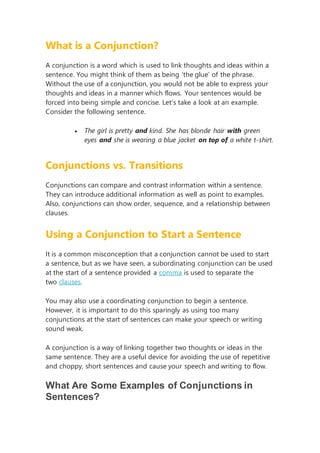
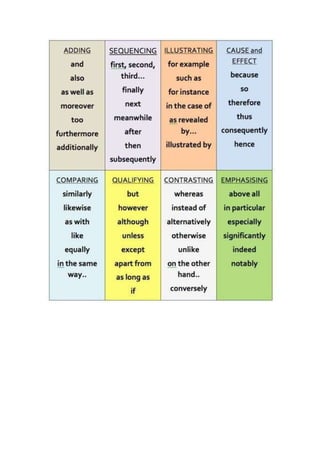
What is a Conjunction?
A conjunction is a word which is used to link thoughts and ideas within a
sentence. You might think of them as being ‘the glue’ of the phrase.
Without the use of a conjunction, you would not be able to express your
thoughts and ideas in a manner which flows. Your sentences would be
forced into being simple and concise. Let’s take a look at an example.
Consider the following sentence.
 The girl is pretty and kind. She has blonde hair with green
eyes and she is wearing a blue jacket on top of a white t-shirt.
Conjunctions vs. Transitions
Conjunctions can compare and contrast information within a sentence.
They can introduce additional information as well as point to examples.
Also, conjunctions can show order, sequence, and a relationship between
clauses.
Using a Conjunction to Start a Sentence
It is a common misconception that a conjunction cannot be used to start
a sentence, but as we have seen, a subordinating conjunction can be used
at the start of a sentence provided a comma is used to separate the
two clauses.
You may also use a coordinating conjunction to begin a sentence.
However, it is important to do this sparingly as using too many
conjunctions at the start of sentences can make your speech or writing
sound weak.
A conjunction is a way of linking together two thoughts or ideas in the
same sentence. They are a useful device for avoiding the use of repetitive
and choppy, short sentences and cause your speech and writing to flow.
What Are Some Examples of Conjunctions in
Sentences?
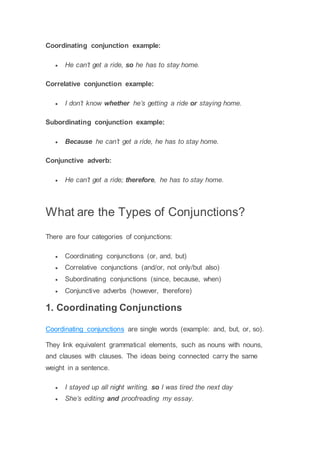
Coordinating conjunction example:
 He can’t get a ride, so he has to stay home.
Correlative conjunction example:
 I don’t know whether he’s getting a ride or staying home.
Subordinating conjunction example:
 Because he can’t get a ride, he has to stay home.
Conjunctive adverb:
 He can’t get a ride; therefore, he has to stay home.
What are the Types of Conjunctions?
There are four categories of conjunctions:
 Coordinating conjunctions (or, and, but)
 Correlative conjunctions (and/or, not only/but also)
 Subordinating conjunctions (since, because, when)
 Conjunctive adverbs (however, therefore)
1. Coordinating Conjunctions
Coordinating conjunctions are single words (example: and, but, or, so).
They link equivalent grammatical elements, such as nouns with nouns,
and clauses with clauses. The ideas being connected carry the same
weight in a sentence.
 I stayed up all night writing, so I was tired the next day
 She’s editing and proofreading my essay.
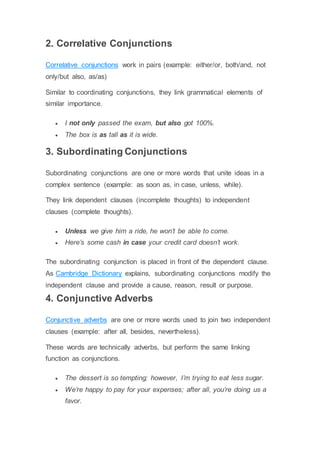
2. Correlative Conjunctions
Correlative conjunctions work in pairs (example: either/or, both/and, not
only/but also, as/as)
Similar to coordinating conjunctions, they link grammatical elements of
similar importance.
 I not only passed the exam, but also got 100%.
 The box is as tall as it is wide.
3. Subordinating Conjunctions
Subordinating conjunctions are one or more words that unite ideas in a
complex sentence (example: as soon as, in case, unless, while).
They link dependent clauses (incomplete thoughts) to independent
clauses (complete thoughts).
 Unless we give him a ride, he won’t be able to come.
 Here’s some cash in case your credit card doesn’t work.
The subordinating conjunction is placed in front of the dependent clause.
As Cambridge Dictionary explains, subordinating conjunctions modify the
independent clause and provide a cause, reason, result or purpose.
4. Conjunctive Adverbs
Conjunctive adverbs are one or more words used to join two independent
clauses (example: after all, besides, nevertheless).
These words are technically adverbs, but perform the same linking
function as conjunctions.
 The dessert is so tempting; however, I’m trying to eat less sugar.
 We’re happy to pay for your expenses; after all, you’re doing us a
favor.
conjunctions trabajo.docx

conjunctions trabajo.docx

  • 1.
    What is aConjunction? A conjunction is a word which is used to link thoughts and ideas within a sentence. You might think of them as being ‘the glue’ of the phrase. Without the use of a conjunction, you would not be able to express your thoughts and ideas in a manner which flows. Your sentences would be forced into being simple and concise. Let’s take a look at an example. Consider the following sentence.  The girl is pretty and kind. She has blonde hair with green eyes and she is wearing a blue jacket on top of a white t-shirt. Conjunctions vs. Transitions Conjunctions can compare and contrast information within a sentence. They can introduce additional information as well as point to examples. Also, conjunctions can show order, sequence, and a relationship between clauses. Using a Conjunction to Start a Sentence It is a common misconception that a conjunction cannot be used to start a sentence, but as we have seen, a subordinating conjunction can be used at the start of a sentence provided a comma is used to separate the two clauses. You may also use a coordinating conjunction to begin a sentence. However, it is important to do this sparingly as using too many conjunctions at the start of sentences can make your speech or writing sound weak. A conjunction is a way of linking together two thoughts or ideas in the same sentence. They are a useful device for avoiding the use of repetitive and choppy, short sentences and cause your speech and writing to flow. What Are Some Examples of Conjunctions in Sentences?
  • 2.
    Coordinating conjunction example: He can’t get a ride, so he has to stay home. Correlative conjunction example:  I don’t know whether he’s getting a ride or staying home. Subordinating conjunction example:  Because he can’t get a ride, he has to stay home. Conjunctive adverb:  He can’t get a ride; therefore, he has to stay home. What are the Types of Conjunctions? There are four categories of conjunctions:  Coordinating conjunctions (or, and, but)  Correlative conjunctions (and/or, not only/but also)  Subordinating conjunctions (since, because, when)  Conjunctive adverbs (however, therefore) 1. Coordinating Conjunctions Coordinating conjunctions are single words (example: and, but, or, so). They link equivalent grammatical elements, such as nouns with nouns, and clauses with clauses. The ideas being connected carry the same weight in a sentence.  I stayed up all night writing, so I was tired the next day  She’s editing and proofreading my essay.
  • 3.
    2. Correlative Conjunctions Correlativeconjunctions work in pairs (example: either/or, both/and, not only/but also, as/as) Similar to coordinating conjunctions, they link grammatical elements of similar importance.  I not only passed the exam, but also got 100%.  The box is as tall as it is wide. 3. Subordinating Conjunctions Subordinating conjunctions are one or more words that unite ideas in a complex sentence (example: as soon as, in case, unless, while). They link dependent clauses (incomplete thoughts) to independent clauses (complete thoughts).  Unless we give him a ride, he won’t be able to come.  Here’s some cash in case your credit card doesn’t work. The subordinating conjunction is placed in front of the dependent clause. As Cambridge Dictionary explains, subordinating conjunctions modify the independent clause and provide a cause, reason, result or purpose. 4. Conjunctive Adverbs Conjunctive adverbs are one or more words used to join two independent clauses (example: after all, besides, nevertheless). These words are technically adverbs, but perform the same linking function as conjunctions.  The dessert is so tempting; however, I’m trying to eat less sugar.  We’re happy to pay for your expenses; after all, you’re doing us a favor.