Annual
Integrated EL Civics
Conference 2017:
Teaching EL Civics Vocabulary
with Technology
KRISTI REYES
MIRACOSTA COLLEGE
NONCREDIT ESL
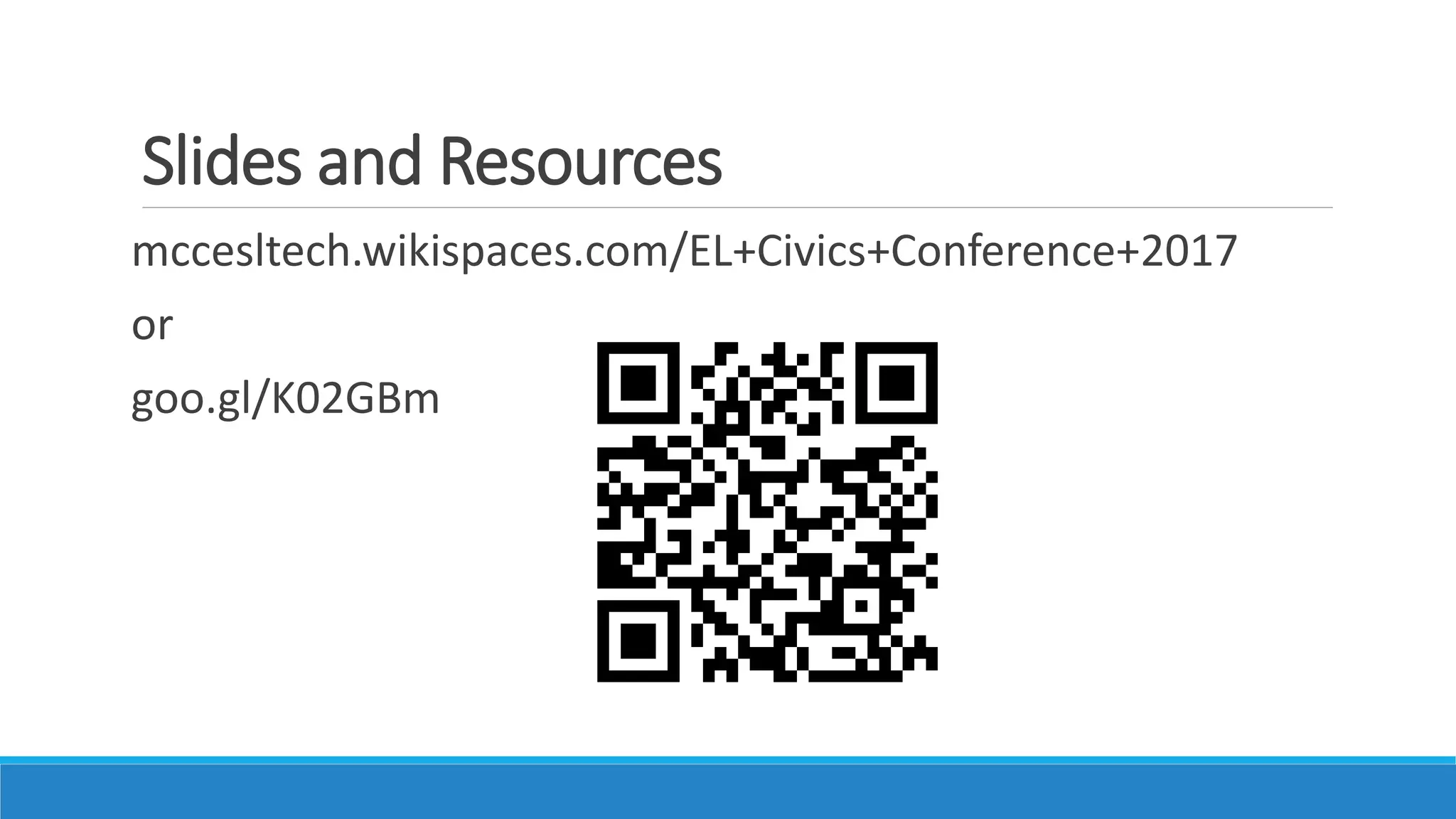
Slides and Resources
mccesltech.wikispaces.com/EL+Civics+Conference+2017
or
goo.gl/K02GBm
Warm-up
1.What does it mean to “know” a word?
2.How many exposures to a word are necessary
for a language learner to acquire and retain
it?
Pairs
Introduce yourself: Name + what, where, who you
teach.
Compare your answers to the questions
1. What does it mean to “know” a word?
2. How many exposures to a word are necessary for a
language learner to acquire and retain it?
What does it mean to “know” a word?
Receptive knowledge
v.
Productive knowledge
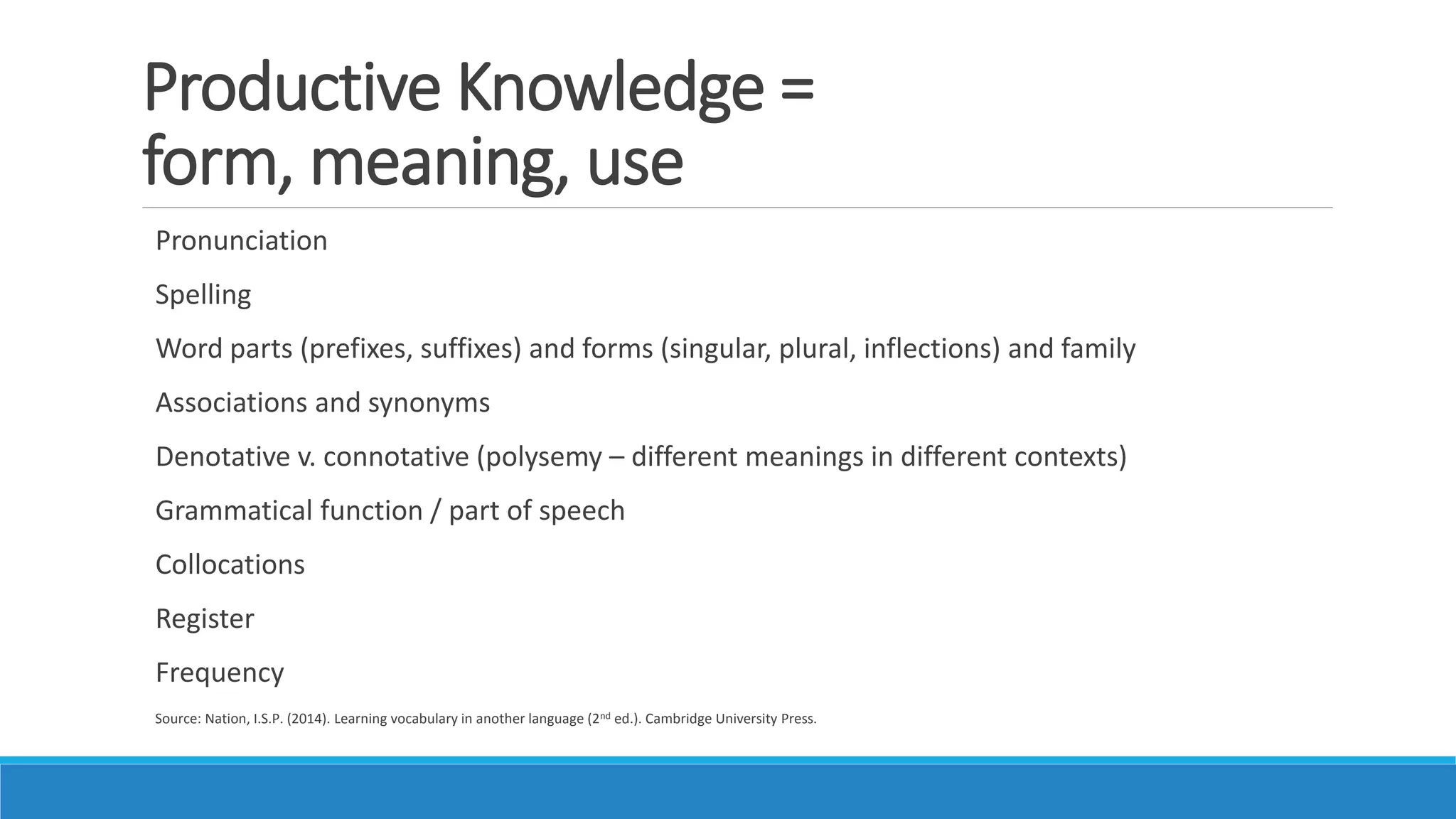
Productive Knowledge =
form, meaning, use
Pronunciation
Spelling
Word parts (prefixes, suffixes) and forms (singular, plural, inflections) and family
Associations and synonyms
Denotative v. connotative (polysemy – different meanings in different contexts)
Grammatical function / part of speech
Collocations
Register
Frequency
Source: Nation, I.S.P. (2014). Learning vocabulary in another language (2nd ed.). Cambridge University Press.
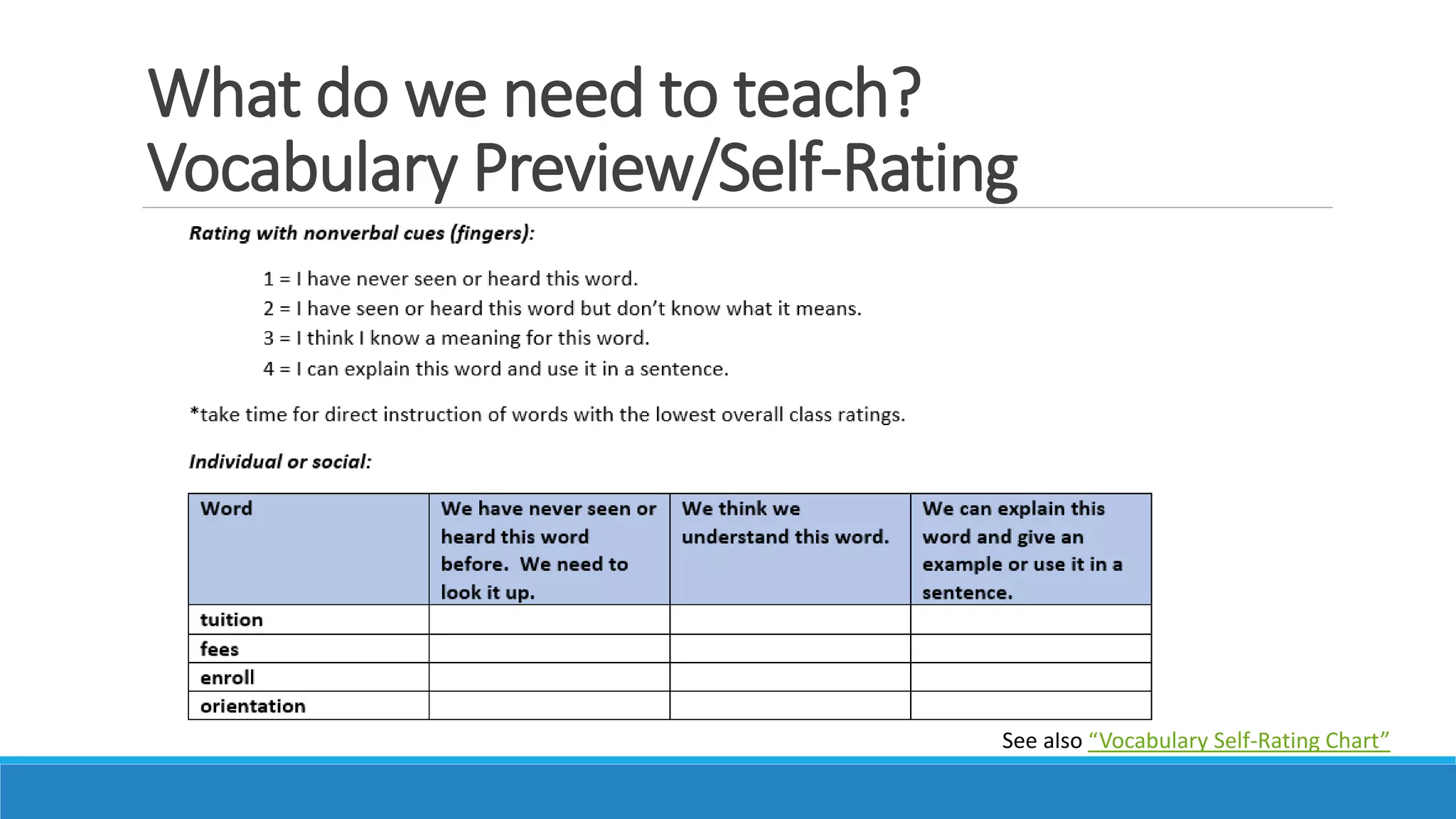
What do we need to teach?
Vocabulary Preview/Self-Rating
See also “Vocabulary Self-Rating Chart”
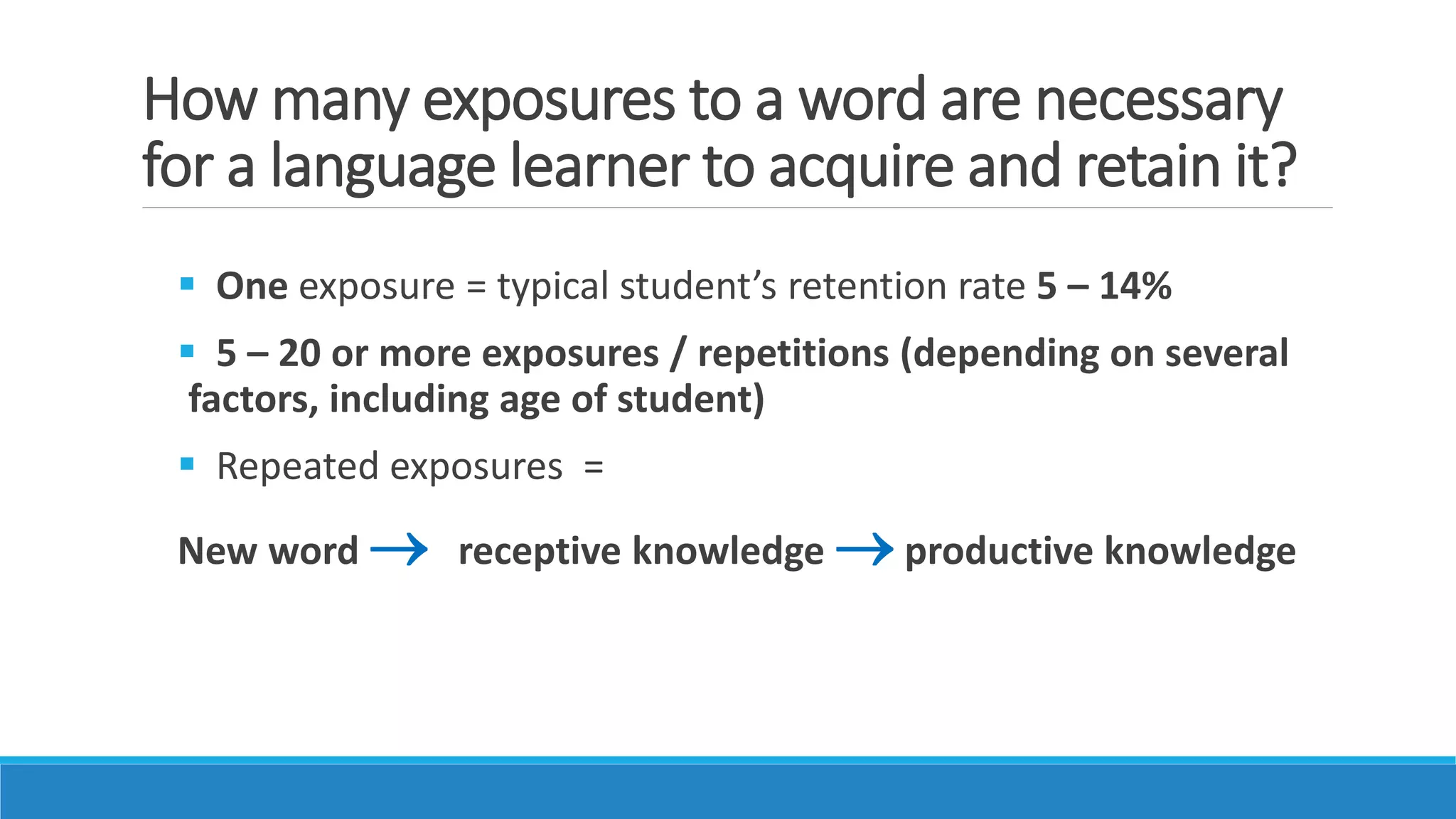
How many exposures to a word are necessary
for a language learner to acquire and retain it?
 One exposure = typical student’s retention rate 5 – 14%
 5 – 20 or more exposures / repetitions (depending on several
factors, including age of student)
 Repeated exposures =
New word  receptive knowledge  productive knowledge
Pairs Again
What is your one best / most effective technique or activity
to …
teach vocabulary?
OR
have students learn/study vocabulary?
OR
get students to use target vocabulary?
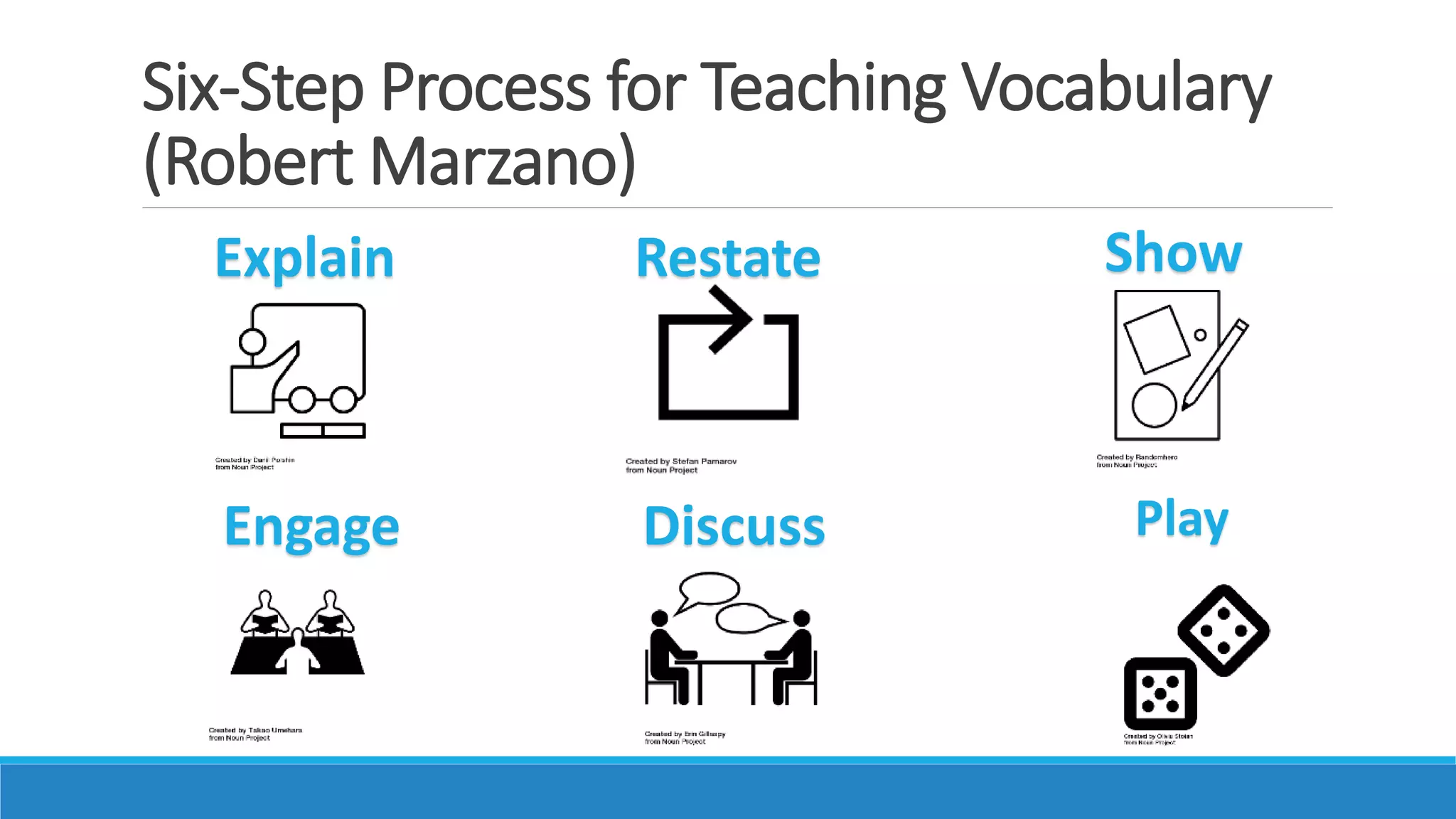
Six-Step Process for Teaching Vocabulary
(Robert Marzano)
RestateExplain Show
Engage Discuss Play
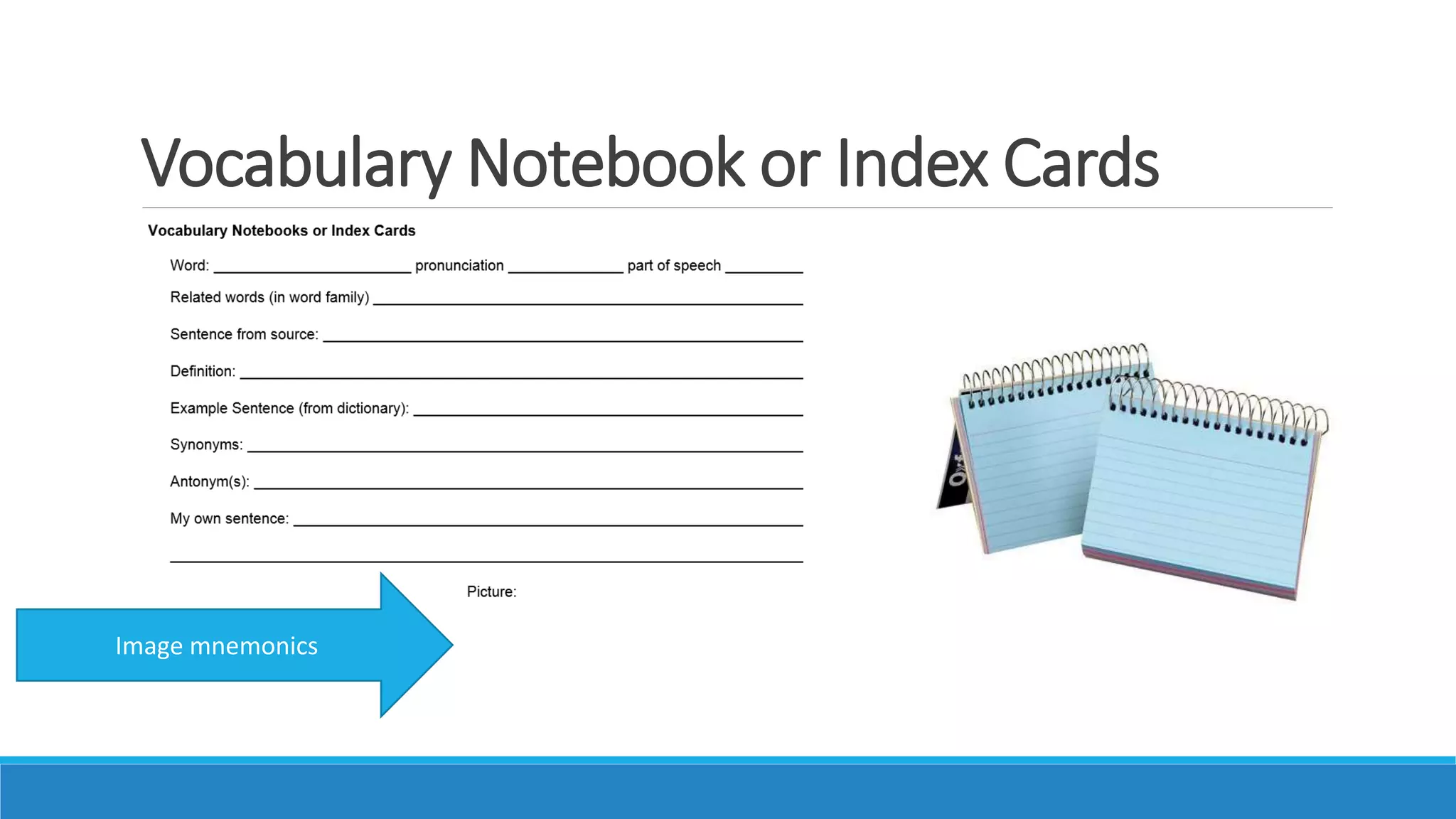
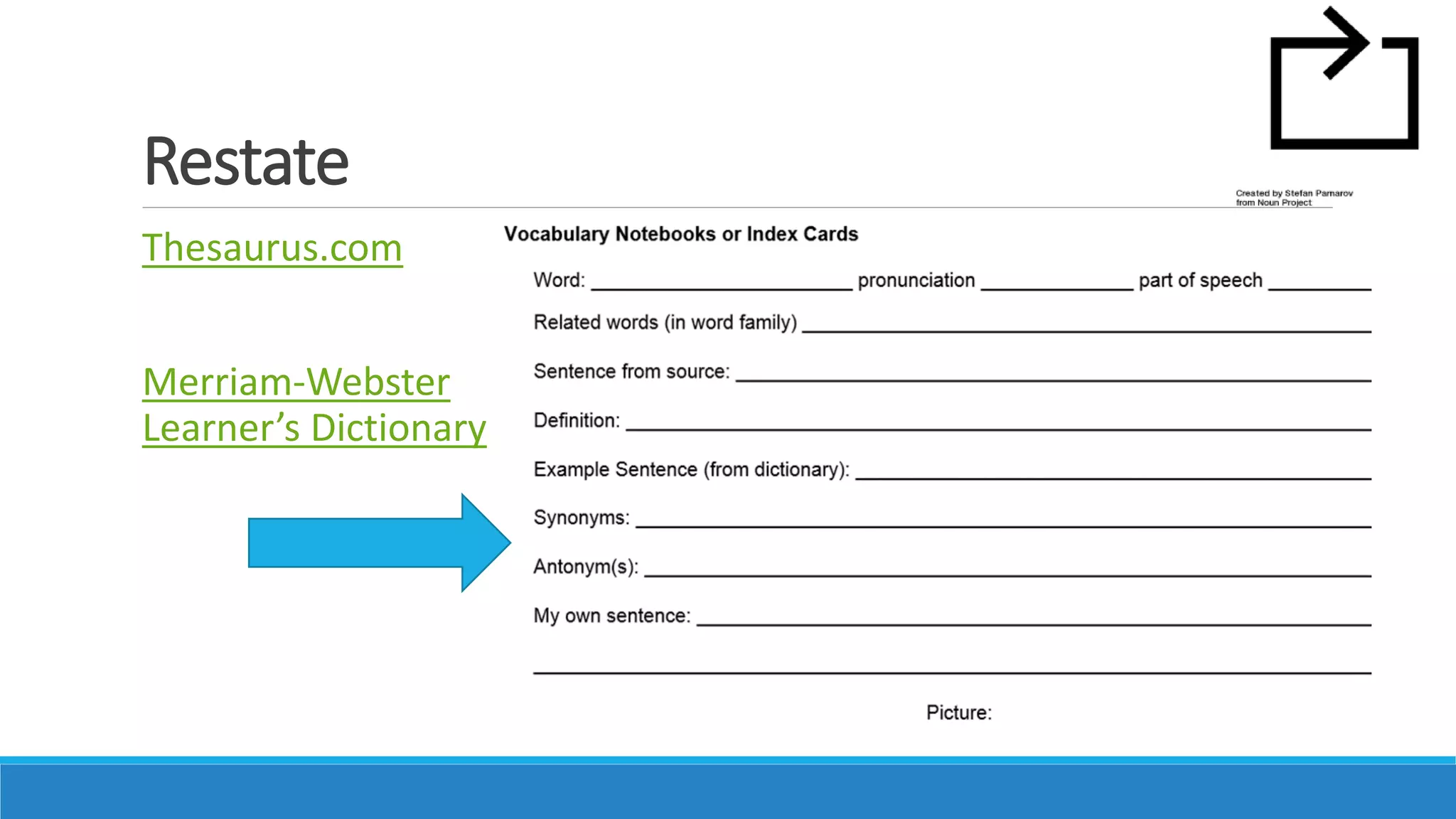
Vocabulary Notebook or Index Cards
Image mnemonics
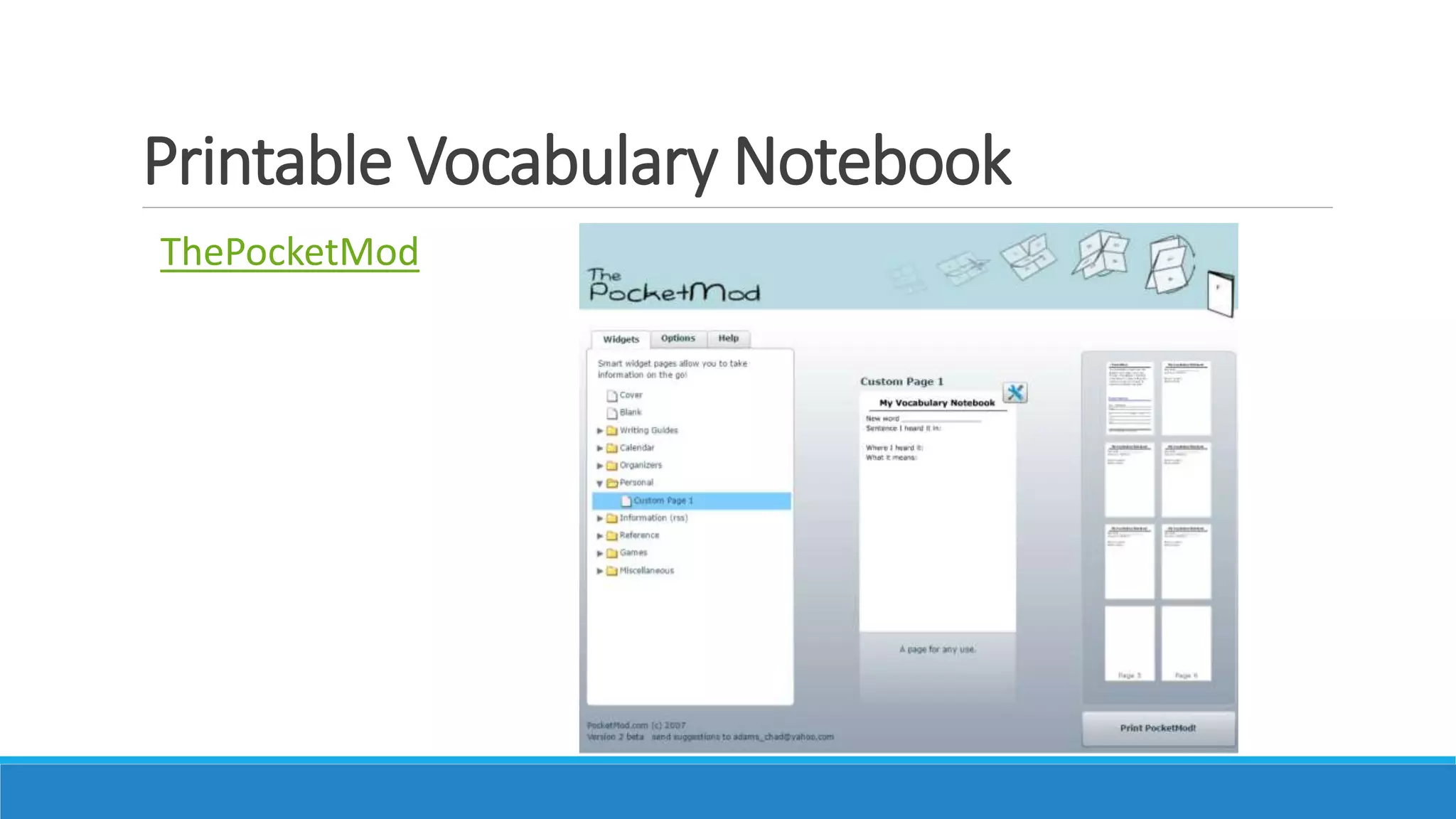
Printable Vocabulary Notebook
ThePocketMod
Step 1: Explain
Provide a student-friendly description, explanation, or example of
the new term
◦ Online images or photos taken with cell phone
◦ Picture dictionary Web sites
◦ Graphic Interchange Format (GIFS) – search for or make your own
by cutting an online video
◦ Comic strips or slideshows
◦ Anecdotal story or a current event
Explain
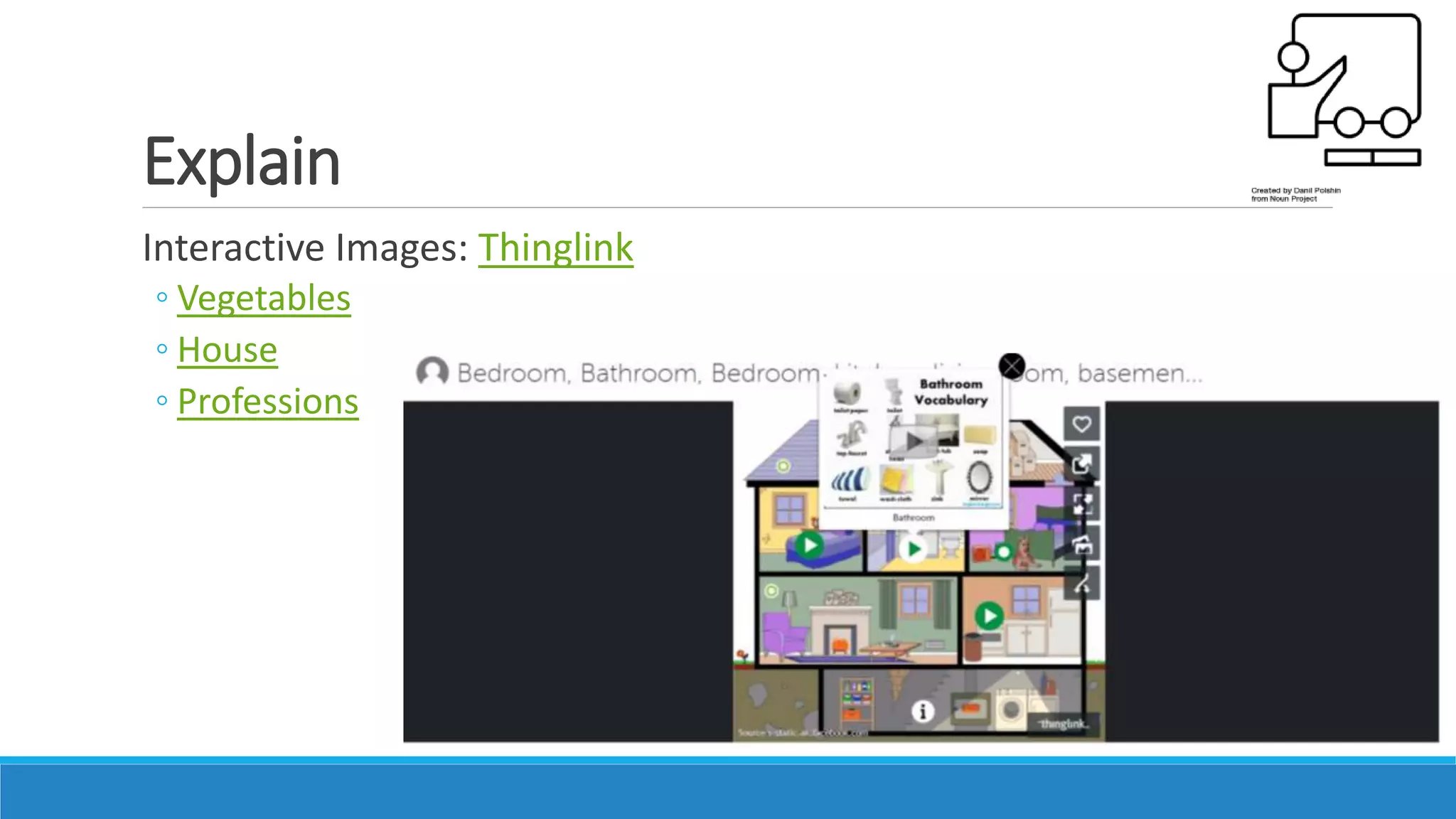
Interactive Images: Thinglink
◦ Vegetables
◦ House
◦ Professions
Explain
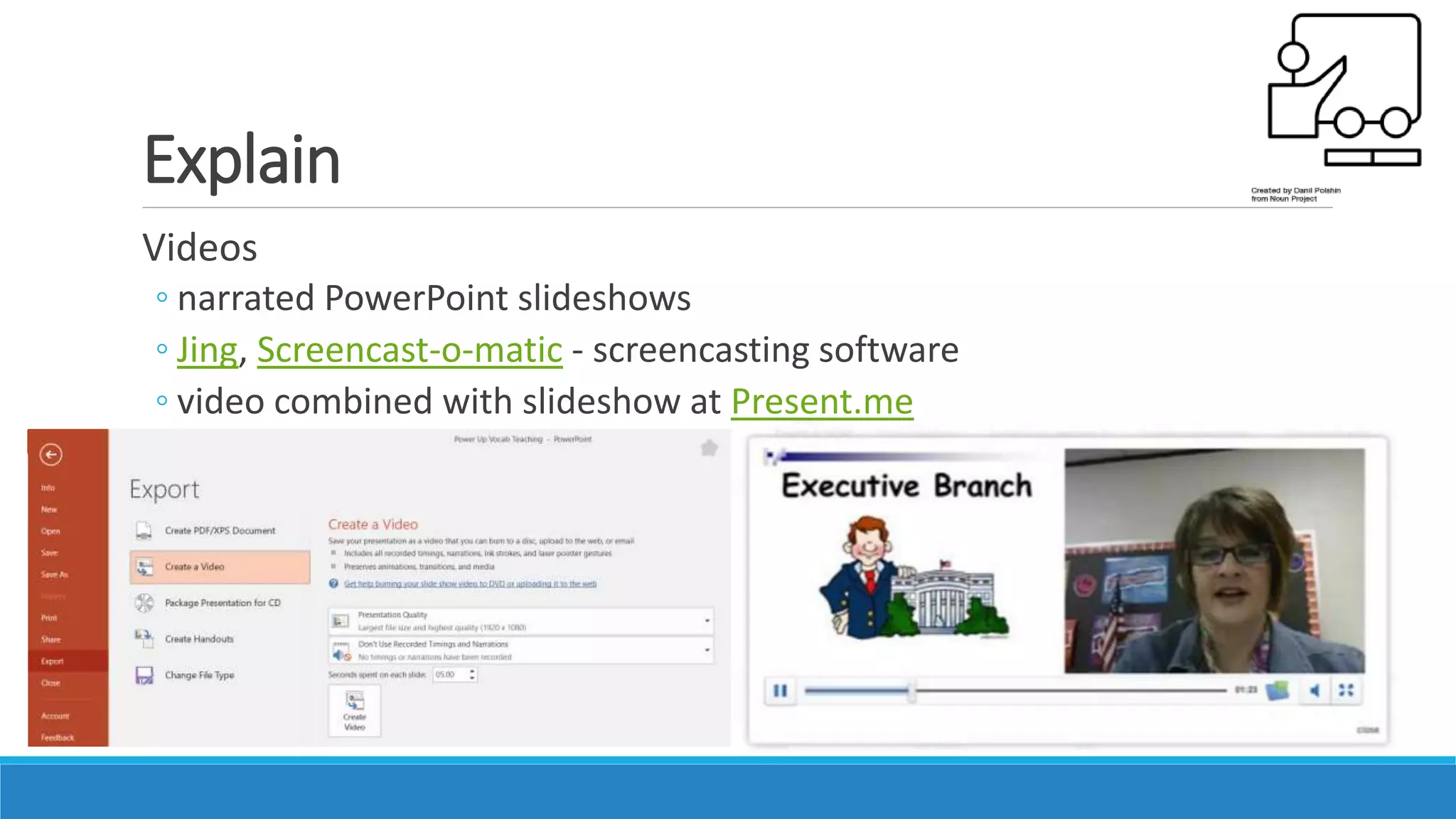
Videos
◦ narrated PowerPoint slideshows
◦ Jing, Screencast-o-matic - screencasting software
◦ video combined with slideshow at Present.me
Step 2: Restate
Ask students to restate the description, explanation, or example in
their own words. (linguistic)
• Cell phone videos with voice recordings or video
• Slideshow
• Poster
• Audio recording
Restate
Thesaurus.com
Merriam-Webster
Learner’s Dictionary
Restate
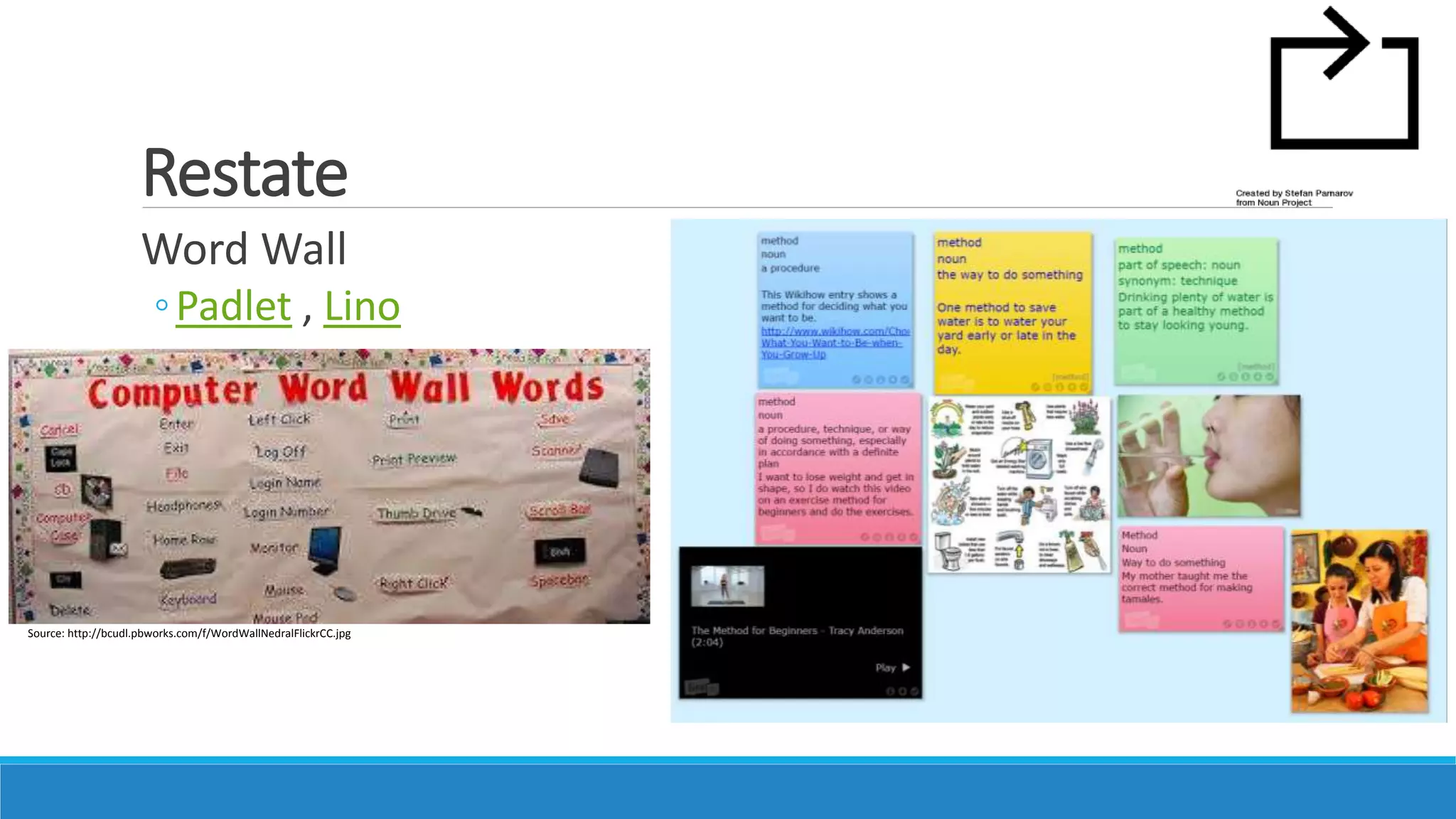
Word Wall
◦Padlet , Lino
Source: http://bcudl.pbworks.com/f/WordWallNedralFlickrCC.jpg
Restate
Interactive Concept Map Sites and online picture dictionaries
◦ Instragrok
Grok for “immigrant”
Step 3: Show
Ask students to construct a picture, symbol, or graphic
representation of the term (nonlinguistic)
• Sketchpads: Pencilapp
• Google apps: Shared Google slideshow, Google Drawing
• Formative - designed for instant polling / formative assessment
(like Kahoot) but students draw
Step 4: Engage
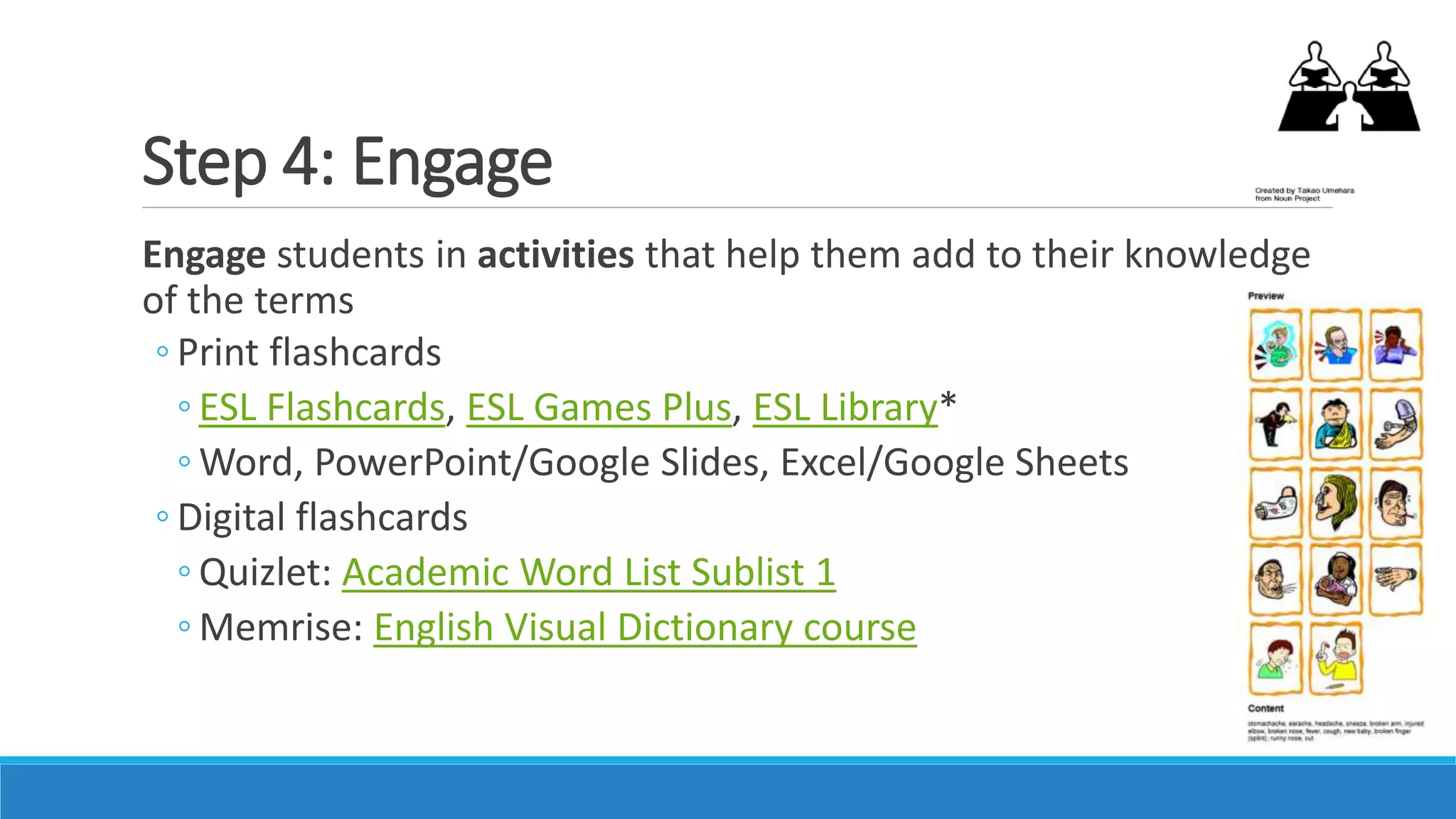
Engage students in activities that help them add to their knowledge
of the terms
◦ Print flashcards
◦ ESL Flashcards, ESL Games Plus, ESL Library*
◦ Word, PowerPoint/Google Slides, Excel/Google Sheets
◦ Digital flashcards
◦ Quizlet: Academic Word List Sublist 1
◦ Memrise: English Visual Dictionary course
Engage
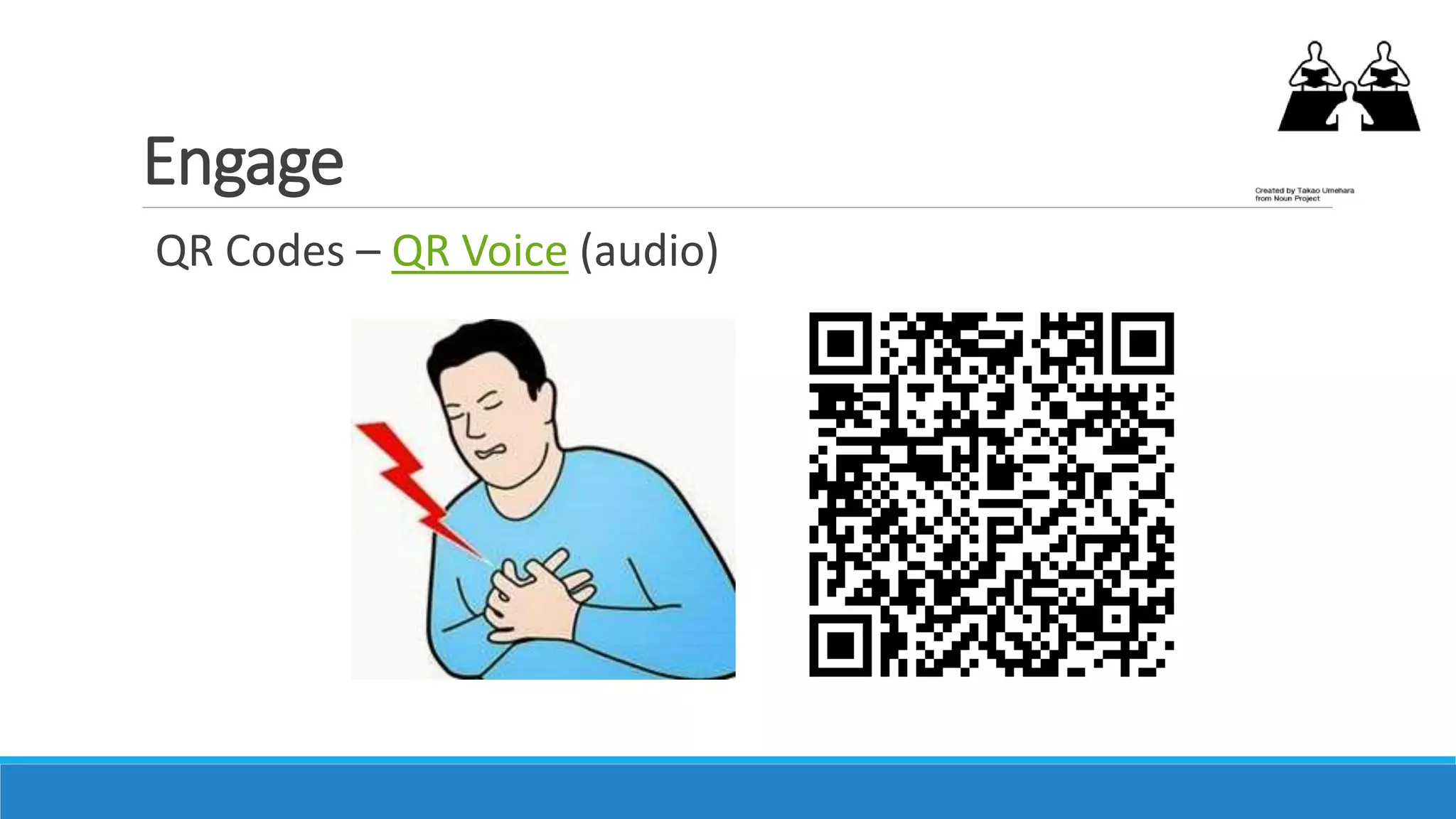
QR Codes – QR Voice (audio)
Engage
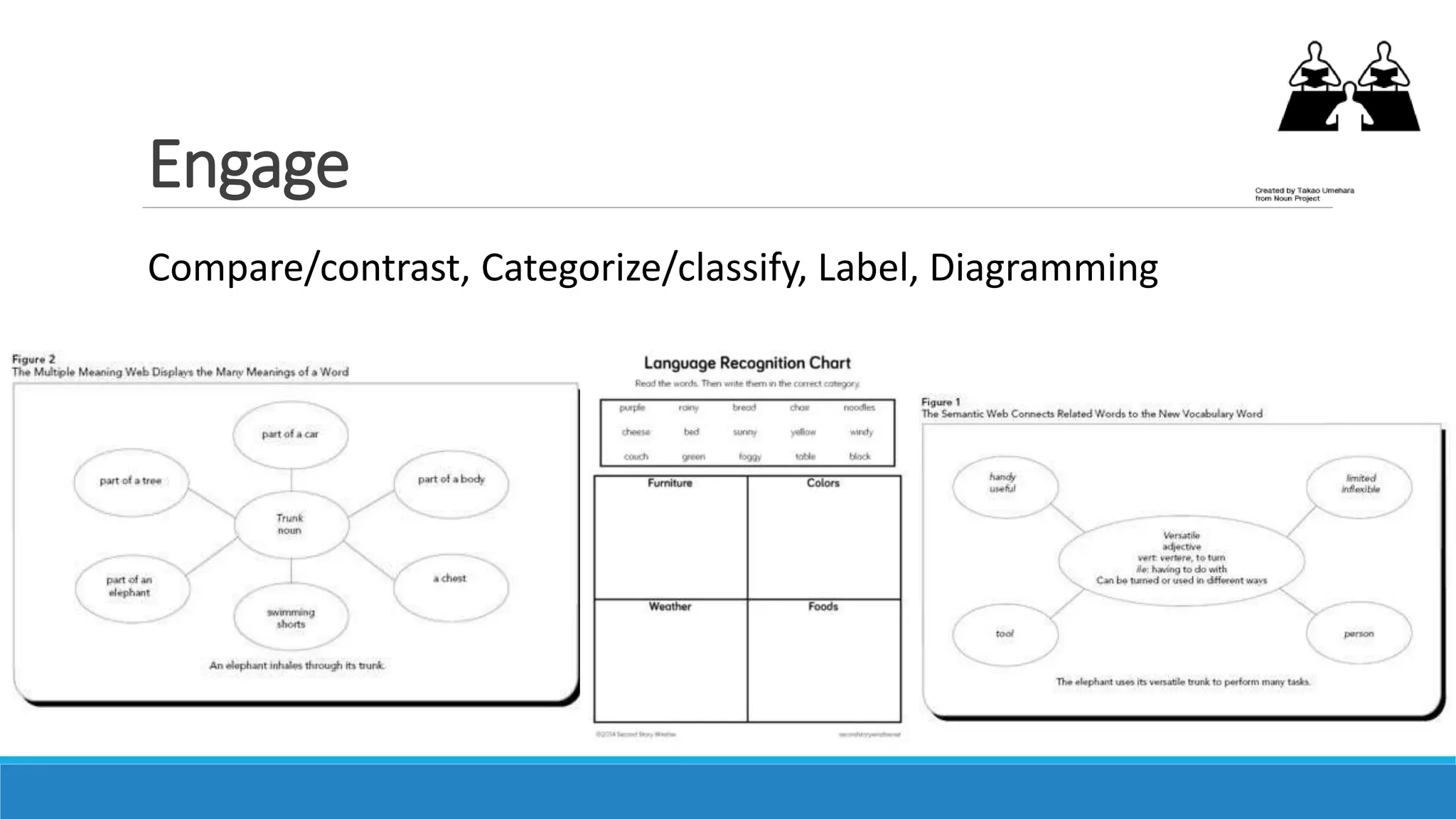
Compare/contrast, Categorize/classify, Label, Diagramming
Engage
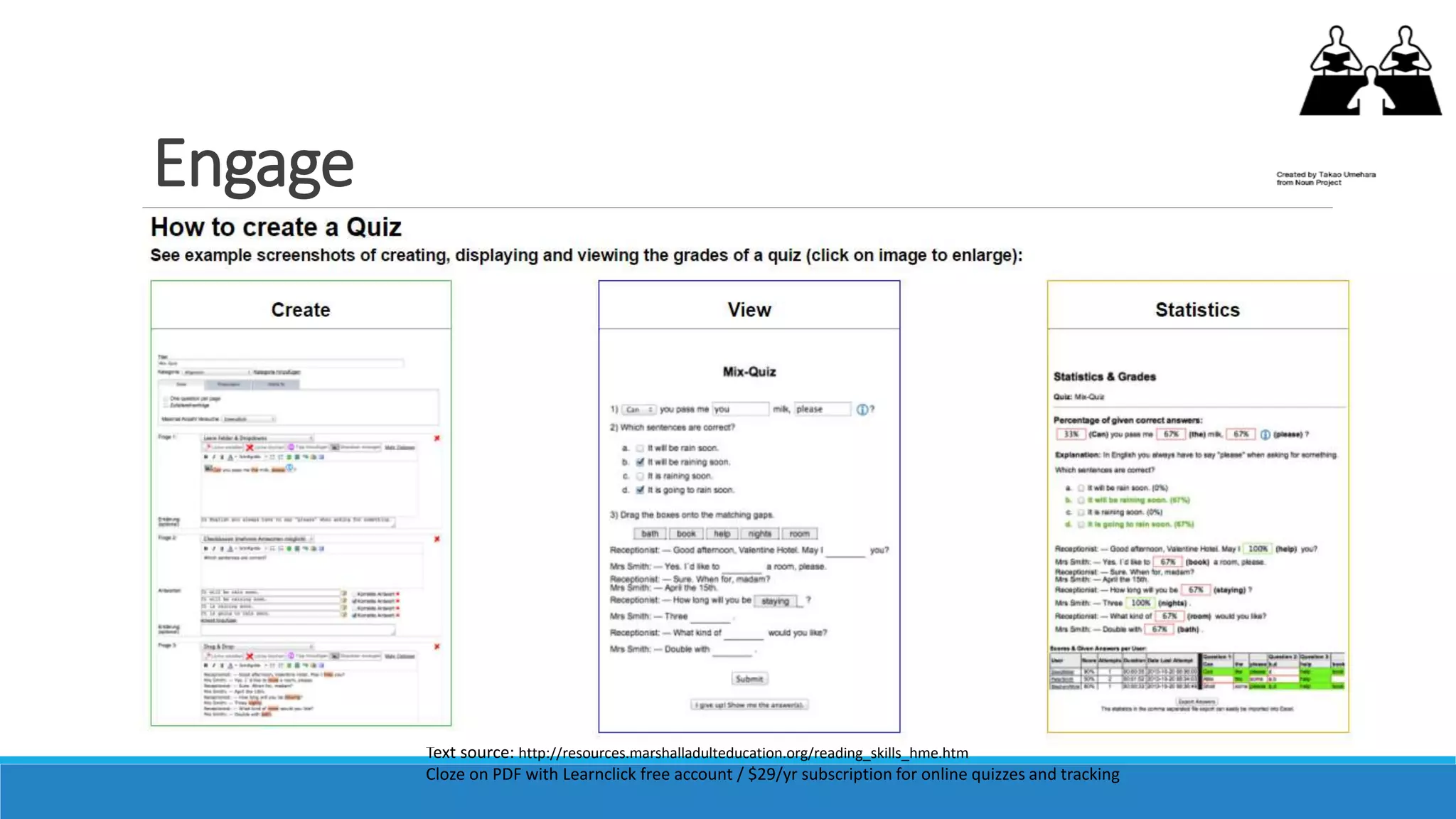
Cloze - Learnclick Cloze Quiz Creator – 7 question
types with app
Text source: http://resources.marshalladulteducation.org/reading_skills_hme.htm
Cloze on PDF with Learnclick free account / $29/yr subscription for online quizzes and tracking
Engage
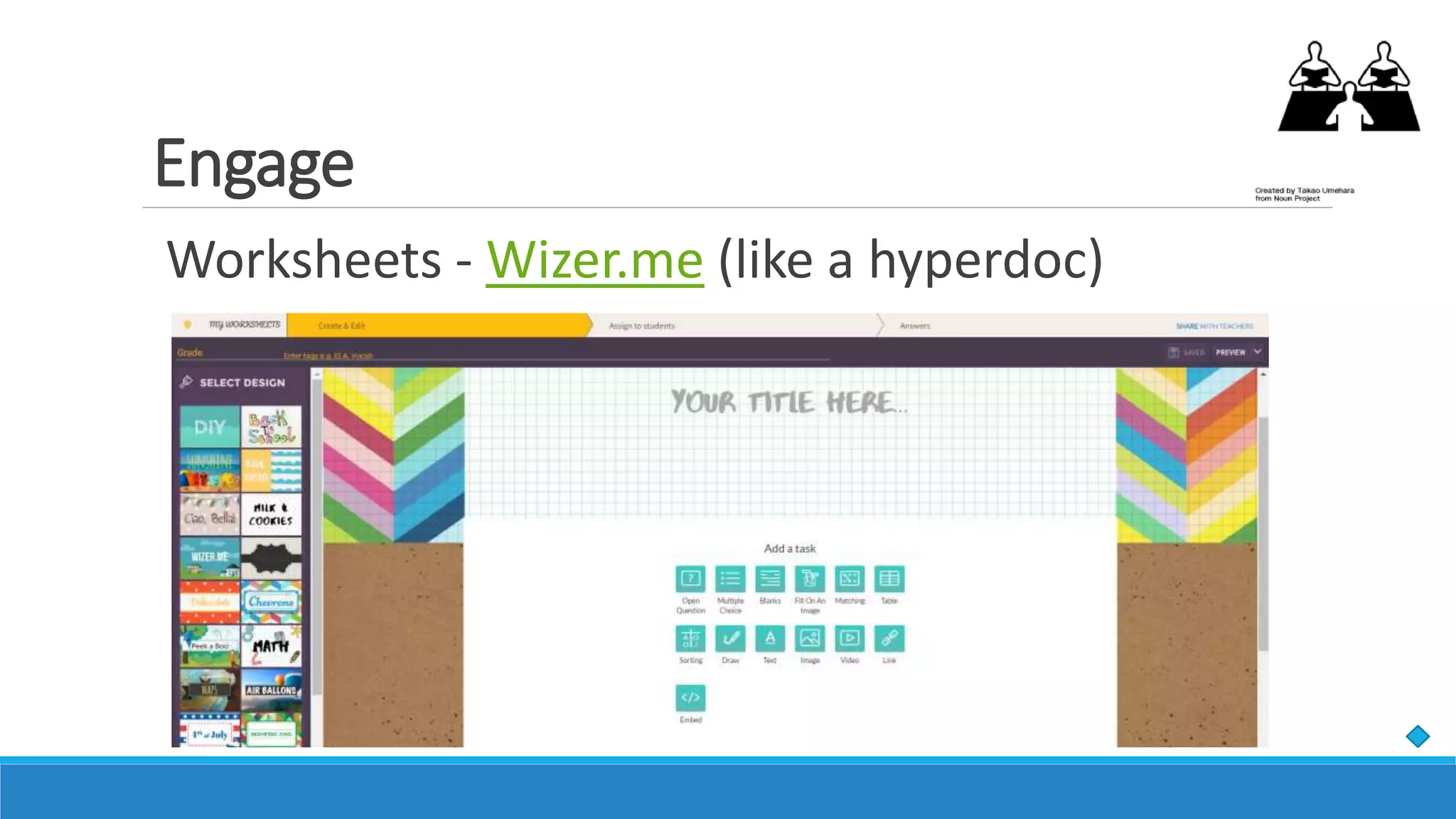
Worksheets - Wizer.me (like a hyperdoc)
Engage
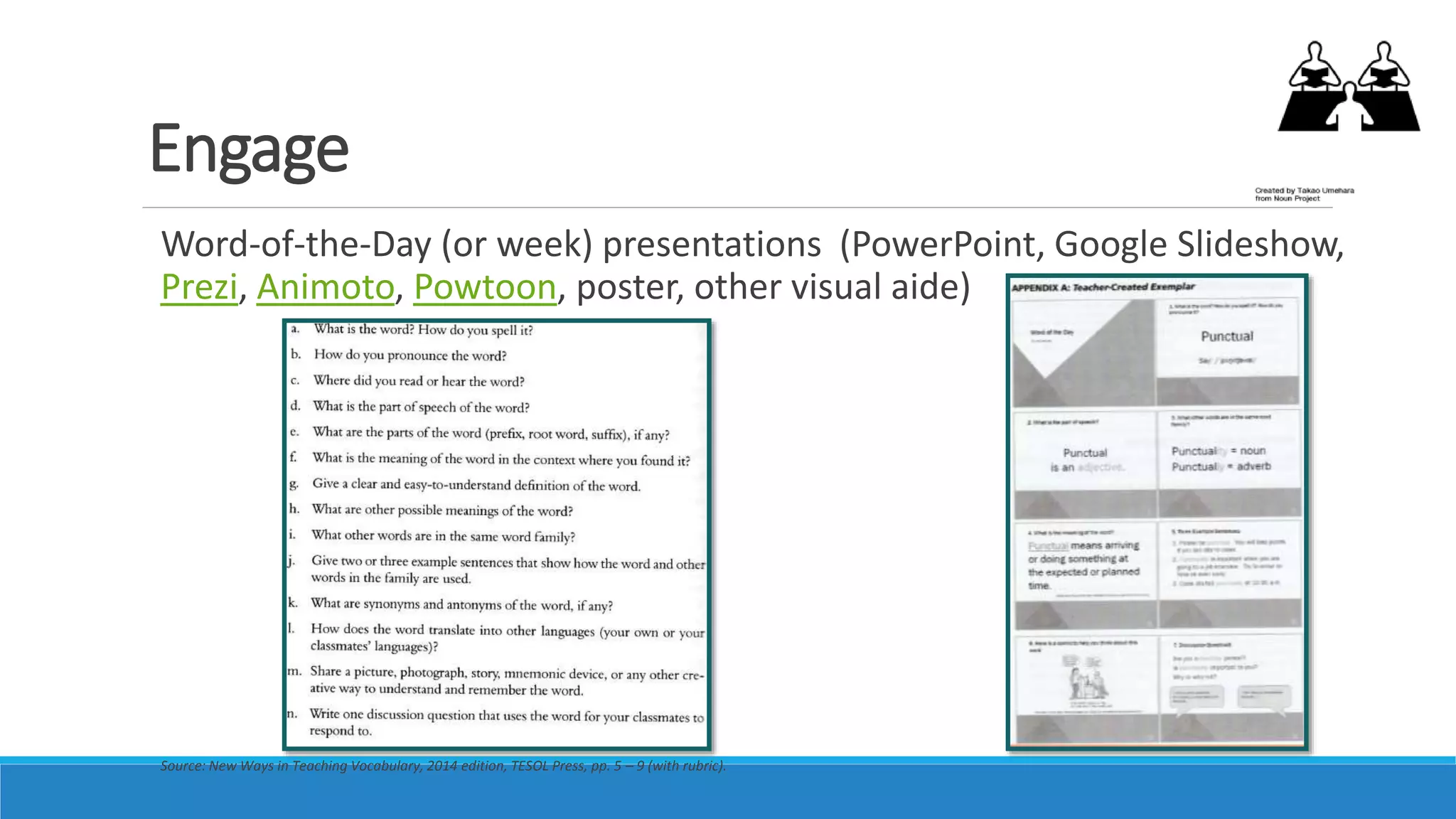
Word-of-the-Day (or week) presentations (PowerPoint, Google Slideshow,
Prezi, Animoto, Powtoon, poster, other visual aide)
Source: New Ways in Teaching Vocabulary, 2014 edition, TESOL Press, pp. 5 – 9 (with rubric).
Engage
Dialog Writing
◦ Comic strips, digital movies, PowerPoint or
Google Slideshow with callouts, videos
Sample comic strip made with StoryBoard That
North Orange County CC Health Video
I hope this finishes
soon! I need to get
my lesson plans ready
for Monday!
Responsibility is my
strongest soft skill!
Step 5: Discuss
Ask students to return to discuss the vocabulary with each other
◦ Conversation Questions – Teacher or student-composed questions
using target vocabulary words sent via QR code or on a shared Google
Doc
◦ Students must reply to questions using full sentences and target vocab
1. What is a good method for looking for a job?
2. What is your preferred method for studying vocabulary?
3. What is the best method for learning another language?
4. What is a recommended method for preparing for a job interview?
Discuss
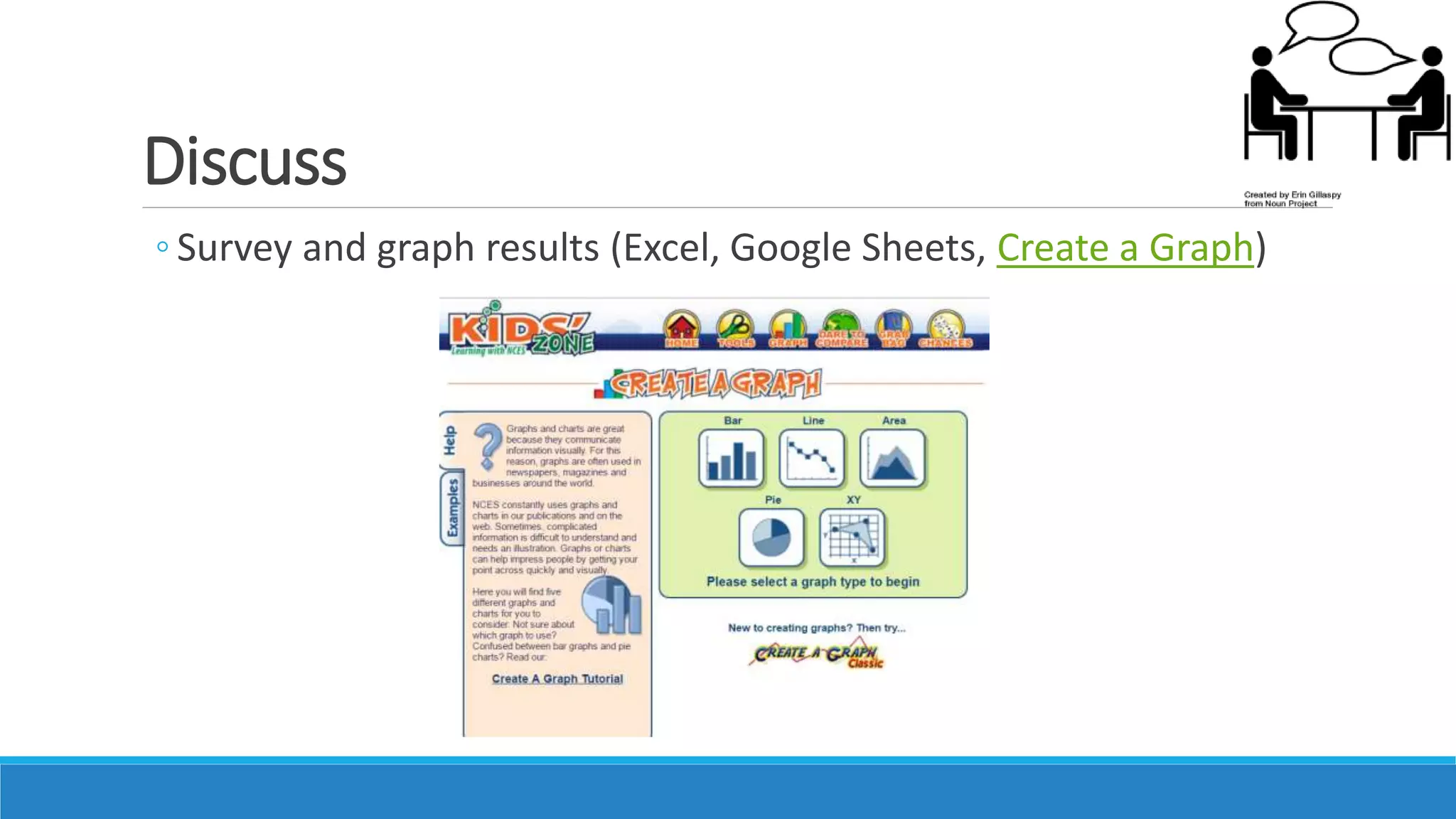
◦ Survey and graph results (Excel, Google Sheets, Create a Graph)
Discuss
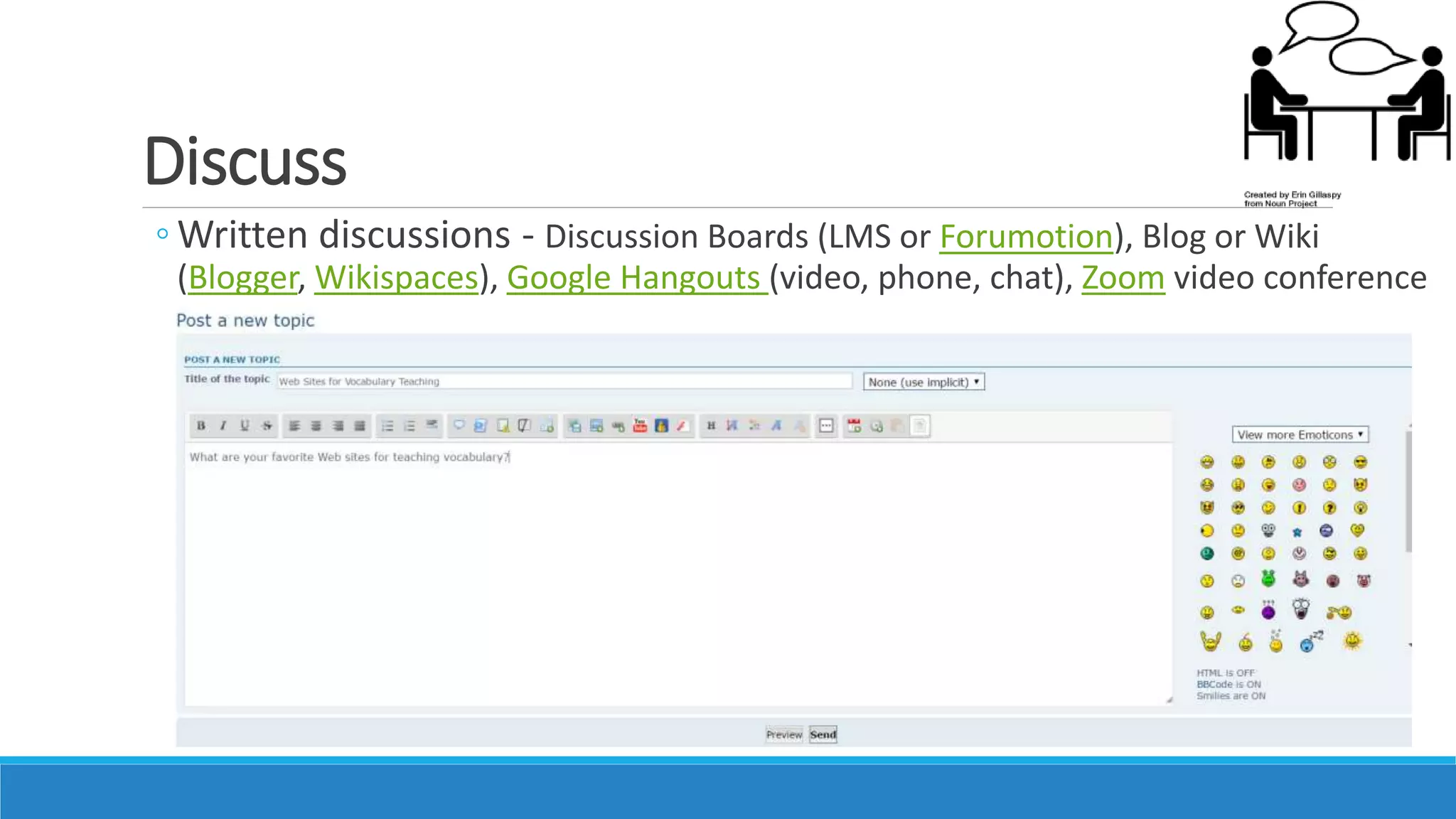
◦ Written discussions - Discussion Boards (LMS or Forumotion), Blog or Wiki
(Blogger, Wikispaces), Google Hangouts (video, phone, chat), Zoom video conference
Discuss
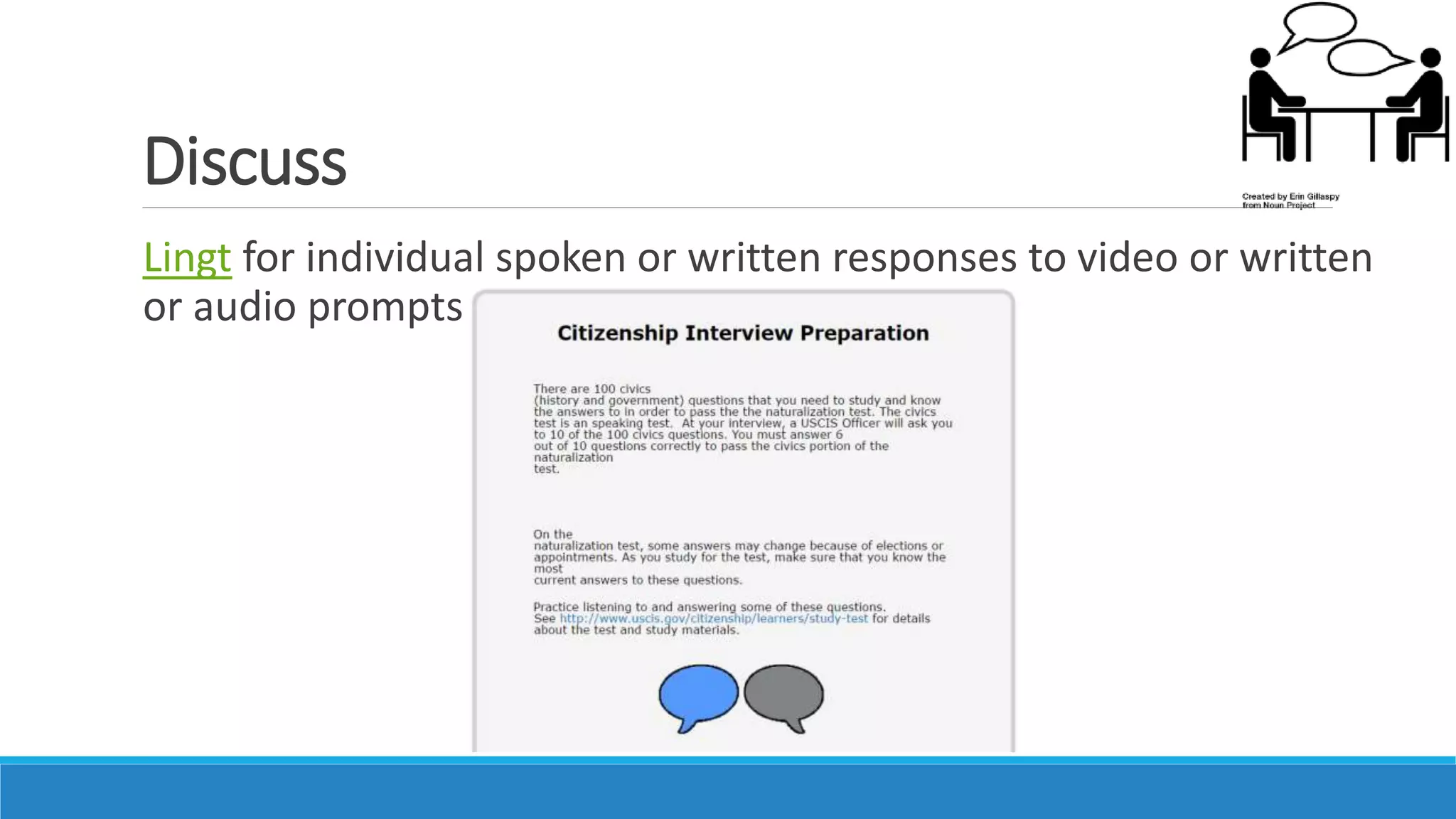
Lingt for individual spoken or written responses to video or written
or audio prompts
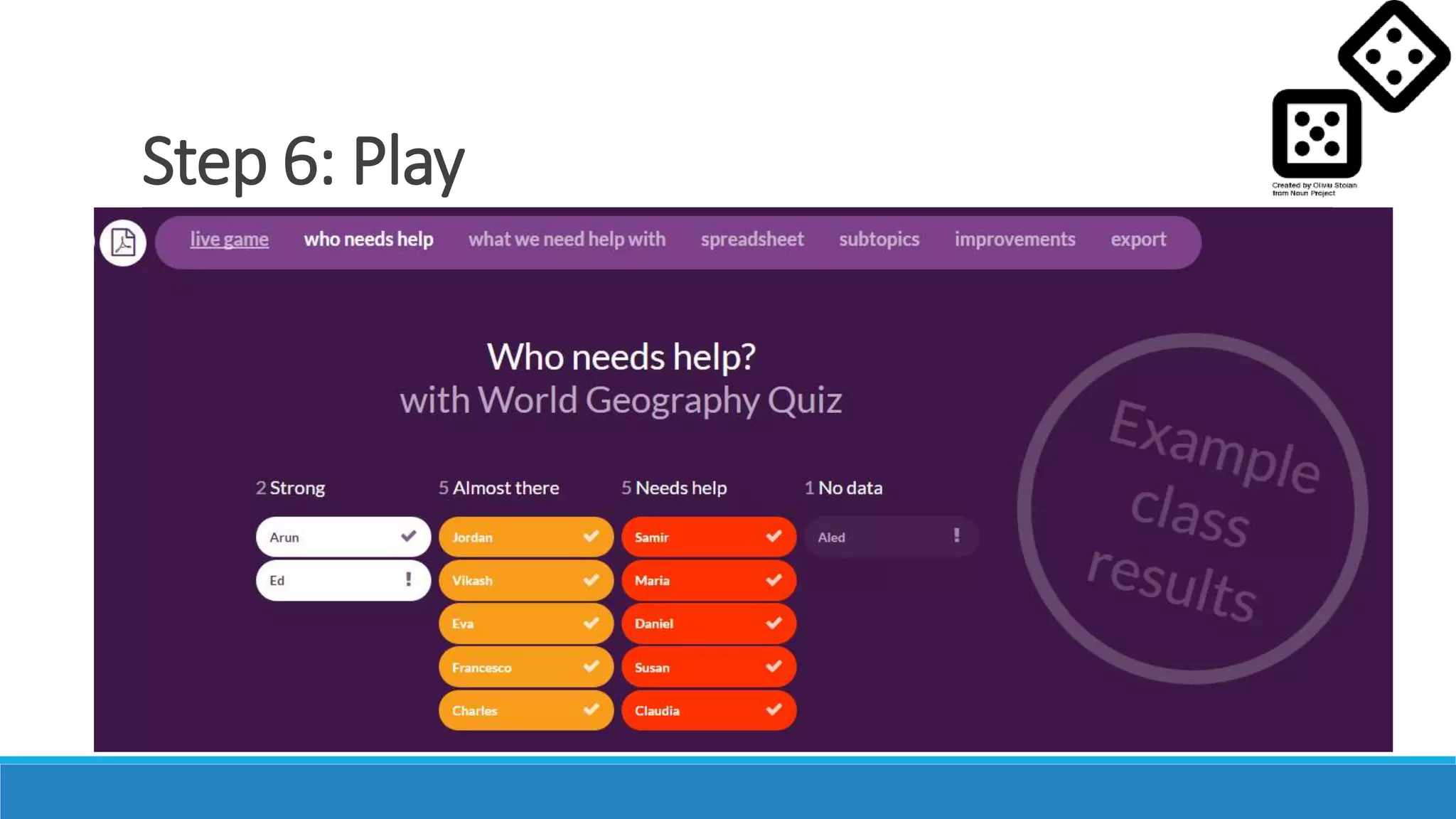
Step 6: Play
Involve students in games that allow them to play with words
◦ Board games, races, Jeopardy, Who Wants to Be a Millionaire,
Password, etc.
A Vocabulary Review Activity:
Soft Skills
Ready to play?
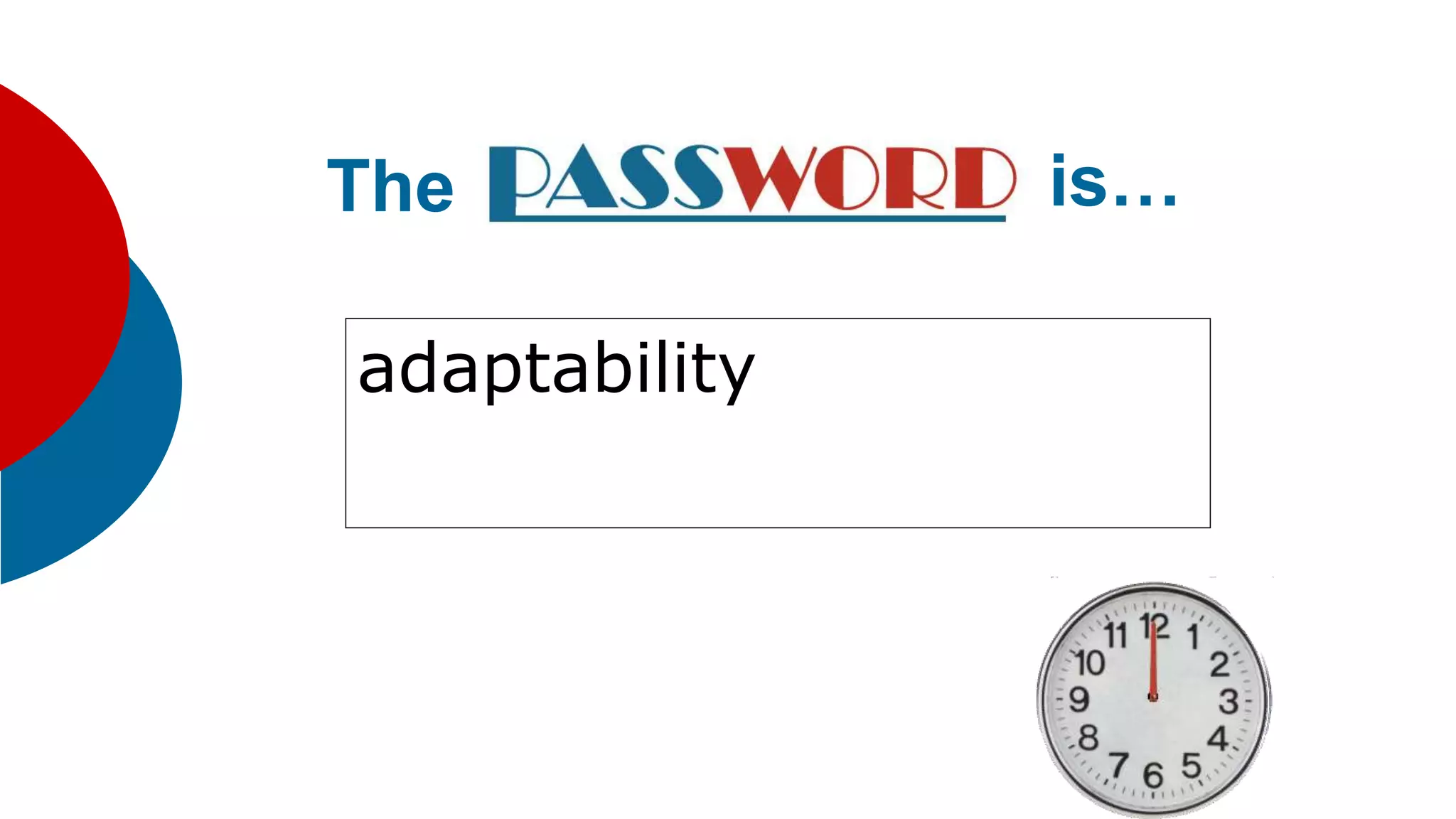
adaptability
The is…
empathy
The is…
initiative
The is…
Step 6: Play
◦ Jeopardy and gameshow sites: eQuizShow, FlipQuiz , Jeopardy
Labs, Jeopardy Rocks, SuperTeacher Tools
◦ Individual or competitive live-play (like Kahoot, Socrative): Quizziz,
IQuizalize, Quizlet Live!
Step 6: Play
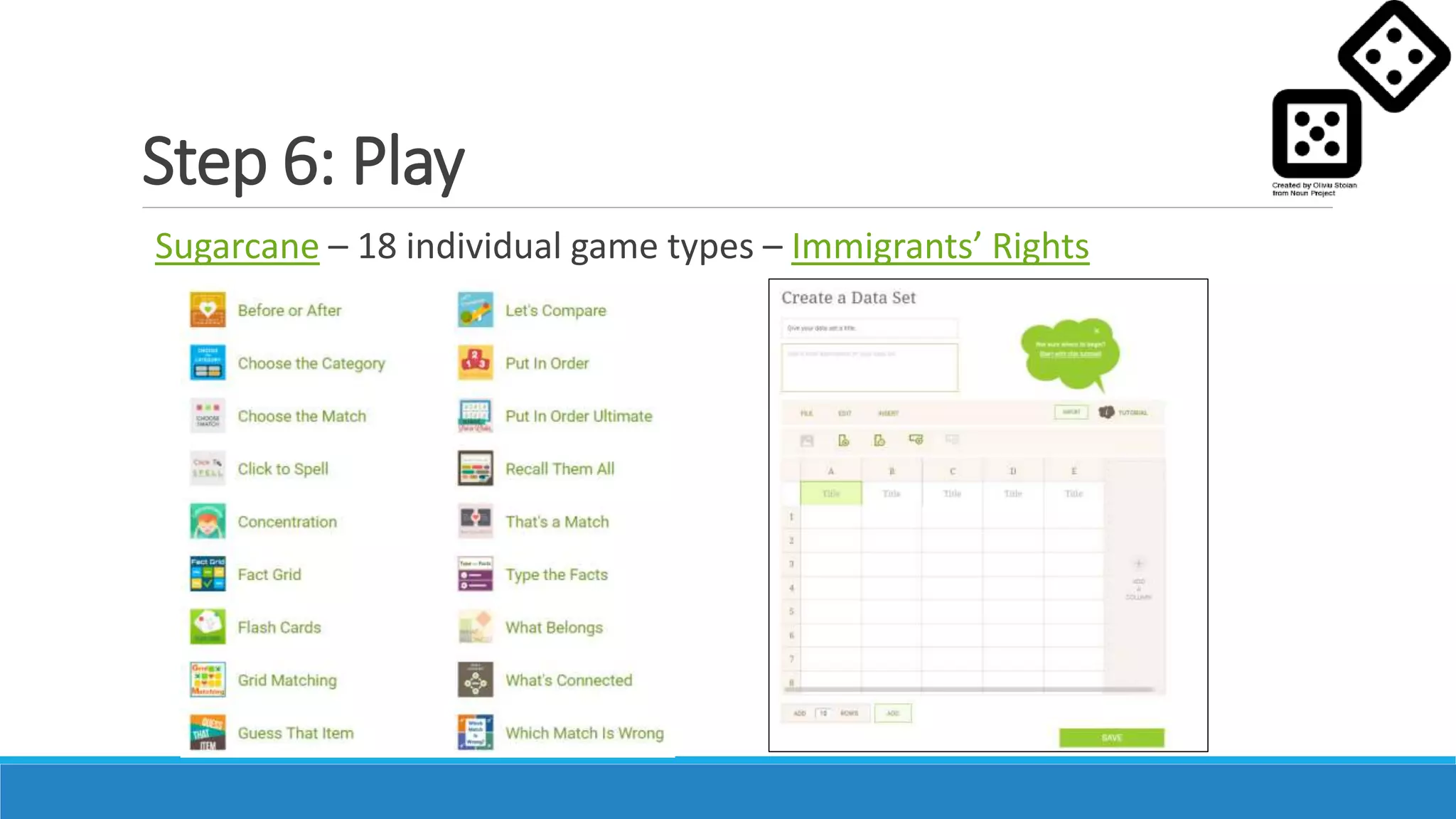
Sugarcane – 18 individual game types – Immigrants’ Rights
Step 6: Play
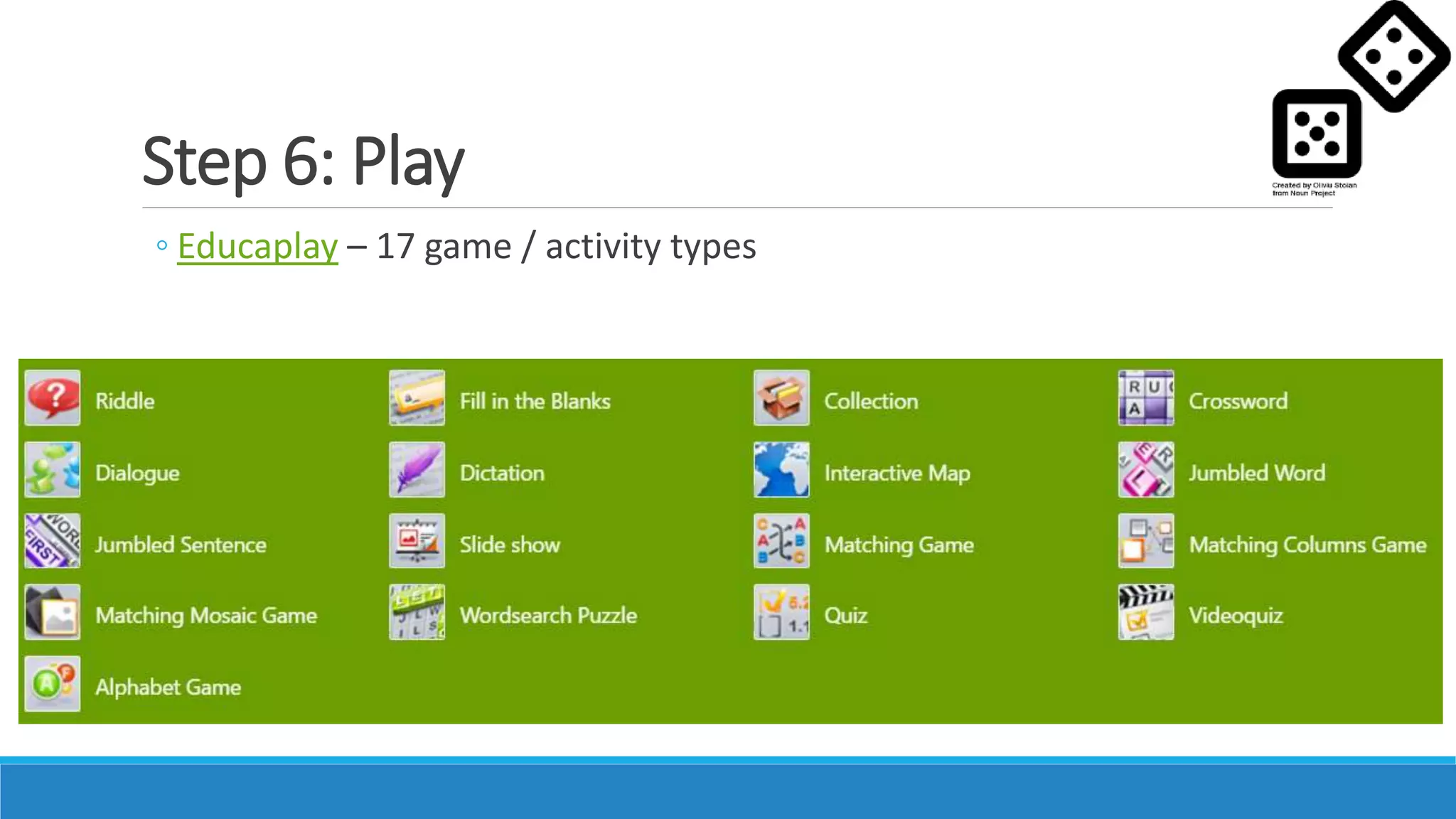
◦ Educaplay – 17 game / activity types
Some key points from research
◦ Use direction instruction for teaching vocabulary
◦ Help students develop strategic communicative competence
◦ paraphrasing & expressions such as What is the word for…?
◦ Present vocabulary in context
◦ Practice activities: controlled practice (listen and repeat, matching, cloze) to
activities that allow students to use the target words in meaningful,
personalized ways
◦ Make time for review in a systematic way with repetition (remember 5 – 20
or more exposures) and recycling
◦ Forgetting occurs soon after learning – review soon after teaching
◦ Competitive fun review (games) – motivational, forces faster retrieval
◦ Writing vocabulary in own sentences strengthens memory of target
vocabulary through generative processing
Promote Vocabulary Study Beyond Class
Word-of-the-Day Web sites (Learners Dictionary)
Apps (Illustrate – vocabulary learning through animated videos,
others – see Web site)
Email Subscriptions (A.Word.A.Day at WordSmith.org, Merriam-
Webster's Word of the Day, Word Central Daily Buzzword, L10)
Provide list of Web sites/apps for supplementary vocabulary practice
(Learning Chocolate, General Academic Vocabulary, and Vocabulary
Exercises for the Academic Word List)
Wrap-up: The “Take-Away”
What is one new activity or technology tool
that you are going to try in your vocabulary
lessons to prepare students for EL Civics
assessments?
Questions? Comments?
Handout, PowerPoint slides, and many resources online at
mccesltech.wikispaces.com/EL+Civics+Conference+2017
or
goo.gl/K02GBm
Thanks for attending!
Happy Vocabulary Teaching!

Six Steps for Teaching EL Civics Vocabulary with Tech

  • 1.
    Annual Integrated EL Civics Conference2017: Teaching EL Civics Vocabulary with Technology KRISTI REYES MIRACOSTA COLLEGE NONCREDIT ESL
  • 2.
  • 3.
    Warm-up 1.What does itmean to “know” a word? 2.How many exposures to a word are necessary for a language learner to acquire and retain it?
  • 4.
    Pairs Introduce yourself: Name+ what, where, who you teach. Compare your answers to the questions 1. What does it mean to “know” a word? 2. How many exposures to a word are necessary for a language learner to acquire and retain it?
  • 5.
    What does itmean to “know” a word? Receptive knowledge v. Productive knowledge
  • 6.
    Productive Knowledge = form,meaning, use Pronunciation Spelling Word parts (prefixes, suffixes) and forms (singular, plural, inflections) and family Associations and synonyms Denotative v. connotative (polysemy – different meanings in different contexts) Grammatical function / part of speech Collocations Register Frequency Source: Nation, I.S.P. (2014). Learning vocabulary in another language (2nd ed.). Cambridge University Press.
  • 7.
    What do weneed to teach? Vocabulary Preview/Self-Rating See also “Vocabulary Self-Rating Chart”
  • 8.
    How many exposuresto a word are necessary for a language learner to acquire and retain it?  One exposure = typical student’s retention rate 5 – 14%  5 – 20 or more exposures / repetitions (depending on several factors, including age of student)  Repeated exposures = New word  receptive knowledge  productive knowledge
  • 9.
    Pairs Again What isyour one best / most effective technique or activity to … teach vocabulary? OR have students learn/study vocabulary? OR get students to use target vocabulary?
  • 10.
    Six-Step Process forTeaching Vocabulary (Robert Marzano) RestateExplain Show Engage Discuss Play
  • 11.
    Vocabulary Notebook orIndex Cards Image mnemonics
  • 12.
  • 13.
    Step 1: Explain Providea student-friendly description, explanation, or example of the new term ◦ Online images or photos taken with cell phone ◦ Picture dictionary Web sites ◦ Graphic Interchange Format (GIFS) – search for or make your own by cutting an online video ◦ Comic strips or slideshows ◦ Anecdotal story or a current event
  • 14.
    Explain Interactive Images: Thinglink ◦Vegetables ◦ House ◦ Professions
  • 15.
    Explain Videos ◦ narrated PowerPointslideshows ◦ Jing, Screencast-o-matic - screencasting software ◦ video combined with slideshow at Present.me
  • 16.
    Step 2: Restate Askstudents to restate the description, explanation, or example in their own words. (linguistic) • Cell phone videos with voice recordings or video • Slideshow • Poster • Audio recording
  • 17.
  • 18.
    Restate Word Wall ◦Padlet ,Lino Source: http://bcudl.pbworks.com/f/WordWallNedralFlickrCC.jpg
  • 19.
    Restate Interactive Concept MapSites and online picture dictionaries ◦ Instragrok Grok for “immigrant”
  • 20.
    Step 3: Show Askstudents to construct a picture, symbol, or graphic representation of the term (nonlinguistic) • Sketchpads: Pencilapp • Google apps: Shared Google slideshow, Google Drawing • Formative - designed for instant polling / formative assessment (like Kahoot) but students draw
  • 21.
    Step 4: Engage Engagestudents in activities that help them add to their knowledge of the terms ◦ Print flashcards ◦ ESL Flashcards, ESL Games Plus, ESL Library* ◦ Word, PowerPoint/Google Slides, Excel/Google Sheets ◦ Digital flashcards ◦ Quizlet: Academic Word List Sublist 1 ◦ Memrise: English Visual Dictionary course
  • 22.
    Engage QR Codes –QR Voice (audio)
  • 23.
  • 24.
    Engage Cloze - LearnclickCloze Quiz Creator – 7 question types with app Text source: http://resources.marshalladulteducation.org/reading_skills_hme.htm Cloze on PDF with Learnclick free account / $29/yr subscription for online quizzes and tracking
  • 25.
  • 26.
    Engage Word-of-the-Day (or week)presentations (PowerPoint, Google Slideshow, Prezi, Animoto, Powtoon, poster, other visual aide) Source: New Ways in Teaching Vocabulary, 2014 edition, TESOL Press, pp. 5 – 9 (with rubric).
  • 27.
    Engage Dialog Writing ◦ Comicstrips, digital movies, PowerPoint or Google Slideshow with callouts, videos Sample comic strip made with StoryBoard That North Orange County CC Health Video I hope this finishes soon! I need to get my lesson plans ready for Monday! Responsibility is my strongest soft skill!
  • 28.
    Step 5: Discuss Askstudents to return to discuss the vocabulary with each other ◦ Conversation Questions – Teacher or student-composed questions using target vocabulary words sent via QR code or on a shared Google Doc ◦ Students must reply to questions using full sentences and target vocab 1. What is a good method for looking for a job? 2. What is your preferred method for studying vocabulary? 3. What is the best method for learning another language? 4. What is a recommended method for preparing for a job interview?
  • 29.
    Discuss ◦ Survey andgraph results (Excel, Google Sheets, Create a Graph)
  • 30.
    Discuss ◦ Written discussions- Discussion Boards (LMS or Forumotion), Blog or Wiki (Blogger, Wikispaces), Google Hangouts (video, phone, chat), Zoom video conference
  • 31.
    Discuss Lingt for individualspoken or written responses to video or written or audio prompts
  • 32.
    Step 6: Play Involvestudents in games that allow them to play with words ◦ Board games, races, Jeopardy, Who Wants to Be a Millionaire, Password, etc.
  • 33.
    A Vocabulary ReviewActivity: Soft Skills
  • 34.
  • 35.
  • 36.
  • 37.
  • 38.
    Step 6: Play ◦Jeopardy and gameshow sites: eQuizShow, FlipQuiz , Jeopardy Labs, Jeopardy Rocks, SuperTeacher Tools ◦ Individual or competitive live-play (like Kahoot, Socrative): Quizziz, IQuizalize, Quizlet Live!
  • 39.
    Step 6: Play Sugarcane– 18 individual game types – Immigrants’ Rights
  • 40.
    Step 6: Play ◦Educaplay – 17 game / activity types
  • 41.
    Some key pointsfrom research ◦ Use direction instruction for teaching vocabulary ◦ Help students develop strategic communicative competence ◦ paraphrasing & expressions such as What is the word for…? ◦ Present vocabulary in context ◦ Practice activities: controlled practice (listen and repeat, matching, cloze) to activities that allow students to use the target words in meaningful, personalized ways ◦ Make time for review in a systematic way with repetition (remember 5 – 20 or more exposures) and recycling ◦ Forgetting occurs soon after learning – review soon after teaching ◦ Competitive fun review (games) – motivational, forces faster retrieval ◦ Writing vocabulary in own sentences strengthens memory of target vocabulary through generative processing
  • 42.
    Promote Vocabulary StudyBeyond Class Word-of-the-Day Web sites (Learners Dictionary) Apps (Illustrate – vocabulary learning through animated videos, others – see Web site) Email Subscriptions (A.Word.A.Day at WordSmith.org, Merriam- Webster's Word of the Day, Word Central Daily Buzzword, L10) Provide list of Web sites/apps for supplementary vocabulary practice (Learning Chocolate, General Academic Vocabulary, and Vocabulary Exercises for the Academic Word List)
  • 43.
    Wrap-up: The “Take-Away” Whatis one new activity or technology tool that you are going to try in your vocabulary lessons to prepare students for EL Civics assessments?
  • 44.
    Questions? Comments? Handout, PowerPointslides, and many resources online at mccesltech.wikispaces.com/EL+Civics+Conference+2017 or goo.gl/K02GBm Thanks for attending! Happy Vocabulary Teaching!

Editor's Notes

  • #11 Steps 1 – 3: Introduce new vocabulary Steps 4 – 6: Provide multiple exposures and help students clarify their understanding
  • #13 My login for Memrise username kreyeS14, usual password My login in Lino reyesmcc, same short password
  • #19 My login for Memrise username kreyeS14, usual password My login in Lino reyesmcc, same short password
  • #22 My login for Memrise username kreyeS14, usual password My login in Lino reyesmcc, same short password