THE
CONJUNCTION
S
tha
n
although
and
for
then
since
wherever
nor
whetherwhile
before
because
even though
but
or
yet
so
until
wher
e
if
unless
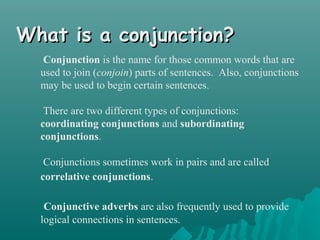
What is a conjunction?What is a conjunction?
Conjunction is the name for those common words that are
used to join (conjoin) parts of sentences. Also, conjunctions
may be used to begin certain sentences.
There are two different types of conjunctions:
coordinating conjunctions and subordinating
conjunctions.
Conjunctions sometimes work in pairs and are called
correlative conjunctions.
Conjunctive adverbs are also frequently used to provide
logical connections in sentences.
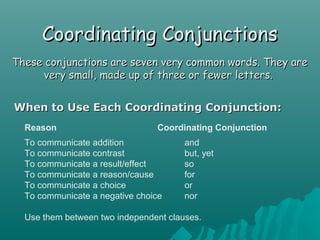
Coordinating ConjunctionsCoordinating Conjunctions
These conjunctions are seven very common words. They areThese conjunctions are seven very common words. They are
very small, made up of three or fewer letters.very small, made up of three or fewer letters.
When to Use Each Coordinating Conjunction:When to Use Each Coordinating Conjunction:
Reason Coordinating Conjunction
To communicate addition and
To communicate contrast but, yet
To communicate a result/effect so
To communicate a reason/cause for
To communicate a choice or
To communicate a negative choice nor
Use them between two independent clauses.
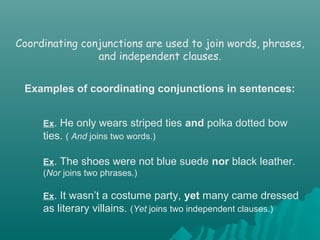
Ex. He only wears striped ties and polka dotted bow
ties. ( And joins two words.)
Ex. The shoes were not blue suede nor black leather.
(Nor joins two phrases.)
Ex. It wasn’t a costume party, yet many came dressed
as literary villains. (Yet joins two independent clauses.)
Coordinating conjunctions are used to join words, phrases,
and independent clauses.
Examples of coordinating conjunctions in sentences:
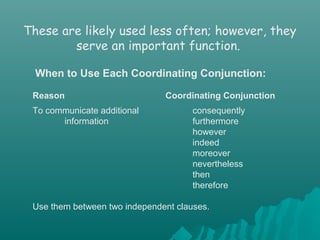
These are likely used less often; however, they
serve an important function.
When to Use Each Coordinating Conjunction:
Reason Coordinating Conjunction
To communicate additional consequently
information furthermore
however
indeed
moreover
nevertheless
then
therefore
Use them between two independent clauses.
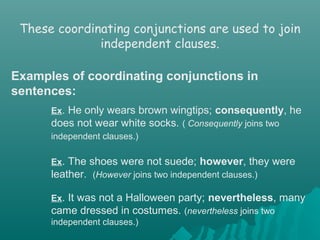
Ex. He only wears brown wingtips; consequently, he
does not wear white socks. ( Consequently joins two
independent clauses.)
Ex. The shoes were not suede; however, they were
leather. (However joins two independent clauses.)
Ex. It was not a Halloween party; nevertheless, many
came dressed in costumes. (nevertheless joins two
independent clauses.)
These coordinating conjunctions are used to join
independent clauses.
Examples of coordinating conjunctions in
sentences:
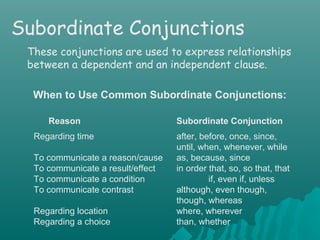
Subordinate Conjunctions
When to Use Common Subordinate Conjunctions:
Reason Subordinate Conjunction
Regarding time after, before, once, since,
until, when, whenever, while
To communicate a reason/cause as, because, since
To communicate a result/effect in order that, so, so that, that
To communicate a condition if, even if, unless
To communicate contrast although, even though,
though, whereas
Regarding location where, wherever
Regarding a choice than, whether
These conjunctions are used to express relationships
between a dependent and an independent clause.
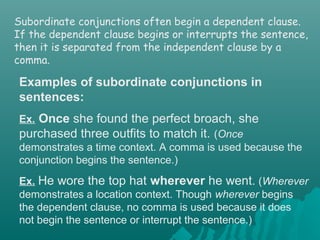
Subordinate conjunctions often begin a dependent clause.
If the dependent clause begins or interrupts the sentence,
then it is separated from the independent clause by a
comma.
Examples of subordinate conjunctions in
sentences:
Ex. Once she found the perfect broach, she
purchased three outfits to match it. (Once
demonstrates a time context. A comma is used because the
conjunction begins the sentence.)
Ex. He wore the top hat wherever he went. (Wherever
demonstrates a location context. Though wherever begins
the dependent clause, no comma is used because it does
not begin the sentence or interrupt the sentence.)
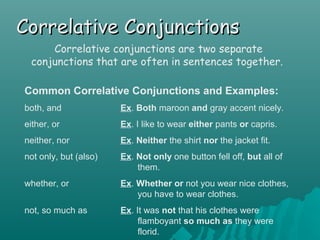
Correlative ConjunctionsCorrelative Conjunctions
Correlative conjunctions are two separate
conjunctions that are often in sentences together.
Common Correlative Conjunctions and Examples:
both, and Ex. Both maroon and gray accent nicely.
either, or Ex. I like to wear either pants or capris.
neither, nor Ex. Neither the shirt nor the jacket fit.
not only, but (also) Ex. Not only one button fell off, but all of
them.
whether, or Ex. Whether or not you wear nice clothes,
you have to wear clothes.
not, so much as Ex. It was not that his clothes were
flamboyant so much as they were
florid.
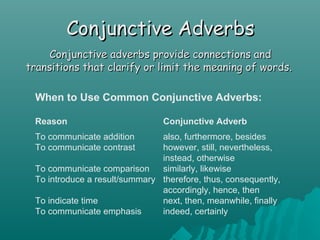
Conjunctive AdverbsConjunctive Adverbs
Conjunctive adverbs provide connections andConjunctive adverbs provide connections and
transitions that clarify or limit the meaning of words.transitions that clarify or limit the meaning of words.
When to Use Common Conjunctive Adverbs:
Reason Conjunctive Adverb
To communicate addition also, furthermore, besides
To communicate contrast however, still, nevertheless,
instead, otherwise
To communicate comparison similarly, likewise
To introduce a result/summary therefore, thus, consequently,
accordingly, hence, then
To indicate time next, then, meanwhile, finally
To communicate emphasis indeed, certainly
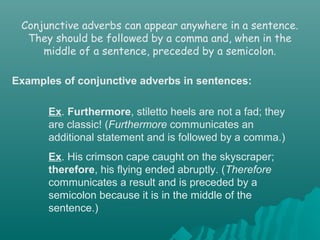
Examples of conjunctive adverbs in sentences:
Ex. Furthermore, stiletto heels are not a fad; they
are classic! (Furthermore communicates an
additional statement and is followed by a comma.)
Ex. His crimson cape caught on the skyscraper;
therefore, his flying ended abruptly. (Therefore
communicates a result and is preceded by a
semicolon because it is in the middle of the
sentence.)
Conjunctive adverbs can appear anywhere in a sentence.
They should be followed by a comma and, when in the
middle of a sentence, preceded by a semicolon.

Conjunctions

  • 1.
  • 2.
  • 3.
    What is aconjunction?What is a conjunction? Conjunction is the name for those common words that are used to join (conjoin) parts of sentences. Also, conjunctions may be used to begin certain sentences. There are two different types of conjunctions: coordinating conjunctions and subordinating conjunctions. Conjunctions sometimes work in pairs and are called correlative conjunctions. Conjunctive adverbs are also frequently used to provide logical connections in sentences.
  • 4.
    Coordinating ConjunctionsCoordinating Conjunctions Theseconjunctions are seven very common words. They areThese conjunctions are seven very common words. They are very small, made up of three or fewer letters.very small, made up of three or fewer letters. When to Use Each Coordinating Conjunction:When to Use Each Coordinating Conjunction: Reason Coordinating Conjunction To communicate addition and To communicate contrast but, yet To communicate a result/effect so To communicate a reason/cause for To communicate a choice or To communicate a negative choice nor Use them between two independent clauses.
  • 5.
    Ex. He onlywears striped ties and polka dotted bow ties. ( And joins two words.) Ex. The shoes were not blue suede nor black leather. (Nor joins two phrases.) Ex. It wasn’t a costume party, yet many came dressed as literary villains. (Yet joins two independent clauses.) Coordinating conjunctions are used to join words, phrases, and independent clauses. Examples of coordinating conjunctions in sentences:
  • 6.
    These are likelyused less often; however, they serve an important function. When to Use Each Coordinating Conjunction: Reason Coordinating Conjunction To communicate additional consequently information furthermore however indeed moreover nevertheless then therefore Use them between two independent clauses.
  • 7.
    Ex. He onlywears brown wingtips; consequently, he does not wear white socks. ( Consequently joins two independent clauses.) Ex. The shoes were not suede; however, they were leather. (However joins two independent clauses.) Ex. It was not a Halloween party; nevertheless, many came dressed in costumes. (nevertheless joins two independent clauses.) These coordinating conjunctions are used to join independent clauses. Examples of coordinating conjunctions in sentences:
  • 8.
    Subordinate Conjunctions When toUse Common Subordinate Conjunctions: Reason Subordinate Conjunction Regarding time after, before, once, since, until, when, whenever, while To communicate a reason/cause as, because, since To communicate a result/effect in order that, so, so that, that To communicate a condition if, even if, unless To communicate contrast although, even though, though, whereas Regarding location where, wherever Regarding a choice than, whether These conjunctions are used to express relationships between a dependent and an independent clause.
  • 9.
    Subordinate conjunctions oftenbegin a dependent clause. If the dependent clause begins or interrupts the sentence, then it is separated from the independent clause by a comma. Examples of subordinate conjunctions in sentences: Ex. Once she found the perfect broach, she purchased three outfits to match it. (Once demonstrates a time context. A comma is used because the conjunction begins the sentence.) Ex. He wore the top hat wherever he went. (Wherever demonstrates a location context. Though wherever begins the dependent clause, no comma is used because it does not begin the sentence or interrupt the sentence.)
  • 10.
    Correlative ConjunctionsCorrelative Conjunctions Correlativeconjunctions are two separate conjunctions that are often in sentences together. Common Correlative Conjunctions and Examples: both, and Ex. Both maroon and gray accent nicely. either, or Ex. I like to wear either pants or capris. neither, nor Ex. Neither the shirt nor the jacket fit. not only, but (also) Ex. Not only one button fell off, but all of them. whether, or Ex. Whether or not you wear nice clothes, you have to wear clothes. not, so much as Ex. It was not that his clothes were flamboyant so much as they were florid.
  • 11.
    Conjunctive AdverbsConjunctive Adverbs Conjunctiveadverbs provide connections andConjunctive adverbs provide connections and transitions that clarify or limit the meaning of words.transitions that clarify or limit the meaning of words. When to Use Common Conjunctive Adverbs: Reason Conjunctive Adverb To communicate addition also, furthermore, besides To communicate contrast however, still, nevertheless, instead, otherwise To communicate comparison similarly, likewise To introduce a result/summary therefore, thus, consequently, accordingly, hence, then To indicate time next, then, meanwhile, finally To communicate emphasis indeed, certainly
  • 12.
    Examples of conjunctiveadverbs in sentences: Ex. Furthermore, stiletto heels are not a fad; they are classic! (Furthermore communicates an additional statement and is followed by a comma.) Ex. His crimson cape caught on the skyscraper; therefore, his flying ended abruptly. (Therefore communicates a result and is preceded by a semicolon because it is in the middle of the sentence.) Conjunctive adverbs can appear anywhere in a sentence. They should be followed by a comma and, when in the middle of a sentence, preceded by a semicolon.