Dr. Ajay Kumar
M. Pharm., Ph.D. 1
BODY FLUIDCOMPARTMENTS
2
• TBW: 60% of body weight (42L)
• ICF:
- 40% of body weight (28L)
- 2/3rd ofTBW
• ECF: 20% of body weight (14L)
- Interstitial fluid (15% of
body weight, 11L)
- Blood plasma (5% of body
weight, 3L)
- 75 to 80% ECF is in interstitial
fluid
1. Blood is a fluid connective tissue that circulate
continuously around the body.
2. Plasma is a clear, straw coloured, watery fluid in
which several different types of blood cells are
suspended ( plasma is blood devoid of bloodcells).
3. Serum is plasma without clotting factors
3
DISTRIBUTIONOFELECTROLYTESANDSUBTANCESIN BODYFLUIDS
4
SUBSTANCE PLASMA(mOsm/LH2O) INTERSTITIAL(mOsm/LH2O)
INTRACELLULAR (mOsm/L
H2O)
Na+ 142 139 14
K+ 4.2 4 140
Ca++ 1.3 1.2 1
Cl- 108 108 4
HCO3- 24 28.3 10
Aminoacid 2 2 8
Lactate 1.2 1.2 1.5
Glucose 5.6 5.6 0-20mg/dL
VOLUME
EXPANDERS
 Volume expanders are the intravenous fluid solutions
that are used to increase or retain the volume of fluid
in the circulating blood.
 Generally volume expanders are used to replace fluids
that are lost due to illness, trauma or surgery.
 They do not carry oxygen .
TYPES OF VOLUME
EXPANDERS
6
There are two main types of volume expanders:
1. Crystalloids: crystalloids are aqueous solutions of
mineral salts or other water- soluble molecules e.g. normal
saline, dextrose, Ringer’s solution etc.
2. Colloids: Colloids are larger insolublemolecules, such as
dextran, human albumin, gelatin, blood. Blood itself is a
colloid.
COLLOIDS ARE BETTER THAN
CRYSTALLOIDS BECAUSE:
7
The larger molecules of colloids are retained more easily in
the intravascular space & increase osmotic pressure.
So, more effective resuscitation of plasma volume occurs by
colloids than produced by that of crystalloids.
Duration of action is relatively longer than crystalloids.
IDEAL PROPERTIES OF
PVES.
8
Iso-oncotic with plasma
Distributed to intravascular compartment
only
Pharmacodynamically inert
Non-pyrogenic, non-allergenic & non- antigenic
No interference with blood grouping or cross-matching
Stable, easily sterilizable and cheap.
COLLOIDAL PLASMA
EXPANDERS
9
Human albumin
Dextran
Degraded gelatin polymer (Polygeline)
Hydroxyethyl starch (Hetastarch/HES)
Polyvinyl pyrrolidone (PVP)
MECHANISM OF
ACTION:
10
 Generally works on the principle of osmosis.
 Increases Plasma osmotic pressure, drawing water into
plasma from interstitial fluid.
 Since the lost blood is replaced with a suitable fluid, the
now diluted blood flows more easily, even in small
vessels. As a result of chemical changes, more oxygen
is released to the tissues.
IMPORTANT POINTS
11
- replace fluid to increase volume as RBCs still
sufficient to supply oxygen.
Molecular weight of colloids determine their duration
of action and ability to expand blood volume.
Dextran , HMW starch have negative impact on
coagulation, may induce acute renal failure, allergy.
Colloids classification-
a)natural-albumin
b)synthetic- gelatin,
HES,PVP
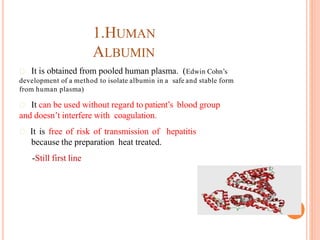
THE NATURAL COLLOID—HUMAN ALBUMIN
12
- most abundant protein in human plasma (40-50 g/L), with a total body
content of 4 to5g/kg.
- hydrophilic, nonglycosylated protein with a molecular weight of 69 kDa.
distributed one third to two thirds in the intravascular compartment relative
to the extravascular compartment, and
accounts for 70% to 80% of the plasma colloid oncotic pressure (COP)
- capacity to bind cations, anions, and toxins, such as bilirubin, gives it an
important physiological role in buffering the acid-base balance of the blood, in
regulating the ionized fraction of cations including calcium and magnesium,
and in scavenging free radicals and transporting proteins and drugs.
synthesized in the liver with a mean half-life of 14.8 days and is degraded
mostly in muscle, the liver, and the kidney.
Hypoalbuminemia from a range of pathologies is a poor prognostic factor.
1.HUMAN
ALBUMIN
13
i
s
It is obtained from pooled human plasma. (Edwin Cohn’s
development of a method to isolate albumin in a safe and stable form
from human plasma)
It can be used without regard to patient’s blood group
and doesn’t interfere with coagulation.
It is free of risk of transmission of hepatitis
because the preparation heat treated.
-Still first line
CONTD…
14
Crystalloid solution must be infused concurrently for
optimum benefit.
It has been used in acute hypoproteinaemia, acute liver
failure and dialysis.
It is comparatively expensive.
Available products:
 Albudac, Albupan 50, 100 ml inj.,
 Albumed 5%, 20% infusion (100 ml)
ALBUMIN CONTD..
15
available as iso-oncotic (4%-5%) solutions for intravascular volume
expansion and as hyperoncotic solutions (20%-25%) for the maintenance
of fluid balance between compartments and the restoration of COP.
albumin’s position as the benchmark biological therapy in terms of
pathogen safety remains unchallenged.
-as an additive stabilizer for other therapeutics such as recombinant proteins
and monoclonal antibodies, and the so-called “new generation”
formulations of these therapies, which excludealbumin in the context of
enhanced safety are addressing perception rather than real risk.
DEXTRANS
16
are groups of branched polysaccharides derived from
sucrose( beet root) by the action of the bacterium
Leuconostoc mesenteroides.
different dextran preparations are polydisperse mixtures
grouped on the basis of their average molecular weight,
which is different from the average molecular weight of the
particles with colloid oncotic power, which is important for
their hemodynamic action.
main types are dextran 40, available as a 10% solution, and
dextran 60 and 70, prepared as a 6% solution.
molecular weight is the chief determinant of the
pharmacodynamics.
A) DEXTRAN
70
17
1. It is most commonly used preparation.
2. It expands plasma volume for nearly 24 hrs.
3. Excreted slowly by glomerular filtration as well as
oxidized in body over weeks . and some amount is
deposited in retuculo- endothelial cells.
DEXTRAN 70 HAS NEARLY ALL THE PROPERTIES
OF AN IDEAL PLASMA EXCEPT:
18
It may interfere with blood grouping and
cross matching.
It can interfere with coagulation and platelet
function and thus prolong bleeding time .
Some polysaccharide reacting antibodies, if present, may
cross react with dextran and trigger anaphylactic reaction
like Urticaria, itching, bronchospasm, fall in BP.
B) DEXTRAN 40
19
It acts more rapidly than dextrose 70.
It reduces blood viscosity .
It is excreted through renal tubules and occasionally
may produce acute renal failure.
The total dose should not exceed 20 ml/kg in 24 hr.
Dextrans can be stored for 10 years and are cheap so are
the most commonly used plasma expanders.
Caution: Dextran doesn’t provide necessary electrolytes and can cause
hyponatremia or other electrolyte disturbances.
3. DEGRADED GELATIN POLYMER (POLYGELINE)
20
It is synthetic polymer (polypeptide) of MW-30,000.
It doesn’t interfere with blood grouping and cross
matching and is non-antigenic.
Expands plasma volume for 12 hrs.
It is more expensive than dextran and can also be used for
priming of heart-lung and dialysis machines.
Brands:
Haemaccel; Seraccel 500 ml vaccine.
GELATIN
21
Gelatins are manufactured from bovine gelatin, a derivative
of collagen, which is cross-linked, urea linked, or
succinylated to yield the final products.
The molecular weight ranges from 30 kDa to 35 kDa, and
4. HYDROXYETHYL STARCH
(HETASTARCH)
22
It is a complex mixture of ethoxylated amylopectin of
various molecular sizes; average MW 4.5 lacs.
It maintains blood volume longer.
No coagulation disturbances.
It improves hemodynamic status for 24 hrs.
HETASTARCH CONTD..
23
Adverse effects:
Vomiting, mild fever,itching, chills, flu like symptoms,
swelling of salivary glands, Urticaria, bronchospasm
etc.
Brand: Expan 6% inj (100 , 500 ml vac)
It has also been used to improve harvesting of granulocytes
because it accelerates erythrocyte sedimentation.
Adverse effects: Anaphylactic reactions, mild fever,
chilling, periorbital edema, Urticaria, itching .
5. POLYVINYLPYRROLIDINE (PVP)
24
It is a synthetic polymer of average MW 40,000 used as a
3.5% solution.
PVP was used as blood plasma expander for trauma
victims after the 1950s.
It interferes with blood grouping and cross matching and is
histmine releaser.
It binds to penicillin and Insulin.
CONTD
25
I.tis excreted by kidney and small amounts by liver into
bile.
A fraction is stored in RE cellsfor prolonged periods.
It is less commonly used plasma expander.
26

Plasma volume expanders

  • 1.
    Dr. Ajay Kumar M.Pharm., Ph.D. 1
  • 2.
    BODY FLUIDCOMPARTMENTS 2 • TBW:60% of body weight (42L) • ICF: - 40% of body weight (28L) - 2/3rd ofTBW • ECF: 20% of body weight (14L) - Interstitial fluid (15% of body weight, 11L) - Blood plasma (5% of body weight, 3L) - 75 to 80% ECF is in interstitial fluid
  • 3.
    1. Blood isa fluid connective tissue that circulate continuously around the body. 2. Plasma is a clear, straw coloured, watery fluid in which several different types of blood cells are suspended ( plasma is blood devoid of bloodcells). 3. Serum is plasma without clotting factors 3
  • 4.
    DISTRIBUTIONOFELECTROLYTESANDSUBTANCESIN BODYFLUIDS 4 SUBSTANCE PLASMA(mOsm/LH2O)INTERSTITIAL(mOsm/LH2O) INTRACELLULAR (mOsm/L H2O) Na+ 142 139 14 K+ 4.2 4 140 Ca++ 1.3 1.2 1 Cl- 108 108 4 HCO3- 24 28.3 10 Aminoacid 2 2 8 Lactate 1.2 1.2 1.5 Glucose 5.6 5.6 0-20mg/dL
  • 5.
    VOLUME EXPANDERS  Volume expandersare the intravenous fluid solutions that are used to increase or retain the volume of fluid in the circulating blood.  Generally volume expanders are used to replace fluids that are lost due to illness, trauma or surgery.  They do not carry oxygen .
  • 6.
    TYPES OF VOLUME EXPANDERS 6 Thereare two main types of volume expanders: 1. Crystalloids: crystalloids are aqueous solutions of mineral salts or other water- soluble molecules e.g. normal saline, dextrose, Ringer’s solution etc. 2. Colloids: Colloids are larger insolublemolecules, such as dextran, human albumin, gelatin, blood. Blood itself is a colloid.
  • 7.
    COLLOIDS ARE BETTERTHAN CRYSTALLOIDS BECAUSE: 7 The larger molecules of colloids are retained more easily in the intravascular space & increase osmotic pressure. So, more effective resuscitation of plasma volume occurs by colloids than produced by that of crystalloids. Duration of action is relatively longer than crystalloids.
  • 8.
    IDEAL PROPERTIES OF PVES. 8 Iso-oncoticwith plasma Distributed to intravascular compartment only Pharmacodynamically inert Non-pyrogenic, non-allergenic & non- antigenic No interference with blood grouping or cross-matching Stable, easily sterilizable and cheap.
  • 9.
    COLLOIDAL PLASMA EXPANDERS 9 Human albumin Dextran Degradedgelatin polymer (Polygeline) Hydroxyethyl starch (Hetastarch/HES) Polyvinyl pyrrolidone (PVP)
  • 10.
    MECHANISM OF ACTION: 10  Generallyworks on the principle of osmosis.  Increases Plasma osmotic pressure, drawing water into plasma from interstitial fluid.  Since the lost blood is replaced with a suitable fluid, the now diluted blood flows more easily, even in small vessels. As a result of chemical changes, more oxygen is released to the tissues.
  • 11.
    IMPORTANT POINTS 11 - replacefluid to increase volume as RBCs still sufficient to supply oxygen. Molecular weight of colloids determine their duration of action and ability to expand blood volume. Dextran , HMW starch have negative impact on coagulation, may induce acute renal failure, allergy. Colloids classification- a)natural-albumin b)synthetic- gelatin, HES,PVP
  • 12.
    THE NATURAL COLLOID—HUMANALBUMIN 12 - most abundant protein in human plasma (40-50 g/L), with a total body content of 4 to5g/kg. - hydrophilic, nonglycosylated protein with a molecular weight of 69 kDa. distributed one third to two thirds in the intravascular compartment relative to the extravascular compartment, and accounts for 70% to 80% of the plasma colloid oncotic pressure (COP) - capacity to bind cations, anions, and toxins, such as bilirubin, gives it an important physiological role in buffering the acid-base balance of the blood, in regulating the ionized fraction of cations including calcium and magnesium, and in scavenging free radicals and transporting proteins and drugs. synthesized in the liver with a mean half-life of 14.8 days and is degraded mostly in muscle, the liver, and the kidney. Hypoalbuminemia from a range of pathologies is a poor prognostic factor.
  • 13.
    1.HUMAN ALBUMIN 13 i s It is obtainedfrom pooled human plasma. (Edwin Cohn’s development of a method to isolate albumin in a safe and stable form from human plasma) It can be used without regard to patient’s blood group and doesn’t interfere with coagulation. It is free of risk of transmission of hepatitis because the preparation heat treated. -Still first line
  • 14.
    CONTD… 14 Crystalloid solution mustbe infused concurrently for optimum benefit. It has been used in acute hypoproteinaemia, acute liver failure and dialysis. It is comparatively expensive. Available products:  Albudac, Albupan 50, 100 ml inj.,  Albumed 5%, 20% infusion (100 ml)
  • 15.
    ALBUMIN CONTD.. 15 available asiso-oncotic (4%-5%) solutions for intravascular volume expansion and as hyperoncotic solutions (20%-25%) for the maintenance of fluid balance between compartments and the restoration of COP. albumin’s position as the benchmark biological therapy in terms of pathogen safety remains unchallenged. -as an additive stabilizer for other therapeutics such as recombinant proteins and monoclonal antibodies, and the so-called “new generation” formulations of these therapies, which excludealbumin in the context of enhanced safety are addressing perception rather than real risk.
  • 16.
    DEXTRANS 16 are groups ofbranched polysaccharides derived from sucrose( beet root) by the action of the bacterium Leuconostoc mesenteroides. different dextran preparations are polydisperse mixtures grouped on the basis of their average molecular weight, which is different from the average molecular weight of the particles with colloid oncotic power, which is important for their hemodynamic action. main types are dextran 40, available as a 10% solution, and dextran 60 and 70, prepared as a 6% solution. molecular weight is the chief determinant of the pharmacodynamics.
  • 17.
    A) DEXTRAN 70 17 1. Itis most commonly used preparation. 2. It expands plasma volume for nearly 24 hrs. 3. Excreted slowly by glomerular filtration as well as oxidized in body over weeks . and some amount is deposited in retuculo- endothelial cells.
  • 18.
    DEXTRAN 70 HASNEARLY ALL THE PROPERTIES OF AN IDEAL PLASMA EXCEPT: 18 It may interfere with blood grouping and cross matching. It can interfere with coagulation and platelet function and thus prolong bleeding time . Some polysaccharide reacting antibodies, if present, may cross react with dextran and trigger anaphylactic reaction like Urticaria, itching, bronchospasm, fall in BP.
  • 19.
    B) DEXTRAN 40 19 Itacts more rapidly than dextrose 70. It reduces blood viscosity . It is excreted through renal tubules and occasionally may produce acute renal failure. The total dose should not exceed 20 ml/kg in 24 hr. Dextrans can be stored for 10 years and are cheap so are the most commonly used plasma expanders. Caution: Dextran doesn’t provide necessary electrolytes and can cause hyponatremia or other electrolyte disturbances.
  • 20.
    3. DEGRADED GELATINPOLYMER (POLYGELINE) 20 It is synthetic polymer (polypeptide) of MW-30,000. It doesn’t interfere with blood grouping and cross matching and is non-antigenic. Expands plasma volume for 12 hrs. It is more expensive than dextran and can also be used for priming of heart-lung and dialysis machines. Brands: Haemaccel; Seraccel 500 ml vaccine.
  • 21.
    GELATIN 21 Gelatins are manufacturedfrom bovine gelatin, a derivative of collagen, which is cross-linked, urea linked, or succinylated to yield the final products. The molecular weight ranges from 30 kDa to 35 kDa, and
  • 22.
    4. HYDROXYETHYL STARCH (HETASTARCH) 22 Itis a complex mixture of ethoxylated amylopectin of various molecular sizes; average MW 4.5 lacs. It maintains blood volume longer. No coagulation disturbances. It improves hemodynamic status for 24 hrs.
  • 23.
    HETASTARCH CONTD.. 23 Adverse effects: Vomiting,mild fever,itching, chills, flu like symptoms, swelling of salivary glands, Urticaria, bronchospasm etc. Brand: Expan 6% inj (100 , 500 ml vac) It has also been used to improve harvesting of granulocytes because it accelerates erythrocyte sedimentation. Adverse effects: Anaphylactic reactions, mild fever, chilling, periorbital edema, Urticaria, itching .
  • 24.
    5. POLYVINYLPYRROLIDINE (PVP) 24 Itis a synthetic polymer of average MW 40,000 used as a 3.5% solution. PVP was used as blood plasma expander for trauma victims after the 1950s. It interferes with blood grouping and cross matching and is histmine releaser. It binds to penicillin and Insulin.
  • 25.
    CONTD 25 I.tis excreted bykidney and small amounts by liver into bile. A fraction is stored in RE cellsfor prolonged periods. It is less commonly used plasma expander.
  • 26.