OVERVIEW OF THETHEORY
Confucianism has existed for more than 2,500 years and is
one of the most influential religious philosophies in the
history of China. It is concerned with inner virtue, morality
and respect for the community and its values. Confucianism is
a philosophy and belief system from ancient China that laid
the foundation for much of Chinese culture. Confucius was a
philosopher and teacher who lived from 551 to 479 B.C.E.
Confucianism promotes ancestor worship and human-
centered virtues for living a peaceful life. Some examples of
ancestor worship include maintaining a shrine in one’s home
for relatives that have passed on and making offerings of
food and drink, flowers or incense at gravesites.
REFERENCE: https://education.nationalgeographic.org/resource/confucianism/
3.
PROPONENT OF THETHEORY
Confucius, Chinese Kongfuzi or K’ung-fu-tzu, (born 551 bc, Ch’ü-
fu, state of Lu—died 479, Lu), Ancient Chinese teacher, philosopher,
and political theorist. Born into a poor family, he managed stables
and worked as a bookkeeper while educating himself. Mastery of
the six arts—ritual, music, archery, charioteering, calligraphy, and
arithmetic—and familiarity with history and poetry enabled him to
begin a brilliant teaching career in his thirties. Confucius saw
education as a process of constant self-improvement and held that
its primary function was the training of noblemen (junzi). He saw
public service as the natural consequence of education and sought to
revitalize Chinese social institutions, including the family, school,
community, state, and kingdom. He served in government posts,
eventually becoming minister of justice in Lu, but his policies
attracted little interest.
REFERENCE: Britannica, T. Editors of Encyclopaedia (2021, April 29). Confucius summary. Encyclopedia Britannica.
https://www.britannica.com/summary/Confucius
4.
IMPORTANT DETAILS ORTRUTHS/BIG
IDEASABOUT THE CONFUCIANISM
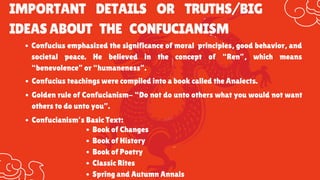
Confucius emphasized the significance of moral principles, good behavior, and
societal peace. He believed in the concept of “Ren”, which means
“benevolence” or “humaneness”.
Confucius teachings were compiled into a book called the Analects.
Golden rule of Confucianism- “Do not do unto others what you would not want
others to do unto you”.
Confucianism’s Basic Text:
Book of Changes
Book of History
Book of Poetry
Classic Rites
Spring and Autumn Annals
5.
IMPORTANT DETAILS ORTRUTHS/BIG
IDEASABOUT THE CONFUCIANISM
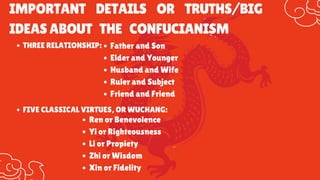
FIVE CLASSICAL VIRTUES, OR WUCHANG:
Ren or Benevolence
Yi or Righteousness
Li or Propiety
Zhi or Wisdom
Xin or Fidelity
THREE RELATIONSHIP: Father and Son
Elder and Younger
Husband and Wife
Ruler and Subject
Friend and Friend
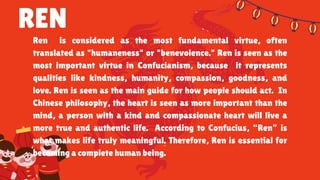
REN
Ren is consideredas the most fundamental virtue, often
translated as "humaneness" or "benevolence." Ren is seen as the
most important virtue in Confucianism, because it represents
qualities like kindness, humanity, compassion, goodness, and
love. Ren is seen as the main guide for how people should act. In
Chinese philosophy, the heart is seen as more important than the
mind, a person with a kind and compassionate heart will live a
more true and authentic life. According to Confucius, “Ren” is
what makes life truly meaningful. Therefore, Ren is essential for
becoming a complete human being.
8.
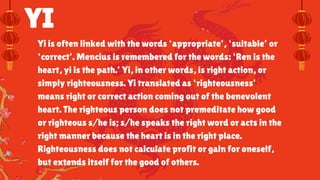
YI
Yi is oftenlinked with the words ‘appropriate’, ‘suitable’ or
‘correct’. Mencius is remembered for the words: ‘Ren is the
heart, yi is the path.’ Yi, in other words, is right action, or
simply righteousness. Yi translated as ‘righteousness’
means right or correct action coming out of the benevolent
heart. The righteous person does not premeditate how good
or righteous s/he is; s/he speaks the right word or acts in the
right manner because the heart is in the right place.
Righteousness does not calculate profit or gain for oneself,
but extends itself for the good of others.
9.
LI OR PROPRIETY
Li,Confucian concept often rendered as “ritual,” “proper
conduct,” or “propriety.” Originally li denoted court rites
performed to sustain social and cosmic order. Generally
doing things that are appropriate in a given situation. It
originally refers to proper ways of performing religious rites
and to proper behavior in court ceremonies. In its general
meaning, however, it includes proper ways of speaking,
behaving, dressing, and others, in given social situations.
10.
ZHI OR WISDOM
Zhior wisdom, is the fourth Confucian virtue. It represented by
Water. Wisdomm is the inntae awareness by which one judge
right and wrong, good and evil. True wisdom comes from our
Buddha nature. This is necessary in the practice of Morality:
otherwise one cannot become a person of virtue.
11.
XIN (TRUSTWORTHINESS)
Xin isconsidered as an essential concept of Confucianism and is
commonly recognized as the standard of value and virtue for
Chinese people. It represents trustworthiness and integrity. It's
about being honest, keeping your promises, and being reliable. A
person with "xin" is someone you can count on, who always acts
with sincerity and doesn't betray your trust. It's about building
strong relationships based on mutual respect and dependability.
Think of it like someone who always follows through on their
commitments, even when it's difficult, because they value
honesty and loyalty above all else.
12.
STRENGHTS
1. Ethical Framework:Confucianism provides a moral compass, emphasizing virtues like respect, loyalty, and
integrity, which can guide personal and social behavior.
2. Social Harmony: It promotes the importance of relationships and social harmony, fostering community
cohesion and mutual respect.
3. Education and Self-Cultivation: Confucian thought values lifelong learning and self-improvement, encouraging
individuals to strive for personal growth and contribute positively to society.
4. Leadership Principles: It emphasizes the role of benevolent leadership, highlighting the responsibility of
leaders to act ethically and serve their communities.
5. Cultural Understanding: Studying Confucianism can deepen one's understanding of East Asian cultures, as it
has significantly influenced social structures, governance, and family dynamics in
the region.
These are some of the main pros or strengths that these
theory provide:
13.
CHALLENGES
The challenges thatthe theory are facing are:
Patriarchal System
Female Infanticide
Women Oppression:
- Foot Binding
- Concubinage
- Widow Suicide.
Confucianism has long influenced and continues to shape
societies with its ethical values and philosophical
teachings. However, despite its influence, Confucianism
also faces issues and challenges. Some of its traditional
beliefs and cultural practices are seen as conflicting with
values, leading to criticisms. Traditions and culture
mentioned are being criticized by many. Mostly,
treatment of gender roles, particularly regarding women.
Confucianism is associated with patriarchal structures
that result in gender inequality. Therefore, their
traditional views on gender roles are being questioned
and rejected by many.
14.
EXAMPLES
1. Xin (Trustworthiness):Jerome
Jerome is known for his honesty and reliability. When his friend, Byron,
asks him to keep a secret, Jerome feels a strong sense of duty to uphold his
trust. He knows that sharing the secret would violate Byron's confidence
and damage their friendship. Jerome chooses to remain silent, even when
it's difficult, because he values trustworthiness above all else.
2. Zhi (Knowledge): Cheska
Cheska is a passionate learner who is always seeking to expand her
understanding of the world. She is eager to share her knowledge with others
and believes that education is essential for personal growth and societal
progress. When her colleague, Francine, is struggling with a challenging
project, Cheska offers her assistance, patiently explaining complex
concepts and providing helpful resources. Cheska's willingness to share her
knowledge reflects her commitment to Zhi.
15.
3. Li (Propriety):Francine
Francine is known for her grace and elegance.
She always strives to act with decorum and
respect in all situations. When attending a
formal event, Francine takes care to dress
appropriately, speak politely, and avoid any
behavior that might be considered offensive.
Her adherence to Li demonstrates her
understanding of social norms and her
commitment to maintaining harmony in social
interactions.
4. Yi (Righteousness): Jefferson
Jefferson is a strong advocate for justice and
fairness. He believes that everyone deserves to be
treated with dignity and respect, regardless of
their background or status. When he witnesses an
act of discrimination, Jefferson speaks up,
challenging the injustice and advocating for the
rights of the marginalized. His commitment to Yi
motivates him to stand up for what he believes is
right, even when it's unpopular.
5. Ren (Benevolence): Byron
Byron is known for his kindness and compassion. He always puts the
needs of others before his own and is willing to go the extra mile to
help those in need. When he sees a neighbor struggling to carry
groceries, Byron offers to assist, demonstrating his genuine concern
for others. His actions embody Ren, reflecting his desire to create a
more caring and supportive community.