Buddhism
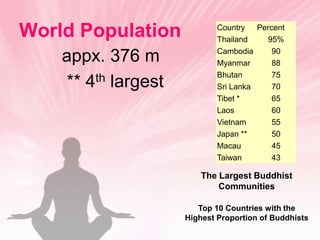
World Populationappx. 376 m ** 4th largest The Largest Buddhist CommunitiesTop 10 Countries with theHighest Proportion of Buddhists
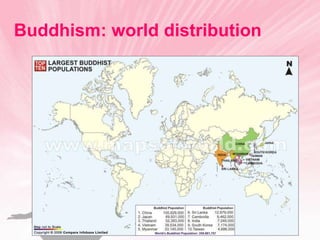
Buddhism: world distribution
Originsdeveloped in India 2500 yrs agobased on many of the core concepts of Hinduismessence of Buddhism is the attainment of enlightenmentpoints to a way of life that avoids self-indulgence and self-denial.no supreme god or deity in Buddhism
Question from your reading: Who was the founder of Buddhism?Siddhartha Gautama
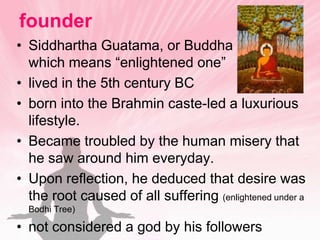
founderSiddhartha Guatama, or Buddha           which means “enlightened one”lived in the 5th century BCborn into the Brahmin caste-led a luxurious lifestyle. Became troubled by the human misery that he saw around him everyday.Upon reflection, he deduced that desire was the root caused of all suffering (enlightened under a Bodhi Tree)not considered a god by his followers
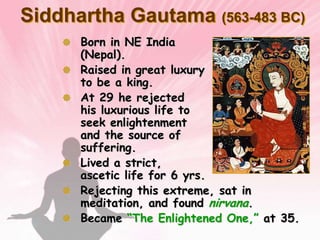
Siddhartha Gautama(563-483 BC)Born in NE India (Nepal).
Raised in great luxuryto be a king.
At 29 he rejectedhis luxurious life toseek enlightenmentand the source ofsuffering.
Lived a strict,ascetic life for 6 yrs.
Rejecting this extreme, sat in meditation, and found nirvana.
Became “The Enlightened One,” at 35.What is the fundamental cause of all suffering?Desire!Therefore, extinguish the self, don’t obsess about oneself.Four Noble TruthsThere is suffering in the world.  To live is to suffer. (Dukkha) The Buddha found this out when he was young and experienced suffering and death in others.Four Noble TruthsThe cause of suffering is self-centered desire and attachments. (Tanha)
Question from your reading: What is the term for a state of “Perfect Peace”?Nirvana
Four Noble TruthsThe solution is to eliminate desire and attachments. (Nirvana = “extinction”)
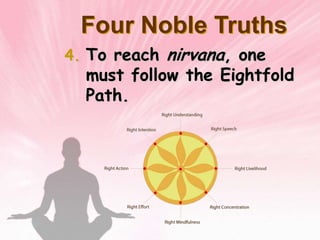
Four Noble TruthsTo reach nirvana, one must follow the Eightfold Path.
Major BeliefsThe Four Noble Truths Siddhartha's  philosophy of the nature of human suffering and its relation to desire is articulated by these four statements:Life is full of pain and suffering. Human desire causes this suffering. By putting an end to desire, humans can end suffering. Humans can end desire by following the Eightfold Path.
Eightfold PathNirvanaThe union with the ultimate    spiritual reality.
 Escape from the cycle of    rebirth.The Eightfold PathWisdomRight View – know the truthRight Intention – resist self-centerednessEthical ConductRight Speech – refrain from unkind, negative speechRight Action – respect all lifeRight Livelihood – work for the good of othersMental DisciplineRight Effort – exert oneself in freeing the mind of evil (egocentric thought)Right Awareness – elevate one’s thoughts beyond the haze of emotion and mood8)	Right Meditation – practice the discipline of meditation
3. Reincarnationconcept that one must go through many cycles of birth, living, and death After many such cycles, if a person releases their attachment to desire and the self, they can attain Nirvana  - a state of liberation and freedom from suffering Nirvana can be achieved from meditating and following the guiding principles of Buddhism, such as the Four Noble Truths, 8-fold path
4. Karma- the law that every cause has an effect, i.e., our actions have results. This explains a number of things: inequality in the world, why some are born handicapped and some gifted, why some live only a short life. Buddhists believe that our are past actions have an effect on who or what we are in our next life.5. Caste Systemis rejected by Buddhists
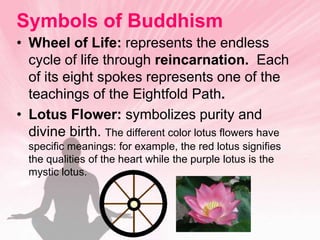
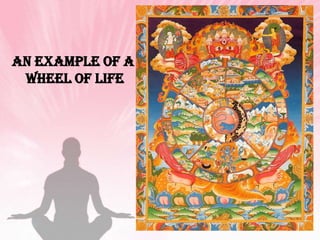
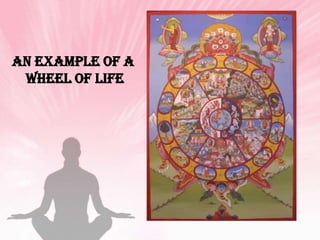
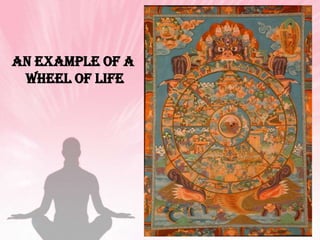
Symbols of Buddhism Wheel of Life: represents the endless cycle of life through reincarnation.  Each of its eight spokes represents one of the teachings of theEightfold Path.Lotus Flower: symbolizes purity and divine birth. The different color lotus flowers have specific meanings: for example, the red lotus signifies the qualities of the heart while the purple lotus is the mystic lotus.
An Example of a Wheel of Life
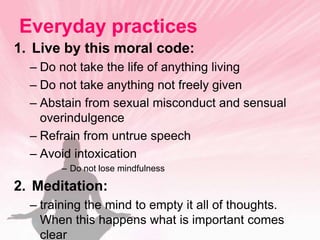
Everyday practicesLive by this moral code:Do not take the life of anything livingDo not take anything not freely givenAbstain from sexual misconduct and sensual overindulgenceRefrain from untrue speechAvoid intoxicationDo not lose mindfulnessMeditation: training the mind to empty it all of thoughts. When this happens what is important comes clear
Question from your reading: What is a person who works to spread their religious beliefs? A missionary
Religious DivisionsTheravada Buddhism - found in Burma, Thailand, Sri Lanka, Laos, Cambodia, Myanmar & in part, Indonesia, Vietnam & Malaysia.Mahayana Buddhism - found in China, Japan, Korea and Vietnam. Vajrayana Buddhism - found in Tibet, Nepal, Sikkim, Bhutan and MongoliaJodo Shin Buddhism or Pure Land Buddhism - mainly from India, JapanZen Buddhism - mostly in Japan
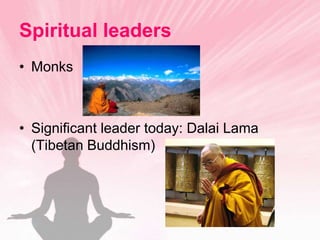
Spiritual leadersMonksSignificant leader today: Dalai Lama (Tibetan Buddhism)

What Is Buddhism

  • 1.
  • 2.
    World Populationappx. 376m ** 4th largest The Largest Buddhist CommunitiesTop 10 Countries with theHighest Proportion of Buddhists
  • 3.
  • 4.
    Originsdeveloped in India2500 yrs agobased on many of the core concepts of Hinduismessence of Buddhism is the attainment of enlightenmentpoints to a way of life that avoids self-indulgence and self-denial.no supreme god or deity in Buddhism
  • 5.
    Question from yourreading: Who was the founder of Buddhism?Siddhartha Gautama
  • 6.
    founderSiddhartha Guatama, orBuddha which means “enlightened one”lived in the 5th century BCborn into the Brahmin caste-led a luxurious lifestyle. Became troubled by the human misery that he saw around him everyday.Upon reflection, he deduced that desire was the root caused of all suffering (enlightened under a Bodhi Tree)not considered a god by his followers
  • 7.
  • 8.
    Raised in greatluxuryto be a king.
  • 9.
    At 29 herejectedhis luxurious life toseek enlightenmentand the source ofsuffering.
  • 10.
    Lived a strict,asceticlife for 6 yrs.
  • 11.
    Rejecting this extreme,sat in meditation, and found nirvana.
  • 12.
    Became “The EnlightenedOne,” at 35.What is the fundamental cause of all suffering?Desire!Therefore, extinguish the self, don’t obsess about oneself.Four Noble TruthsThere is suffering in the world. To live is to suffer. (Dukkha) The Buddha found this out when he was young and experienced suffering and death in others.Four Noble TruthsThe cause of suffering is self-centered desire and attachments. (Tanha)
  • 13.
    Question from yourreading: What is the term for a state of “Perfect Peace”?Nirvana
  • 14.
    Four Noble TruthsThesolution is to eliminate desire and attachments. (Nirvana = “extinction”)
  • 15.
    Four Noble TruthsToreach nirvana, one must follow the Eightfold Path.
  • 16.
    Major BeliefsThe FourNoble Truths Siddhartha's  philosophy of the nature of human suffering and its relation to desire is articulated by these four statements:Life is full of pain and suffering. Human desire causes this suffering. By putting an end to desire, humans can end suffering. Humans can end desire by following the Eightfold Path.
  • 17.
    Eightfold PathNirvanaThe unionwith the ultimate spiritual reality.
  • 18.
    Escape fromthe cycle of rebirth.The Eightfold PathWisdomRight View – know the truthRight Intention – resist self-centerednessEthical ConductRight Speech – refrain from unkind, negative speechRight Action – respect all lifeRight Livelihood – work for the good of othersMental DisciplineRight Effort – exert oneself in freeing the mind of evil (egocentric thought)Right Awareness – elevate one’s thoughts beyond the haze of emotion and mood8) Right Meditation – practice the discipline of meditation
  • 19.
    3. Reincarnationconcept thatone must go through many cycles of birth, living, and death After many such cycles, if a person releases their attachment to desire and the self, they can attain Nirvana  - a state of liberation and freedom from suffering Nirvana can be achieved from meditating and following the guiding principles of Buddhism, such as the Four Noble Truths, 8-fold path
  • 20.
    4. Karma- thelaw that every cause has an effect, i.e., our actions have results. This explains a number of things: inequality in the world, why some are born handicapped and some gifted, why some live only a short life. Buddhists believe that our are past actions have an effect on who or what we are in our next life.5. Caste Systemis rejected by Buddhists
  • 21.
    Symbols of BuddhismWheel of Life: represents the endless cycle of life through reincarnation. Each of its eight spokes represents one of the teachings of theEightfold Path.Lotus Flower: symbolizes purity and divine birth. The different color lotus flowers have specific meanings: for example, the red lotus signifies the qualities of the heart while the purple lotus is the mystic lotus.
  • 22.
    An Example ofa Wheel of Life
  • 23.
    An Example ofa Wheel of Life
  • 24.
    An Example ofa Wheel of Life
  • 25.
    Everyday practicesLive bythis moral code:Do not take the life of anything livingDo not take anything not freely givenAbstain from sexual misconduct and sensual overindulgenceRefrain from untrue speechAvoid intoxicationDo not lose mindfulnessMeditation: training the mind to empty it all of thoughts. When this happens what is important comes clear
  • 26.
    Question from yourreading: What is a person who works to spread their religious beliefs? A missionary
  • 27.
    Religious DivisionsTheravada Buddhism- found in Burma, Thailand, Sri Lanka, Laos, Cambodia, Myanmar & in part, Indonesia, Vietnam & Malaysia.Mahayana Buddhism - found in China, Japan, Korea and Vietnam. Vajrayana Buddhism - found in Tibet, Nepal, Sikkim, Bhutan and MongoliaJodo Shin Buddhism or Pure Land Buddhism - mainly from India, JapanZen Buddhism - mostly in Japan
  • 28.
    Spiritual leadersMonksSignificant leadertoday: Dalai Lama (Tibetan Buddhism)
  • 29.
    Question from yourreading: Who is the main god of BuddhismThere are no Gods, Not even Buddha himself
  • 30.
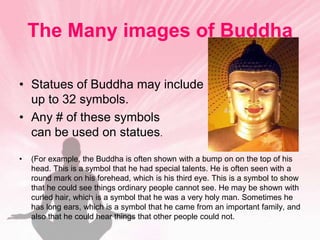
    The Many imagesof BuddhaStatues of Buddha may include up to 32 symbols. Any # of these symbols can be used on statues. (For example, the Buddha is often shown with a bump on on the top of his head. This is a symbol that he had special talents. He is often seen with a round mark on his forehead, which is his third eye. This is a symbol to show that he could see things ordinary people cannot see. He may be shown with curled hair, which is a symbol that he was a very holy man. Sometimes he has long ears, which is a symbol that he came from an important family, and also that he could hear things that other people could not.