Hello.
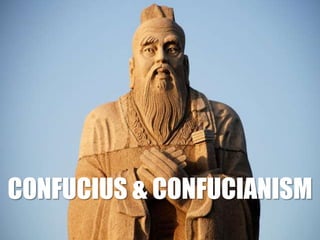
CONFUCIUS & CONFUCIANISM
WHO IS CONFUCIUS?
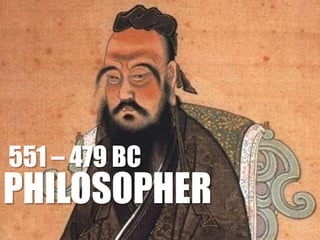
551 – 479 BC

PHILOSOPHER
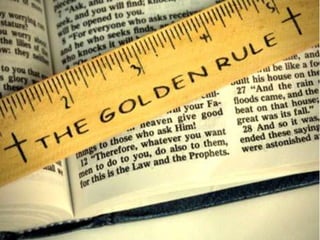
ALL of religions use the

GOLDEN RULE
to summarize their
ethical teachings.
Defined Chinese Society for the
past 2000 years
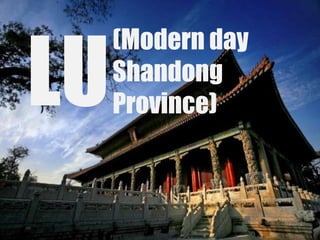
LU

(Modern day
Shandong
Province)
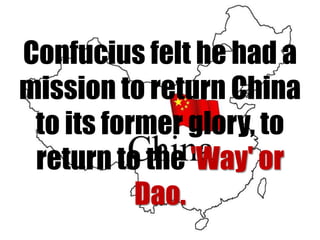
Confucius felt he had a
mission to return China
to its former glory, to
return to the 'Way' or
Dao.
Dao -culture of
self-cultivation
and emphasis on
the way of virtue
Confucianism is very
much a philosophy for
those living in society
Buddhism and Daoism
stress withdrawing
from the world to
seek spiritual
enlightenment.
He was never employed in any
significant government post during
his lifetime.

IRONIC

300 years after his death,
Confucianism was adopted as
China's state philosophy.
CONFUCIANISM‟S
ADVOCACY
PROMOTES HARMONY
AMIDST CHANGE
The embeddedness of each person
in concentric circles of
relationships and ethical
responsibilities
1. The importance of
family (past, present
& future)
2. The function of a
hierarchical social
system
3. The significance of
education
4. The role of government
in establishing a political
bureaucracy
4 Key Elements
of the

Confucian
Worldview
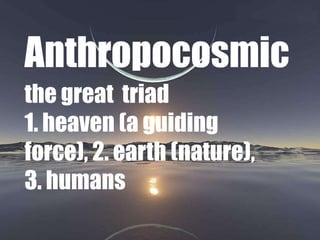
Anthropocosmic
the great triad
1. heaven (a guiding
force), 2. earth (nature),
3. humans
Organic Holism
the universe is seen as
unified, interconnected,
and interpenetrating
Dynamic Vitalism
basis of the underlying
unity of reality which is

ch‟i,

constituted of
the
material force of the
universe
Comprehensive Ethics
humans are biological-

historical-ethical beings
who live in a universe of
complex correspondences and
relationships.
Essential
Teachings
The main core of
Confucianism
is humanism
It focuses on the
importance of life
and all that
affects it such as
the family
It does not focus on
the belief of the
afterlife and of gods
Philosophies
Religion?

Ethical Code
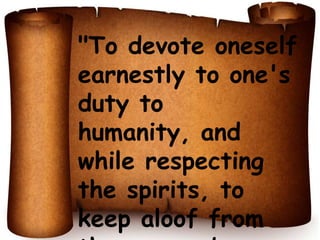
"To devote oneself
earnestly to one's
duty to
humanity, and
while respecting
the spirits, to
keep aloof from
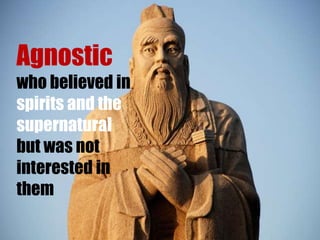
Agnostic
who believed in
spirits and the
supernatural
but was not
interested in
them
Built on the foundational belief

that man is basically

good.
Teachings:
*Morality
*The importance of
justice, sincerity and
filial piety - the duty of
every son to serve his
parents.
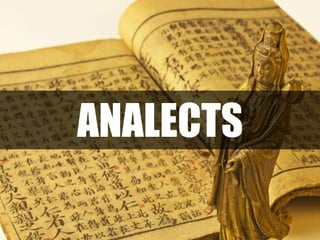
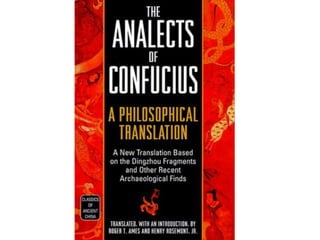
ANALECTS
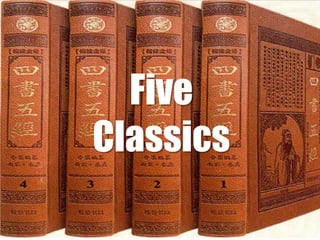
Five
Classics
defined as "Utilitarianism"
by John Stuart Mills
Five Constants
(五常)
Ren(仁, being
humane)

Best expressed by the golden rule or
the ethic of reciprocity.
Political dimension: makes rulers
take care of subjects
Yi 義:
upholding of
righteousness and the
moral disposition to do
good.
Li 禮:
Following/respecting
of etiquette and
norms of daily life
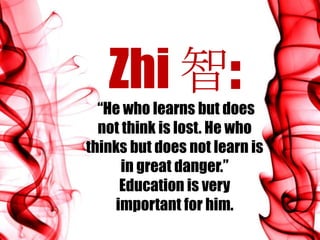
Zhi 智:
“He who learns but does
not think is lost. He who
thinks but does not learn is
in great danger.”
Education is very
important for him.
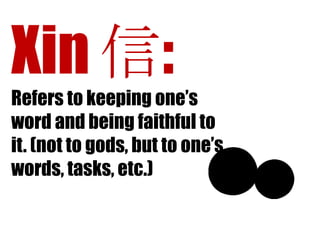
Xin 信:
Refers to keeping one‟s
word and being faithful to
it. (not to gods, but to one‟s
words, tasks, etc.)
Four Virtues
(五常)
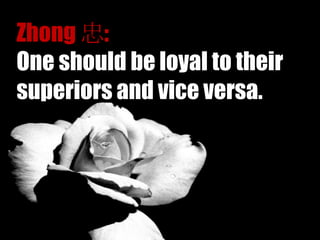
Zhong 忠:
One should be loyal to their
superiors and vice versa.
Jie 節:
One must
exercise self
control.
Xiao 孝:
Children must respect their
parents, but a child has a
duty to dispute with his/her
parents if necessary
Yi 義:
The same as the one in the five constants, which is the moral disposition to do good.

Yi 義:
The same as the one in the
five constants, which is the
moral disposition to do
good.
Contributions of
Confusianism
Public policies
Family codes
Relationship ethics
Education
Government
Influenced the
Chinese people to
respect their
leaders and their
leaders to set a
good example as
well
Explained humanity as „to love
the people‟ and „to love the
masses extensively‟
Development of
everyone‟s potential
ability‟
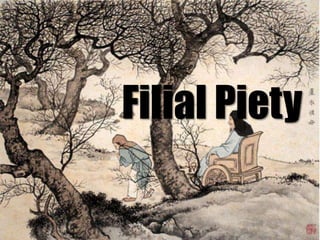
Filial Piety
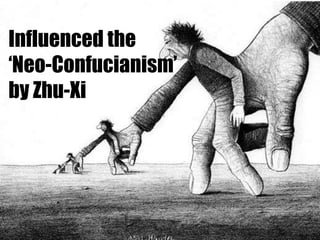
Influenced the
„Neo-Confucianism‟
by Zhu-Xi
Bye.

Confucianism