CONFUCIANISM
Prepared by:
o Confucius married at 19 years old
o The name "Confucius" is a Latinization of the Mandarin
Chinese Kǒng Fūzǐ (孔夫子, "Master Kong"), and was
coined in the late 16th century by the early Jesuit
missionaries to China
o Confucius married at 19 years old
o The name "Confucius" is a Latinization of the Mandarin Chinese Kǒng
Fūzǐ (孔夫子, "Master Kong"), and was coined in the late 16th century by
the early Jesuit missionaries to China
o Confucius is a breadwinner to his mother and his disabled
brother after the death of his father
o Confucius married at 19 years old
o The name "Confucius" is a Latinization of the Mandarin Chinese Kǒng
Fūzǐ (孔夫子, "Master Kong"), and was coined in the late 16th century by
the early Jesuit missionaries to China
o Traditionally parents choose their childrens marriage
o Confucius is a breadwinner to his mother and his disabled brother after the death of
his father
o Confucius married at 19 years old
o The name "Confucius" is a Latinization of the Mandarin Chinese Kǒng
Fūzǐ (孔夫子, "Master Kong"), and was coined in the late 16th century by
the early Jesuit missionaries to China
o Traditionally parents choose their children's marriage
o Confucius is a breadwinner to his mother and his disabled brother after the death of
his father
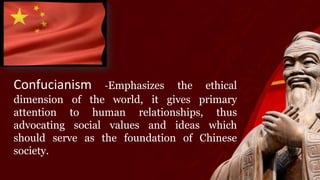
Confucianism -Emphasizes the ethical
dimension of the world, it gives primary
attention to human relationships, thus
advocating social values and ideas which
should serve as the foundation of Chinese
society.
Confucianism, also known as Ruism, is
described as tradition, a philosophy, a religion,
a humanistic or rationalistic religion, a way of
governing, or simply a way of life.
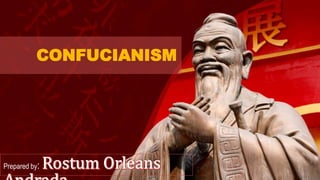
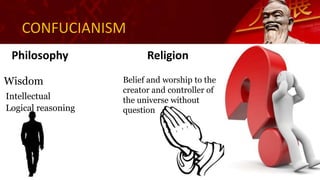
CONFUCIANISM
Philosophy
Wisdom
Religion
Intellectual
Logical reasoning
Belief and worship to the
creator and controller of
the universe without
question
Confucius: “Never meant to established a
religion”
He just want to revive the ancient religion of
Zhou Dynasty
Good human relationship and social values
and ideals—which become the foundation of
the Chinese society
Confucianism as Philosophy
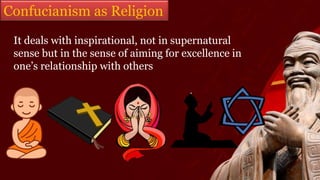
It deals with inspirational, not in supernatural
sense but in the sense of aiming for excellence in
one’s relationship with others
Confucianism as Religion
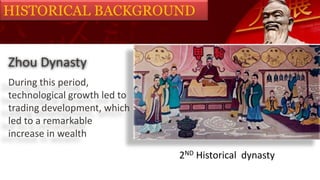
HISTORICAL BACKGROUND
Zhou Dynasty
2ND Historical dynasty
During this period,
technological growth led to
trading development, which
led to a remarkable
increase in wealth
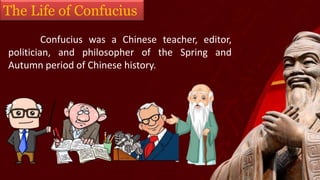
The Life of Confucius
Confucius was a Chinese teacher, editor,
politician, and philosopher of the Spring and
Autumn period of Chinese history.
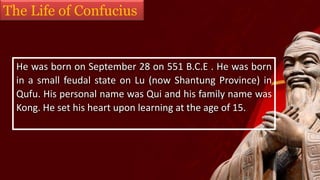
The Life of Confucius
He was born on September 28 on 551 B.C.E . He was born
in a small feudal state on Lu (now Shantung Province) in
Qufu. His personal name was Qui and his family name was
Kong. He set his heart upon learning at the age of 15.
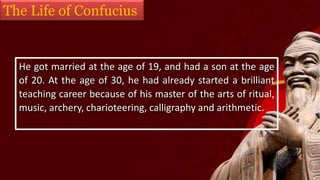
The Life of Confucius
He got married at the age of 19, and had a son at the age
of 20. At the age of 30, he had already started a brilliant
teaching career because of his master of the arts of ritual,
music, archery, charioteering, calligraphy and arithmetic.
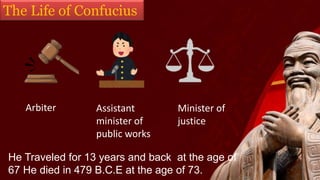
The Life of Confucius
Arbiter Assistant
minister of
public works
Minister of
justice
He Traveled for 13 years and back at the age of
67 He died in 479 B.C.E at the age of 73.
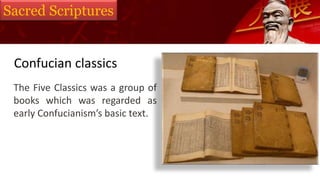
Sacred Scriptures
The Five Classics was a group of
books which was regarded as
early Confucianism’s basic text.
Confucian classics
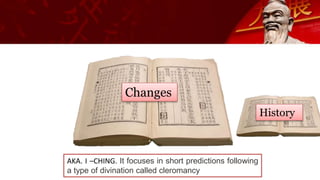
Changes
History
AKA. I –CHING. It focuses in short predictions following
a type of divination called cleromancy
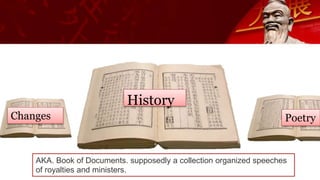
Changes Poetry
History
AKA. Book of Documents. supposedly a collection organized speeches
of royalties and ministers.
Classic of Rite
Poetry
History
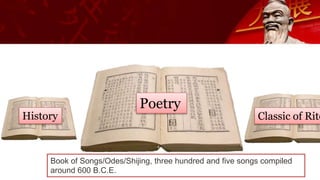
Book of Songs/Odes/Shijing, three hundred and five songs compiled
around 600 B.C.E.
Classic of Rites
Poetry
Spring an
Autumn A
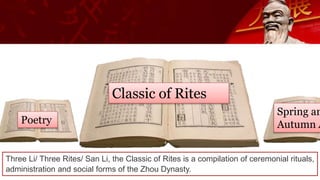
Three Li/ Three Rites/ San Li, the Classic of Rites is a compilation of ceremonial rituals,
administration and social forms of the Zhou Dynasty.
Classic of
Rites
Spring and
Autumn Analects
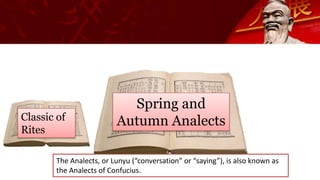
The Analects, or Lunyu (“conversation” or “saying”), is also known as
the Analects of Confucius.
Confucian Doctrine/belief
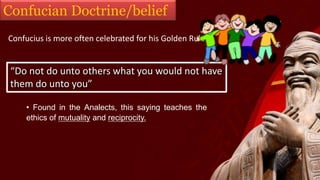
Confucius is more often celebrated for his Golden Rule:
“Do not do unto others what you would not have
them do unto you”
• Found in the Analects, this saying teaches the
ethics of mutuality and reciprocity.
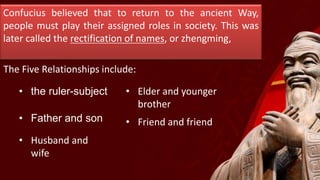
Confucius believed that to return to the ancient Way,
people must play their assigned roles in society. This was
later called the rectification of names, or zhengming,
The Five Relationships include:
• the ruler-subject
• Father and son
• Husband and
wife
• Elder and younger
brother
• Friend and friend
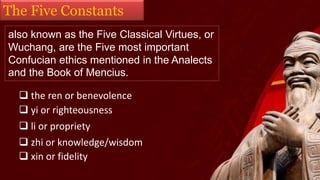
The Five Constants
also known as the Five Classical Virtues, or
Wuchang, are the Five most important
Confucian ethics mentioned in the Analects
and the Book of Mencius.
 the ren or benevolence
 yi or righteousness
 li or propriety
 zhi or knowledge/wisdom
 xin or fidelity
Although Confucius presented the
family as the foundation of society, he
was divorced from his wife and lived
with his students.
During the reign of Emperor Qin Shi Huan
from 259-210 BCE, Confucianism was
banned, texts were burned, and hundreds
of Confucian intellectuals were killed
Activity: search for Confucius’ famous
quotes that you think you possess or
you can apply to your daily lives
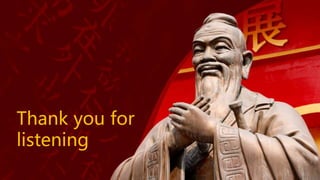
Thank you for
listening

CONFUCIANISM WRB1.pptx

  • 2.
  • 3.
    o Confucius marriedat 19 years old
  • 4.
    o Confucius marriedat 19 years old o The name "Confucius" is a Latinization of the Mandarin Chinese Kǒng Fūzǐ (孔夫子, "Master Kong"), and was coined in the late 16th century by the early Jesuit missionaries to China
  • 5.
    o Confucius marriedat 19 years old o The name "Confucius" is a Latinization of the Mandarin Chinese Kǒng Fūzǐ (孔夫子, "Master Kong"), and was coined in the late 16th century by the early Jesuit missionaries to China o Confucius is a breadwinner to his mother and his disabled brother after the death of his father
  • 6.
    o Confucius marriedat 19 years old o The name "Confucius" is a Latinization of the Mandarin Chinese Kǒng Fūzǐ (孔夫子, "Master Kong"), and was coined in the late 16th century by the early Jesuit missionaries to China o Traditionally parents choose their childrens marriage o Confucius is a breadwinner to his mother and his disabled brother after the death of his father
  • 7.
    o Confucius marriedat 19 years old o The name "Confucius" is a Latinization of the Mandarin Chinese Kǒng Fūzǐ (孔夫子, "Master Kong"), and was coined in the late 16th century by the early Jesuit missionaries to China o Traditionally parents choose their children's marriage o Confucius is a breadwinner to his mother and his disabled brother after the death of his father
  • 8.
    Confucianism -Emphasizes theethical dimension of the world, it gives primary attention to human relationships, thus advocating social values and ideas which should serve as the foundation of Chinese society.
  • 9.
    Confucianism, also knownas Ruism, is described as tradition, a philosophy, a religion, a humanistic or rationalistic religion, a way of governing, or simply a way of life.
  • 10.
    CONFUCIANISM Philosophy Wisdom Religion Intellectual Logical reasoning Belief andworship to the creator and controller of the universe without question
  • 11.
    Confucius: “Never meantto established a religion” He just want to revive the ancient religion of Zhou Dynasty Good human relationship and social values and ideals—which become the foundation of the Chinese society Confucianism as Philosophy
  • 12.
    It deals withinspirational, not in supernatural sense but in the sense of aiming for excellence in one’s relationship with others Confucianism as Religion
  • 13.
    HISTORICAL BACKGROUND Zhou Dynasty 2NDHistorical dynasty During this period, technological growth led to trading development, which led to a remarkable increase in wealth
  • 14.
    The Life ofConfucius Confucius was a Chinese teacher, editor, politician, and philosopher of the Spring and Autumn period of Chinese history.
  • 15.
    The Life ofConfucius He was born on September 28 on 551 B.C.E . He was born in a small feudal state on Lu (now Shantung Province) in Qufu. His personal name was Qui and his family name was Kong. He set his heart upon learning at the age of 15.
  • 16.
    The Life ofConfucius He got married at the age of 19, and had a son at the age of 20. At the age of 30, he had already started a brilliant teaching career because of his master of the arts of ritual, music, archery, charioteering, calligraphy and arithmetic.
  • 17.
    The Life ofConfucius Arbiter Assistant minister of public works Minister of justice He Traveled for 13 years and back at the age of 67 He died in 479 B.C.E at the age of 73.
  • 18.
    Sacred Scriptures The FiveClassics was a group of books which was regarded as early Confucianism’s basic text. Confucian classics
  • 19.
    Changes History AKA. I –CHING.It focuses in short predictions following a type of divination called cleromancy
  • 20.
    Changes Poetry History AKA. Bookof Documents. supposedly a collection organized speeches of royalties and ministers.
  • 21.
    Classic of Rite Poetry History Bookof Songs/Odes/Shijing, three hundred and five songs compiled around 600 B.C.E.
  • 22.
    Classic of Rites Poetry Springan Autumn A Three Li/ Three Rites/ San Li, the Classic of Rites is a compilation of ceremonial rituals, administration and social forms of the Zhou Dynasty.
  • 23.
    Classic of Rites Spring and AutumnAnalects The Analects, or Lunyu (“conversation” or “saying”), is also known as the Analects of Confucius.
  • 24.
    Confucian Doctrine/belief Confucius ismore often celebrated for his Golden Rule: “Do not do unto others what you would not have them do unto you” • Found in the Analects, this saying teaches the ethics of mutuality and reciprocity.
  • 25.
    Confucius believed thatto return to the ancient Way, people must play their assigned roles in society. This was later called the rectification of names, or zhengming, The Five Relationships include: • the ruler-subject • Father and son • Husband and wife • Elder and younger brother • Friend and friend
  • 26.
    The Five Constants alsoknown as the Five Classical Virtues, or Wuchang, are the Five most important Confucian ethics mentioned in the Analects and the Book of Mencius.  the ren or benevolence  yi or righteousness  li or propriety  zhi or knowledge/wisdom  xin or fidelity
  • 27.
    Although Confucius presentedthe family as the foundation of society, he was divorced from his wife and lived with his students. During the reign of Emperor Qin Shi Huan from 259-210 BCE, Confucianism was banned, texts were burned, and hundreds of Confucian intellectuals were killed
  • 28.
    Activity: search forConfucius’ famous quotes that you think you possess or you can apply to your daily lives
  • 29.