From The
Analects
By Confucius
Translated by Arthur Waley
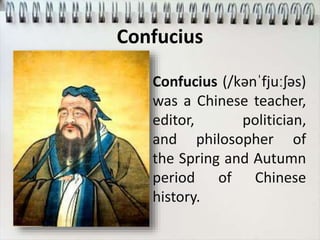
Confucius
Confucius (/kənˈfjuːʃəs)
was a Chinese teacher,
editor, politician,
and philosopher of
the Spring and Autumn
period of Chinese
history.
The philosophy of Confucius emphasized
personal and governmental morality, correctness
of social relationships, justice and sincerity. His
followers competed successfully with many
other schools during the Hundred Schools of
Thought era only to be suppressed in favor of
the Legalists during the Qin Dynasty. Following
the victory of Han over Chu after the collapse of
Qin, Confucius's thoughts received official
sanction and were further developed into a
system known as Confucianism.
Confucius is traditionally credited with
having authored or edited many of
the Chinese classic texts including all of
the Five Classics, but modern scholars are
cautious of attributing specific assertions to
Confucius himself. Aphorisms concerning his
teachings were compiled in the Analects,
but only many years after his death.
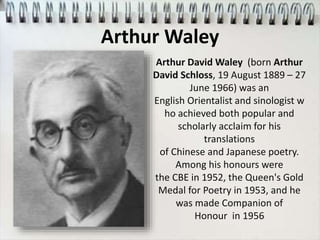
Arthur Waley
Arthur David Waley (born Arthur
David Schloss, 19 August 1889 – 27
June 1966) was an
English Orientalist and sinologist w
ho achieved both popular and
scholarly acclaim for his
translations
of Chinese and Japanese poetry.
Among his honours were
the CBE in 1952, the Queen's Gold
Medal for Poetry in 1953, and he
was made Companion of
Honour in 1956
From the Analects
by Confucius translated
by Arthur Waley
The Master said, “To learn and at
due times to repeat what one has
learnt, is that not after all a pleasure?
Those friends should come to one from
afar, is this not after all delightful? To
remain unsoured even though one’s
merits are unrecognized by others is
that not after all what is expected of a
gentleman?”
The Master said, “A young man’s
duty is to behave well to his parents at
home and to his elders abroad, to be
cautious in giving promises and
punctual in giving them, to have kindly
feelings towards everyone, but seek the
intimacy of good. If, when all that is
done, he has any energy to spare, and
then let him study the polite arts.”
The Master said, “The good man
does not grieve that other people do
not recognize his merits. His only
anxiety is lest he should fail to recognize
theirs.”
The Master said, “He who rules by
moral force is like the Pole star, which
remains in its place where all the lesser
stars do homage to it.”
The Master said, “If out of three
hundred songs I had to take one phrase
to cover all my teaching, I would say, Let
there be no evil in your thoughts.”
The Master said, “Govern the
people by regulations, keep order
among them by chastisements, and they
will flee from you, and lose all self-
respect. Govern them by moral force,
keep order among them by ritual, they
will keep their self-respect and come to
you of their own accord.”
Meng Wu Po asked about the
treatment of parents. The Master said,
“Behave in such a way that your father
and mother have no anxiety about you,
except concerning your health.”
The Master said, “A gentleman can
see a question from all sides without
bias. The small man is biased and can
see a question only from one side.”
The Master said, “You, shall I teach
you what knowledge is? When you
know a thing, to recognize that you
know it, and when you do not know a
thing, to recognize that you do not
know it. That is knowledge.”
The Master said, “High office filled
by men of narrow views, ritual
performed without reverence, the
forms of mourning observed without
grief—these are things I cannot bear to
see!”
The Master said, “In the presence
of a good man, think all the time how
you may learn to equal him. In the
presence of a bad man, turn your gaze
within!”
The Master said, “In old days, a
man kept hold on his words, fearing the
disgrace that would ensue should he
himself fail to keep pace with them.”
The Master said, “A gentleman
covets the reputation of being slow in
word but prompt in deed.”
The Master said, “In old days, men
studied for the sake of self-
improvement; nowadays men study to
impress other people.”
The Master said, “A gentleman is
ashamed to let his words outrun his
deeds.”
The Master said, “He who will not
worry about what is far off will soon
find something worse than worry close
at hand.”
The Master said, “To demand much
from oneself and little from others is the
way (for a ruler) to banish discontent.”
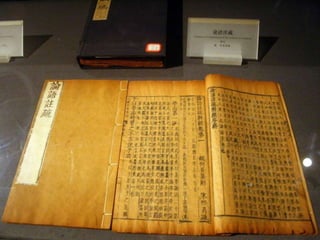
Analects are literary extracts or
selected passages from literary or
philosophical works especially from a
published collection. They share a lot of
qualities with other meaningful pieces
of writing, so expect to find works that
are rich in meanings.
FROM THE ANALECTS

FROM THE ANALECTS

  • 1.
  • 2.
    Confucius Confucius (/kənˈfjuːʃəs) was aChinese teacher, editor, politician, and philosopher of the Spring and Autumn period of Chinese history.
  • 3.
    The philosophy ofConfucius emphasized personal and governmental morality, correctness of social relationships, justice and sincerity. His followers competed successfully with many other schools during the Hundred Schools of Thought era only to be suppressed in favor of the Legalists during the Qin Dynasty. Following the victory of Han over Chu after the collapse of Qin, Confucius's thoughts received official sanction and were further developed into a system known as Confucianism.
  • 4.
    Confucius is traditionallycredited with having authored or edited many of the Chinese classic texts including all of the Five Classics, but modern scholars are cautious of attributing specific assertions to Confucius himself. Aphorisms concerning his teachings were compiled in the Analects, but only many years after his death.
  • 5.
    Arthur Waley Arthur DavidWaley (born Arthur David Schloss, 19 August 1889 – 27 June 1966) was an English Orientalist and sinologist w ho achieved both popular and scholarly acclaim for his translations of Chinese and Japanese poetry. Among his honours were the CBE in 1952, the Queen's Gold Medal for Poetry in 1953, and he was made Companion of Honour in 1956
  • 7.
    From the Analects byConfucius translated by Arthur Waley
  • 8.
    The Master said,“To learn and at due times to repeat what one has learnt, is that not after all a pleasure? Those friends should come to one from afar, is this not after all delightful? To remain unsoured even though one’s merits are unrecognized by others is that not after all what is expected of a gentleman?”
  • 9.
    The Master said,“A young man’s duty is to behave well to his parents at home and to his elders abroad, to be cautious in giving promises and punctual in giving them, to have kindly feelings towards everyone, but seek the intimacy of good. If, when all that is done, he has any energy to spare, and then let him study the polite arts.”
  • 10.
    The Master said,“The good man does not grieve that other people do not recognize his merits. His only anxiety is lest he should fail to recognize theirs.” The Master said, “He who rules by moral force is like the Pole star, which remains in its place where all the lesser stars do homage to it.”
  • 11.
    The Master said,“If out of three hundred songs I had to take one phrase to cover all my teaching, I would say, Let there be no evil in your thoughts.”
  • 12.
    The Master said,“Govern the people by regulations, keep order among them by chastisements, and they will flee from you, and lose all self- respect. Govern them by moral force, keep order among them by ritual, they will keep their self-respect and come to you of their own accord.”
  • 13.
    Meng Wu Poasked about the treatment of parents. The Master said, “Behave in such a way that your father and mother have no anxiety about you, except concerning your health.”
  • 14.
    The Master said,“A gentleman can see a question from all sides without bias. The small man is biased and can see a question only from one side.”
  • 15.
    The Master said,“You, shall I teach you what knowledge is? When you know a thing, to recognize that you know it, and when you do not know a thing, to recognize that you do not know it. That is knowledge.”
  • 16.
    The Master said,“High office filled by men of narrow views, ritual performed without reverence, the forms of mourning observed without grief—these are things I cannot bear to see!”
  • 17.
    The Master said,“In the presence of a good man, think all the time how you may learn to equal him. In the presence of a bad man, turn your gaze within!” The Master said, “In old days, a man kept hold on his words, fearing the disgrace that would ensue should he himself fail to keep pace with them.”
  • 18.
    The Master said,“A gentleman covets the reputation of being slow in word but prompt in deed.” The Master said, “In old days, men studied for the sake of self- improvement; nowadays men study to impress other people.”
  • 19.
    The Master said,“A gentleman is ashamed to let his words outrun his deeds.” The Master said, “He who will not worry about what is far off will soon find something worse than worry close at hand.” The Master said, “To demand much from oneself and little from others is the way (for a ruler) to banish discontent.”
  • 20.
    Analects are literaryextracts or selected passages from literary or philosophical works especially from a published collection. They share a lot of qualities with other meaningful pieces of writing, so expect to find works that are rich in meanings.