An Introduction to the Light
Microscope, Confocal Microscopy
Techniques
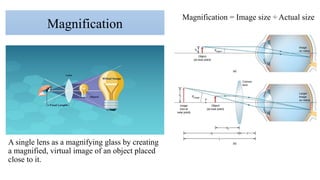
A single lens as a magnifying glass by creating
a magnified, virtual image of an object placed
close to it.
Magnification
Magnification = Image size ÷ Actual size
Simple Microscope Compound Microscope
Compound microscope bodies. a) Standard upright microscope indicating (1) eyepiece (ocular lens), (2) objective
turret, revolver, or revolving nose piece (to hold multiple objective lenses), (3) objective lenses, focus knobs (to
move the stage) (4) coarse adjustment, (5) Fine adjustment, (6) Stage (to hold the specimen), (7) Light source (a light
or a mirror), (8) Diaphragm and condenser, (9) Mechanical stage. b) Stereo microscope. c) Inverted microscope. d)
Comparison microscope.
Compound Microscope Components
- Bright field microscopy
- Dark field microscopy
- Phase contrast microscopy
- Differential interference contrast microscopy
- Polarized light microscopy
- Fluorescence microscopy
- Immunofluorescence microscopy
- Confocal microscopy
- Two-photon microscopy
- Light sheet microscopy
- Total internal reflection fluorescence microscopy
- Expansion microscopy
Light Microscopy
Confocal Microscopy
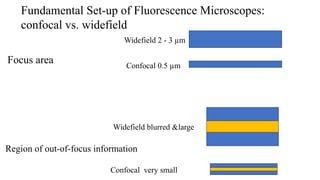
Region of out-of-focus information
Widefield blurred &large
Confocal very small
Fundamental Set-up of Fluorescence Microscopes:
confocal vs. widefield
Widefield 2 - 3 µm
Confocal 0.5 µm
Focus area
Confocal Microscopy Principle
In confocal microscopy two pinholes are typically used:
A pinhole is placed in front of the illumination source to allow
transmission only through a small area.
This illumination pinhole is imaged onto the focal plane of the
specimen, i.e. only a point of the specimen is illuminated at
one time.
Fluorescence excited in this manner at the focal plane is
imaged onto a confocal pinhole placed right in front of the
detector.
Only fluorescence excited within the focal plane of the
specimen will go through the detector pinhole.
Scanning of small sections is done and joined them together
for better view.
Working
Confocal microscope incorporates two ideas:
1. Point by point illumination of the specimen.
2. Rejection of out of focus of light.
Light source of very high intensity is used-Zirconium arc lamp in
Minsky’s design and laser light source in modern design.
a)Laser provides intense blue excitation light.
b)The light reflects off a dichroic mirror, which directs it to an assembly
of vertically and horizontally scanning mirrors.
c)These motor driven mirrors scan the laser beam across the specimen.
d)The specimen is scanned by moving the stage back and forth in
vertical and horizontal directions and optics are kept stationary.
Advantages
The specimen is everywhere illuminated axially , rather than at
different angles, thereby avoiding optical aberrations.
Entire field of view is illuminated uniformly.
The field of view can be made larger than that of the static objective
by controlling the amplitude of the stage movements.
Image formed are of better resolution.
Cells can be live or fixed.
Serial optical sections can be collected.
Taking a series of optical slices from different focus levels in the
specimen generates a 3D data set.
Drawbacks
Resolution: It has inherent resolution limitation due to diffraction .
Maximum best resolution of confocal microscopy is typically about
200nm.
Pin hole size: Strength of optical sectioning depends on the size of the
pinhole.
Fluorophores:
a)The fluorophores should tag the correct part of the specimen.
b)Fluorophore should be sensitive enough for the given excitation
wavelength.
c)It should not significantly alter the dynamics of the organism in the
living specimen.
Photobleaching: Photochemical alternation of a dye or a fluorophore
molecule such that it permanently is unable to fluorescence.

SKY super resolution microscope ppt.pptx

  • 1.
    An Introduction tothe Light Microscope, Confocal Microscopy Techniques
  • 2.
    A single lensas a magnifying glass by creating a magnified, virtual image of an object placed close to it. Magnification Magnification = Image size ÷ Actual size
  • 3.
  • 4.
    Compound microscope bodies.a) Standard upright microscope indicating (1) eyepiece (ocular lens), (2) objective turret, revolver, or revolving nose piece (to hold multiple objective lenses), (3) objective lenses, focus knobs (to move the stage) (4) coarse adjustment, (5) Fine adjustment, (6) Stage (to hold the specimen), (7) Light source (a light or a mirror), (8) Diaphragm and condenser, (9) Mechanical stage. b) Stereo microscope. c) Inverted microscope. d) Comparison microscope. Compound Microscope Components
  • 5.
    - Bright fieldmicroscopy - Dark field microscopy - Phase contrast microscopy - Differential interference contrast microscopy - Polarized light microscopy - Fluorescence microscopy - Immunofluorescence microscopy - Confocal microscopy - Two-photon microscopy - Light sheet microscopy - Total internal reflection fluorescence microscopy - Expansion microscopy Light Microscopy
  • 6.
  • 7.
    Region of out-of-focusinformation Widefield blurred &large Confocal very small Fundamental Set-up of Fluorescence Microscopes: confocal vs. widefield Widefield 2 - 3 µm Confocal 0.5 µm Focus area
  • 8.
    Confocal Microscopy Principle Inconfocal microscopy two pinholes are typically used: A pinhole is placed in front of the illumination source to allow transmission only through a small area. This illumination pinhole is imaged onto the focal plane of the specimen, i.e. only a point of the specimen is illuminated at one time. Fluorescence excited in this manner at the focal plane is imaged onto a confocal pinhole placed right in front of the detector. Only fluorescence excited within the focal plane of the specimen will go through the detector pinhole. Scanning of small sections is done and joined them together for better view.
  • 9.
    Working Confocal microscope incorporatestwo ideas: 1. Point by point illumination of the specimen. 2. Rejection of out of focus of light. Light source of very high intensity is used-Zirconium arc lamp in Minsky’s design and laser light source in modern design. a)Laser provides intense blue excitation light. b)The light reflects off a dichroic mirror, which directs it to an assembly of vertically and horizontally scanning mirrors. c)These motor driven mirrors scan the laser beam across the specimen. d)The specimen is scanned by moving the stage back and forth in vertical and horizontal directions and optics are kept stationary.
  • 10.
    Advantages The specimen iseverywhere illuminated axially , rather than at different angles, thereby avoiding optical aberrations. Entire field of view is illuminated uniformly. The field of view can be made larger than that of the static objective by controlling the amplitude of the stage movements. Image formed are of better resolution. Cells can be live or fixed. Serial optical sections can be collected. Taking a series of optical slices from different focus levels in the specimen generates a 3D data set.
  • 11.
    Drawbacks Resolution: It hasinherent resolution limitation due to diffraction . Maximum best resolution of confocal microscopy is typically about 200nm. Pin hole size: Strength of optical sectioning depends on the size of the pinhole. Fluorophores: a)The fluorophores should tag the correct part of the specimen. b)Fluorophore should be sensitive enough for the given excitation wavelength. c)It should not significantly alter the dynamics of the organism in the living specimen. Photobleaching: Photochemical alternation of a dye or a fluorophore molecule such that it permanently is unable to fluorescence.