DISTAL RADIUS FRACTURE
CASE DISCUSSION
CASE : FEMALE 52 YR, FALL ON OUTSTRETCHED HAND
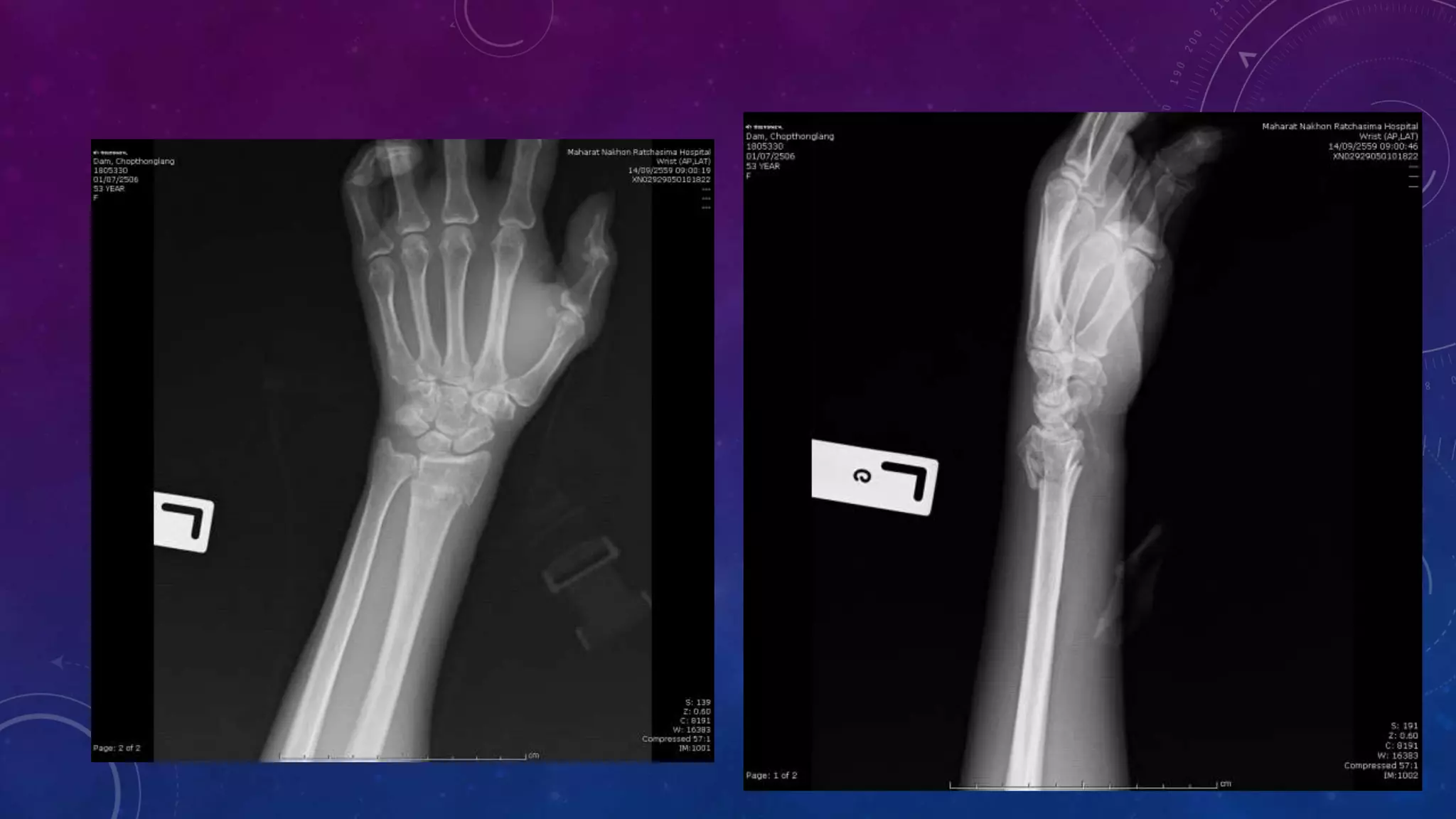
• History : 1 hrPTA falls on her outstretching hand. She has pain and swelling
in her wrist. Her wrist has fork-shape deformities.
• Past History : no underlying disease, no drug allergy
• Physical Examination
• V/S – Stable
• Rt wrist - Fork-shape deformity
- Swelling and tender around wrist
- Stepping was palpable at distal radius
- Limit ROM due to pain
- Motor and sensory are intact
ANATOMY
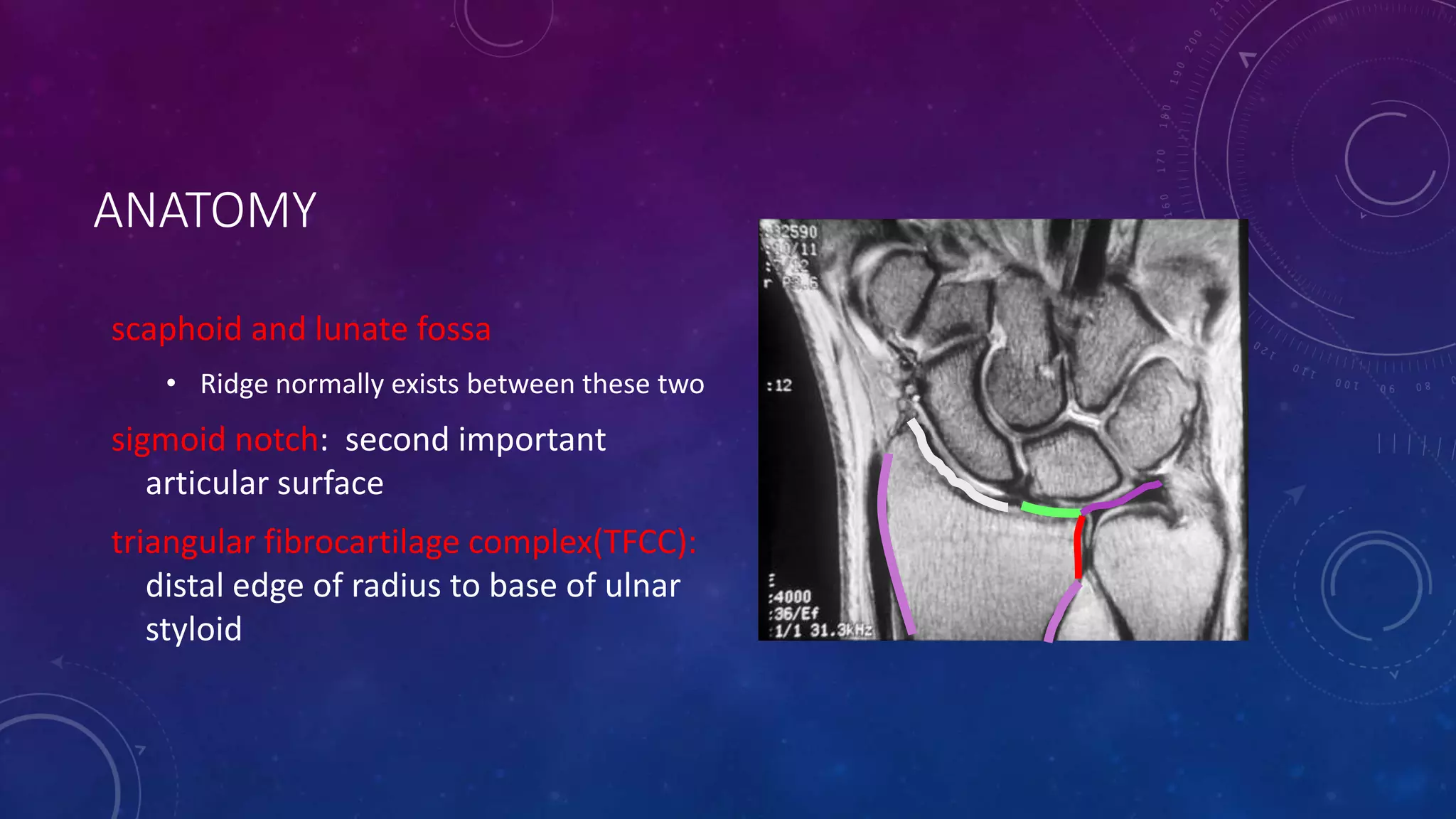
scaphoid and lunate fossa
• Ridge normally exists between these two
sigmoid notch: second important
articular surface
triangular fibrocartilage complex(TFCC):
distal edge of radius to base of ulnar
styloid
DIAGNOSIS: HISTORY AND PHYSICAL FINDINGS
• History of mechanism of injury
• A visible deformity of the wrist is usually noted, with the hand most
commonly displaced in the dorsal direction. (90% cases)
• The acute shortening of the radius relative to the ulna may manifest as an
open wound palmarly and ulnarly where the intact ulna buttonholes through
the skin.
• Movement of the hand and wrist are painful.
• Adequate and accurate assessment of the neurovascular status of the hand is
imperative. (Median nerve involvement – Carpal tunnel syndrome)
DIAGNOSIS: DIAGNOSTIC TESTS AND EXAMINATION
• Evaluation of the injured joint, and a joint above and below
(ipsilateral elbow & shoulder joint)
• Radiographs of the injured wrist (PA & Lateral)
• Radiographs of other areas, if symptoms warrant.
• CT scan of the distal radius in selected instances.
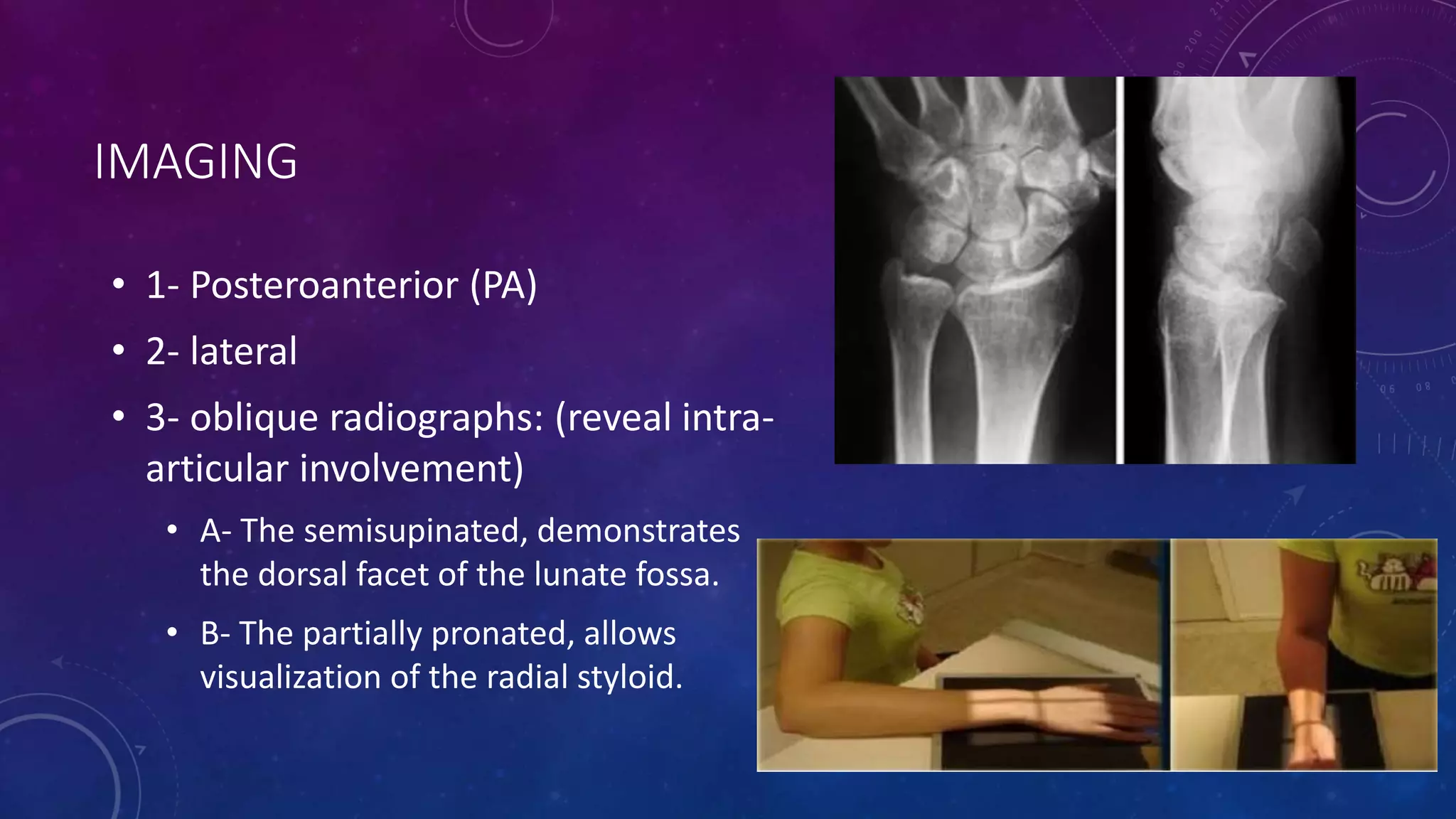
IMAGING
• 1- Posteroanterior (PA)
• 2- lateral
• 3- oblique radiographs: (reveal intra-
articular involvement)
• A- The semisupinated, demonstrates
the dorsal facet of the lunate fossa.
• B- The partially pronated, allows
visualization of the radial styloid.
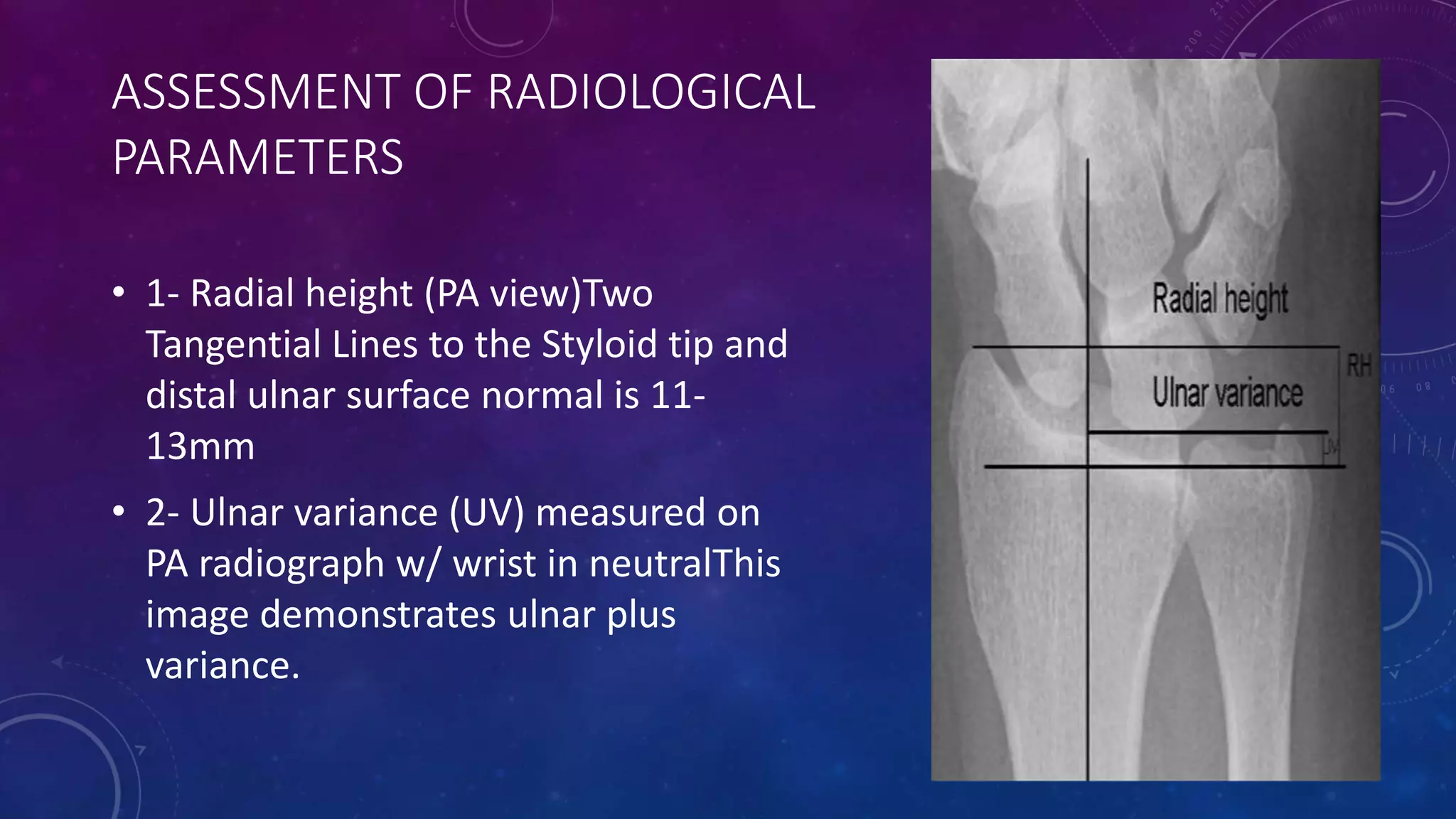
ASSESSMENT OF RADIOLOGICAL
PARAMETERS
• 1- Radial height (PA view)Two
Tangential Lines to the Styloid tip and
distal ulnar surface normal is 11-
13mm
• 2- Ulnar variance (UV) measured on
PA radiograph w/ wrist in neutralThis
image demonstrates ulnar plus
variance.
• 3-Radial inclination is measured
onthe PA viewThe normal angle is 15-
25º.
• 4-The volar tilt, or palmar inclination, is
measured on the lateral view. Slope of
the dorsal-to-palmar surface of the
radius. The normal angle is 10-25º.
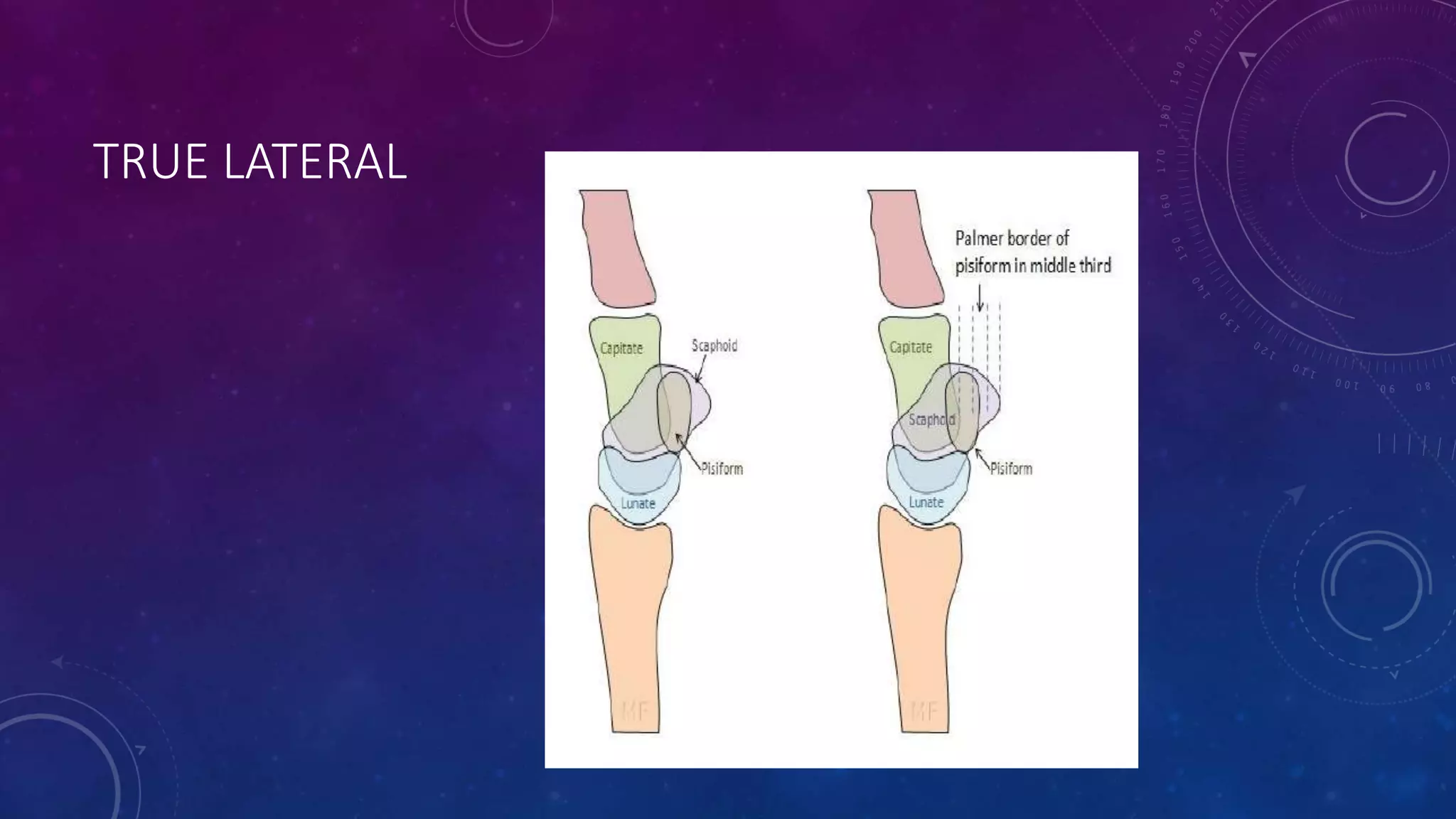
TRUE LATERAL
PATHOMECHANICS
• Injury depends on the position of the wrist, the magnitude and
direction of force, and the physical properties of the bone.
CLASSIFICATION
Ideal system should describe:
• Type of injury
• Severity
• Evaluation
• Treatment
• Prognosis
COMMON CLASSIFICATIONS
1. Gartland & Werley
2. Frykman (radiocarpal & radioulnar)
3. AO
4. Melone (impaction of lunate)
5. Fernandez (mechanism)
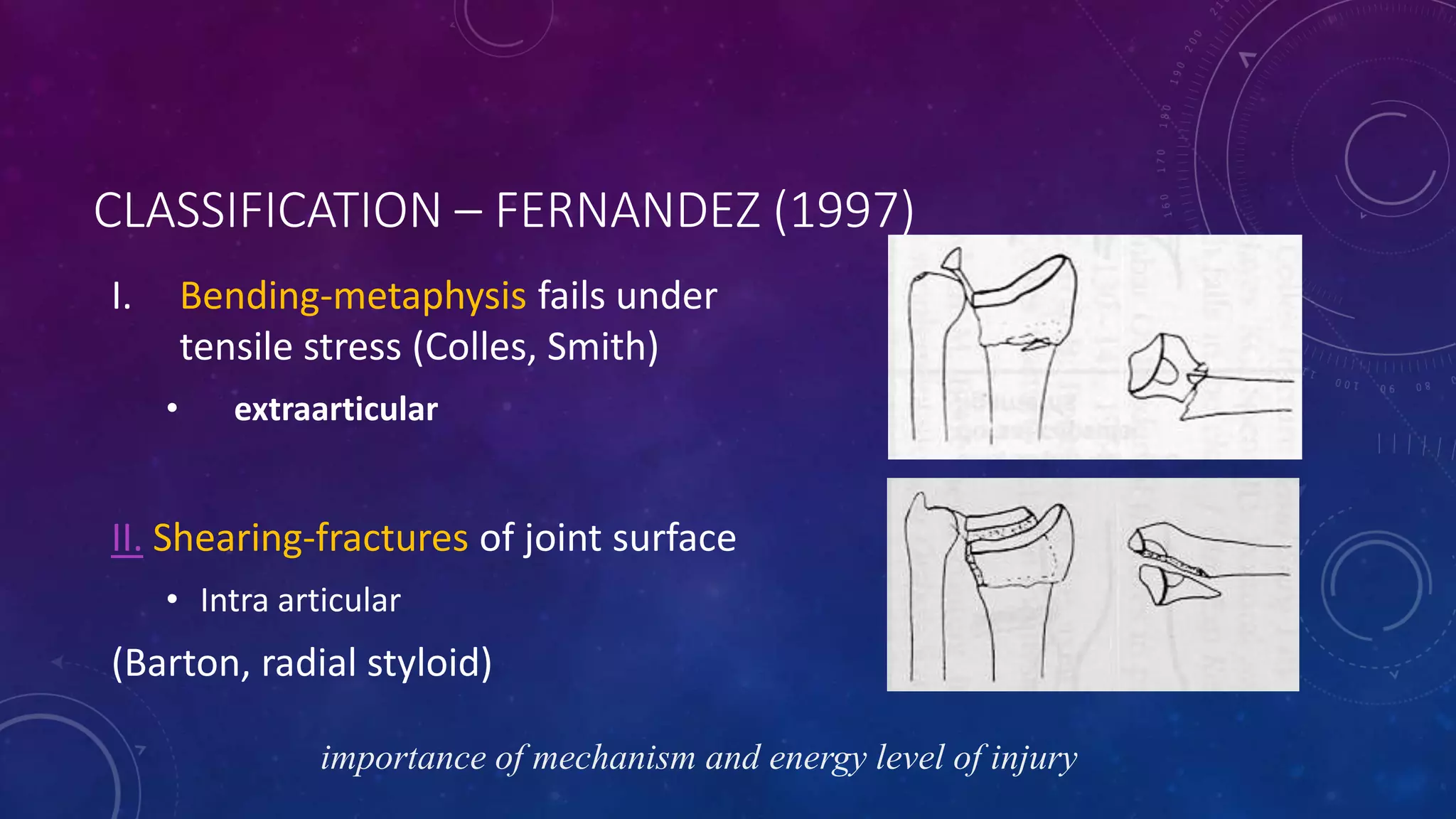
CLASSIFICATION – FERNANDEZ (1997)
I. Bending-metaphysis fails under
tensile stress (Colles, Smith)
• extraarticular
II. Shearing-fractures of joint surface
• Intra articular
(Barton, radial styloid)
importance of mechanism and energy level of injury
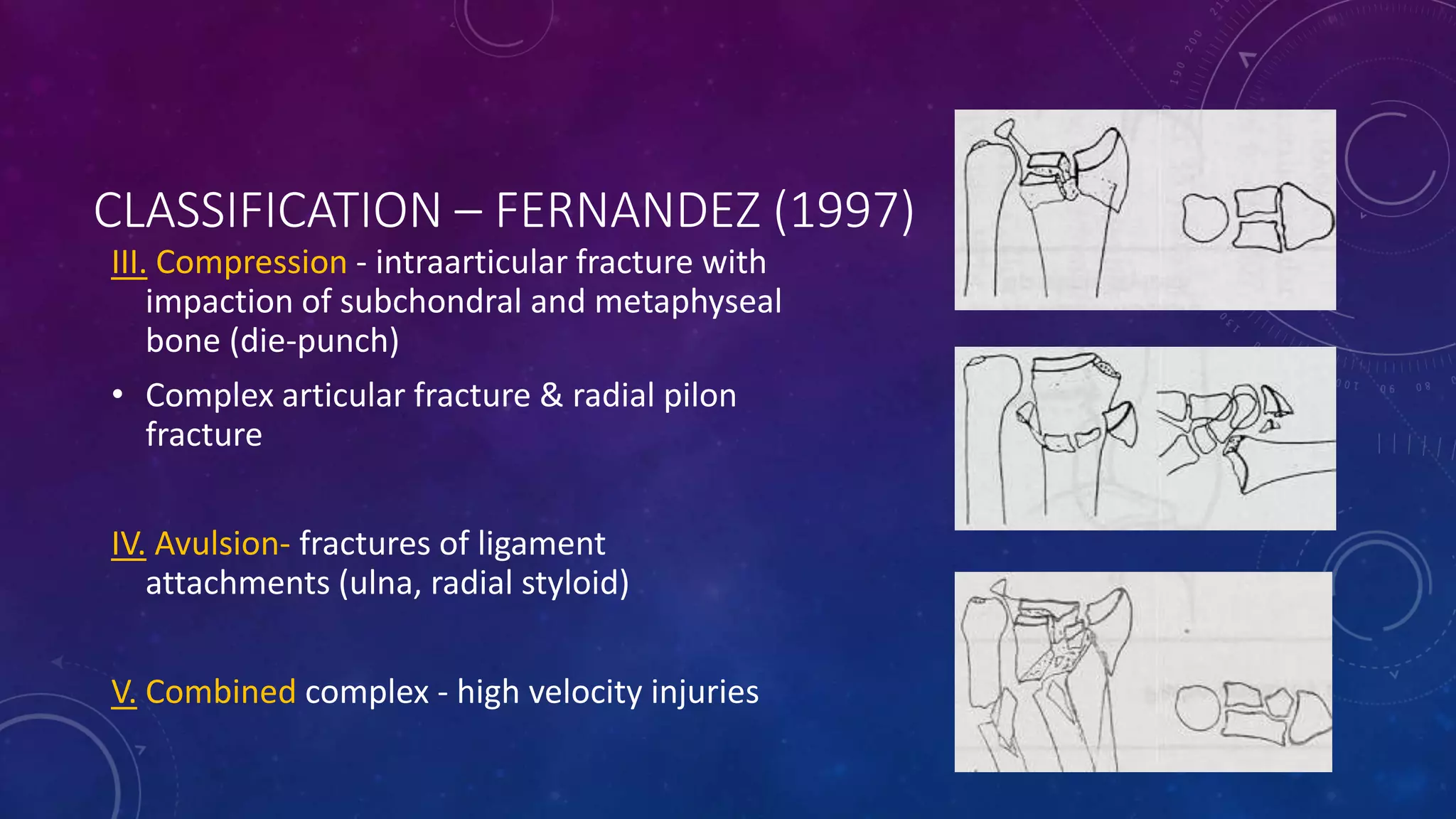
CLASSIFICATION – FERNANDEZ (1997)
III. Compression - intraarticular fracture with
impaction of subchondral and metaphyseal
bone (die-punch)
• Complex articular fracture & radial pilon
fracture
IV. Avulsion- fractures of ligament
attachments (ulna, radial styloid)
V. Combined complex - high velocity injuries
FRACTURE DESCRIPTION
• Location : Extra or Intra articular
• Configuration : Simple : transverse or oblique/ Comminuted.
• Displacement : Radial inclination Radial length Volar tilt intra-
articular incongruity
• Ulna & DRUJ
COMPLICATIONS OF DISTAL RADIAL FRACTURES
• Disruption of the triangular fibrocartilage (TFC) complex.
• Scapholunate and lunotriquetral interosseous ligament injuries.
• Ulnar nerve injury
• Carpal tunnel syndrome
• Posttraumatic radiocarpal osteoarthritis6-Heterotopic ossification
• Reflex sympathetic dystrophy (RSD)
• Tendon rupture (extensor pollicis longus)
TREATMENT GOALS
• Preserve hand and wrist function
• Realign normal osseous anatomy
• Articular surface
• Promote bony healing
• Allow early finger and elbow ROM
OPTIONS FOR TREATMENT
Casting
• Long arm vs. short arm
External Fixation
• Joint-spanning
• Non bridging
Percutaneous pinning
Internal Fixation
• Dorsal plating
• Volar plating
• Combined dorsal/volar plating
• focal (fracture specific) plating
INDICATION OF INSTABILITY
1. >10 degrees loss of volar angulation
2. >5 mm of radial shortening
3. >2mm of articular incongruity
4. comminution of cortex across the midaxial line on lateral x-ray
5. comminution of dorsal and palmar cotices
6. Irreducible fracture
7. Loss of reduction at follow up.
TECHNIQUE OF CLOSED REDUCTION
Anesthesia (pain relief & decrease muscle spasm)
• Hematoma block
• Intravenous sedation
• Bier block
Traction: finger traps and weights
Reduction Maneuver (dorsally angulated fracture):
• hyperextension of the distal fragment,
• Correct radial tilt
• Maintain weighted traction and reduce the distal to the proximal
fragment with pressure applied to the distal radius.
Apply well-molded splint or cast, with wrist in neutral to slight flexion.
Do check X-ray to confirm the acceptable reduction.
NON-ACCEPTABLE REDUCTION
• Radial shortening > 5 mm
• Radial inclination < 10°
• Tilt on lateral projection > 10°dorsal tilt
and > 20° volar tilt
• Intra-articular step-off 2 mm or more
• Articular incongruity 2 mm or more of the
sigmoid notch ( articular surface of distal
radius in DRUJ).
AFTER-TREATMENT
Watch for median nerve symptoms
• parasthesia common but should diminish over few hours
• If persist release pressure on cast, take wrist out of flexion
• Acute carpal tunnel: symptoms progress; CTR required
Follow-up x-rays needed in 1-2 weeks to evaluate reduction.
Change to short-arm cast after 2-3 weeks, continue until fracture
healing.
INDICATIONS FOR SURGICAL TREATMENT
1. High-energy injury with instability
2. Comminuted displaced intraarticular fracture
3. Open injury
4. Radial inclination < 15°
5. Articular step-off, or gap > 2mm
6. Dorsal tilt > 10 °
7. DRUJ incongruity
INDICATION FOR SURGERY
1. Unstable
• 1) Fernandez type II, IV, V and some case in I, III
• 2) Lafontaine criteria > 3 of 5 instability parameters
• 3) Secondary displacement after casting
Lafontaine criteria (1989)
Dorsal angulation > 20°
Ulnar fracture Dorsal comminution
Intraarticular Fx
Age >60
2. Irreducible fracture
1) Double die punch
2) Displaced comminuted PM fragment
3) Articular step off > 2 mm
4) Severe comminution
5) Shortening > 5mm
• 3. Unacceptable alignment
1) Radial inclination < 15°
2) Shortening > 5 mm
3) Dorsal tilt > 10°
4) Volar tilt > 20°
5) Articular step off or gap > 2 mm
• 4. Open fracture
• 5. Associated injury
COLLES FRACTURE
• A Colles fracture is a fracture
of the distal metaphysis of the
radius with dorsal angulation
and displacement leading to a
silver fork deformity
• Colles fractures are seen more
frequently with advancing age
and in women with
osteoporosis.
CLOSED REDUCTION
:Technique
Traction on fingers and counter traction near
elbow by assistant.
Fracture is disimpacted.
Length is established.
Fracture is locked by over flexing and ulnar
deviation of the wrist.
Below elbow cast is applied.
CLOSED REDUCTION
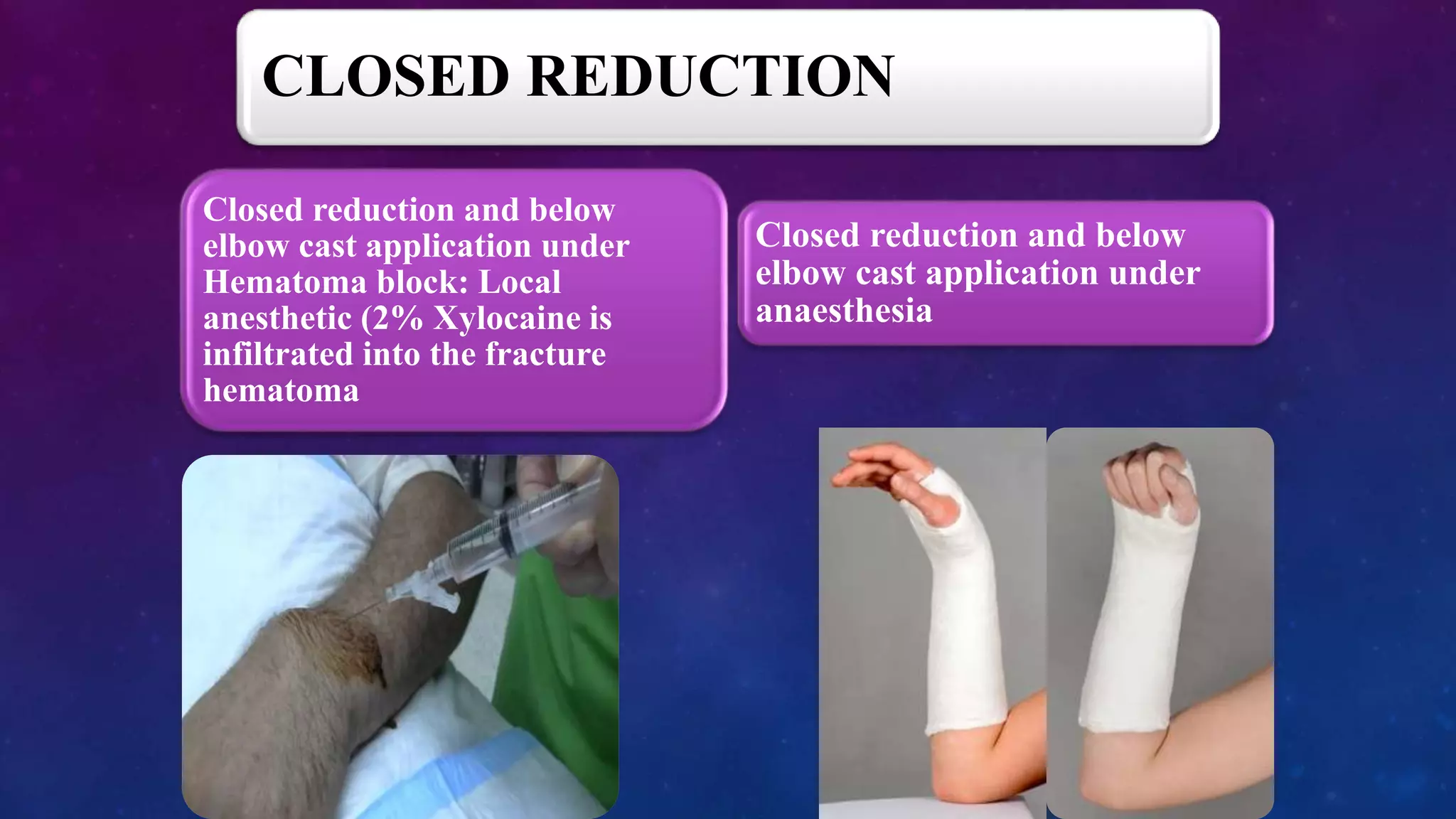
Closed reduction and below
elbow cast application under
Hematoma block: Local
anesthetic (2% Xylocaine is
infiltrated into the fracture
hematoma
Closed reduction and below
elbow cast application under
anaesthesia
distal end radius fracture

distal end radius fracture

  • 1.
  • 2.
    CASE : FEMALE52 YR, FALL ON OUTSTRETCHED HAND • History : 1 hrPTA falls on her outstretching hand. She has pain and swelling in her wrist. Her wrist has fork-shape deformities. • Past History : no underlying disease, no drug allergy • Physical Examination • V/S – Stable • Rt wrist - Fork-shape deformity - Swelling and tender around wrist - Stepping was palpable at distal radius - Limit ROM due to pain - Motor and sensory are intact
  • 4.
    ANATOMY scaphoid and lunatefossa • Ridge normally exists between these two sigmoid notch: second important articular surface triangular fibrocartilage complex(TFCC): distal edge of radius to base of ulnar styloid
  • 5.
    DIAGNOSIS: HISTORY ANDPHYSICAL FINDINGS • History of mechanism of injury • A visible deformity of the wrist is usually noted, with the hand most commonly displaced in the dorsal direction. (90% cases) • The acute shortening of the radius relative to the ulna may manifest as an open wound palmarly and ulnarly where the intact ulna buttonholes through the skin. • Movement of the hand and wrist are painful. • Adequate and accurate assessment of the neurovascular status of the hand is imperative. (Median nerve involvement – Carpal tunnel syndrome)
  • 6.
    DIAGNOSIS: DIAGNOSTIC TESTSAND EXAMINATION • Evaluation of the injured joint, and a joint above and below (ipsilateral elbow & shoulder joint) • Radiographs of the injured wrist (PA & Lateral) • Radiographs of other areas, if symptoms warrant. • CT scan of the distal radius in selected instances.
  • 7.
    IMAGING • 1- Posteroanterior(PA) • 2- lateral • 3- oblique radiographs: (reveal intra- articular involvement) • A- The semisupinated, demonstrates the dorsal facet of the lunate fossa. • B- The partially pronated, allows visualization of the radial styloid.
  • 8.
    ASSESSMENT OF RADIOLOGICAL PARAMETERS •1- Radial height (PA view)Two Tangential Lines to the Styloid tip and distal ulnar surface normal is 11- 13mm • 2- Ulnar variance (UV) measured on PA radiograph w/ wrist in neutralThis image demonstrates ulnar plus variance.
  • 9.
    • 3-Radial inclinationis measured onthe PA viewThe normal angle is 15- 25º.
  • 10.
    • 4-The volartilt, or palmar inclination, is measured on the lateral view. Slope of the dorsal-to-palmar surface of the radius. The normal angle is 10-25º.
  • 11.
  • 12.
    PATHOMECHANICS • Injury dependson the position of the wrist, the magnitude and direction of force, and the physical properties of the bone.
  • 13.
    CLASSIFICATION Ideal system shoulddescribe: • Type of injury • Severity • Evaluation • Treatment • Prognosis
  • 14.
    COMMON CLASSIFICATIONS 1. Gartland& Werley 2. Frykman (radiocarpal & radioulnar) 3. AO 4. Melone (impaction of lunate) 5. Fernandez (mechanism)
  • 15.
    CLASSIFICATION – FERNANDEZ(1997) I. Bending-metaphysis fails under tensile stress (Colles, Smith) • extraarticular II. Shearing-fractures of joint surface • Intra articular (Barton, radial styloid) importance of mechanism and energy level of injury
  • 16.
    CLASSIFICATION – FERNANDEZ(1997) III. Compression - intraarticular fracture with impaction of subchondral and metaphyseal bone (die-punch) • Complex articular fracture & radial pilon fracture IV. Avulsion- fractures of ligament attachments (ulna, radial styloid) V. Combined complex - high velocity injuries
  • 17.
    FRACTURE DESCRIPTION • Location: Extra or Intra articular • Configuration : Simple : transverse or oblique/ Comminuted. • Displacement : Radial inclination Radial length Volar tilt intra- articular incongruity • Ulna & DRUJ
  • 18.
    COMPLICATIONS OF DISTALRADIAL FRACTURES • Disruption of the triangular fibrocartilage (TFC) complex. • Scapholunate and lunotriquetral interosseous ligament injuries. • Ulnar nerve injury • Carpal tunnel syndrome • Posttraumatic radiocarpal osteoarthritis6-Heterotopic ossification • Reflex sympathetic dystrophy (RSD) • Tendon rupture (extensor pollicis longus)
  • 19.
    TREATMENT GOALS • Preservehand and wrist function • Realign normal osseous anatomy • Articular surface • Promote bony healing • Allow early finger and elbow ROM
  • 20.
    OPTIONS FOR TREATMENT Casting •Long arm vs. short arm External Fixation • Joint-spanning • Non bridging Percutaneous pinning Internal Fixation • Dorsal plating • Volar plating • Combined dorsal/volar plating • focal (fracture specific) plating
  • 22.
    INDICATION OF INSTABILITY 1.>10 degrees loss of volar angulation 2. >5 mm of radial shortening 3. >2mm of articular incongruity 4. comminution of cortex across the midaxial line on lateral x-ray 5. comminution of dorsal and palmar cotices 6. Irreducible fracture 7. Loss of reduction at follow up.
  • 23.
    TECHNIQUE OF CLOSEDREDUCTION Anesthesia (pain relief & decrease muscle spasm) • Hematoma block • Intravenous sedation • Bier block Traction: finger traps and weights Reduction Maneuver (dorsally angulated fracture): • hyperextension of the distal fragment, • Correct radial tilt • Maintain weighted traction and reduce the distal to the proximal fragment with pressure applied to the distal radius. Apply well-molded splint or cast, with wrist in neutral to slight flexion. Do check X-ray to confirm the acceptable reduction.
  • 24.
    NON-ACCEPTABLE REDUCTION • Radialshortening > 5 mm • Radial inclination < 10° • Tilt on lateral projection > 10°dorsal tilt and > 20° volar tilt • Intra-articular step-off 2 mm or more • Articular incongruity 2 mm or more of the sigmoid notch ( articular surface of distal radius in DRUJ).
  • 25.
    AFTER-TREATMENT Watch for mediannerve symptoms • parasthesia common but should diminish over few hours • If persist release pressure on cast, take wrist out of flexion • Acute carpal tunnel: symptoms progress; CTR required Follow-up x-rays needed in 1-2 weeks to evaluate reduction. Change to short-arm cast after 2-3 weeks, continue until fracture healing.
  • 26.
    INDICATIONS FOR SURGICALTREATMENT 1. High-energy injury with instability 2. Comminuted displaced intraarticular fracture 3. Open injury 4. Radial inclination < 15° 5. Articular step-off, or gap > 2mm 6. Dorsal tilt > 10 ° 7. DRUJ incongruity
  • 27.
    INDICATION FOR SURGERY 1.Unstable • 1) Fernandez type II, IV, V and some case in I, III • 2) Lafontaine criteria > 3 of 5 instability parameters • 3) Secondary displacement after casting Lafontaine criteria (1989) Dorsal angulation > 20° Ulnar fracture Dorsal comminution Intraarticular Fx Age >60
  • 28.
    2. Irreducible fracture 1)Double die punch 2) Displaced comminuted PM fragment 3) Articular step off > 2 mm 4) Severe comminution 5) Shortening > 5mm
  • 29.
    • 3. Unacceptablealignment 1) Radial inclination < 15° 2) Shortening > 5 mm 3) Dorsal tilt > 10° 4) Volar tilt > 20° 5) Articular step off or gap > 2 mm • 4. Open fracture • 5. Associated injury
  • 30.
    COLLES FRACTURE • AColles fracture is a fracture of the distal metaphysis of the radius with dorsal angulation and displacement leading to a silver fork deformity • Colles fractures are seen more frequently with advancing age and in women with osteoporosis.
  • 31.
    CLOSED REDUCTION :Technique Traction onfingers and counter traction near elbow by assistant. Fracture is disimpacted. Length is established. Fracture is locked by over flexing and ulnar deviation of the wrist. Below elbow cast is applied.
  • 32.
    CLOSED REDUCTION Closed reductionand below elbow cast application under Hematoma block: Local anesthetic (2% Xylocaine is infiltrated into the fracture hematoma Closed reduction and below elbow cast application under anaesthesia