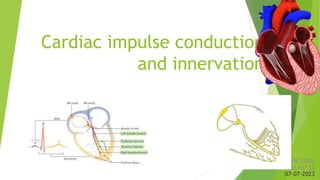
Cardiac impulse conduction
and innervation
ATIK GOEL
ROLL NO 33
07-07-2023
SESSION OBJECTIVES
 Pacemakers of heart
 Electrical conduction system of heart
 Time delay in transmission
 Conduction velocities of various conduction fibres
 Innervation of heart
Introduction
Cardiac electrophysiology : All processes
involved in activation of heart , action
potential , conduction system and effects of
ANS.
Heart has 2 special systems for
1. Cardiac impulse generation - pacemakers
2. Impulse conduction
This allows atria to contract 1/6th second
ahead of
ventricle
and all ventricle to contract simultaneously
Pacemaker
 Generally S A node is pacemaker.
 It is having highest rate of firing 70 -80 beats /min.
 If SA node fails : Pacemakers are
Av node
(40-
60Beats/min)
Bundle of
his(about 40
beats/min)
Purkinje fibres
(15-40
beats/min)
SA node
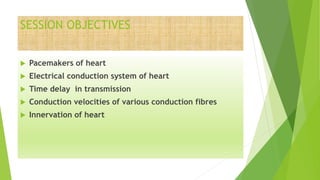
 Flattened ellipsoid specialized cardiac muscle
15mm long 3 mm wide 1mm thick.
 Location : Immediately below and lateral to
opening of superior vena cava
 Normal Pacemaker of heart.
 It develops from right side of embryo and
innervated by right vagus
Av node
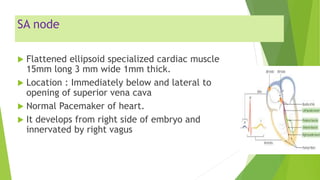
 Shows AV nodal delay of 0.1 sec.
 AV nodal delay has following
significance :
 Preventing excess transmission
of impulses by SA node .
 Gives time for atria to contract
fully before ventricular
depolarisation
 Located near opening of
coronary sinus
 Conducts Impulses from SA node
 Defect in it’s conduction causes
heart blocks
Bundle of his and purkinje fibres
BUNDLE OF HIS
Derived from AV nodal cells
They divide into 2 segments and
lies on inter ventricular septum
They are isolated in a canal till
they form purkinje fibres
 PURKINJE FIBRES
They penetrate the
ventricular wall
Their fast conduction
velocity allows ventricle to
contract almost altogether
CONDUCTION SYSTEM
OF HEART
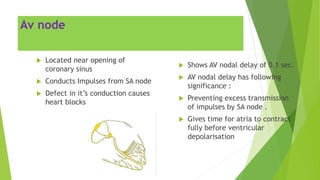
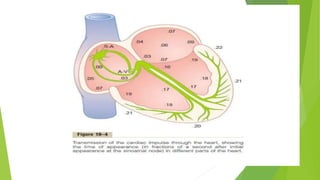
Pathway of transmission
SA NODE
INTERNODAL
PATHWAY AV NODE
BUNDLE OF
HIS
PURKINJE
FIBRES
SA NODE
INTERNODAL
TRACTS
AV NODE
BUNDLE OF HIS
PURKINJE FIBRES
 SA NODE
 INTERNODAL TRACTS
 AV NODE
 BUNDLE OF HIS
 PURKINJE FIBRES
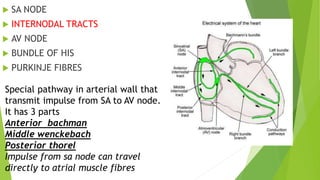
Special pathway in arterial wall that
transmit impulse from SA to AV node.
It has 3 parts
Anterior bachman
Middle wenckebach
Posterior thorel
Impulse from sa node can travel
directly to atrial muscle fibres
SA NODE
INTERNODAL
TRACTS
AV NODE
BUNDLE OF HIS
PURKINJE FIBRES
SA NODE
INTERNODAL
TRACTS
AV NODE
BUNDLE OF HIS
PURKINJE FIBRES
SA NODAL PATHWAY
INTERNODAL
TRACTS
AV NODE
BUNDLE OF HIS
PURKINJE FIBRES
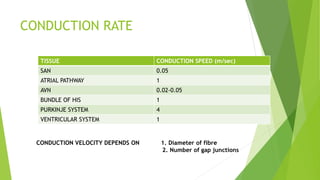
CONDUCTION RATE
TISSUE CONDUCTION SPEED (m/sec)
SAN 0.05
ATRIAL PATHWAY 1
AVN 0.02-0.05
BUNDLE OF HIS 1
PURKINJE SYSTEM 4
VENTRICULAR SYSTEM 1
CONDUCTION VELOCITY DEPENDS ON 1. Diameter of fibre
2. Number of gap junctions
INNERVATION SYSTEM
OF HEART
BY VAGUS AND SYMPATHETIC NERVOUS
SYSTEM
VAGUS (Parasympathetic) effects
 Acetylcholine released at vagal endings increases permeability of fibres to k+
ions.
 This causes increased negativity inside the fibers called hyperpolarization
 This makes tissue less excitable
 Membrane potential of SA nodal fibers decreases to -65 to -75 mv from -55 to
-60mv.
 Therefore initial rise of sinus nodal membrane potential caused by Na and Ca
leakage requires more time to reach threshold.
 They are constantly active, producing a rhythm of 60 – 80 beats per minute. If
the vagus nerve was lesioned, the resting heart rate would be around 100
beats per minute.
Summary: acetylcholine binds on to M₂ receptors, which act to decrease the
slope of the pacemaker potential. This leads to a decrease in heart rate
negative chronotropic effect
SYMPATHETIC EFFECT
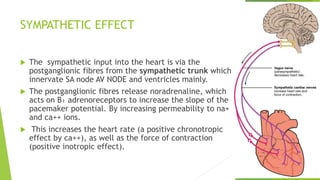
 The sympathetic input into the heart is via the
postganglionic fibres from the sympathetic trunk which
innervate SA node AV NODE and ventricles mainly.
 The postganglionic fibres release noradrenaline, which
acts on B₁ adrenoreceptors to increase the slope of the
pacemaker potential. By increasing permeability to na+
and ca++ ions.
 This increases the heart rate (a positive chronotropic
effect by ca++), as well as the force of contraction
(positive inotropic effect).
Thank you

Cardiac impulse conduction and innervation.pptx

  • 1.
    Cardiac impulse conduction andinnervation ATIK GOEL ROLL NO 33 07-07-2023
  • 2.
    SESSION OBJECTIVES  Pacemakersof heart  Electrical conduction system of heart  Time delay in transmission  Conduction velocities of various conduction fibres  Innervation of heart
  • 3.
    Introduction Cardiac electrophysiology :All processes involved in activation of heart , action potential , conduction system and effects of ANS.
  • 4.
    Heart has 2special systems for 1. Cardiac impulse generation - pacemakers 2. Impulse conduction This allows atria to contract 1/6th second ahead of ventricle and all ventricle to contract simultaneously
  • 5.
    Pacemaker  Generally SA node is pacemaker.  It is having highest rate of firing 70 -80 beats /min.  If SA node fails : Pacemakers are Av node (40- 60Beats/min) Bundle of his(about 40 beats/min) Purkinje fibres (15-40 beats/min)
  • 6.
    SA node  Flattenedellipsoid specialized cardiac muscle 15mm long 3 mm wide 1mm thick.  Location : Immediately below and lateral to opening of superior vena cava  Normal Pacemaker of heart.  It develops from right side of embryo and innervated by right vagus
  • 7.
    Av node  ShowsAV nodal delay of 0.1 sec.  AV nodal delay has following significance :  Preventing excess transmission of impulses by SA node .  Gives time for atria to contract fully before ventricular depolarisation  Located near opening of coronary sinus  Conducts Impulses from SA node  Defect in it’s conduction causes heart blocks
  • 8.
    Bundle of hisand purkinje fibres BUNDLE OF HIS Derived from AV nodal cells They divide into 2 segments and lies on inter ventricular septum They are isolated in a canal till they form purkinje fibres  PURKINJE FIBRES They penetrate the ventricular wall Their fast conduction velocity allows ventricle to contract almost altogether
  • 9.
  • 10.
    Pathway of transmission SANODE INTERNODAL PATHWAY AV NODE BUNDLE OF HIS PURKINJE FIBRES
  • 12.
  • 13.
     SA NODE INTERNODAL TRACTS  AV NODE  BUNDLE OF HIS  PURKINJE FIBRES Special pathway in arterial wall that transmit impulse from SA to AV node. It has 3 parts Anterior bachman Middle wenckebach Posterior thorel Impulse from sa node can travel directly to atrial muscle fibres
  • 14.
  • 15.
  • 16.
    SA NODAL PATHWAY INTERNODAL TRACTS AVNODE BUNDLE OF HIS PURKINJE FIBRES
  • 19.
    CONDUCTION RATE TISSUE CONDUCTIONSPEED (m/sec) SAN 0.05 ATRIAL PATHWAY 1 AVN 0.02-0.05 BUNDLE OF HIS 1 PURKINJE SYSTEM 4 VENTRICULAR SYSTEM 1 CONDUCTION VELOCITY DEPENDS ON 1. Diameter of fibre 2. Number of gap junctions
  • 20.
    INNERVATION SYSTEM OF HEART BYVAGUS AND SYMPATHETIC NERVOUS SYSTEM
  • 21.
    VAGUS (Parasympathetic) effects Acetylcholine released at vagal endings increases permeability of fibres to k+ ions.  This causes increased negativity inside the fibers called hyperpolarization  This makes tissue less excitable  Membrane potential of SA nodal fibers decreases to -65 to -75 mv from -55 to -60mv.  Therefore initial rise of sinus nodal membrane potential caused by Na and Ca leakage requires more time to reach threshold.  They are constantly active, producing a rhythm of 60 – 80 beats per minute. If the vagus nerve was lesioned, the resting heart rate would be around 100 beats per minute. Summary: acetylcholine binds on to M₂ receptors, which act to decrease the slope of the pacemaker potential. This leads to a decrease in heart rate negative chronotropic effect
  • 22.
    SYMPATHETIC EFFECT  Thesympathetic input into the heart is via the postganglionic fibres from the sympathetic trunk which innervate SA node AV NODE and ventricles mainly.  The postganglionic fibres release noradrenaline, which acts on B₁ adrenoreceptors to increase the slope of the pacemaker potential. By increasing permeability to na+ and ca++ ions.  This increases the heart rate (a positive chronotropic effect by ca++), as well as the force of contraction (positive inotropic effect).
  • 23.