DR.MAGDI AWAD SASI
CVS PHYSIOLOGY
HEAD OF BIOLOGY SCIENCES
LIMU----BENGHAZI
MAGDI AWAD SASI1
Learning Objectives
MAGDI AWAD SASI2
 Define the rhythamicity and account for its myogenic origin.
 List the possible pacemakers tissues of the cardiac muscle.
 Illustrate the pacemaker potential and ionic basis of it.
 Discuss the factors affecting rhythamicity
 Describe the autonomic supply of the heart & its function
Circulation Reviewed
Heart – "four chambered"
Right atrium & ventricle
Pulmonary circuit
Left atrium & ventricle
Systemic circuit
Blood Vessels – "closed circulation"
Arteries –from heart
Capillaries– cell exchange
Veins – to heart
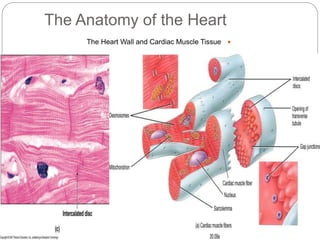
The Anatomy of the Heart
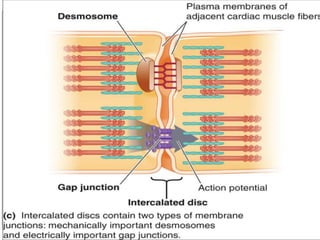
The Heart Wall and Cardiac Muscle Tissue
Figure 12-4(c)
The Anatomy of the Heart
Cardiac Muscle Cells
Shorter than skeletal muscle fibers
Have single nucleus
Have striations (sarcomere organization)
Depend on aerobic metabolism
Connected by intercalated discs
Copyright © 2007 Pearson Education, Inc., publishing as Benjamin Cummings
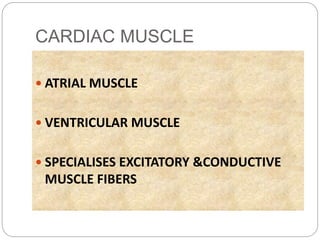
CARDIAC MUSCLE
 ATRIAL MUSCLE
 VENTRICULAR MUSCLE
 SPECIALISES EXCITATORY &CONDUCTIVE
MUSCLE FIBERS
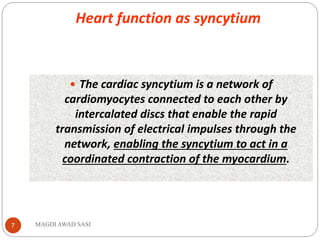
Heart function as syncytium
MAGDI AWAD SASI7
 The cardiac syncytium is a network of
cardiomyocytes connected to each other by
intercalated discs that enable the rapid
transmission of electrical impulses through the
network, enabling the syncytium to act in a
coordinated contraction of the myocardium.
Functional properties of the heart
• F
EXCITABILITY
AUTOMATICITY
CONDUCTIVITY
RHYTHAMICITY
CONTRACTILITY
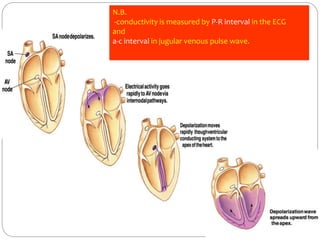
N.B.
-conductivity is measured by P-R interval in the ECG
and
a-c interval in jugular venous pulse wave.
 Heart beats rhythmically as result of action potentials it
generates by itself.
 Two specialized types of cardiac muscle cells
A. Contractile cells
 99% of cardiac muscle cells
 Do mechanical work of pumping
 Normally do not initiate own action potentials
B. Autorhythmic cells
-- Do not contract
 Initiate and conduct action potentials responsible for contraction.
C. CONDUCTIVE TISSUE
Sherwood’s Human Physiology 9-11 (9-8 6th Edition)
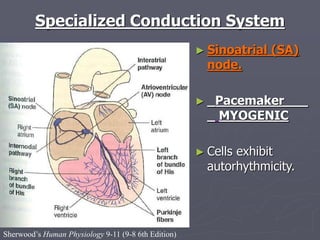
Specialized Conduction System
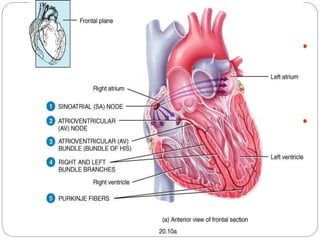
► Sinoatrial (SA)
node.
► _Pacemaker___
_ MYOGENIC
► Cells exhibit
autorhythmicity.
The pacemaker of the heart:
= The SA- node.
♥ Contains the P- cells, which are probably the actual
pacemaker cells.
♥ Has the fastest rhythm (rate of discharge) of all parts of
the heart, 90 impulses/min.
♥ Has spontaneous (w/out stimulation) depolarization,
up to firing level.
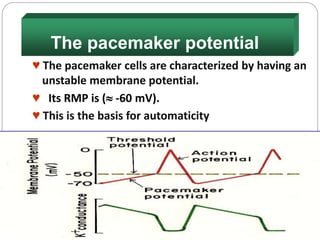
The pacemaker potential
♥ The pacemaker cells are characterized by having an
unstable membrane potential.
♥ Its RMP is ( -60 mV).
♥ This is the basis for automaticity
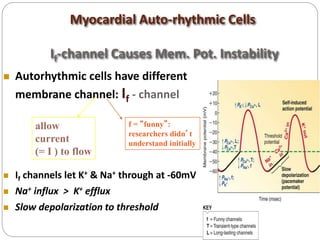
Myocardial Auto-rhythmic Cells
If-channel Causes Mem. Pot. Instability
 Autorhythmic cells have different
membrane channel: If - channel
 If channels let K+ & Na+ through at -60mV
 Na+ influx > K+ efflux
 Slow depolarization to threshold
allow
current
(= I ) to flow
f = “funny”:
researchers didn’t
understand initially
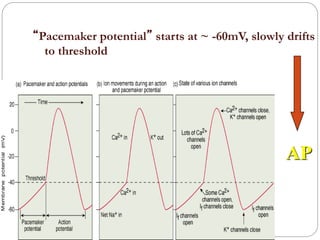
“Pacemaker potential” starts at ~ -60mV, slowly drifts
to threshold
AP
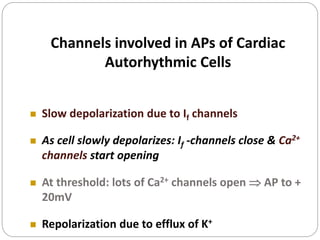
Channels involved in APs of Cardiac
Autorhythmic Cells
 Slow depolarization due to If channels
 As cell slowly depolarizes: If -channels close & Ca2+
channels start opening
 At threshold: lots of Ca2+ channels open  AP to +
20mV
 Repolarization due to efflux of K+
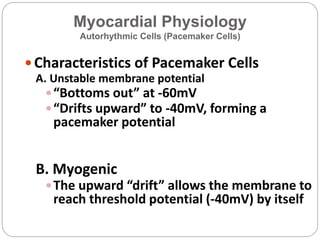
Myocardial Physiology
Autorhythmic Cells (Pacemaker Cells)
 Characteristics of Pacemaker Cells
A. Unstable membrane potential
“Bottoms out” at -60mV
“Drifts upward” to -40mV, forming a
pacemaker potential
B. Myogenic
The upward “drift” allows the membrane to
reach threshold potential (-40mV) by itself
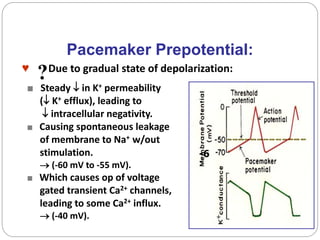
Pacemaker Prepotential:
♥ Due to gradual state of depolarization:
■ Steady  in K+ permeability
( K+ efflux), leading to
 intracellular negativity.
■ Causing spontaneous leakage
of membrane to Na+ w/out
stimulation.
 (-60 mV to -55 mV).
■ Which causes op of voltage
gated transient Ca2+ channels,
leading to some Ca2+ influx.
 (-40 mV).
?
-6
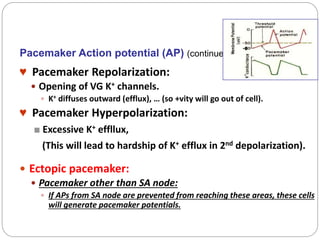
Pacemaker Action potential (AP) (continued)
♥ Pacemaker Repolarization:
 Opening of VG K+ channels.
 K+ diffuses outward (efflux), … (so +vity will go out of cell).
♥ Pacemaker Hyperpolarization:
■ Excessive K+ effllux,
(This will lead to hardship of K+ efflux in 2nd depolarization).
 Ectopic pacemaker:
 Pacemaker other than SA node:
 If APs from SA node are prevented from reaching these areas, these cells
will generate pacemaker potentials.
-6
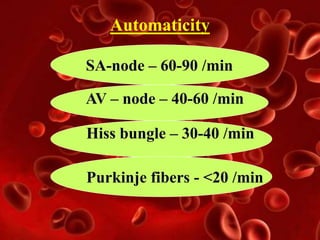
Automaticity
Hiss bungle – 30-40 /min
SA-node – 60-90 /min
AV – node – 40-60 /min
Purkinje fibers - <20 /min
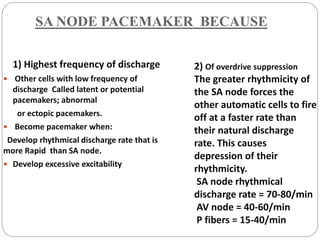
SA NODE PACEMAKER BECAUSE
1) Highest frequency of discharge
 Other cells with low frequency of
discharge Called latent or potential
pacemakers; abnormal
or ectopic pacemakers.
 Become pacemaker when:
Develop rhythmical discharge rate that is
more Rapid than SA node.
 Develop excessive excitability
2) Of overdrive suppression
The greater rhythmicity of
the SA node forces the
other automatic cells to fire
off at a faster rate than
their natural discharge
rate. This causes
depression of their
rhythmicity.
SA node rhythmical
discharge rate = 70-80/min
AV node = 40-60/min
P fibers = 15-40/min
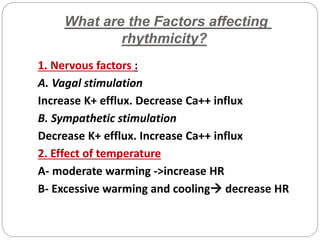
What are the Factors affecting
rhythmicity?
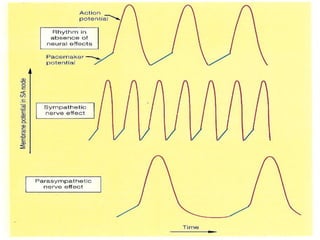
1. Nervous factors :
A. Vagal stimulation
Increase K+ efflux. Decrease Ca++ influx
B. Sympathetic stimulation
Decrease K+ efflux. Increase Ca++ influx
2. Effect of temperature
A- moderate warming ->increase HR
B- Excessive warming and cooling decrease HR
MAGDI AWAD SASI24
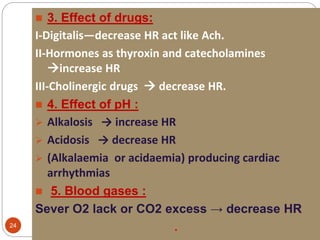
 3. Effect of drugs:
I-Digitalis—decrease HR act like Ach.
II-Hormones as thyroxin and catecholamines
increase HR
III-Cholinergic drugs  decrease HR.
 4. Effect of pH :
 Alkalosis → increase HR
 Acidosis → decrease HR
 (Alkalaemia or acidaemia) producing cardiac
arrhythmias
 5. Blood gases :
Sever O2 lack or CO2 excess → decrease HR
.
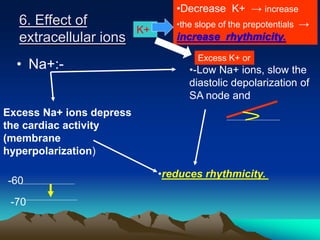
6. Effect of
extracellular ions
• Na+:-
Excess Na+ ions depress
the cardiac activity
(membrane
hyperpolarization)
•-Low Na+ ions, slow the
diastolic depolarization of
SA node and
•reduces rhythmicity.
-60
-70
Excess K+ or
•Decrease K+ → increase
•the slope of the prepotentials →
increase rhythmicity.
K+
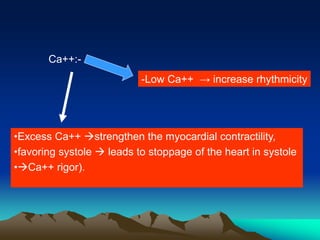
•Excess Ca++ strengthen the myocardial contractility,
•favoring systole  leads to stoppage of the heart in systole
•Ca++ rigor).
-Low Ca++ → increase rhythmicity
Ca++:-
Autonomic Neurotransmitters
Modulate Heart Rate
 The speed at which pacemaker cells depolarize
determines the rate at which the heart contracts
 The interval between action potentials can be
altered by changing the permeability of the
autorhythmic cells to different ions
Increase Na + and Ca +2 permeability speeds up
depolarization and heart rate
Decrease Ca +2 permeability or increase K + permeability
slow depolarization and slows heart rate
Extrinsic Innervation of the Heart
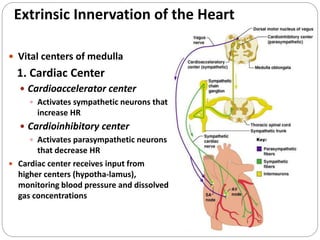
 Vital centers of medulla
1. Cardiac Center
 Cardioaccelerator center
 Activates sympathetic neurons that
increase HR
 Cardioinhibitory center
 Activates parasympathetic neurons
that decrease HR
 Cardiac center receives input from
higher centers (hypotha-lamus),
monitoring blood pressure and dissolved
gas concentrations
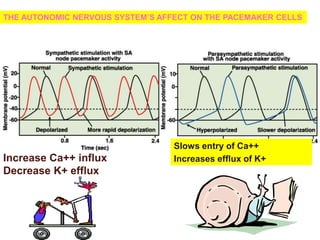
THE AUTONOMIC NERVOUS SYSTEM’S AFFECT ON THE PACEMAKER CELLS
Increase Ca++ influx
Decrease K+ efflux
Slows entry of Ca++
Increases efflux of K+
Nerve Supply to Heart
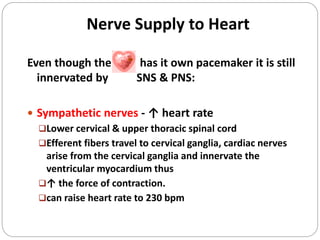
Even though the has it own pacemaker it is still
innervated by SNS & PNS:
 Sympathetic nerves - ↑ heart rate
Lower cervical & upper thoracic spinal cord
Efferent fibers travel to cervical ganglia, cardiac nerves
arise from the cervical ganglia and innervate the
ventricular myocardium thus
↑ the force of contraction.
can raise heart rate to 230 bpm
Autonomic Neurotransmitters
Modulate Heart Rate
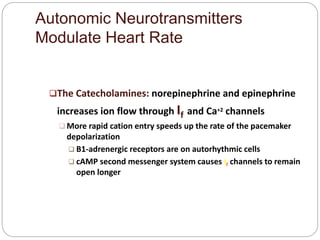
The Catecholamines: norepinephrine and epinephrine
increases ion flow through If and Ca+2 channels
 More rapid cation entry speeds up the rate of the pacemaker
depolarization
 Β1-adrenergic receptors are on autorhythmic cells
 cAMP second messenger system causes If channels to remain
open longer
Sympathetic Activity Summary:
increased chronotropic effects
heart rate
increased dromotropic effects
conduction of APs
increased inotropic effects
contractility
Autonomic Neurotransmitters
Modulate Heart Rate
 Parasympathetic neurotransmitter
(Acetylcholine) slows heart rate
Ach activates muscarinic cholinergic
receptors that
 Increase K+ permeability and
 Decrease Ca+2 permeability
Nerve Supply to the Heart
 Parasympathetic nerves - ↓ heart rate
 Pathway is through
 right vagal nerve innervates the electrical center of the
heart called the SA node (sinoatrial);
 vagal tone – normally slows heart rate to
70 - 80 bpm. Without vagas n. influence the heart would
have a resting heart rate of about 100 bpm.
Vagus N. (CN X);
References
35
 Human physiology by Lauralee Sherwood, 7th
edition
 Text book physiology by Guyton &Hall,12th edition
 Text book of physiology by Linda .s contanzo,third
edition

Cvs introduction 2018.ms

  • 1.
    DR.MAGDI AWAD SASI CVSPHYSIOLOGY HEAD OF BIOLOGY SCIENCES LIMU----BENGHAZI MAGDI AWAD SASI1
  • 2.
    Learning Objectives MAGDI AWADSASI2  Define the rhythamicity and account for its myogenic origin.  List the possible pacemakers tissues of the cardiac muscle.  Illustrate the pacemaker potential and ionic basis of it.  Discuss the factors affecting rhythamicity  Describe the autonomic supply of the heart & its function
  • 3.
    Circulation Reviewed Heart –"four chambered" Right atrium & ventricle Pulmonary circuit Left atrium & ventricle Systemic circuit Blood Vessels – "closed circulation" Arteries –from heart Capillaries– cell exchange Veins – to heart
  • 4.
    The Anatomy ofthe Heart The Heart Wall and Cardiac Muscle Tissue Figure 12-4(c)
  • 5.
    The Anatomy ofthe Heart Cardiac Muscle Cells Shorter than skeletal muscle fibers Have single nucleus Have striations (sarcomere organization) Depend on aerobic metabolism Connected by intercalated discs Copyright © 2007 Pearson Education, Inc., publishing as Benjamin Cummings
  • 6.
    CARDIAC MUSCLE  ATRIALMUSCLE  VENTRICULAR MUSCLE  SPECIALISES EXCITATORY &CONDUCTIVE MUSCLE FIBERS
  • 7.
    Heart function assyncytium MAGDI AWAD SASI7  The cardiac syncytium is a network of cardiomyocytes connected to each other by intercalated discs that enable the rapid transmission of electrical impulses through the network, enabling the syncytium to act in a coordinated contraction of the myocardium.
  • 8.
    Functional properties ofthe heart • F EXCITABILITY AUTOMATICITY CONDUCTIVITY RHYTHAMICITY CONTRACTILITY
  • 9.
    N.B. -conductivity is measuredby P-R interval in the ECG and a-c interval in jugular venous pulse wave.
  • 10.
     Heart beatsrhythmically as result of action potentials it generates by itself.  Two specialized types of cardiac muscle cells A. Contractile cells  99% of cardiac muscle cells  Do mechanical work of pumping  Normally do not initiate own action potentials B. Autorhythmic cells -- Do not contract  Initiate and conduct action potentials responsible for contraction. C. CONDUCTIVE TISSUE
  • 11.
    Sherwood’s Human Physiology9-11 (9-8 6th Edition) Specialized Conduction System ► Sinoatrial (SA) node. ► _Pacemaker___ _ MYOGENIC ► Cells exhibit autorhythmicity.
  • 12.
    The pacemaker ofthe heart: = The SA- node. ♥ Contains the P- cells, which are probably the actual pacemaker cells. ♥ Has the fastest rhythm (rate of discharge) of all parts of the heart, 90 impulses/min. ♥ Has spontaneous (w/out stimulation) depolarization, up to firing level.
  • 13.
    The pacemaker potential ♥The pacemaker cells are characterized by having an unstable membrane potential. ♥ Its RMP is ( -60 mV). ♥ This is the basis for automaticity
  • 14.
    Myocardial Auto-rhythmic Cells If-channelCauses Mem. Pot. Instability  Autorhythmic cells have different membrane channel: If - channel  If channels let K+ & Na+ through at -60mV  Na+ influx > K+ efflux  Slow depolarization to threshold allow current (= I ) to flow f = “funny”: researchers didn’t understand initially
  • 15.
    “Pacemaker potential” startsat ~ -60mV, slowly drifts to threshold AP
  • 16.
    Channels involved inAPs of Cardiac Autorhythmic Cells  Slow depolarization due to If channels  As cell slowly depolarizes: If -channels close & Ca2+ channels start opening  At threshold: lots of Ca2+ channels open  AP to + 20mV  Repolarization due to efflux of K+
  • 17.
    Myocardial Physiology Autorhythmic Cells(Pacemaker Cells)  Characteristics of Pacemaker Cells A. Unstable membrane potential “Bottoms out” at -60mV “Drifts upward” to -40mV, forming a pacemaker potential B. Myogenic The upward “drift” allows the membrane to reach threshold potential (-40mV) by itself
  • 18.
    Pacemaker Prepotential: ♥ Dueto gradual state of depolarization: ■ Steady  in K+ permeability ( K+ efflux), leading to  intracellular negativity. ■ Causing spontaneous leakage of membrane to Na+ w/out stimulation.  (-60 mV to -55 mV). ■ Which causes op of voltage gated transient Ca2+ channels, leading to some Ca2+ influx.  (-40 mV). ? -6
  • 19.
    Pacemaker Action potential(AP) (continued) ♥ Pacemaker Repolarization:  Opening of VG K+ channels.  K+ diffuses outward (efflux), … (so +vity will go out of cell). ♥ Pacemaker Hyperpolarization: ■ Excessive K+ effllux, (This will lead to hardship of K+ efflux in 2nd depolarization).  Ectopic pacemaker:  Pacemaker other than SA node:  If APs from SA node are prevented from reaching these areas, these cells will generate pacemaker potentials. -6
  • 20.
    Automaticity Hiss bungle –30-40 /min SA-node – 60-90 /min AV – node – 40-60 /min Purkinje fibers - <20 /min
  • 21.
    SA NODE PACEMAKERBECAUSE 1) Highest frequency of discharge  Other cells with low frequency of discharge Called latent or potential pacemakers; abnormal or ectopic pacemakers.  Become pacemaker when: Develop rhythmical discharge rate that is more Rapid than SA node.  Develop excessive excitability 2) Of overdrive suppression The greater rhythmicity of the SA node forces the other automatic cells to fire off at a faster rate than their natural discharge rate. This causes depression of their rhythmicity. SA node rhythmical discharge rate = 70-80/min AV node = 40-60/min P fibers = 15-40/min
  • 22.
    What are theFactors affecting rhythmicity? 1. Nervous factors : A. Vagal stimulation Increase K+ efflux. Decrease Ca++ influx B. Sympathetic stimulation Decrease K+ efflux. Increase Ca++ influx 2. Effect of temperature A- moderate warming ->increase HR B- Excessive warming and cooling decrease HR
  • 24.
    MAGDI AWAD SASI24 3. Effect of drugs: I-Digitalis—decrease HR act like Ach. II-Hormones as thyroxin and catecholamines increase HR III-Cholinergic drugs  decrease HR.  4. Effect of pH :  Alkalosis → increase HR  Acidosis → decrease HR  (Alkalaemia or acidaemia) producing cardiac arrhythmias  5. Blood gases : Sever O2 lack or CO2 excess → decrease HR .
  • 25.
    6. Effect of extracellularions • Na+:- Excess Na+ ions depress the cardiac activity (membrane hyperpolarization) •-Low Na+ ions, slow the diastolic depolarization of SA node and •reduces rhythmicity. -60 -70 Excess K+ or •Decrease K+ → increase •the slope of the prepotentials → increase rhythmicity. K+
  • 26.
    •Excess Ca++ strengthenthe myocardial contractility, •favoring systole  leads to stoppage of the heart in systole •Ca++ rigor). -Low Ca++ → increase rhythmicity Ca++:-
  • 27.
    Autonomic Neurotransmitters Modulate HeartRate  The speed at which pacemaker cells depolarize determines the rate at which the heart contracts  The interval between action potentials can be altered by changing the permeability of the autorhythmic cells to different ions Increase Na + and Ca +2 permeability speeds up depolarization and heart rate Decrease Ca +2 permeability or increase K + permeability slow depolarization and slows heart rate
  • 28.
    Extrinsic Innervation ofthe Heart  Vital centers of medulla 1. Cardiac Center  Cardioaccelerator center  Activates sympathetic neurons that increase HR  Cardioinhibitory center  Activates parasympathetic neurons that decrease HR  Cardiac center receives input from higher centers (hypotha-lamus), monitoring blood pressure and dissolved gas concentrations
  • 29.
    THE AUTONOMIC NERVOUSSYSTEM’S AFFECT ON THE PACEMAKER CELLS Increase Ca++ influx Decrease K+ efflux Slows entry of Ca++ Increases efflux of K+
  • 30.
    Nerve Supply toHeart Even though the has it own pacemaker it is still innervated by SNS & PNS:  Sympathetic nerves - ↑ heart rate Lower cervical & upper thoracic spinal cord Efferent fibers travel to cervical ganglia, cardiac nerves arise from the cervical ganglia and innervate the ventricular myocardium thus ↑ the force of contraction. can raise heart rate to 230 bpm
  • 31.
    Autonomic Neurotransmitters Modulate HeartRate The Catecholamines: norepinephrine and epinephrine increases ion flow through If and Ca+2 channels  More rapid cation entry speeds up the rate of the pacemaker depolarization  Β1-adrenergic receptors are on autorhythmic cells  cAMP second messenger system causes If channels to remain open longer
  • 32.
    Sympathetic Activity Summary: increasedchronotropic effects heart rate increased dromotropic effects conduction of APs increased inotropic effects contractility
  • 33.
    Autonomic Neurotransmitters Modulate HeartRate  Parasympathetic neurotransmitter (Acetylcholine) slows heart rate Ach activates muscarinic cholinergic receptors that  Increase K+ permeability and  Decrease Ca+2 permeability
  • 34.
    Nerve Supply tothe Heart  Parasympathetic nerves - ↓ heart rate  Pathway is through  right vagal nerve innervates the electrical center of the heart called the SA node (sinoatrial);  vagal tone – normally slows heart rate to 70 - 80 bpm. Without vagas n. influence the heart would have a resting heart rate of about 100 bpm. Vagus N. (CN X);
  • 35.
    References 35  Human physiologyby Lauralee Sherwood, 7th edition  Text book physiology by Guyton &Hall,12th edition  Text book of physiology by Linda .s contanzo,third edition