Introduction
Polymers are typically utilized in electrical and electronic
applications as insulators where advantage is taken of their
very high resistivity.
Conducting polymers are unique as possible substitute for
metallic conductor and semiconductor.
Exhibited highly reversible redox behavior and the
unusual combination of properties of metal and plastics.
These have unique condition mechanism and good
environmental stability in present of oxygen and water .
These polymer could be highly promising for many
technological uses because of their chemical versatility,
stability ,prcoessability, don’t break easily, low specific
gravity , longer life time, and low cost .
 There are at least four major classes of semiconducting
polymers that have been developed so far. They include
Conjugated conducting polymers.
Charge transfer polymers.
Ionically conducting polymers.
conductively filled polymers.
What is a conducting polymer?
A polymer which can exhibit significant level of
electricity (it is conduct electricity) is termed as
conducting polymer.
The electricity conductivity is attributed by the present
of free electrons, hole, charged atoms and molecules.
To electron free move there are many condition most be
present; depends up on the type of conducting polymer
( Extrinsic - Intrinsic ).
There are Tree type of conducting polymer :-
Electronic conducting polymer .
Proton conducting polymer .
Ionic conducting polymer .
7-
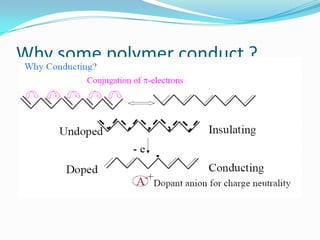
Why some polymer conduct ?
Band theory
The electrical properties of direct gap inorganic
semiconductors are determined by their electronic
structures, and the electrons move within discrete energy
states called bands.
 The bonding and ant bonding electron , orbitals of the sp2
hybridized , electron materials(e.g. polyenes) generate
energy bands, which are fully occupied band and empty
band.
highest occupied band is called the valence band, and the
lowest unoccupied band is the conduction band. The
energy difference between them is called the band gap.
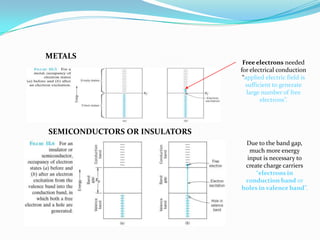
METALS
SEMICONDUCTORS OR INSULATORS
Free electrons needed
for electrical conduction
“applied electric field is
sufficient to generate
large number of free
electrons”.
Due to the band gap,
much more energy
input is necessary to
create charge carriers
“electrons in
conduction band or
holes in valence band”.
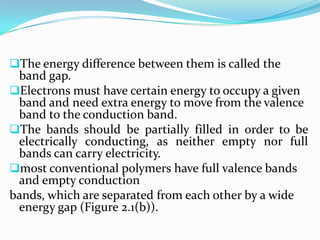
The energy difference between them is called the
band gap.
Electrons must have certain energy to occupy a given
band and need extra energy to move from the valence
band to the conduction band.
The bands should be partially filled in order to be
electrically conducting, as neither empty nor full
bands can carry electricity.
most conventional polymers have full valence bands
and empty conduction
bands, which are separated from each other by a wide
energy gap (Figure 2.1(b)).
conjugated polymers have narrower band gaps
(Figure 2.1(c)) and doping can change their band
structures by either taking electrons from the valence
band (p-doping) or adding electrons to the conduction
band (n-doping).
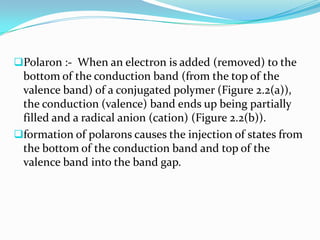
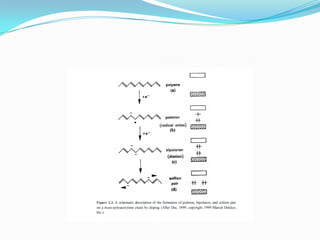
Polaron :- When an electron is added (removed) to the
bottom of the conduction band (from the top of the
valence band) of a conjugated polymer (Figure 2.2(a)),
the conduction (valence) band ends up being partially
filled and a radical anion (cation) (Figure 2.2(b)).
formation of polarons causes the injection of states from
the bottom of the conduction band and top of the
valence band into the band gap.
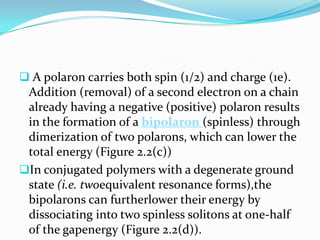
 A polaron carries both spin (1/2) and charge (1e).
Addition (removal) of a second electron on a chain
already having a negative (positive) polaron results
in the formation of a bipolaron (spinless) through
dimerization of two polarons, which can lower the
total energy (Figure 2.2(c))
In conjugated polymers with a degenerate ground
state (i.e. twoequivalent resonance forms),the
bipolarons can furtherlower their energy by
dissociating into two spinless solitons at one-half
of the gapenergy (Figure 2.2(d)).
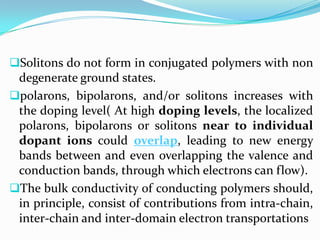
Solitons do not form in conjugated polymers with non
degenerate ground states.
polarons, bipolarons, and/or solitons increases with
the doping level( At high doping levels, the localized
polarons, bipolarons or solitons near to individual
dopant ions could overlap, leading to new energy
bands between and even overlapping the valence and
conduction bands, through which electrons can flow).
The bulk conductivity of conducting polymers should,
in principle, consist of contributions from intra-chain,
inter-chain and inter-domain electron transportations
Picture of conductivity of some
materials
Sp . gv.ConductivityMaterial
10.5102Au
8.96x 1o4Cu
2.74x10⁶Al
11.5x10⁵ dopedPolyacetylene
21.4105Pt
1104 doped
200 undoped
Polythiophene
600Polypyrrole
13.5104Hg
1.7-2500Carbon fiber
110Carbon black fill PE
10-8Poly TFE
10Polyaniline
500Poly p-Phenylene
1000Poly Phenylen vinylene
20Poly p-Phenylene sulfide
50Poly IsothianaPhthene
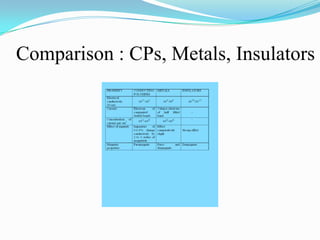
Comparison : CPs, Metals, Insulators
Factors that affect in conductivity
1) Denesity of charge carriers.
2) Thier mobility.
3) The direction.
4) presence of doping materials (additives that
facilitate the polymer conductivity)
5) Temperature.
6) Conjugation length of the polymer chain.
7) Doping Level.
8) Frequency of current.
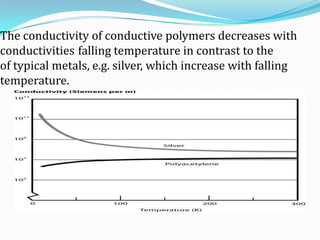
The conductivity of conductive polymers decreases with
falling temperature in contrast to theconductivities
of typical metals, e.g. silver, which increase with falling
temperature.
Type of conducting polymer
INTRINSICALLY
CONDUCTING
POLYMERS
CONDUCTING
POLYMERS HAVING
CONJUGATION
DOPED CONDUCTING
POLYMERS
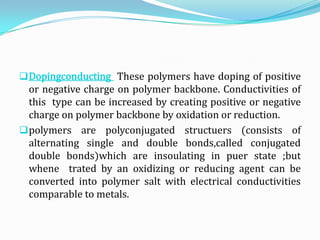
Dopingconducting These polymers have doping of positive
or negative charge on polymer backbone. Conductivities of
this type can be increased by creating positive or negative
charge on polymer backbone by oxidation or reduction.
polymers are polyconjugated structuers (consists of
alternating single and double bonds,called conjugated
double bonds)which are insoulating in puer state ;but
whene trated by an oxidizing or reducing agent can be
converted into polymer salt with electrical conductivities
comparable to metals.
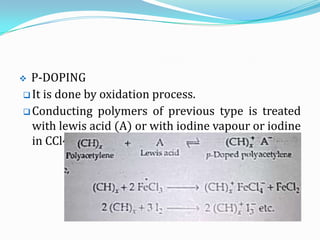
 P-DOPING
 It is done by oxidation process.
 Conducting polymers of previous type is treated
with lewis acid (A) or with iodine vapour or iodine
in CCl4.
N-DOPING
It is done by reduction process.
Conducting polymer of previous type is treated with lewis
base (B) like sodium naphthalide.
In conjugation, the bonds between the carbon
atoms are alternately single and double. Every
bond contains a localised “sigma” (σ) bond which
forms a strong chemical bond. In addition, every
double bond also contains a less strongly localised
“pi” (π) bond which is weaker.
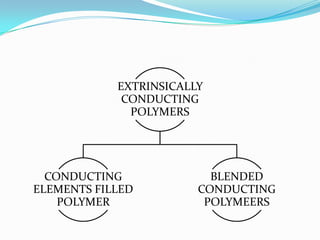
EXTRINSICALLY
CONDUCTING
POLYMERS
CONDUCTING
ELEMENTS FILLED
POLYMER
BLENDED
CONDUCTING
POLYMEERS
EXTRINSICALLY CONDUCTING
POLYMERS
These polymers owe their conductivity due to the
presence of externally added ingredients in them.
Conductive element filled polymer:-In this, the
polymer acts as the binder to hold the conducting
element (such as carbon black, metallic fibers,
metallic oxides,etc.) together in the solid entity.
Generally, special conducting grade C-Black is
used as filler which has very high surface area,
more porosity and more of filamentous properties.
BLENDED CONDUCTING POLYMERS
These polymers are obtained by blending a conventional
polymer with a conducting polymer. Such polymers possess
better physical, chemical, electrical and mechanical
properties and they can be easily processed.
For example :-
upto 40% of polypyrrole will have little efffect on tensile
strength than obtained with a carbon-black filled compound
at only 10% loading.
Advantages of conducting polymer
 It is being said that ‘one day conducting polymers
may be used in place of metals in electrical wiring.’
 Lighter weight.
 They do not corrode.
Synthesis of conducting polymer
Chemical polymerization(Conjugated monomers react with an
excess amount of an oxidant in a suitable solvent, such as acid. The
polymerization takes place spontaneously and requires constant stirring.
Advantage: mass-production at a reasonable cost.
Electrochemical polymerization (Both counter and reference
electrodes (such as platinum) are placed into the solution
containing diluted monomer and electrolyte (the dopant) in a
solvent. After applying a suitable voltage, the polymer film
immediately starts to form on the working electrolyte.
Photochemical polymerization.
Solid state polymerization.
Inclusion polymerization.
Applications
Conducting polymers have many uses. The most
documented are as follows:
anti-static substances for photographic film
Corrosion Inhibitors
Compact Capacitors
Anti Static Coating
Electromagnetic shielding for computers "Smart
Windows" A second generation of conducting
polymers have been developed these have industrial
uses like:
Transistors.
Light Emitting Diodes (LEDs).
Lasers used in flat televisions.
Solar cells.
 Displays in mobile telephones and mini-format
television screens.
smart" windows
Shield for computer screen
against electromagnetic
"smart" windows
radiation
Solar cell
Photographic Film
Light-emitting diodes
Conclusion
 For conductance free electrons are needed.
 Conjugated polymers are semiconductor materials while
doped polymers are conductors.
 The conductivity of conductive polymers decreases with
falling temperature in contrast to the conductivities of
typical metals, e.g. silver, which increase with falling
temperature.
 Today conductive plastics are being developed for many
uses.
FOR YOUR ATTENTION
Microsoft office power point presentation جديد ‫‬

Microsoft office power point presentation جديد ‫‬

  • 2.
    Introduction Polymers are typicallyutilized in electrical and electronic applications as insulators where advantage is taken of their very high resistivity. Conducting polymers are unique as possible substitute for metallic conductor and semiconductor. Exhibited highly reversible redox behavior and the unusual combination of properties of metal and plastics. These have unique condition mechanism and good environmental stability in present of oxygen and water .
  • 3.
    These polymer couldbe highly promising for many technological uses because of their chemical versatility, stability ,prcoessability, don’t break easily, low specific gravity , longer life time, and low cost .  There are at least four major classes of semiconducting polymers that have been developed so far. They include Conjugated conducting polymers. Charge transfer polymers. Ionically conducting polymers. conductively filled polymers.
  • 4.
    What is aconducting polymer? A polymer which can exhibit significant level of electricity (it is conduct electricity) is termed as conducting polymer. The electricity conductivity is attributed by the present of free electrons, hole, charged atoms and molecules. To electron free move there are many condition most be present; depends up on the type of conducting polymer ( Extrinsic - Intrinsic ).
  • 5.
    There are Treetype of conducting polymer :- Electronic conducting polymer . Proton conducting polymer . Ionic conducting polymer .
  • 6.
  • 7.
  • 8.
    Band theory The electricalproperties of direct gap inorganic semiconductors are determined by their electronic structures, and the electrons move within discrete energy states called bands.  The bonding and ant bonding electron , orbitals of the sp2 hybridized , electron materials(e.g. polyenes) generate energy bands, which are fully occupied band and empty band. highest occupied band is called the valence band, and the lowest unoccupied band is the conduction band. The energy difference between them is called the band gap.
  • 9.
    METALS SEMICONDUCTORS OR INSULATORS Freeelectrons needed for electrical conduction “applied electric field is sufficient to generate large number of free electrons”. Due to the band gap, much more energy input is necessary to create charge carriers “electrons in conduction band or holes in valence band”.
  • 10.
    The energy differencebetween them is called the band gap. Electrons must have certain energy to occupy a given band and need extra energy to move from the valence band to the conduction band. The bands should be partially filled in order to be electrically conducting, as neither empty nor full bands can carry electricity. most conventional polymers have full valence bands and empty conduction bands, which are separated from each other by a wide energy gap (Figure 2.1(b)).
  • 11.
    conjugated polymers havenarrower band gaps (Figure 2.1(c)) and doping can change their band structures by either taking electrons from the valence band (p-doping) or adding electrons to the conduction band (n-doping).
  • 12.
    Polaron :- Whenan electron is added (removed) to the bottom of the conduction band (from the top of the valence band) of a conjugated polymer (Figure 2.2(a)), the conduction (valence) band ends up being partially filled and a radical anion (cation) (Figure 2.2(b)). formation of polarons causes the injection of states from the bottom of the conduction band and top of the valence band into the band gap.
  • 13.
     A polaroncarries both spin (1/2) and charge (1e). Addition (removal) of a second electron on a chain already having a negative (positive) polaron results in the formation of a bipolaron (spinless) through dimerization of two polarons, which can lower the total energy (Figure 2.2(c)) In conjugated polymers with a degenerate ground state (i.e. twoequivalent resonance forms),the bipolarons can furtherlower their energy by dissociating into two spinless solitons at one-half of the gapenergy (Figure 2.2(d)).
  • 14.
    Solitons do notform in conjugated polymers with non degenerate ground states. polarons, bipolarons, and/or solitons increases with the doping level( At high doping levels, the localized polarons, bipolarons or solitons near to individual dopant ions could overlap, leading to new energy bands between and even overlapping the valence and conduction bands, through which electrons can flow). The bulk conductivity of conducting polymers should, in principle, consist of contributions from intra-chain, inter-chain and inter-domain electron transportations
  • 16.
    Picture of conductivityof some materials Sp . gv.ConductivityMaterial 10.5102Au 8.96x 1o4Cu 2.74x10⁶Al 11.5x10⁵ dopedPolyacetylene
  • 17.
  • 18.
    10Polyaniline 500Poly p-Phenylene 1000Poly Phenylenvinylene 20Poly p-Phenylene sulfide 50Poly IsothianaPhthene
  • 19.
    Comparison : CPs,Metals, Insulators
  • 20.
    Factors that affectin conductivity 1) Denesity of charge carriers. 2) Thier mobility. 3) The direction. 4) presence of doping materials (additives that facilitate the polymer conductivity) 5) Temperature. 6) Conjugation length of the polymer chain. 7) Doping Level. 8) Frequency of current.
  • 21.
    The conductivity ofconductive polymers decreases with falling temperature in contrast to theconductivities of typical metals, e.g. silver, which increase with falling temperature.
  • 22.
    Type of conductingpolymer INTRINSICALLY CONDUCTING POLYMERS CONDUCTING POLYMERS HAVING CONJUGATION DOPED CONDUCTING POLYMERS
  • 23.
    Dopingconducting These polymershave doping of positive or negative charge on polymer backbone. Conductivities of this type can be increased by creating positive or negative charge on polymer backbone by oxidation or reduction. polymers are polyconjugated structuers (consists of alternating single and double bonds,called conjugated double bonds)which are insoulating in puer state ;but whene trated by an oxidizing or reducing agent can be converted into polymer salt with electrical conductivities comparable to metals.
  • 24.
     P-DOPING  Itis done by oxidation process.  Conducting polymers of previous type is treated with lewis acid (A) or with iodine vapour or iodine in CCl4.
  • 25.
    N-DOPING It is doneby reduction process. Conducting polymer of previous type is treated with lewis base (B) like sodium naphthalide.
  • 26.
    In conjugation, thebonds between the carbon atoms are alternately single and double. Every bond contains a localised “sigma” (σ) bond which forms a strong chemical bond. In addition, every double bond also contains a less strongly localised “pi” (π) bond which is weaker.
  • 27.
  • 28.
    EXTRINSICALLY CONDUCTING POLYMERS These polymersowe their conductivity due to the presence of externally added ingredients in them. Conductive element filled polymer:-In this, the polymer acts as the binder to hold the conducting element (such as carbon black, metallic fibers, metallic oxides,etc.) together in the solid entity. Generally, special conducting grade C-Black is used as filler which has very high surface area, more porosity and more of filamentous properties.
  • 29.
    BLENDED CONDUCTING POLYMERS Thesepolymers are obtained by blending a conventional polymer with a conducting polymer. Such polymers possess better physical, chemical, electrical and mechanical properties and they can be easily processed. For example :- upto 40% of polypyrrole will have little efffect on tensile strength than obtained with a carbon-black filled compound at only 10% loading.
  • 30.
    Advantages of conductingpolymer  It is being said that ‘one day conducting polymers may be used in place of metals in electrical wiring.’  Lighter weight.  They do not corrode.
  • 31.
    Synthesis of conductingpolymer Chemical polymerization(Conjugated monomers react with an excess amount of an oxidant in a suitable solvent, such as acid. The polymerization takes place spontaneously and requires constant stirring. Advantage: mass-production at a reasonable cost. Electrochemical polymerization (Both counter and reference electrodes (such as platinum) are placed into the solution containing diluted monomer and electrolyte (the dopant) in a solvent. After applying a suitable voltage, the polymer film immediately starts to form on the working electrolyte. Photochemical polymerization. Solid state polymerization. Inclusion polymerization.
  • 32.
    Applications Conducting polymers havemany uses. The most documented are as follows: anti-static substances for photographic film Corrosion Inhibitors Compact Capacitors Anti Static Coating Electromagnetic shielding for computers "Smart Windows" A second generation of conducting polymers have been developed these have industrial uses like:
  • 33.
    Transistors. Light Emitting Diodes(LEDs). Lasers used in flat televisions. Solar cells.  Displays in mobile telephones and mini-format television screens.
  • 34.
    smart" windows Shield forcomputer screen against electromagnetic "smart" windows radiation Solar cell Photographic Film Light-emitting diodes
  • 35.
    Conclusion  For conductancefree electrons are needed.  Conjugated polymers are semiconductor materials while doped polymers are conductors.  The conductivity of conductive polymers decreases with falling temperature in contrast to the conductivities of typical metals, e.g. silver, which increase with falling temperature.  Today conductive plastics are being developed for many uses.
  • 36.