Conducting polymers
Conductive polymers are organic polymers that conduct electricity.
These polymers are not thermoplastics but like insulating polymers,
they are organic materials.
They can offer high electrical conductivity but do not show similar
mechanical properties to other commercially available polymers.
Conductive polymers are prepared by oxidative coupling of
monocyclic precursors.
In 1977, Shirakawa, MacDiarmid, and Heeger were able to increase
the conductivity of trans polyacetylene samples, after doping, to a
conductivity of about 1000 S/m or 1 S/cm. They got Nobel Prize in
2000.
INTRODUCTION
Polyacetylene
Properties/Characteristics:
Polyacetylene has been produced by several methods, many utilizing the
Zeigler–Natta polymerization systems.
Both cis and trans isomers exist. The cis polyacetylene is copper-
colored with films having a conductivity of about 10-8 S/m. By
comparison, the trans-polyacetylene is silver-colored with films
having a much greater conductivity on the order of 10-3 S/m.
The cis isomer is converted into the thermodynamically
more stable trans isomer by heating (150 °C).
Conductivity is greatly increased when the trans-
polyacetylene is doped (to about 10^2 – 10^4 S/cm).
CONJUGATED CONDUCTING POLYMERS
The carriers of electron conducting polymers are free electrons and their
common characteristic is a long π-conjugated system in the molecular
skeleton, which results in delocalised electrons.
These molecules are called conjugated conducting polymers.
To efficiently increase the movement of electrons in the π-system, the energy
level difference caused by energy band splitting should be reduced to easily
overcome the energy difference between the full and empty bands.
They are widely used in organic solar cells (OSCs), organic field effect
transistors (OFETs), sensors, and colour-changing coatings.
Extrinsic conducting polymers
Those conducting polymers which owe their conductivity due
to the presence of externally added ingredients in them are
called extrinsically conducting polymers.
Extrinsically conducting polymers (ECP’s) are of two types.
These are: (1) conducting elements filled polymers(CEFP),
and (2) blended conducting polymers(BCP)
1.CONDUCTING ELEMENTS FILLED POLYMERS
In this type, a conducting element is added to the polymer.
The conducting material will have more surface area and more porosity.
Therefore, the polymer acts as a binder to hold the conducting elements
together in solid entity.
Thus, conductivity of these polymers is due to the addition of external
ingredients.
Upon addition of conducting element, the polymer will have a property of
that conducting element and it will start conducting electricity.
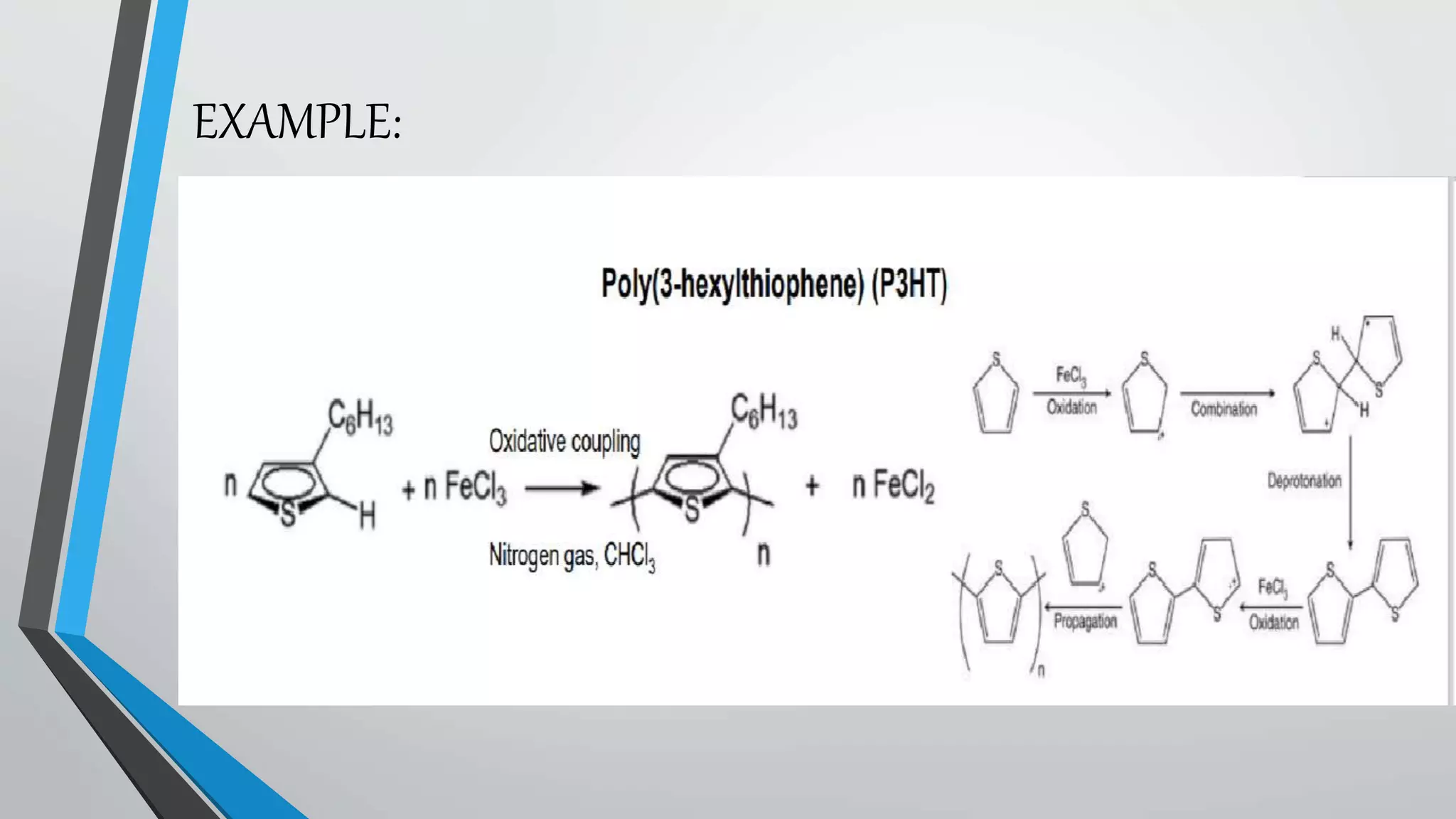
EXAMPLE:
Properties/Characteristics:
Poly(3-hexylthiophene) (P3HT) is a derivative of
polythiophene. The two major steps for the preparation is
Grignard metathesis polymerization, and quenching reaction.
P3HT is popular because of its wide availability, low cost,
well-known morphology, and easy processability.
P3HT is a semicrystalline polymer and its backbone is made
up of isolated rings and linear side chains. This structural
arrangement enables the freedom to sample conformational
space.
It is used in personal mobile phone charger, solar panel,
organic transistors.
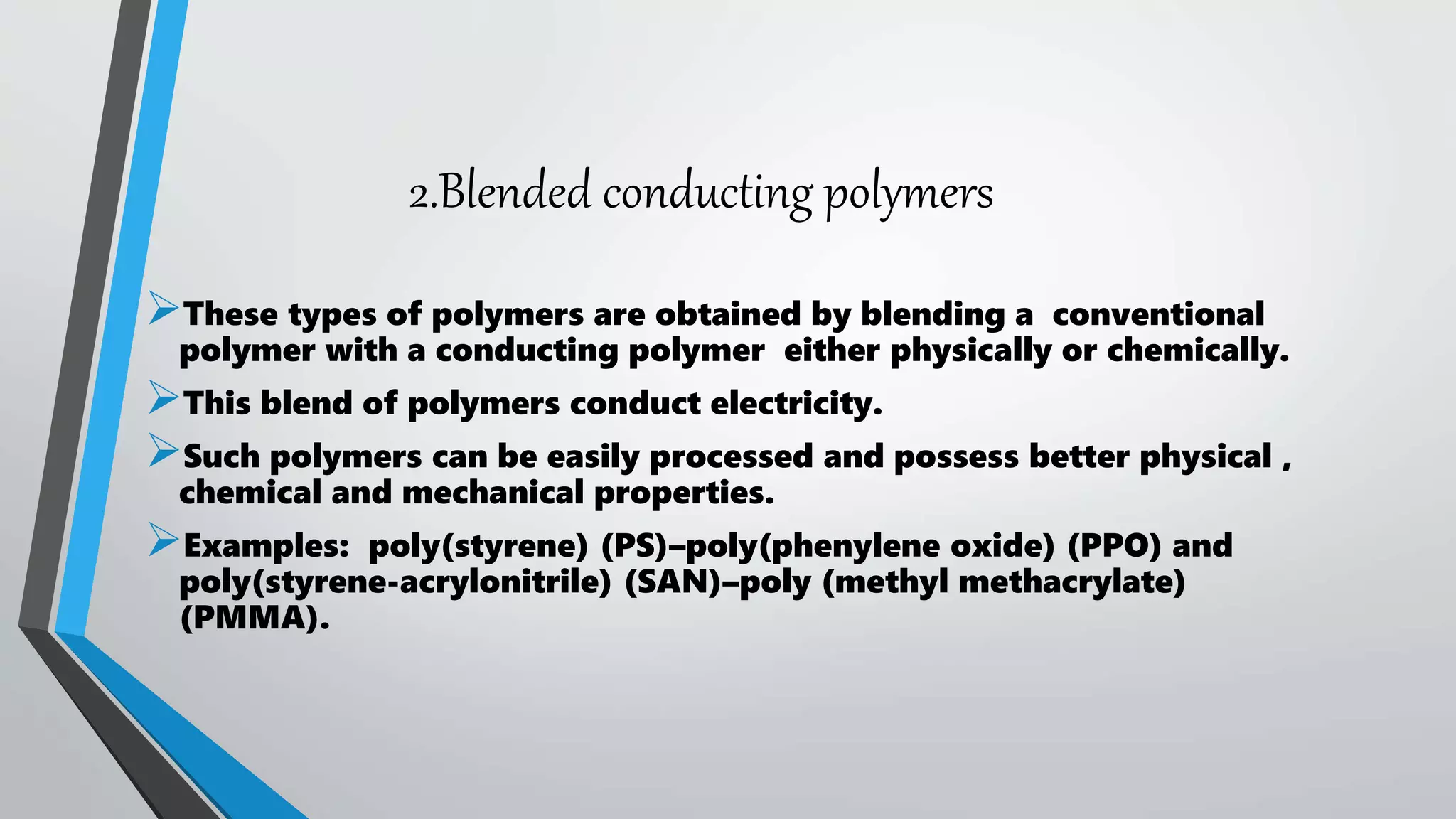
2.Blended conducting polymers
These types of polymers are obtained by blending a conventional
polymer with a conducting polymer either physically or chemically.
This blend of polymers conduct electricity.
Such polymers can be easily processed and possess better physical ,
chemical and mechanical properties.
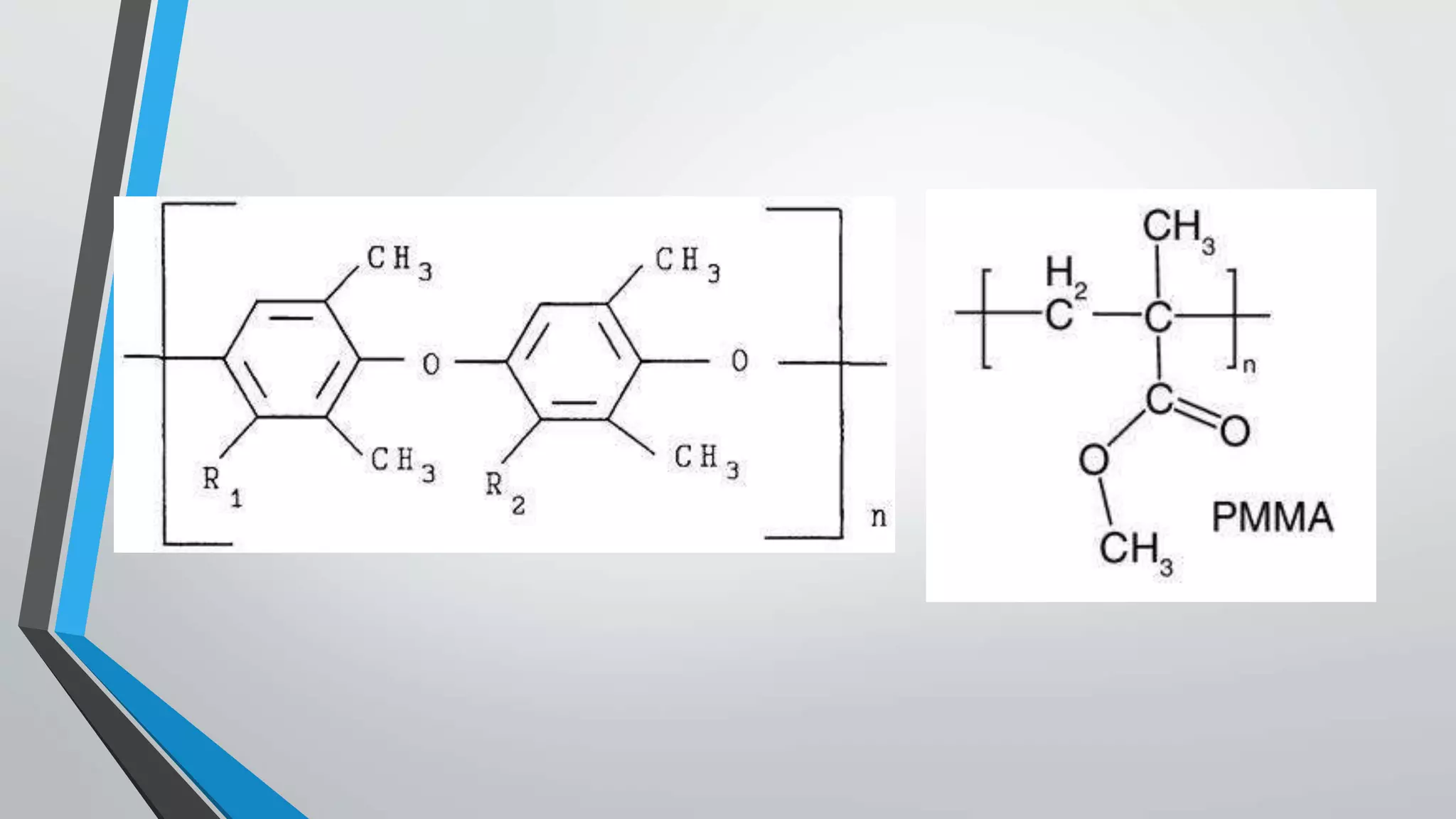
Examples: poly(styrene) (PS)–poly(phenylene oxide) (PPO) and
poly(styrene-acrylonitrile) (SAN)–poly (methyl methacrylate)
(PMMA).
THANK YOU
BY- M.SHRI HARSHA(478)
S.SHYLENDRAN(519)
RAHUL V.K.(529)

Conducting polymers final.pptx

  • 1.
  • 2.
    Conductive polymers areorganic polymers that conduct electricity. These polymers are not thermoplastics but like insulating polymers, they are organic materials. They can offer high electrical conductivity but do not show similar mechanical properties to other commercially available polymers. Conductive polymers are prepared by oxidative coupling of monocyclic precursors. In 1977, Shirakawa, MacDiarmid, and Heeger were able to increase the conductivity of trans polyacetylene samples, after doping, to a conductivity of about 1000 S/m or 1 S/cm. They got Nobel Prize in 2000. INTRODUCTION
  • 4.
    Polyacetylene Properties/Characteristics: Polyacetylene has beenproduced by several methods, many utilizing the Zeigler–Natta polymerization systems. Both cis and trans isomers exist. The cis polyacetylene is copper- colored with films having a conductivity of about 10-8 S/m. By comparison, the trans-polyacetylene is silver-colored with films having a much greater conductivity on the order of 10-3 S/m. The cis isomer is converted into the thermodynamically more stable trans isomer by heating (150 °C). Conductivity is greatly increased when the trans- polyacetylene is doped (to about 10^2 – 10^4 S/cm).
  • 5.
    CONJUGATED CONDUCTING POLYMERS Thecarriers of electron conducting polymers are free electrons and their common characteristic is a long π-conjugated system in the molecular skeleton, which results in delocalised electrons. These molecules are called conjugated conducting polymers. To efficiently increase the movement of electrons in the π-system, the energy level difference caused by energy band splitting should be reduced to easily overcome the energy difference between the full and empty bands. They are widely used in organic solar cells (OSCs), organic field effect transistors (OFETs), sensors, and colour-changing coatings.
  • 10.
    Extrinsic conducting polymers Thoseconducting polymers which owe their conductivity due to the presence of externally added ingredients in them are called extrinsically conducting polymers. Extrinsically conducting polymers (ECP’s) are of two types. These are: (1) conducting elements filled polymers(CEFP), and (2) blended conducting polymers(BCP)
  • 11.
    1.CONDUCTING ELEMENTS FILLEDPOLYMERS In this type, a conducting element is added to the polymer. The conducting material will have more surface area and more porosity. Therefore, the polymer acts as a binder to hold the conducting elements together in solid entity. Thus, conductivity of these polymers is due to the addition of external ingredients. Upon addition of conducting element, the polymer will have a property of that conducting element and it will start conducting electricity.
  • 12.
  • 13.
    Properties/Characteristics: Poly(3-hexylthiophene) (P3HT) isa derivative of polythiophene. The two major steps for the preparation is Grignard metathesis polymerization, and quenching reaction. P3HT is popular because of its wide availability, low cost, well-known morphology, and easy processability. P3HT is a semicrystalline polymer and its backbone is made up of isolated rings and linear side chains. This structural arrangement enables the freedom to sample conformational space. It is used in personal mobile phone charger, solar panel, organic transistors.
  • 15.
    2.Blended conducting polymers Thesetypes of polymers are obtained by blending a conventional polymer with a conducting polymer either physically or chemically. This blend of polymers conduct electricity. Such polymers can be easily processed and possess better physical , chemical and mechanical properties. Examples: poly(styrene) (PS)–poly(phenylene oxide) (PPO) and poly(styrene-acrylonitrile) (SAN)–poly (methyl methacrylate) (PMMA).
  • 17.
    THANK YOU BY- M.SHRIHARSHA(478) S.SHYLENDRAN(519) RAHUL V.K.(529)