CONDUCTING POLYMERS
Name-Souma Jyoti Ghosh.
M.Sc. 2nd year
Department of Materials Science
Roll-20
Sardar Patel University.
CONTENTS
• INTRODUCTION
• BASICS OF CONDUCTIVITY
• MECHANISM OF CONDUCTION IN POLYMERS
• SOME CONDUCTING POLYMERS
1. POLYACETYLENE
2. POLYANILENE
3. POLYPYRROLE
• METAL CONJUGATED POLYMER
• CONCLUSION
• REFERENCES
Introduction
Polymers (or plastics as they are also called) are
known to have good insulating properties.
Polymers are one of the most used materials in the
modern world. Their uses and application range
from containers to clothing.
They are used to coat metal wires to prevent electric
shocks.
Yet Alan J. Heeger, Alan G. MacDiarmid and Hideki Shirakawa have changed this view with their
discovery that a polymer, polyacetylene, can be made conductive almost like a metal.
What is conductivity?
Conductivity can be defined simply by Ohms Law.
V= IR
Where R is the resistance, I the current and V the voltage present in the
material. The conductivity depends on the number of charge carriers
(number of electrons) in the material and their mobility.In a metal it is
assumed that all the outer electrons are free to carry charge.
Insulators however have tightly bound electrons so that nearly no
electron flow occurs so they offer high resistance to charge
flow. So for conductance free electrons are needed.
General electrical properties
Polyacetylene (PA) or (CH)x is chemically the simplest
A semiconductor in
which chain
conformation (structure)
impacts band gap
(as synthesized)
(after thermal conversion)
What makes the material conductive?
Three simple carbon compounds are diamond, graphite and polyacetylene.
They may be regarded as three- two- and one-dimensional forms of carbon
materials .
Diamond, which contains only σ bonds, is an insulator
and its high symmetry gives it isotropic properties.
Graphite and acetylene both have mobile π electrons
and are, when doped, highly anisotropic metallic
conductors.
Even when doped to a highly conductive state most
p-conjugated polymers behave as classic
semiconductors (VRH-variable range hoping is the
standard proposed mechanism)
Band structure is essentially rigid
Conventional Semiconductors at the atomic level
+
n-type doping
Egap
e-
Si Si
Si Si
P+
5 valence electrons
Phosphorous has
VB
CB
0
Edonor+
At room temperature electron is
delocalized in conduction band (CB)
p-type
doping
VB
CB
0 E acceptor
Si Si
Al
Si Si
Si Si
Al
Si Si
-
hole in valence band
(hole in valence band)
An unbonded electron
+
+
CB
VB
Edonor
ef
CB
VB
Eacceptoref
At room temperature hole is
delocalized in valence band (VB)
Mobility is everything
p-conjugated “polymers” (pentacene) at the molecular level
X-ray diffraction Microstructure Mobility
Structure matters
p-conjugated polymers have unusual charge excitations
Conformational structure impacts electronic properties
2. Conjugation yields an energy/unit length which is
minimized with increasing backbone planarity
3. Rotation breaks conjugation
C C CC C C
C CC
C C C
p bonding
(as synthesized)
(after thermal conversion)
1. Cis and trans polyacetylene, according to the tight binding picture
just presented, should have the same band gap but they don’t!
Structural instabilities and disorder are extremely important (at all length scales)
Two conditions to become conductive:
1-The first condition for this is that the polymer consists of alternating single
and double bonds, called conjugated double bonds.
In conjugation, the bonds between the carbon atoms are alternately single
and double. Every bond contains a localised “sigma” (σ) bond which forms
a strong chemical bond. In addition, every double bond also contains a less
strongly localised “pi” (π) bond which is weaker.
2-The second condition is that the plastic has to be disturbed - either by removing electrons from
(oxidation), or inserting them into (reduction), the material. The process is known as Doping.
• There are two types of doping:
1-oxidation with halogen (or p-doping).
2- Reduction with alkali metal (called n-doping).
    -
 3
2
3
ICHI
x
CH nn
    -
 xNaCHxNaCH
x
nn
POLYACETYLENE
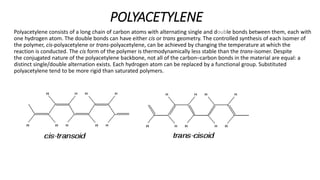
Polyacetylene consists of a long chain of carbon atoms with alternating single and double bonds between them, each with
one hydrogen atom. The double bonds can have either cis or trans geometry. The controlled synthesis of each isomer of
the polymer, cis-polyacetylene or trans-polyacetylene, can be achieved by changing the temperature at which the
reaction is conducted. The cis form of the polymer is thermodynamically less stable than the trans-isomer. Despite
the conjugated nature of the polyacetylene backbone, not all of the carbon–carbon bonds in the material are equal: a
distinct single/double alternation exists. Each hydrogen atom can be replaced by a functional group. Substituted
polyacetylene tend to be more rigid than saturated polymers.
• From acetylene:
• Polyacetylene can also be produced by radiation polymerization of acetylene. Glow discharge radiation, γ-
radiation, and ultraviolet irradiation have been used. These methods avoid the use of catalysts and solvent, but
they require low temperatures to produce regular polymers.
• Ring-opening metathesis polymerization:
• From precursor polymers:
Short, irregular segments of polyacetylene can be obtained by dehydrohalogenation of poly(vinyl chloride).Thermal
conversion of precursor polymers is a more effective method for synthesizing long polyacetylene chains.
POLYANILINE
Properties of Polyaniline:
• Polyaniline’s electrical properties can be reversibly controlled by charge-transfer doping and protonation.
• Polyaniline is environmentally stable and inert (noble) where stainless steel is corroded.
• Polyaniline is applicable to electrical, electrochemical, and optical applications. Polyaniline is currently used
in cell phones and calculators, and other LCD technology.
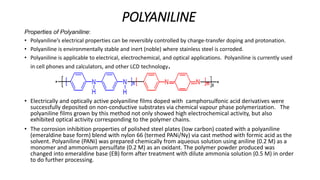
• Electrically and optically active polyaniline films doped with camphorsulfonic acid derivatives were
successfully deposited on non-conductive substrates via chemical vapour phase polymerization. The
polyaniline films grown by this method not only showed high electrochemical activity, but also
exhibited optical activity corresponding to the polymer chains.
• The corrosion inhibition properties of polished steel plates (low carbon) coated with a polyaniline
(emeraldine base form) blend with nylon 66 (termed PANi/Ny) via cast method with formic acid as the
solvent. Polyaniline (PANi) was prepared chemically from aqueous solution using aniline (0.2 M) as a
monomer and ammonium persulfate (0.2 M) as an oxidant. The polymer powder produced was
changed into emeraldine base (EB) form after treatment with dilute ammonia solution (0.5 M) in order
to do further processing.
Synthesis:
1. Homopolymerization of Polyaniline:
2. Formation by the ion conjugation of aniline molecule:
Oxidation States and Acid Base Behavior
of Polyaniline (emaraldine, pernigraniline)
• POLY-PYRROLES
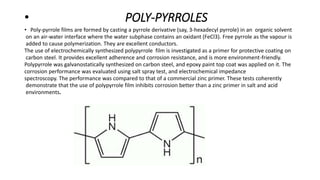
• Poly-pyrrole films are formed by casting a pyrrole derivative (say, 3-hexadecyl pyrrole) in an organic solvent
on an air-water interface where the water subphase contains an oxidant (FeCl3). Free pyrrole as the vapour is
added to cause polymerization. They are excellent conductors.
The use of electrochemically synthesized polypyrrole film is investigated as a primer for protective coating on
carbon steel. It provides excellent adherence and corrosion resistance, and is more environment-friendly.
Polypyrrole was galvanostatically synthesized on carbon steel, and epoxy paint top coat was applied on it. The
corrosion performance was evaluated using salt spray test, and electrochemical impedance
spectroscopy. The performance was compared to that of a commercial zinc primer. These tests coherently
demonstrate that the use of polypyrrole film inhibits corrosion better than a zinc primer in salt and acid
environments.
• Other conducting polymers are polythiophenes, poly(p- phenylene
sulfide), Poly p- phenelynes etc.
METALLO-ORGANIC
POLYMERS
OR
METAL CONJUGATED
POLYMERS
Metal-containing conducting polymers can be divided into three types,
known as types I, II and III .These are tethered, coupled and incorporated
respectively. Type I polymers have the metal group tethered to the
conjugated backbone by a linker moiety such as an alkyl group. In these
Cases the polymer acts as a conductive electrolyte and the metal ions act in
similar way to an untethered group. Type II polymers have the metal
directly coupled to the polymer backbone or coupled to the backbone by a
conjugated linker group, which makes it easier for the polymer and the
metal group to affect each other's properties directly. The third type of polymer
has the metal group directly incorporated into the conjugated backbone. In this
type the metal group has the greatest influence on the properties of the
conducting polymer.
• Several methods of synthesizing this polymers are available. These include condensation, ROMP, electro
polymerization. Electro- polymerization is the most suitable process for the Type 1 and Type 2 as they form
the insoluble thin films which are difficult to cast by solution process. They include heterocyclic aromatic
compound like pyrrole, thiophenes.
• Most Type 3 can not be electro-polymerized except the thiophene based type 3 polymers. So the basically
or synthesized by condensation or ROMP process.Examples include ferrocene based polymers, polysilanes
and metal polychelates of bis-chelating ligands.
ferrocene
porphyrin
Shield for computer screen
against electromagnetic
"smart" windows
radiation
smart" windows
Photographic Film Light-emitting diodes
CONCLUSION
• For conductance free electrons are needed.
• Conjugated polymers are semiconductor materials while doped
polymers are conductors.
• The conductivity of conductive polymers decreases with falling
temperature in contrast to the conductivities of typical metals, e.g.
silver, which increase with falling temperature.
• Today conductive plastics are being developed for many uses.
REFERENCES
• H. Shirakawa, E.J. Louis, A.G. MacDiarmid, C.K. Chiang and A.J.
Heeger, J Chem Soc Chem Comm (1977).
• T. Ito, H. Shirakawa and S. Ikeda, J.Polym. Sci., Polym.Chem. Ed. 12
(1974) .
• Evaristo Riande and Ricardo Díaz-Calleja, Electrical Properties of
Polymers.
• POLYMER SCIENCE AND TECHNOLOGY-BY PREMAMOY GHOSH.
EVERY LIFE IS UNIQUE AND
HAS A PURPOSE.
THANK YOU.

Conducting polymers

  • 1.
    CONDUCTING POLYMERS Name-Souma JyotiGhosh. M.Sc. 2nd year Department of Materials Science Roll-20 Sardar Patel University.
  • 2.
    CONTENTS • INTRODUCTION • BASICSOF CONDUCTIVITY • MECHANISM OF CONDUCTION IN POLYMERS • SOME CONDUCTING POLYMERS 1. POLYACETYLENE 2. POLYANILENE 3. POLYPYRROLE • METAL CONJUGATED POLYMER • CONCLUSION • REFERENCES
  • 3.
    Introduction Polymers (or plasticsas they are also called) are known to have good insulating properties. Polymers are one of the most used materials in the modern world. Their uses and application range from containers to clothing. They are used to coat metal wires to prevent electric shocks.
  • 4.
    Yet Alan J.Heeger, Alan G. MacDiarmid and Hideki Shirakawa have changed this view with their discovery that a polymer, polyacetylene, can be made conductive almost like a metal.
  • 5.
    What is conductivity? Conductivitycan be defined simply by Ohms Law. V= IR Where R is the resistance, I the current and V the voltage present in the material. The conductivity depends on the number of charge carriers (number of electrons) in the material and their mobility.In a metal it is assumed that all the outer electrons are free to carry charge. Insulators however have tightly bound electrons so that nearly no electron flow occurs so they offer high resistance to charge flow. So for conductance free electrons are needed.
  • 6.
    General electrical properties Polyacetylene(PA) or (CH)x is chemically the simplest A semiconductor in which chain conformation (structure) impacts band gap (as synthesized) (after thermal conversion)
  • 7.
    What makes thematerial conductive? Three simple carbon compounds are diamond, graphite and polyacetylene. They may be regarded as three- two- and one-dimensional forms of carbon materials . Diamond, which contains only σ bonds, is an insulator and its high symmetry gives it isotropic properties. Graphite and acetylene both have mobile π electrons and are, when doped, highly anisotropic metallic conductors.
  • 8.
    Even when dopedto a highly conductive state most p-conjugated polymers behave as classic semiconductors (VRH-variable range hoping is the standard proposed mechanism)
  • 9.
    Band structure isessentially rigid Conventional Semiconductors at the atomic level + n-type doping Egap e- Si Si Si Si P+ 5 valence electrons Phosphorous has VB CB 0 Edonor+ At room temperature electron is delocalized in conduction band (CB) p-type doping VB CB 0 E acceptor Si Si Al Si Si Si Si Al Si Si - hole in valence band (hole in valence band) An unbonded electron + + CB VB Edonor ef CB VB Eacceptoref At room temperature hole is delocalized in valence band (VB) Mobility is everything
  • 10.
    p-conjugated “polymers” (pentacene)at the molecular level X-ray diffraction Microstructure Mobility Structure matters
  • 11.
    p-conjugated polymers haveunusual charge excitations
  • 12.
    Conformational structure impactselectronic properties 2. Conjugation yields an energy/unit length which is minimized with increasing backbone planarity 3. Rotation breaks conjugation C C CC C C C CC C C C p bonding (as synthesized) (after thermal conversion) 1. Cis and trans polyacetylene, according to the tight binding picture just presented, should have the same band gap but they don’t! Structural instabilities and disorder are extremely important (at all length scales)
  • 13.
    Two conditions tobecome conductive: 1-The first condition for this is that the polymer consists of alternating single and double bonds, called conjugated double bonds. In conjugation, the bonds between the carbon atoms are alternately single and double. Every bond contains a localised “sigma” (σ) bond which forms a strong chemical bond. In addition, every double bond also contains a less strongly localised “pi” (π) bond which is weaker.
  • 14.
    2-The second conditionis that the plastic has to be disturbed - either by removing electrons from (oxidation), or inserting them into (reduction), the material. The process is known as Doping. • There are two types of doping: 1-oxidation with halogen (or p-doping). 2- Reduction with alkali metal (called n-doping).     -  3 2 3 ICHI x CH nn     -  xNaCHxNaCH x nn
  • 15.
    POLYACETYLENE Polyacetylene consists ofa long chain of carbon atoms with alternating single and double bonds between them, each with one hydrogen atom. The double bonds can have either cis or trans geometry. The controlled synthesis of each isomer of the polymer, cis-polyacetylene or trans-polyacetylene, can be achieved by changing the temperature at which the reaction is conducted. The cis form of the polymer is thermodynamically less stable than the trans-isomer. Despite the conjugated nature of the polyacetylene backbone, not all of the carbon–carbon bonds in the material are equal: a distinct single/double alternation exists. Each hydrogen atom can be replaced by a functional group. Substituted polyacetylene tend to be more rigid than saturated polymers.
  • 16.
    • From acetylene: •Polyacetylene can also be produced by radiation polymerization of acetylene. Glow discharge radiation, γ- radiation, and ultraviolet irradiation have been used. These methods avoid the use of catalysts and solvent, but they require low temperatures to produce regular polymers. • Ring-opening metathesis polymerization: • From precursor polymers: Short, irregular segments of polyacetylene can be obtained by dehydrohalogenation of poly(vinyl chloride).Thermal conversion of precursor polymers is a more effective method for synthesizing long polyacetylene chains.
  • 17.
    POLYANILINE Properties of Polyaniline: •Polyaniline’s electrical properties can be reversibly controlled by charge-transfer doping and protonation. • Polyaniline is environmentally stable and inert (noble) where stainless steel is corroded. • Polyaniline is applicable to electrical, electrochemical, and optical applications. Polyaniline is currently used in cell phones and calculators, and other LCD technology. • Electrically and optically active polyaniline films doped with camphorsulfonic acid derivatives were successfully deposited on non-conductive substrates via chemical vapour phase polymerization. The polyaniline films grown by this method not only showed high electrochemical activity, but also exhibited optical activity corresponding to the polymer chains. • The corrosion inhibition properties of polished steel plates (low carbon) coated with a polyaniline (emeraldine base form) blend with nylon 66 (termed PANi/Ny) via cast method with formic acid as the solvent. Polyaniline (PANi) was prepared chemically from aqueous solution using aniline (0.2 M) as a monomer and ammonium persulfate (0.2 M) as an oxidant. The polymer powder produced was changed into emeraldine base (EB) form after treatment with dilute ammonia solution (0.5 M) in order to do further processing.
  • 18.
    Synthesis: 1. Homopolymerization ofPolyaniline: 2. Formation by the ion conjugation of aniline molecule:
  • 19.
    Oxidation States andAcid Base Behavior of Polyaniline (emaraldine, pernigraniline)
  • 20.
    • POLY-PYRROLES • Poly-pyrrolefilms are formed by casting a pyrrole derivative (say, 3-hexadecyl pyrrole) in an organic solvent on an air-water interface where the water subphase contains an oxidant (FeCl3). Free pyrrole as the vapour is added to cause polymerization. They are excellent conductors. The use of electrochemically synthesized polypyrrole film is investigated as a primer for protective coating on carbon steel. It provides excellent adherence and corrosion resistance, and is more environment-friendly. Polypyrrole was galvanostatically synthesized on carbon steel, and epoxy paint top coat was applied on it. The corrosion performance was evaluated using salt spray test, and electrochemical impedance spectroscopy. The performance was compared to that of a commercial zinc primer. These tests coherently demonstrate that the use of polypyrrole film inhibits corrosion better than a zinc primer in salt and acid environments.
  • 21.
    • Other conductingpolymers are polythiophenes, poly(p- phenylene sulfide), Poly p- phenelynes etc.
  • 22.
  • 23.
    Metal-containing conducting polymerscan be divided into three types, known as types I, II and III .These are tethered, coupled and incorporated respectively. Type I polymers have the metal group tethered to the conjugated backbone by a linker moiety such as an alkyl group. In these Cases the polymer acts as a conductive electrolyte and the metal ions act in similar way to an untethered group. Type II polymers have the metal directly coupled to the polymer backbone or coupled to the backbone by a conjugated linker group, which makes it easier for the polymer and the metal group to affect each other's properties directly. The third type of polymer has the metal group directly incorporated into the conjugated backbone. In this type the metal group has the greatest influence on the properties of the conducting polymer.
  • 25.
    • Several methodsof synthesizing this polymers are available. These include condensation, ROMP, electro polymerization. Electro- polymerization is the most suitable process for the Type 1 and Type 2 as they form the insoluble thin films which are difficult to cast by solution process. They include heterocyclic aromatic compound like pyrrole, thiophenes. • Most Type 3 can not be electro-polymerized except the thiophene based type 3 polymers. So the basically or synthesized by condensation or ROMP process.Examples include ferrocene based polymers, polysilanes and metal polychelates of bis-chelating ligands. ferrocene porphyrin
  • 26.
    Shield for computerscreen against electromagnetic "smart" windows radiation smart" windows Photographic Film Light-emitting diodes
  • 27.
    CONCLUSION • For conductancefree electrons are needed. • Conjugated polymers are semiconductor materials while doped polymers are conductors. • The conductivity of conductive polymers decreases with falling temperature in contrast to the conductivities of typical metals, e.g. silver, which increase with falling temperature. • Today conductive plastics are being developed for many uses.
  • 28.
    REFERENCES • H. Shirakawa,E.J. Louis, A.G. MacDiarmid, C.K. Chiang and A.J. Heeger, J Chem Soc Chem Comm (1977). • T. Ito, H. Shirakawa and S. Ikeda, J.Polym. Sci., Polym.Chem. Ed. 12 (1974) . • Evaristo Riande and Ricardo Díaz-Calleja, Electrical Properties of Polymers. • POLYMER SCIENCE AND TECHNOLOGY-BY PREMAMOY GHOSH.
  • 29.
    EVERY LIFE ISUNIQUE AND HAS A PURPOSE. THANK YOU.