1: Introducing Strategy
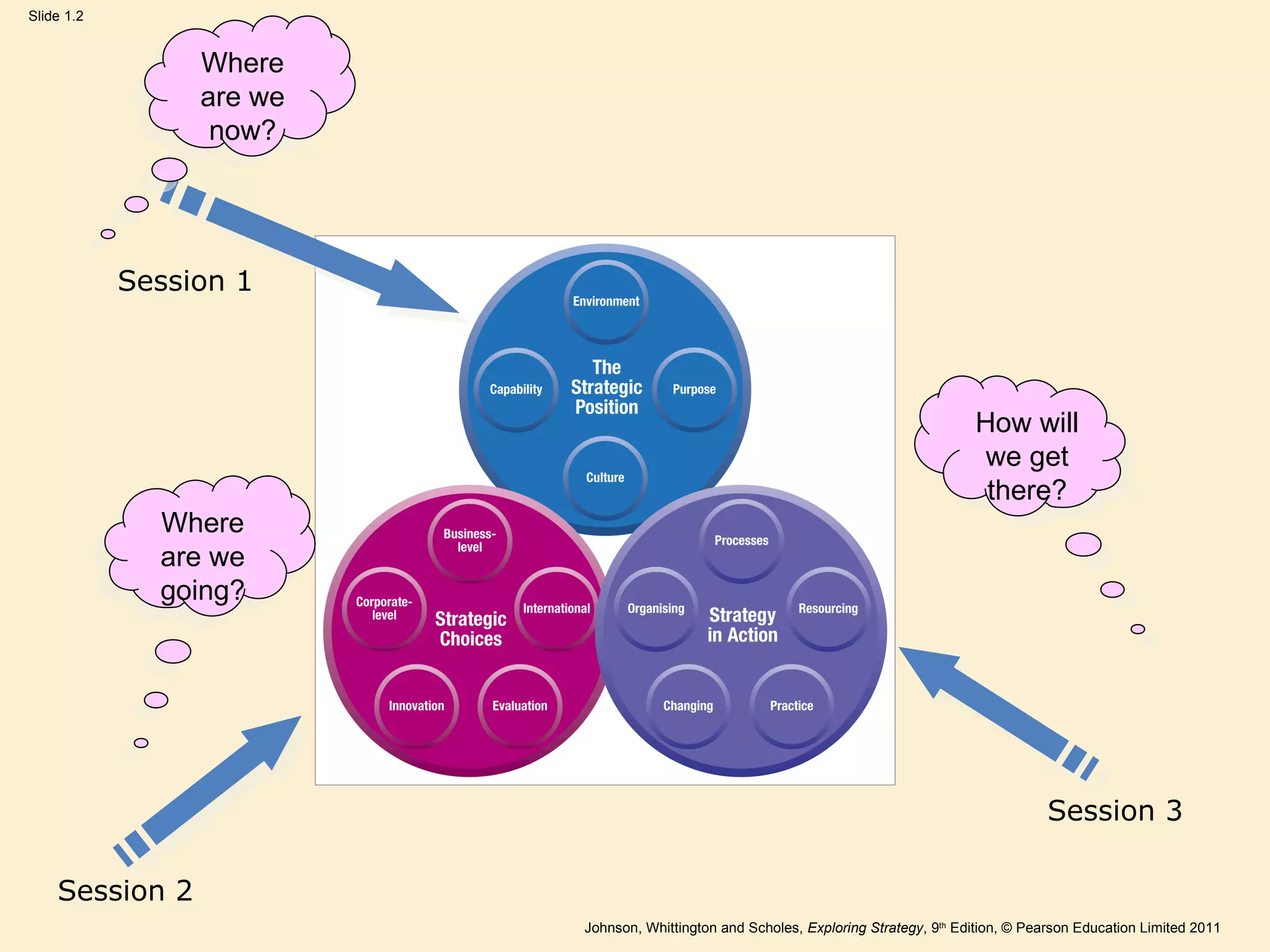
Session 1 Session 2 Session 3 Where are we now? Where are we going? How will we get there?
Learnings Summarise the strategy of an organisation in a  ‘ strategy statement ’ . Identify key issues for an organisation ’ s strategy according to the  Exploring Strategy model . Distinguish between  corporate, business and operational strategies. Understand  how different people contribute  to strategy at work. Appreciate the contributions of different  academic disciplines and theoretical lenses  to practical strategy analysis.
Definitions of strategy ‘ ..the determination of the long-run goals and objectives of an enterprise and the adoption of courses of action and the allocation of resource necessary for carrying out these goals ’ Alfred Chandler ‘ Competitive strategy is about being different. It means  deliberately choosing a different set of activities to deliver a unique mix of value ’ Michael Porter ..a pattern in a stream of decisions ’ Henry Mintzberg ‘ ..the long-term direction of an organisation ’ Exploring Strategy Sources: A.D. Chandler,  Strategy and Structure: Chapters in the History of American Enterprise, MIT Press, 1963, p. 13 M.E. Porter,  ‘ What is strategy? ’ ,  Harvard Business Review, 1996, November–December, p. 60 H. Mintzberg,  Tracking Strategy: Toward a General Theory, Oxford University Press, 2007, p. 3
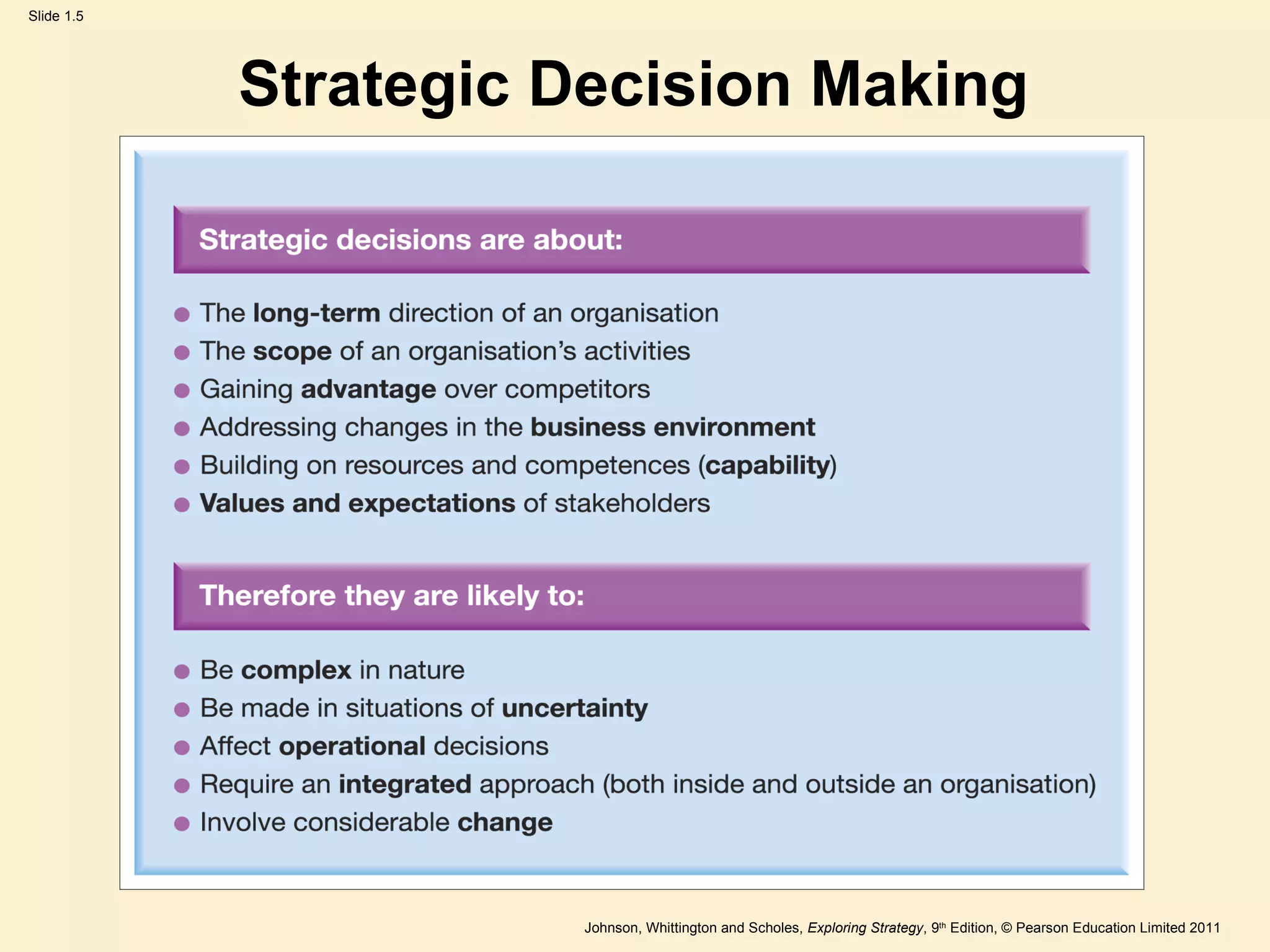
Strategic Decision Making
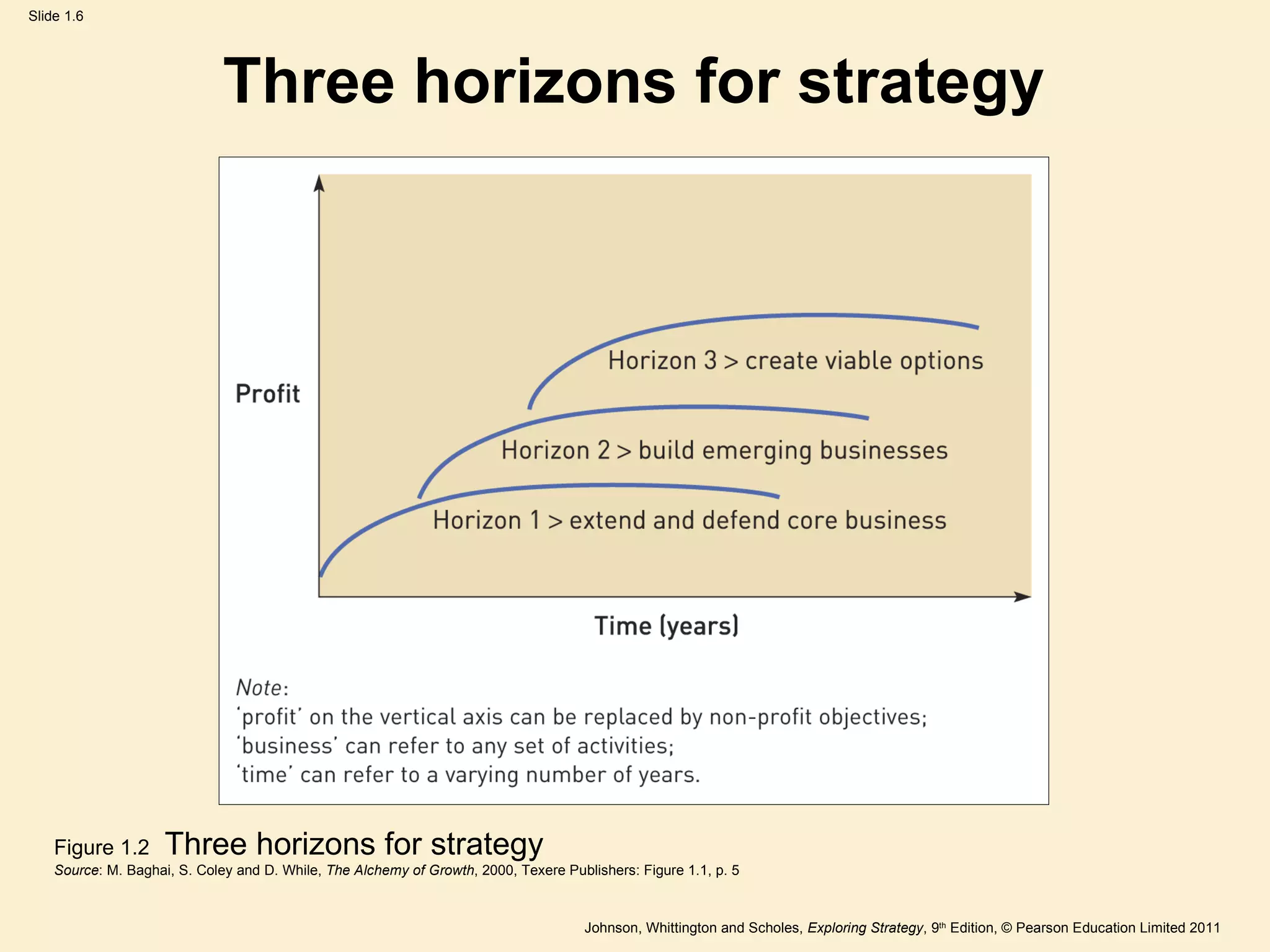
Three horizons for strategy Figure 1.2  Three horizons for strategy Source : M. Baghai, S. Coley and D. While,  The Alchemy of Growth , 2000, Texere Publishers: Figure 1.1, p. 5
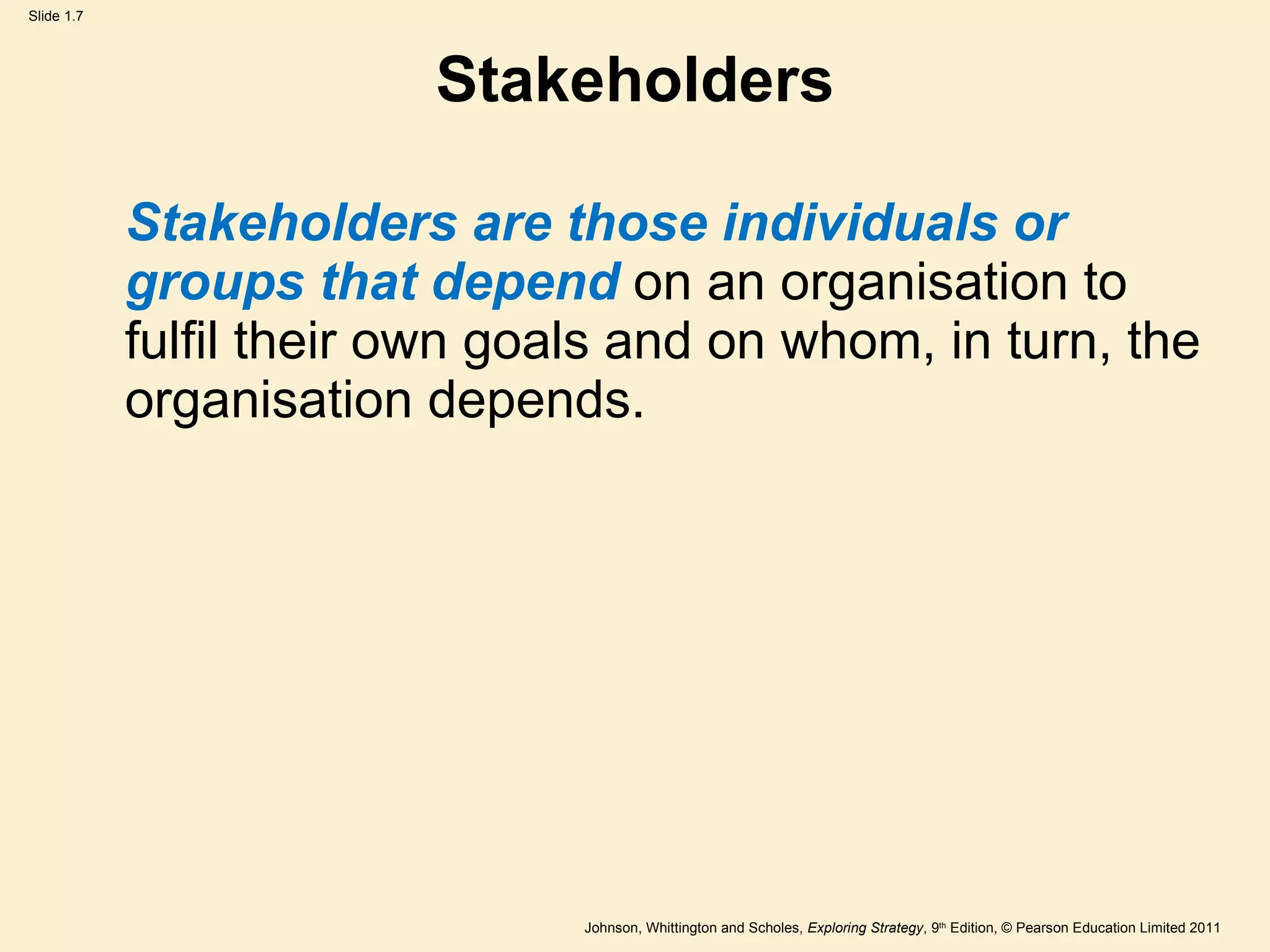
Stakeholders Stakeholders are those individuals or groups that depend  on an organisation to fulfil their own goals and on whom, in turn, the organisation depends.
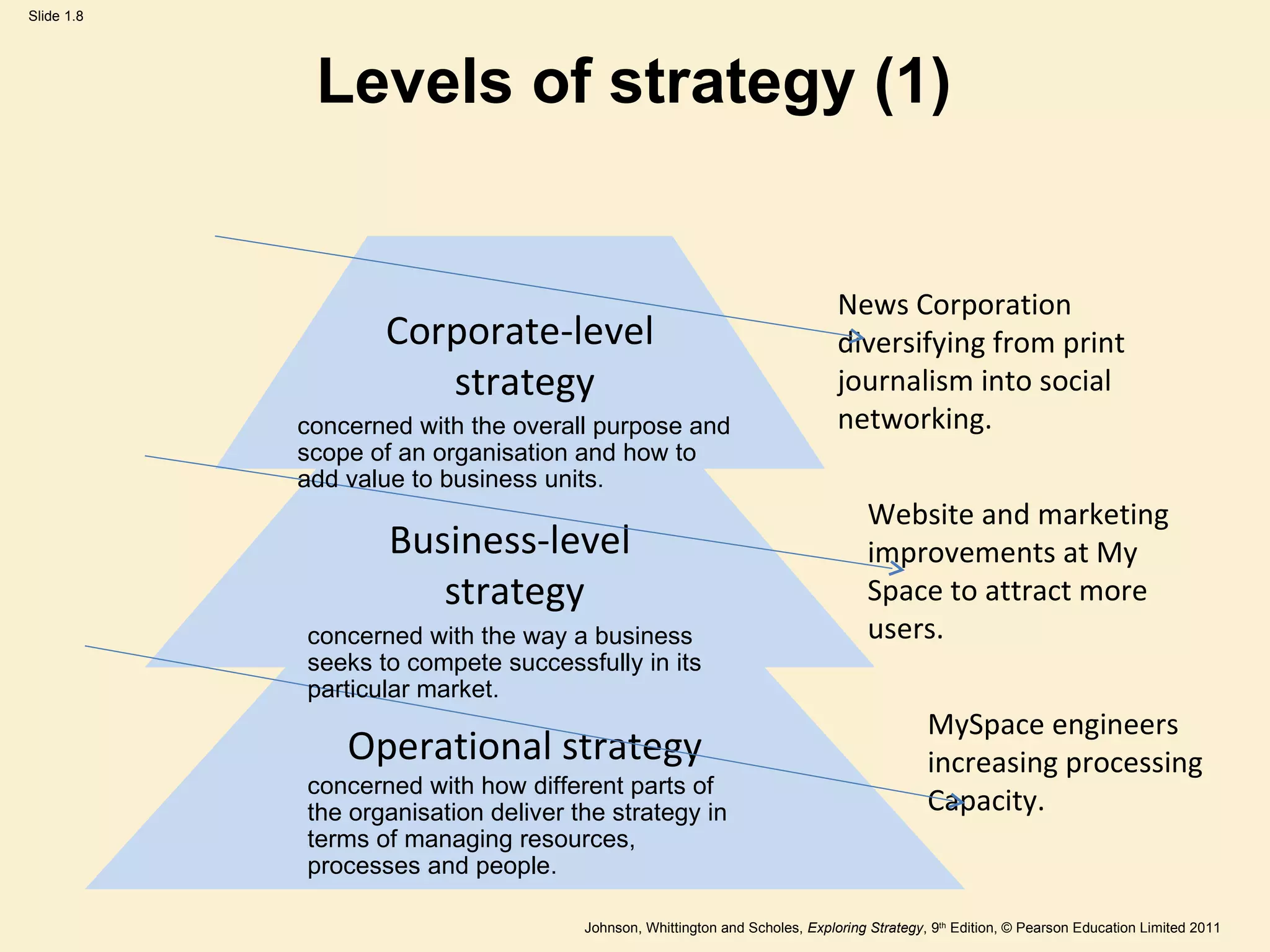
Levels of strategy (1) Operational strategy Business-level strategy Corporate-level strategy News Corporation diversifying from print journalism into social networking. Website and marketing improvements at My Space to attract more users. MySpace engineers  increasing processing Capacity. concerned with the overall purpose and scope of an organisation and how to add value to business units. concerned with the way a business seeks to compete successfully in its particular market. concerned with how different parts of the organisation deliver the strategy in terms of managing resources, processes and people.
Strategy statements Strategy statements should have three main themes:  the fundamental  goals  that the organisation seeks, which draw on the stated mission, vision and objectives the  scope  or domain of the organisation ’ s activities and the particular advantages or  capabilities  it has to deliver all these.
Working with strategy All managers are concerned with strategy : Top managers  frequently formulate and control strategy but may also involve others in the process. Middle and lower level managers  have to meet strategic objectives and deal with constraints. All managers  have to communicate strategy to their teams. All managers  can contribute to the formation of strategy through ideas and feedback. Organisations may also use strategy specialists : Many large organisations have in-house  strategic planning or analyst roles . Strategy consultants  can be engaged from one of many general management consulting firms (e.g. Accenture, IBM Consulting, PwC). There are a growing number of  specialist strategy consulting firms  (e.g. McKinsey &Co, The Boston Consulting Group
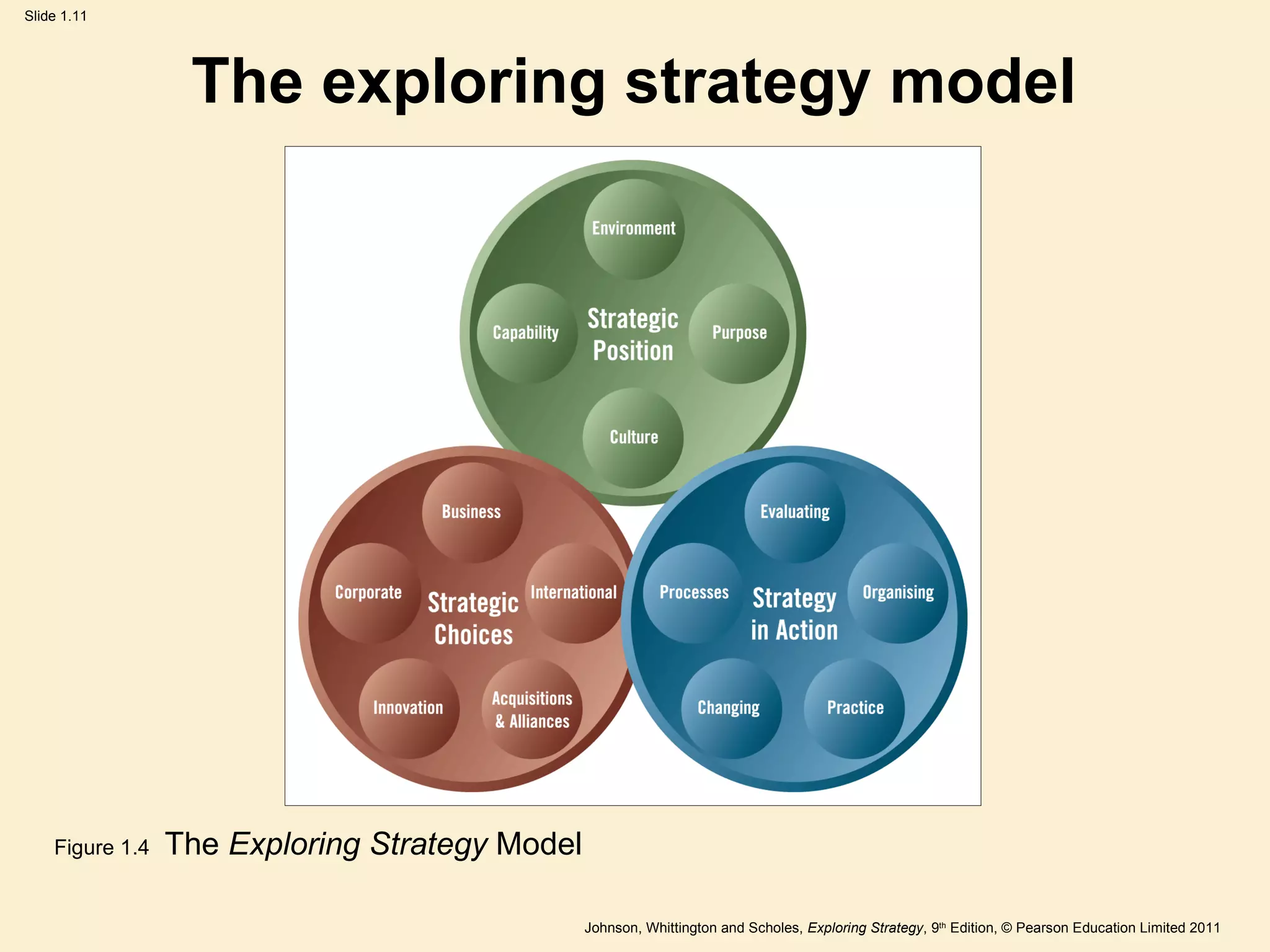
The exploring strategy model Figure 1.4  The  Exploring Strategy  Model
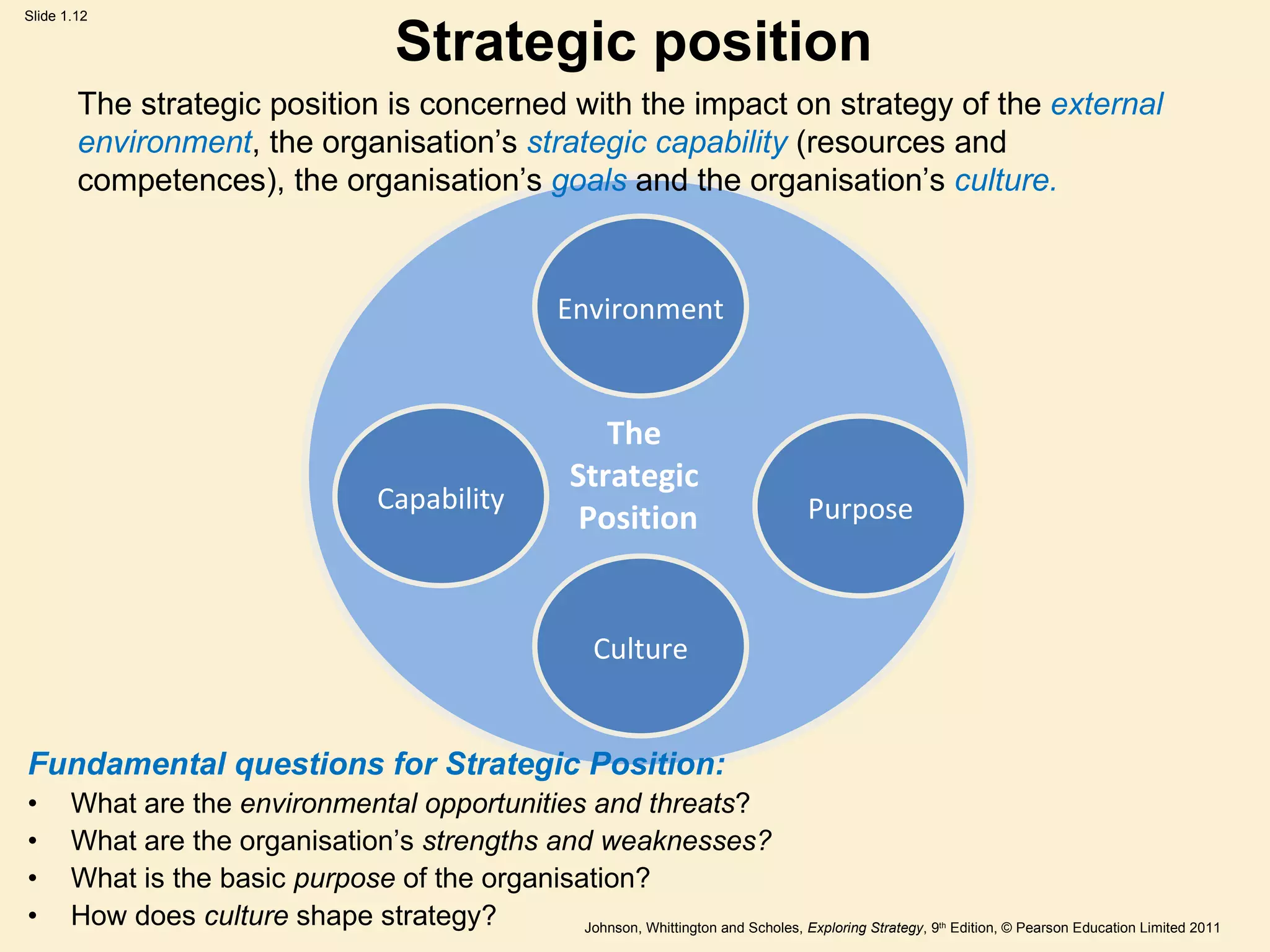
Strategic position The  Strategic  Position Environment Culture Purpose Capability The strategic position is concerned with the impact on strategy of the  external environment , the organisation ’ s  strategic capability  (resources and competences), the organisation ’ s  goals  and the organisation ’ s  culture. Fundamental questions for Strategic Position: •  What are the  environmental opportunities and threats ? •  What are the organisation ’ s  strengths and weaknesses? •  What is the basic  purpose  of the organisation? •  How does  culture  shape strategy?
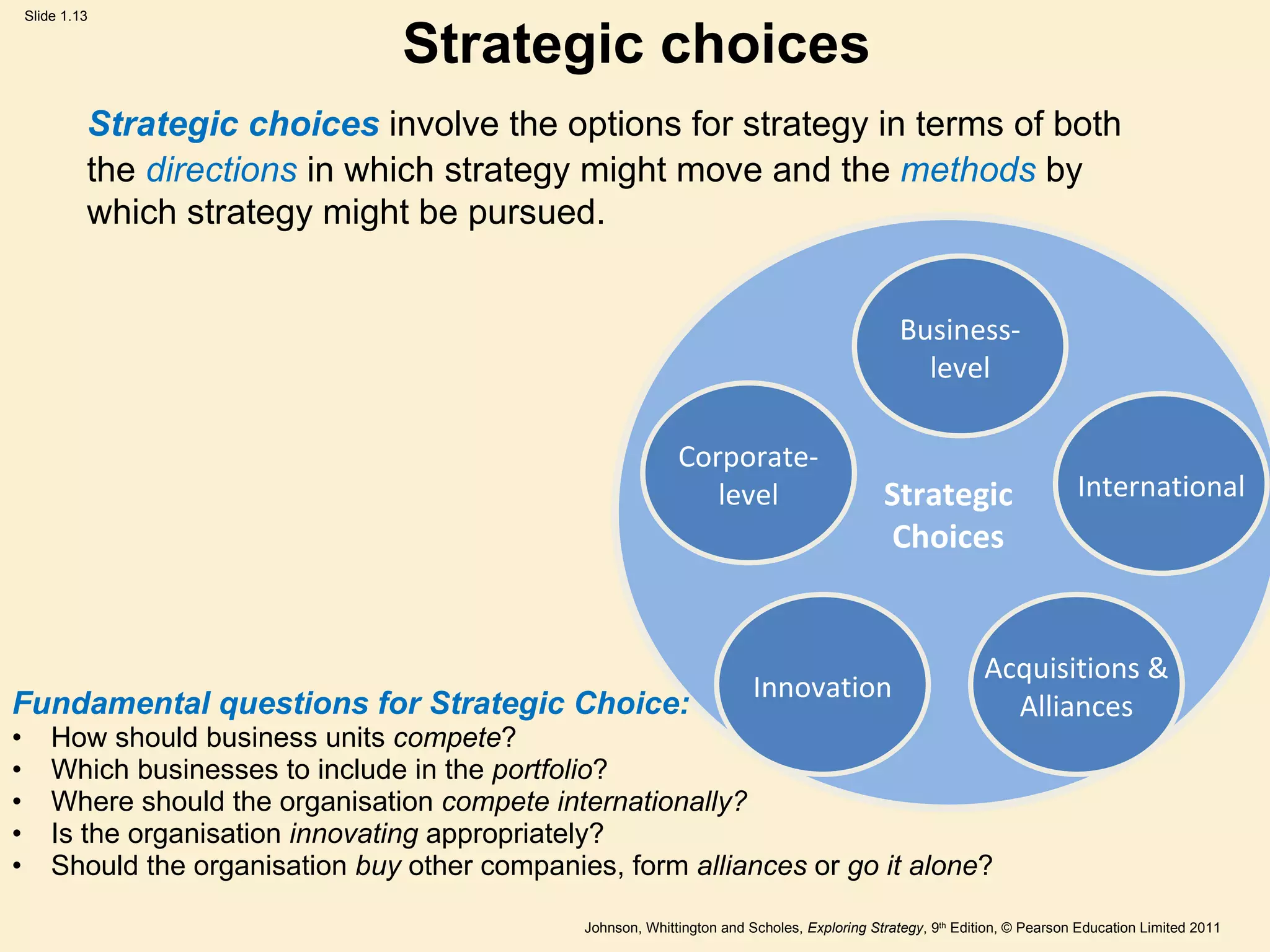
Strategic choices Strategic  Choices Business- level Innovation International Corporate- level Acquisitions & Alliances  Strategic choices  involve the options for strategy in terms of both the  directions   in which strategy might move and the  methods   by which strategy might be pursued. Fundamental questions for Strategic Choice: •  How should business units  compete ? •  Which businesses to include in the  portfolio ? •  Where should the organisation  compete internationally? •  Is the organisation  innovating  appropriately? •  Should the organisation  buy  other companies, form  alliances  or  go it alone ?
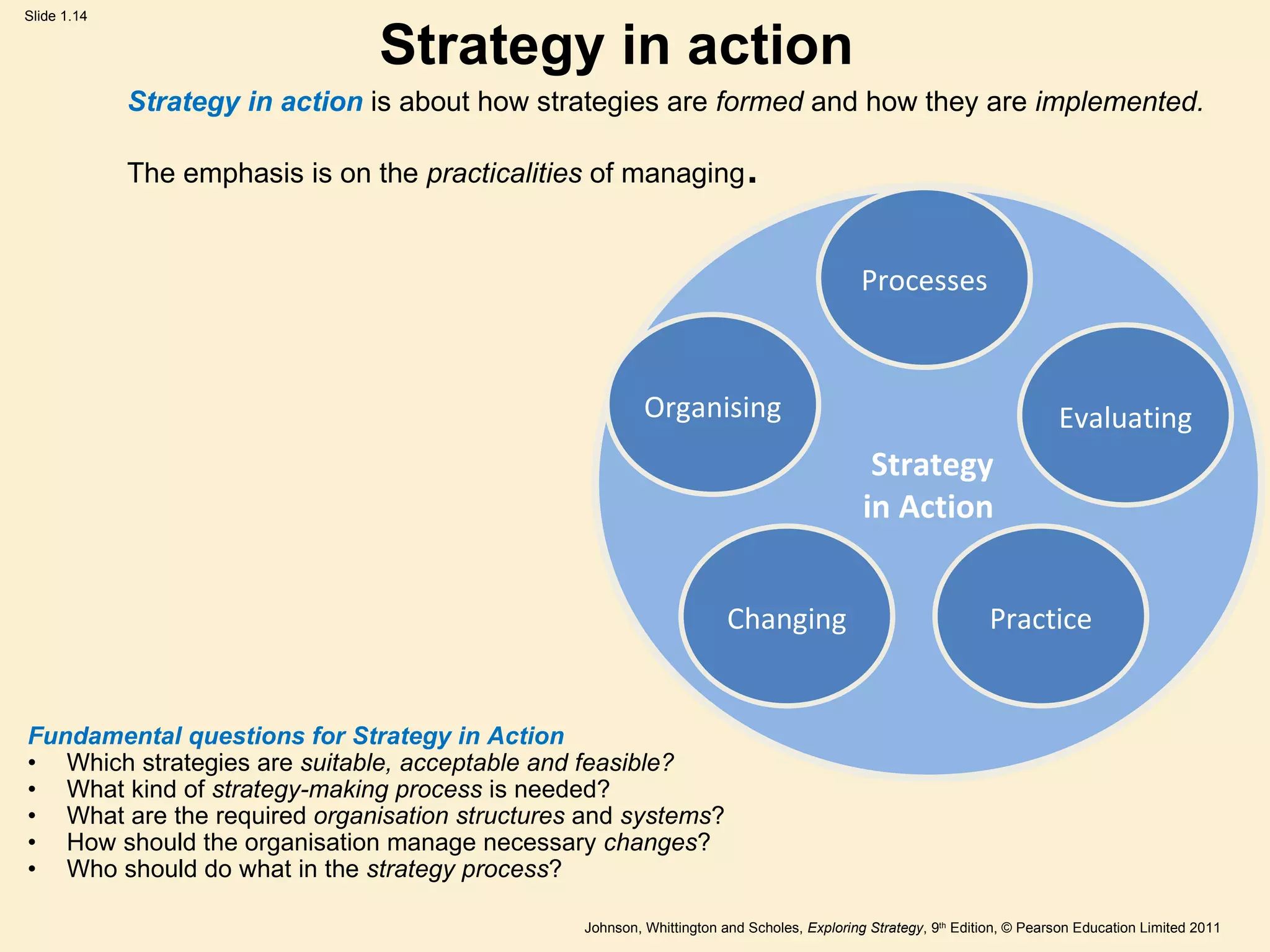
Strategy in action Strategy in Action  Processes Changing Evaluating Organising Practice Strategy in action  is about how strategies are  formed  and how they are  implemented. The emphasis is on the  practicalities  of managing . Fundamental questions for Strategy in Action •  Which strategies are  suitable, acceptable and feasible? •  What kind of  strategy-making process  is needed? •  What are the required  organisation structures  and  systems ? •  How should the organisation manage necessary  changes ? •  Who should do what in the  strategy process ?
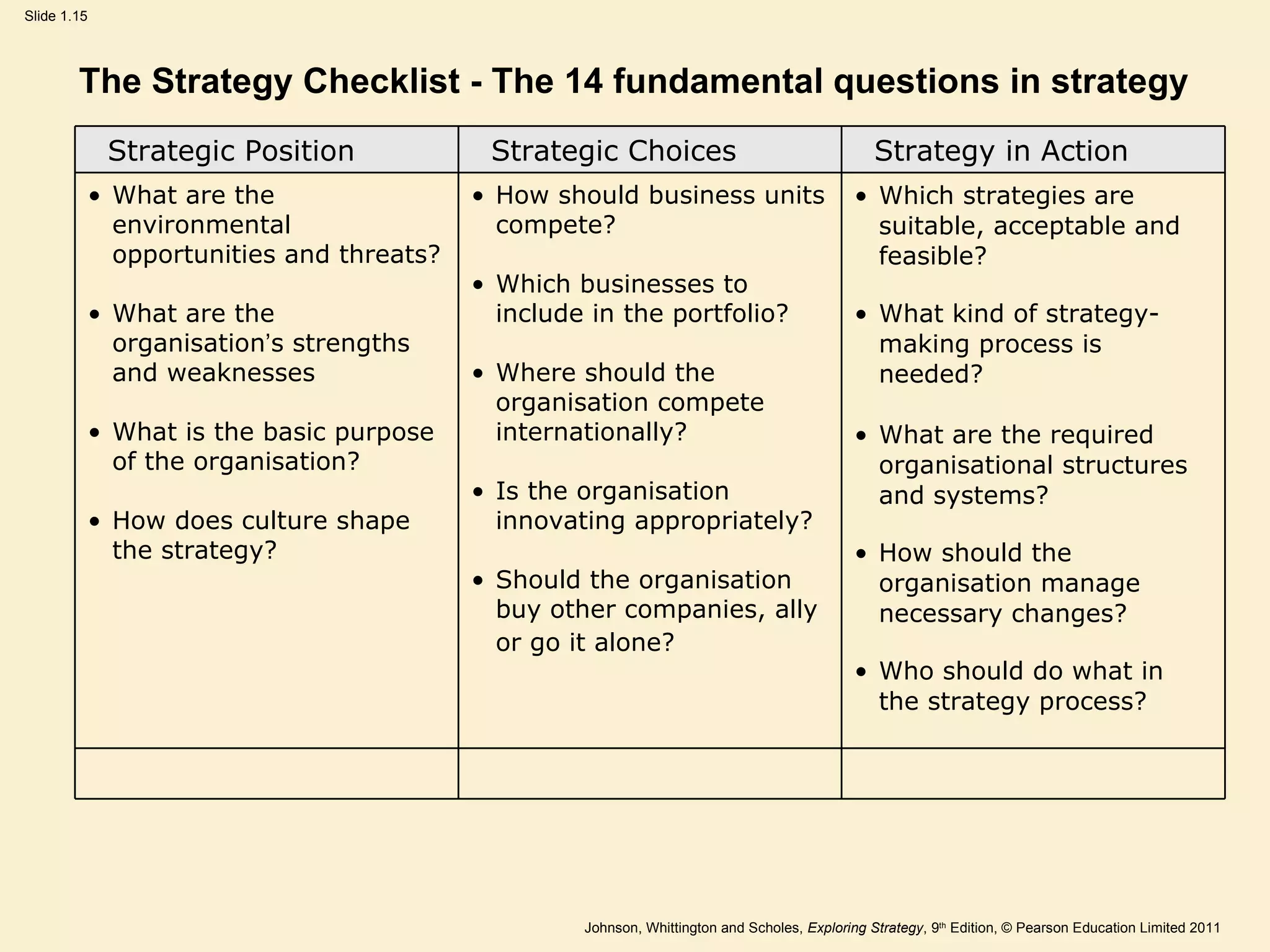
The Strategy Checklist - The 14 fundamental questions in strategy Strategic Position Strategic Choices  Strategy in Action What are the  environmental opportunities and threats? What are the organisation ’ s strengths and weaknesses What is the basic purpose of the organisation? How does culture shape the strategy? How should business units compete? Which businesses to include in the portfolio? Where should the organisation compete internationally? Is the organisation innovating appropriately? Should the organisation buy other companies, ally or go it alone?   Which strategies are suitable, acceptable and feasible? What kind of strategy-making process is needed? What are the required organisational structures and systems? How should the organisation manage necessary changes? Who should do what in the strategy process?
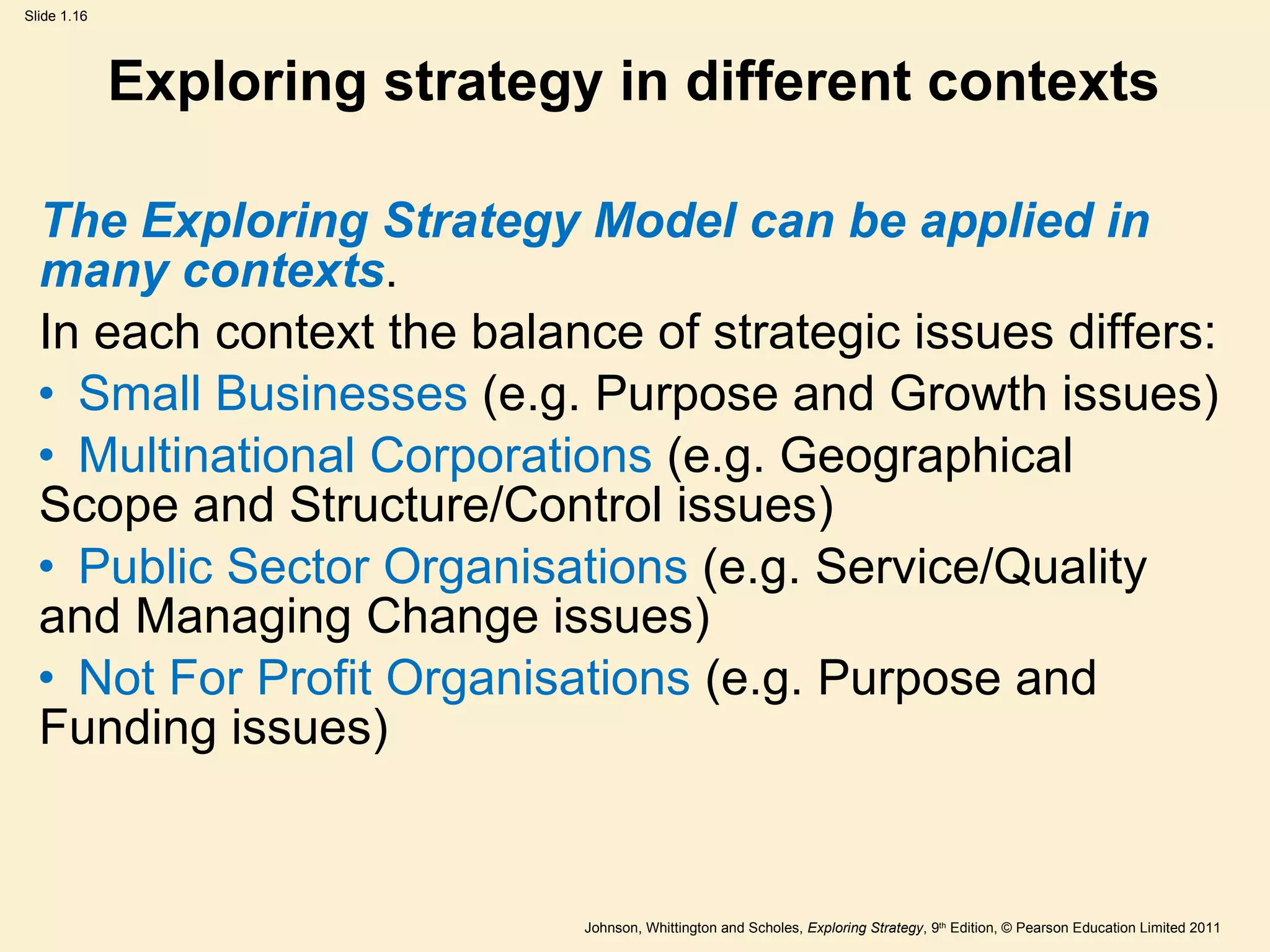
Exploring strategy in different contexts The Exploring Strategy Model can be applied in many contexts . In each context the balance of strategic issues differs: Small Businesses  (e.g. Purpose and Growth issues) Multinational Corporations  (e.g. Geographical  Scope and Structure/Control issues) Public Sector Organisations  (e.g. Service/Quality  and Managing Change issues) Not For Profit Organisations  (e.g. Purpose and  Funding issues)
The strategy lenses The strategy lenses  are ways of looking at strategy issues differently in order to generate many insights. Looking at problems in different ways will raise new issues and new solutions. Strategy can be seen as: Design Experience Variety (Ideas) Discourse
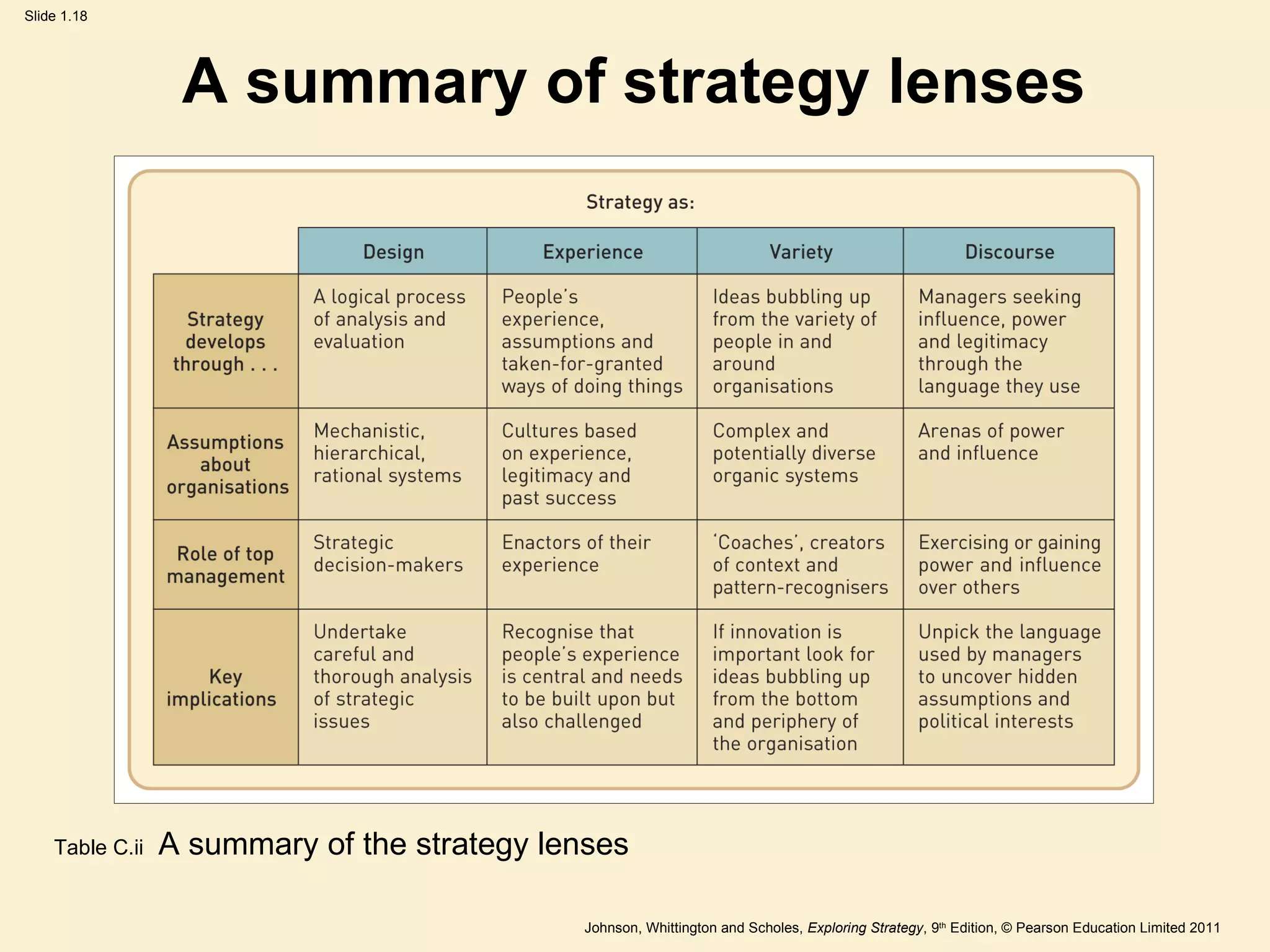
A summary of strategy lenses Table C.ii  A summary of the strategy lenses
Summary Strategy is the  long-term direction  of an organisation. A  ‘ strategy statement ’  should cover the  goals  of an organisation, the  scope  of the organisation ’ s activities and the  advantages or   capabilities  the organisation brings to these goals and activities. Corporate-level strategy  is concerned with an organisation ’ s overall scope;  business-level strategy  is concerned with how to compete; and  operational strategy  is concerned with how resources, processes and people deliver corporate- and business-level strategy. Strategy work  is done by  managers  throughout an organisation, as well as  specialist strategic planners  and  strategy consultants . Research on strategy  context, content and process  shows how the analytical perspectives of economics, sociology and psychology can all provide practical insights for approaching strategy issues The Exploring Strategy Model has three major elements: understanding the  strategic position , making  strategic choices  for the future and managing  strategy-in-action . Strategic issues are best seen from a variety of perspectives, as exemplified by the four  strategy lenses of design, experience, variety and discourse .
Session I: The Strategic Position
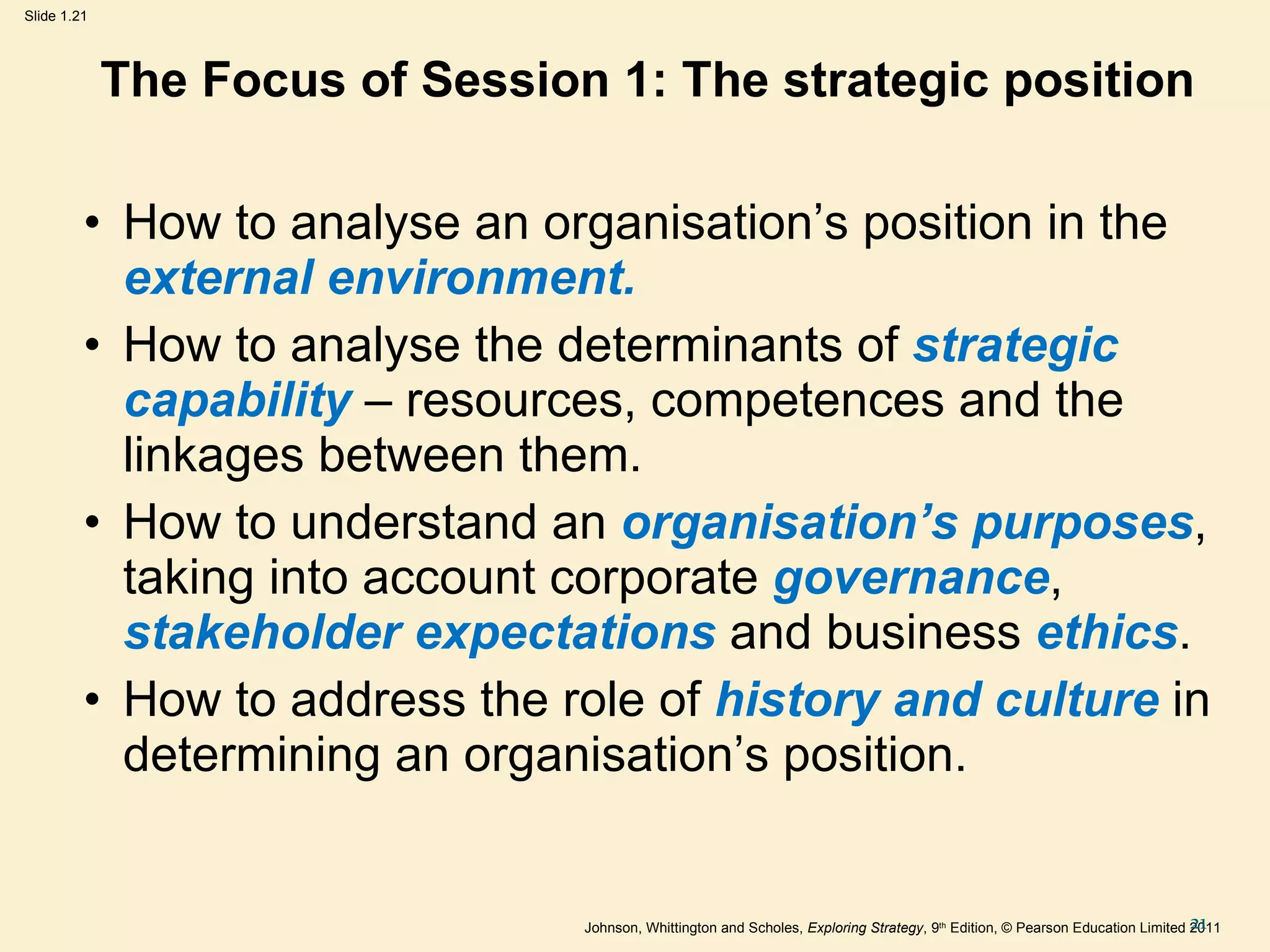
The Focus of Session 1: The strategic position How to analyse an organisation ’ s position in the  external environment. How to analyse the determinants of  strategic capability  – resources, competences and the linkages between them. How to understand an  organisation ’ s purposes , taking into account corporate  governance ,  stakeholder expectations  and business  ethics . How to address the role of  history and culture  in determining an organisation ’ s position.
The Strategic Position 2: The Environment
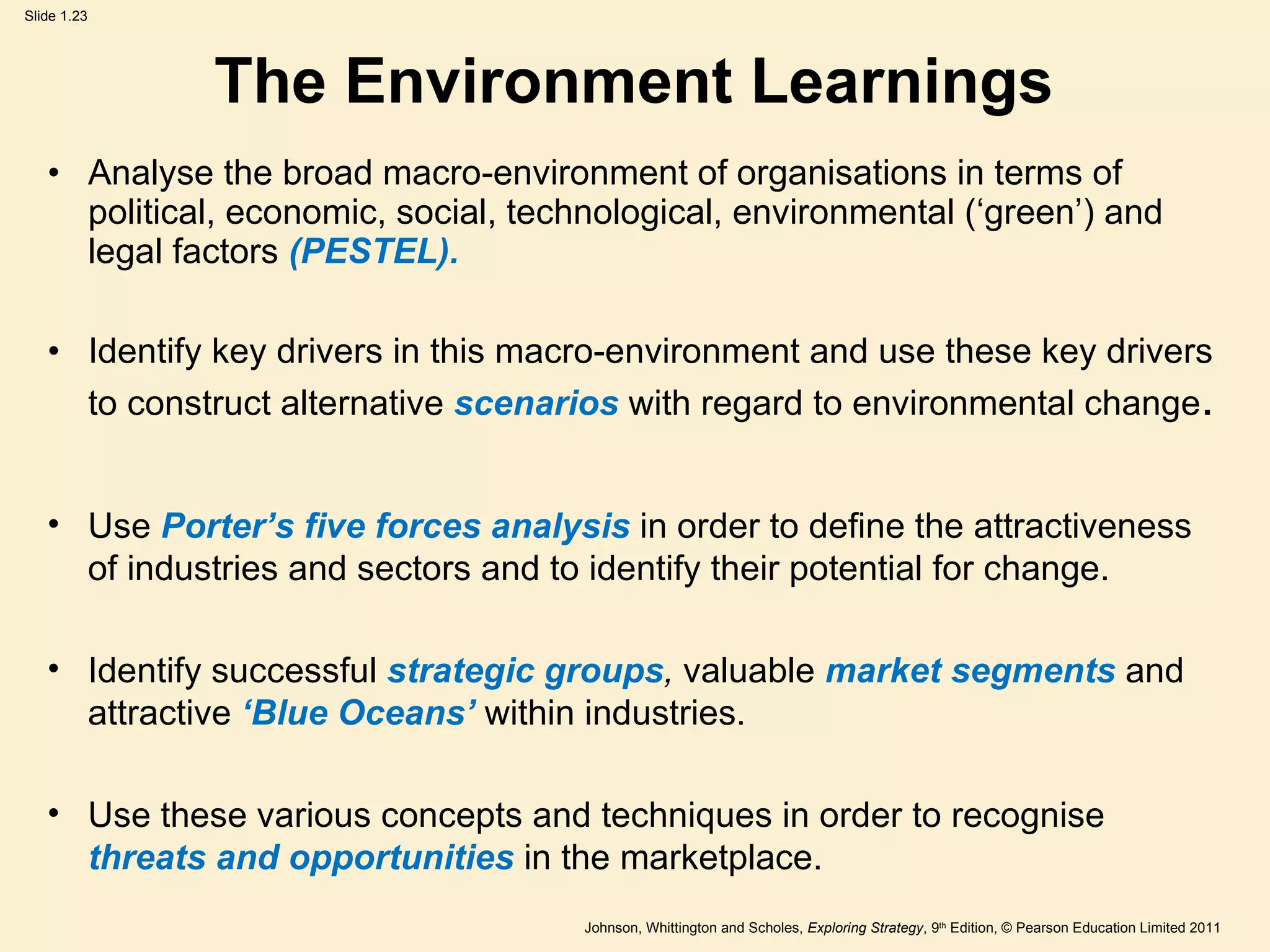
The Environment Learnings Analyse the broad macro-environment of organisations in terms of political, economic, social, technological, environmental ( ‘ green ’ ) and legal factors  (PESTEL). Identify key drivers in this macro-environment and use these key drivers to construct alternative  scenarios  with regard to   environmental change . Use  Porter ’ s five forces analysis  in order to define the attractiveness of industries and sectors and to identify their potential for change. Identify successful  strategic groups ,  valuable   market segments  and attractive  ‘ Blue Oceans ’   within industries. Use these various concepts and techniques in order to recognise  threats and opportunities  in the marketplace.
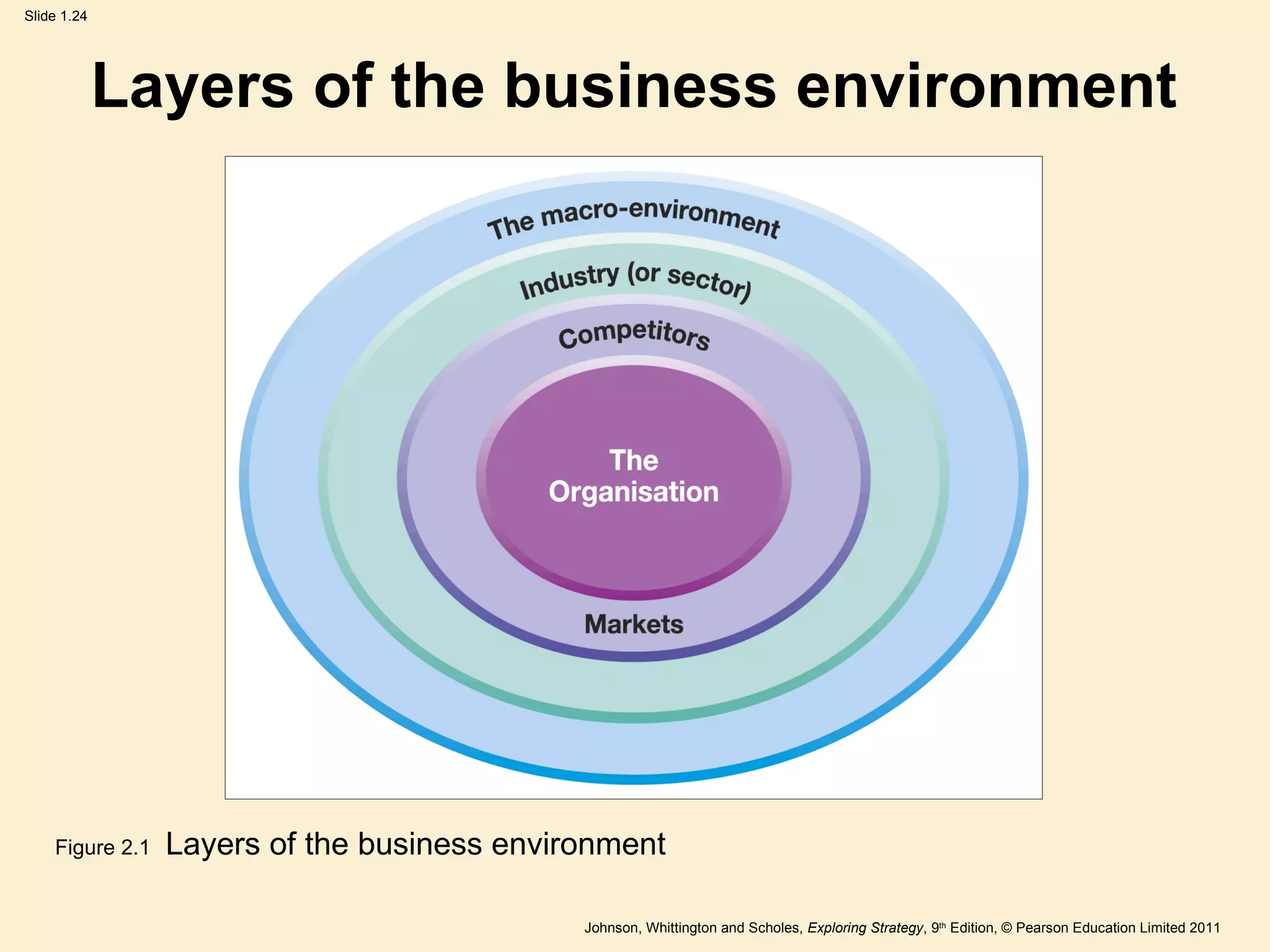
Layers of the business environment Figure 2.1   Layers of the business environment
The PESTEL framework (1) The PESTEL framework categorises environmental influences into six main types:   political,  economic,  social,  technological,    environmental  legal Thus PESTEL provides a comprehensive list of influences on the possible success or failure of particular strategies.
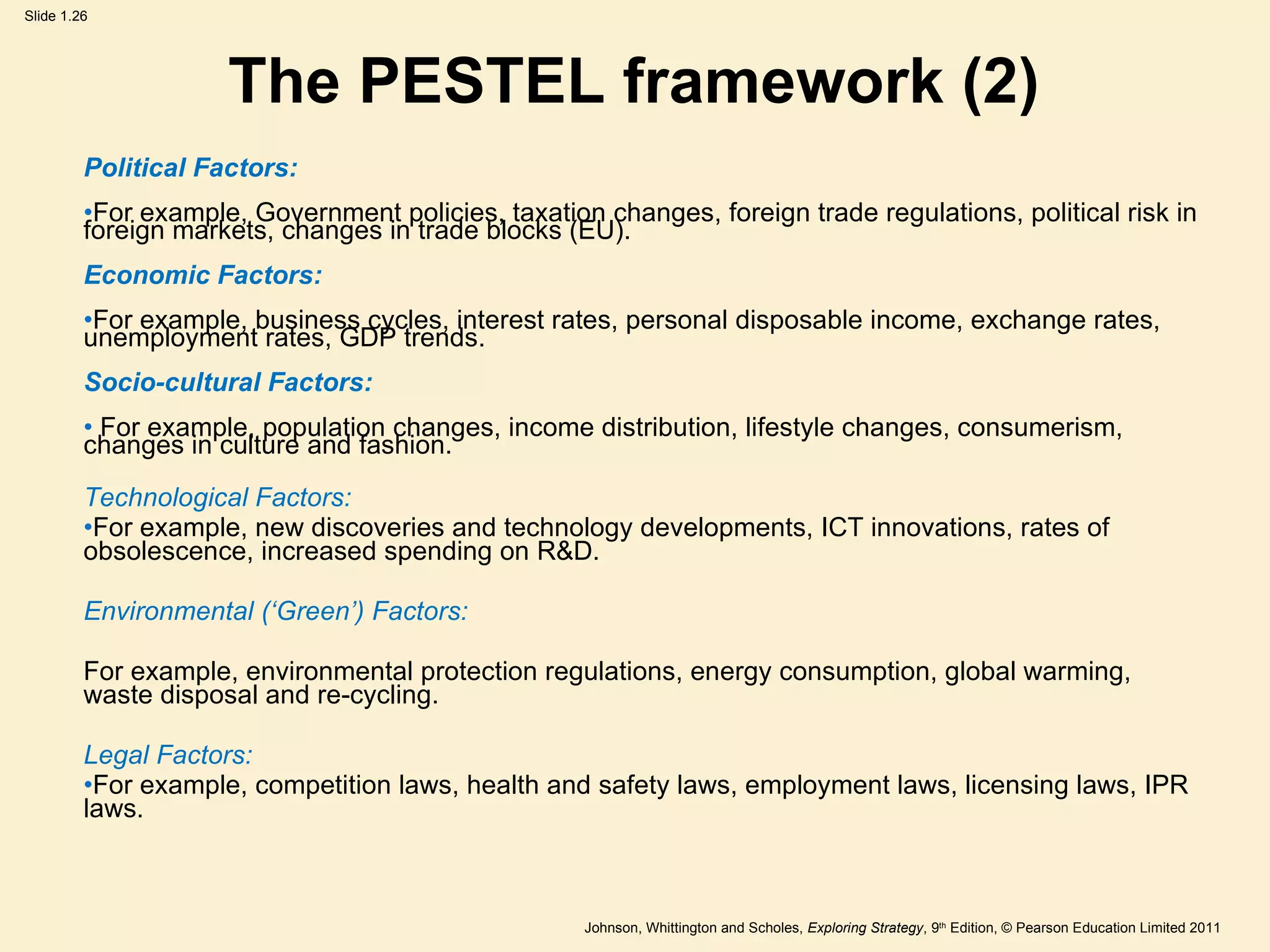
The PESTEL framework (2) Political Factors:  For example, Government policies, taxation changes, foreign trade regulations, political risk in foreign markets, changes in trade blocks (EU). Economic Factors: For example, business cycles, interest rates, personal disposable income, exchange rates, unemployment rates, GDP trends. Socio-cultural Factors:  For example, population changes, income distribution, lifestyle changes, consumerism, changes in culture and fashion. Technological Factors:   For example, new discoveries and technology developments, ICT innovations, rates of obsolescence, increased spending on R&D. Environmental ( ‘ Green ’ ) Factors:   For example, environmental protection regulations, energy consumption, global warming, waste disposal and re-cycling. Legal Factors:   For example, competition laws, health and safety laws, employment laws, licensing laws, IPR laws.
Key drivers of change Key drivers for change: The environmental factors likely to have a high impact on the success or failure of strategy.  For example, the birth rate is a key driver for those planning nursery education provision in the public sector. Typically key drivers vary by industry or sector.
Using the PESTEL framework Apply  selectively  –identify specific factors which impact on the industry, market and organisation in question. Identify factors which are  important currently  but also consider which will become  more important in the next few years. Use  data  to support the points and analyse trends using up to date information Identify  opportunities and threats  – the main point of the exercise!
Scenarios Scenarios  are detailed and plausible views of how the environment of an organisation might develop in the future based on key drivers of change about which there is a high level of uncertainty. Build on PESTEL analysis . Do not offer a single forecast of how the  environment will change. An organisation should develop a few alternative  scenarios (2 – 4) to analyse future strategic options.
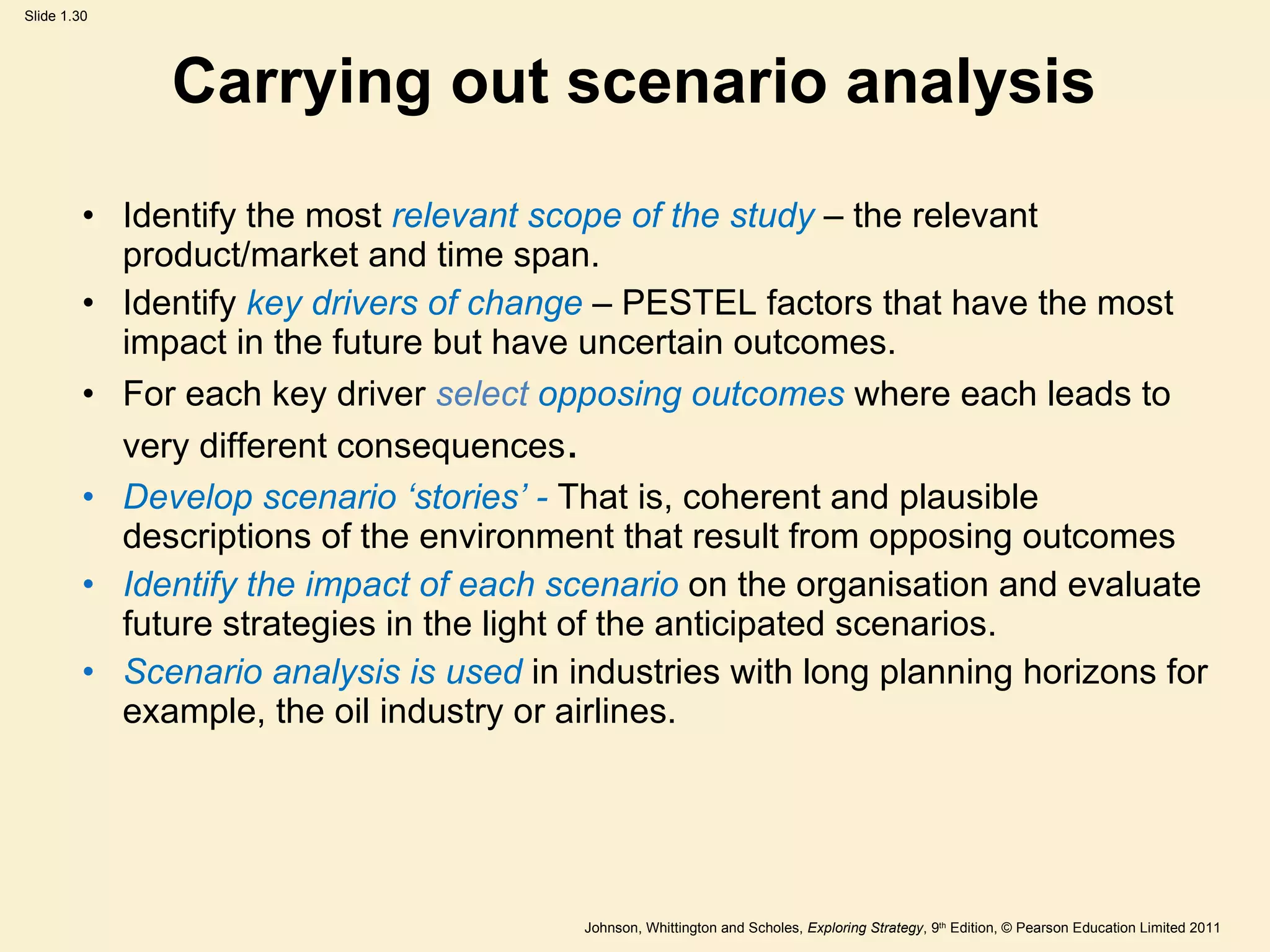
Carrying out scenario analysis Identify the most  relevant scope of the study  – the relevant product/market and time span. Identify  key drivers of change  – PESTEL factors that have the most impact in the future but have uncertain outcomes. For each key driver  select  opposing outcomes  where each leads to very different consequences . Develop scenario  ‘ stories ’  -  That is, coherent and plausible descriptions of the environment that result from opposing outcomes Identify the impact of each scenario  on the organisation and evaluate future strategies in the light of the anticipated scenarios. Scenario analysis is used  in industries with long planning horizons for example, the oil industry or airlines.
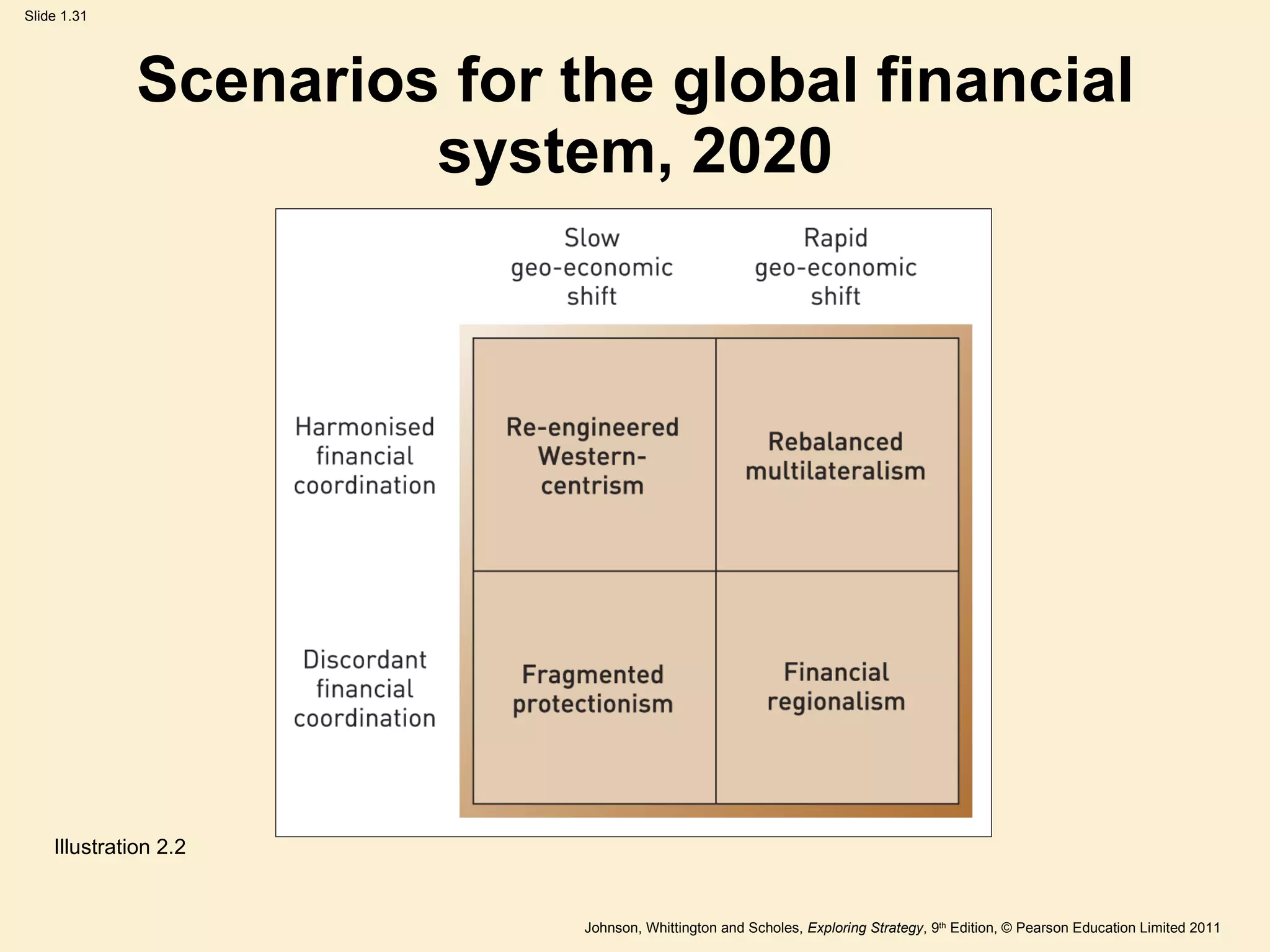
Scenarios for the global financial system, 2020 Illustration 2.2
Industries, markets and sectors An industry  is a group of firms producing products and services that are essentially the same. For example, automobile industry and airline industry. A market  is a group of customers for specific products or services that are essentially the same (e.g. the market for luxury cars in Germany). A sector  is a broad industry group (or a group of markets) especially in the public sector (e.g. the health sector)
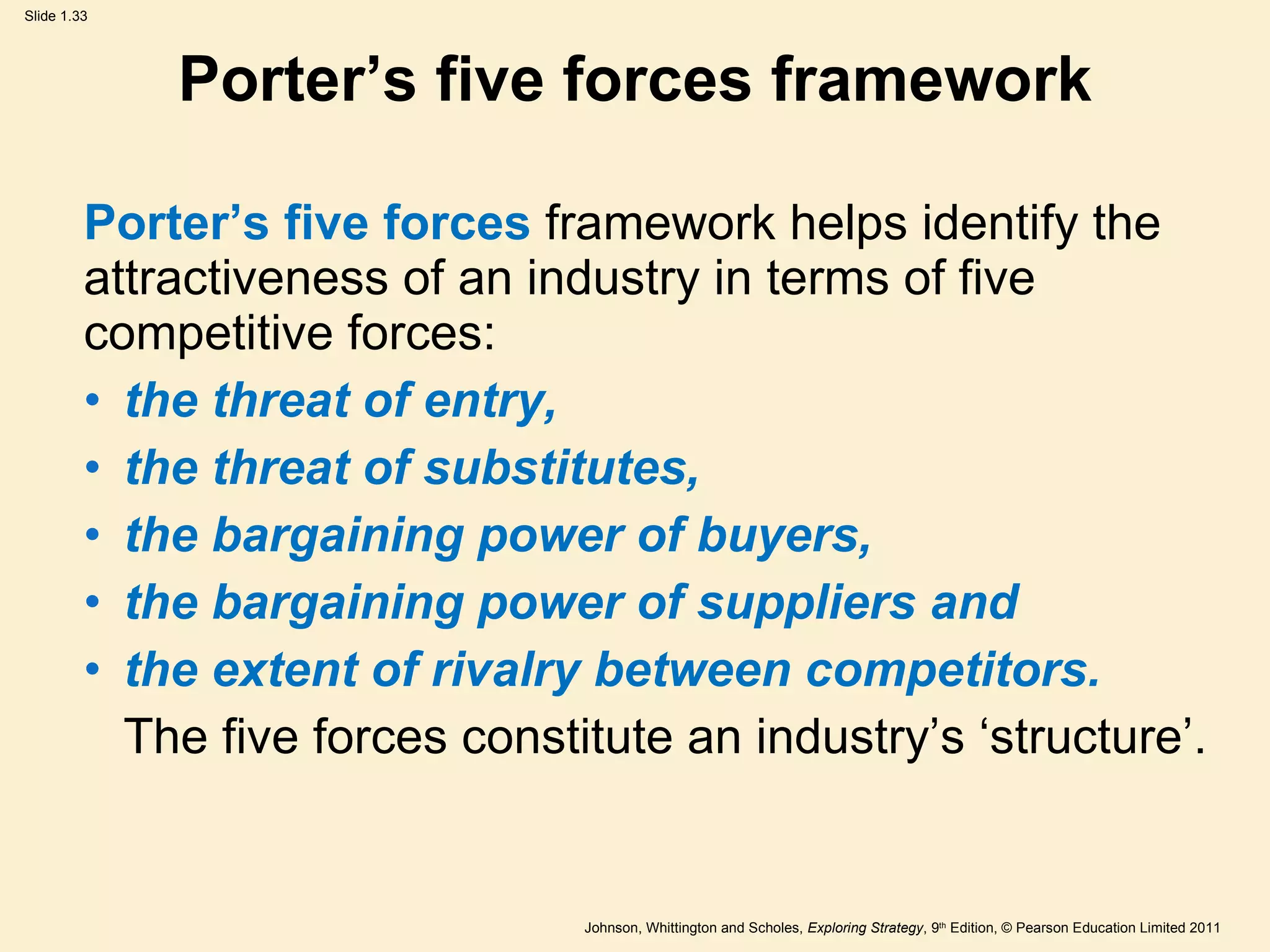
Porter ’ s five forces framework Porter ’ s five forces  framework helps identify the attractiveness of an industry in terms of five competitive forces:  the threat of entry,  the threat of substitutes,  the bargaining power of buyers, the bargaining power of suppliers and the extent of rivalry between competitors.  The five forces constitute an industry ’ s  ‘ structure ’ .
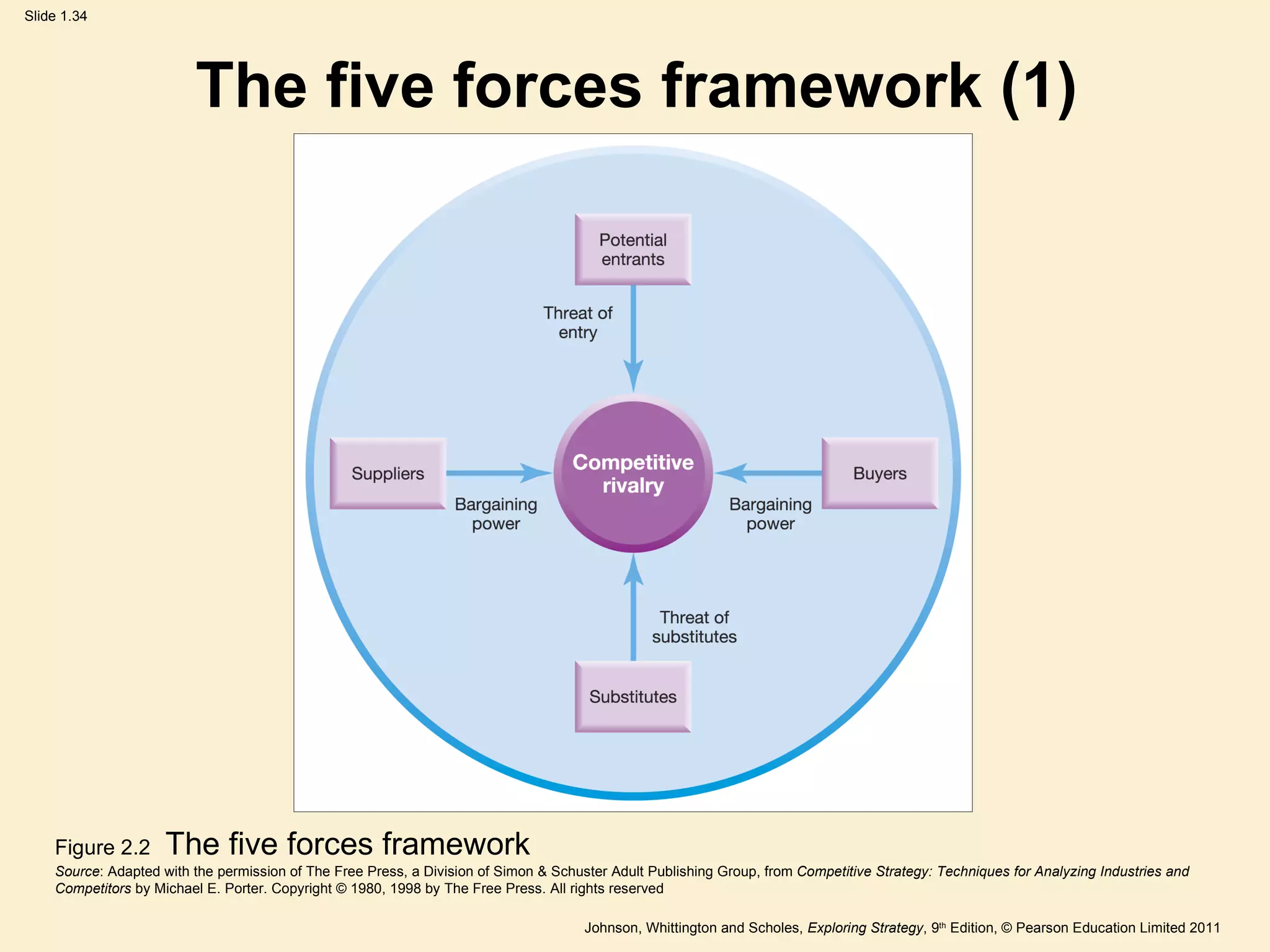
Source : Adapted with the permission of The Free Press, a Division of Simon & Schuster Adult Publishing Group, from  Competitive Strategy: Techniques for Analyzing Industries and Competitors  by Michael E. Porter. Copyright © 1980, 1998 by The Free Press. All rights reserved The five forces framework (1) Figure 2.2   The five forces framework
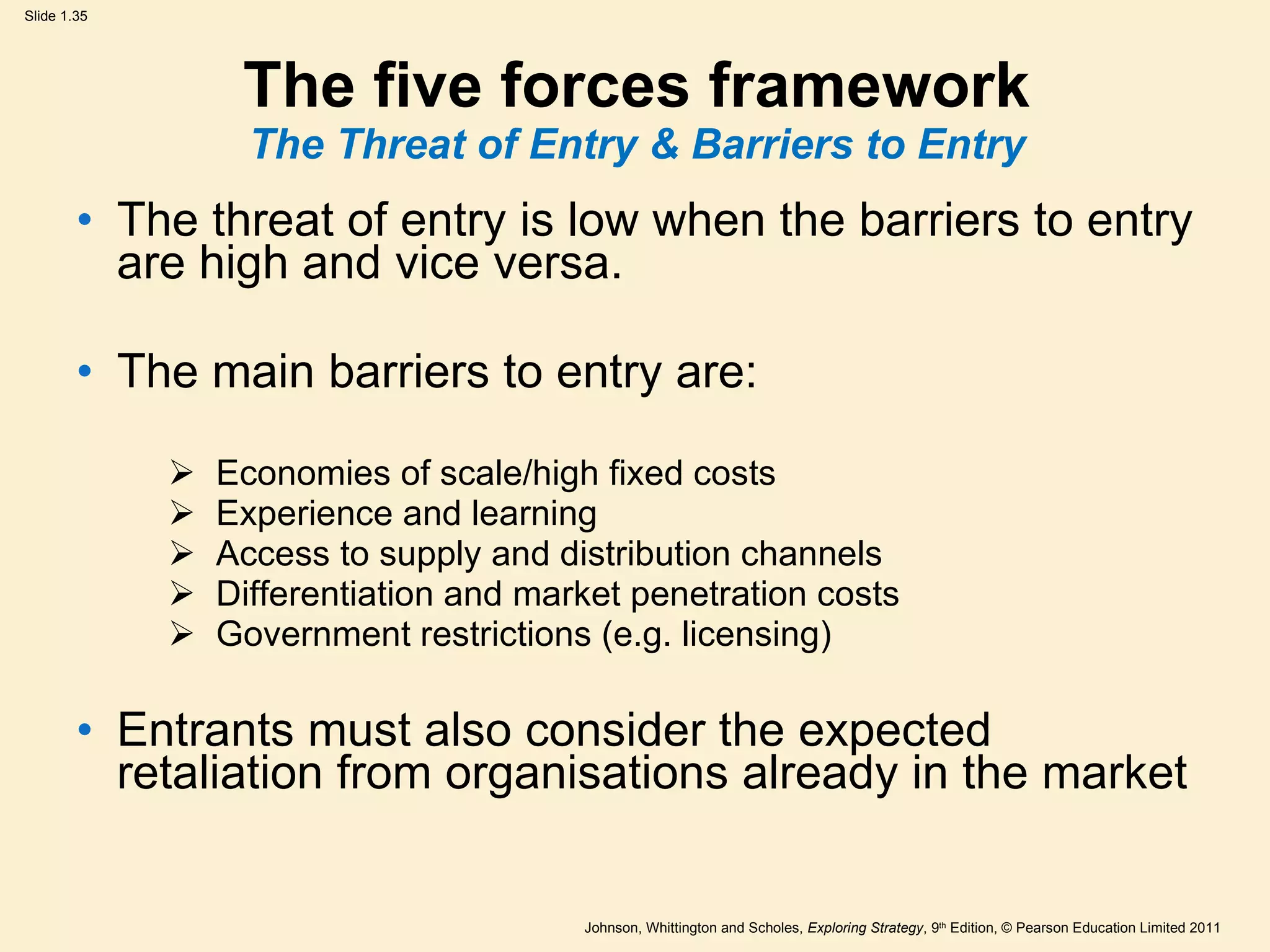
The five forces framework The Threat of Entry & Barriers to Entry The threat of entry is low when the barriers to entry are high and vice versa. The main barriers to entry are: Economies of scale/high fixed costs Experience and learning Access to supply and distribution channels Differentiation and market penetration costs Government restrictions (e.g. licensing) Entrants must also consider the expected retaliation from organisations already in the market
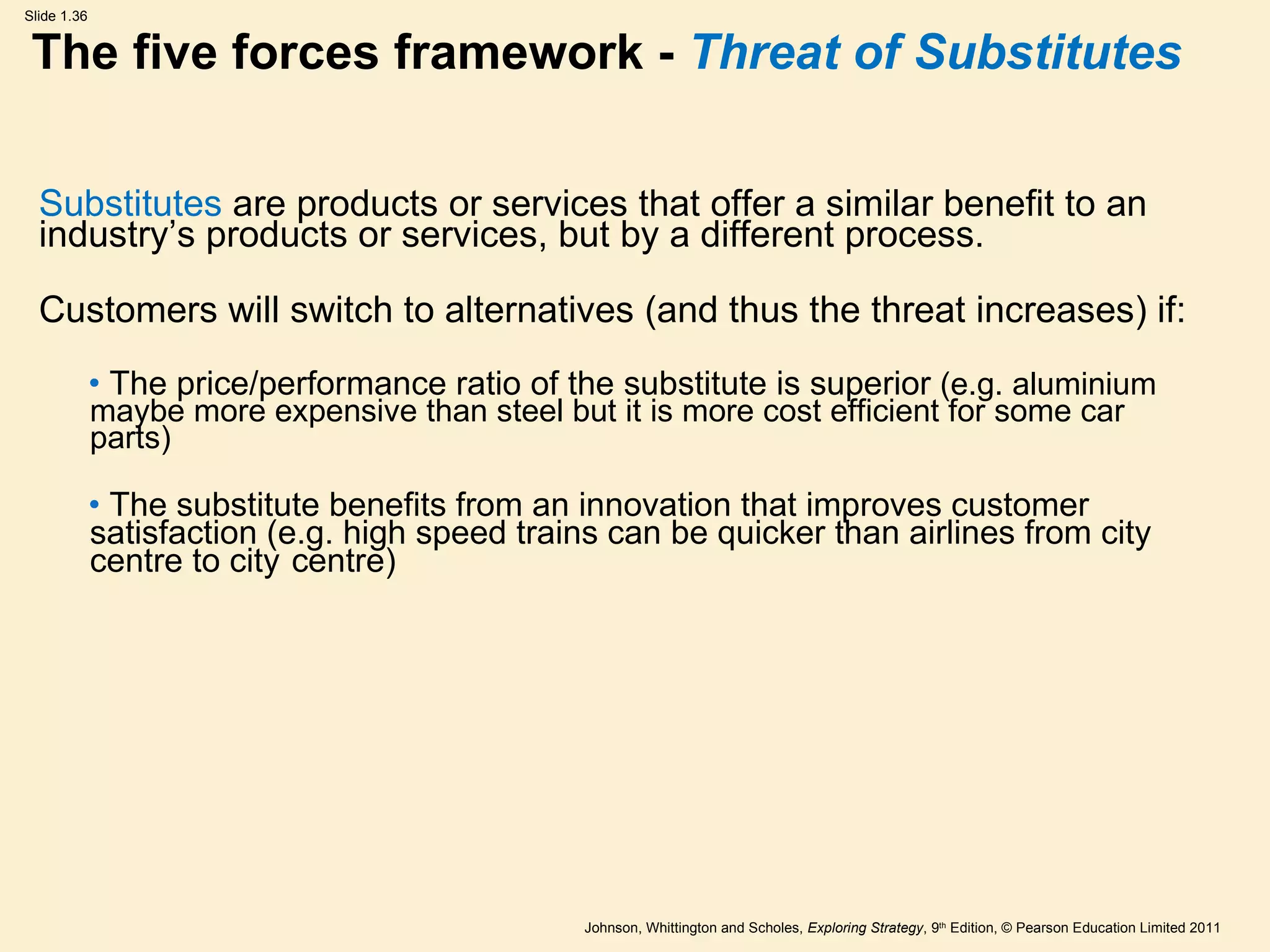
The five forces framework -  Threat of Substitutes Substitutes  are products or services that offer a similar benefit to an industry ’ s products or services, but by a different process. Customers will switch to alternatives (and thus the threat increases) if: The price/performance ratio of the substitute is superior  (e.g. aluminium maybe more expensive than steel but it is more cost efficient for some car parts) The substitute benefits from an innovation that improves customer satisfaction (e.g. high speed trains can be quicker than airlines from city centre to city  centre)
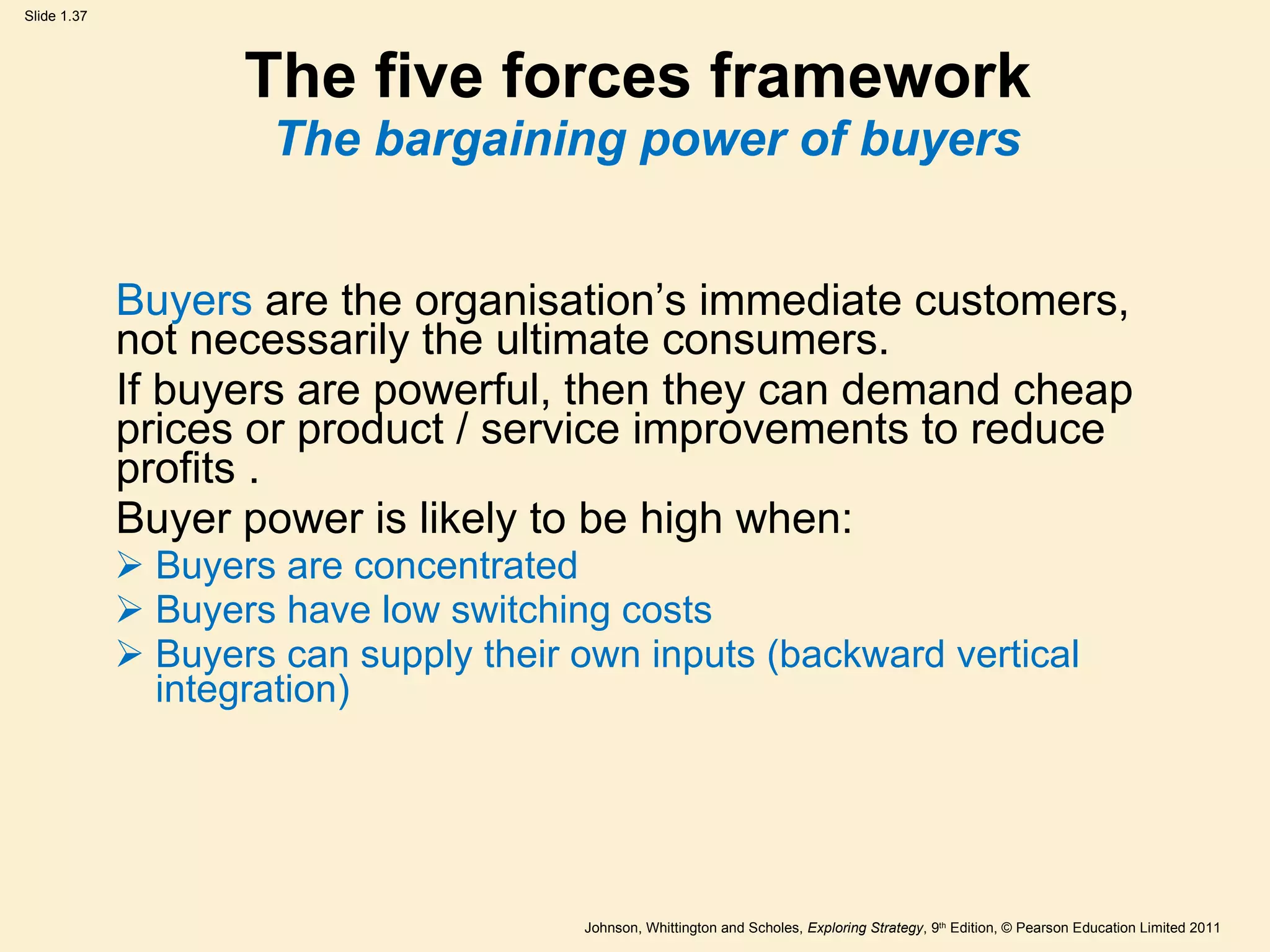
The five forces framework  The bargaining power of buyers Buyers  are the organisation ’ s immediate customers, not necessarily the ultimate consumers.  If buyers are powerful, then they can demand cheap prices or product / service improvements to reduce profits . Buyer power is likely to be high when: Buyers are concentrated Buyers have low switching costs Buyers can supply their own inputs (backward vertical integration)
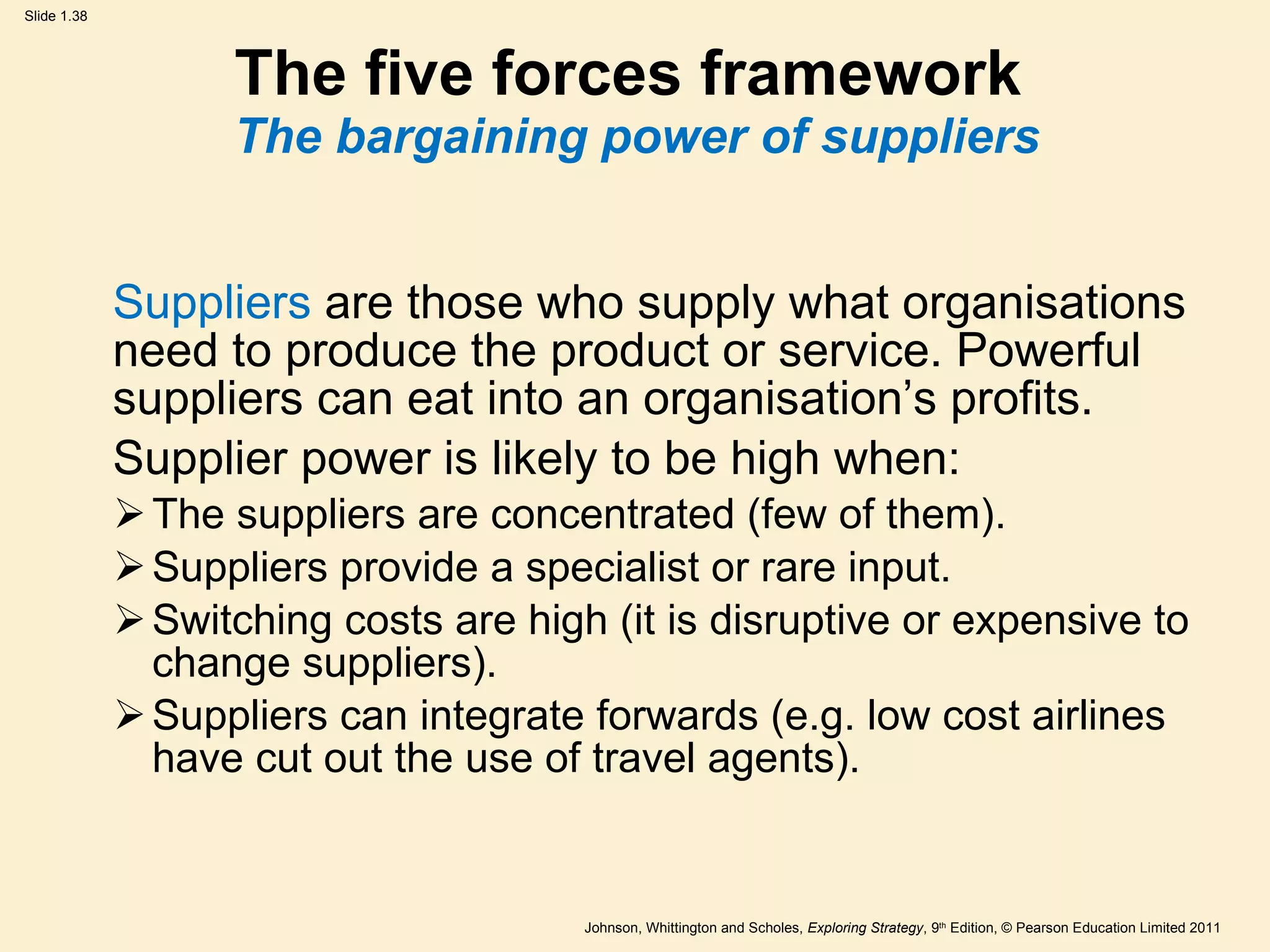
The five forces framework  The bargaining power of suppliers Suppliers  are those who supply what organisations need to produce the product or service. Powerful suppliers can eat into an organisation ’ s profits.  Supplier power is likely to be high when: The suppliers are concentrated (few of them). Suppliers provide a specialist or rare input. Switching costs are high (it is disruptive or expensive to change suppliers). Suppliers can integrate forwards (e.g. low cost airlines have cut out the use of travel agents).
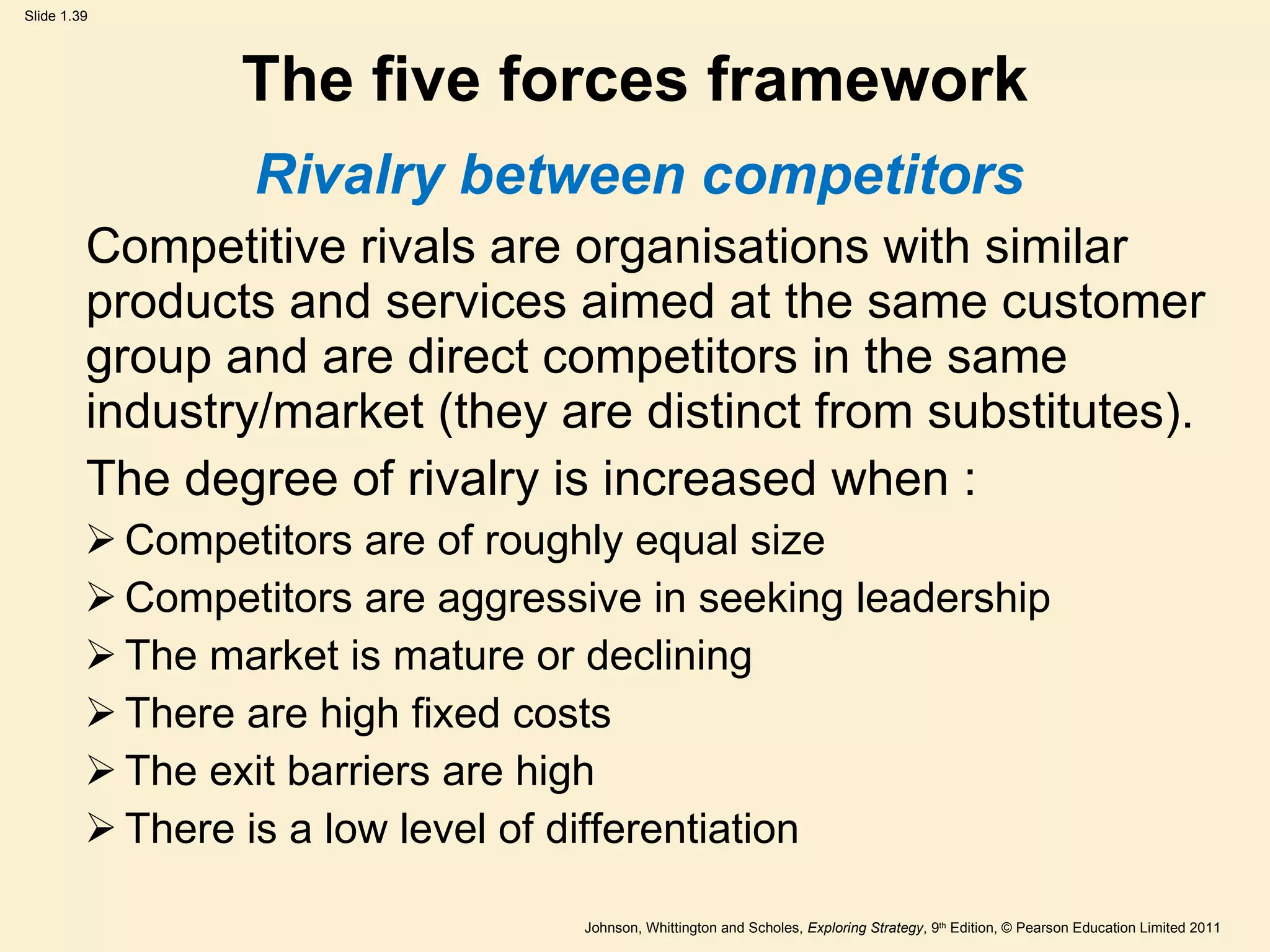
The five forces framework Rivalry between competitors Competitive rivals are organisations with similar products and services aimed at the same customer group and are direct competitors in the same industry/market (they are distinct from substitutes). The degree of rivalry is increased when : Competitors are of roughly equal size Competitors are aggressive in seeking leadership The market is mature or declining There are high fixed costs The exit barriers are high There is a low level of differentiation
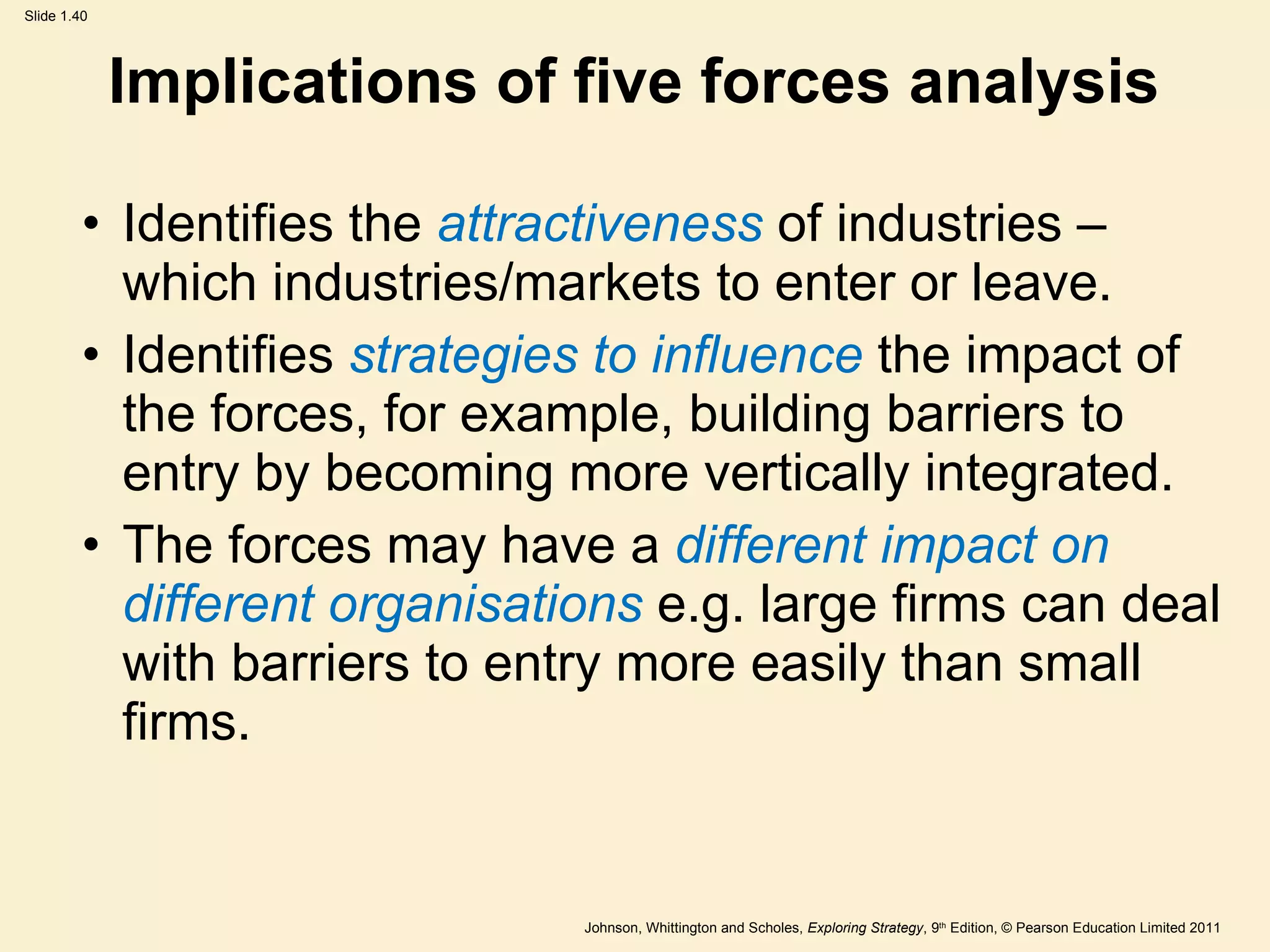
Implications of five forces analysis Identifies the  attractiveness  of industries – which industries/markets to enter or leave. Identifies  strategies to influence  the impact of the forces, for example, building barriers to entry by becoming more vertically integrated. The forces may have a  different impact on different organisations  e.g. large firms can deal with barriers to entry more easily than small firms.
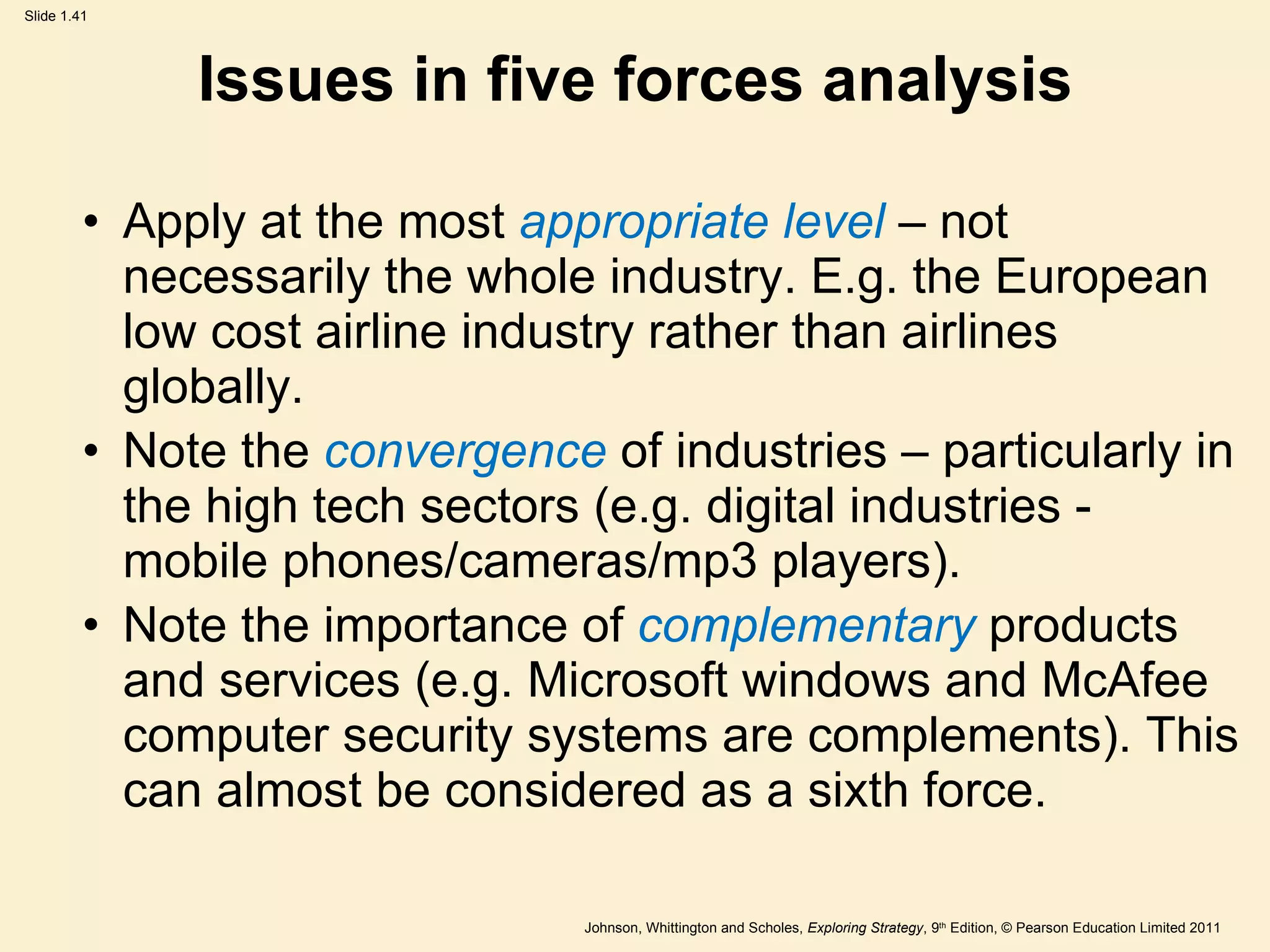
Issues in five forces analysis Apply at the most  appropriate level  – not necessarily the whole industry. E.g. the European low cost airline industry rather than airlines globally. Note the  convergence   of industries – particularly in the high tech sectors (e.g. digital industries - mobile phones/cameras/mp3 players). Note the importance of  complementary   products and services (e.g. Microsoft windows and McAfee computer security systems are complements). This can almost be considered as a sixth force.
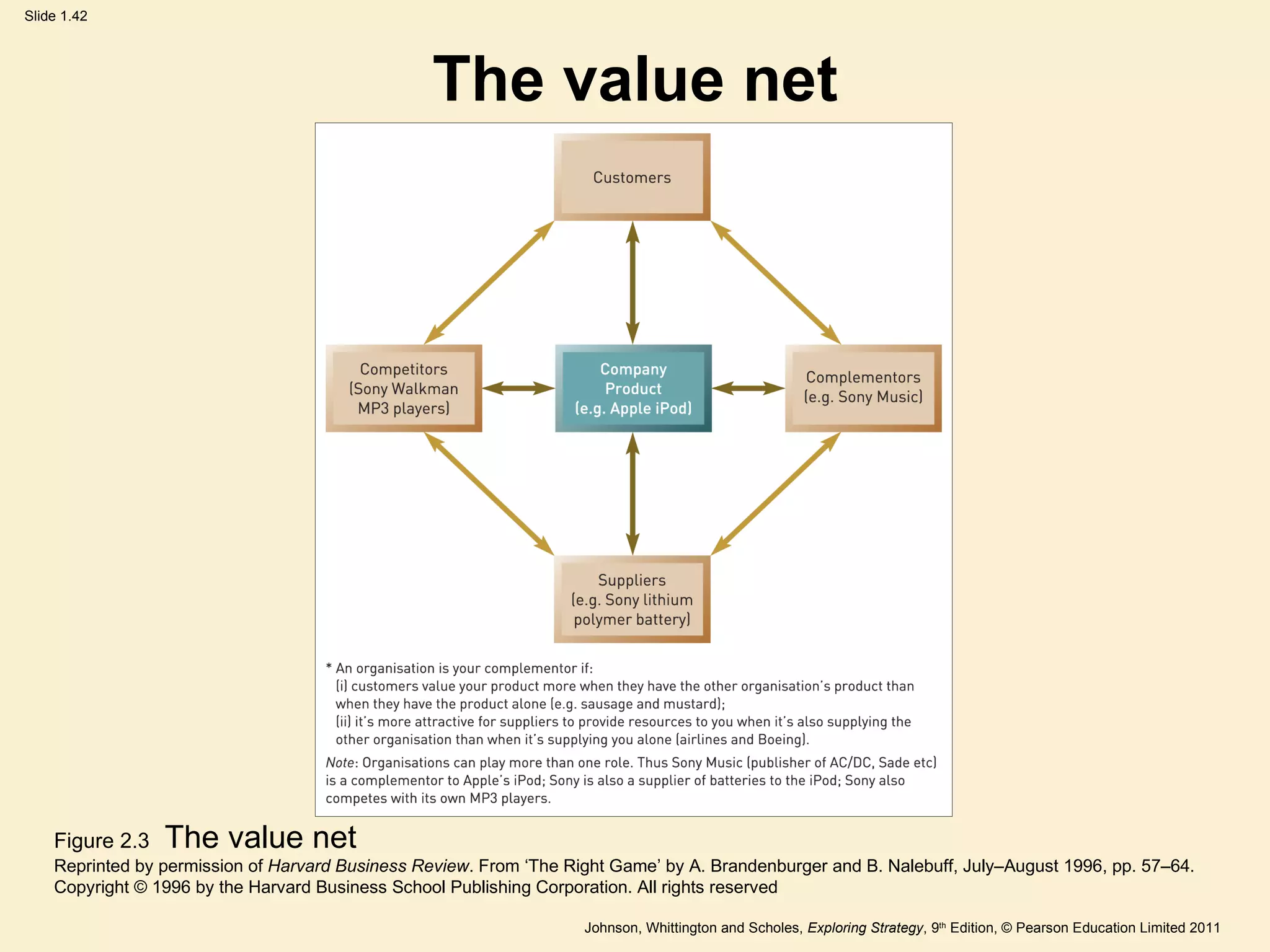
The value net Figure 2.3  The value net Reprinted by permission of  Harvard Business Review . From  ‘The Right Game’ by A. Brandenburger and B. Nalebuff, July–August 1996, pp. 57–64. Copyright © 1996 by the Harvard Business School Publishing Corporation. All rights reserved
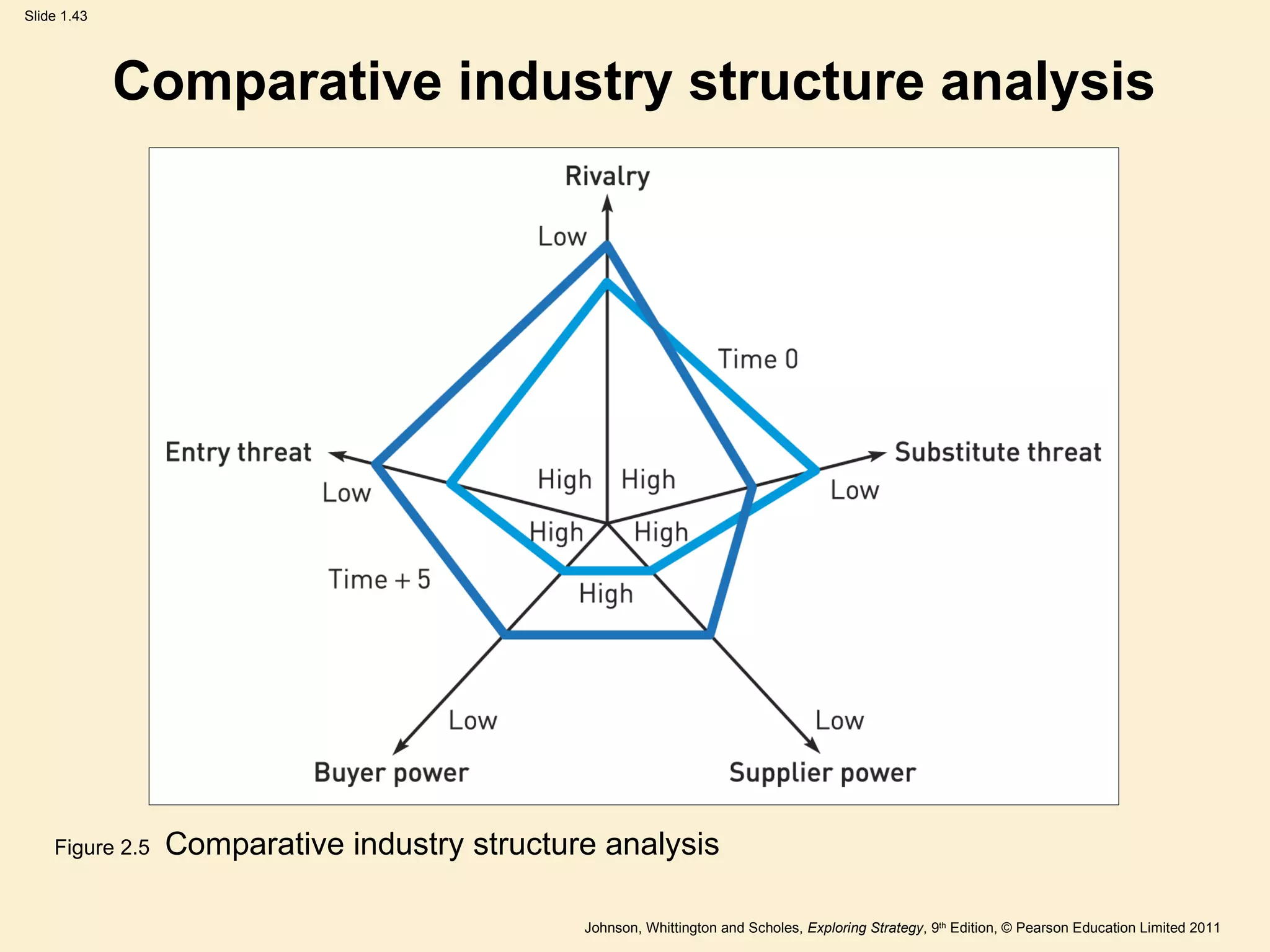
Comparative industry structure analysis Figure 2.5  Comparative industry structure analysis
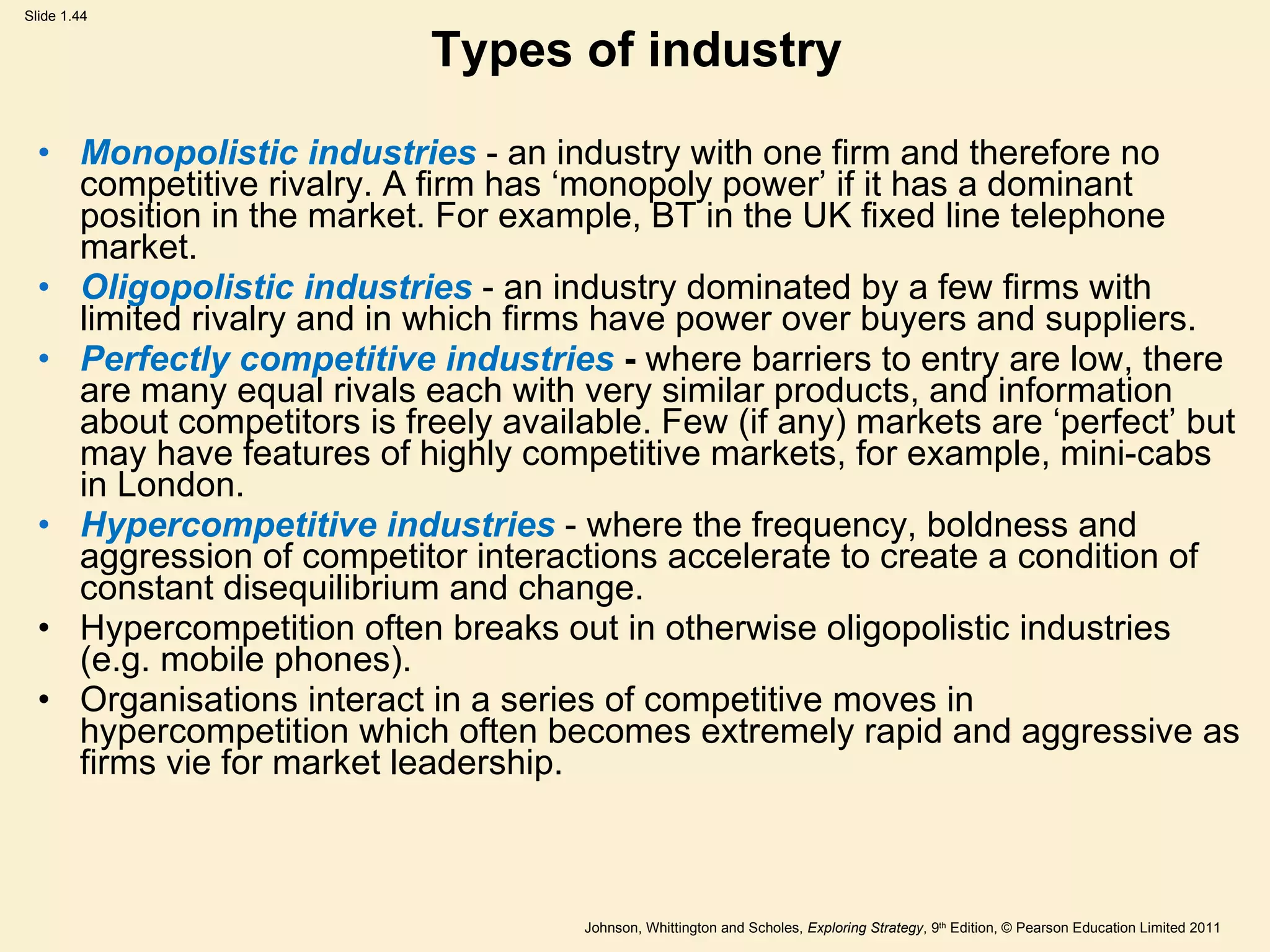
Types of industry Monopolistic industries  - an industry with one firm and therefore no competitive rivalry. A firm has  ‘ monopoly power ’  if it has a dominant position in the market. For example, BT in the UK fixed line telephone market. Oligopolistic industries  - an industry dominated by a few firms with limited rivalry and in which firms have power over buyers and suppliers. Perfectly competitive industries  -  where barriers to entry are low, there are many equal rivals each with very similar products, and information about competitors is freely available. Few (if any) markets are  ‘ perfect ’  but may have features of highly competitive markets, for example, mini-cabs in London. Hypercompetitive industries  - where the frequency, boldness and aggression of competitor interactions accelerate to create a condition of constant disequilibrium and change. Hypercompetition often breaks out in otherwise oligopolistic industries (e.g. mobile phones). Organisations interact in a series of competitive moves in hypercompetition which often becomes extremely rapid and aggressive as firms vie for market leadership.
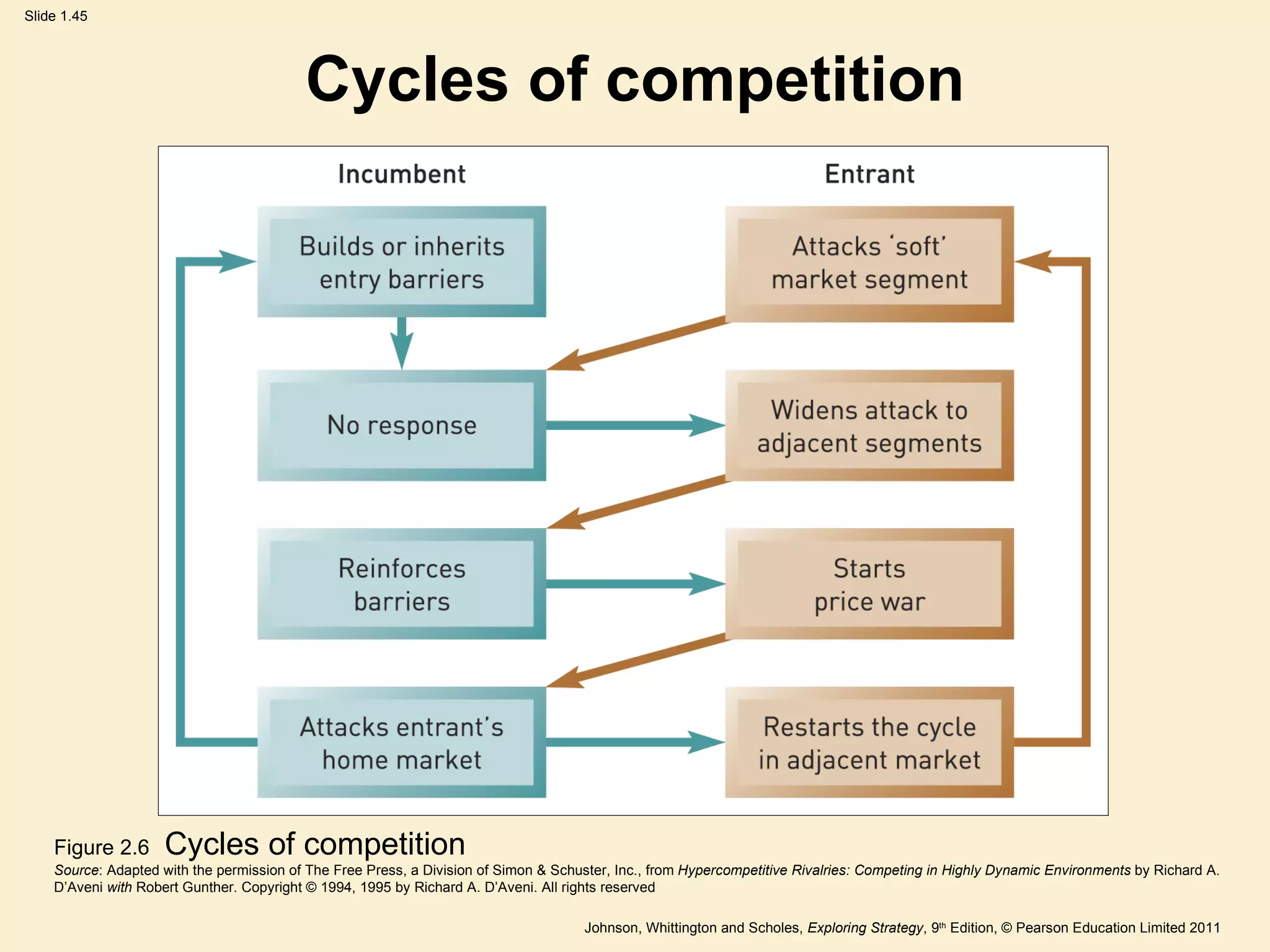
Cycles of competition Figure 2.6  Cycles of competition Source : Adapted with the permission of The Free Press, a Division of Simon & Schuster, Inc., from  Hypercompetitive Rivalries: Competing in Highly Dynamic Environments  by Richard A. D ’Aveni  with  Robert Gunther. Copyright © 1994, 1995 by Richard A. D’Aveni. All rights reserved
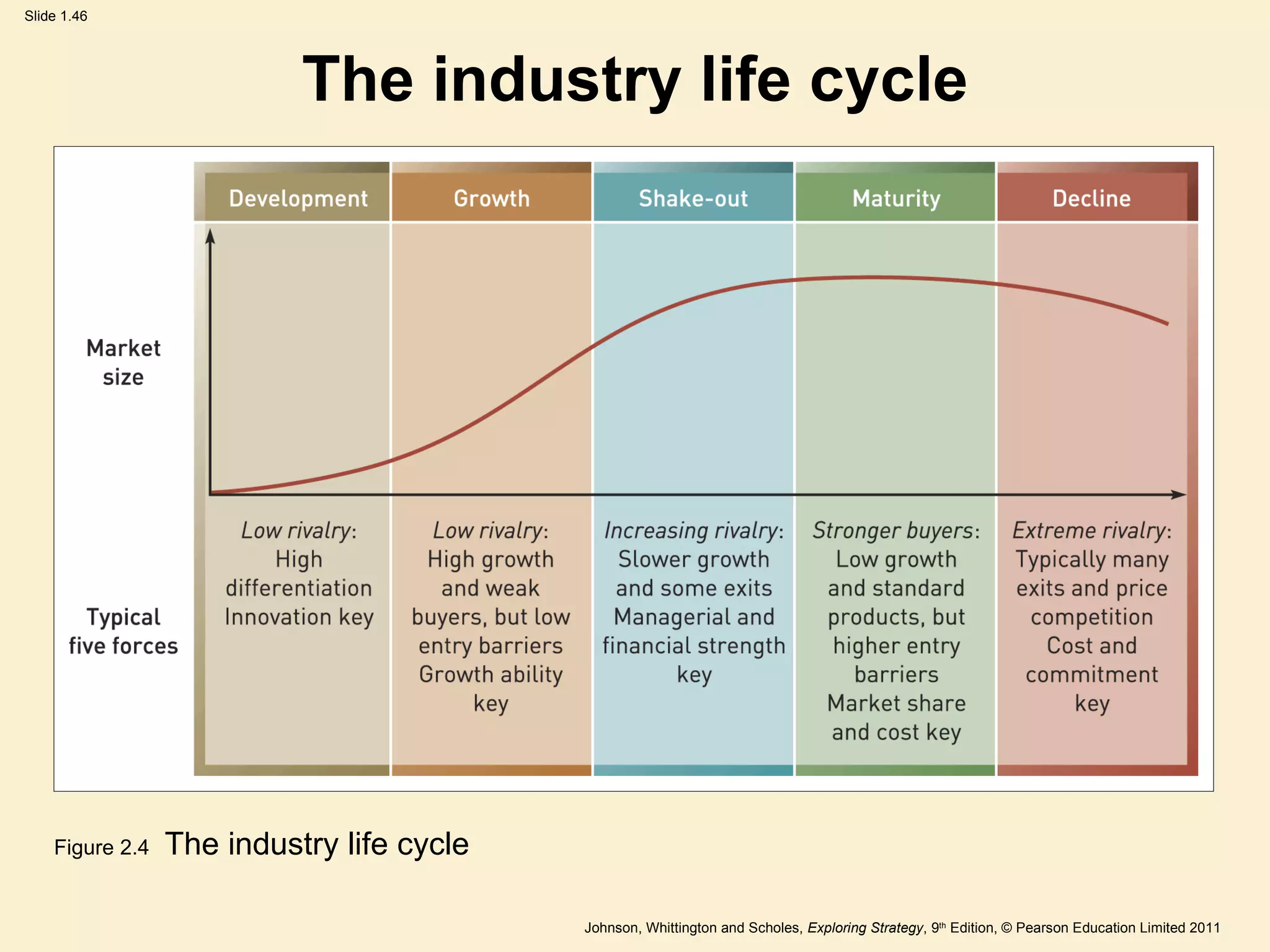
The industry life cycle Figure 2.4  The industry life cycle
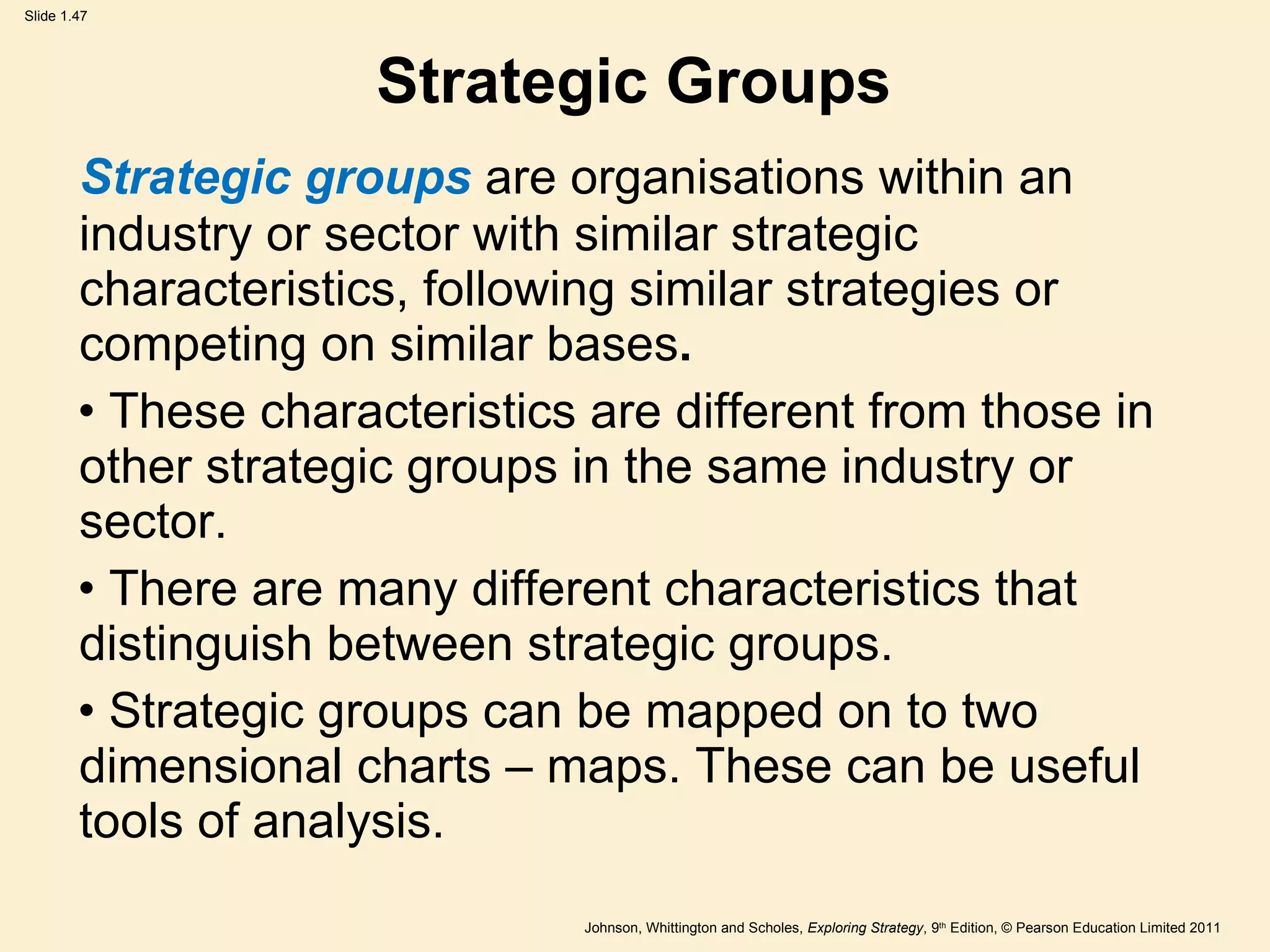
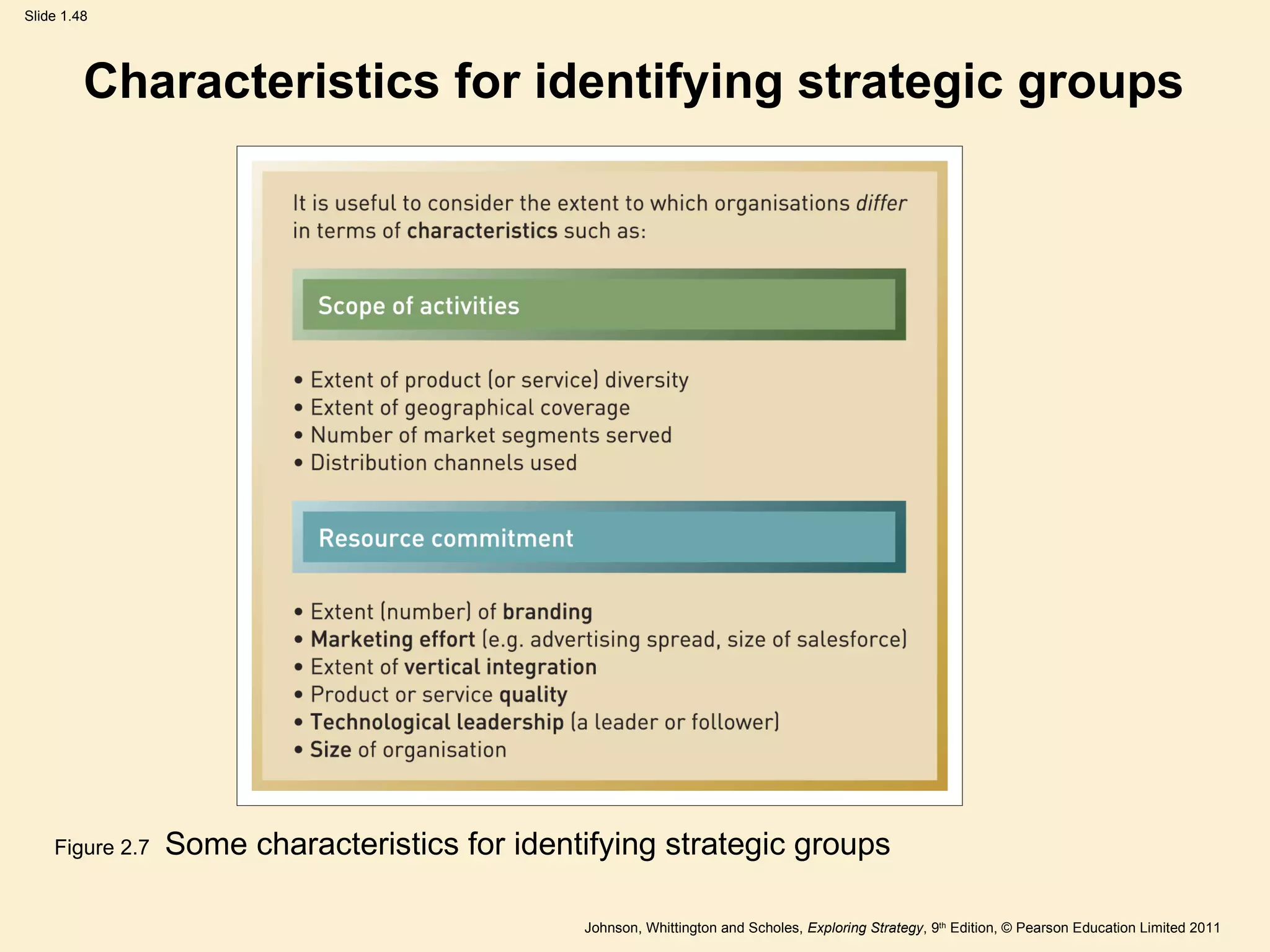
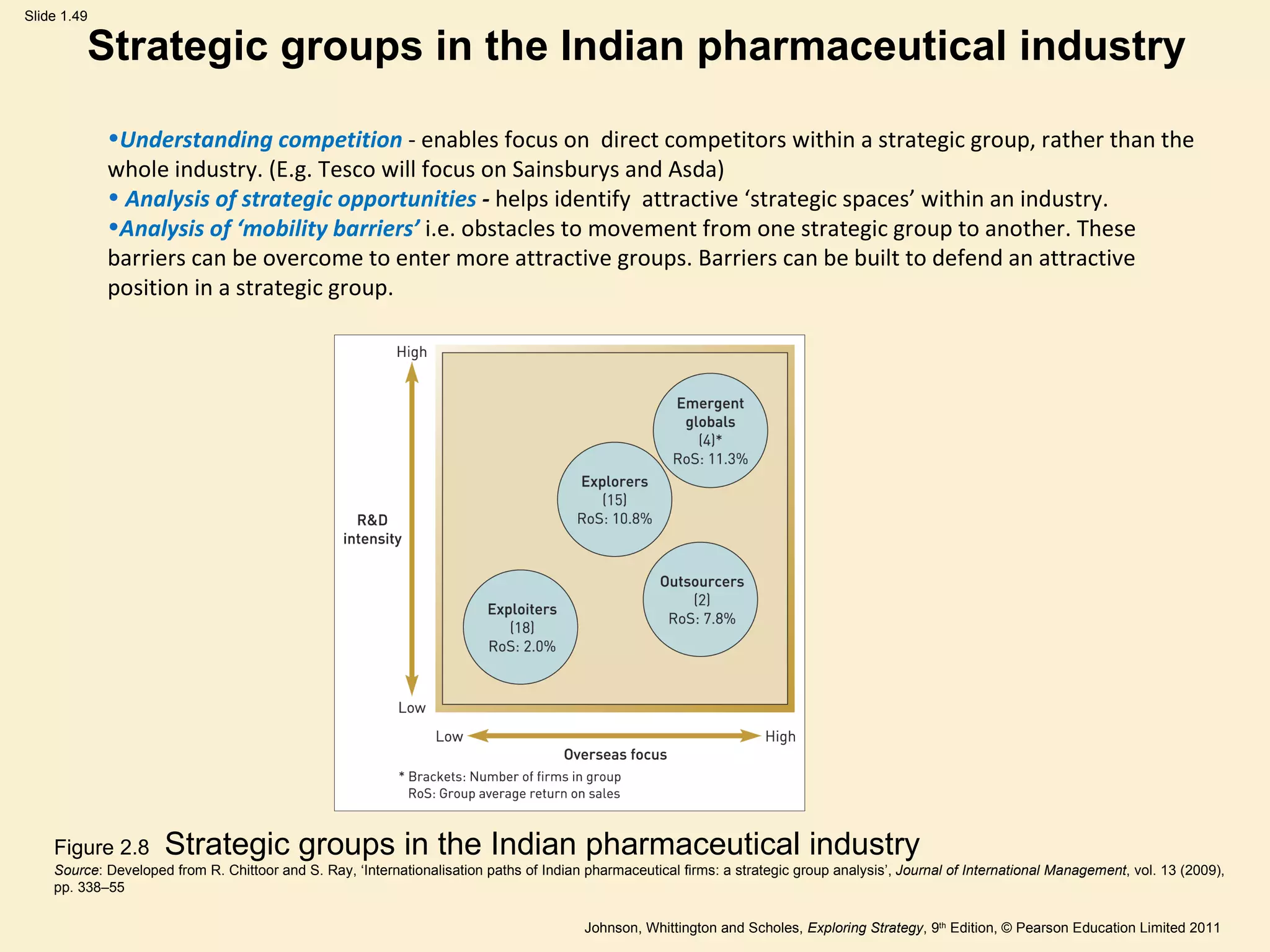
Strategic Groups Strategic groups  are organisations within an industry or sector with similar strategic characteristics, following similar strategies or competing on similar bases . These characteristics are different from those in  other strategic groups in the same industry or  sector. There are many different characteristics that  distinguish between strategic groups. Strategic groups can be mapped on to two  dimensional charts – maps. These can be useful  tools of analysis.
Characteristics for identifying strategic groups Figure 2.7  Some characteristics for identifying strategic groups
Strategic groups in the Indian pharmaceutical industry Figure 2.8  Strategic groups in the Indian pharmaceutical industry Source : Developed from R. Chittoor and S. Ray,  ‘Internationalisation paths of Indian pharmaceutical firms: a strategic group analysis’,  Journal of International Management , vol. 13 (2009), pp. 338–55 Understanding competition  - enables focus on  direct competitors within a strategic group, rather than the whole industry. (E.g. Tesco will focus on Sainsburys and Asda) Analysis of strategic opportunities  -  helps identify  attractive  ‘ strategic spaces ’  within an industry.  Analysis of  ‘ mobility barriers ’   i.e. obstacles to movement from one strategic group to another. These barriers can be overcome to enter more attractive groups. Barriers can be built to defend an attractive  position in a strategic group.
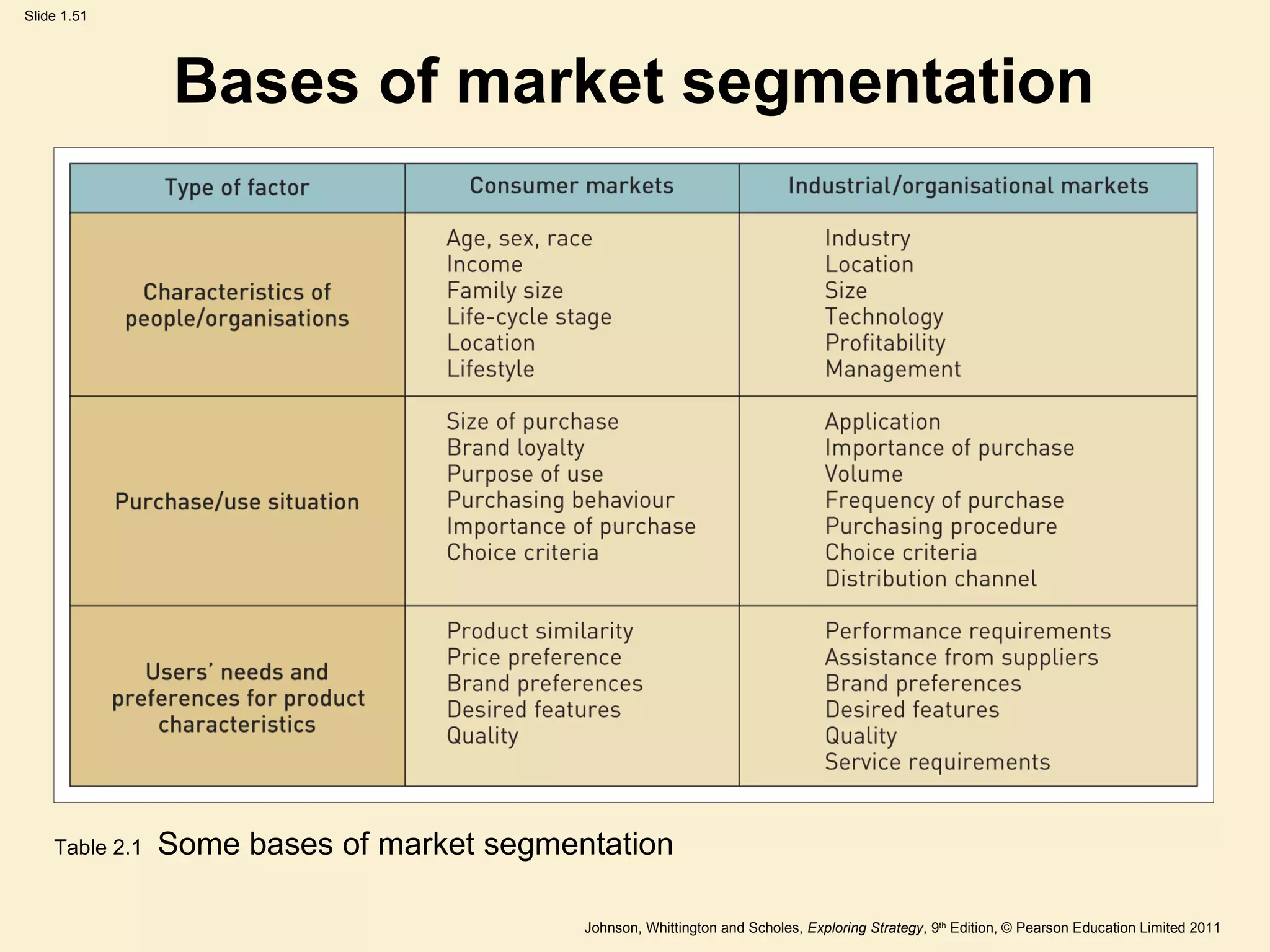
Market segments A market segment  is a group of customers who have similar needs that are different from customer needs in other parts of the market. Where these customer groups are relatively small, such  market segments are called  ‘ niches ’ . Customer needs vary. Focusing on customer needs that are highly distinctive is one means of building a secure segment strategy. Customer needs vary for a variety of reasons –these factors can be used to identify distinct market segments. Not all segments are attractive or viable market opportunities – evaluation is essential.
Bases of market segmentation Table 2.1  Some bases of market segmentation
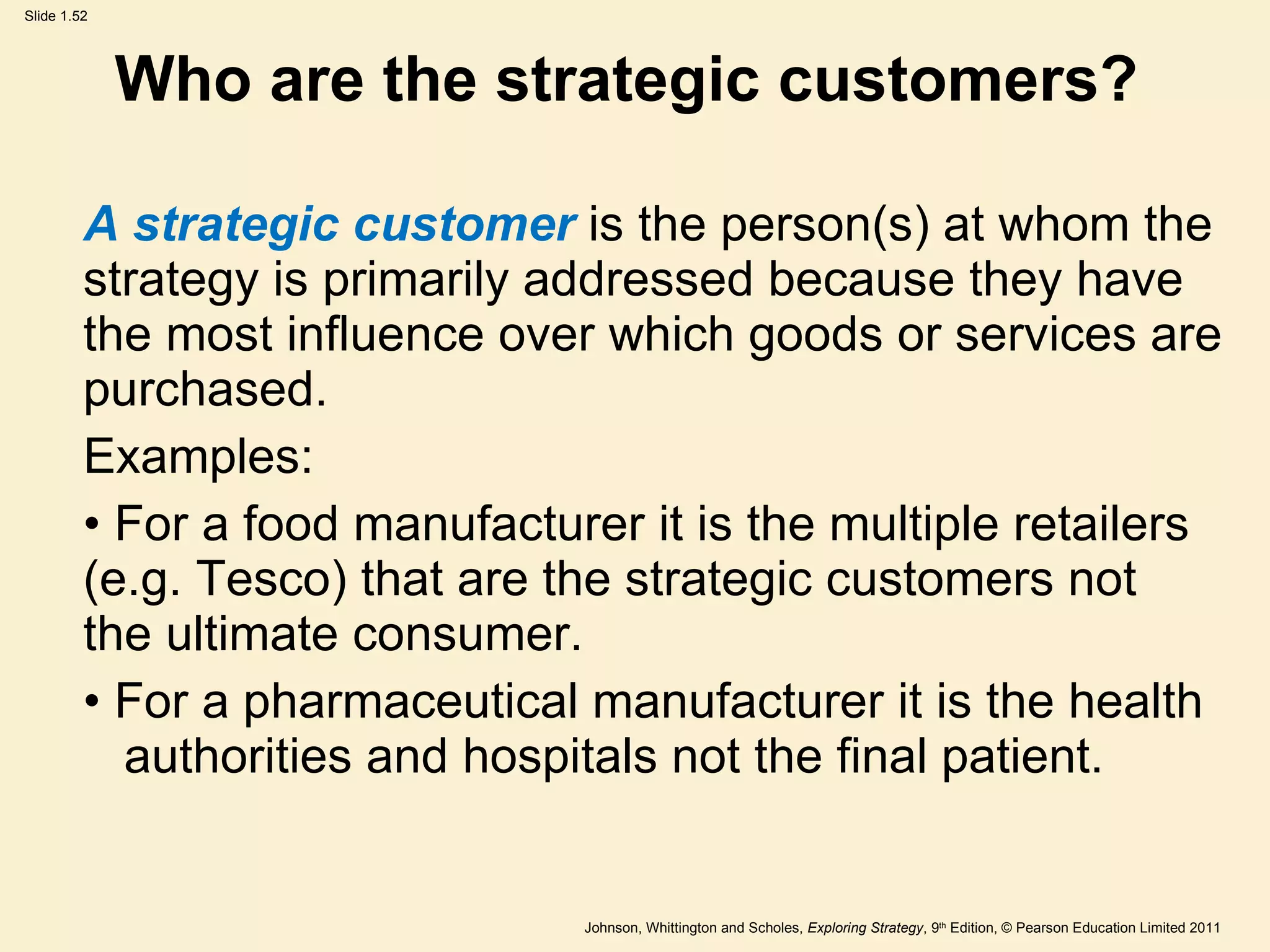
Who are the strategic customers?  A strategic customer  is the person(s) at whom the strategy is primarily addressed because they have  the most influence over which goods or services are purchased. Examples: For a food manufacturer it is the multiple retailers  (e.g. Tesco) that are the strategic customers not  the ultimate consumer. For a pharmaceutical manufacturer it is the health  authorities and hospitals not the final patient.
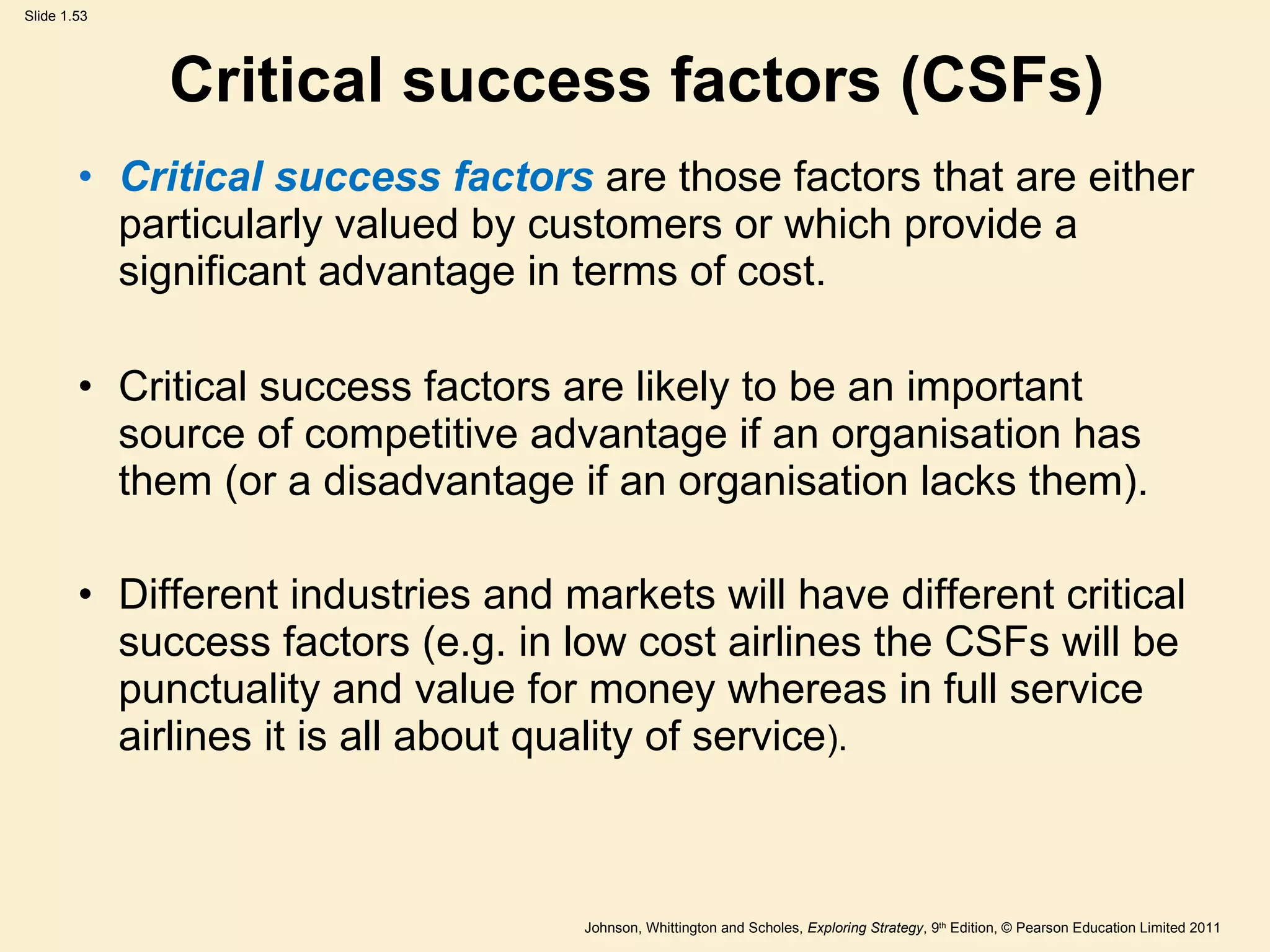
Critical success factors (CSFs) Critical success factors  are those factors that are either particularly valued by customers or which provide a significant advantage in terms of cost. Critical success factors are likely to be an important source of competitive advantage if an organisation has them (or a disadvantage if an organisation lacks them). Different industries and markets will have different critical success factors (e.g. in low cost airlines the CSFs will be punctuality and value for money whereas in full service airlines it is all about quality of service ).
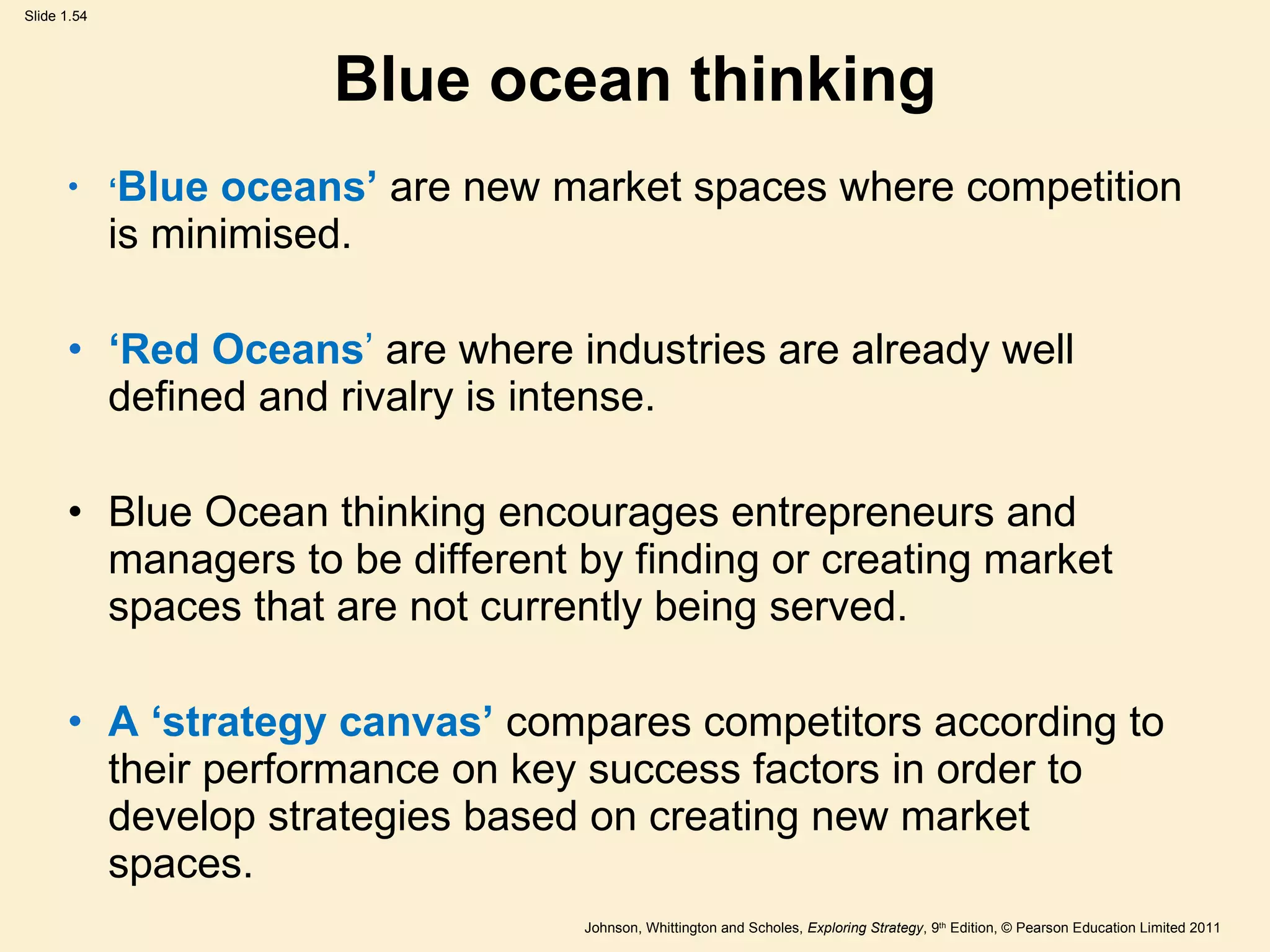
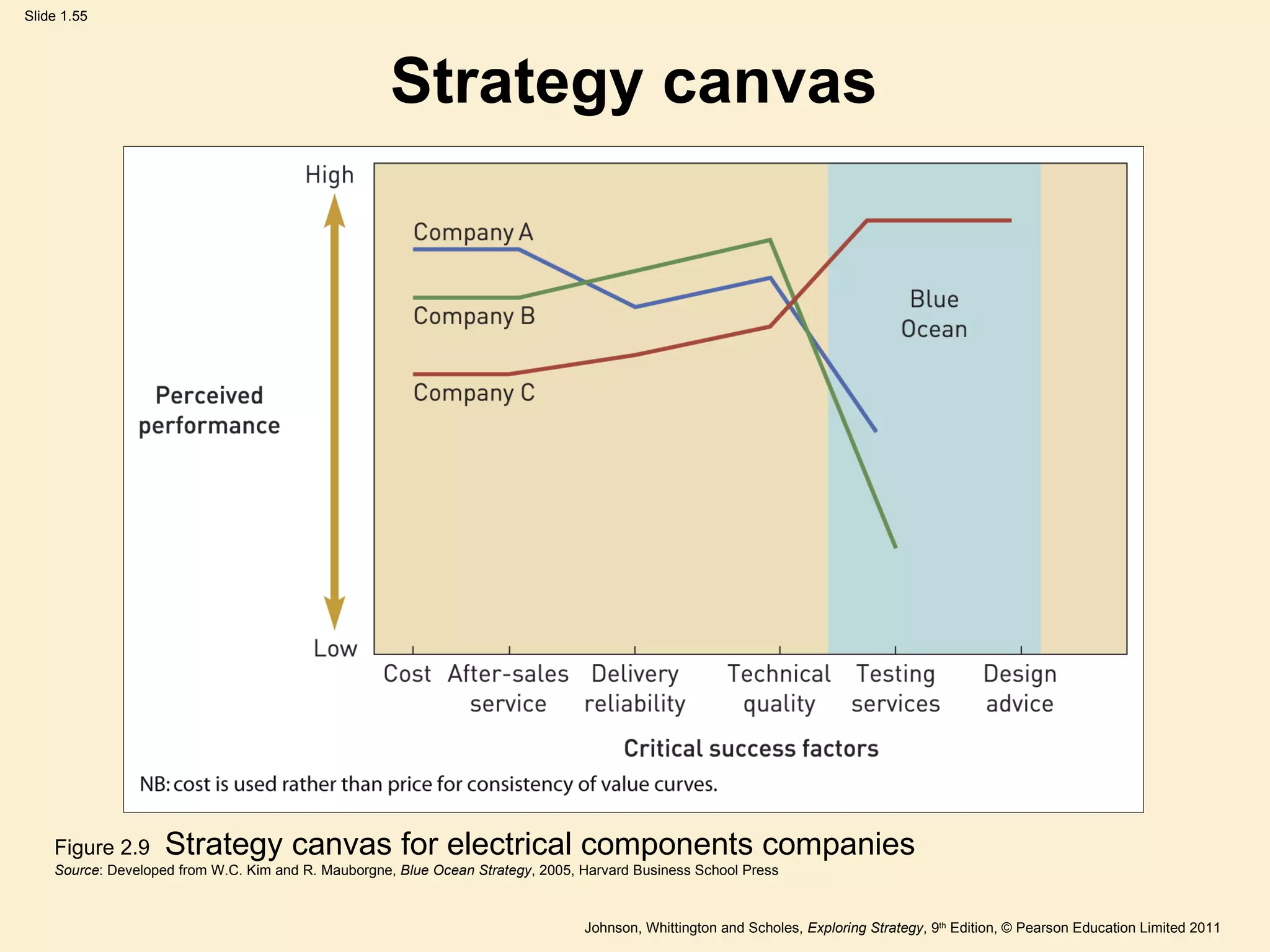
Blue ocean thinking ‘ Blue oceans ’   are new market spaces where competition is minimised. ‘ Red Oceans ’   are where industries are already well defined and rivalry is intense. Blue Ocean thinking encourages entrepreneurs and managers to be different by finding or creating market spaces that are not currently being served. A   ‘ strategy canvas ’   compares competitors according to their performance on key success factors in order to develop strategies based on creating new market spaces.
Strategy canvas Figure 2.9  Strategy canvas for electrical components companies Source : Developed from W.C. Kim and R. Mauborgne,  Blue Ocean Strategy , 2005, Harvard Business School Press
Summary Environmental influences can be thought of as  layers  around an organisation, with the outer layer making up  the macro-environment , the middle layer making up the  industry or sector  and the inner layer  strategic groups and market segments . The macro-environment can be analysed in terms of the  PESTEL factors , from which  key drivers of change  can be identified. Alternative  scenarios  about the future can be constructed according to how the key drivers develop. Industries and sectors can be analysed in terms of  Porter ’ s five forces  – barriers to entry, substitutes, buyer power, supplier power and rivalry. Together, these determine  industry or sector attractiveness. Industries and sectors are dynamic , and their changes can be analysed in terms of the  industry life cycle ,  comparative five forces radar plots  and  hypercompetitive cycles  of competition . In the inner layer of the environment ,  strategic group analysis, market segment analysis and the strategy canvas  can help identify strategic gaps or opportunities. Blue Ocean strategies   characterised by low rivalry are likely to be better opportunities than  Red Ocean  strategies with many rivals. The most important reason for environmental analysis is to  identify OPPORTUNITIES AND THREATS
The Strategic Position 3: Strategic Capabilities
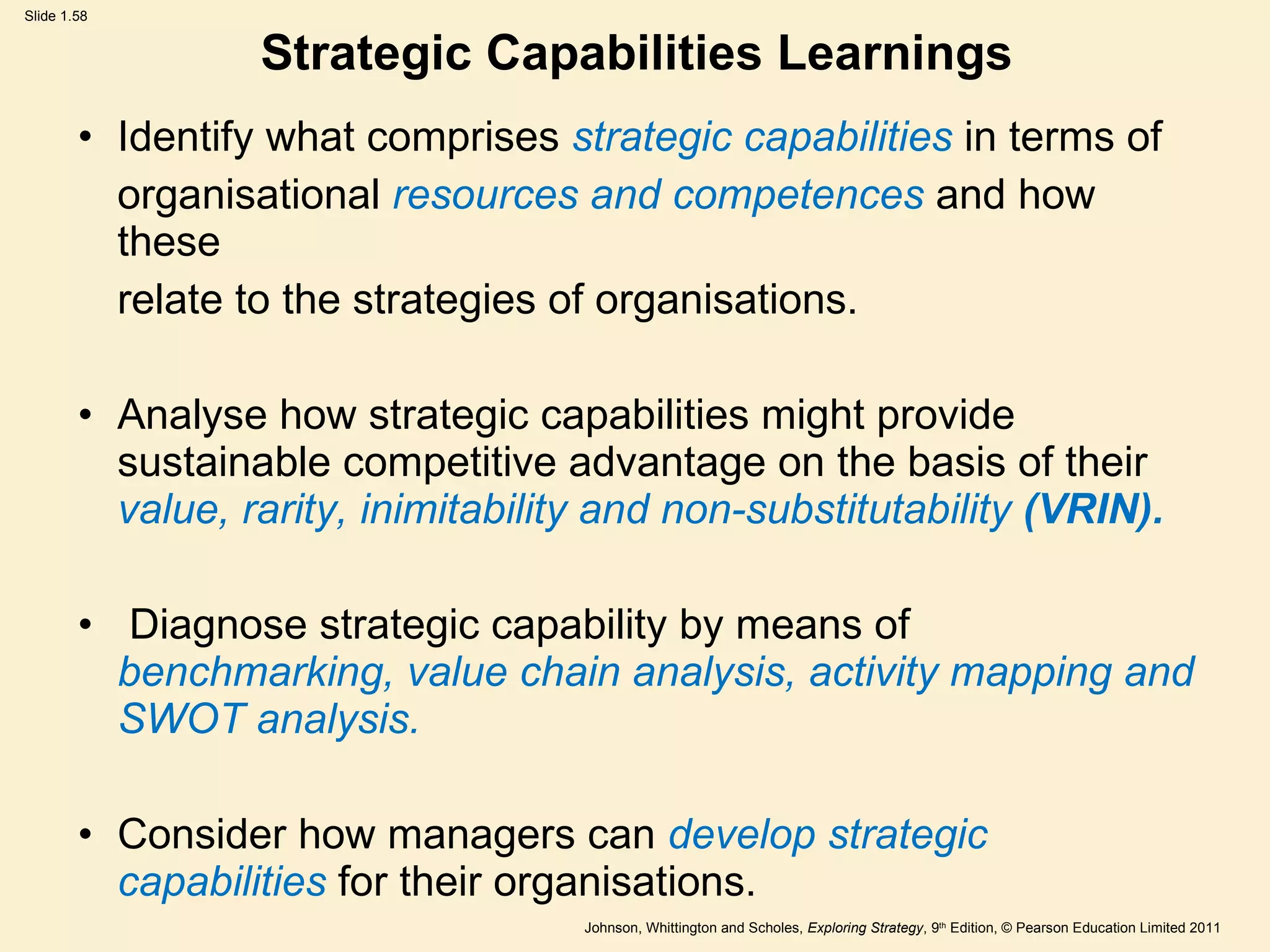
Strategic Capabilities Learnings Identify what comprises  strategic capabilities  in terms of organisational  resources and competences  and how these relate to the strategies of organisations. Analyse how strategic capabilities might provide sustainable competitive advantage   on the basis of their  value, rarity, inimitability and non-substitutability  (VRIN). Diagnose strategic capability by means of  benchmarking, value chain analysis, activity mapping and SWOT analysis. Consider how managers can  develop strategic capabilities  for their organisations.
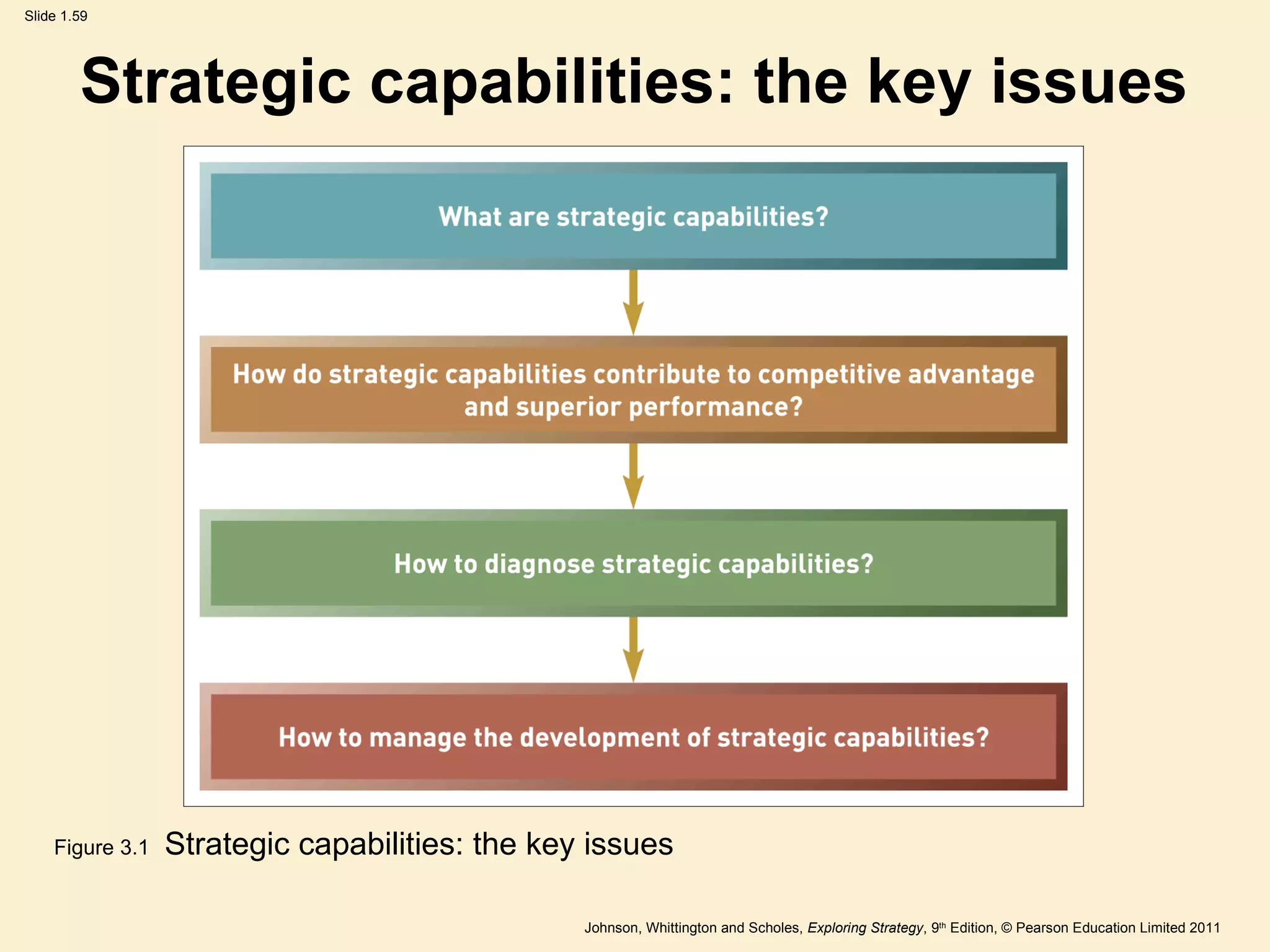
Strategic capabilities: the key issues Figure 3.1   Strategic capabilities: the key issues
Resource-based strategy The resource-based view (RBV)  of strategy asserts that the competitive advantage and superior performance of an organisation is explained by the distinctiveness of its capabilities.
Resources and competences Resources   are the assets that organisations have or can call upon (e.g. from partners or suppliers) ,that is,   ‘ what we have ’  . Competences  are the ways those assets are used or deployed effectively , that is, what we do well ’ .
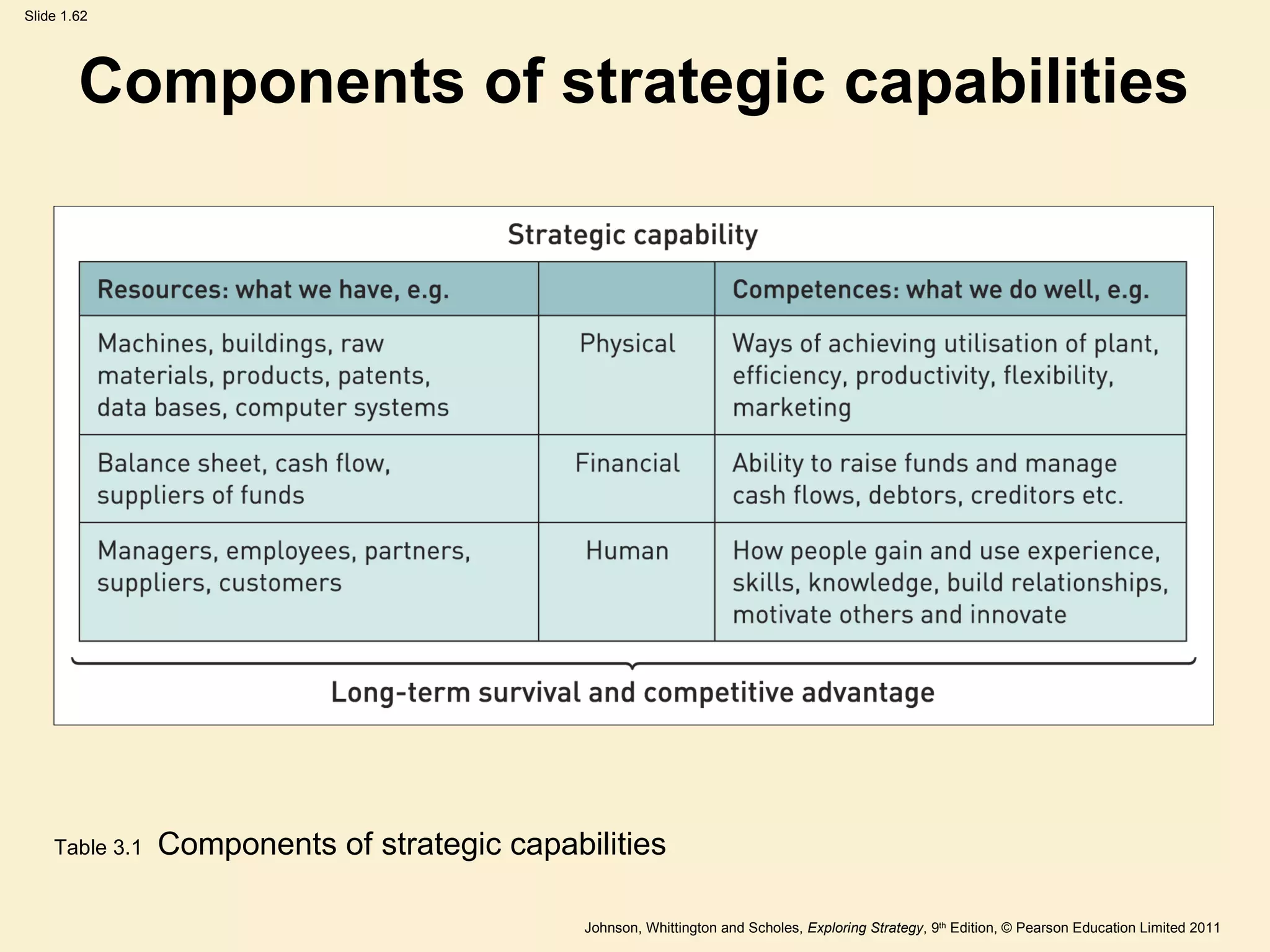
Components of strategic capabilities Table 3.1   Components of strategic capabilities
Redundant capabilities Capabilities, however effective in the past, can become less relevant as industries evolve and change. Such  ‘ capabilities ’  can become  ‘ rigidities ’   that inhibit change and become a weakness.
Dynamic capabilities Dynamic capability  is the ability of an organisation to renew and recreate its strategic capabilities to meet the needs of changing environments.
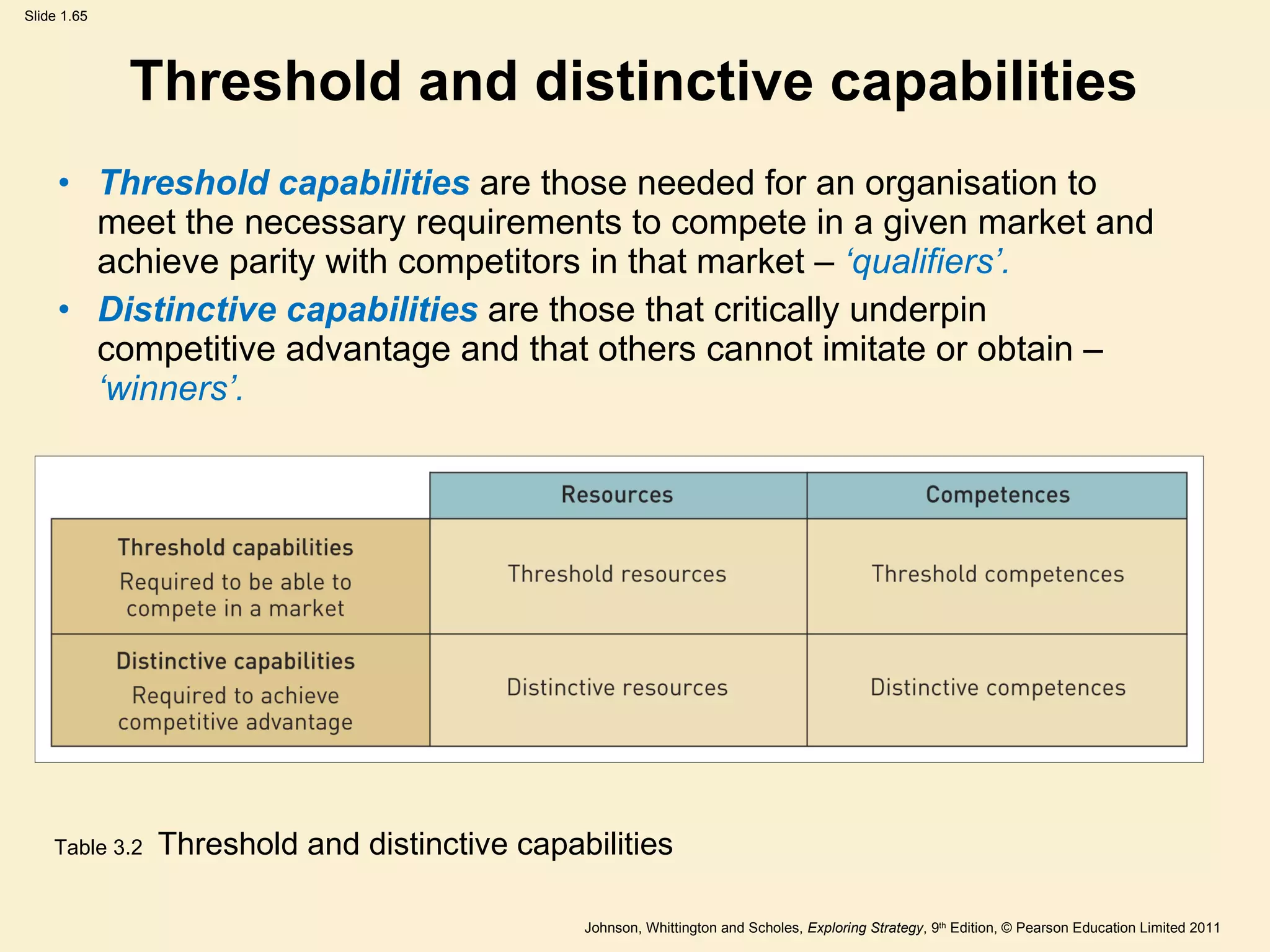
Threshold and distinctive capabilities Threshold capabilities  are those needed for an organisation to meet the necessary requirements to compete in a given market and achieve parity with competitors in that market –  ‘ qualifiers ’ . Distinctive capabilities  are those that critically underpin competitive advantage and that others cannot imitate or obtain –  ‘ winners ’ . Table 3.2   Threshold and distinctive capabilities
Core competences Core competences 1   are the   linked set  of skills, activities and resources that, together: deliver customer value differentiate a business from its competitors potentially, can be extended and developed as markets change or new opportunities arise.   1 G. Hamel and C.K. Prahalad,  ‘ The core competence of the corporation ’ ,  Harvard Business Review, vol. 68, no. 3  (1990), pp. 79–91.
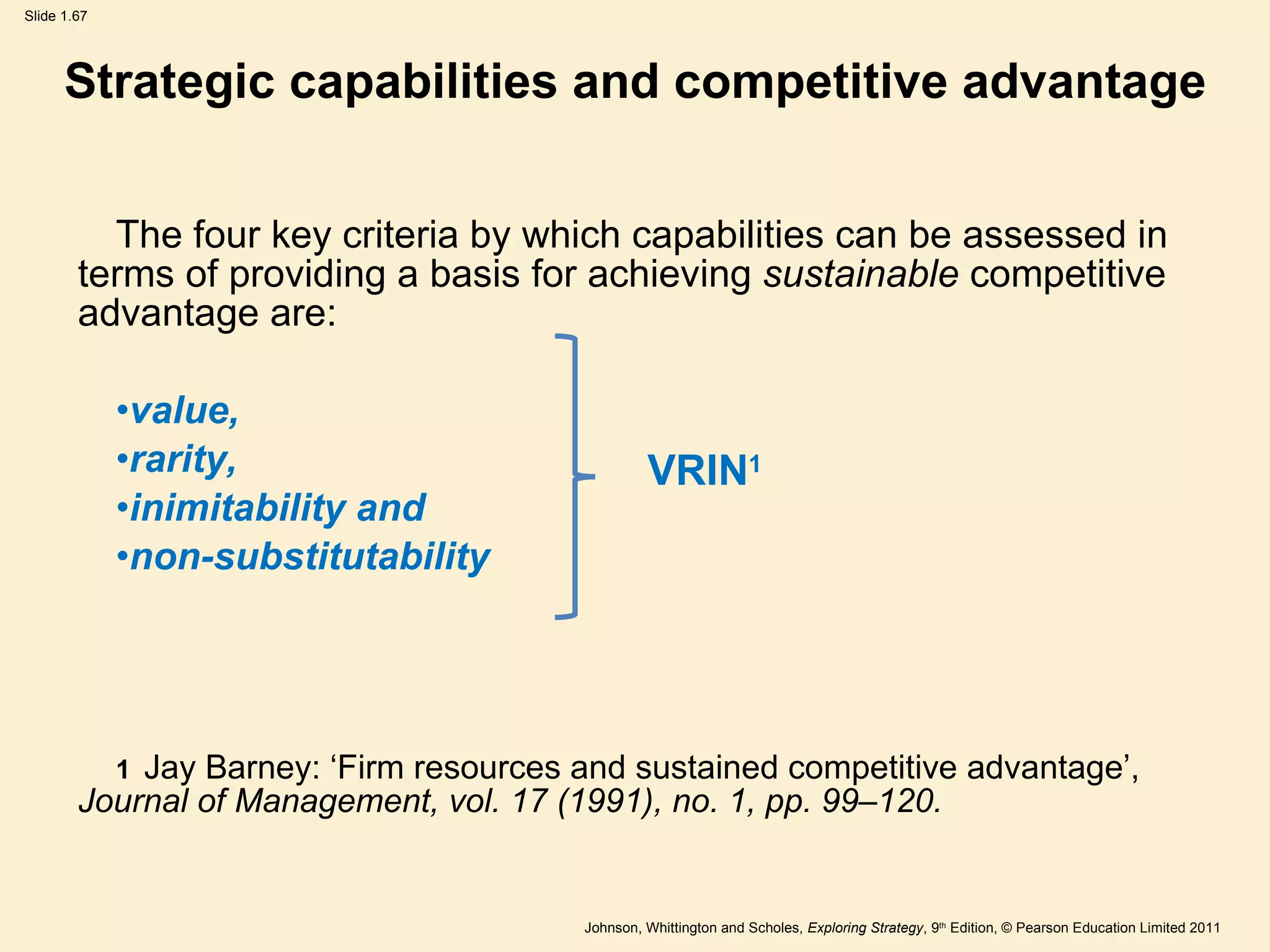
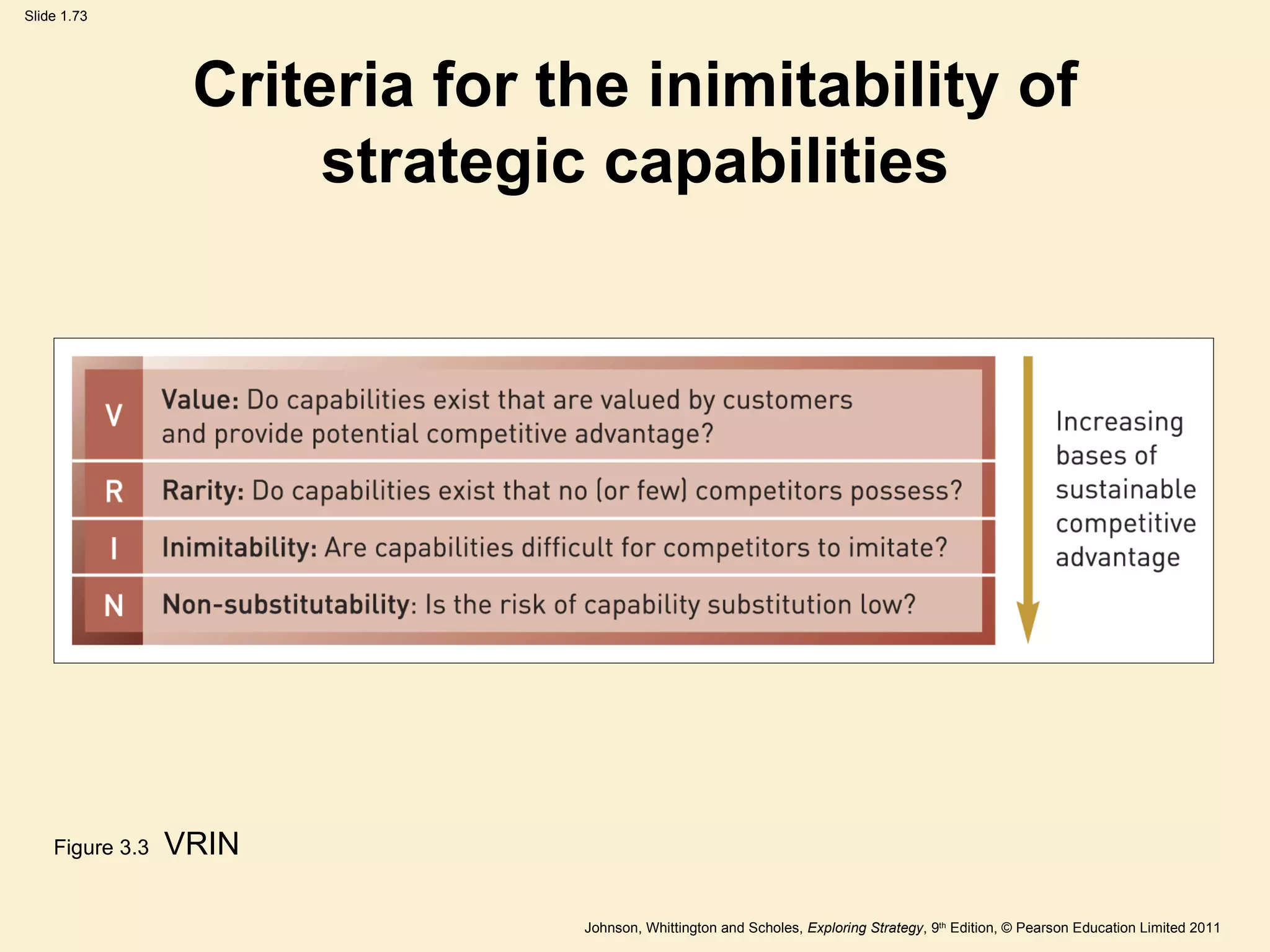
Strategic capabilities and competitive advantage The four key criteria by which capabilities can be assessed in  terms of providing a basis for achieving  sustainable  competitive  advantage are: value,  rarity,  inimitability and  non-substitutability 1   Jay Barney:  ‘ Firm resources and sustained competitive advantage ’ ,  Journal of  Management, vol. 17 (1991), no. 1, pp. 99–120. VRIN 1
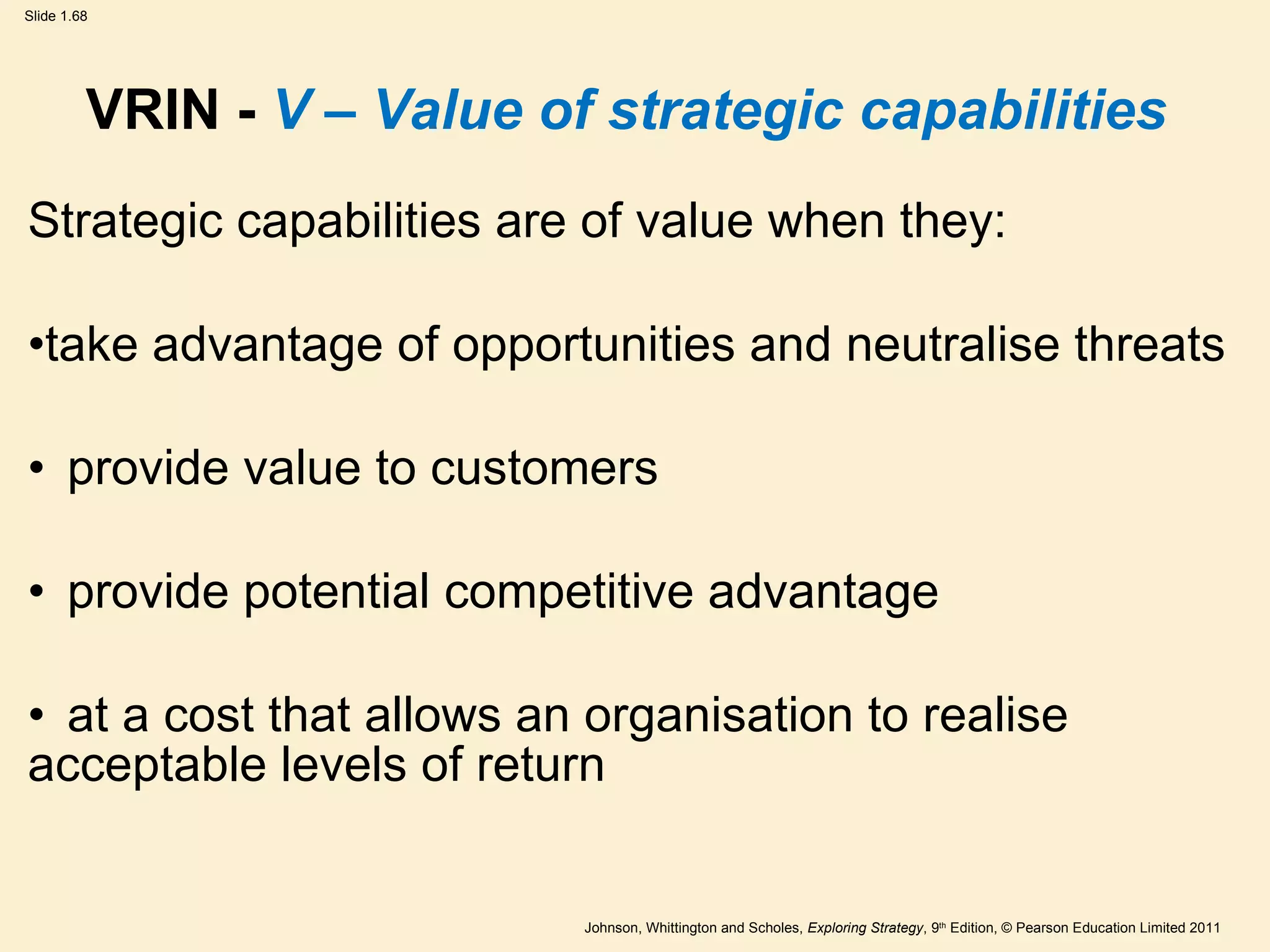
VRIN -  V – Value of strategic capabilities Strategic capabilities are of value when they:  take advantage of opportunities and neutralise threats provide value to customers provide potential competitive advantage at a cost that allows an organisation to realise  acceptable levels of return
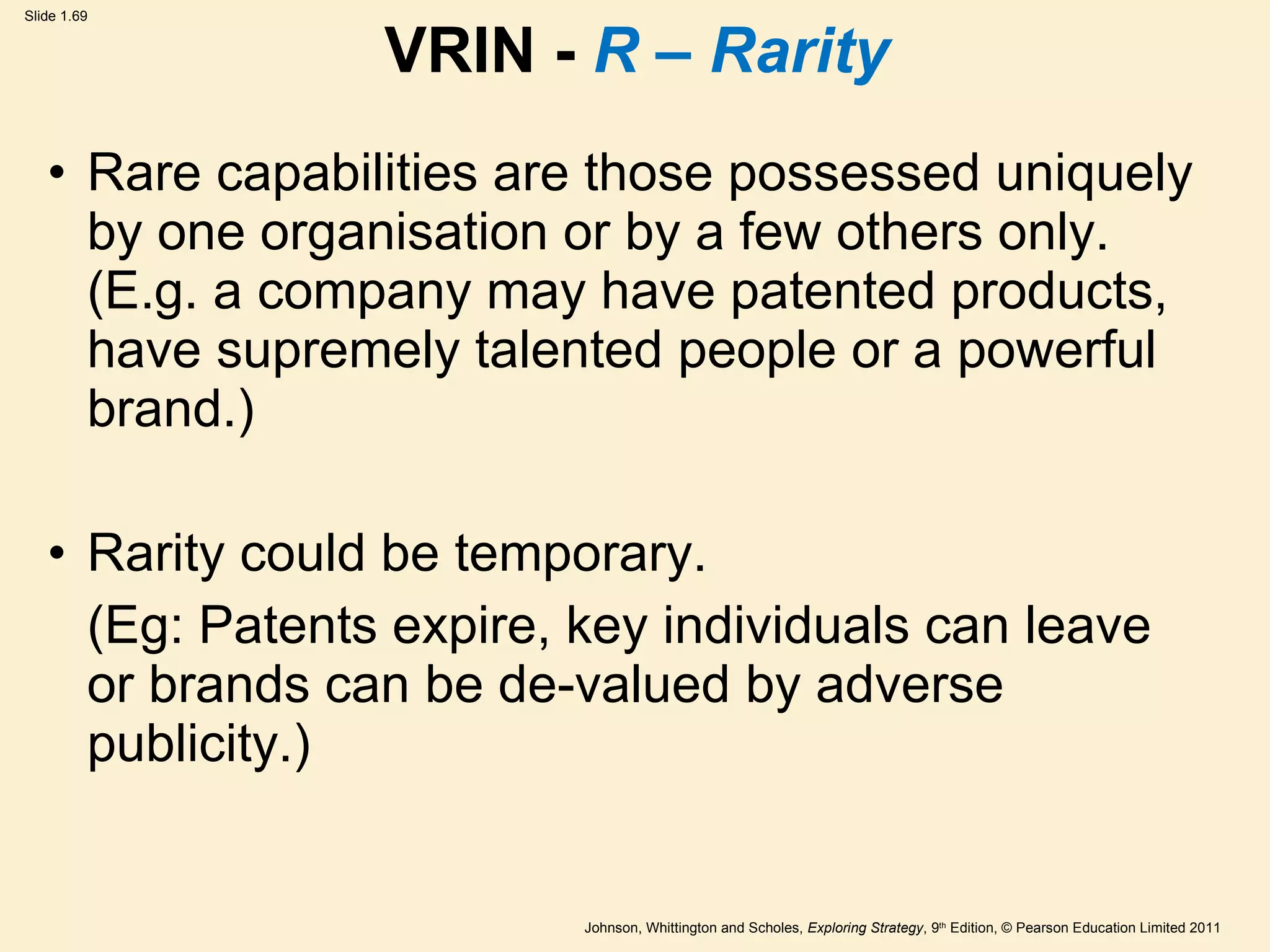
VRIN -  R – Rarity Rare capabilities are those possessed uniquely by one organisation or by a few others only. (E.g. a company may have patented products, have supremely talented people or a powerful brand.) Rarity could be temporary. (Eg: Patents expire, key individuals can leave or brands can be de-valued by adverse publicity.)
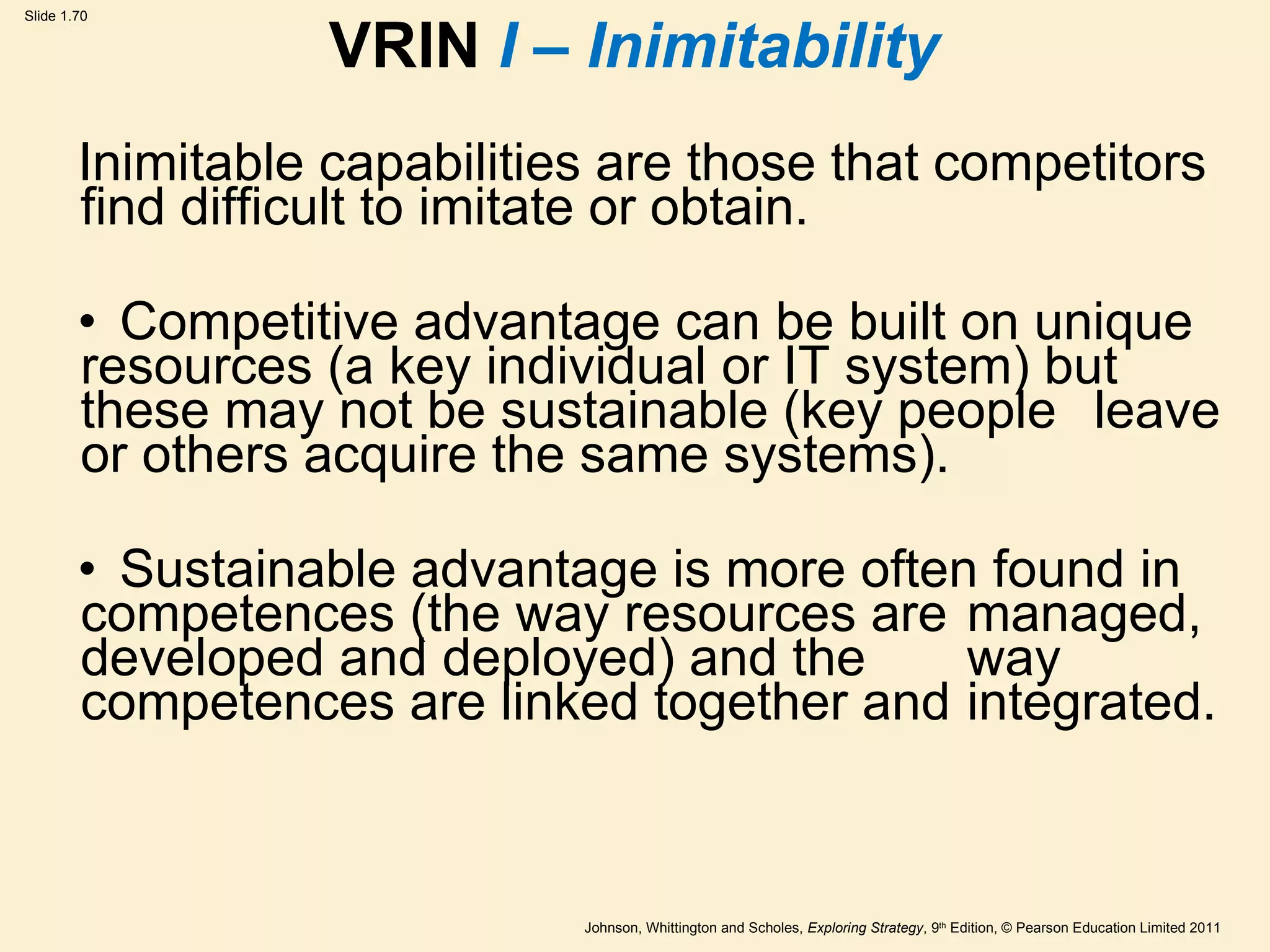
VRIN  I – Inimitability Inimitable capabilities are those that competitors find difficult to imitate or   obtain. Competitive advantage can be built on unique  resources (a key individual or IT system) but  these may not be sustainable (key people  leave or others acquire the same systems). Sustainable advantage is more often found in  competences (the way resources are  managed, developed and deployed) and the  way competences are linked together and  integrated.
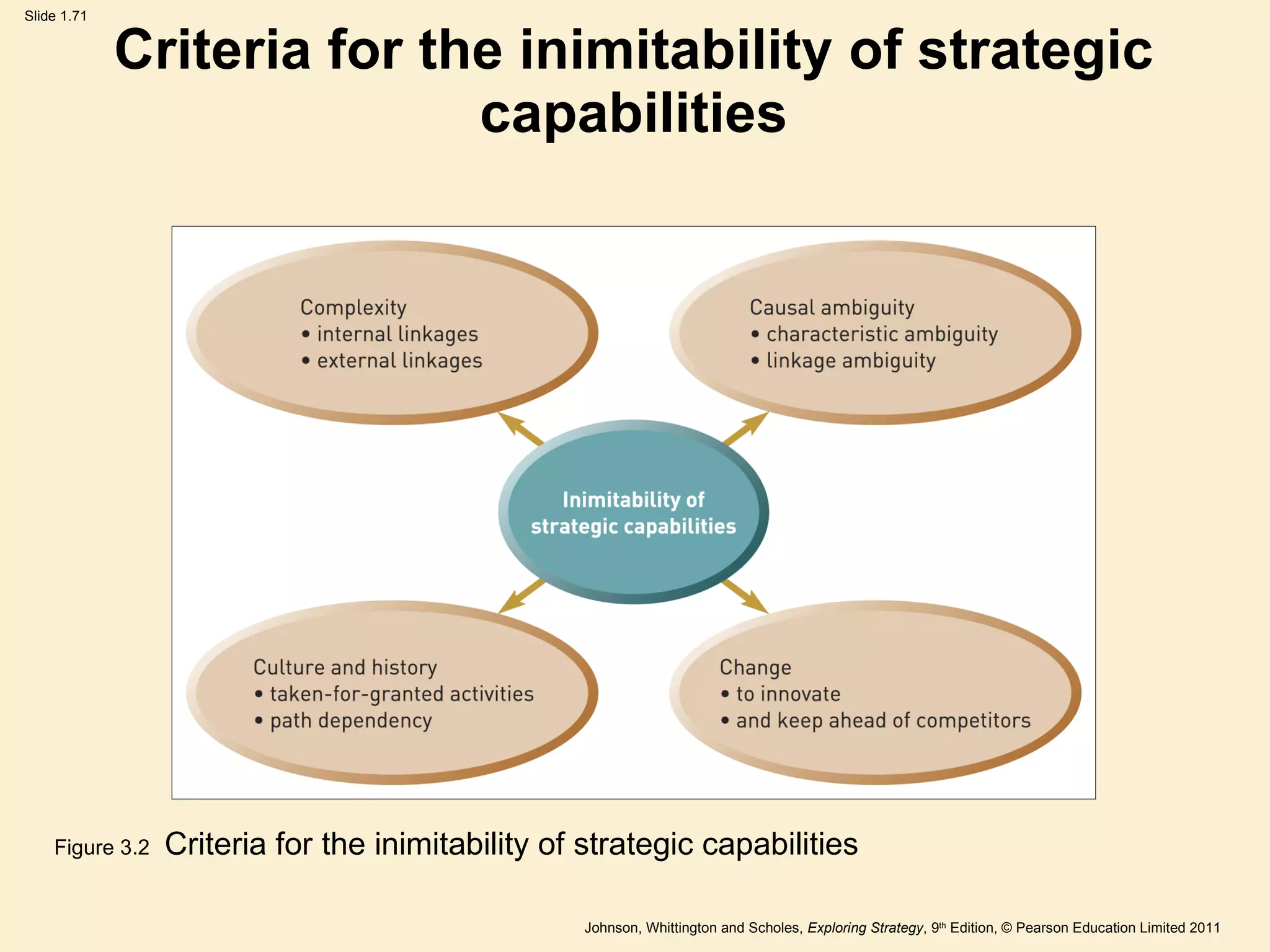
Criteria for the inimitability of strategic capabilities Figure 3.2   Criteria for the inimitability of strategic capabilities
VRIN -  N - Non-substitutability Competitive advantage may not be sustainable if there is a threat of substitution. Product or service substitution from a different industry/market. For example, postal services partly substituted by e-mail. Competence substitution. For example, a skill substituted by expert systems or IT solutions
Criteria for the inimitability of strategic capabilities Figure 3.3   VRIN
Organisational knowledge Organisational knowledge  is the collective intelligence, specific to an organisation, accumulated through both formal systems and the shared experience of people in that organisation. Some of this knowledge is  ‘ Tacit ’  knowledge  that is, more personal, context-specific and hard to formalise and communicate – so it is difficult to imitate, for example, the knowledge and relationships in a top R&D team.
Benchmarking Benchmarking   is a means of understanding how an organisation compares with others – typically competitors. Two approaches to benchmarking: Industry/sector benchmarking  -  comparing performance against other organisations in the same industry/sector against a set of performance indicators. Best-in-class benchmarking  - comparing an organisation ’ s performance or capabilities against  ‘ best-in-class ’  performance – wherever that is found even in a very different industry. (E.g. BA benchmarked its refuelling operations against Formula 1).
The value chain The value chain  describes the categories of activities within an organisation which, together, create a product or service. The value chain invites the strategist to think of an organisation in terms of sets of activities – sources of competitive advantage can be analysed in any or all of these activities.
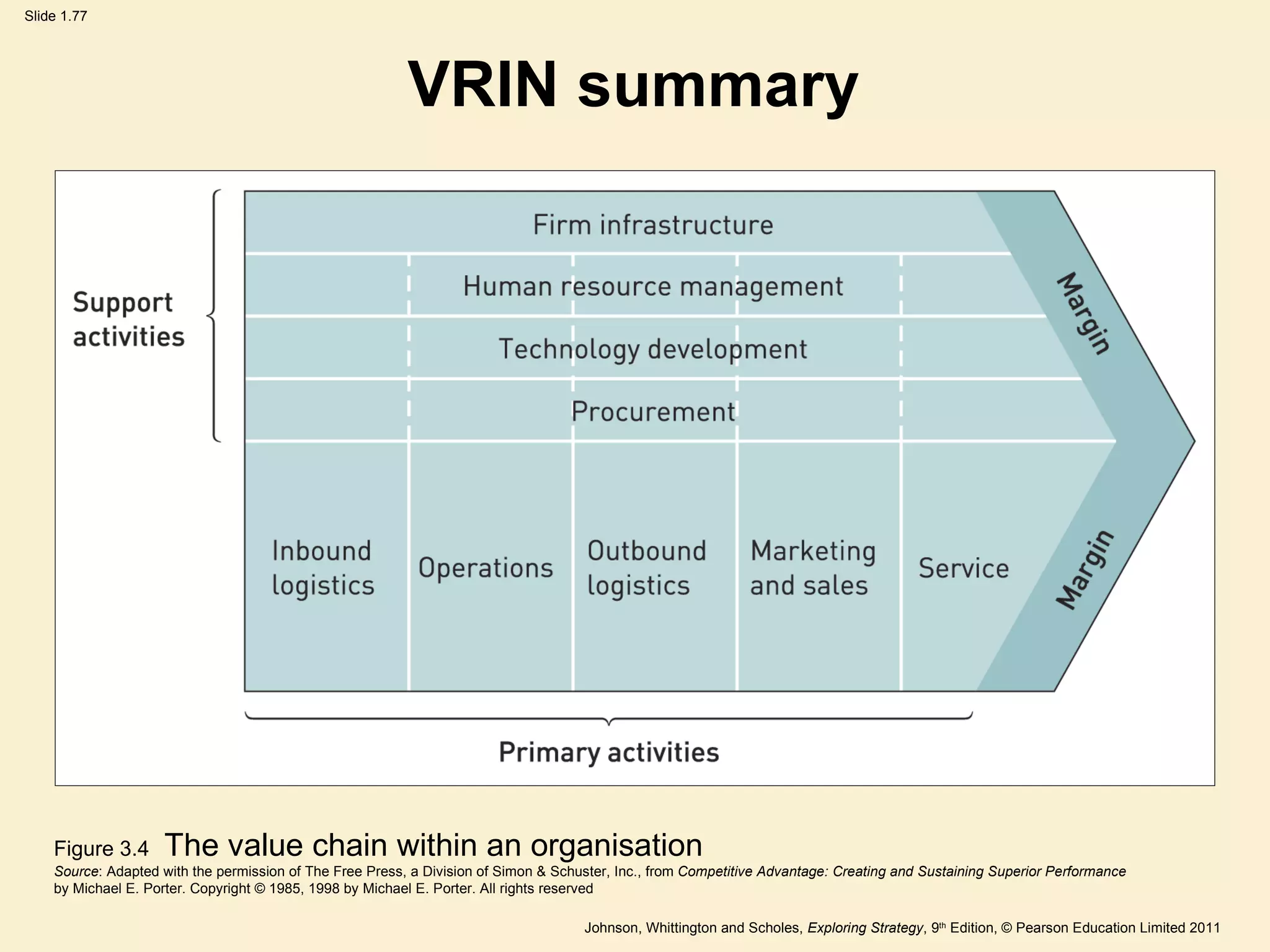
VRIN summary Figure 3.4   The value chain within an organisation Source : Adapted with the permission of The Free Press, a Division of Simon & Schuster, Inc., from  Competitive Advantage: Creating and Sustaining Superior Performance by Michael E. Porter. Copyright © 1985, 1998 by Michael E. Porter. All rights reserved
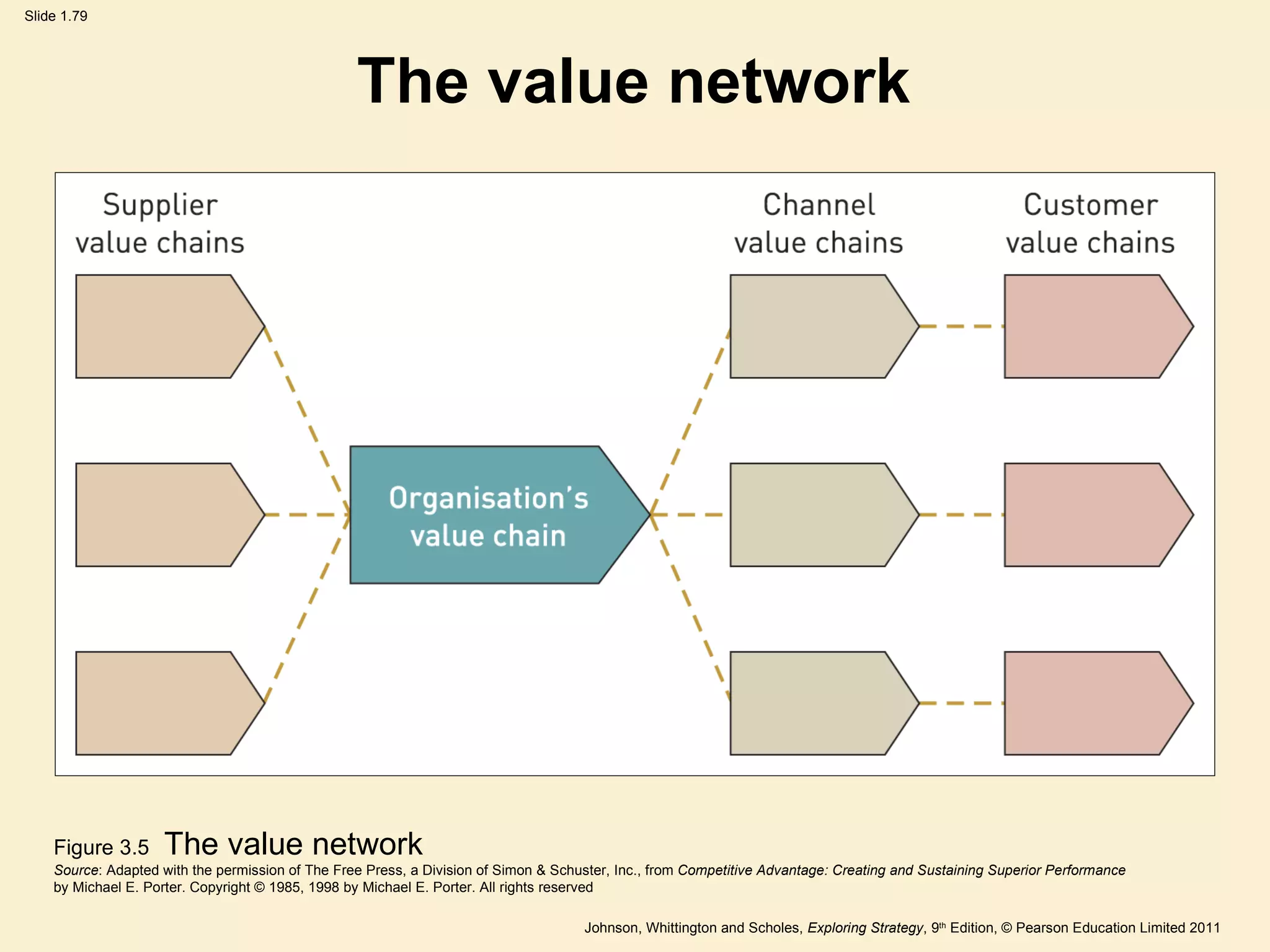
The value network The value network  comprises the set of inter-organisational links and relationships that are necessary to create a product or service. Competitive advantage can be derived from  linkages  within the value network.
The value network Figure 3.5   The value network Source : Adapted with the permission of The Free Press, a Division of Simon & Schuster, Inc., from  Competitive Advantage: Creating and Sustaining Superior Performance by Michael E. Porter. Copyright © 1985, 1998 by Michael E. Porter. All rights reserved
Uses of the value chain A generic description of activities  – understanding the discrete activities and how they both contribute to consumer benefit and how they add to cost. Identifying activities  where the organisation has particular strengths or weaknesses Analysing the competitive position  of the organisation using the VRIN criteria – thus identifying sources of sustainable advantage. Looking for ways to  enhance value or decrease cost  in value activities (e.g. outsourcing)
Uses of the value network Understanding cost/price structures  across the value network   – analysing the best area of focus and the best business model . Identifying  ‘ profit pools ’   within the value network and seek to exploit these. The  ‘ make or buy ’  decision : deciding which activities to do  ‘ in-house ’  and which to outsource. Partnering and relationships  – deciding who to work with and the nature of these relationships.
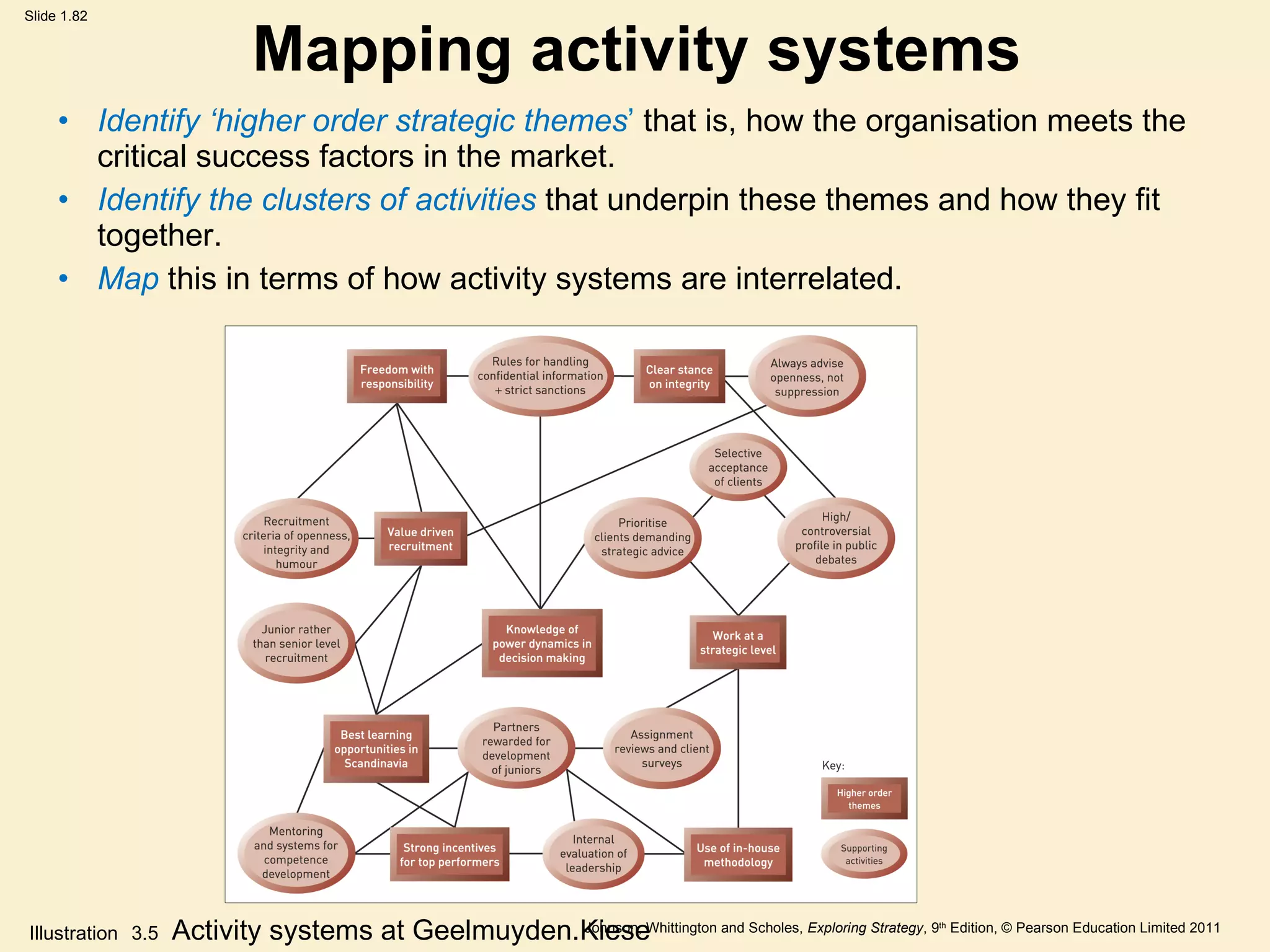
Mapping activity systems Identify  ‘ higher order strategic themes ’   that is, how the organisation meets the critical success factors in the market. Identify the clusters of activities  that underpin these themes and how they fit together. Map  this in terms of how activity systems are interrelated. Illustration  3.5  Activity systems at Geelmuyden.Kiese
Using activity system maps A means of  identifying strategic capabilities  in terms of linkages of activities Internal and external links   are identified (e.g. in terms of the needs of customers). Therefore helps identify  bases of competitive advantage . And  sustainable advantage  for example, in terms of bases of inimitability.
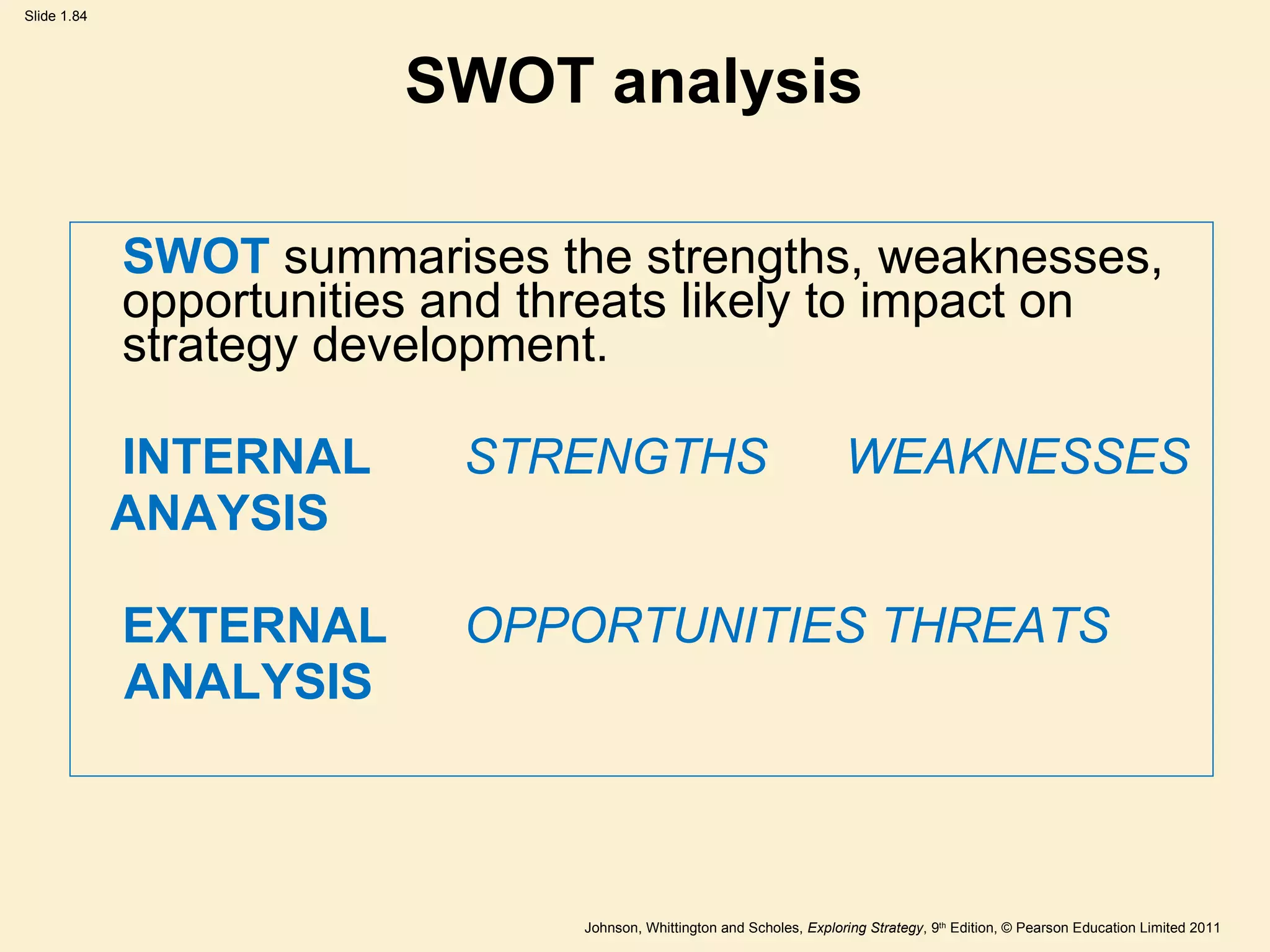
SWOT analysis SWOT   summarises the strengths, weaknesses, opportunities and threats likely to impact on strategy development. INTERNAL STRENGTHS WEAKNESSES ANAYSIS EXTERNAL OPPORTUNITIES THREATS ANALYSIS
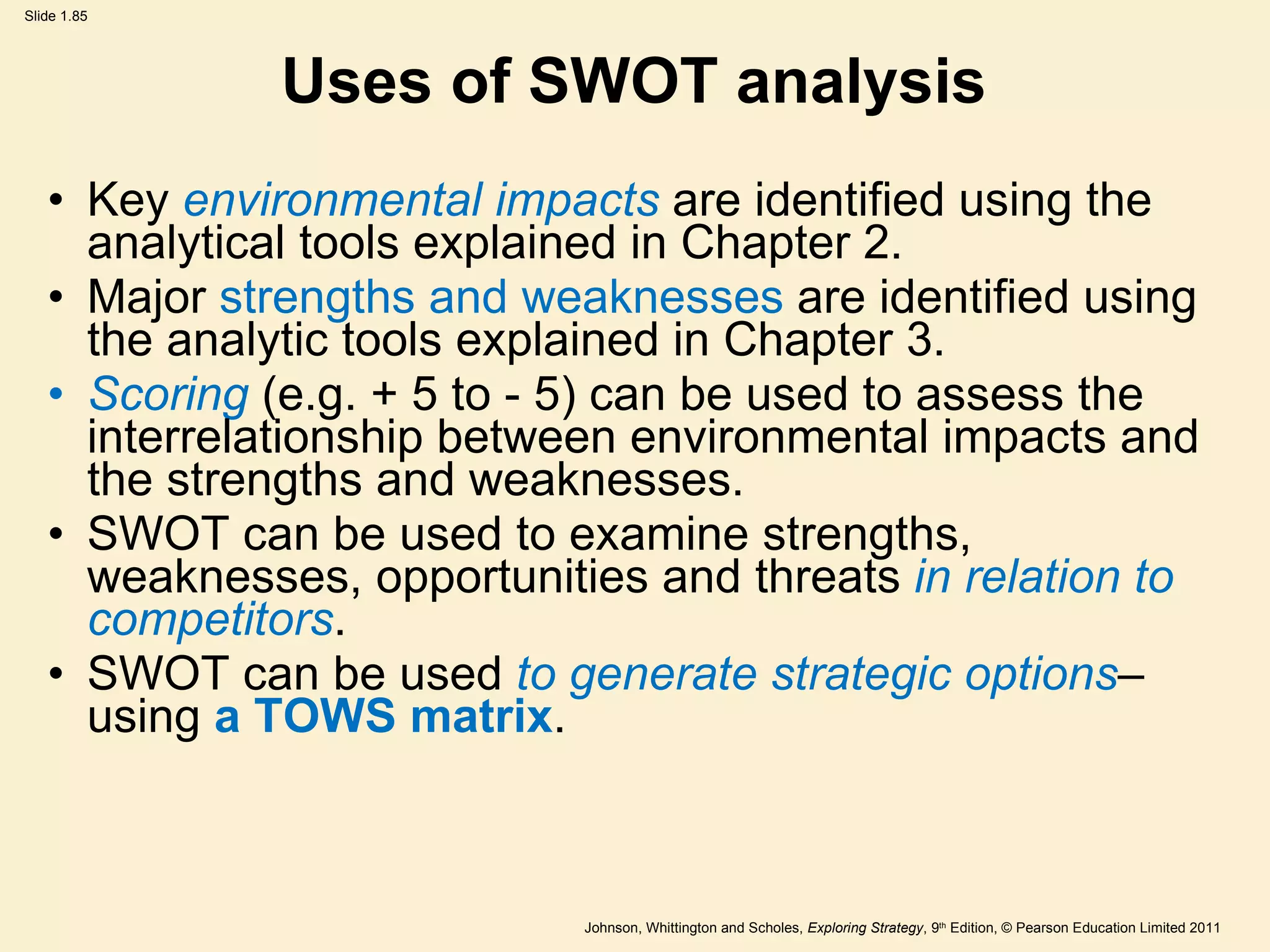
Uses of SWOT analysis Key  environmental impacts  are identified using the analytical tools explained in Chapter 2. Major  strengths and weaknesses  are identified using the analytic tools explained in Chapter 3. Scoring  (e.g. + 5 to - 5) can be used to assess the interrelationship between environmental impacts and the strengths and weaknesses. SWOT can be used to examine strengths, weaknesses, opportunities and threats  in relation to competitors . SWOT can be used  to generate strategic options – using  a TOWS matrix .
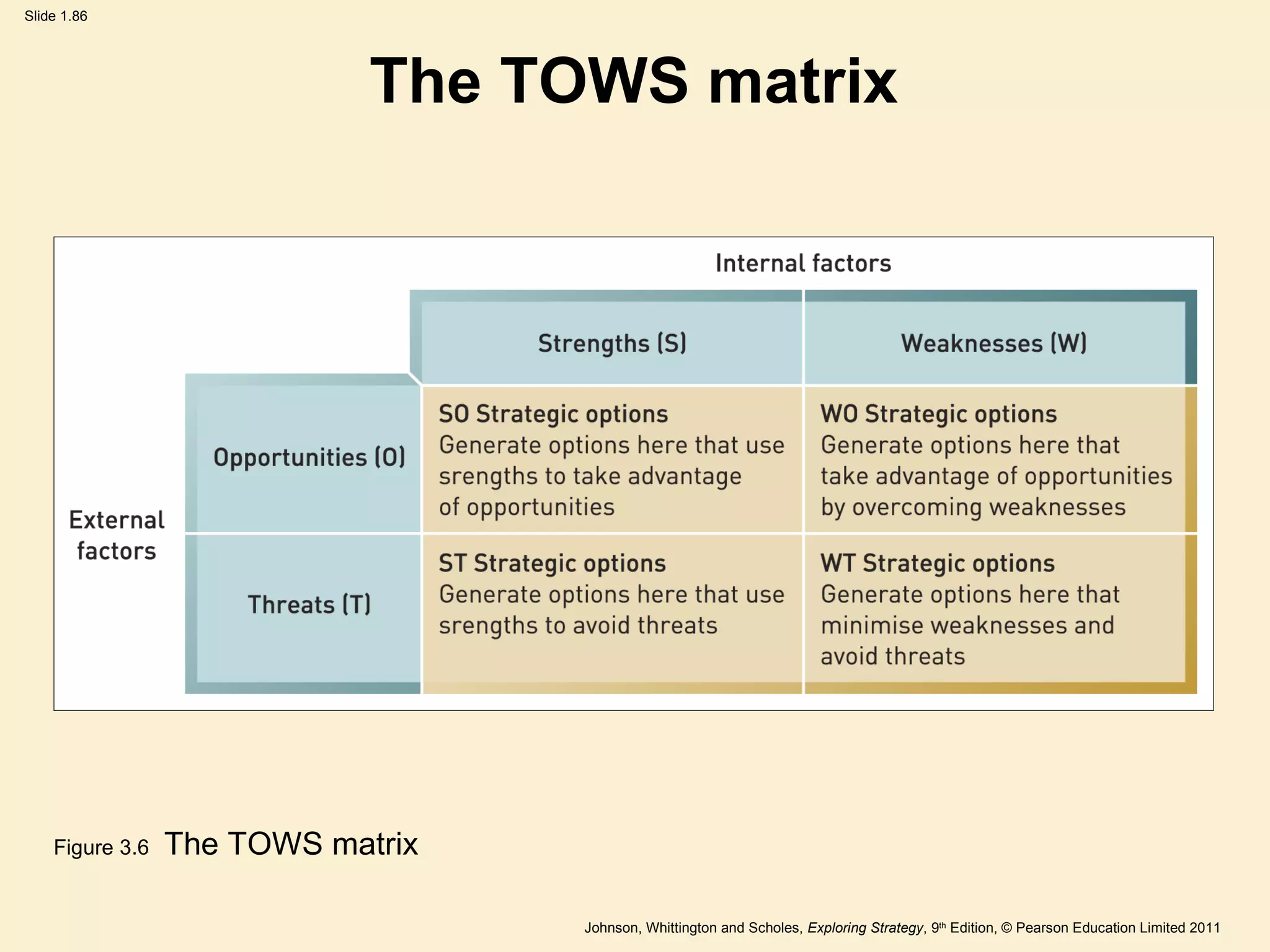
The TOWS matrix Figure 3.6   The TOWS matrix
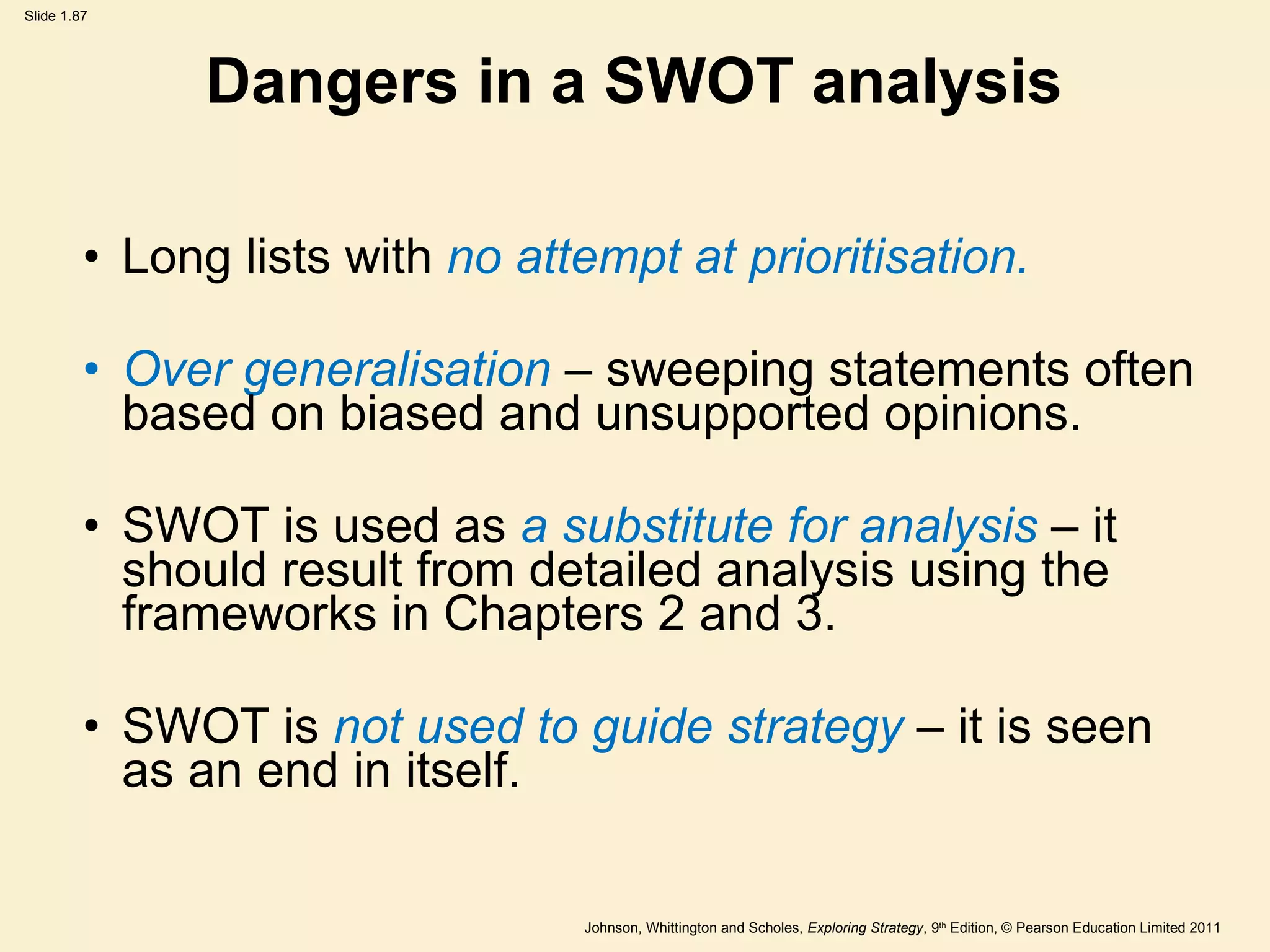
Dangers in a SWOT analysis Long lists with  no attempt at prioritisation. Over generalisation  – sweeping statements often based on biased and unsupported opinions. SWOT is used as  a substitute for analysis  – it should result from detailed analysis using the frameworks in Chapters 2 and 3. SWOT is  not used to guide strategy  – it is seen as an end in itself.
Developing strategic capabilities Internal capability development : Leveraging capabilities  – identifying capabilities in one part of the organisation and transferring them to other parts (sharing best practice).  Stretching capabilities  - building new products or services out of existing capabilities.  External capability development  – adding capabilities through mergers, acquisitions or alliances. Ceasing activities  – non-core activities can be stopped, outsourced or reduced in cost. Monitor outputs and benefits  – to understand sources of consumer benefit and enhance anything that contributes to this. Managing the capabilities of people   – training, development and organisation learning.
Summary Strategic capabilities  comprise both resources and competences. The concept of  dynamic capabilities  highlights that strategic capabilities need to change as the market and environmental context of an organisation changes. Sustainability  of competitive advantage is likely to depend on an organisation ’ s capabilities being of at least  threshold value  in a market but also being  valuable , relatively rare,  intimable and non-substitutable. Ways of  diagnosing organisational capabilities  include: Benchmarking   as a means of understanding the relative performance of organisations. Analysing an organisation ’ s  value chain and value network   as a basis for understanding how value to a customer is created and can be developed. Activity mapping  as a means of identifying more detailed activities which underpin strategic capabilities. SWOT analysis  as a way of drawing together an understanding of strengths, weaknesses,  opportunities and threats an organisation faces.
The Strategic Position 4: Strategic Purpose
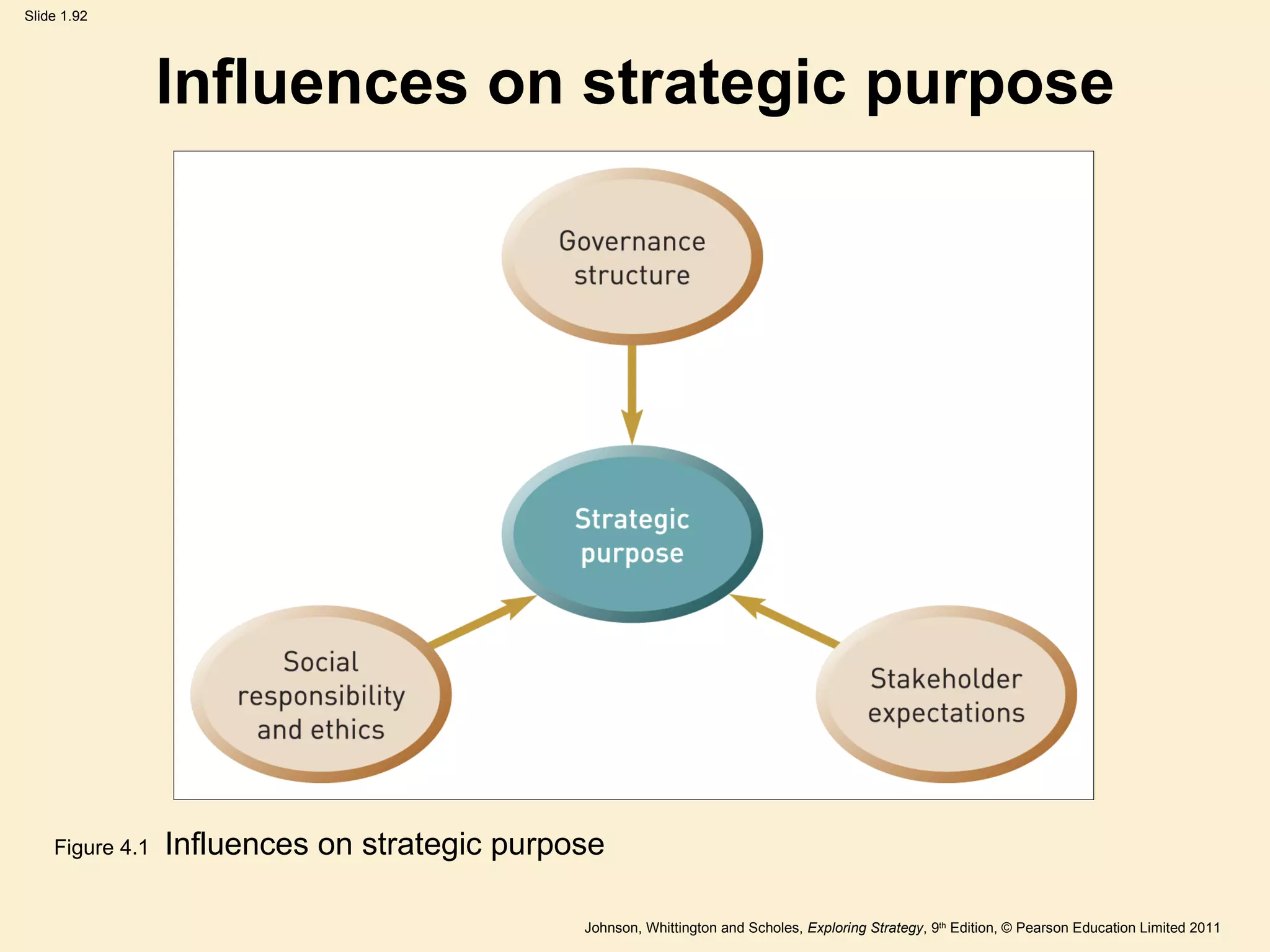
Strategic Purpose Learnings Consider appropriate ways to express the  strategic purpose  of an organisation in terms of statements of purpose, values,vision, mission or objectives. Identify the components of the  governance chain  of an organisation. Understand differences in  governance structures  and the advantages and disadvantages of these. Identify differences in the  corporate responsibility stances  taken by organisations and how  ethical issues  relate to strategic purpose. Undertake  stakeholder analysis  as a means of identifying the influence of different stakeholder groups in terms of their power and interest.
Influences on strategic purpose Figure 4.1   Influences on strategic purpose
Who are the stakeholders? Stakeholders   are those individuals or groups who depend on an organisation to fulfil their own goals and on whom, in turn, the organisation depends.
Mission statements A mission statement  aims to provide employees and stakeholders with clarity about the overriding purpose of the organisation A mission statement should answer the questions:    ‘ What business are we in? ’ ‘ How do we make a difference? ’ ‘ Why do we do this? ’
Vision statements A vision statement  is concerned with the desired future state of the organisation; an aspiration that will enthuse, gain commitment and stretch performance. A vision statement should answer the question : ‘ What do we want to achieve? ’
Statement of corporate values A statement of corporate values  should communicate the underlying and enduring core  ‘ principles ’  that guide an organisation ’ s strategy and define the way that the organisation should operate. Such core values should remain intact whatever the circumstances and constraints faced by the organisation.
Objectives Objectives   are statements of specific outcomes that are to be achieved. Objectives are frequently expressed in:  financial terms  e.g. desired profit levels market terms  e.g. desired market share and increasingly social terms  e.g. corporate social responsibility targets
Issues in setting objectives Do objectives need to be specific and quantified targets? The need to identify core objectives that are crucial for survival. The need for a hierarchy of objectives that cascade down the organisation and define specific objectives at each level.
Corporate governance Corporate governance  is concerned with the structures and systems of control by which managers are held accountable to those who have a legitimate stake in an organisation.
The growing importance of governance The separation of ownership and management control –  defining different roles in governance. Corporate failures and scandals  (e.g. Enron) – focussing attention on governance issues. Increased accountability  to wider stakeholder interests and the need for corporate social responsibility (e.g. green issues).
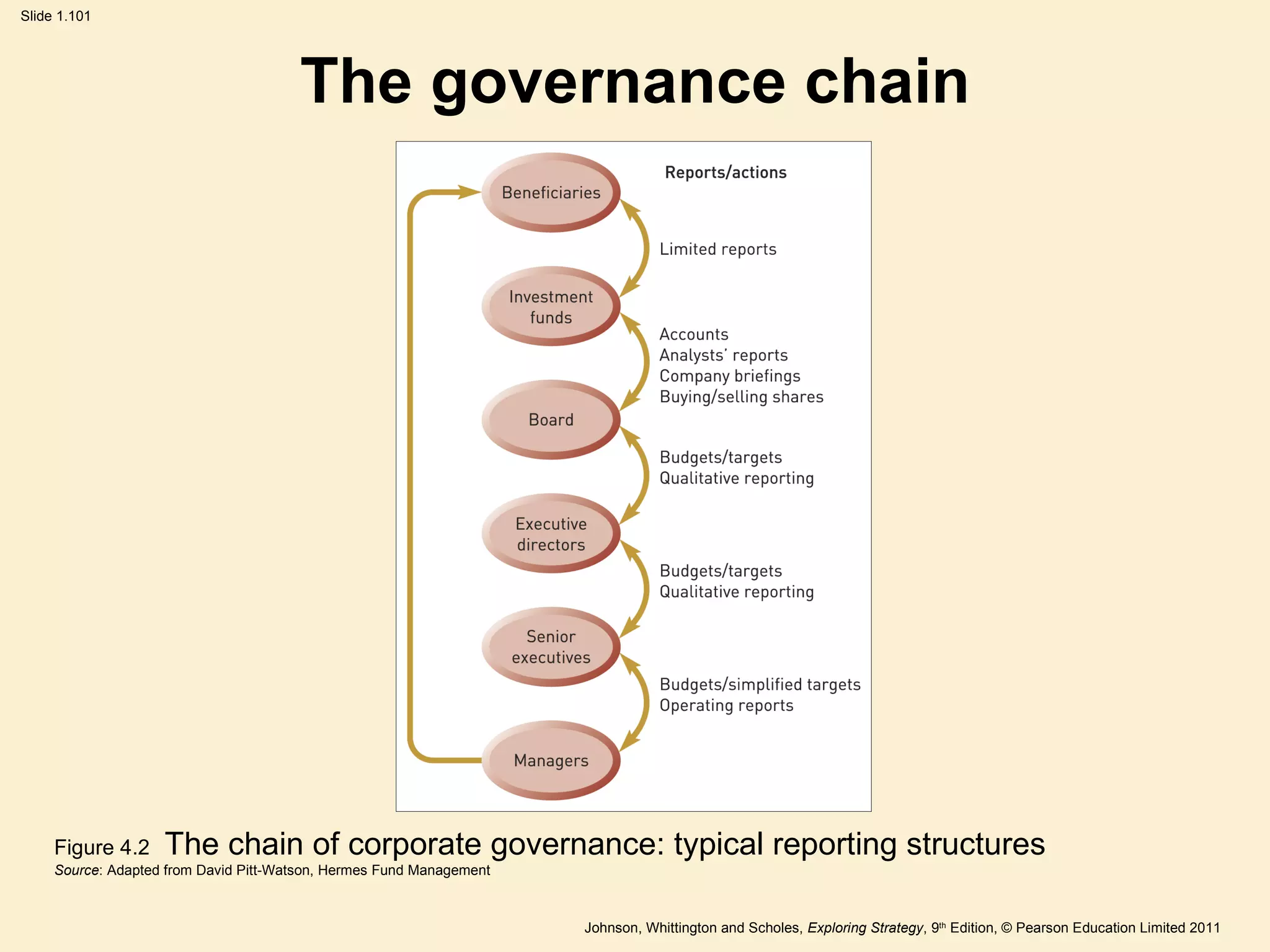
The governance chain Figure 4.2   The chain of corporate governance: typical reporting structures Source : Adapted from David Pitt-Watson, Hermes Fund Management
The principal-agent model Governance can be seen in terms of the principal agent model Principals pay agents to act on their behalf (e.g. beneficiaries/trustees pay investment managers to manage funds, Boards of Directors pay executives to run a company). Agents may act in their own self interest.
Issues in governance The key challenge is to align the interests of agents with those of the principals. Misalignment of incentives and control – e.g. beneficiaries may require long term growth but executives may be seeking short term profit.   Responsibility to whom – should executives pursue solely shareholder aims or serve a wider constituency of stakeholders? Who are the shareholders – should boards respond to the demands of institutional investment managers or the needs of the ultimate beneficiaries? The role of institutional investors – should they actively intervene in strategy? Establishing the specific role of the board – in particular the role of non-executive directors. Scrutiny and control  –  statutory requirements and voluntary codes to regulate boards.
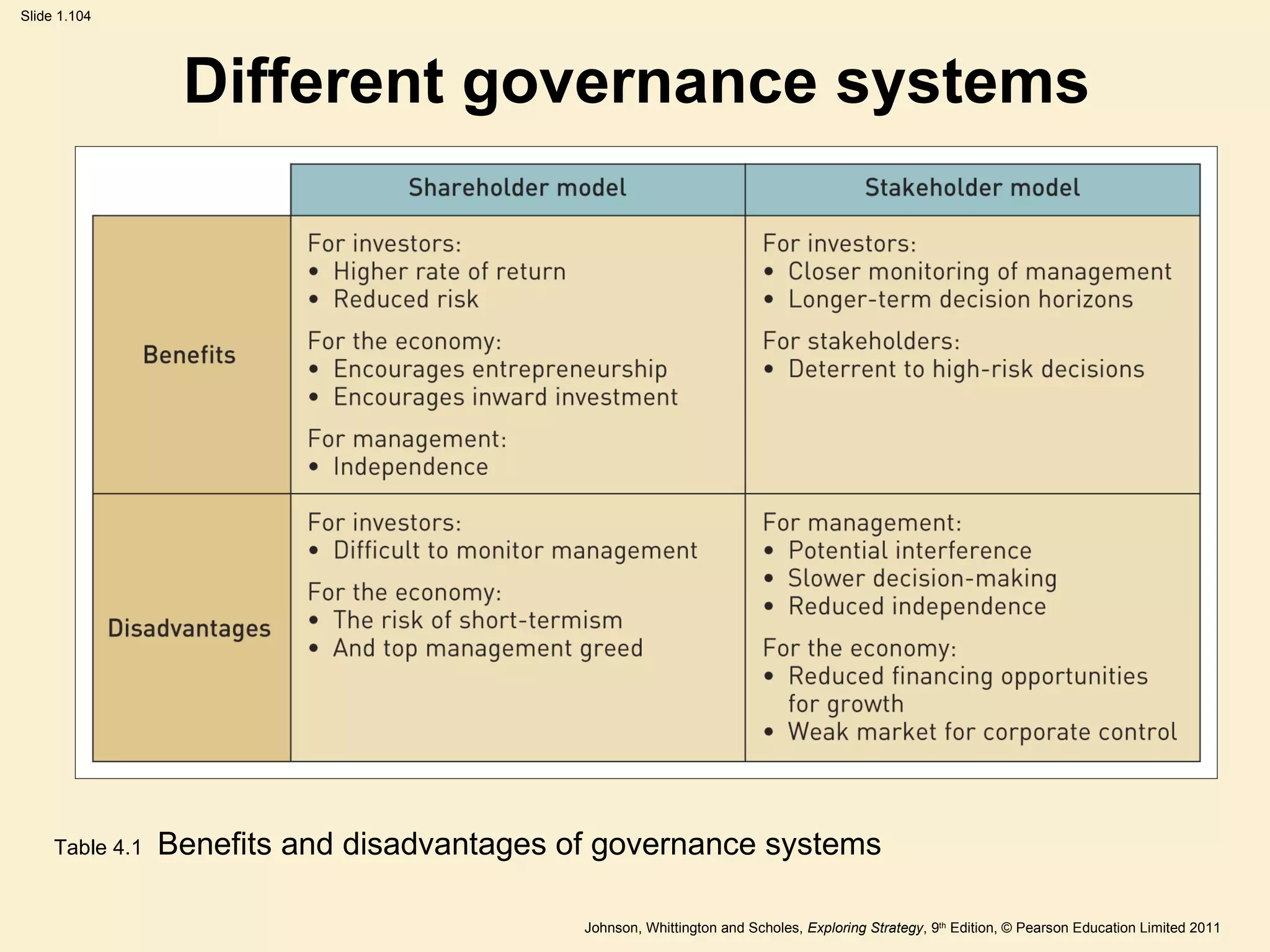
Different governance systems Table 4.1   Benefits and disadvantages of governance systems
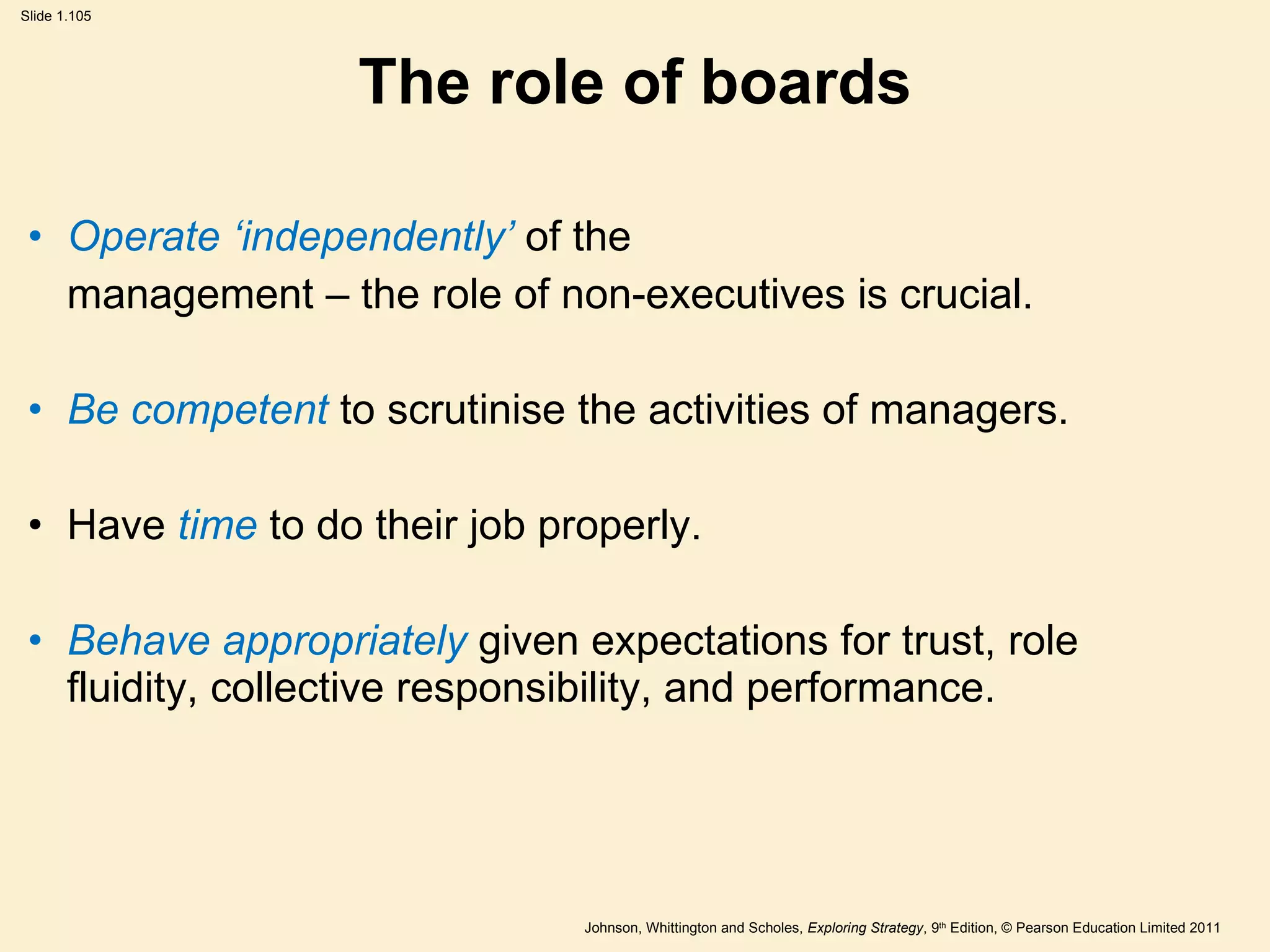
The role of boards Operate  ‘ independently ’   of the management – the role of non-executives is crucial. Be competent  to scrutinise the activities of managers. Have  time  to do their job properly. Behave appropriately  given expectations for trust, role fluidity, collective responsibility, and performance.
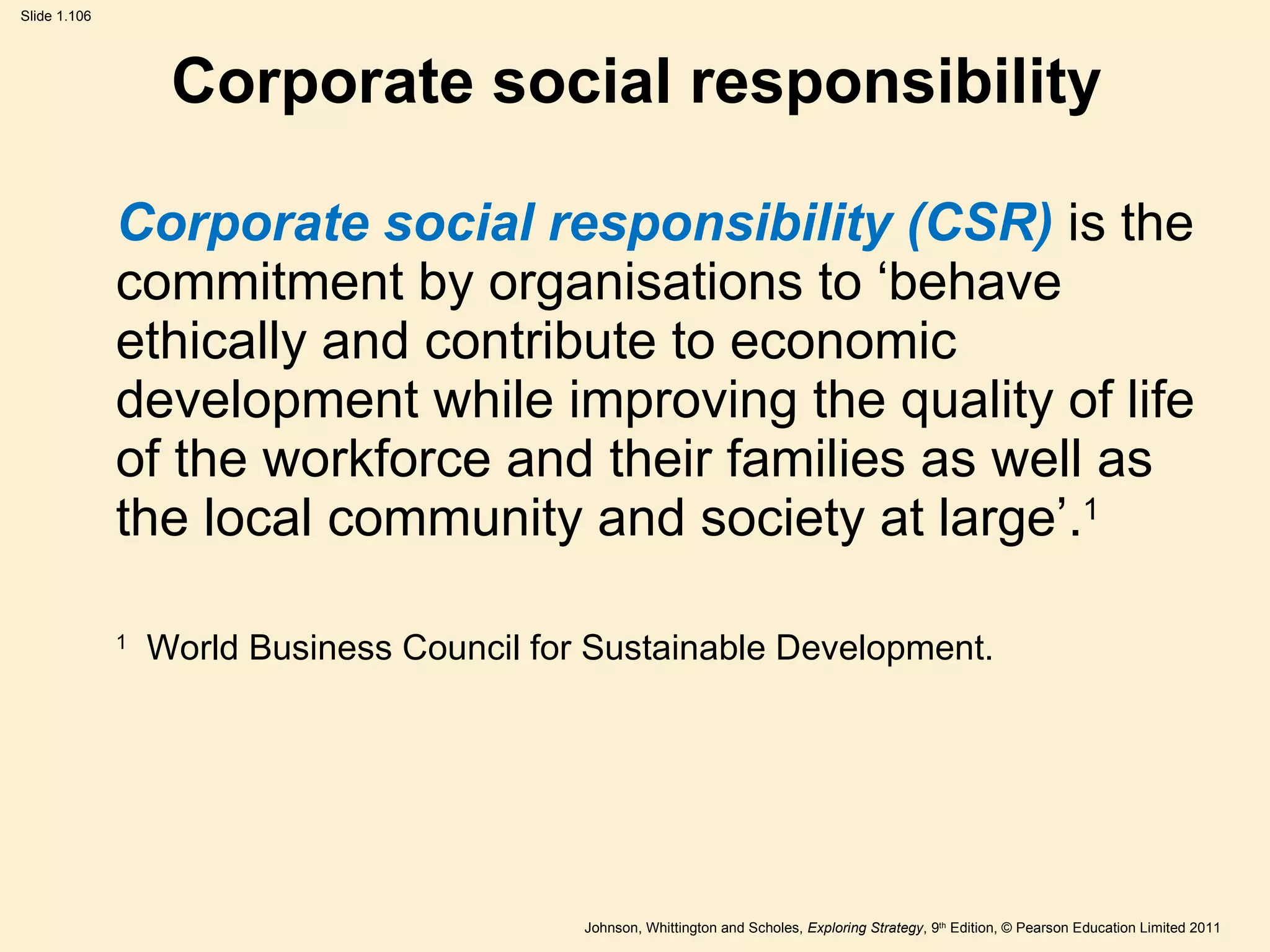
Corporate social responsibility Corporate social responsibility (CSR)  is the commitment by organisations to  ‘ behave ethically and contribute to economic development while improving the quality of life of the workforce and their families as well as the local community and society at large ’ . 1 1   World Business Council for Sustainable Development.
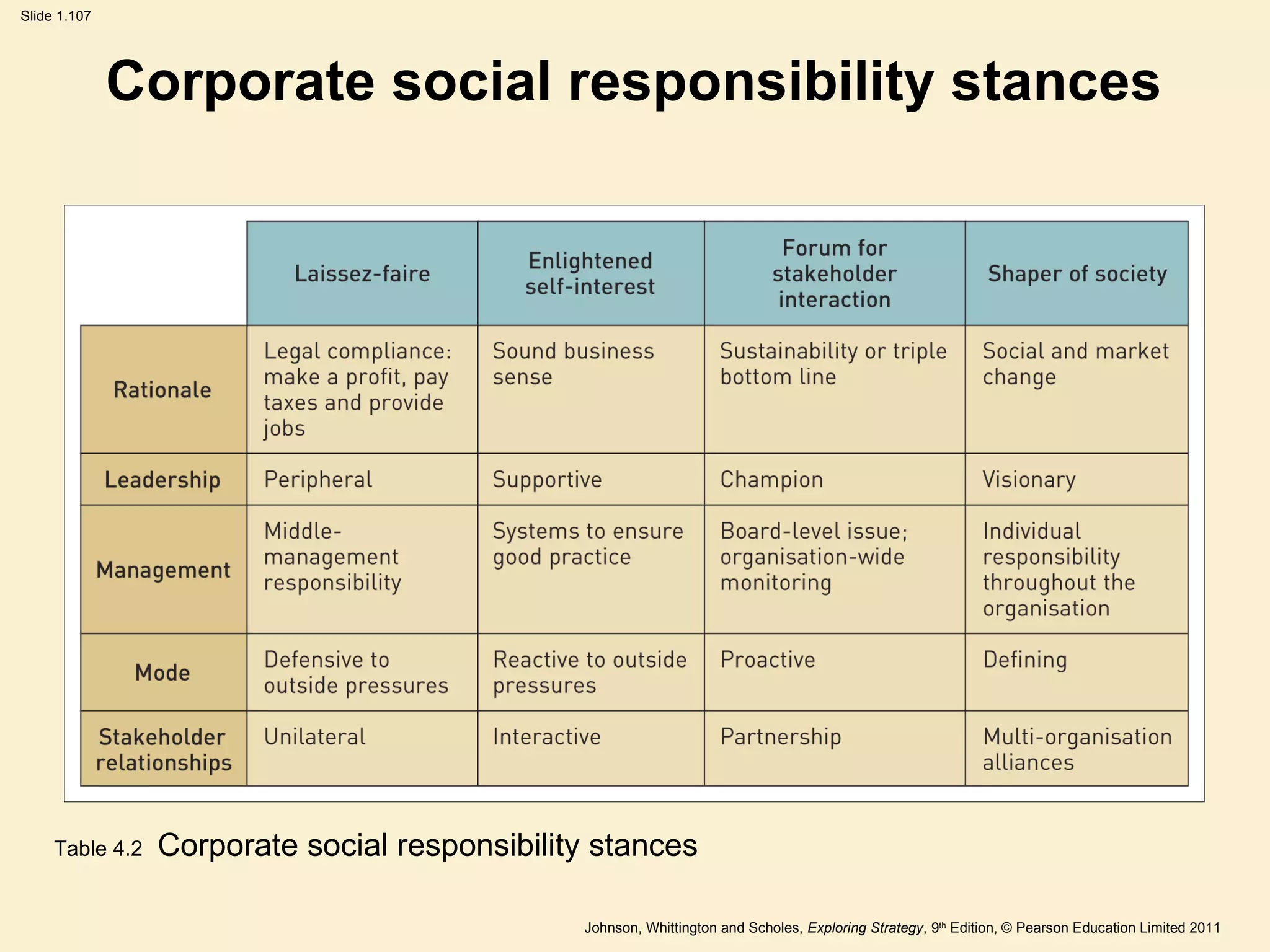
Corporate social responsibility stances Table 4.2   Corporate social responsibility stances
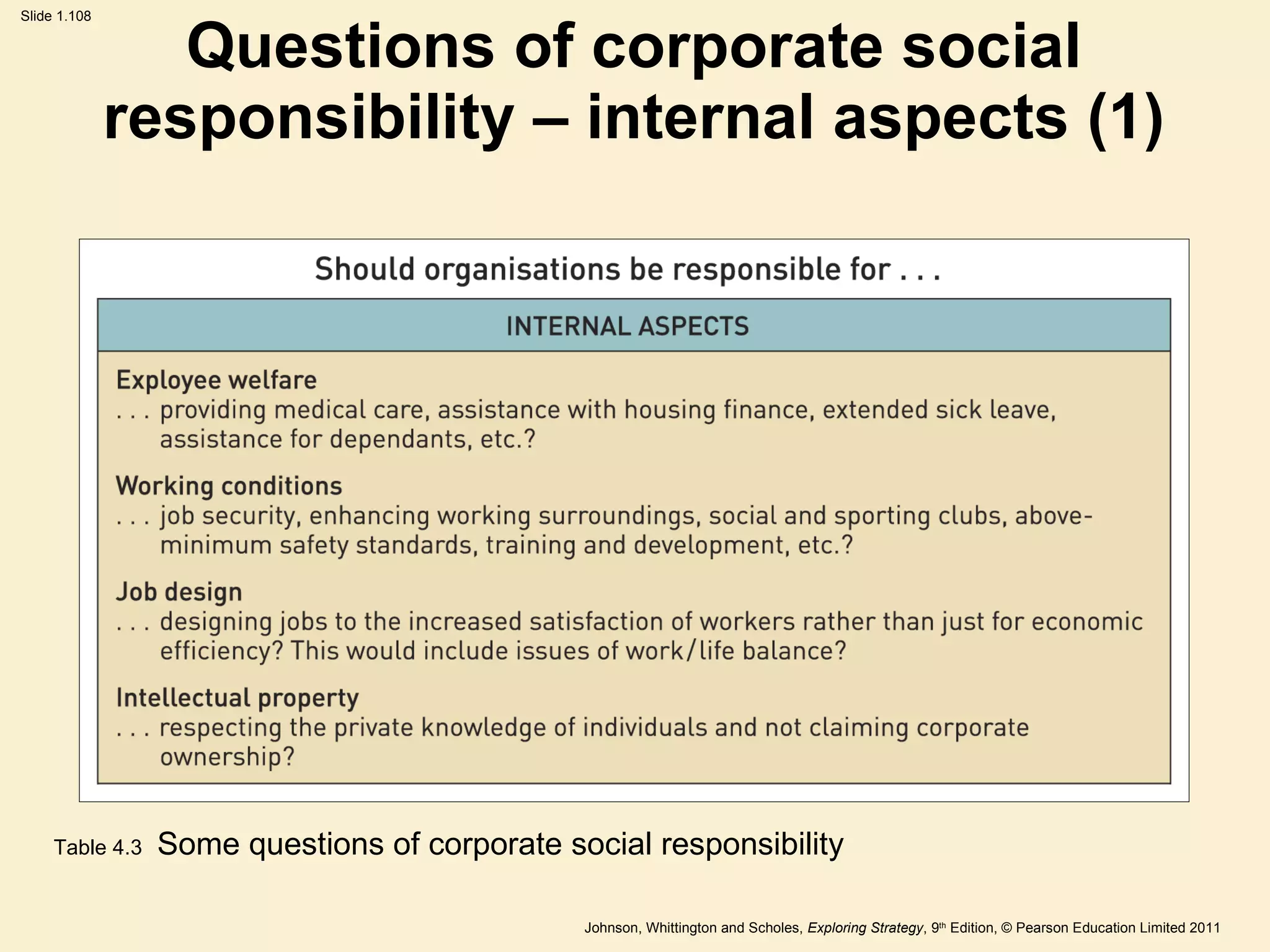
Questions of corporate social responsibility – internal aspects (1) Table 4.3   Some questions of corporate social responsibility
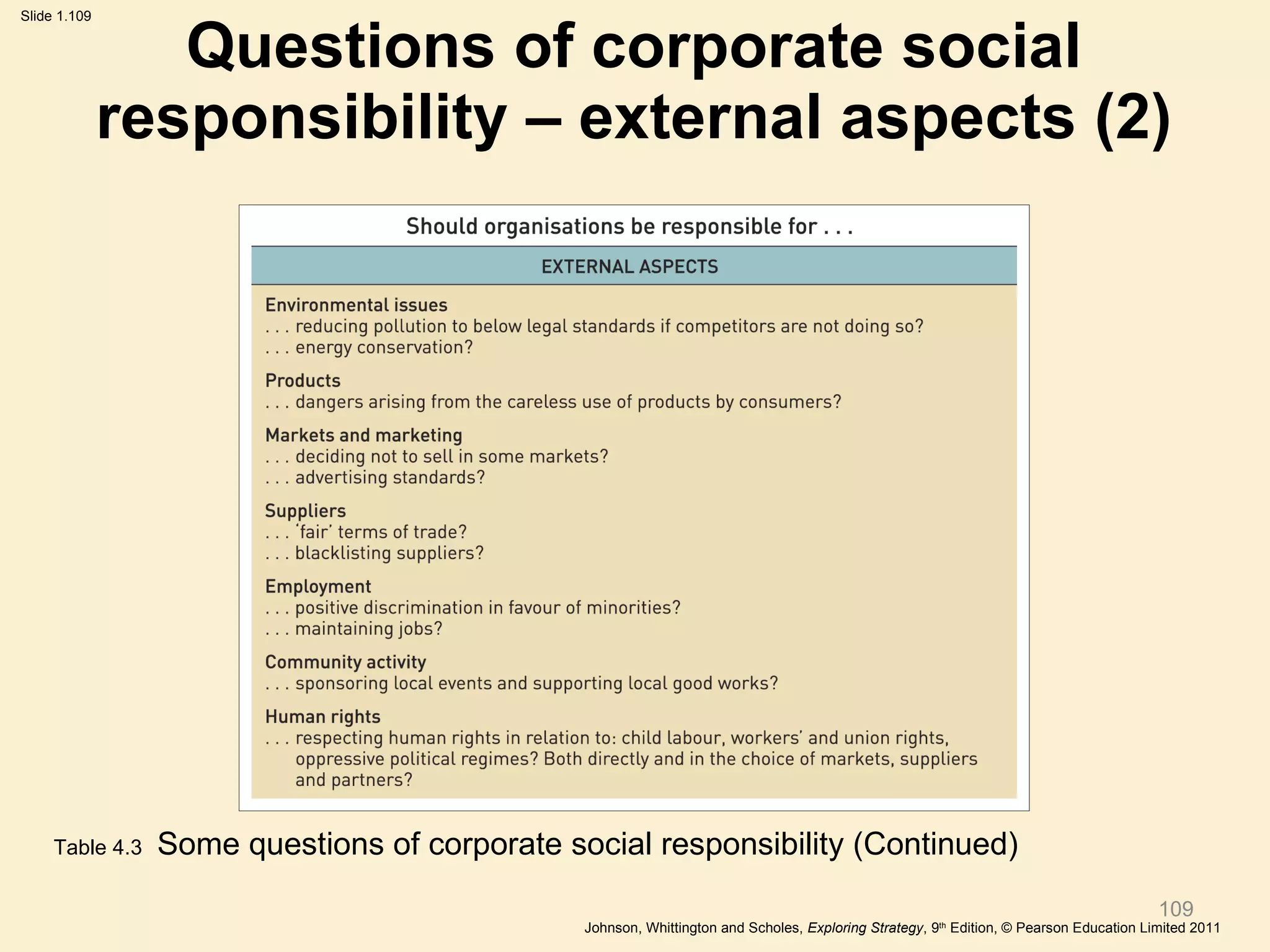
Questions of corporate social responsibility – external aspects (2) Table 4.3   Some questions of corporate social responsibility (Continued)
The ethics of individuals and managers Ethical issues  have to be faced at the individual level  : The responsibility of an individual who believes  that the strategy of the organisation is unethical  – resign, ignore it or take action. ‘ Whistle-blowing ’   - divulging information to the  authorities or media about an organisation if  wrong doing is suspected.
Texas instruments ’  guidelines Is the action legal? . . . If no, stop immediately. Does it comply with our values? . . . If it does not, stop. If you do it would you feel bad? . . . Ask your own conscience if you can live with it. How would this look in the newspaper? . . . Ask if this goes public tomorrow would you do it today? If you know it ’ s wrong . . . don ’ t do it. If you are not sure . . . ask; and keep asking until you get an answer.
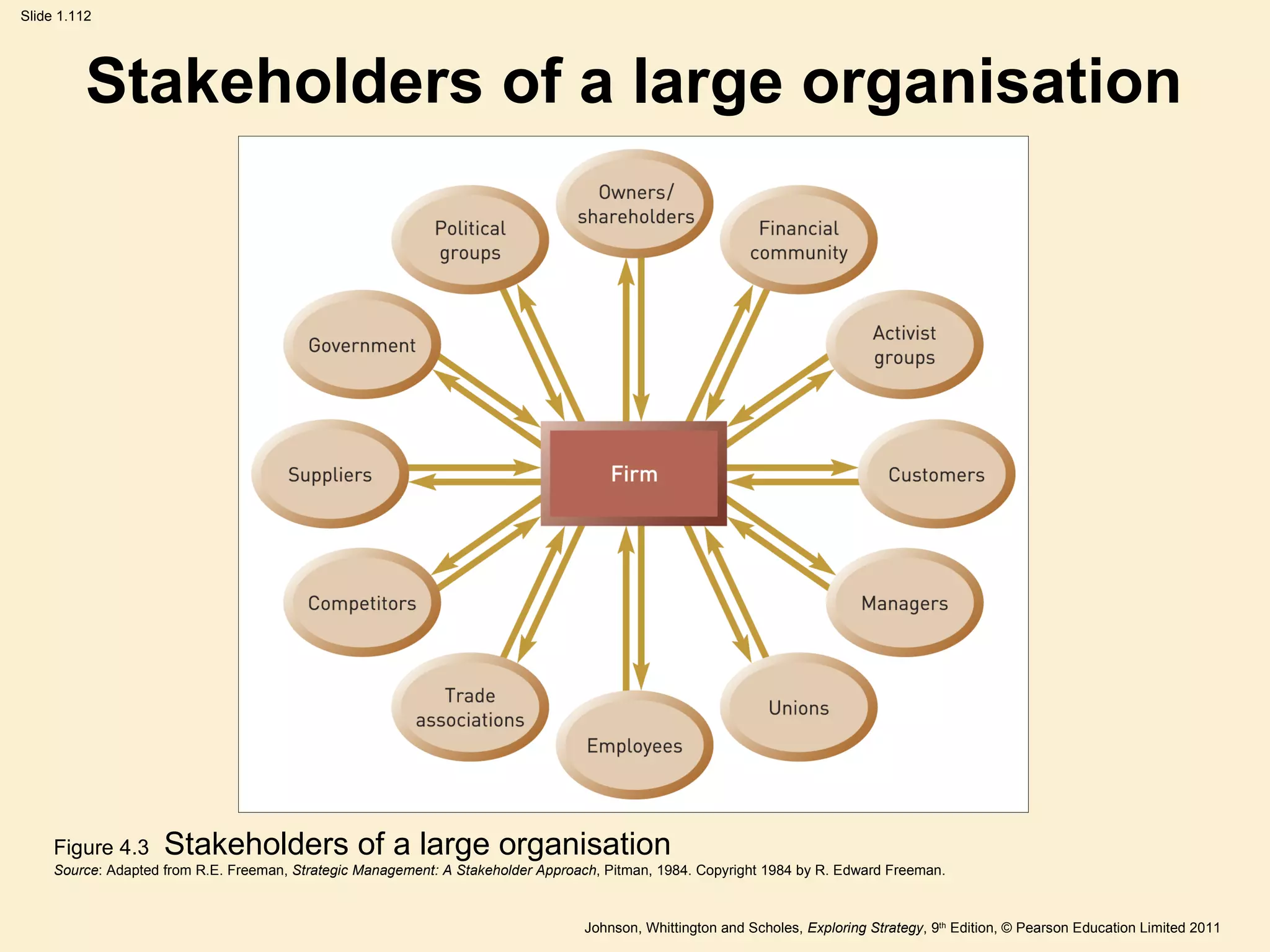
Stakeholders of a large organisation Figure 4.3   Stakeholders of a large organisation Source :  Adapted from R.E. Freeman,  Strategic Management: A Stakeholder Approach , Pitman, 1984. Copyright 1984 by R. Edward Freeman.
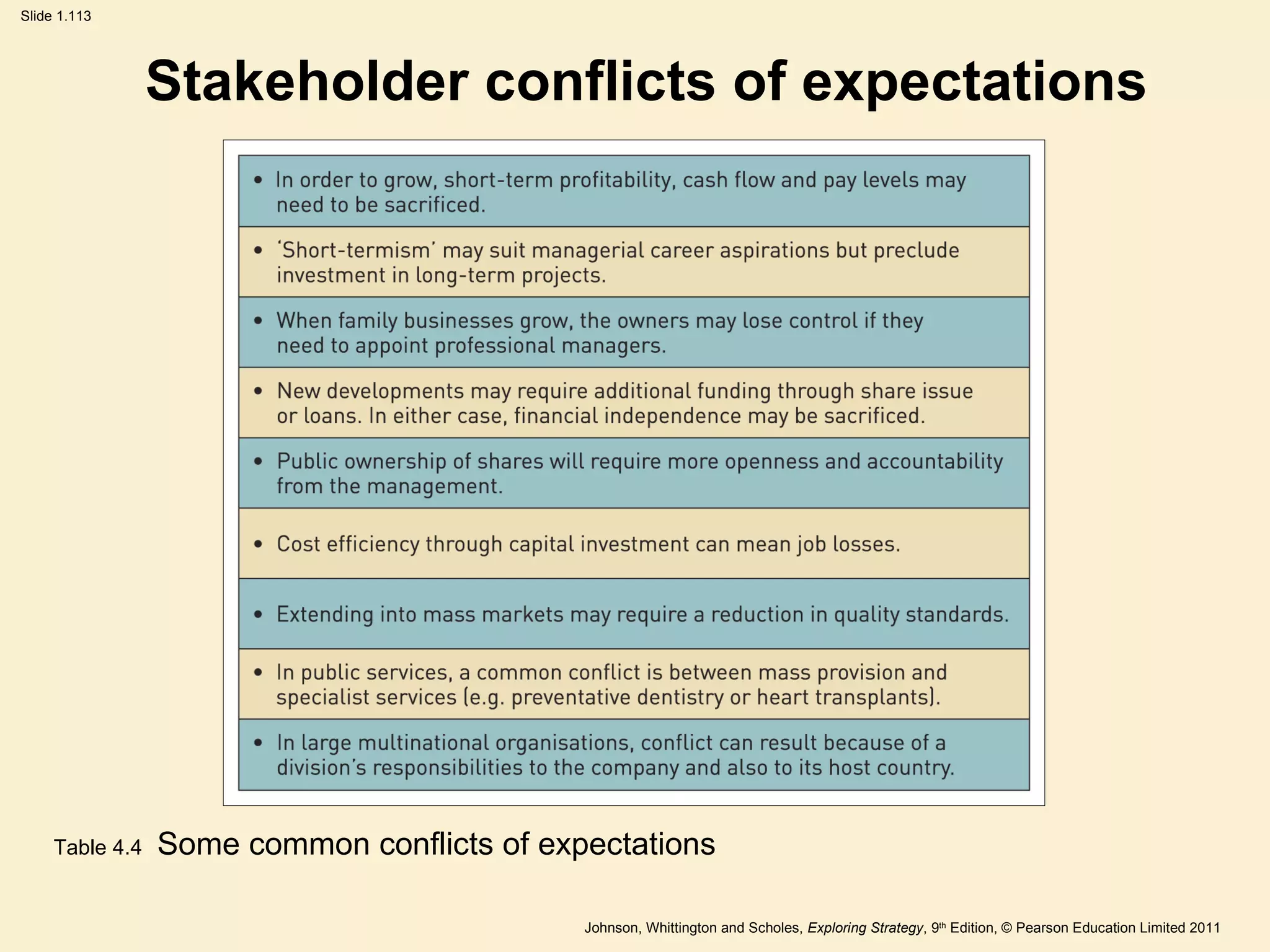
Stakeholder conflicts of expectations Table 4.4   Some common conflicts of expectations
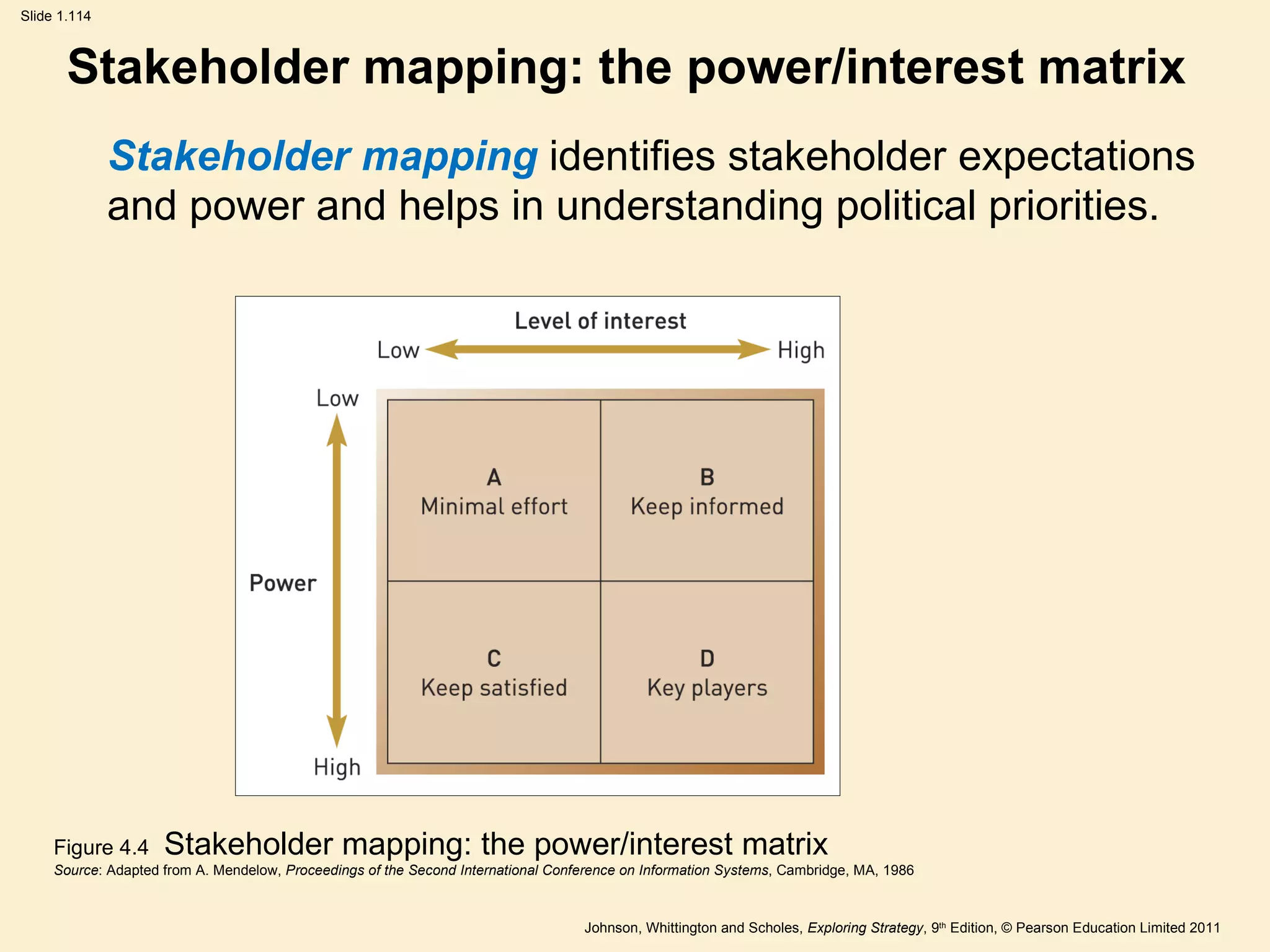
Stakeholder mapping: the power/interest matrix Stakeholder mapping  identifies stakeholder expectations and power and helps in understanding political priorities. Figure 4.4   Stakeholder mapping: the power/interest matrix Source : Adapted from A. Mendelow,  Proceedings of the Second International Conference on Information Systems , Cambridge, MA, 1986
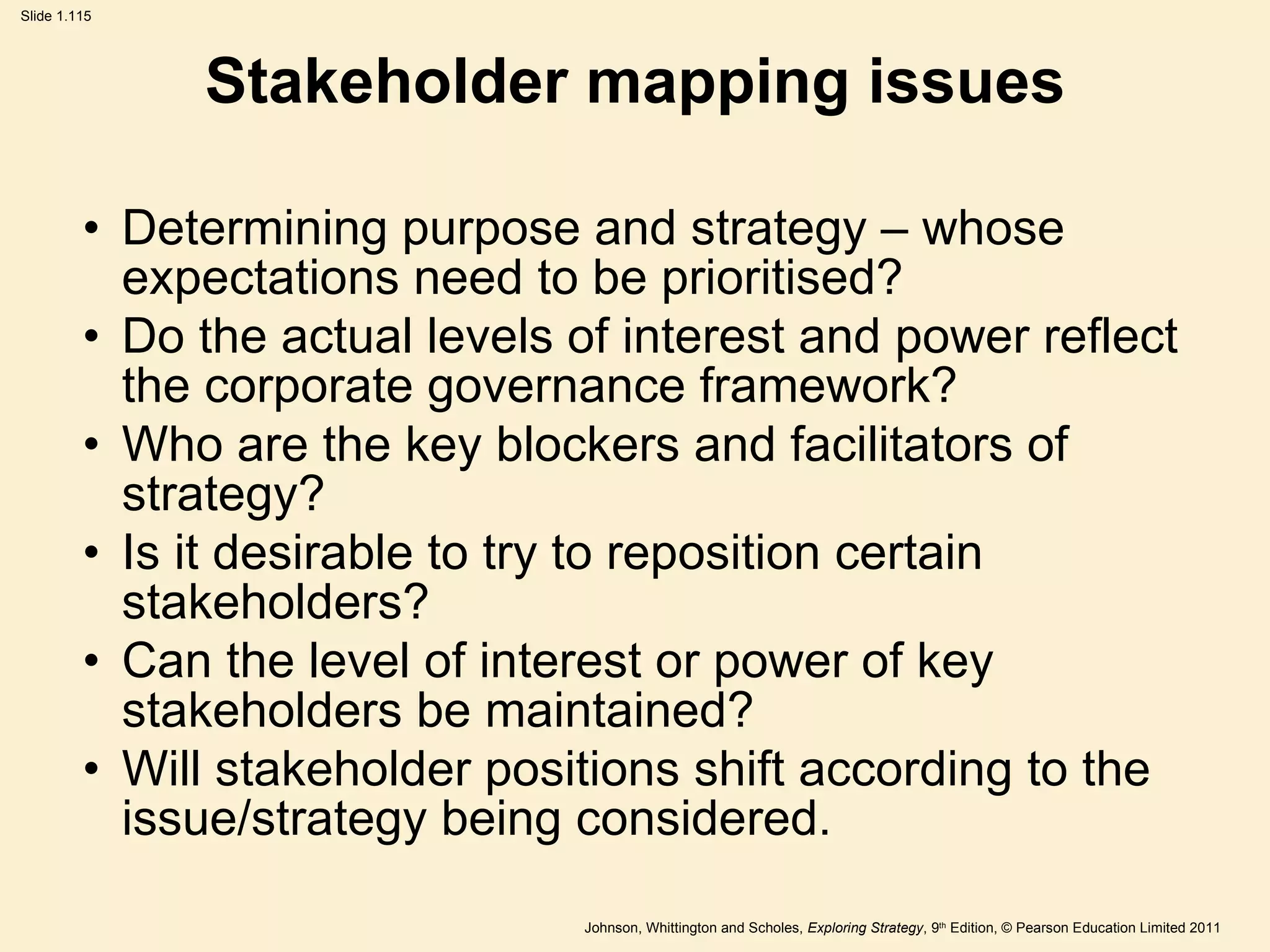
Stakeholder mapping issues Determining purpose and strategy – whose expectations need to be prioritised? Do the actual levels of interest and power reflect the corporate governance framework? Who are the key blockers and facilitators of strategy? Is it desirable to try to reposition certain stakeholders? Can the level of interest or power of key stakeholders be maintained? Will stakeholder positions shift according to the issue/strategy being considered.
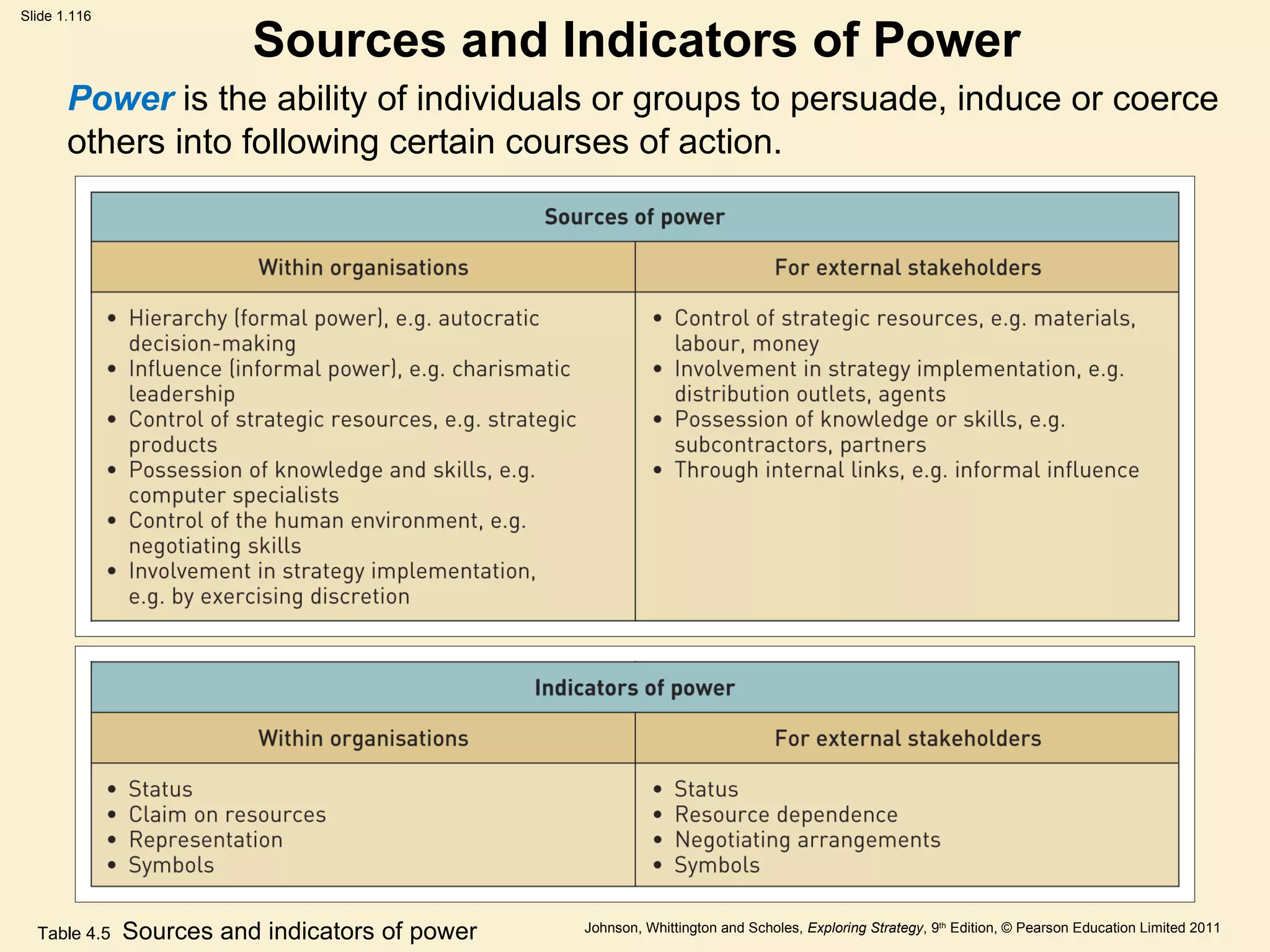
Sources and Indicators of Power Power  is the ability of individuals or groups to persuade, induce or coerce others into following certain courses of action. Table 4.5   Sources and indicators of power
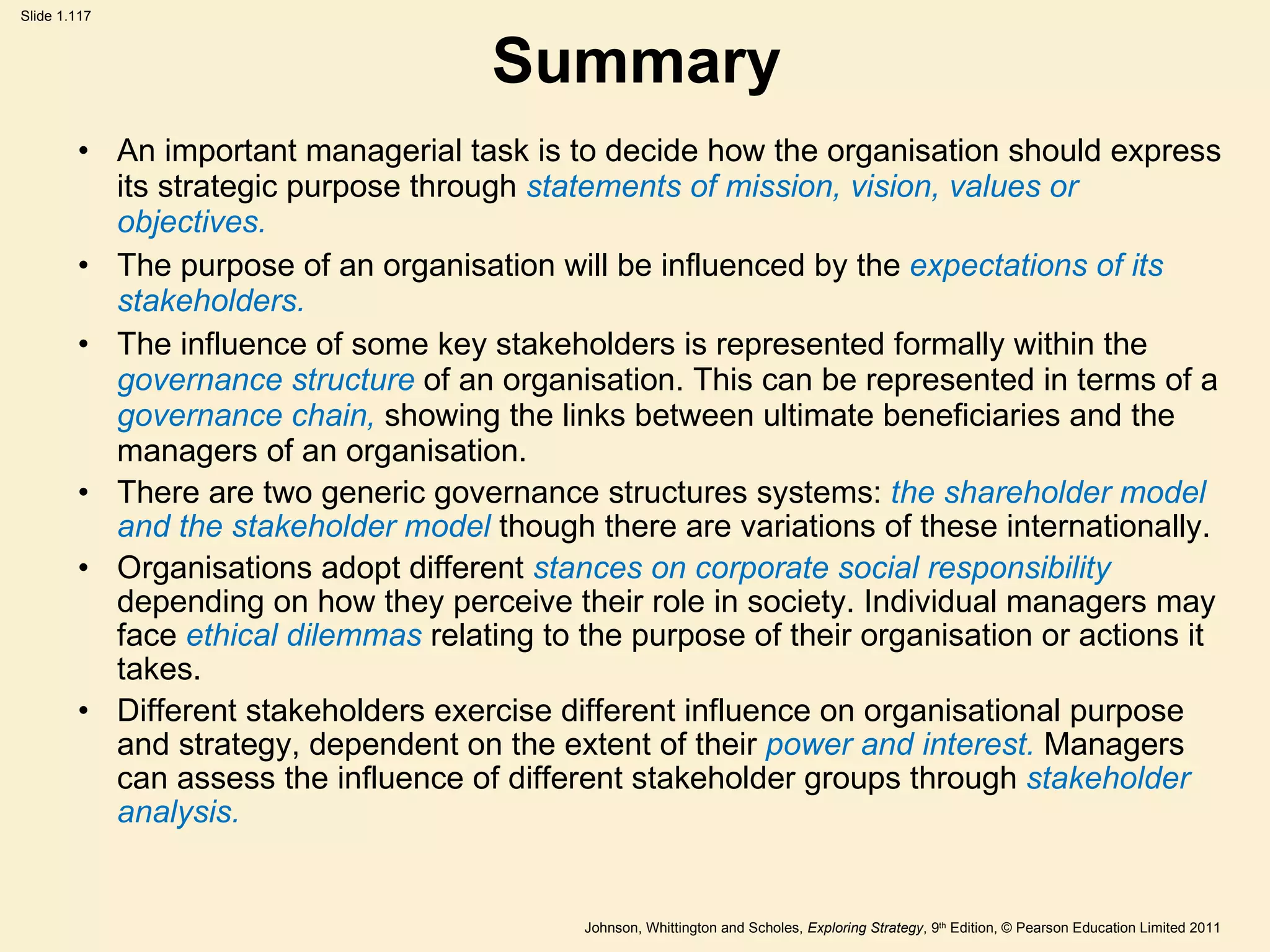
Summary An important managerial task is to decide how the organisation should express its strategic purpose through  statements of mission, vision, values or objectives. The purpose of an organisation will be influenced by the  expectations of its stakeholders. The influence of some key stakeholders is represented formally within the  governance structure  of an organisation. This can be represented in terms of a  governance chain,  showing the links between ultimate beneficiaries and the managers of an organisation. There are two generic governance structures systems:  the shareholder model and the stakeholder model  though there are variations of these internationally. Organisations adopt different  stances on corporate social responsibility  depending on how they perceive their role in society. Individual managers may face  ethical dilemmas  relating to the purpose of their organisation or actions it takes. Different stakeholders exercise different influence on organisational purpose and strategy, dependent on the extent of their  power and interest.  Managers can assess the influence of different stakeholder groups through  stakeholder analysis.
The Strategic Position 5: Culture and Strategy
Culture and Strategy Learnings Identify organisations that have experienced  strategic drift  and the symptoms of strategic drift. Analyse how  history  influences the strategic position of organisations. Analyse the influence of an organisation ’ s  culture  on its strategy using the  cultural web . Recognise the importance of strategists  questioning the taken–for–granted  aspects of a culture.
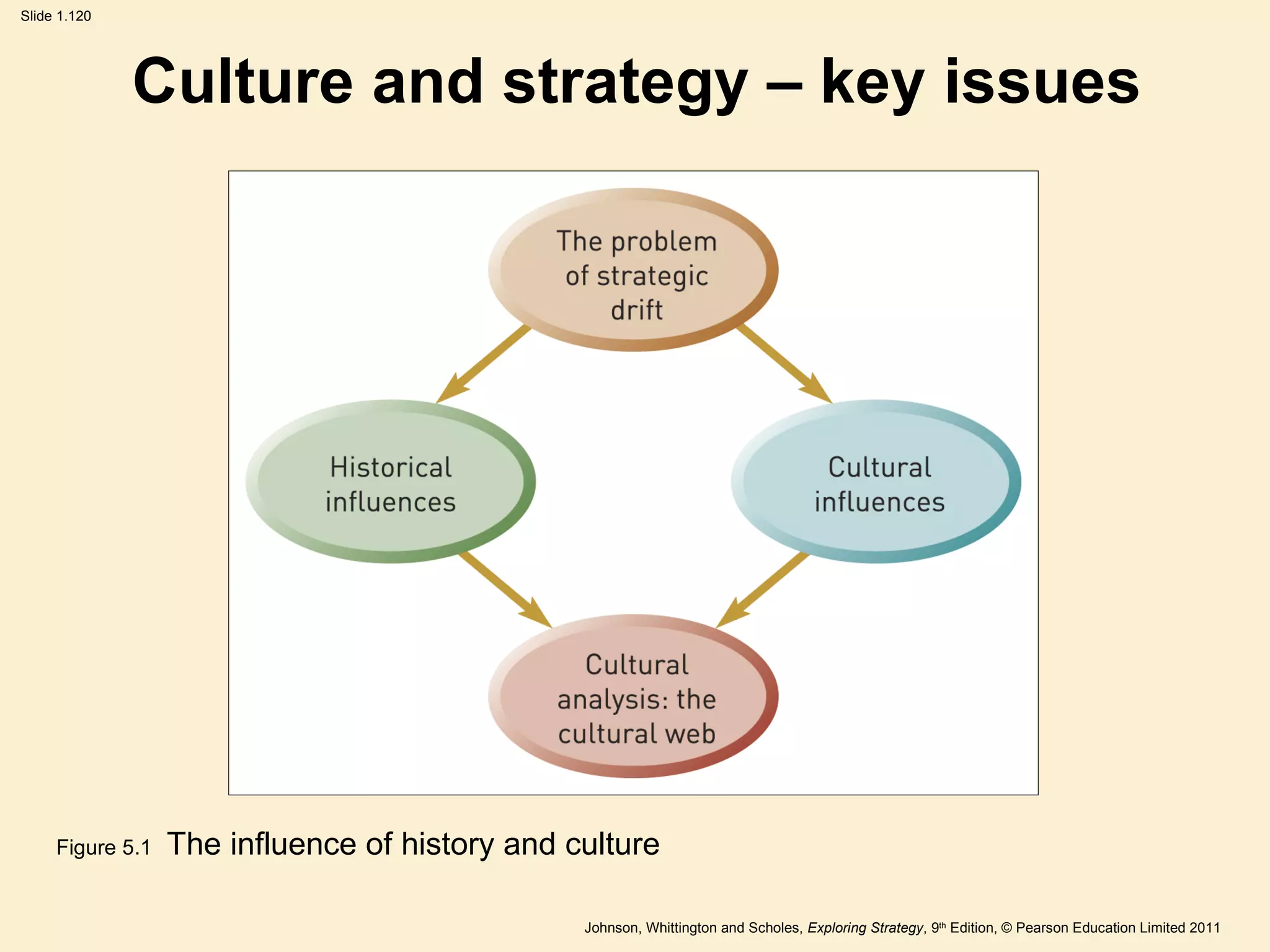
Culture and strategy – key issues Figure 5.1  The influence of history and culture
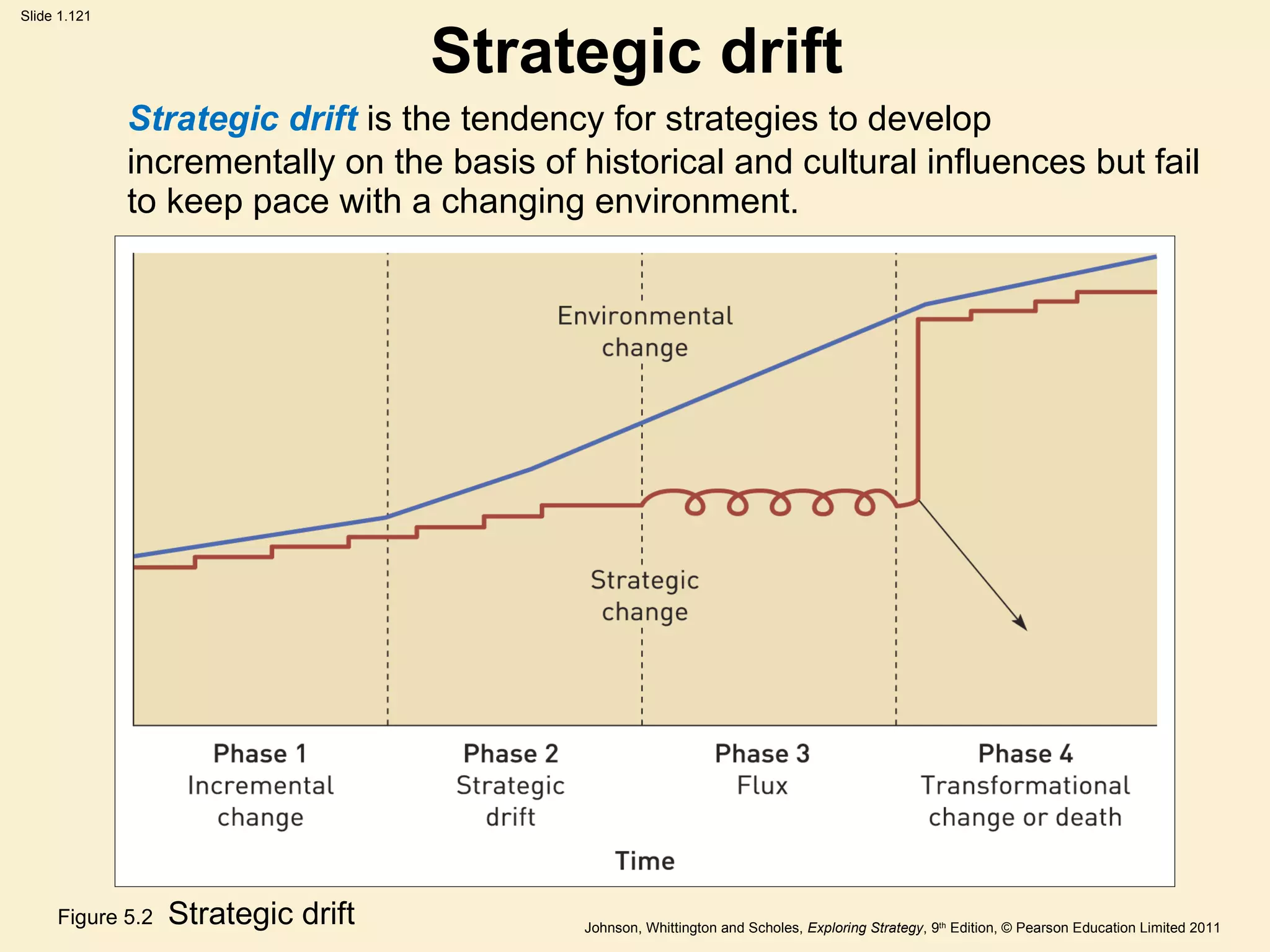
Strategic drift Strategic drift  is the tendency for strategies to develop incrementally on the basis of historical and cultural influences but fail to keep pace with a changing environment. Figure 5.2  Strategic drift
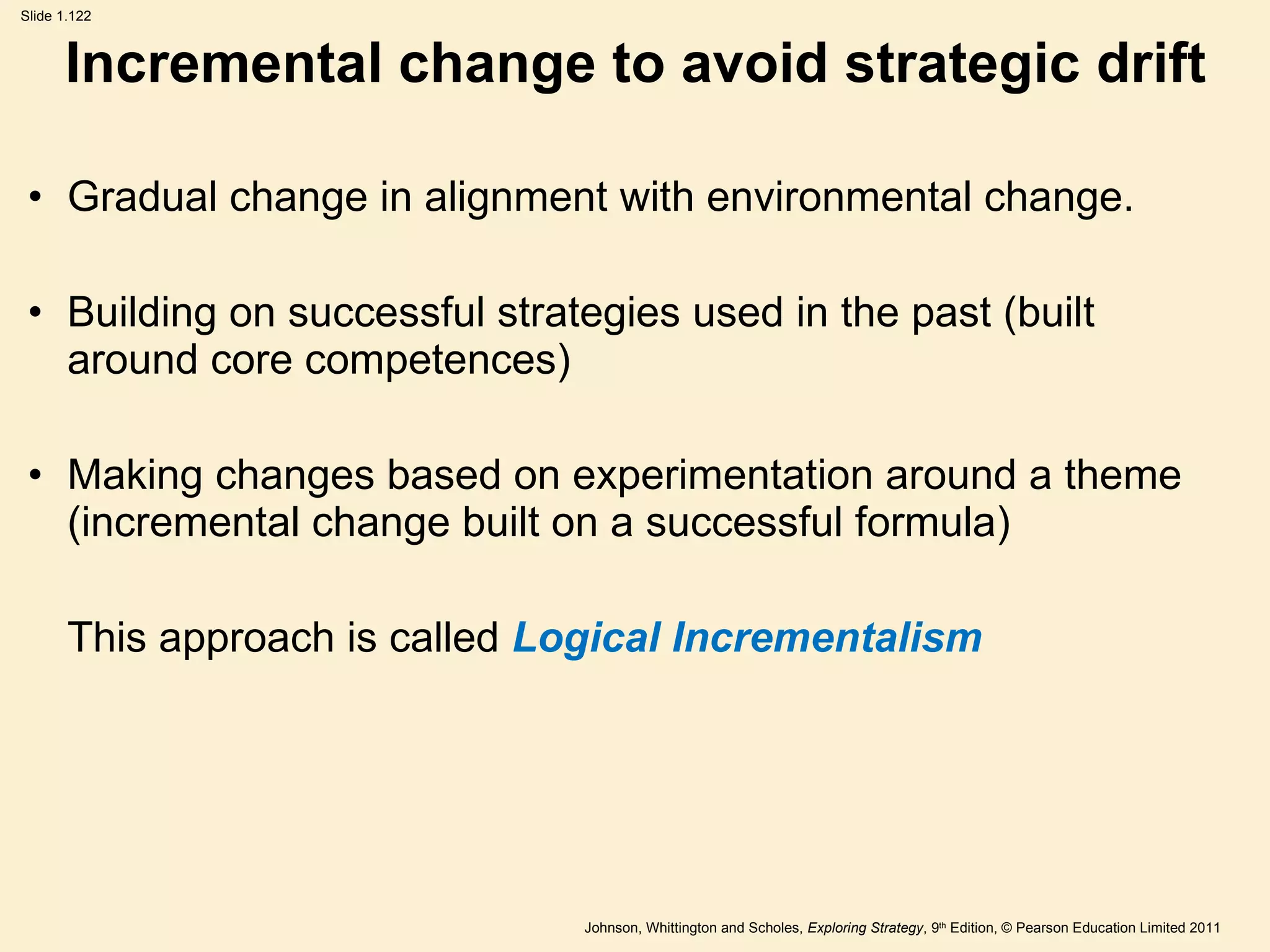
Incremental change to avoid strategic drift Gradual change in alignment with environmental change. Building on successful strategies used in the past (built around core competences) Making changes based on experimentation around a theme (incremental change built on a successful formula) This approach is called  Logical Incrementalism
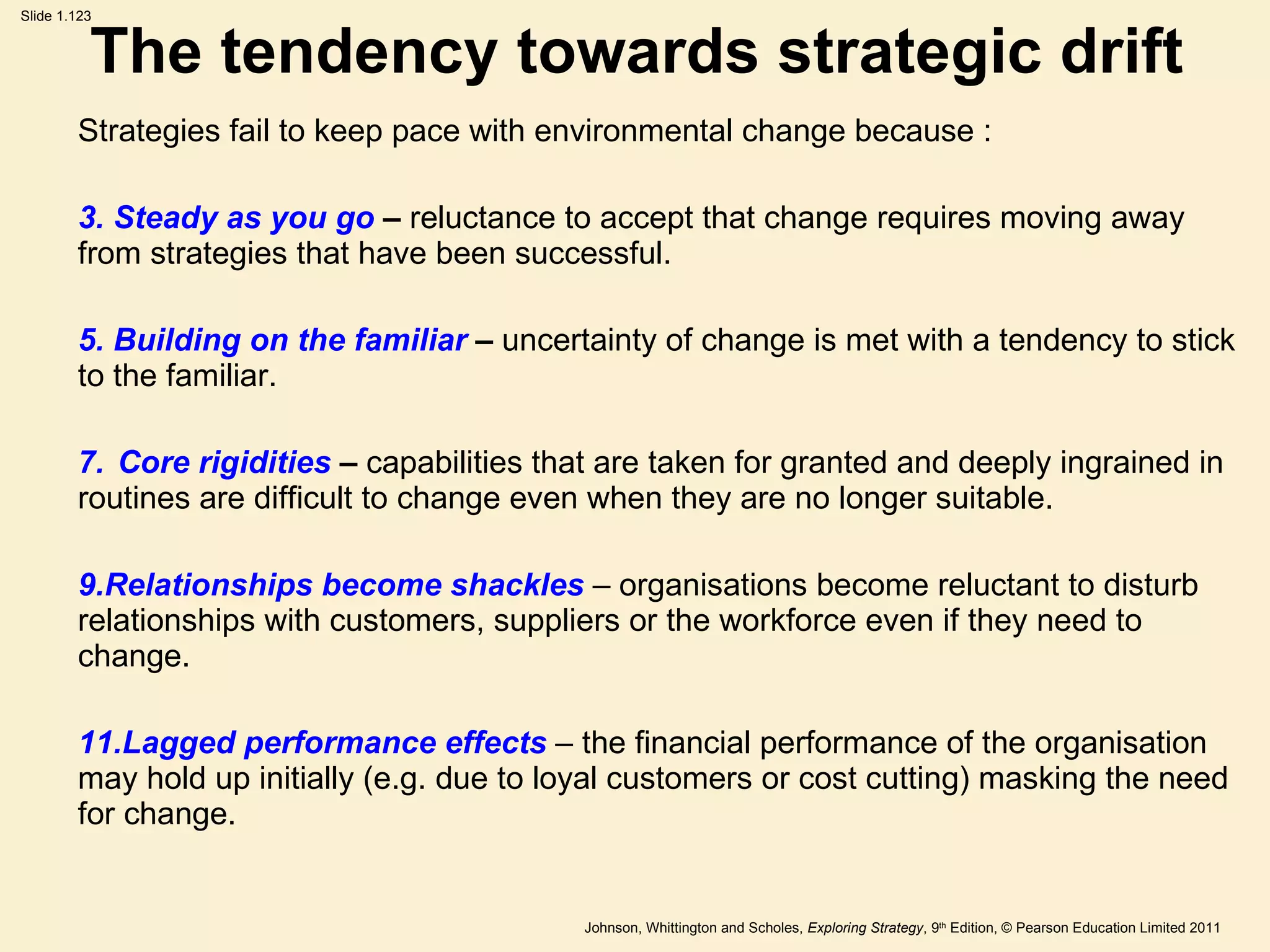
The tendency towards strategic drift Strategies fail to keep pace with environmental change because : Steady as you go  –  reluctance to accept that change requires moving away from strategies that have been successful. Building on the familiar  –  uncertainty of change is met with a tendency to stick to the familiar. Core rigidities  –   capabilities that are taken for granted and deeply ingrained in routines are difficult to change even when they are no longer suitable. Relationships become shackles  – organisations become reluctant to disturb relationships with customers, suppliers or the workforce even if they need to change. Lagged performance effects  – the financial performance of the organisation may hold up initially (e.g. due to loyal customers or cost cutting) masking the need for change.
A period of flux As performance declines and the organisation loses track of the environment then a period of  Flux  occurs typified by: Strategies that change, but in  no clear  direction . Top management  conflict  and managerial  changes . Internal disagreement  on the  ‘ right ’  strategies. Declining performance  and morale. Customers  becoming  alienated .
Transformational change or death As performance continues to deteriorate the outcome is likely to be : The organisation dies  (e.g. goes bankrupt or  into receivership). The organisation is taken over  (and perhaps  radically changed by new owners). The organisation implements transformational  change  – multiple, rapid and fundamental  changes.
Why history is important Recognising that organisational experience becomes deeply embedded in behaviour. Avoiding recency bias  –  learning from the past. Asking  ‘what if’ questions based on past experience. History as legitimisation  –  past success can be used as evidence to support specific strategies. Innovation based on historic capabilities which can be adapted and transferred.
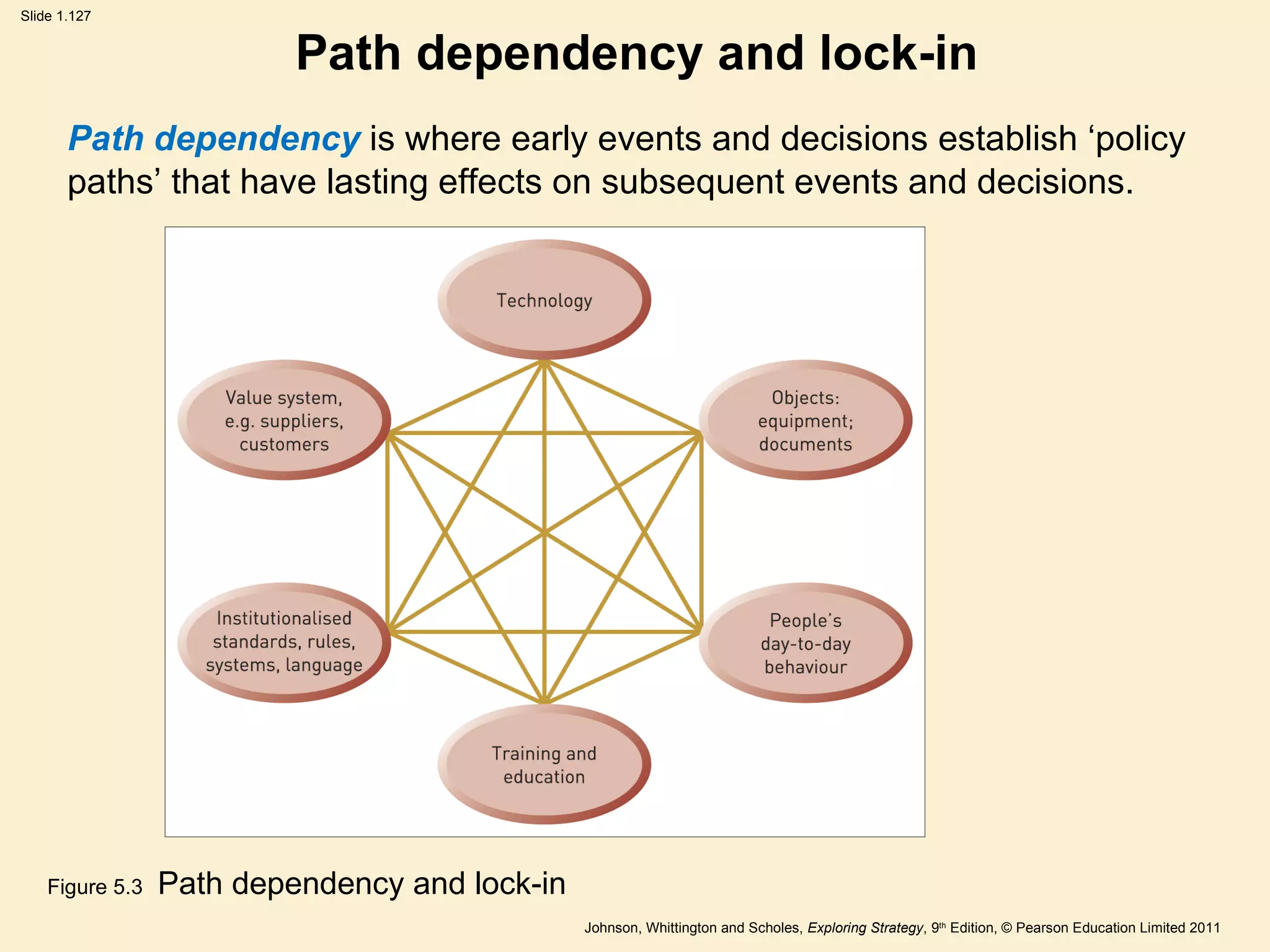
Path dependency and lock-in Path dependency  is where early events and decisions establish  ‘ policy paths ’  that have lasting effects on subsequent events and decisions. Figure 5.3  Path dependency and lock-in
The impact of path dependency Building strategy  around the path-dependent capabilities that have been successful in the past. Path creation  – changing strategies in a way that is built on the past and acceptable to key players. Management style  may be rooted in and evolved from the early style adopted by the founder(s).
Methods of historical analysis Chronological  analysis Cyclical  influence Anchor  points Historical  narratives
Organisational culture Organisational culture  is the taken-for-granted assumptions and behaviours that make sense of people ’ s organisational context
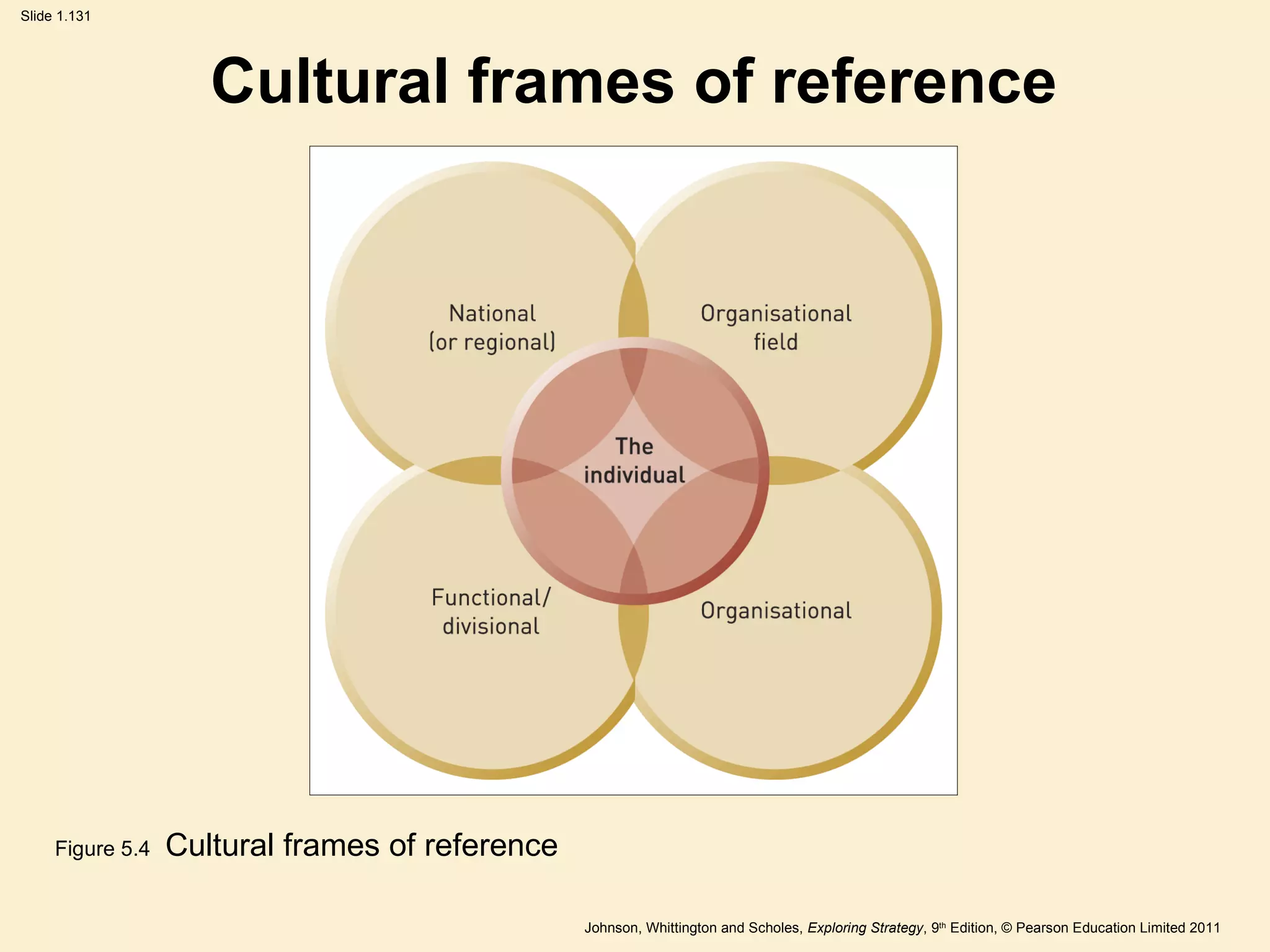
Cultural frames of reference Figure 5.4  Cultural frames of reference
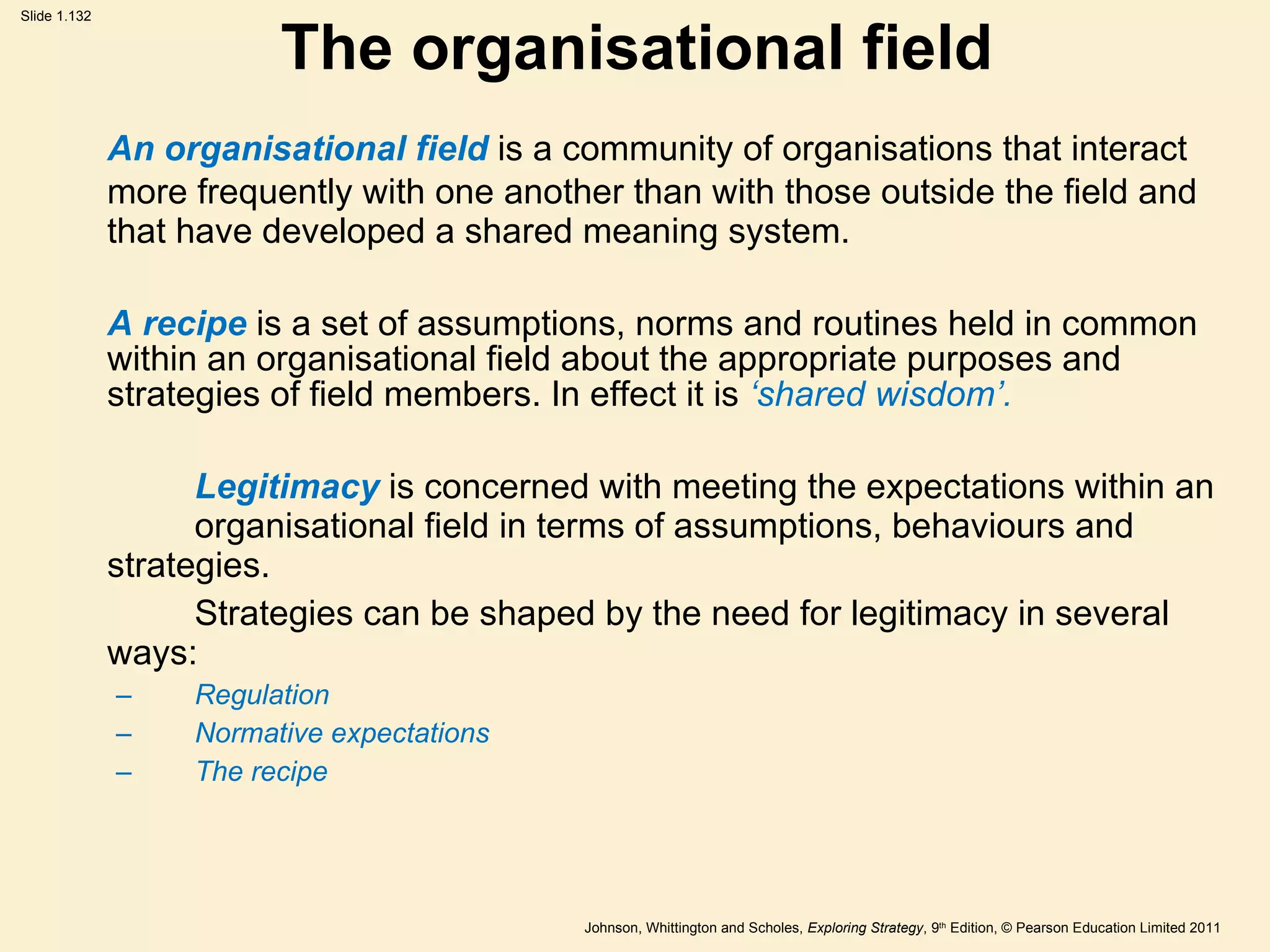
The organisational field An organisational field  is a community of organisations that interact more frequently with one another than with those outside the field and that have developed a shared meaning system. A recipe  is a set of assumptions, norms and routines held in common within an organisational field about the appropriate purposes and strategies of field members. In effect it is  ‘ shared wisdom ’ . Legitimacy   is concerned with meeting the expectations within an  organisational field in terms of assumptions, behaviours and strategies. Strategies can be shaped by the need for legitimacy in several ways: Regulation Normative expectations The recipe
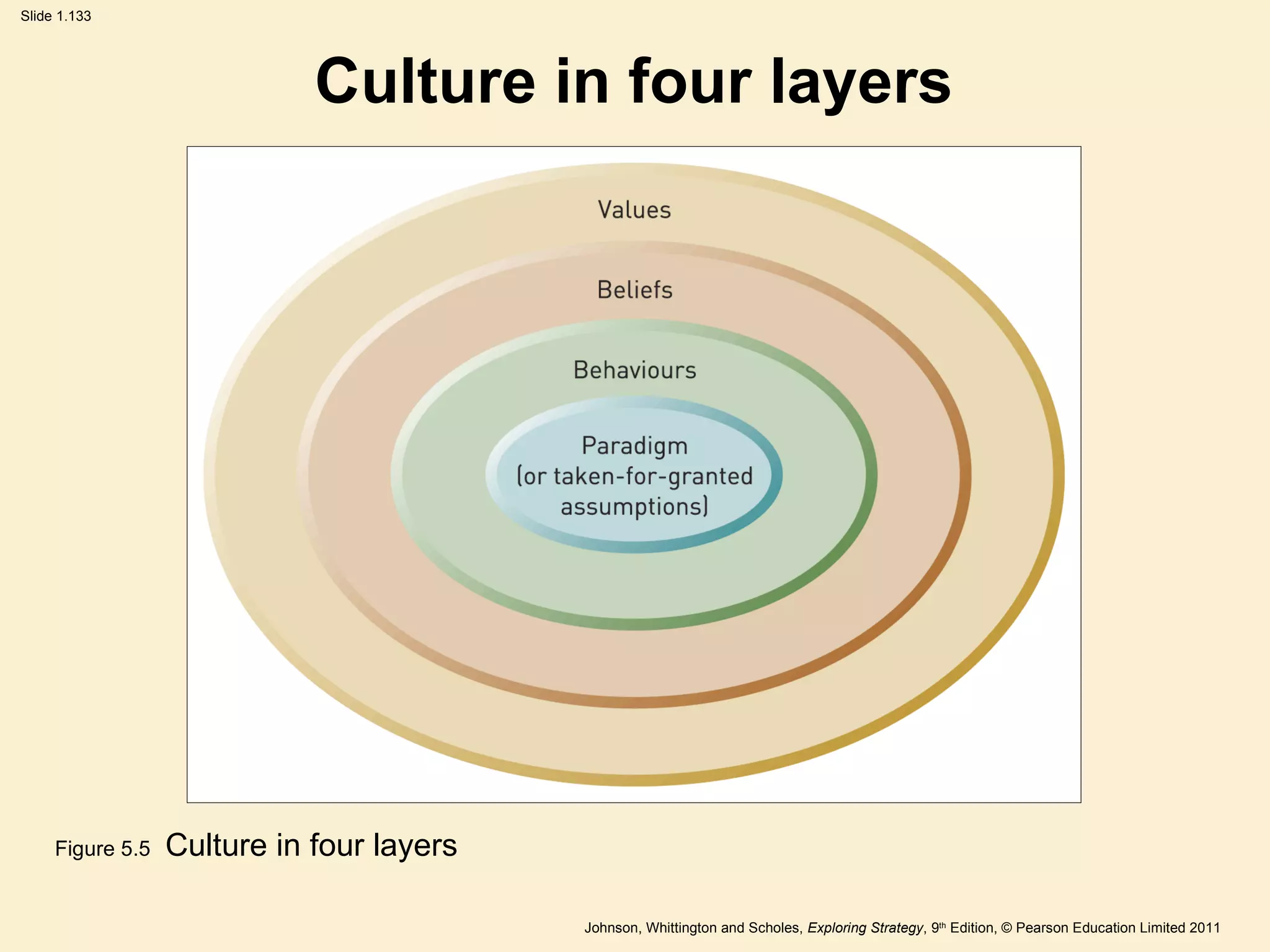
Culture in four layers Figure 5.5  Culture in four layers
The paradigm The paradigm  is the set of assumptions held in common and taken for granted in an organisation. The paradigm: is built on  collective experience informs  what people  in the organisation  do   influences how organisations  respond to  change.
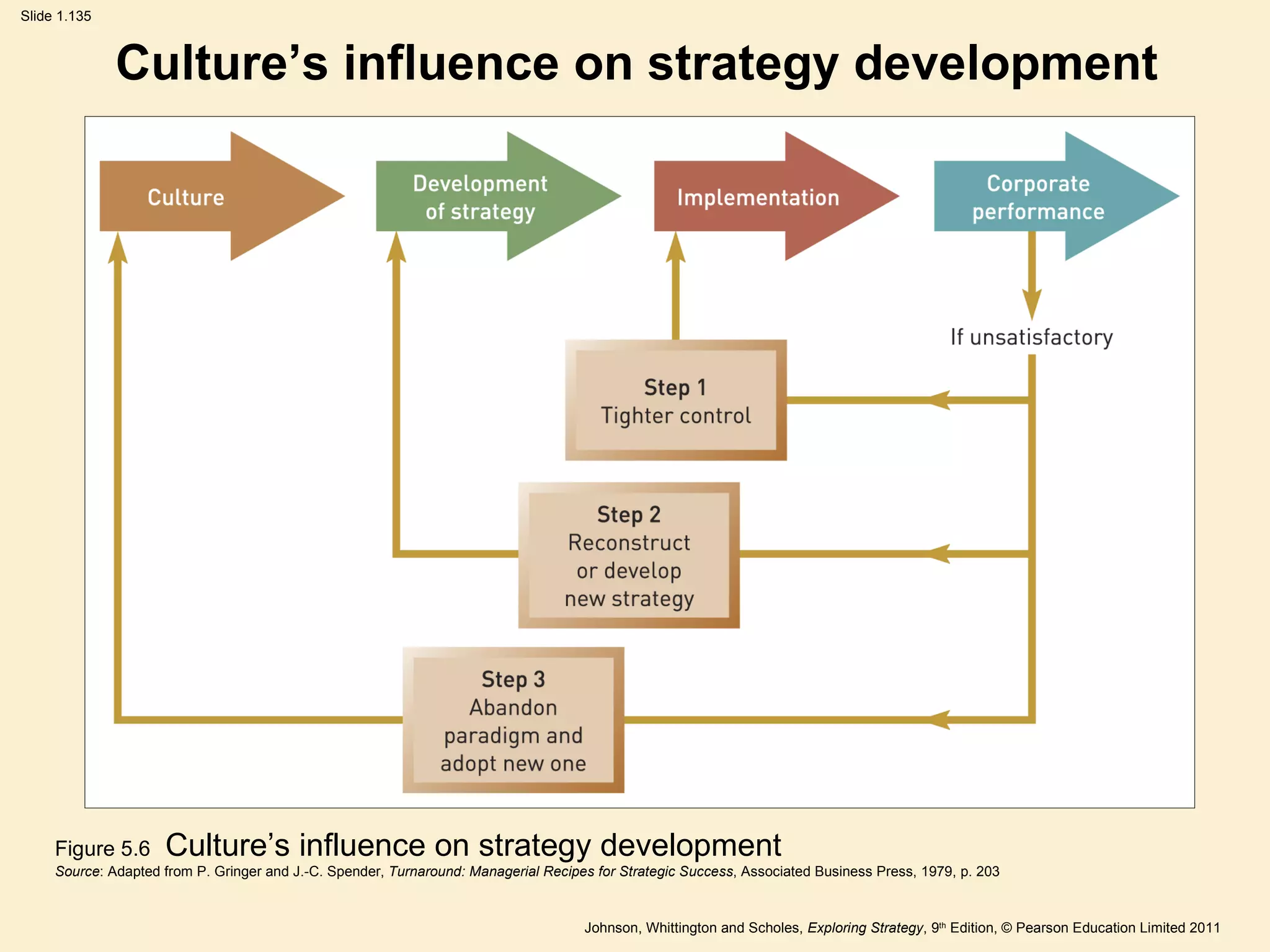
Culture ’ s influence on strategy development Figure 5.6  Culture ’s influence on strategy development Source : Adapted from P. Gringer and J.-C. Spender,  Turnaround: Managerial Recipes for Strategic Success , Associated Business Press, 1979, p. 203
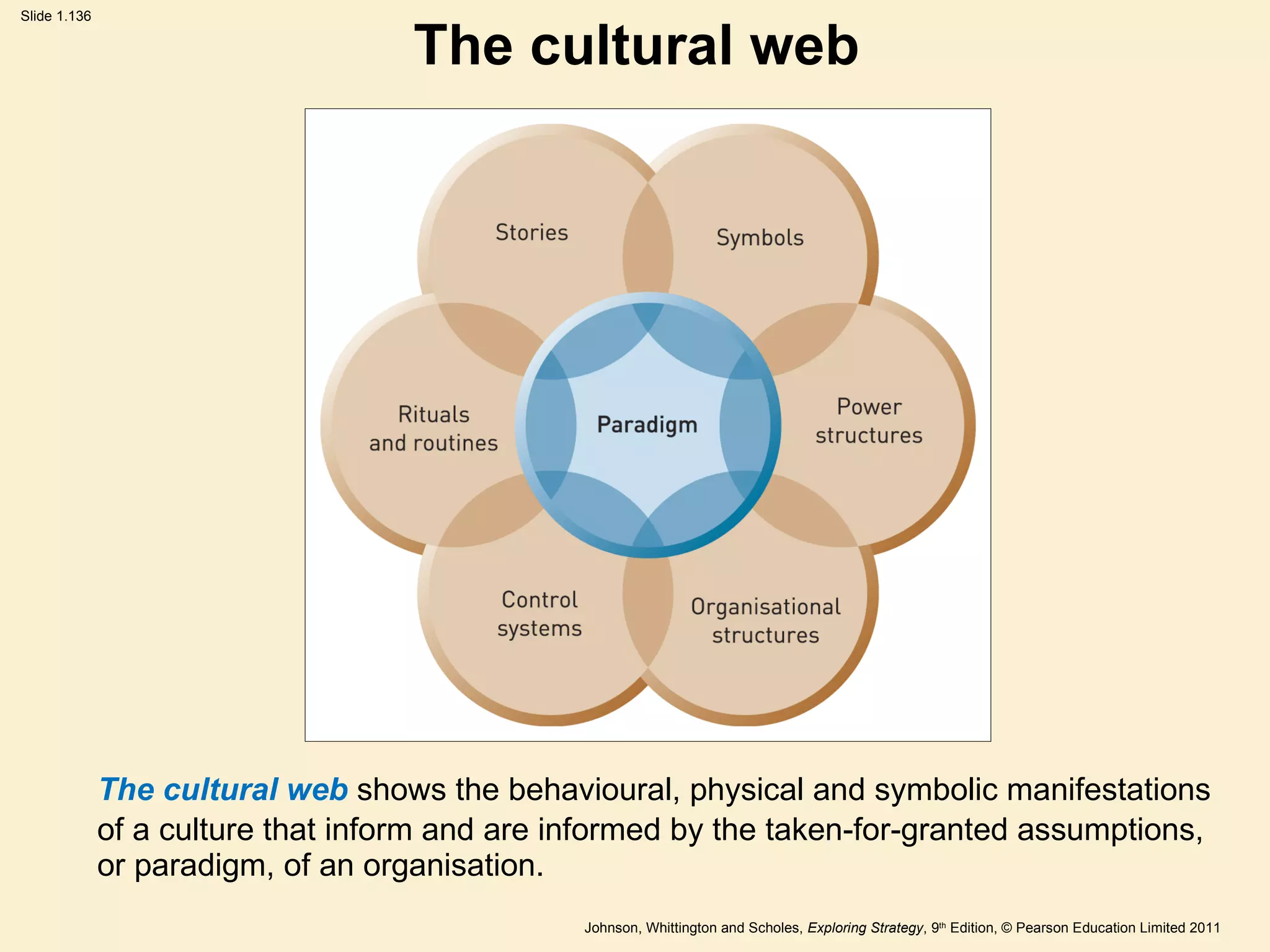
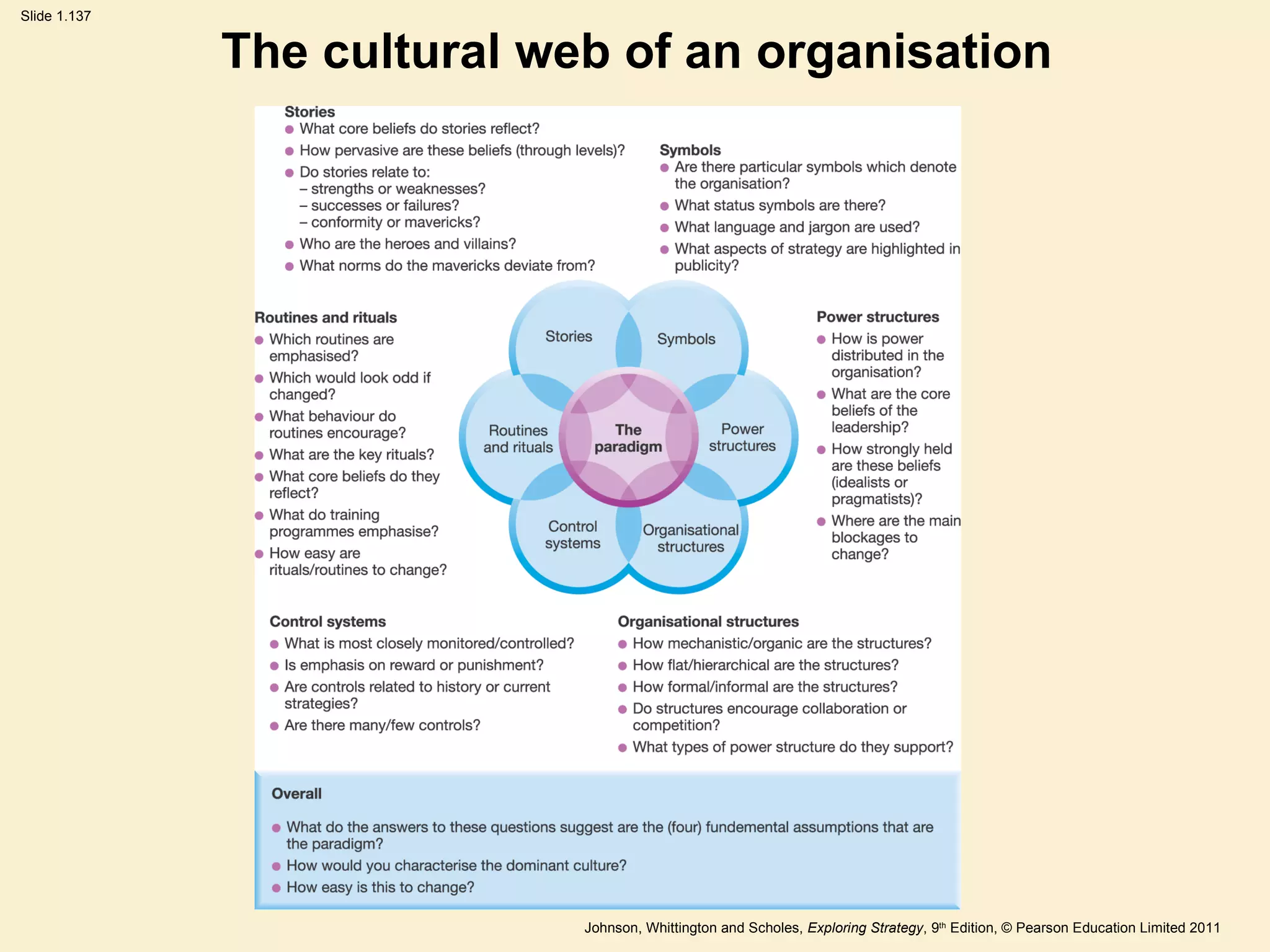
The cultural web The cultural web  shows the behavioural, physical and symbolic manifestations of a culture that inform and are informed by the taken-for-granted assumptions, or paradigm, of an organisation.
The cultural web of an organisation
Summary – Culture and Strategy The  history and culture  of an organisation may contribute to its strategic capabilities, but may also give rise to  strategic drift  as its strategy develops incrementally on the basis of such influences and fails to keep pace with a changing environment. Historical,  path-dependent  processes play a significant part in the success or failure of an organisation and need to be understood by managers. There are historical analyses that can be conducted to help uncover these influences. Cultural and institutional influences  both inform and constrain the strategic development of organisations. Organisational culture  is the basic assumptions and beliefs that are shared by members of an organisation, that operate unconsciously and define in a basic taken-for-granted fashion an organisation ’ s view of itself and its environment. An understanding of the culture of an organisation and its relationship to organisational strategy can be gained by using the  cultural web .

Session 1

  • 1.
  • 2.
    Session 1 Session2 Session 3 Where are we now? Where are we going? How will we get there?
  • 3.
    Learnings Summarise thestrategy of an organisation in a ‘ strategy statement ’ . Identify key issues for an organisation ’ s strategy according to the Exploring Strategy model . Distinguish between corporate, business and operational strategies. Understand how different people contribute to strategy at work. Appreciate the contributions of different academic disciplines and theoretical lenses to practical strategy analysis.
  • 4.
    Definitions of strategy‘ ..the determination of the long-run goals and objectives of an enterprise and the adoption of courses of action and the allocation of resource necessary for carrying out these goals ’ Alfred Chandler ‘ Competitive strategy is about being different. It means deliberately choosing a different set of activities to deliver a unique mix of value ’ Michael Porter ..a pattern in a stream of decisions ’ Henry Mintzberg ‘ ..the long-term direction of an organisation ’ Exploring Strategy Sources: A.D. Chandler, Strategy and Structure: Chapters in the History of American Enterprise, MIT Press, 1963, p. 13 M.E. Porter, ‘ What is strategy? ’ , Harvard Business Review, 1996, November–December, p. 60 H. Mintzberg, Tracking Strategy: Toward a General Theory, Oxford University Press, 2007, p. 3
  • 5.
  • 6.
    Three horizons forstrategy Figure 1.2 Three horizons for strategy Source : M. Baghai, S. Coley and D. While, The Alchemy of Growth , 2000, Texere Publishers: Figure 1.1, p. 5
  • 7.
    Stakeholders Stakeholders arethose individuals or groups that depend on an organisation to fulfil their own goals and on whom, in turn, the organisation depends.
  • 8.
    Levels of strategy(1) Operational strategy Business-level strategy Corporate-level strategy News Corporation diversifying from print journalism into social networking. Website and marketing improvements at My Space to attract more users. MySpace engineers increasing processing Capacity. concerned with the overall purpose and scope of an organisation and how to add value to business units. concerned with the way a business seeks to compete successfully in its particular market. concerned with how different parts of the organisation deliver the strategy in terms of managing resources, processes and people.
  • 9.
    Strategy statements Strategystatements should have three main themes: the fundamental goals that the organisation seeks, which draw on the stated mission, vision and objectives the scope or domain of the organisation ’ s activities and the particular advantages or capabilities it has to deliver all these.
  • 10.
    Working with strategyAll managers are concerned with strategy : Top managers frequently formulate and control strategy but may also involve others in the process. Middle and lower level managers have to meet strategic objectives and deal with constraints. All managers have to communicate strategy to their teams. All managers can contribute to the formation of strategy through ideas and feedback. Organisations may also use strategy specialists : Many large organisations have in-house strategic planning or analyst roles . Strategy consultants can be engaged from one of many general management consulting firms (e.g. Accenture, IBM Consulting, PwC). There are a growing number of specialist strategy consulting firms (e.g. McKinsey &Co, The Boston Consulting Group
  • 11.
    The exploring strategymodel Figure 1.4 The Exploring Strategy Model
  • 12.
    Strategic position The Strategic Position Environment Culture Purpose Capability The strategic position is concerned with the impact on strategy of the external environment , the organisation ’ s strategic capability (resources and competences), the organisation ’ s goals and the organisation ’ s culture. Fundamental questions for Strategic Position: • What are the environmental opportunities and threats ? • What are the organisation ’ s strengths and weaknesses? • What is the basic purpose of the organisation? • How does culture shape strategy?
  • 13.
    Strategic choices Strategic Choices Business- level Innovation International Corporate- level Acquisitions & Alliances Strategic choices involve the options for strategy in terms of both the directions in which strategy might move and the methods by which strategy might be pursued. Fundamental questions for Strategic Choice: • How should business units compete ? • Which businesses to include in the portfolio ? • Where should the organisation compete internationally? • Is the organisation innovating appropriately? • Should the organisation buy other companies, form alliances or go it alone ?
  • 14.
    Strategy in actionStrategy in Action Processes Changing Evaluating Organising Practice Strategy in action is about how strategies are formed and how they are implemented. The emphasis is on the practicalities of managing . Fundamental questions for Strategy in Action • Which strategies are suitable, acceptable and feasible? • What kind of strategy-making process is needed? • What are the required organisation structures and systems ? • How should the organisation manage necessary changes ? • Who should do what in the strategy process ?
  • 15.
    The Strategy Checklist- The 14 fundamental questions in strategy Strategic Position Strategic Choices Strategy in Action What are the environmental opportunities and threats? What are the organisation ’ s strengths and weaknesses What is the basic purpose of the organisation? How does culture shape the strategy? How should business units compete? Which businesses to include in the portfolio? Where should the organisation compete internationally? Is the organisation innovating appropriately? Should the organisation buy other companies, ally or go it alone? Which strategies are suitable, acceptable and feasible? What kind of strategy-making process is needed? What are the required organisational structures and systems? How should the organisation manage necessary changes? Who should do what in the strategy process?
  • 16.
    Exploring strategy indifferent contexts The Exploring Strategy Model can be applied in many contexts . In each context the balance of strategic issues differs: Small Businesses (e.g. Purpose and Growth issues) Multinational Corporations (e.g. Geographical Scope and Structure/Control issues) Public Sector Organisations (e.g. Service/Quality and Managing Change issues) Not For Profit Organisations (e.g. Purpose and Funding issues)
  • 17.
    The strategy lensesThe strategy lenses are ways of looking at strategy issues differently in order to generate many insights. Looking at problems in different ways will raise new issues and new solutions. Strategy can be seen as: Design Experience Variety (Ideas) Discourse
  • 18.
    A summary ofstrategy lenses Table C.ii A summary of the strategy lenses
  • 19.
    Summary Strategy isthe long-term direction of an organisation. A ‘ strategy statement ’ should cover the goals of an organisation, the scope of the organisation ’ s activities and the advantages or capabilities the organisation brings to these goals and activities. Corporate-level strategy is concerned with an organisation ’ s overall scope; business-level strategy is concerned with how to compete; and operational strategy is concerned with how resources, processes and people deliver corporate- and business-level strategy. Strategy work is done by managers throughout an organisation, as well as specialist strategic planners and strategy consultants . Research on strategy context, content and process shows how the analytical perspectives of economics, sociology and psychology can all provide practical insights for approaching strategy issues The Exploring Strategy Model has three major elements: understanding the strategic position , making strategic choices for the future and managing strategy-in-action . Strategic issues are best seen from a variety of perspectives, as exemplified by the four strategy lenses of design, experience, variety and discourse .
  • 20.
    Session I: TheStrategic Position
  • 21.
    The Focus ofSession 1: The strategic position How to analyse an organisation ’ s position in the external environment. How to analyse the determinants of strategic capability – resources, competences and the linkages between them. How to understand an organisation ’ s purposes , taking into account corporate governance , stakeholder expectations and business ethics . How to address the role of history and culture in determining an organisation ’ s position.
  • 22.
    The Strategic Position2: The Environment
  • 23.
    The Environment LearningsAnalyse the broad macro-environment of organisations in terms of political, economic, social, technological, environmental ( ‘ green ’ ) and legal factors (PESTEL). Identify key drivers in this macro-environment and use these key drivers to construct alternative scenarios with regard to environmental change . Use Porter ’ s five forces analysis in order to define the attractiveness of industries and sectors and to identify their potential for change. Identify successful strategic groups , valuable market segments and attractive ‘ Blue Oceans ’ within industries. Use these various concepts and techniques in order to recognise threats and opportunities in the marketplace.
  • 24.
    Layers of thebusiness environment Figure 2.1 Layers of the business environment
  • 25.
    The PESTEL framework(1) The PESTEL framework categorises environmental influences into six main types: political, economic, social, technological, environmental legal Thus PESTEL provides a comprehensive list of influences on the possible success or failure of particular strategies.
  • 26.
    The PESTEL framework(2) Political Factors: For example, Government policies, taxation changes, foreign trade regulations, political risk in foreign markets, changes in trade blocks (EU). Economic Factors: For example, business cycles, interest rates, personal disposable income, exchange rates, unemployment rates, GDP trends. Socio-cultural Factors: For example, population changes, income distribution, lifestyle changes, consumerism, changes in culture and fashion. Technological Factors: For example, new discoveries and technology developments, ICT innovations, rates of obsolescence, increased spending on R&D. Environmental ( ‘ Green ’ ) Factors: For example, environmental protection regulations, energy consumption, global warming, waste disposal and re-cycling. Legal Factors: For example, competition laws, health and safety laws, employment laws, licensing laws, IPR laws.
  • 27.
    Key drivers ofchange Key drivers for change: The environmental factors likely to have a high impact on the success or failure of strategy. For example, the birth rate is a key driver for those planning nursery education provision in the public sector. Typically key drivers vary by industry or sector.
  • 28.
    Using the PESTELframework Apply selectively –identify specific factors which impact on the industry, market and organisation in question. Identify factors which are important currently but also consider which will become more important in the next few years. Use data to support the points and analyse trends using up to date information Identify opportunities and threats – the main point of the exercise!
  • 29.
    Scenarios Scenarios are detailed and plausible views of how the environment of an organisation might develop in the future based on key drivers of change about which there is a high level of uncertainty. Build on PESTEL analysis . Do not offer a single forecast of how the environment will change. An organisation should develop a few alternative scenarios (2 – 4) to analyse future strategic options.
  • 30.
    Carrying out scenarioanalysis Identify the most relevant scope of the study – the relevant product/market and time span. Identify key drivers of change – PESTEL factors that have the most impact in the future but have uncertain outcomes. For each key driver select opposing outcomes where each leads to very different consequences . Develop scenario ‘ stories ’ - That is, coherent and plausible descriptions of the environment that result from opposing outcomes Identify the impact of each scenario on the organisation and evaluate future strategies in the light of the anticipated scenarios. Scenario analysis is used in industries with long planning horizons for example, the oil industry or airlines.
  • 31.
    Scenarios for theglobal financial system, 2020 Illustration 2.2
  • 32.
    Industries, markets andsectors An industry is a group of firms producing products and services that are essentially the same. For example, automobile industry and airline industry. A market is a group of customers for specific products or services that are essentially the same (e.g. the market for luxury cars in Germany). A sector is a broad industry group (or a group of markets) especially in the public sector (e.g. the health sector)
  • 33.
    Porter ’ sfive forces framework Porter ’ s five forces framework helps identify the attractiveness of an industry in terms of five competitive forces: the threat of entry, the threat of substitutes, the bargaining power of buyers, the bargaining power of suppliers and the extent of rivalry between competitors. The five forces constitute an industry ’ s ‘ structure ’ .
  • 34.
    Source : Adaptedwith the permission of The Free Press, a Division of Simon & Schuster Adult Publishing Group, from Competitive Strategy: Techniques for Analyzing Industries and Competitors by Michael E. Porter. Copyright © 1980, 1998 by The Free Press. All rights reserved The five forces framework (1) Figure 2.2 The five forces framework
  • 35.
    The five forcesframework The Threat of Entry & Barriers to Entry The threat of entry is low when the barriers to entry are high and vice versa. The main barriers to entry are: Economies of scale/high fixed costs Experience and learning Access to supply and distribution channels Differentiation and market penetration costs Government restrictions (e.g. licensing) Entrants must also consider the expected retaliation from organisations already in the market
  • 36.
    The five forcesframework - Threat of Substitutes Substitutes are products or services that offer a similar benefit to an industry ’ s products or services, but by a different process. Customers will switch to alternatives (and thus the threat increases) if: The price/performance ratio of the substitute is superior (e.g. aluminium maybe more expensive than steel but it is more cost efficient for some car parts) The substitute benefits from an innovation that improves customer satisfaction (e.g. high speed trains can be quicker than airlines from city centre to city centre)
  • 37.
    The five forcesframework The bargaining power of buyers Buyers are the organisation ’ s immediate customers, not necessarily the ultimate consumers. If buyers are powerful, then they can demand cheap prices or product / service improvements to reduce profits . Buyer power is likely to be high when: Buyers are concentrated Buyers have low switching costs Buyers can supply their own inputs (backward vertical integration)
  • 38.
    The five forcesframework The bargaining power of suppliers Suppliers are those who supply what organisations need to produce the product or service. Powerful suppliers can eat into an organisation ’ s profits. Supplier power is likely to be high when: The suppliers are concentrated (few of them). Suppliers provide a specialist or rare input. Switching costs are high (it is disruptive or expensive to change suppliers). Suppliers can integrate forwards (e.g. low cost airlines have cut out the use of travel agents).
  • 39.
    The five forcesframework Rivalry between competitors Competitive rivals are organisations with similar products and services aimed at the same customer group and are direct competitors in the same industry/market (they are distinct from substitutes). The degree of rivalry is increased when : Competitors are of roughly equal size Competitors are aggressive in seeking leadership The market is mature or declining There are high fixed costs The exit barriers are high There is a low level of differentiation
  • 40.
    Implications of fiveforces analysis Identifies the attractiveness of industries – which industries/markets to enter or leave. Identifies strategies to influence the impact of the forces, for example, building barriers to entry by becoming more vertically integrated. The forces may have a different impact on different organisations e.g. large firms can deal with barriers to entry more easily than small firms.
  • 41.
    Issues in fiveforces analysis Apply at the most appropriate level – not necessarily the whole industry. E.g. the European low cost airline industry rather than airlines globally. Note the convergence of industries – particularly in the high tech sectors (e.g. digital industries - mobile phones/cameras/mp3 players). Note the importance of complementary products and services (e.g. Microsoft windows and McAfee computer security systems are complements). This can almost be considered as a sixth force.
  • 42.
    The value netFigure 2.3 The value net Reprinted by permission of Harvard Business Review . From ‘The Right Game’ by A. Brandenburger and B. Nalebuff, July–August 1996, pp. 57–64. Copyright © 1996 by the Harvard Business School Publishing Corporation. All rights reserved
  • 43.
    Comparative industry structureanalysis Figure 2.5 Comparative industry structure analysis
  • 44.
    Types of industryMonopolistic industries - an industry with one firm and therefore no competitive rivalry. A firm has ‘ monopoly power ’ if it has a dominant position in the market. For example, BT in the UK fixed line telephone market. Oligopolistic industries - an industry dominated by a few firms with limited rivalry and in which firms have power over buyers and suppliers. Perfectly competitive industries - where barriers to entry are low, there are many equal rivals each with very similar products, and information about competitors is freely available. Few (if any) markets are ‘ perfect ’ but may have features of highly competitive markets, for example, mini-cabs in London. Hypercompetitive industries - where the frequency, boldness and aggression of competitor interactions accelerate to create a condition of constant disequilibrium and change. Hypercompetition often breaks out in otherwise oligopolistic industries (e.g. mobile phones). Organisations interact in a series of competitive moves in hypercompetition which often becomes extremely rapid and aggressive as firms vie for market leadership.
  • 45.
    Cycles of competitionFigure 2.6 Cycles of competition Source : Adapted with the permission of The Free Press, a Division of Simon & Schuster, Inc., from Hypercompetitive Rivalries: Competing in Highly Dynamic Environments by Richard A. D ’Aveni with Robert Gunther. Copyright © 1994, 1995 by Richard A. D’Aveni. All rights reserved
  • 46.
    The industry lifecycle Figure 2.4 The industry life cycle
  • 47.
    Strategic Groups Strategicgroups are organisations within an industry or sector with similar strategic characteristics, following similar strategies or competing on similar bases . These characteristics are different from those in other strategic groups in the same industry or sector. There are many different characteristics that distinguish between strategic groups. Strategic groups can be mapped on to two dimensional charts – maps. These can be useful tools of analysis.
  • 48.
    Characteristics for identifyingstrategic groups Figure 2.7 Some characteristics for identifying strategic groups
  • 49.
    Strategic groups inthe Indian pharmaceutical industry Figure 2.8 Strategic groups in the Indian pharmaceutical industry Source : Developed from R. Chittoor and S. Ray, ‘Internationalisation paths of Indian pharmaceutical firms: a strategic group analysis’, Journal of International Management , vol. 13 (2009), pp. 338–55 Understanding competition - enables focus on direct competitors within a strategic group, rather than the whole industry. (E.g. Tesco will focus on Sainsburys and Asda) Analysis of strategic opportunities - helps identify attractive ‘ strategic spaces ’ within an industry. Analysis of ‘ mobility barriers ’ i.e. obstacles to movement from one strategic group to another. These barriers can be overcome to enter more attractive groups. Barriers can be built to defend an attractive position in a strategic group.
  • 50.
    Market segments Amarket segment is a group of customers who have similar needs that are different from customer needs in other parts of the market. Where these customer groups are relatively small, such market segments are called ‘ niches ’ . Customer needs vary. Focusing on customer needs that are highly distinctive is one means of building a secure segment strategy. Customer needs vary for a variety of reasons –these factors can be used to identify distinct market segments. Not all segments are attractive or viable market opportunities – evaluation is essential.
  • 51.
    Bases of marketsegmentation Table 2.1 Some bases of market segmentation
  • 52.
    Who are thestrategic customers? A strategic customer is the person(s) at whom the strategy is primarily addressed because they have the most influence over which goods or services are purchased. Examples: For a food manufacturer it is the multiple retailers (e.g. Tesco) that are the strategic customers not the ultimate consumer. For a pharmaceutical manufacturer it is the health authorities and hospitals not the final patient.
  • 53.
    Critical success factors(CSFs) Critical success factors are those factors that are either particularly valued by customers or which provide a significant advantage in terms of cost. Critical success factors are likely to be an important source of competitive advantage if an organisation has them (or a disadvantage if an organisation lacks them). Different industries and markets will have different critical success factors (e.g. in low cost airlines the CSFs will be punctuality and value for money whereas in full service airlines it is all about quality of service ).
  • 54.
    Blue ocean thinking‘ Blue oceans ’ are new market spaces where competition is minimised. ‘ Red Oceans ’ are where industries are already well defined and rivalry is intense. Blue Ocean thinking encourages entrepreneurs and managers to be different by finding or creating market spaces that are not currently being served. A ‘ strategy canvas ’ compares competitors according to their performance on key success factors in order to develop strategies based on creating new market spaces.
  • 55.
    Strategy canvas Figure2.9 Strategy canvas for electrical components companies Source : Developed from W.C. Kim and R. Mauborgne, Blue Ocean Strategy , 2005, Harvard Business School Press
  • 56.
    Summary Environmental influencescan be thought of as layers around an organisation, with the outer layer making up the macro-environment , the middle layer making up the industry or sector and the inner layer strategic groups and market segments . The macro-environment can be analysed in terms of the PESTEL factors , from which key drivers of change can be identified. Alternative scenarios about the future can be constructed according to how the key drivers develop. Industries and sectors can be analysed in terms of Porter ’ s five forces – barriers to entry, substitutes, buyer power, supplier power and rivalry. Together, these determine industry or sector attractiveness. Industries and sectors are dynamic , and their changes can be analysed in terms of the industry life cycle , comparative five forces radar plots and hypercompetitive cycles of competition . In the inner layer of the environment , strategic group analysis, market segment analysis and the strategy canvas can help identify strategic gaps or opportunities. Blue Ocean strategies characterised by low rivalry are likely to be better opportunities than Red Ocean strategies with many rivals. The most important reason for environmental analysis is to identify OPPORTUNITIES AND THREATS
  • 57.
    The Strategic Position3: Strategic Capabilities
  • 58.
    Strategic Capabilities LearningsIdentify what comprises strategic capabilities in terms of organisational resources and competences and how these relate to the strategies of organisations. Analyse how strategic capabilities might provide sustainable competitive advantage on the basis of their value, rarity, inimitability and non-substitutability (VRIN). Diagnose strategic capability by means of benchmarking, value chain analysis, activity mapping and SWOT analysis. Consider how managers can develop strategic capabilities for their organisations.
  • 59.
    Strategic capabilities: thekey issues Figure 3.1 Strategic capabilities: the key issues
  • 60.
    Resource-based strategy Theresource-based view (RBV) of strategy asserts that the competitive advantage and superior performance of an organisation is explained by the distinctiveness of its capabilities.
  • 61.
    Resources and competencesResources are the assets that organisations have or can call upon (e.g. from partners or suppliers) ,that is, ‘ what we have ’ . Competences are the ways those assets are used or deployed effectively , that is, what we do well ’ .
  • 62.
    Components of strategiccapabilities Table 3.1 Components of strategic capabilities
  • 63.
    Redundant capabilities Capabilities,however effective in the past, can become less relevant as industries evolve and change. Such ‘ capabilities ’ can become ‘ rigidities ’ that inhibit change and become a weakness.
  • 64.
    Dynamic capabilities Dynamiccapability is the ability of an organisation to renew and recreate its strategic capabilities to meet the needs of changing environments.
  • 65.
    Threshold and distinctivecapabilities Threshold capabilities are those needed for an organisation to meet the necessary requirements to compete in a given market and achieve parity with competitors in that market – ‘ qualifiers ’ . Distinctive capabilities are those that critically underpin competitive advantage and that others cannot imitate or obtain – ‘ winners ’ . Table 3.2 Threshold and distinctive capabilities
  • 66.
    Core competences Corecompetences 1 are the linked set of skills, activities and resources that, together: deliver customer value differentiate a business from its competitors potentially, can be extended and developed as markets change or new opportunities arise. 1 G. Hamel and C.K. Prahalad, ‘ The core competence of the corporation ’ , Harvard Business Review, vol. 68, no. 3 (1990), pp. 79–91.
  • 67.
    Strategic capabilities andcompetitive advantage The four key criteria by which capabilities can be assessed in terms of providing a basis for achieving sustainable competitive advantage are: value, rarity, inimitability and non-substitutability 1 Jay Barney: ‘ Firm resources and sustained competitive advantage ’ , Journal of Management, vol. 17 (1991), no. 1, pp. 99–120. VRIN 1
  • 68.
    VRIN - V – Value of strategic capabilities Strategic capabilities are of value when they: take advantage of opportunities and neutralise threats provide value to customers provide potential competitive advantage at a cost that allows an organisation to realise acceptable levels of return
  • 69.
    VRIN - R – Rarity Rare capabilities are those possessed uniquely by one organisation or by a few others only. (E.g. a company may have patented products, have supremely talented people or a powerful brand.) Rarity could be temporary. (Eg: Patents expire, key individuals can leave or brands can be de-valued by adverse publicity.)
  • 70.
    VRIN I– Inimitability Inimitable capabilities are those that competitors find difficult to imitate or obtain. Competitive advantage can be built on unique resources (a key individual or IT system) but these may not be sustainable (key people leave or others acquire the same systems). Sustainable advantage is more often found in competences (the way resources are managed, developed and deployed) and the way competences are linked together and integrated.
  • 71.
    Criteria for theinimitability of strategic capabilities Figure 3.2 Criteria for the inimitability of strategic capabilities
  • 72.
    VRIN - N - Non-substitutability Competitive advantage may not be sustainable if there is a threat of substitution. Product or service substitution from a different industry/market. For example, postal services partly substituted by e-mail. Competence substitution. For example, a skill substituted by expert systems or IT solutions
  • 73.
    Criteria for theinimitability of strategic capabilities Figure 3.3 VRIN
  • 74.
    Organisational knowledge Organisationalknowledge is the collective intelligence, specific to an organisation, accumulated through both formal systems and the shared experience of people in that organisation. Some of this knowledge is ‘ Tacit ’ knowledge that is, more personal, context-specific and hard to formalise and communicate – so it is difficult to imitate, for example, the knowledge and relationships in a top R&D team.
  • 75.
    Benchmarking Benchmarking is a means of understanding how an organisation compares with others – typically competitors. Two approaches to benchmarking: Industry/sector benchmarking - comparing performance against other organisations in the same industry/sector against a set of performance indicators. Best-in-class benchmarking - comparing an organisation ’ s performance or capabilities against ‘ best-in-class ’ performance – wherever that is found even in a very different industry. (E.g. BA benchmarked its refuelling operations against Formula 1).
  • 76.
    The value chainThe value chain describes the categories of activities within an organisation which, together, create a product or service. The value chain invites the strategist to think of an organisation in terms of sets of activities – sources of competitive advantage can be analysed in any or all of these activities.
  • 77.
    VRIN summary Figure3.4 The value chain within an organisation Source : Adapted with the permission of The Free Press, a Division of Simon & Schuster, Inc., from Competitive Advantage: Creating and Sustaining Superior Performance by Michael E. Porter. Copyright © 1985, 1998 by Michael E. Porter. All rights reserved
  • 78.
    The value networkThe value network comprises the set of inter-organisational links and relationships that are necessary to create a product or service. Competitive advantage can be derived from linkages within the value network.
  • 79.
    The value networkFigure 3.5 The value network Source : Adapted with the permission of The Free Press, a Division of Simon & Schuster, Inc., from Competitive Advantage: Creating and Sustaining Superior Performance by Michael E. Porter. Copyright © 1985, 1998 by Michael E. Porter. All rights reserved
  • 80.
    Uses of thevalue chain A generic description of activities – understanding the discrete activities and how they both contribute to consumer benefit and how they add to cost. Identifying activities where the organisation has particular strengths or weaknesses Analysing the competitive position of the organisation using the VRIN criteria – thus identifying sources of sustainable advantage. Looking for ways to enhance value or decrease cost in value activities (e.g. outsourcing)
  • 81.
    Uses of thevalue network Understanding cost/price structures across the value network – analysing the best area of focus and the best business model . Identifying ‘ profit pools ’ within the value network and seek to exploit these. The ‘ make or buy ’ decision : deciding which activities to do ‘ in-house ’ and which to outsource. Partnering and relationships – deciding who to work with and the nature of these relationships.
  • 82.
    Mapping activity systemsIdentify ‘ higher order strategic themes ’ that is, how the organisation meets the critical success factors in the market. Identify the clusters of activities that underpin these themes and how they fit together. Map this in terms of how activity systems are interrelated. Illustration 3.5 Activity systems at Geelmuyden.Kiese
  • 83.
    Using activity systemmaps A means of identifying strategic capabilities in terms of linkages of activities Internal and external links are identified (e.g. in terms of the needs of customers). Therefore helps identify bases of competitive advantage . And sustainable advantage for example, in terms of bases of inimitability.
  • 84.
    SWOT analysis SWOT summarises the strengths, weaknesses, opportunities and threats likely to impact on strategy development. INTERNAL STRENGTHS WEAKNESSES ANAYSIS EXTERNAL OPPORTUNITIES THREATS ANALYSIS
  • 85.
    Uses of SWOTanalysis Key environmental impacts are identified using the analytical tools explained in Chapter 2. Major strengths and weaknesses are identified using the analytic tools explained in Chapter 3. Scoring (e.g. + 5 to - 5) can be used to assess the interrelationship between environmental impacts and the strengths and weaknesses. SWOT can be used to examine strengths, weaknesses, opportunities and threats in relation to competitors . SWOT can be used to generate strategic options – using a TOWS matrix .
  • 86.
    The TOWS matrixFigure 3.6 The TOWS matrix
  • 87.
    Dangers in aSWOT analysis Long lists with no attempt at prioritisation. Over generalisation – sweeping statements often based on biased and unsupported opinions. SWOT is used as a substitute for analysis – it should result from detailed analysis using the frameworks in Chapters 2 and 3. SWOT is not used to guide strategy – it is seen as an end in itself.
  • 88.
    Developing strategic capabilitiesInternal capability development : Leveraging capabilities – identifying capabilities in one part of the organisation and transferring them to other parts (sharing best practice). Stretching capabilities - building new products or services out of existing capabilities. External capability development – adding capabilities through mergers, acquisitions or alliances. Ceasing activities – non-core activities can be stopped, outsourced or reduced in cost. Monitor outputs and benefits – to understand sources of consumer benefit and enhance anything that contributes to this. Managing the capabilities of people – training, development and organisation learning.
  • 89.
    Summary Strategic capabilities comprise both resources and competences. The concept of dynamic capabilities highlights that strategic capabilities need to change as the market and environmental context of an organisation changes. Sustainability of competitive advantage is likely to depend on an organisation ’ s capabilities being of at least threshold value in a market but also being valuable , relatively rare, intimable and non-substitutable. Ways of diagnosing organisational capabilities include: Benchmarking as a means of understanding the relative performance of organisations. Analysing an organisation ’ s value chain and value network as a basis for understanding how value to a customer is created and can be developed. Activity mapping as a means of identifying more detailed activities which underpin strategic capabilities. SWOT analysis as a way of drawing together an understanding of strengths, weaknesses, opportunities and threats an organisation faces.
  • 90.
    The Strategic Position4: Strategic Purpose
  • 91.
    Strategic Purpose LearningsConsider appropriate ways to express the strategic purpose of an organisation in terms of statements of purpose, values,vision, mission or objectives. Identify the components of the governance chain of an organisation. Understand differences in governance structures and the advantages and disadvantages of these. Identify differences in the corporate responsibility stances taken by organisations and how ethical issues relate to strategic purpose. Undertake stakeholder analysis as a means of identifying the influence of different stakeholder groups in terms of their power and interest.
  • 92.
    Influences on strategicpurpose Figure 4.1 Influences on strategic purpose
  • 93.
    Who are thestakeholders? Stakeholders are those individuals or groups who depend on an organisation to fulfil their own goals and on whom, in turn, the organisation depends.
  • 94.
    Mission statements Amission statement aims to provide employees and stakeholders with clarity about the overriding purpose of the organisation A mission statement should answer the questions: ‘ What business are we in? ’ ‘ How do we make a difference? ’ ‘ Why do we do this? ’
  • 95.
    Vision statements Avision statement is concerned with the desired future state of the organisation; an aspiration that will enthuse, gain commitment and stretch performance. A vision statement should answer the question : ‘ What do we want to achieve? ’
  • 96.
    Statement of corporatevalues A statement of corporate values should communicate the underlying and enduring core ‘ principles ’ that guide an organisation ’ s strategy and define the way that the organisation should operate. Such core values should remain intact whatever the circumstances and constraints faced by the organisation.
  • 97.
    Objectives Objectives are statements of specific outcomes that are to be achieved. Objectives are frequently expressed in: financial terms e.g. desired profit levels market terms e.g. desired market share and increasingly social terms e.g. corporate social responsibility targets
  • 98.
    Issues in settingobjectives Do objectives need to be specific and quantified targets? The need to identify core objectives that are crucial for survival. The need for a hierarchy of objectives that cascade down the organisation and define specific objectives at each level.
  • 99.
    Corporate governance Corporategovernance is concerned with the structures and systems of control by which managers are held accountable to those who have a legitimate stake in an organisation.
  • 100.
    The growing importanceof governance The separation of ownership and management control – defining different roles in governance. Corporate failures and scandals (e.g. Enron) – focussing attention on governance issues. Increased accountability to wider stakeholder interests and the need for corporate social responsibility (e.g. green issues).
  • 101.
    The governance chainFigure 4.2 The chain of corporate governance: typical reporting structures Source : Adapted from David Pitt-Watson, Hermes Fund Management
  • 102.
    The principal-agent modelGovernance can be seen in terms of the principal agent model Principals pay agents to act on their behalf (e.g. beneficiaries/trustees pay investment managers to manage funds, Boards of Directors pay executives to run a company). Agents may act in their own self interest.
  • 103.
    Issues in governanceThe key challenge is to align the interests of agents with those of the principals. Misalignment of incentives and control – e.g. beneficiaries may require long term growth but executives may be seeking short term profit. Responsibility to whom – should executives pursue solely shareholder aims or serve a wider constituency of stakeholders? Who are the shareholders – should boards respond to the demands of institutional investment managers or the needs of the ultimate beneficiaries? The role of institutional investors – should they actively intervene in strategy? Establishing the specific role of the board – in particular the role of non-executive directors. Scrutiny and control – statutory requirements and voluntary codes to regulate boards.
  • 104.
    Different governance systemsTable 4.1 Benefits and disadvantages of governance systems
  • 105.
    The role ofboards Operate ‘ independently ’ of the management – the role of non-executives is crucial. Be competent to scrutinise the activities of managers. Have time to do their job properly. Behave appropriately given expectations for trust, role fluidity, collective responsibility, and performance.
  • 106.
    Corporate social responsibilityCorporate social responsibility (CSR) is the commitment by organisations to ‘ behave ethically and contribute to economic development while improving the quality of life of the workforce and their families as well as the local community and society at large ’ . 1 1 World Business Council for Sustainable Development.
  • 107.
    Corporate social responsibilitystances Table 4.2 Corporate social responsibility stances
  • 108.
    Questions of corporatesocial responsibility – internal aspects (1) Table 4.3 Some questions of corporate social responsibility
  • 109.
    Questions of corporatesocial responsibility – external aspects (2) Table 4.3 Some questions of corporate social responsibility (Continued)
  • 110.
    The ethics ofindividuals and managers Ethical issues have to be faced at the individual level : The responsibility of an individual who believes that the strategy of the organisation is unethical – resign, ignore it or take action. ‘ Whistle-blowing ’ - divulging information to the authorities or media about an organisation if wrong doing is suspected.
  • 111.
    Texas instruments ’ guidelines Is the action legal? . . . If no, stop immediately. Does it comply with our values? . . . If it does not, stop. If you do it would you feel bad? . . . Ask your own conscience if you can live with it. How would this look in the newspaper? . . . Ask if this goes public tomorrow would you do it today? If you know it ’ s wrong . . . don ’ t do it. If you are not sure . . . ask; and keep asking until you get an answer.
  • 112.
    Stakeholders of alarge organisation Figure 4.3 Stakeholders of a large organisation Source : Adapted from R.E. Freeman, Strategic Management: A Stakeholder Approach , Pitman, 1984. Copyright 1984 by R. Edward Freeman.
  • 113.
    Stakeholder conflicts ofexpectations Table 4.4 Some common conflicts of expectations
  • 114.
    Stakeholder mapping: thepower/interest matrix Stakeholder mapping identifies stakeholder expectations and power and helps in understanding political priorities. Figure 4.4 Stakeholder mapping: the power/interest matrix Source : Adapted from A. Mendelow, Proceedings of the Second International Conference on Information Systems , Cambridge, MA, 1986
  • 115.
    Stakeholder mapping issuesDetermining purpose and strategy – whose expectations need to be prioritised? Do the actual levels of interest and power reflect the corporate governance framework? Who are the key blockers and facilitators of strategy? Is it desirable to try to reposition certain stakeholders? Can the level of interest or power of key stakeholders be maintained? Will stakeholder positions shift according to the issue/strategy being considered.
  • 116.
    Sources and Indicatorsof Power Power is the ability of individuals or groups to persuade, induce or coerce others into following certain courses of action. Table 4.5 Sources and indicators of power
  • 117.
    Summary An importantmanagerial task is to decide how the organisation should express its strategic purpose through statements of mission, vision, values or objectives. The purpose of an organisation will be influenced by the expectations of its stakeholders. The influence of some key stakeholders is represented formally within the governance structure of an organisation. This can be represented in terms of a governance chain, showing the links between ultimate beneficiaries and the managers of an organisation. There are two generic governance structures systems: the shareholder model and the stakeholder model though there are variations of these internationally. Organisations adopt different stances on corporate social responsibility depending on how they perceive their role in society. Individual managers may face ethical dilemmas relating to the purpose of their organisation or actions it takes. Different stakeholders exercise different influence on organisational purpose and strategy, dependent on the extent of their power and interest. Managers can assess the influence of different stakeholder groups through stakeholder analysis.
  • 118.
    The Strategic Position5: Culture and Strategy
  • 119.
    Culture and StrategyLearnings Identify organisations that have experienced strategic drift and the symptoms of strategic drift. Analyse how history influences the strategic position of organisations. Analyse the influence of an organisation ’ s culture on its strategy using the cultural web . Recognise the importance of strategists questioning the taken–for–granted aspects of a culture.
  • 120.
    Culture and strategy– key issues Figure 5.1 The influence of history and culture
  • 121.
    Strategic drift Strategicdrift is the tendency for strategies to develop incrementally on the basis of historical and cultural influences but fail to keep pace with a changing environment. Figure 5.2 Strategic drift
  • 122.
    Incremental change toavoid strategic drift Gradual change in alignment with environmental change. Building on successful strategies used in the past (built around core competences) Making changes based on experimentation around a theme (incremental change built on a successful formula) This approach is called Logical Incrementalism
  • 123.
    The tendency towardsstrategic drift Strategies fail to keep pace with environmental change because : Steady as you go – reluctance to accept that change requires moving away from strategies that have been successful. Building on the familiar – uncertainty of change is met with a tendency to stick to the familiar. Core rigidities – capabilities that are taken for granted and deeply ingrained in routines are difficult to change even when they are no longer suitable. Relationships become shackles – organisations become reluctant to disturb relationships with customers, suppliers or the workforce even if they need to change. Lagged performance effects – the financial performance of the organisation may hold up initially (e.g. due to loyal customers or cost cutting) masking the need for change.
  • 124.
    A period offlux As performance declines and the organisation loses track of the environment then a period of Flux occurs typified by: Strategies that change, but in no clear direction . Top management conflict and managerial changes . Internal disagreement on the ‘ right ’ strategies. Declining performance and morale. Customers becoming alienated .
  • 125.
    Transformational change ordeath As performance continues to deteriorate the outcome is likely to be : The organisation dies (e.g. goes bankrupt or into receivership). The organisation is taken over (and perhaps radically changed by new owners). The organisation implements transformational change – multiple, rapid and fundamental changes.
  • 126.
    Why history isimportant Recognising that organisational experience becomes deeply embedded in behaviour. Avoiding recency bias – learning from the past. Asking ‘what if’ questions based on past experience. History as legitimisation – past success can be used as evidence to support specific strategies. Innovation based on historic capabilities which can be adapted and transferred.
  • 127.
    Path dependency andlock-in Path dependency is where early events and decisions establish ‘ policy paths ’ that have lasting effects on subsequent events and decisions. Figure 5.3 Path dependency and lock-in
  • 128.
    The impact ofpath dependency Building strategy around the path-dependent capabilities that have been successful in the past. Path creation – changing strategies in a way that is built on the past and acceptable to key players. Management style may be rooted in and evolved from the early style adopted by the founder(s).
  • 129.
    Methods of historicalanalysis Chronological analysis Cyclical influence Anchor points Historical narratives
  • 130.
    Organisational culture Organisationalculture is the taken-for-granted assumptions and behaviours that make sense of people ’ s organisational context
  • 131.
    Cultural frames ofreference Figure 5.4 Cultural frames of reference
  • 132.
    The organisational fieldAn organisational field is a community of organisations that interact more frequently with one another than with those outside the field and that have developed a shared meaning system. A recipe is a set of assumptions, norms and routines held in common within an organisational field about the appropriate purposes and strategies of field members. In effect it is ‘ shared wisdom ’ . Legitimacy is concerned with meeting the expectations within an organisational field in terms of assumptions, behaviours and strategies. Strategies can be shaped by the need for legitimacy in several ways: Regulation Normative expectations The recipe
  • 133.
    Culture in fourlayers Figure 5.5 Culture in four layers
  • 134.
    The paradigm Theparadigm is the set of assumptions held in common and taken for granted in an organisation. The paradigm: is built on collective experience informs what people in the organisation do influences how organisations respond to change.
  • 135.
    Culture ’ sinfluence on strategy development Figure 5.6 Culture ’s influence on strategy development Source : Adapted from P. Gringer and J.-C. Spender, Turnaround: Managerial Recipes for Strategic Success , Associated Business Press, 1979, p. 203
  • 136.
    The cultural webThe cultural web shows the behavioural, physical and symbolic manifestations of a culture that inform and are informed by the taken-for-granted assumptions, or paradigm, of an organisation.
  • 137.
    The cultural webof an organisation
  • 138.
    Summary – Cultureand Strategy The history and culture of an organisation may contribute to its strategic capabilities, but may also give rise to strategic drift as its strategy develops incrementally on the basis of such influences and fails to keep pace with a changing environment. Historical, path-dependent processes play a significant part in the success or failure of an organisation and need to be understood by managers. There are historical analyses that can be conducted to help uncover these influences. Cultural and institutional influences both inform and constrain the strategic development of organisations. Organisational culture is the basic assumptions and beliefs that are shared by members of an organisation, that operate unconsciously and define in a basic taken-for-granted fashion an organisation ’ s view of itself and its environment. An understanding of the culture of an organisation and its relationship to organisational strategy can be gained by using the cultural web .

Editor's Notes

  • #2 Need to change to 9 th Edition and change title to Exploring Strategy – the rest is OK.
  • #21 Change to 9 th Edition and change title to Exploring Strategy. Update design
  • #23 Update: Change to 9 th edition and title to Exploring Strategy
  • #58 Update slide – change to 9 th edition and title to Exploring Strategy
  • #91 Update
  • #119 Update slide – 9 th edition and change to Exploring Strategy
  • #130 Use Marks and Spencer, start at 5:16 through 6:07 on benchmarking and analysis of profitability.