


Marketing Research
Exam Type Questions
1. Explain the importance of
information to the company
and its understanding of the
marketplace.
2. Outline the steps in the
marketing research process.
3. What is meant by primary and
secondary data?
Managing Marketing
Information
 Information needs of organization:
customer value & satisfaction
 Competitors, resellers, and other forces
in the marketplace
 Wal-Mart daily data equivalent to 96000
DVDs
 Marketers need better information
 Marketing information system: consists
of people, equipment, and procedures to
gather, sort, analyze, evaluate and
distribute needed, timely, and accurate
information to marketing decision
makers.
Developing Information
 Internal databases: electronic collection of
consumer and market information obtained from
data sources within the company network.
 Accounting department keeps detailed records
of sales, costs, and cash flows.
 Operations department reports on production
schedules, shipments, and inventories.
 Marketing department furnishes information on
customer transactions, demographics,
psychographics, and buying behavior.
 Pizza Hut database: 40 million US households
gleaned from 7,500 restaurants. Coupon offers
on the basis of data.
Quickly and easily
developed
May be incomplete and
not serve specific purpose
Marketing Intelligence
The systematic collection
and analysis of publicly
available information about
consumers, competitors
and developments in the
marketing environment
Marketing Intelligence
 Quizzing employees
 Benchmarking products
 Researching the internet
 Trade shows and exhibitions
 Annual reports
 Business publications and ads
 Trash bins routing
 Microsoft vs Google example
Marketing Research
 Formal studies of specific situations
 Samsung Plasma, Pizza Hut sales
 Marketing research is the systematic
design, collection, analysis, and reporting
of data relevant to a specific marketing
situation facing an organization.
 Market potential, market share, formulate
marketing mix strategy
 Own research department, consultants,
research companies (ACNielson)
Marketing Research Process
Involves four steps: defining
the problem and research
objectives, developing the
research plan, implementing
the research plan, and
interpreting and reporting
the findings.
Defining the Problem and
Research Objectives
 A difficult ask: the manager may know that
something is wrong, without knowing the specific
causes.
 Once problem defined, research objectives must
be set.
 Exploratory research: to gather preliminary
information that will help define problems and
suggest hypotheses.
 Descriptive research: to better describe marketing
problems, situations, or markets, such as the
market potential for a product or the
demographics and attitudes of customers.
 Causal research: to test hypotheses about cause
and effect relationship. For example, would 10 %
decrease in tuition fee result in an enrollment
increase.
Defining the Research Plan
Specific information needs
Existing data and spells specific
research approaches, contact
methods, sampling plans and
instruments to gather data
Campbell soup example
Written proposal contains
research costs
Secondary Data
 Information that already exists
somewhere, having been collected
for other purpose.
 Internal data bases, buying
secondary reports, online data
bases (Dialog, ProQuest,
LexisNexis)
 Can be obtained more quickly at
lower cost
 Needed information may not exist
Primary Data
Information collected for the
specific purpose at hand.
Relevant, accurate, current and
unbiased
Collection of primary data may
involve research approaches,
contact methods, sampling
plan, and research instruments.
Research Approaches
Observational research: the
gathering of primary data by
observing relevant people,
actions, and situations.
Example bank
(neighborhood conditions,
location of competing
branches, traffic routes)
Ethnographic Research
A form of observational
research that involves
sending trained observers to
watch and interact with
consumers in their “natural
habitat” Example Marriot
hotel
Survey Research
Gathering primary data by
asking people questions
about their knowledge,
attitudes, preferences,
and buying behavior.
Experimental Research
Gathering primary data by
selecting matched groups of
subjects giving them
different treatments,
controlling related factors,
and checking differences in
groups.
Contact Methods
Mail
Telephone
Personal Interviewing
Focus groups interviewing
Online marketing research
Sampling Plan
Drawing conclusions about
large group of customers by
studying a small sample of
the total consumer
population.
Sampling decision for a car
Probability Sample
 Simple random sample: every member of
the population has a known and equal
chance of selection.
 Stratified random sample: the population
is divided into mutually exclusive groups
(such as age groups), and random
samples are drawn from each group
 Cluster (area) sample: the population is
divided into mutually exclusive groups
(such as blocks), and the researchers
draws a sample of the groups to
interview
Non Probability Sample
 Convenience sample: the researcher
selects the easiest population
members from which to obtain
information
 Judgment sample: the researcher uses
his or her judgment to select
population members who are good
prospects of accurate information.
 Quota sample: the researcher finds
and interviews a prescribed number of
people in each of several categories
Research Instrument
Questionnaire
Mechanical devices
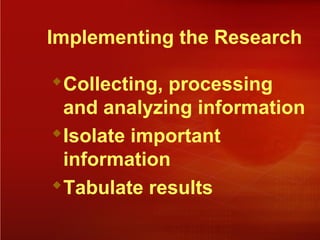
Implementing the Research
Collecting, processing
and analyzing information
Isolate important
information
Tabulate results
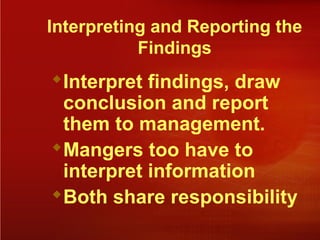
Interpreting and Reporting the
Findings
Interpret findings, draw
conclusion and report
them to management.
Mangers too have to
interpret information
Both share responsibility

16 research

  • 1.
  • 2.
    Exam Type Questions 1.Explain the importance of information to the company and its understanding of the marketplace. 2. Outline the steps in the marketing research process. 3. What is meant by primary and secondary data?
  • 3.
    Managing Marketing Information  Informationneeds of organization: customer value & satisfaction  Competitors, resellers, and other forces in the marketplace  Wal-Mart daily data equivalent to 96000 DVDs  Marketers need better information  Marketing information system: consists of people, equipment, and procedures to gather, sort, analyze, evaluate and distribute needed, timely, and accurate information to marketing decision makers.
  • 4.
    Developing Information  Internaldatabases: electronic collection of consumer and market information obtained from data sources within the company network.  Accounting department keeps detailed records of sales, costs, and cash flows.  Operations department reports on production schedules, shipments, and inventories.  Marketing department furnishes information on customer transactions, demographics, psychographics, and buying behavior.  Pizza Hut database: 40 million US households gleaned from 7,500 restaurants. Coupon offers on the basis of data.
  • 5.
    Quickly and easily developed Maybe incomplete and not serve specific purpose
  • 6.
    Marketing Intelligence The systematiccollection and analysis of publicly available information about consumers, competitors and developments in the marketing environment
  • 7.
    Marketing Intelligence  Quizzingemployees  Benchmarking products  Researching the internet  Trade shows and exhibitions  Annual reports  Business publications and ads  Trash bins routing  Microsoft vs Google example
  • 8.
    Marketing Research  Formalstudies of specific situations  Samsung Plasma, Pizza Hut sales  Marketing research is the systematic design, collection, analysis, and reporting of data relevant to a specific marketing situation facing an organization.  Market potential, market share, formulate marketing mix strategy  Own research department, consultants, research companies (ACNielson)
  • 9.
    Marketing Research Process Involvesfour steps: defining the problem and research objectives, developing the research plan, implementing the research plan, and interpreting and reporting the findings.
  • 10.
    Defining the Problemand Research Objectives  A difficult ask: the manager may know that something is wrong, without knowing the specific causes.  Once problem defined, research objectives must be set.  Exploratory research: to gather preliminary information that will help define problems and suggest hypotheses.  Descriptive research: to better describe marketing problems, situations, or markets, such as the market potential for a product or the demographics and attitudes of customers.  Causal research: to test hypotheses about cause and effect relationship. For example, would 10 % decrease in tuition fee result in an enrollment increase.
  • 11.
    Defining the ResearchPlan Specific information needs Existing data and spells specific research approaches, contact methods, sampling plans and instruments to gather data Campbell soup example Written proposal contains research costs
  • 12.
    Secondary Data  Informationthat already exists somewhere, having been collected for other purpose.  Internal data bases, buying secondary reports, online data bases (Dialog, ProQuest, LexisNexis)  Can be obtained more quickly at lower cost  Needed information may not exist
  • 13.
    Primary Data Information collectedfor the specific purpose at hand. Relevant, accurate, current and unbiased Collection of primary data may involve research approaches, contact methods, sampling plan, and research instruments.
  • 14.
    Research Approaches Observational research:the gathering of primary data by observing relevant people, actions, and situations. Example bank (neighborhood conditions, location of competing branches, traffic routes)
  • 15.
    Ethnographic Research A formof observational research that involves sending trained observers to watch and interact with consumers in their “natural habitat” Example Marriot hotel
  • 16.
    Survey Research Gathering primarydata by asking people questions about their knowledge, attitudes, preferences, and buying behavior.
  • 17.
    Experimental Research Gathering primarydata by selecting matched groups of subjects giving them different treatments, controlling related factors, and checking differences in groups.
  • 18.
    Contact Methods Mail Telephone Personal Interviewing Focusgroups interviewing Online marketing research
  • 19.
    Sampling Plan Drawing conclusionsabout large group of customers by studying a small sample of the total consumer population. Sampling decision for a car
  • 20.
    Probability Sample  Simplerandom sample: every member of the population has a known and equal chance of selection.  Stratified random sample: the population is divided into mutually exclusive groups (such as age groups), and random samples are drawn from each group  Cluster (area) sample: the population is divided into mutually exclusive groups (such as blocks), and the researchers draws a sample of the groups to interview
  • 21.
    Non Probability Sample Convenience sample: the researcher selects the easiest population members from which to obtain information  Judgment sample: the researcher uses his or her judgment to select population members who are good prospects of accurate information.  Quota sample: the researcher finds and interviews a prescribed number of people in each of several categories
  • 22.
  • 23.
    Implementing the Research Collecting,processing and analyzing information Isolate important information Tabulate results
  • 24.
    Interpreting and Reportingthe Findings Interpret findings, draw conclusion and report them to management. Mangers too have to interpret information Both share responsibility