ConditionalsWelcome to a presentation on
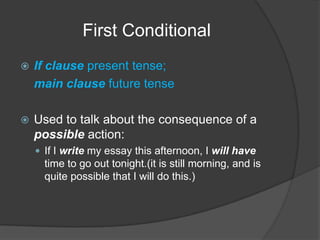
First ConditionalIf clause present tense;main clause future tenseUsed to talk about the consequence of a possible action:If I write my essay this afternoon, I will have time to go out tonight.(it is still morning, and is quite possible that I will do this.)
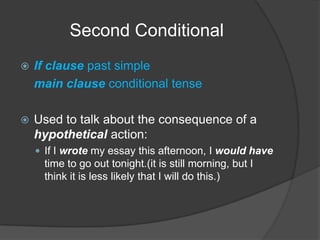
Second ConditionalIf clause past simplemain clause conditional tenseUsed to talk about the consequence of a hypothetical action:If I wrote my essay this afternoon, I would have time to go out tonight.(it is still morning, but I think it is less likely that I will do this.)
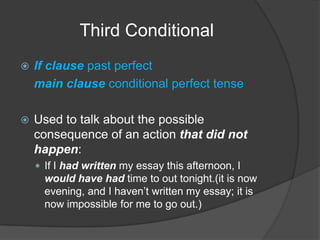
Third ConditionalIf clause past perfectmain clause conditional perfect tenseUsed to talk about the possible consequence of an action that did not happen:If I had written my essay this afternoon, I would have had time to out tonight.(it is now evening, and I haven’t written my essay; it is now impossible for me to go out.)
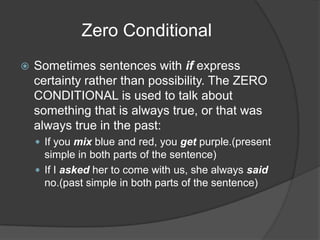
Zero ConditionalSometimes sentences with if express certainty rather than possibility. The ZERO CONDITIONAL is used to talk about something that is always true, or that was always true in the past:If you mix blue and red, you get purple.(present simple in both parts of the sentence)If I asked her to come with us, she always said no.(past simple in both parts of the sentence)
Thank you

Conditionals

  • 1.
  • 2.
    First ConditionalIf clausepresent tense;main clause future tenseUsed to talk about the consequence of a possible action:If I write my essay this afternoon, I will have time to go out tonight.(it is still morning, and is quite possible that I will do this.)
  • 3.
    Second ConditionalIf clausepast simplemain clause conditional tenseUsed to talk about the consequence of a hypothetical action:If I wrote my essay this afternoon, I would have time to go out tonight.(it is still morning, but I think it is less likely that I will do this.)
  • 4.
    Third ConditionalIf clausepast perfectmain clause conditional perfect tenseUsed to talk about the possible consequence of an action that did not happen:If I had written my essay this afternoon, I would have had time to out tonight.(it is now evening, and I haven’t written my essay; it is now impossible for me to go out.)
  • 5.
    Zero ConditionalSometimes sentenceswith if express certainty rather than possibility. The ZERO CONDITIONAL is used to talk about something that is always true, or that was always true in the past:If you mix blue and red, you get purple.(present simple in both parts of the sentence)If I asked her to come with us, she always said no.(past simple in both parts of the sentence)
  • 6.