ONADCOTINIL ENSCESTEN
CONDITIONAL SENTENCES
Prepared by:
Jeason Mosquite
Chelsy Oposa
Charmel Ortiz
Objectives:
By the end of the lesson, students will:
1. Define conditional sentences and their purpose.
2. Identify the types of conditional sentences.
3. Construct sentences using correct conditional forms.
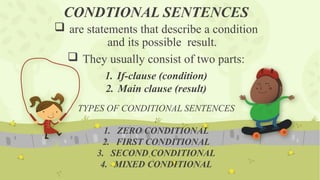
CONDTIONAL SENTENCES
 are statements that describe a condition
and its possible result.
 They usually consist of two parts:
1. If-clause (condition)
2. Main clause (result)
TYPES OF CONDITIONAL SENTENCES
:
1. ZERO CONDITIONAL
2. FIRST CONDITIONAL
3. SECOND CONDITIONAL
4. MIXED CONDITIONAL
ZERO CONDITIONAL
• real condition
• Results that are always the same
If + present simple + present simple
Ex:
“If you heat water, it boils.”
“If you add sugar to tea, it becomes sweeter.”
The Zero Conditional uses the present simple because it
talks about facts, general truths, or situations that always
happen under certain conditions.
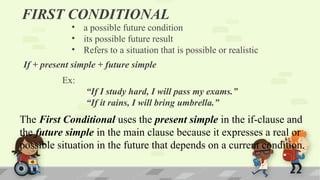
FIRST CONDITIONAL
• a possible future condition
• its possible future result
• Refers to a situation that is possible or realistic
If + present simple + future simple
Ex:
“If I study hard, I will pass my exams.”
“If it rains, I will bring umbrella.”
The First Conditional uses the present simple in the if-clause and
the future simple in the main clause because it expresses a real or
possible situation in the future that depends on a current condition.
SECOND CONDITIONAL
• imaginary / unreal / hypothetical condition
• refers to a situation that is impossible or unlikely to happen
If + past simple + would + verb (base form)
Ex:
“If I won the lottery, I would buy a mansion.”
“ If I were rich, I would travel.”
The Second Conditional uses the past simple in the f-clause and
would + base verb in the main clause because it expresses
hypothetical or unlikely situations that are not true in the present
or are imagined possibilities.
THIRD CONDITIONAL
• unreal / impossible / hypothetical condition
• refers to a past situation that differs from reality
If + past perfect + would have + past participle
Ex:
“If I had saved my money, I would have bought a car.”
“If I had studied, I would have passed.”
The Third Conditional uses past perfect in the if-clause and would
have + past participate in the main clause because it expresses a
hypothetical situation in the past that did not happen, often
reflecting regret or imagining a different outcome.
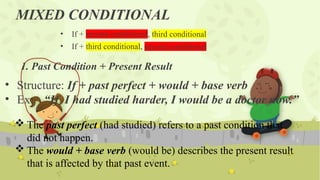
MIXED CONDITIONAL
• If + second conditional, third conditional
• If + third conditional, second conditional
1. Past Condition + Present Result
• Structure: If + past perfect + would + base verb
• Ex: “If I had studied harder, I would be a doctor now.”
 The past perfect (had studied) refers to a past condition that
did not happen.
 The would + base verb (would be) describes the present result
that is affected by that past event.
2. Present Condition + Past Result
• Structure: If + past simple + would have + past participle
• Ex: “If I were rich, I would have traveled the world by
now.”
The past simple (were) indicates a present hypothetical
condition.
The would have + past participle (would have have traveled)
describes a past result that didn’t happen because the present
condition isn’t true.
CONCLUSIONS
 Conditional sentences help express possibilities,
predictions, and hypothetical situations.
 The five types are: Zero, First, Second, Third, and
Mixed Conditionals- each serving specific purposes.
 Mastering these structures improves both written and
spoken communication.
THANK YOU!

All about Conditional-Sentences-FINAL.pptx

  • 1.
    ONADCOTINIL ENSCESTEN CONDITIONAL SENTENCES Preparedby: Jeason Mosquite Chelsy Oposa Charmel Ortiz
  • 2.
    Objectives: By the endof the lesson, students will: 1. Define conditional sentences and their purpose. 2. Identify the types of conditional sentences. 3. Construct sentences using correct conditional forms.
  • 3.
    CONDTIONAL SENTENCES  arestatements that describe a condition and its possible result.  They usually consist of two parts: 1. If-clause (condition) 2. Main clause (result) TYPES OF CONDITIONAL SENTENCES : 1. ZERO CONDITIONAL 2. FIRST CONDITIONAL 3. SECOND CONDITIONAL 4. MIXED CONDITIONAL
  • 4.
    ZERO CONDITIONAL • realcondition • Results that are always the same If + present simple + present simple Ex: “If you heat water, it boils.” “If you add sugar to tea, it becomes sweeter.” The Zero Conditional uses the present simple because it talks about facts, general truths, or situations that always happen under certain conditions.
  • 5.
    FIRST CONDITIONAL • apossible future condition • its possible future result • Refers to a situation that is possible or realistic If + present simple + future simple Ex: “If I study hard, I will pass my exams.” “If it rains, I will bring umbrella.” The First Conditional uses the present simple in the if-clause and the future simple in the main clause because it expresses a real or possible situation in the future that depends on a current condition.
  • 6.
    SECOND CONDITIONAL • imaginary/ unreal / hypothetical condition • refers to a situation that is impossible or unlikely to happen If + past simple + would + verb (base form) Ex: “If I won the lottery, I would buy a mansion.” “ If I were rich, I would travel.” The Second Conditional uses the past simple in the f-clause and would + base verb in the main clause because it expresses hypothetical or unlikely situations that are not true in the present or are imagined possibilities.
  • 7.
    THIRD CONDITIONAL • unreal/ impossible / hypothetical condition • refers to a past situation that differs from reality If + past perfect + would have + past participle Ex: “If I had saved my money, I would have bought a car.” “If I had studied, I would have passed.” The Third Conditional uses past perfect in the if-clause and would have + past participate in the main clause because it expresses a hypothetical situation in the past that did not happen, often reflecting regret or imagining a different outcome.
  • 8.
    MIXED CONDITIONAL • If+ second conditional, third conditional • If + third conditional, second conditional 1. Past Condition + Present Result • Structure: If + past perfect + would + base verb • Ex: “If I had studied harder, I would be a doctor now.”  The past perfect (had studied) refers to a past condition that did not happen.  The would + base verb (would be) describes the present result that is affected by that past event.
  • 9.
    2. Present Condition+ Past Result • Structure: If + past simple + would have + past participle • Ex: “If I were rich, I would have traveled the world by now.” The past simple (were) indicates a present hypothetical condition. The would have + past participle (would have have traveled) describes a past result that didn’t happen because the present condition isn’t true.
  • 10.
    CONCLUSIONS  Conditional sentenceshelp express possibilities, predictions, and hypothetical situations.  The five types are: Zero, First, Second, Third, and Mixed Conditionals- each serving specific purposes.  Mastering these structures improves both written and spoken communication.
  • 11.

Editor's Notes

  • #3 NOTE: To change images on this slide, select a picture and delete it. Then click the Insert Picture icon in the placeholder to insert your own image.