CONDITIONAL SENTENCES
( “IF” sentences)
A.G.N.Sudath(JP)
Master of Education, Bachelor of Education
National Diploma in Teaching English
Diploma In English For Teachers Of English
Former National Trainer at the PIC at the Ministry of Education
Visiting Lecturer of English – University of Sabaragamuwa
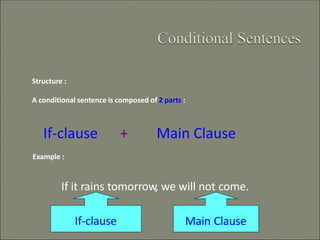
Structure :
A conditional sentence is composed of 2 parts :
If-clause + Main Clause
Example :
If it rains tomorrow, we will not come.
If-clause Main Clause
These sentences are in two halves (clauses):
▪ The if part - (if clause)
▪ The other part where you can use words such as
can, will, may, might, could and would -
(main clause)
If you come with me , I will buy an
ice cream
Types :
➢There are 4 types of conditional sentences.
They are classified according to their specific
implications.
➢Each type of conditional sentences uses
different tenses to show the difference in their
implications.
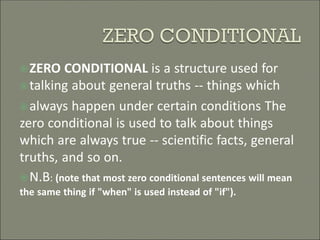
ZERO CONDITIONAL is a structure used for
talking about general truths -- things which
always happen under certain conditions The
zero conditional is used to talk about things
which are always true -- scientific facts, general
truths, and so on.
N.B: (note that most zero conditional sentences will mean
the same thing if "when" is used instead of "if").
If clause Main clause
If + Present Simple Present Simple
If you heat the
water to 100
degrees,
It boils
Present Tense Present Tense
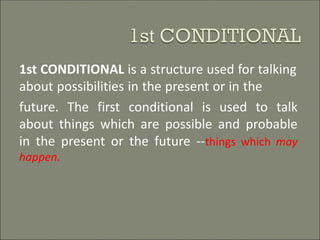
1st CONDITIONAL is a structure used for talking
about possibilities in the present or in the
future. The first conditional is used to talk
about things which are possible and probable
in the present or the future --things which may
happen.
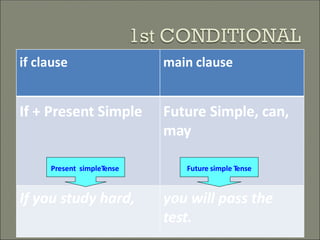
if clause
If + Present Simple
main clause
Future Simple, can,
may
Present simpleTense
If you study hard,
Future simple Tense
you will pass the
test.
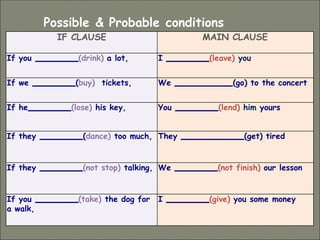
Possible & Probable conditions
IF CLAUSE MAIN CLAUSE
If you (drink) a lot, I (leave) you
If we (buy) tickets, We (go) to the concert
If he (lose) his key, You (lend) him yours
If they (dance) too much, They (get) tired
If they (not stop) talking, We (not finish) our lesson
If you (take) the dog for
a walk,
I (give) you some money
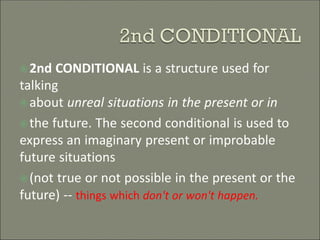
2nd CONDITIONAL is a structure used for
talking
about unreal situations in the present or in
the future. The second conditional is used to
express an imaginary present or improbable
future situations
(not true or not possible in the present or the
future) -- things which don't or won't happen.
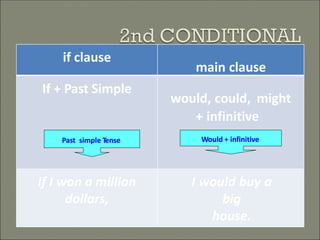
if clause
If + Past Simple
main clause
would, could, might
+ infinitive
If I won a million
dollars,
I would buy a
big
house.
Past simple Tense Would + infinitive
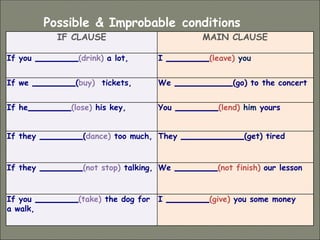
Possible & Improbable conditions
IF CLAUSE MAIN CLAUSE
If you (drink) a lot, I (leave) you
If we (buy) tickets, We (go) to the concert
If he (lose) his key, You (lend) him yours
If they (dance) too much, They (get) tired
If they (not stop) talking, We (not finish) our lesson
If you (take) the dog for
a walk,
I (give) you some money
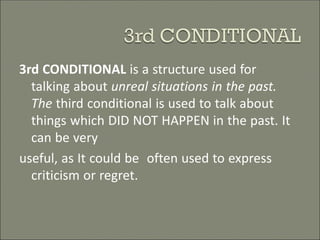
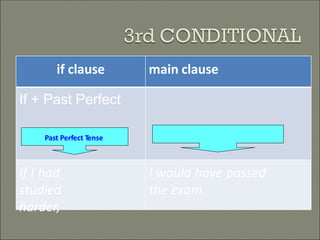
3rd CONDITIONAL is a structure used for
talking about unreal situations in the past.
The third conditional is used to talk about
things which DID NOT HAPPEN in the past. It
can be very
useful, as It could be often used to express
criticism or regret.
would/could/might
have
+ Past Participle
 Would + Present Perfect Form
if clause main clause
If + Past Perfect
If I had
studied
harder,
I would have passed
the exam.
Past Perfect Tense
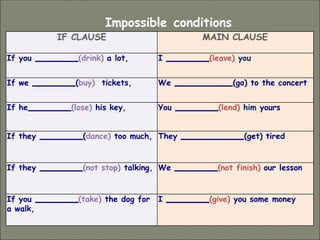
Impossible conditions
IF CLAUSE MAIN CLAUSE
If you (drink) a lot, I (leave) you
If we (buy) tickets, We (go) to the concert
If he (lose) his key, You (lend) him yours
If they (dance) too much, They (get) tired
If they (not stop) talking, We (not finish) our lesson
If you (take) the dog for
a walk,
I (give) you some money
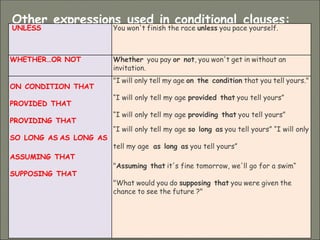
Other expressions used in conditional clauses:
UNLESS You won't finish the race unless you pace yourself.
WHETHER…OR NOT Whether you pay or not, you won't get in without an
invitation.
ON CONDITION THAT
PROVIDED THAT
PROVIDING THAT
SO LONG AS AS LONG AS
ASSUMING THAT
SUPPOSING THAT
"I will only tell my age on the condition that you tell yours."
“I will only tell my age provided that you tell yours”
“I will only tell my age providing that you tell yours”
“I will only tell my age so long as you tell yours” “I will only
tell my age as long as you tell yours”
"Assuming that it's fine tomorrow, we'll go for a swim“
"What would you do supposing that you were given the
chance to see the future ?"
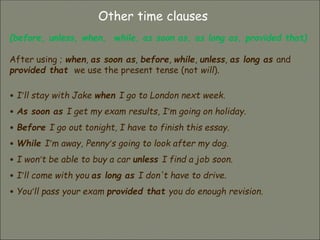
Other time clauses
(before, unless, when, while, as soon as, as long as, provided that)
After using ; when, as soon as, before, while, unless, as long as and
provided that we use the present tense (not will).
• I’ll stay with Jake when I go to London next week.
• As soon as I get my exam results, I’m going on holiday.
• Before I go out tonight, I have to finish this essay.
• While I’m away, Penny’s going to look after my dog.
• I won’t be able to buy a car unless I find a job soon.
• I’ll come with you as long as I don't have to drive.
• You’ll pass your exam provided that you do enough revision.
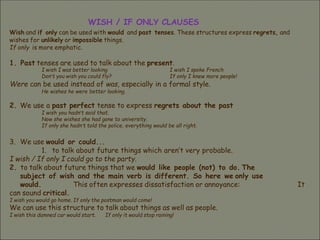
WISH / IF ONLY CLAUSES
Wish and if only can be used with would and past tenses. These structures express regrets, and
wishes for unlikely or impossible things.
If only is more emphatic.
1. Past tenses are used to talk about the present.
I wish I was better looking
Don’t you wish you could fly?
I wish I spoke French
If only I knew more people!
Were can be used instead of was, especially in a formal style.
He wishes he were better looking.
2. We use a past perfect tense to express regrets about the past
I wish you hadn’t said that.
Now she wishes she had gone to university.
If only she hadn’t told the police, everything would be all right.
3. We use would or could...
1. to talk about future things which aren’t very probable.
I wish / If only I could go to the party.
2. to talk about future things that we would like people (not) to do. The
subject of wish and the main verb is different. So here we only use
would. This often expresses dissatisfaction or annoyance:
can sound critical.
I wish you would go home. If only the postman would come!
We can use this structure to talk about things as well as people.
I wish this damned car would start. If only it would stop raining!
It
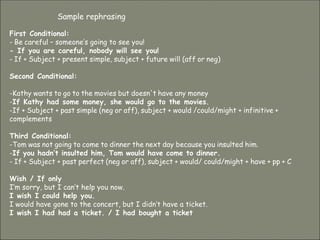
Sample rephrasing
First Conditional:
- Be careful – someone’s going to see you!
- If you are careful, nobody will see you!
- If + Subject + present simple, subject + future will (aff or neg)
Second Conditional:
-Kathy wants to go to the movies but doesn't have any money
-If Kathy had some money, she would go to the movies.
-If + Subject + past simple (neg or aff), subject + would /could/might + infinitive +
complements
Third Conditional:
-Tom was not going to come to dinner the next day because you insulted him.
-If you hadn’t insulted him, Tom would have come to dinner.
- If + Subject + past perfect (neg or aff), subject + would/ could/might + have + pp + C
Wish / If only
I’m sorry, but I can’t help you now.
I wish I could help you.
I would have gone to the concert, but I didn’t have a ticket.
I wish I had had a ticket. / I had bought a ticket
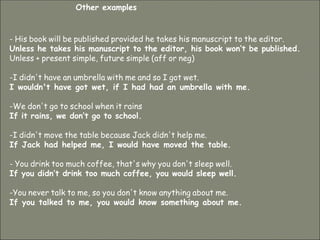
- His book will be published provided he takes his manuscript to the editor.
Unless he takes his manuscript to the editor, his book won’t be published.
Unless + present simple, future simple (aff or neg)
-I didn't have an umbrella with me and so I got wet.
I wouldn't have got wet, if I had had an umbrella with me.
-We don't go to school when it rains
If it rains, we don’t go to school.
-I didn't move the table because Jack didn't help me.
If Jack had helped me, I would have moved the table.
- You drink too much coffee, that's why you don't sleep well.
If you didn’t drink too much coffee, you would sleep well.
-You never talk to me, so you don't know anything about me.
If you talked to me, you would know something about me.
Other examples
Thank you

A.g.n.sudath

  • 1.
    CONDITIONAL SENTENCES ( “IF”sentences) A.G.N.Sudath(JP) Master of Education, Bachelor of Education National Diploma in Teaching English Diploma In English For Teachers Of English Former National Trainer at the PIC at the Ministry of Education Visiting Lecturer of English – University of Sabaragamuwa
  • 2.
    Structure : A conditionalsentence is composed of 2 parts : If-clause + Main Clause Example : If it rains tomorrow, we will not come. If-clause Main Clause
  • 3.
    These sentences arein two halves (clauses): ▪ The if part - (if clause) ▪ The other part where you can use words such as can, will, may, might, could and would - (main clause) If you come with me , I will buy an ice cream
  • 4.
    Types : ➢There are4 types of conditional sentences. They are classified according to their specific implications. ➢Each type of conditional sentences uses different tenses to show the difference in their implications.
  • 5.
    ZERO CONDITIONAL isa structure used for talking about general truths -- things which always happen under certain conditions The zero conditional is used to talk about things which are always true -- scientific facts, general truths, and so on. N.B: (note that most zero conditional sentences will mean the same thing if "when" is used instead of "if").
  • 6.
    If clause Mainclause If + Present Simple Present Simple If you heat the water to 100 degrees, It boils Present Tense Present Tense
  • 7.
    1st CONDITIONAL isa structure used for talking about possibilities in the present or in the future. The first conditional is used to talk about things which are possible and probable in the present or the future --things which may happen.
  • 8.
    if clause If +Present Simple main clause Future Simple, can, may Present simpleTense If you study hard, Future simple Tense you will pass the test.
  • 9.
    Possible & Probableconditions IF CLAUSE MAIN CLAUSE If you (drink) a lot, I (leave) you If we (buy) tickets, We (go) to the concert If he (lose) his key, You (lend) him yours If they (dance) too much, They (get) tired If they (not stop) talking, We (not finish) our lesson If you (take) the dog for a walk, I (give) you some money
  • 10.
    2nd CONDITIONAL isa structure used for talking about unreal situations in the present or in the future. The second conditional is used to express an imaginary present or improbable future situations (not true or not possible in the present or the future) -- things which don't or won't happen.
  • 11.
    if clause If +Past Simple main clause would, could, might + infinitive If I won a million dollars, I would buy a big house. Past simple Tense Would + infinitive
  • 12.
    Possible & Improbableconditions IF CLAUSE MAIN CLAUSE If you (drink) a lot, I (leave) you If we (buy) tickets, We (go) to the concert If he (lose) his key, You (lend) him yours If they (dance) too much, They (get) tired If they (not stop) talking, We (not finish) our lesson If you (take) the dog for a walk, I (give) you some money
  • 13.
    3rd CONDITIONAL isa structure used for talking about unreal situations in the past. The third conditional is used to talk about things which DID NOT HAPPEN in the past. It can be very useful, as It could be often used to express criticism or regret.
  • 14.
    would/could/might have + Past Participle Would + Present Perfect Form if clause main clause If + Past Perfect If I had studied harder, I would have passed the exam. Past Perfect Tense
  • 15.
    Impossible conditions IF CLAUSEMAIN CLAUSE If you (drink) a lot, I (leave) you If we (buy) tickets, We (go) to the concert If he (lose) his key, You (lend) him yours If they (dance) too much, They (get) tired If they (not stop) talking, We (not finish) our lesson If you (take) the dog for a walk, I (give) you some money
  • 16.
    Other expressions usedin conditional clauses: UNLESS You won't finish the race unless you pace yourself. WHETHER…OR NOT Whether you pay or not, you won't get in without an invitation. ON CONDITION THAT PROVIDED THAT PROVIDING THAT SO LONG AS AS LONG AS ASSUMING THAT SUPPOSING THAT "I will only tell my age on the condition that you tell yours." “I will only tell my age provided that you tell yours” “I will only tell my age providing that you tell yours” “I will only tell my age so long as you tell yours” “I will only tell my age as long as you tell yours” "Assuming that it's fine tomorrow, we'll go for a swim“ "What would you do supposing that you were given the chance to see the future ?"
  • 17.
    Other time clauses (before,unless, when, while, as soon as, as long as, provided that) After using ; when, as soon as, before, while, unless, as long as and provided that we use the present tense (not will). • I’ll stay with Jake when I go to London next week. • As soon as I get my exam results, I’m going on holiday. • Before I go out tonight, I have to finish this essay. • While I’m away, Penny’s going to look after my dog. • I won’t be able to buy a car unless I find a job soon. • I’ll come with you as long as I don't have to drive. • You’ll pass your exam provided that you do enough revision.
  • 18.
    WISH / IFONLY CLAUSES Wish and if only can be used with would and past tenses. These structures express regrets, and wishes for unlikely or impossible things. If only is more emphatic. 1. Past tenses are used to talk about the present. I wish I was better looking Don’t you wish you could fly? I wish I spoke French If only I knew more people! Were can be used instead of was, especially in a formal style. He wishes he were better looking. 2. We use a past perfect tense to express regrets about the past I wish you hadn’t said that. Now she wishes she had gone to university. If only she hadn’t told the police, everything would be all right. 3. We use would or could... 1. to talk about future things which aren’t very probable. I wish / If only I could go to the party. 2. to talk about future things that we would like people (not) to do. The subject of wish and the main verb is different. So here we only use would. This often expresses dissatisfaction or annoyance: can sound critical. I wish you would go home. If only the postman would come! We can use this structure to talk about things as well as people. I wish this damned car would start. If only it would stop raining! It
  • 19.
    Sample rephrasing First Conditional: -Be careful – someone’s going to see you! - If you are careful, nobody will see you! - If + Subject + present simple, subject + future will (aff or neg) Second Conditional: -Kathy wants to go to the movies but doesn't have any money -If Kathy had some money, she would go to the movies. -If + Subject + past simple (neg or aff), subject + would /could/might + infinitive + complements Third Conditional: -Tom was not going to come to dinner the next day because you insulted him. -If you hadn’t insulted him, Tom would have come to dinner. - If + Subject + past perfect (neg or aff), subject + would/ could/might + have + pp + C Wish / If only I’m sorry, but I can’t help you now. I wish I could help you. I would have gone to the concert, but I didn’t have a ticket. I wish I had had a ticket. / I had bought a ticket
  • 20.
    - His bookwill be published provided he takes his manuscript to the editor. Unless he takes his manuscript to the editor, his book won’t be published. Unless + present simple, future simple (aff or neg) -I didn't have an umbrella with me and so I got wet. I wouldn't have got wet, if I had had an umbrella with me. -We don't go to school when it rains If it rains, we don’t go to school. -I didn't move the table because Jack didn't help me. If Jack had helped me, I would have moved the table. - You drink too much coffee, that's why you don't sleep well. If you didn’t drink too much coffee, you would sleep well. -You never talk to me, so you don't know anything about me. If you talked to me, you would know something about me. Other examples
  • 21.