Condensation
CONDENSERS


Power plant – water is boiled in boiler and condensed in condenser
Oil refinery - oil is evaporated in distillation column and condensed
into liquid fuels like gasoline and kerosene
Desalination plant – water vapor is produced by evaporation from
brine and condensed as pure water

Condensation – enthalpy of phase change to be removed by a coolant
Enthalpy of phase change is relatively large, for water (2.5 106 J/kg)
and associated heat transfer rates are also large
Heat transfer to phase interface – convective process – complicated by
an irregular surface – bubbles and drops
CONDENSATION HEAT TRANSFER
• Film condensation
• Dropwise condensation
                                   FILM CONDENSATION
                      Condensate wets the surface and forms a liquid film
                      on the surface that slides down under the influence
  80° C
                      of gravity.
                      Surface is blanketed by a liquid film of increasing
                      thickness, and this “liquid wall” between the solid
                      surface and the vapor serves as a resistance to heat
                      transfer


  Liquid film
• Condensate film thickness are thin – heat transfer coefficients are large
• Example - steam at a saturation temperature of 305 K condenses on a 2 cm – O.D
tube with a wall temperature of 300 K
•Average film thickness - 50m (0.05 mm) and the average heat transfer coefficient –
11,700 W/m2.K
• If the condensate flow rate is small, the surface of the film will be smooth and the
flow laminar because
        • Temperature difference is small
        • Wall is short
• If the condensate flow rate is high, waves will form on the surface to give wavy
laminar flow
•If the condensate flow rate is yet higher, the flow becomes turbulent
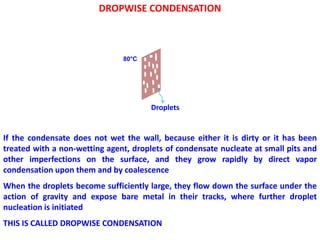
DROPWISE CONDENSATION


                               80°C


                                       Droplets


If the condensate does not wet the wall, because either it is dirty or it has been
treated with a non-wetting agent, droplets of condensate nucleate at small pits and
other imperfections on the surface, and they grow rapidly by direct vapor
condensation upon them and by coalescence
When the droplets become sufficiently large, they flow down the surface under the
action of gravity and expose bare metal in their tracks, where further droplet
nucleation is initiated
THIS IS CALLED DROPWISE CONDENSATION
Droplets slide down when they reach a certain size, clearing the surface and
exposing it to vapor.
There is no liquid film in this case to resist heat transfer.
Heat transfer rates that are more than 10 times larger than those associated with
film condensation can be achieved with dropwise condensation
Most of the heat transfer is through drops of less than 100m diameter
Thermal resistance of such drops is small; hence, heat transfer coefficients for
dropwise condensation are large; values of upto 30000 W/m2.K have been
measured.
Hence, dropwise condensation is preferred over filmwise condensation
Considerable efforts are put for non-wetting heat exchanger surfaces
If the surface is treated with non-wetting agent (stearic acid) to promote dropwise
condensation, the effect lasts only few days, until the promoter is washed off or
oxidised.
Continuous adding of the promoter to the vapour is expensive and contaminates the
condensate.
Bonding a polymer such as teflon to the surface is expensive and adds additional
thermal resistance
Gold plating is also expensive
Because of lack of sustainability of dropwise condensation, present day condensers
are designed based on filmwise condensation
Filmwise condensation – conservative estimate
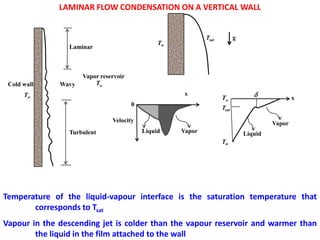
LAMINAR FLOW CONDENSATION ON A VERTICAL WALL


                                                             Tsat          g
                                                Tw
                Laminar


                     Vapor reservoir
 Cold wall    Wavy        T
      Tw                                              x
                                                                    T                         x
                                       0
                                                                    Tsat

                               Velocity                                                 Vapor
                Turbulent                  Liquid    Vapor                     Liquid
                                                                    Tw


Temperature of the liquid-vapour interface is the saturation temperature that
       corresponds to Tsat
Vapour in the descending jet is colder than the vapour reservoir and warmer than
        the liquid in the film attached to the wall
LAMINAR FLOW CONDENSATION ON A VERTICAL WALL

Consider a vertical wall exposed to a saturated vapour at pressure p and saturation
        temperature Tsat = Tsat(P).
The wall could be flat or could be the outside surface of a vertical tube
If the surface is maintained at a temperature Tw < Tsat, vapour will continuously
         condense on the wall, and if the liquid phase wets the surface well, will flow
         down the wall in a thin film
Provided the condensation rate is not too large, there will be no discernable waves
        on the film surface, and the flow in the film will be laminar
• Fluid dynamics of the flow of a thin liquid film
• Heat transfer during the flow of a thin liquid film
0
                     x


                     Laminar film of
                       condensate                                                 x
                                                                    0
                                                  T
                  Tsat
                                                                                            u
                                                                            Zero shear ,       0
                                                                v                           y
                         u
  Tw
              v
                             x = δ(y)
                             Interface
                                                                                T = Tsat
                                                             Tsat


          
                                                               Tw           x
  y       H                                                             
y + dy                                   From reservoir of
                               hg d
                                         saturated vapor
            d
                                            T  Tsat
          H + dH
ASSUMPTIONS
• Laminar flow and constant properties are assumed for the liquid film
• Gas is assumed to be pure vapour and at a uniform temperature equal to Tsat. The
         merit of this simplification is that it allows us to focus exclusively on the
         flow of the liquid film and to neglect the movement of the nearest layers of
         vapour
• Shear stress at the liquid-vapour interface is assumed to be negligible
• With no temperature gradient in the vapour, heat transfer to the liquid-vapour
       interface can occur only by condensation at the interface and not by
       conduction from the vapour
Steady state two dimensional incompressible flow
                     u   u    P        2u  2u 
                  L u  v   
                     x             L  2  2 
                          y    x       x   y 

                    v   v    P        2v  2v 
                 L u  v   
                    x             L  2  2    L g
                         y    y       x   y 

           x ~ ;y ~ L
           u  v , Hence , x  momentum equation vanishes
                                                            Neglected, y<<x
                    v   v    dP       v  v
                                                2      2
                 L u  v   
                    x             L  2  2    L g
                         y    dy       x y 
   dP
       pressure imposed from the inviscid potion   v g  Hydrostatic pressure
   dy
                           v   v                      2v
                       L  u  v    L   v g   L 2
                           x
                                y 
                                                        x
 v   v                                             2v
               L u  v 
                  x                               L   v g   L 2
                         
                  y                               
                                                                    x
                                                 SINKING EFFECT
                                                                                       FRICTION
                        INERTIA

Assuming inertia is negligible
                                     2v
                                  L 2   L   v g  0
                                    x
Boundary conditions              x0 v0
                                      v
                                 x     0
                                      x
Integrating                  v
                           L  g   L   v  x  C1
                             x
                                                x2
                           L v  g  L   v   C1 x  C 2
                                                2

                           x  0 v  0  C2  0

                        v          v
                 x        0  L     g  L   v x  C1  g  L   v   C1
                        x          x
x2
     L v  g  L   v   C1 x  C 2
                          2
    C2  0

   C1  g  L   v 
                                                 x2
                           L v  g   L   v   g   L   v  x
                                                 2
                                g  L   v       x2 
                             v                 x  
                                               
                                     L             2 
                               g  L   v  2 
                                                 x 1  x 2 
                   vx , y                         
                                    L           2  
                                                            
Film thickness is unknown function of (y)
Local mass flow rate per unit width  (y)

                                                                            y
                                            
                                    y     Lv dx
                                            0


                                 g  L   v         x 1  x 2 
                   y    L                     2      dx
                                       L               2  
                          0
                                                                   
                                                                  
                              g  L   v  2  x 2 1  x 3  
                   y   L                   3 
                                   L           2 6   
                                                         0

                                   L g  L   v  2    
                        y                          
                                         L            2 6

                                        L g  L   v  2 
                            y                        
                                              L            3

                                        L g  L   v   3
                                y 
                                              L           3
 L g  L   v   3
                                y 
                                              L           3

                                         b L g L   v   3
                          m  b  y  
                          
                                                L           3
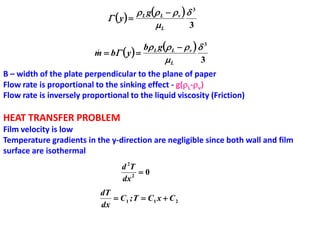
B – width of the plate perpendicular to the plane of paper
Flow rate is proportional to the sinking effect - g(L-v)
Flow rate is inversely proportional to the liquid viscosity (Friction)

HEAT TRANSFER PROBLEM
Film velocity is low
Temperature gradients in the y-direction are negligible since both wall and film
surface are isothermal
                                  d 2T
                                       0
                                  dx 2
                            dT
                                C1 ; T  C1 x  C 2
                            dx
T  C1 x  C 2
              x   T  Tsat
              x  0 T  Tw  C 2  Tw
                                                       Tsat  Tw
              T  C1 x  Tw  Tsat  C1  Tw  C1 
                                                          


                  T  Tsat  Tw 
                                            x
                                                 Tw
                                           
This is a linear temperature profile similar to the conduction in a plane
wall
Heat flux into the wall = Heat flux across the film

                                                      Q k l Tsat  Tw 
                                                      
                                      hTsat  Tw   
                                dT
                             kl
                                dx w                  A         

                                         kl
                                            dT       k l Tsat  Tw 
                                    h
                                            dx w
                                                                     k
                                                                       l
                                       Tsat  Tw  Tsat  Tw  
                                                          kl
                                                    h
                                                          
Determination of film thickness

              L g  L   v                                b L g L   v   3
                                                m  b  y  
                                3
    y                          ;            
                                                                      L           3
                    L           3


                                       b L g L   v  3 2 d      Rate of condensation of
                            b  y  
                        dm
                        dy                     L           3 dy        vapour over a vertical
                                                                        distance dy
Rate of heat transfer from the vapour             = Heat releasead as vapour is condensed
to the plate through the liquid film


                               dmh  k b dy Tsat  Tw
                            dQ     fg  l
                                                    

                                     dm k l b Tsat  Tw
                                      
                                        
                                     dy h fg      

                            b L g  L   v  3 2 d k l b Tsat  Tw
                 b  y  
             dm
                                                        
             dy                      L           3 dy h fg        

            L g  L   v  3 2 d   k T  Tw
                                       l sat
                  L           3 dy h fg      
                        L k l Tsat  Tw 
            3 d                           dy
                       L g  L   v h fg
           4     L k l Tsat  Tw 
                                      yC            y  0,     0C  0
            4    L g  L   v h fg
4     L k l Tsat  Tw 
                                                   y
                         4    L g  L   v h fg
                                                               1
                                 4 k 4 T  T              4
                        y    L l sat            w
                                                        y
                                  L g  L   v h fg 
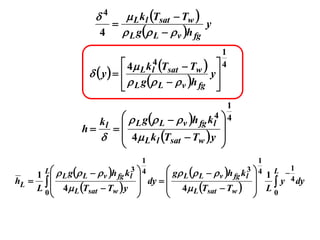
                                                        
                                                                  1
                           g             L   v h fg k l4  4
                   h    L
                         kl                                     
                        4 L k l Tsat  Tw  y 
                                                 
                                        1                                   1

         L g                                                
      L           L   v h fg k l3  4
                                                g L  L   v h fg k l3  4   L 1
    1
hL                                  
                                 dy                                      1
                                                                           L
                                                                                 y 4 dy
    L 0   4 L Tsat  Tw  y                    4 L Tsat  Tw 
                                                                          0
1
                                     
                                             
                                          g L  L   v h fg k l3  4
                                                                   
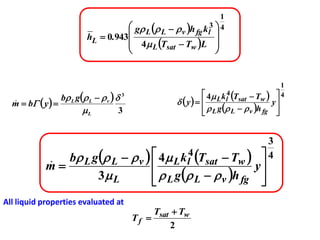
                          hL  0.943
                                      4 T  T L 
                                        L sat   w  


                                                                                          1
                 b L g L   v   3                           4 k 4 T  T        4
  m  b  y  
                                                        y    L l sat            w
                                                                                         y
                        L           3                             L g  L   v h fg 
                                                                                         


                                                                                     3
                b L g  L   v   4 L k l4 Tsat  Tw                         4
             m
                                                           y
                      3 L            L g  L   v h fg 
                                                             
All liquid properties evaluated at
                                               Tsat  Tw
                                          Tf 
                                                    2
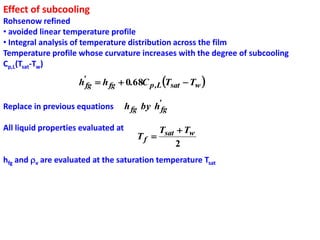
Effect of subcooling
Rohsenow refined
• avoided linear temperature profile
• Integral analysis of temperature distribution across the film
Temperature profile whose curvature increases with the degree of subcooling
Cp,L(Tsat-Tw)

                     h'fg  h fg  0.68C p ,L Tsat  Tw 

Replace in previous equations        h fg by h'fg

All liquid properties evaluated at           Tsat  Tw
                                        Tf 
                                                  2
hfg and v are evaluated at the saturation temperature Tsat
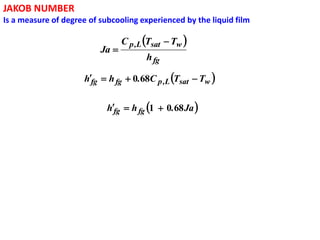
JAKOB NUMBER
Is a measure of degree of subcooling experienced by the liquid film

                               C p ,L Tsat  Tw 
                          Ja 
                                       h fg

                      hfg  h fg  0.68C p ,L Tsat  Tw 


                            hfg  h fg 1  0.68 Ja 
Reynolds Number
               L um Dh                   4 Ac 4b
         Re            ; um       ; Dh           4
                  L            L         P    b
                                 4 4
                    Re   L           
                                L  L  L

                                   4
                            Re 
                                   L

                            L g  L   v   3
                    y 
                                  L           3

                     4  4  L g  L   v   3
               Re     
                    L          3 L          L


                                    4  L g 3
                                        2
                                                        4 g 3
            L   v  Re                         
                                        3 L
                                           2
                                                        3 L
                                                           2
4  L g 3
                                     2
  L   v  Re 
                                   3 L
                                      2


                 x  L  l
           kl                k
      
           h                hx  L

                        3
             hx  L      havg
                        4

                                              3
                                      
                              2 
                                   kL 
                       3
     4 g L  k L 
           2
                         4 g L
Re       2 
                                   
                     
      3  L  hx  L     3 L  3
                             2
                                       
                                 havg 
                                4     

                                       1
                            1
                                 g 3
      havg  1.47 k l    Re 3 
                                  2 
                                  l 
Hydraulic diameter


                         D


                                        P  2L
PL                  P D              Ac  2 L
Ac  L              Ac   D                 4 Ac
                                        Dh          4
                            4 Ac                P
    4A
Dh  c  4          Dh          4
     P                       P
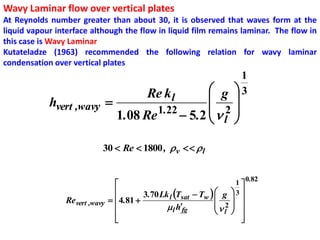
Wavy Laminar flow over vertical plates
At Reynolds number greater than about 30, it is observed that waves form at the
liquid vapour interface although the flow in liquid film remains laminar. The flow in
this case is Wavy Laminar
Kutateladze (1963) recommended the following relation for wavy laminar
condensation over vertical plates
                                                                     1
                                              g
                                         Re k l                     3
            hvert ,wavy                         
                          1.08 Re 1.22        2 
                                        5.2  l 

                           30  Re  1800 ,  v   l


                                                                           0.82
                                                                    1
                                       3.70 Lk l Tsat  Tw   g  3 
                                                                    
                Re vert ,wavy  4.81 
                                               l hfg         2  
                                                                l 
                                
                                                                      
                                                                       
Turbulent flow over vertical plates (Re > 1800)
Labuntsov proposed the following relation
                                                                            1
                                         Re k l          g                3
                                                              
    hvert ,turbulent 
                                              
                       8750  58 Pr  0.5 Re 0.75  253   l2 
                                                                
Film condensation on an inclined Plates

       hinclined  hvert cos                             Condensate

                                                  


                      1                                          1
                                                            1 2
          hL   l2  3
             
          kl  g 
                     
                     Re L0.44 
                     
                                                           3
                                     5.82  10  6 Re L.88 PrL 
                                                      0
                                                                       
                                                                    
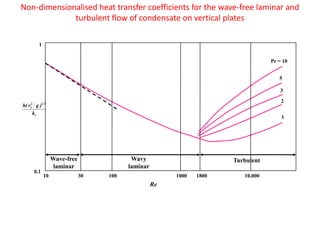
Non-dimensionalised heat transfer coefficients for the wave-free laminar and
             turbulent flow of condensate on vertical plates

         1


                                                                                  Pr = 10


                                                                                     5

                                                                                      3

                                                                                      2
h( vl2 g )1 3
      kl
                                                                                      1


                  Wave-free               Wavy                        Turbulent
                   laminar               laminar
      0.1
             10               30   100                  1000   1800      10,000
                                                   Re
Problem: Saturated steam at atmospheric pressure condenses on a 2 m high and 3 m
wide vertical plate that is maintained at 80C by circulating cooling water through
the other side. Determine (a) the rate of heat transfer by condensation to the plate
(b) the rate at which the condensate drips off the plate at the bottom
Solution: saturated steam at 1 atm condenses on a vertical plate. The rats of heat
transfer and condensation are to be determined
Assumptions: 1. steady operating conditions exist 2. The plate is isothermal. 3. The
condensate flow is wavy laminar over the entire plate (will be verified). 4. The
density of vapour is much smaller than the density of the liquid v<<l
Properties: The properties of water at the saturation temperature of 100C are hfg =
2257 103 J/g and v = 0.6 kg/m3. The properties of liquid water at the film
temperature 90C are
         T  Tw 100  80
    T f  sat            90
              2    2                   hfg  h fg  0.68C p ,L Tsat  Tw 
     l  965 .3 kg / m   3

                   3
     l  0.315  10 Pa .s             hfg  2257 103  0.68 4206 100 80
           
     l  l  0.326  10  6 m 2 / s
           l                                 hfg  2314103 J / kg
    C pl  4206 J / kg .K
    k l  0.675 W / m .K
    Pr  1.9628
1                                          1
              g                  9.81  965 .3  965 .32314  1000 
                              v h fg k l3  4                                0.675 3  4
              L L                                                                  
  hL  0.943                    0.943                                               
              4  T  T L                  4  0.315  10  3 100  80 4       
                 L sat  w                                                          

                                                        W
                                         hL  2656 .2
                                                        m2K

Q  hL As Tsat  Tw   2562 .2  2  3  100  80   307464 W

 
Q  mh  307464  m  2314  10 3  m  0.1329 kg / s
                                             
        sf


       4         4 m         4        0.1329 
Re                                            562.5
       L         L  b  0.315  10 3     3 
1                                                1
                                                                       1 2
               hL   l2  3
                  
               kl  g 
                          
                          Re L0.44 
                          
                                                                      3
                                                5.82  10  6 Re L.88 PrL 
                                                                 0
                                                                                  
                                                                               
                                  1                                                         1

           
           
      hL  0.326  10         
                           6 2  3 
                                    
                                                    
                                    562 .5  0.44            
                                                                                        1 2
                                                    5.82  10  6  562 .50.88  1.9628 3
                                                                                          
                                                                                          
     0.675 
              9.81                                                                     
                                                                                       
                                                    W
                                  hL  7691 .4
                                                  m2K

       Q  hL As  Tsat  Tw   7691.4  2  3   100  80   2307420 W
       
        
       Q  mhsf  2307420  m  2314  103  m  0.9972 kg / s
                                                       

                  4       4 m        4        0.9972 
          Re                 b  0.315  103  3   4221
                                   
                  L       L                          

          This confirms that condensation is in turbulent region

Comments: This Reynolds number confirms that condensation is in Wavy laminar
domain

Condensation

  • 1.
  • 2.
    CONDENSERS Power plant –water is boiled in boiler and condensed in condenser Oil refinery - oil is evaporated in distillation column and condensed into liquid fuels like gasoline and kerosene Desalination plant – water vapor is produced by evaporation from brine and condensed as pure water Condensation – enthalpy of phase change to be removed by a coolant Enthalpy of phase change is relatively large, for water (2.5 106 J/kg) and associated heat transfer rates are also large Heat transfer to phase interface – convective process – complicated by an irregular surface – bubbles and drops
  • 3.
    CONDENSATION HEAT TRANSFER •Film condensation • Dropwise condensation FILM CONDENSATION Condensate wets the surface and forms a liquid film on the surface that slides down under the influence 80° C of gravity. Surface is blanketed by a liquid film of increasing thickness, and this “liquid wall” between the solid surface and the vapor serves as a resistance to heat transfer Liquid film
  • 4.
    • Condensate filmthickness are thin – heat transfer coefficients are large • Example - steam at a saturation temperature of 305 K condenses on a 2 cm – O.D tube with a wall temperature of 300 K •Average film thickness - 50m (0.05 mm) and the average heat transfer coefficient – 11,700 W/m2.K • If the condensate flow rate is small, the surface of the film will be smooth and the flow laminar because • Temperature difference is small • Wall is short • If the condensate flow rate is high, waves will form on the surface to give wavy laminar flow •If the condensate flow rate is yet higher, the flow becomes turbulent
  • 5.
    DROPWISE CONDENSATION 80°C Droplets If the condensate does not wet the wall, because either it is dirty or it has been treated with a non-wetting agent, droplets of condensate nucleate at small pits and other imperfections on the surface, and they grow rapidly by direct vapor condensation upon them and by coalescence When the droplets become sufficiently large, they flow down the surface under the action of gravity and expose bare metal in their tracks, where further droplet nucleation is initiated THIS IS CALLED DROPWISE CONDENSATION
  • 6.
    Droplets slide downwhen they reach a certain size, clearing the surface and exposing it to vapor. There is no liquid film in this case to resist heat transfer. Heat transfer rates that are more than 10 times larger than those associated with film condensation can be achieved with dropwise condensation Most of the heat transfer is through drops of less than 100m diameter Thermal resistance of such drops is small; hence, heat transfer coefficients for dropwise condensation are large; values of upto 30000 W/m2.K have been measured. Hence, dropwise condensation is preferred over filmwise condensation Considerable efforts are put for non-wetting heat exchanger surfaces If the surface is treated with non-wetting agent (stearic acid) to promote dropwise condensation, the effect lasts only few days, until the promoter is washed off or oxidised. Continuous adding of the promoter to the vapour is expensive and contaminates the condensate.
  • 7.
    Bonding a polymersuch as teflon to the surface is expensive and adds additional thermal resistance Gold plating is also expensive Because of lack of sustainability of dropwise condensation, present day condensers are designed based on filmwise condensation Filmwise condensation – conservative estimate
  • 8.
    LAMINAR FLOW CONDENSATIONON A VERTICAL WALL Tsat g Tw Laminar Vapor reservoir Cold wall Wavy T Tw x T  x 0 Tsat Velocity Vapor Turbulent Liquid Vapor Liquid Tw Temperature of the liquid-vapour interface is the saturation temperature that corresponds to Tsat Vapour in the descending jet is colder than the vapour reservoir and warmer than the liquid in the film attached to the wall
  • 9.
    LAMINAR FLOW CONDENSATIONON A VERTICAL WALL Consider a vertical wall exposed to a saturated vapour at pressure p and saturation temperature Tsat = Tsat(P). The wall could be flat or could be the outside surface of a vertical tube If the surface is maintained at a temperature Tw < Tsat, vapour will continuously condense on the wall, and if the liquid phase wets the surface well, will flow down the wall in a thin film Provided the condensation rate is not too large, there will be no discernable waves on the film surface, and the flow in the film will be laminar • Fluid dynamics of the flow of a thin liquid film • Heat transfer during the flow of a thin liquid film
  • 10.
    0 x Laminar film of condensate  x 0 T Tsat u Zero shear , 0 v y u Tw v x = δ(y) Interface T = Tsat Tsat  Tw x y H  y + dy From reservoir of hg d saturated vapor   d T  Tsat H + dH
  • 11.
    ASSUMPTIONS • Laminar flowand constant properties are assumed for the liquid film • Gas is assumed to be pure vapour and at a uniform temperature equal to Tsat. The merit of this simplification is that it allows us to focus exclusively on the flow of the liquid film and to neglect the movement of the nearest layers of vapour • Shear stress at the liquid-vapour interface is assumed to be negligible • With no temperature gradient in the vapour, heat transfer to the liquid-vapour interface can occur only by condensation at the interface and not by conduction from the vapour
  • 12.
    Steady state twodimensional incompressible flow  u u  P   2u  2u  L u  v     x   L  2  2   y  x  x y   v v  P   2v  2v  L u  v     x   L  2  2    L g  y  y  x y  x ~ ;y ~ L u  v , Hence , x  momentum equation vanishes Neglected, y<<x  v v  dP  v  v 2 2 L u  v     x   L  2  2    L g  y  dy  x y  dP  pressure imposed from the inviscid potion   v g  Hydrostatic pressure dy  v v   2v  L  u  v    L   v g   L 2  x  y   x
  • 13.
     v v   2v L u  v   x   L   v g   L 2    y      x   SINKING EFFECT FRICTION INERTIA Assuming inertia is negligible  2v  L 2   L   v g  0 x Boundary conditions x0 v0 v x  0 x Integrating v  L  g   L   v  x  C1 x x2  L v  g  L   v   C1 x  C 2 2 x  0 v  0  C2  0 v v x   0  L  g  L   v x  C1  g  L   v   C1 x x
  • 14.
    x2  L v  g  L   v   C1 x  C 2 2 C2  0 C1  g  L   v  x2  L v  g   L   v   g   L   v  x 2 g  L   v   x2  v  x    L  2  g  L   v  2   x 1  x 2  vx , y        L  2     Film thickness is unknown function of (y)
  • 15.
    Local mass flowrate per unit width  (y)     y    y     Lv dx 0  g  L   v   x 1  x 2    y    L  2      dx L  2   0    g  L   v  2  x 2 1  x 3     y   L     3  L  2 6      0  L g  L   v  2       y      L 2 6  L g  L   v  2    y   L 3  L g  L   v   3   y  L 3
  • 16.
     L g L   v   3   y  L 3 b L g L   v   3 m  b  y    L 3 B – width of the plate perpendicular to the plane of paper Flow rate is proportional to the sinking effect - g(L-v) Flow rate is inversely proportional to the liquid viscosity (Friction) HEAT TRANSFER PROBLEM Film velocity is low Temperature gradients in the y-direction are negligible since both wall and film surface are isothermal d 2T 0 dx 2 dT  C1 ; T  C1 x  C 2 dx
  • 17.
    T  C1x  C 2 x   T  Tsat x  0 T  Tw  C 2  Tw Tsat  Tw T  C1 x  Tw  Tsat  C1  Tw  C1   T  Tsat  Tw  x  Tw  This is a linear temperature profile similar to the conduction in a plane wall
  • 18.
    Heat flux intothe wall = Heat flux across the film Q k l Tsat  Tw    hTsat  Tw    dT kl dx w A  kl dT k l Tsat  Tw  h dx w   k  l Tsat  Tw  Tsat  Tw   kl h  Determination of film thickness  L g  L   v   b L g L   v   3 m  b  y   3   y  ;  L 3 L 3  b L g L   v  3 2 d Rate of condensation of  b  y   dm dy L 3 dy vapour over a vertical distance dy
  • 19.
    Rate of heattransfer from the vapour = Heat releasead as vapour is condensed to the plate through the liquid film   dmh  k b dy Tsat  Tw dQ  fg l  dm k l b Tsat  Tw   dy h fg   b L g  L   v  3 2 d k l b Tsat  Tw  b  y   dm  dy L 3 dy h fg   L g  L   v  3 2 d k T  Tw  l sat L 3 dy h fg   L k l Tsat  Tw   3 d  dy  L g  L   v h fg 4  L k l Tsat  Tw   yC y  0,   0C  0 4  L g  L   v h fg
  • 20.
    4  L k l Tsat  Tw   y 4  L g  L   v h fg 1  4 k 4 T  T  4   y    L l sat w y   L g  L   v h fg    1   g   L   v h fg k l4  4 h   L kl    4 L k l Tsat  Tw  y    1 1   L g    L  L   v h fg k l3  4  g L  L   v h fg k l3  4 L 1 1 hL    dy    1  L y 4 dy L 0 4 L Tsat  Tw  y   4 L Tsat  Tw      0
  • 21.
    1     g L  L   v h fg k l3  4  hL  0.943  4 T  T L   L sat w  1 b L g L   v   3  4 k 4 T  T  4 m  b  y      y    L l sat w y L 3   L g  L   v h fg    3 b L g  L   v   4 L k l4 Tsat  Tw  4 m   y 3 L   L g  L   v h fg    All liquid properties evaluated at Tsat  Tw Tf  2
  • 22.
    Effect of subcooling Rohsenowrefined • avoided linear temperature profile • Integral analysis of temperature distribution across the film Temperature profile whose curvature increases with the degree of subcooling Cp,L(Tsat-Tw) h'fg  h fg  0.68C p ,L Tsat  Tw  Replace in previous equations h fg by h'fg All liquid properties evaluated at Tsat  Tw Tf  2 hfg and v are evaluated at the saturation temperature Tsat
  • 23.
    JAKOB NUMBER Is ameasure of degree of subcooling experienced by the liquid film C p ,L Tsat  Tw  Ja  h fg hfg  h fg  0.68C p ,L Tsat  Tw  hfg  h fg 1  0.68 Ja 
  • 24.
    Reynolds Number  L um Dh  4 Ac 4b Re  ; um  ; Dh    4 L  L P b  4 4 Re   L   L  L  L 4 Re  L  L g  L   v   3   y  L 3 4 4  L g  L   v   3 Re   L 3 L L 4  L g 3 2 4 g 3  L   v  Re   3 L 2 3 L 2
  • 25.
    4  Lg 3 2  L   v  Re  3 L 2    x  L  l kl k   h hx  L 3 hx  L  havg 4 3   2  kL  3 4 g L  k L  2 4 g L Re  2        3  L  hx  L  3 L  3 2   havg  4  1 1   g 3 havg  1.47 k l Re 3   2   l 
  • 26.
    Hydraulic diameter D P  2L PL P D Ac  2 L Ac  L Ac   D 4 Ac Dh   4 4 Ac P 4A Dh  c  4 Dh   4 P P
  • 27.
    Wavy Laminar flowover vertical plates At Reynolds number greater than about 30, it is observed that waves form at the liquid vapour interface although the flow in liquid film remains laminar. The flow in this case is Wavy Laminar Kutateladze (1963) recommended the following relation for wavy laminar condensation over vertical plates 1  g Re k l 3 hvert ,wavy    1.08 Re 1.22  2   5.2  l  30  Re  1800 ,  v   l 0.82  1  3.70 Lk l Tsat  Tw   g  3     Re vert ,wavy  4.81    l hfg  2    l     
  • 28.
    Turbulent flow oververtical plates (Re > 1800) Labuntsov proposed the following relation 1 Re k l  g 3   hvert ,turbulent   8750  58 Pr  0.5 Re 0.75  253   l2     Film condensation on an inclined Plates hinclined  hvert cos  Condensate  1 1  1 2 hL   l2  3  kl  g      Re L0.44     3 5.82  10  6 Re L.88 PrL  0     
  • 29.
    Non-dimensionalised heat transfercoefficients for the wave-free laminar and turbulent flow of condensate on vertical plates 1 Pr = 10 5 3 2 h( vl2 g )1 3 kl 1 Wave-free Wavy Turbulent laminar laminar 0.1 10 30 100 1000 1800 10,000 Re
  • 30.
    Problem: Saturated steamat atmospheric pressure condenses on a 2 m high and 3 m wide vertical plate that is maintained at 80C by circulating cooling water through the other side. Determine (a) the rate of heat transfer by condensation to the plate (b) the rate at which the condensate drips off the plate at the bottom Solution: saturated steam at 1 atm condenses on a vertical plate. The rats of heat transfer and condensation are to be determined Assumptions: 1. steady operating conditions exist 2. The plate is isothermal. 3. The condensate flow is wavy laminar over the entire plate (will be verified). 4. The density of vapour is much smaller than the density of the liquid v<<l Properties: The properties of water at the saturation temperature of 100C are hfg = 2257 103 J/g and v = 0.6 kg/m3. The properties of liquid water at the film temperature 90C are T  Tw 100  80 T f  sat   90 2 2 hfg  h fg  0.68C p ,L Tsat  Tw   l  965 .3 kg / m 3 3  l  0.315  10 Pa .s hfg  2257 103  0.68 4206 100 80   l  l  0.326  10  6 m 2 / s l hfg  2314103 J / kg C pl  4206 J / kg .K k l  0.675 W / m .K Pr  1.9628
  • 31.
    1 1  g     9.81  965 .3  965 .32314  1000   v h fg k l3  4 0.675 3  4  L L    hL  0.943  0.943   4  T  T L   4  0.315  10  3 100  80 4   L sat w    W hL  2656 .2 m2K Q  hL As Tsat  Tw   2562 .2  2  3  100  80   307464 W    Q  mh  307464  m  2314  10 3  m  0.1329 kg / s   sf 4 4 m 4  0.1329  Re        562.5 L  L  b  0.315  10 3  3 
  • 32.
    1 1  1 2 hL   l2  3  kl  g      Re L0.44     3 5.82  10  6 Re L.88 PrL  0      1 1   hL  0.326  10   6 2  3      562 .5  0.44   1 2 5.82  10  6  562 .50.88  1.9628 3   0.675   9.81        W hL  7691 .4 m2K Q  hL As  Tsat  Tw   7691.4  2  3   100  80   2307420 W    Q  mhsf  2307420  m  2314  103  m  0.9972 kg / s   4 4 m 4  0.9972  Re    b  0.315  103  3   4221  L L     This confirms that condensation is in turbulent region Comments: This Reynolds number confirms that condensation is in Wavy laminar domain