Hardened Concrete
Strength of Concrete
⦁ Strength of concrete is commonly considered its most valuable
property, although in many practical cases, other
characteristics, such as durability and permeability may in fact
be more important.
⦁ Strength usually gives an overall picture of the quality of
concrete because strength is directly related to the structure
of the hydrated cement paste.
⦁ Strength of concrete could be defined as the ultimate load that
causes failure (or is its resistance to rupture) and its units are
force units divided by area (N/mm2).
Strength of Concrete
⦁ Characteristic strength - Compressive,T
ensile and Flexure
strength
⦁ Modulus of Elasticity
⦁ Creep and shrinkage of concrete
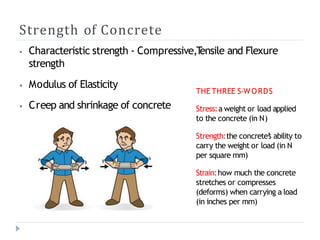
THE THREE S-WORDS
Stress:a weight or load applied
to the concrete (in N)
Strength:the concrete’
s ability to
carry the weight or load (in N
per square mm)
Strain:how much the concrete
stretches or compresses
(deforms) when carrying a load
(in inches per mm)
Fracture and failure
⦁ Concrete specimens subjected to any state of stress can
support loads of up to 40–60% of ultimate without any
apparent signs of distress.
⦁ Below this level, any sustained load results in creep strain
which is proportional to the applied stress and can be defined
in terms of specific creep (i.e.creep strain per unit stress)
⦁ As the load is increased above this level, soft but distinct
noises of internal disruption can be heard until, at about 70–
90% of ultimate,small fissures or cracks appear on the surface.
⦁ At ultimate load and beyond; the specimens are increasingly
disrupted and eventually fractured into a large number of
separate pieces.
The stages of cracking (fracture) in concrete:
Types of Concrete Strength
⦁ Compressive strength
⦁ T
ensile strength
⦁ Shear strength
⦁ Bond strength
⦁ Impact strength
⦁ Fatigue strength
Compressive Strength
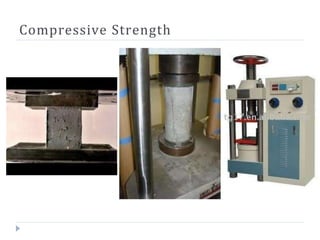
⦁ The compressive strength of concrete is defined as the
strength of 28 days old specimens tested under monotonic
uniaxial compressive load.
⦁ Testing of cylindrical samples with 15 cm diameter and 30 cm
height is standard.
⦁ Cube specimens of 15 cm × 15 cm × 15 cm are also being
used.
⦁ Normally
, the compressive strength of concrete is determined
by testing, and the tensile strength and modulus of elasticity
are expressed in terms of the compressive strength.
Compressive Strength
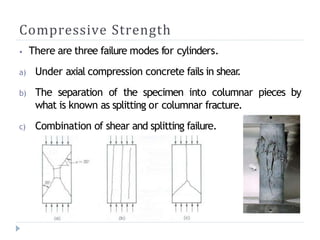
⦁ There are three failure modes for cylinders.
a) Under axial compression concrete fails in shear
.
b) The separation of the specimen into columnar pieces by
what is known as splitting or columnar fracture.
c) Combination of shear and splitting failure.
Compressive Strength
Tensile Strength of Concrete
⦁ The tensile strength of concrete is much lower than the
compressive strength, largely because of the ease with which
cracks can propagate under tensile loads
⦁ The tensile strength of concrete is measured in three ways:
direct tension,splitting tension,and flexural tension
Tensile Strength of Concrete
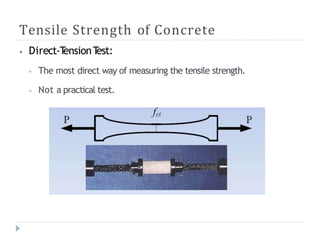
⦁ It is difficult to test concrete in direct (uniaxial) tension
because of the problem of gripping the specimen satisfactorily
and because there must be no eccentricity of the applied load.
Therefore, direct tensile test is not standardized and rarely
used
⦁ Modulus of rupture test and splitting test are commonly used
to determine the tensile strength of concrete
Tensile Strength of Concrete
⦁ Direct-T
ensionT
est:
⦁ The most direct way of measuring the tensile strength.
⦁ Not a practical test.
Tensile Strength of Concrete
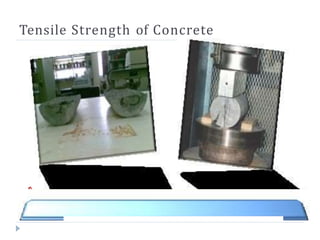
⦁ Split-CylinderT
est:
Tensile Strength of Concrete
9
Tensile Strength of Concrete
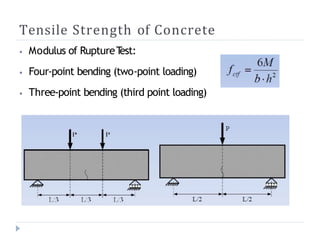
⦁ Modulus of RuptureT
est:
⦁ Four-point bending (two-point loading)
⦁ Three-point bending (third point loading)
Relationship Between Compressive and
Tensile Strength of Concrete
⦁ Tensile strength of concrete is proportional to the square-root
of the compressive strength.
⦁ The proportionality constant depends on many factors, such as
the concrete strength and the test method used to determine
the tensile strength.
⦁ The following relations can be used as a rule of thumb:
Concrete Strength
⦁ Shear Strength
⦁ Shear strength of concrete is taken approximately equal to 20
% its compressive strength
⦁ Bond Strength
⦁ The strength of bond between steel reinforcement
and concrete is called as bond strength of concrete
⦁ Bond strength develops primarily due to friction and adhesion
between steel reinforcement and concrete
⦁ In general, bond strength is approximately proportional to the
compressive strength of concrete up to about 20 MPa
Concrete Strength
⦁ Impact Strength
⦁ Impact strength of concrete is of importance in driving
concrete piles, in foundations for machines exerting impulsive
loading, and also when accidental impact is possible, e.g. when
handling precast concrete members
⦁ There is no unique relation between impact strength and
other strengths of concrete.
⦁ However, some researchers have found that impact is related
to the compressive strength, and it has been suggested that
the impact strength varies from 0.50 to 0.75 of the
compressive cube strength
Concrete Strength
⦁ Fatigue Strength
⦁ The strength of concrete against cyclic or repeated loading is
called as its fatigue strength

Hardened Concrete.pptx

  • 1.
  • 2.
    Strength of Concrete ⦁Strength of concrete is commonly considered its most valuable property, although in many practical cases, other characteristics, such as durability and permeability may in fact be more important. ⦁ Strength usually gives an overall picture of the quality of concrete because strength is directly related to the structure of the hydrated cement paste. ⦁ Strength of concrete could be defined as the ultimate load that causes failure (or is its resistance to rupture) and its units are force units divided by area (N/mm2).
  • 3.
    Strength of Concrete ⦁Characteristic strength - Compressive,T ensile and Flexure strength ⦁ Modulus of Elasticity ⦁ Creep and shrinkage of concrete THE THREE S-WORDS Stress:a weight or load applied to the concrete (in N) Strength:the concrete’ s ability to carry the weight or load (in N per square mm) Strain:how much the concrete stretches or compresses (deforms) when carrying a load (in inches per mm)
  • 4.
    Fracture and failure ⦁Concrete specimens subjected to any state of stress can support loads of up to 40–60% of ultimate without any apparent signs of distress. ⦁ Below this level, any sustained load results in creep strain which is proportional to the applied stress and can be defined in terms of specific creep (i.e.creep strain per unit stress) ⦁ As the load is increased above this level, soft but distinct noises of internal disruption can be heard until, at about 70– 90% of ultimate,small fissures or cracks appear on the surface. ⦁ At ultimate load and beyond; the specimens are increasingly disrupted and eventually fractured into a large number of separate pieces.
  • 5.
    The stages ofcracking (fracture) in concrete:
  • 6.
    Types of ConcreteStrength ⦁ Compressive strength ⦁ T ensile strength ⦁ Shear strength ⦁ Bond strength ⦁ Impact strength ⦁ Fatigue strength
  • 7.
    Compressive Strength ⦁ Thecompressive strength of concrete is defined as the strength of 28 days old specimens tested under monotonic uniaxial compressive load. ⦁ Testing of cylindrical samples with 15 cm diameter and 30 cm height is standard. ⦁ Cube specimens of 15 cm × 15 cm × 15 cm are also being used. ⦁ Normally , the compressive strength of concrete is determined by testing, and the tensile strength and modulus of elasticity are expressed in terms of the compressive strength.
  • 8.
  • 9.
    Compressive Strength ⦁ Thereare three failure modes for cylinders. a) Under axial compression concrete fails in shear . b) The separation of the specimen into columnar pieces by what is known as splitting or columnar fracture. c) Combination of shear and splitting failure.
  • 10.
  • 11.
    Tensile Strength ofConcrete ⦁ The tensile strength of concrete is much lower than the compressive strength, largely because of the ease with which cracks can propagate under tensile loads ⦁ The tensile strength of concrete is measured in three ways: direct tension,splitting tension,and flexural tension
  • 12.
    Tensile Strength ofConcrete ⦁ It is difficult to test concrete in direct (uniaxial) tension because of the problem of gripping the specimen satisfactorily and because there must be no eccentricity of the applied load. Therefore, direct tensile test is not standardized and rarely used ⦁ Modulus of rupture test and splitting test are commonly used to determine the tensile strength of concrete
  • 13.
    Tensile Strength ofConcrete ⦁ Direct-T ensionT est: ⦁ The most direct way of measuring the tensile strength. ⦁ Not a practical test.
  • 14.
    Tensile Strength ofConcrete ⦁ Split-CylinderT est:
  • 15.
  • 16.
    Tensile Strength ofConcrete ⦁ Modulus of RuptureT est: ⦁ Four-point bending (two-point loading) ⦁ Three-point bending (third point loading)
  • 17.
    Relationship Between Compressiveand Tensile Strength of Concrete ⦁ Tensile strength of concrete is proportional to the square-root of the compressive strength. ⦁ The proportionality constant depends on many factors, such as the concrete strength and the test method used to determine the tensile strength. ⦁ The following relations can be used as a rule of thumb:
  • 18.
    Concrete Strength ⦁ ShearStrength ⦁ Shear strength of concrete is taken approximately equal to 20 % its compressive strength ⦁ Bond Strength ⦁ The strength of bond between steel reinforcement and concrete is called as bond strength of concrete ⦁ Bond strength develops primarily due to friction and adhesion between steel reinforcement and concrete ⦁ In general, bond strength is approximately proportional to the compressive strength of concrete up to about 20 MPa
  • 19.
    Concrete Strength ⦁ ImpactStrength ⦁ Impact strength of concrete is of importance in driving concrete piles, in foundations for machines exerting impulsive loading, and also when accidental impact is possible, e.g. when handling precast concrete members ⦁ There is no unique relation between impact strength and other strengths of concrete. ⦁ However, some researchers have found that impact is related to the compressive strength, and it has been suggested that the impact strength varies from 0.50 to 0.75 of the compressive cube strength
  • 20.
    Concrete Strength ⦁ FatigueStrength ⦁ The strength of concrete against cyclic or repeated loading is called as its fatigue strength