Impact, 10% Fines & Crushing Tests


              NANYANG TECHNOLOGICAL UNIVERSITY
                 School of Civil and Structural Engineering


                LABORATORY - PAVEMENT MATERIALS

 AGGREGATE IMPACT TEST, TEN PERCENT FINES TEST
        AND AGGREGATE CRUSHING TEST


OBJECTIVES

To assess the resistance of an aggregate to mechanical degradation by the
Aggregate Impact Test, Ten Percent Fines Test and Aggregate Crushing Test.


BACKGROUND

When a road aggregate has been manufactured to a specified grading it is
stockpiled, loaded into trucks, transported, tipped, spread and compacted. If the
aggregate is weak, some degradation may take place and result in a change in
grading and/or the production of excessive and undesirable fines. Thus, an
aggregate complying with a specification at the quarry may fail to do so when it
is in the pavement.

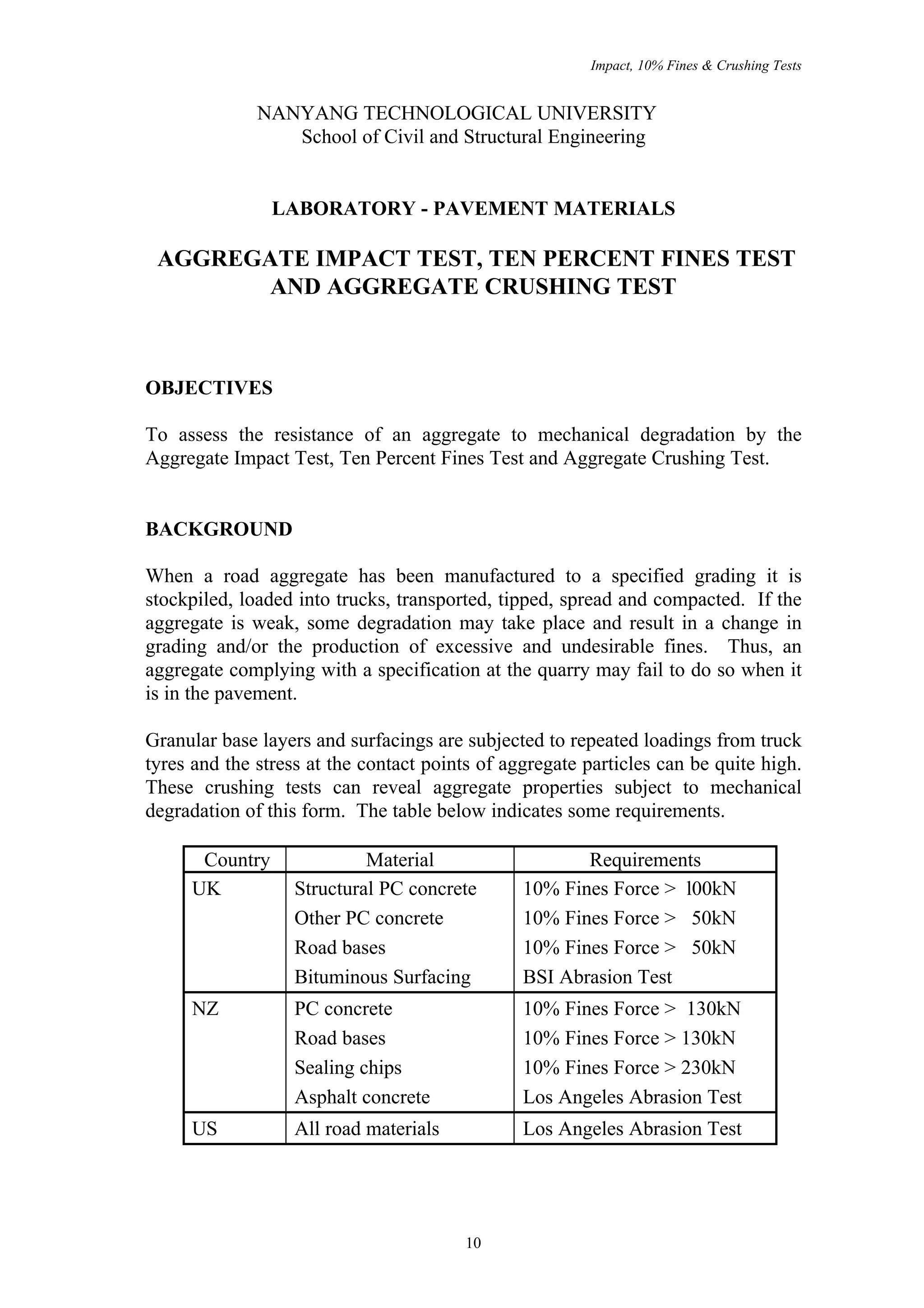
Granular base layers and surfacings are subjected to repeated loadings from truck
tyres and the stress at the contact points of aggregate particles can be quite high.
These crushing tests can reveal aggregate properties subject to mechanical
degradation of this form. The table below indicates some requirements.

      Country               Material                   Requirements
     UK            Structural PC concrete       10% Fines Force > l00kN
                   Other PC concrete            10% Fines Force > 50kN
                   Road bases                   10% Fines Force > 50kN
                   Bituminous Surfacing         BSI Abrasion Test
     NZ            PC concrete                  10% Fines Force > 130kN
                   Road bases                   10% Fines Force > 130kN
                   Sealing chips                10% Fines Force > 230kN
                   Asphalt concrete             Los Angeles Abrasion Test
     US            All road materials           Los Angeles Abrasion Test


                                        10
Impact, 10% Fines & Crushing Tests


Quarry plant such as crushers, screens, conveyors, etc. are all subject to wear
and these crushing tests can indicate the magnitude of the problem for design
purposes.


PROCEDURE - Aggregate Impact Value (SS 1974)

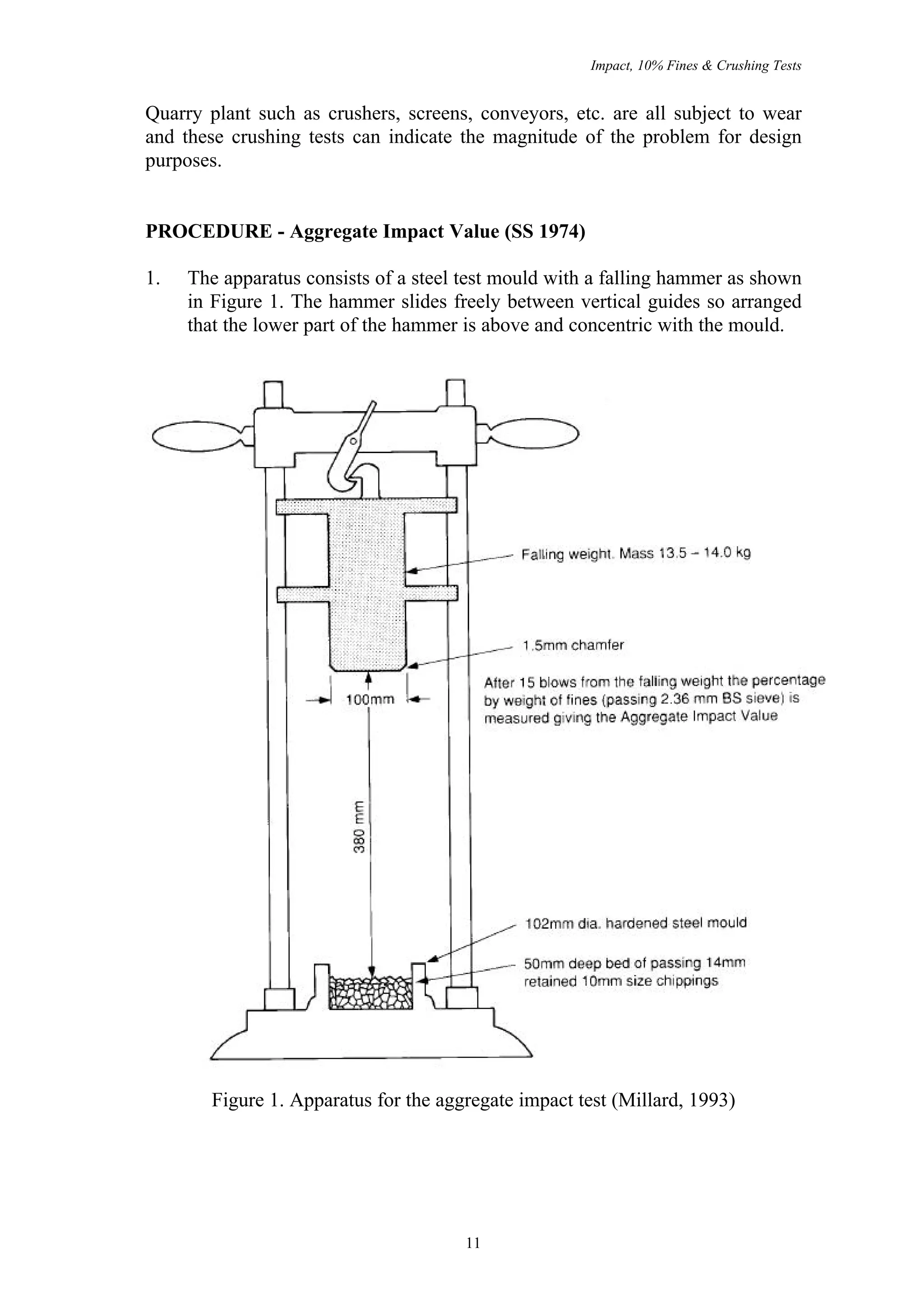
1.   The apparatus consists of a steel test mould with a falling hammer as shown
     in Figure 1. The hammer slides freely between vertical guides so arranged
     that the lower part of the hammer is above and concentric with the mould.


       Figure 1. Apparatus for the aggregate impact test (Millard, 1993)


                                      11
Impact, 10% Fines & Crushing Tests


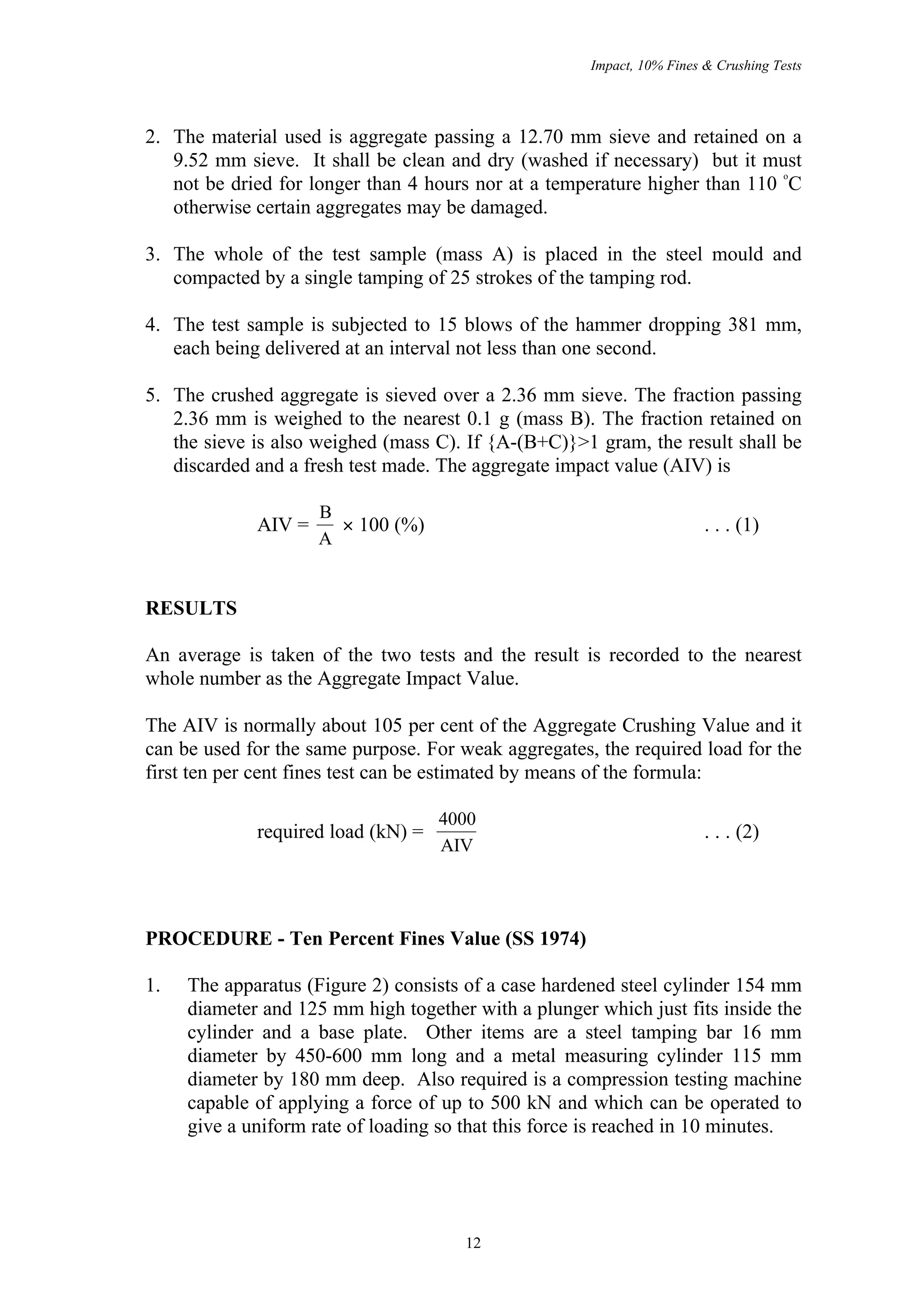
2. The material used is aggregate passing a 12.70 mm sieve and retained on a
   9.52 mm sieve. It shall be clean and dry (washed if necessary) but it must
                                                                             o
   not be dried for longer than 4 hours nor at a temperature higher than 110 C
   otherwise certain aggregates may be damaged.

3. The whole of the test sample (mass A) is placed in the steel mould and
   compacted by a single tamping of 25 strokes of the tamping rod.

4. The test sample is subjected to 15 blows of the hammer dropping 381 mm,
   each being delivered at an interval not less than one second.

5. The crushed aggregate is sieved over a 2.36 mm sieve. The fraction passing
   2.36 mm is weighed to the nearest 0.1 g (mass B). The fraction retained on
   the sieve is also weighed (mass C). If {A-(B+C)}>1 gram, the result shall be
   discarded and a fresh test made. The aggregate impact value (AIV) is

                     B
             AIV =     × 100 (%)                                        . . . (1)
                     A


RESULTS

An average is taken of the two tests and the result is recorded to the nearest
whole number as the Aggregate Impact Value.

The AIV is normally about 105 per cent of the Aggregate Crushing Value and it
can be used for the same purpose. For weak aggregates, the required load for the
first ten per cent fines test can be estimated by means of the formula:

                                    4000
             required load (kN) =                                       . . . (2)
                                    AIV


PROCEDURE - Ten Percent Fines Value (SS 1974)

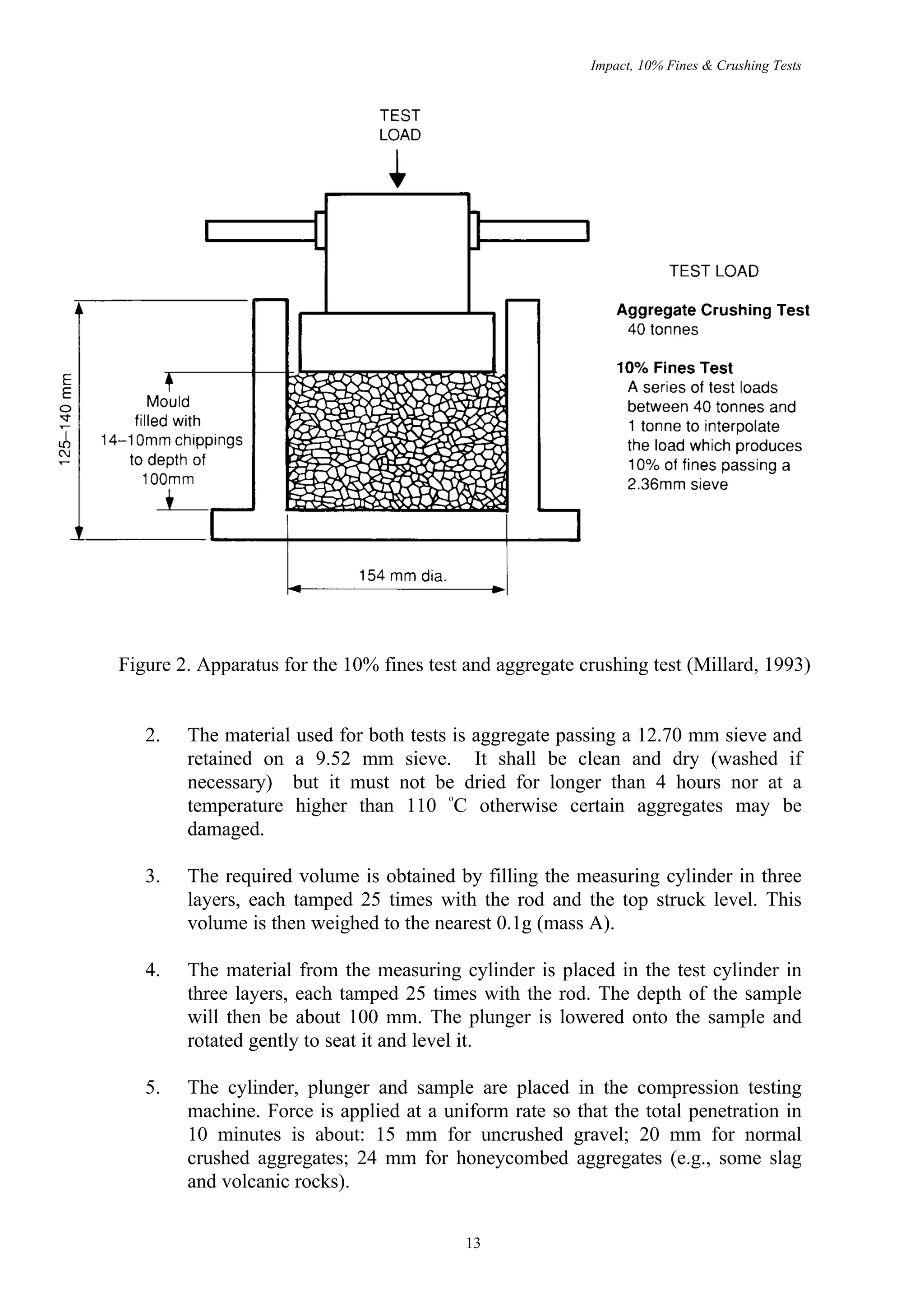
1.   The apparatus (Figure 2) consists of a case hardened steel cylinder 154 mm
     diameter and 125 mm high together with a plunger which just fits inside the
     cylinder and a base plate. Other items are a steel tamping bar 16 mm
     diameter by 450-600 mm long and a metal measuring cylinder 115 mm
     diameter by 180 mm deep. Also required is a compression testing machine
     capable of applying a force of up to 500 kN and which can be operated to
     give a uniform rate of loading so that this force is reached in 10 minutes.


                                       12
Impact, 10% Fines & Crushing Tests


Figure 2. Apparatus for the 10% fines test and aggregate crushing test (Millard, 1993)


   2.   The material used for both tests is aggregate passing a 12.70 mm sieve and
        retained on a 9.52 mm sieve. It shall be clean and dry (washed if
        necessary) but it must not be dried for longer than 4 hours nor at a
                                        o
        temperature higher than 110 C otherwise certain aggregates may be
        damaged.

   3.   The required volume is obtained by filling the measuring cylinder in three
        layers, each tamped 25 times with the rod and the top struck level. This
        volume is then weighed to the nearest 0.1g (mass A).

   4.   The material from the measuring cylinder is placed in the test cylinder in
        three layers, each tamped 25 times with the rod. The depth of the sample
        will then be about 100 mm. The plunger is lowered onto the sample and
        rotated gently to seat it and level it.

   5.   The cylinder, plunger and sample are placed in the compression testing
        machine. Force is applied at a uniform rate so that the total penetration in
        10 minutes is about: 15 mm for uncrushed gravel; 20 mm for normal
        crushed aggregates; 24 mm for honeycombed aggregates (e.g., some slag
        and volcanic rocks).

                                           13
Impact, 10% Fines & Crushing Tests


6.   The sample is then sieved over a 2.36 mm sieve. As this is a fairly fine
     sieve, it is preferable to pass the whole sample over a larger sieve (say 4.75
     mm) first. The material passing 2.36 mm is then weighed (mass B) and
     expressed as a percentage of the original mass [y=100%×B/A].

7.   If the percentage fines lies between 7.5% and 12.5%, the following
     calculation for Ten Percent Fines Value (TFV) is made:

                                                        14x
              TFV = Force to produce 10% fines =                          . . . (3)
                                                       y + 4
      where
              x = maximum force used (kN)
              y = percentage fines from the test (%)

     The result should be reported to the nearest whole number.

8.   If the percentage fines lies outside the range 7.5 to 12.5, the test must be
     repeated, applying the force given by the formula over a period of 10
     minutes. Two tests are required and the ten percent fines values (TFV) are
     averaged to obtain the final result, reported to the nearest 10 kN (for forces
     > 100kN)


PROCEDURE - Aggregate Crushing Value (SS 1974)

1. The apparatus and sample preparation is identical with that described above
   for the Ten Percent Fines Test.

2. The cylinder, plunger and sample are placed in the compression test machine.
   It is loaded at a uniform rate so that a force of 400 kN is reached in 10
   minutes. The load is then released.

3. The percentage fines is then determined as before. The material passing 2.36
   mm is weighed (mass B) and expressed as a percentage of the original mass
   (mass A) to give the aggregate crushing value (ACV).

                         B
              ACV =        × 100%                                         . . . (4)
                         A


RESULTS

The average is taken of two tests and the result recorded as Aggregate Crushing
Value.


                                             14
Impact, 10% Fines & Crushing Tests


If the percentage fines exceeds 30, the result may be anomalous as the broken
pieces of aggregate will tend to fill the voids and prevent further crushing. In
this case, the Ten Percent Fines Test is more appropriate. Some countries, e.g.,
Australia and New Zealand, only use the latter test.

DISCUSSION

(a) Report the geological description of the aggregate, the source quarry and
    particle size.

(b) Report the applied force, the masses of material before and after sieving,
    the calculations, and the final result (AIV/TFV/ACV).

(c) Comment on the results.

(d)   Compile results from other group(s) and compare the values obtained.


REFERENCES

1. SS (1974). SS73:1974 Specification for methods for sampling and testing of
   mineral aggregates, sand and fillers - Determination of aggregate impact
   value, aggregate crushing value and ten percent fines value. Singapore
   Standard, Singapore.

2. Millard, R.S. (1993). Road building in the Tropics. Transport Research
   Laboratory State-of-the-art Review 9, HMSO, London.


                                       15

Aggregate impact and crushing test

  • 1.
    Impact, 10% Fines& Crushing Tests NANYANG TECHNOLOGICAL UNIVERSITY School of Civil and Structural Engineering LABORATORY - PAVEMENT MATERIALS AGGREGATE IMPACT TEST, TEN PERCENT FINES TEST AND AGGREGATE CRUSHING TEST OBJECTIVES To assess the resistance of an aggregate to mechanical degradation by the Aggregate Impact Test, Ten Percent Fines Test and Aggregate Crushing Test. BACKGROUND When a road aggregate has been manufactured to a specified grading it is stockpiled, loaded into trucks, transported, tipped, spread and compacted. If the aggregate is weak, some degradation may take place and result in a change in grading and/or the production of excessive and undesirable fines. Thus, an aggregate complying with a specification at the quarry may fail to do so when it is in the pavement. Granular base layers and surfacings are subjected to repeated loadings from truck tyres and the stress at the contact points of aggregate particles can be quite high. These crushing tests can reveal aggregate properties subject to mechanical degradation of this form. The table below indicates some requirements. Country Material Requirements UK Structural PC concrete 10% Fines Force > l00kN Other PC concrete 10% Fines Force > 50kN Road bases 10% Fines Force > 50kN Bituminous Surfacing BSI Abrasion Test NZ PC concrete 10% Fines Force > 130kN Road bases 10% Fines Force > 130kN Sealing chips 10% Fines Force > 230kN Asphalt concrete Los Angeles Abrasion Test US All road materials Los Angeles Abrasion Test 10
  • 2.
    Impact, 10% Fines& Crushing Tests Quarry plant such as crushers, screens, conveyors, etc. are all subject to wear and these crushing tests can indicate the magnitude of the problem for design purposes. PROCEDURE - Aggregate Impact Value (SS 1974) 1. The apparatus consists of a steel test mould with a falling hammer as shown in Figure 1. The hammer slides freely between vertical guides so arranged that the lower part of the hammer is above and concentric with the mould. Figure 1. Apparatus for the aggregate impact test (Millard, 1993) 11
  • 3.
    Impact, 10% Fines& Crushing Tests 2. The material used is aggregate passing a 12.70 mm sieve and retained on a 9.52 mm sieve. It shall be clean and dry (washed if necessary) but it must o not be dried for longer than 4 hours nor at a temperature higher than 110 C otherwise certain aggregates may be damaged. 3. The whole of the test sample (mass A) is placed in the steel mould and compacted by a single tamping of 25 strokes of the tamping rod. 4. The test sample is subjected to 15 blows of the hammer dropping 381 mm, each being delivered at an interval not less than one second. 5. The crushed aggregate is sieved over a 2.36 mm sieve. The fraction passing 2.36 mm is weighed to the nearest 0.1 g (mass B). The fraction retained on the sieve is also weighed (mass C). If {A-(B+C)}>1 gram, the result shall be discarded and a fresh test made. The aggregate impact value (AIV) is B AIV = × 100 (%) . . . (1) A RESULTS An average is taken of the two tests and the result is recorded to the nearest whole number as the Aggregate Impact Value. The AIV is normally about 105 per cent of the Aggregate Crushing Value and it can be used for the same purpose. For weak aggregates, the required load for the first ten per cent fines test can be estimated by means of the formula: 4000 required load (kN) = . . . (2) AIV PROCEDURE - Ten Percent Fines Value (SS 1974) 1. The apparatus (Figure 2) consists of a case hardened steel cylinder 154 mm diameter and 125 mm high together with a plunger which just fits inside the cylinder and a base plate. Other items are a steel tamping bar 16 mm diameter by 450-600 mm long and a metal measuring cylinder 115 mm diameter by 180 mm deep. Also required is a compression testing machine capable of applying a force of up to 500 kN and which can be operated to give a uniform rate of loading so that this force is reached in 10 minutes. 12
  • 4.
    Impact, 10% Fines& Crushing Tests Figure 2. Apparatus for the 10% fines test and aggregate crushing test (Millard, 1993) 2. The material used for both tests is aggregate passing a 12.70 mm sieve and retained on a 9.52 mm sieve. It shall be clean and dry (washed if necessary) but it must not be dried for longer than 4 hours nor at a o temperature higher than 110 C otherwise certain aggregates may be damaged. 3. The required volume is obtained by filling the measuring cylinder in three layers, each tamped 25 times with the rod and the top struck level. This volume is then weighed to the nearest 0.1g (mass A). 4. The material from the measuring cylinder is placed in the test cylinder in three layers, each tamped 25 times with the rod. The depth of the sample will then be about 100 mm. The plunger is lowered onto the sample and rotated gently to seat it and level it. 5. The cylinder, plunger and sample are placed in the compression testing machine. Force is applied at a uniform rate so that the total penetration in 10 minutes is about: 15 mm for uncrushed gravel; 20 mm for normal crushed aggregates; 24 mm for honeycombed aggregates (e.g., some slag and volcanic rocks). 13
  • 5.
    Impact, 10% Fines& Crushing Tests 6. The sample is then sieved over a 2.36 mm sieve. As this is a fairly fine sieve, it is preferable to pass the whole sample over a larger sieve (say 4.75 mm) first. The material passing 2.36 mm is then weighed (mass B) and expressed as a percentage of the original mass [y=100%×B/A]. 7. If the percentage fines lies between 7.5% and 12.5%, the following calculation for Ten Percent Fines Value (TFV) is made: 14x TFV = Force to produce 10% fines = . . . (3) y + 4 where x = maximum force used (kN) y = percentage fines from the test (%) The result should be reported to the nearest whole number. 8. If the percentage fines lies outside the range 7.5 to 12.5, the test must be repeated, applying the force given by the formula over a period of 10 minutes. Two tests are required and the ten percent fines values (TFV) are averaged to obtain the final result, reported to the nearest 10 kN (for forces > 100kN) PROCEDURE - Aggregate Crushing Value (SS 1974) 1. The apparatus and sample preparation is identical with that described above for the Ten Percent Fines Test. 2. The cylinder, plunger and sample are placed in the compression test machine. It is loaded at a uniform rate so that a force of 400 kN is reached in 10 minutes. The load is then released. 3. The percentage fines is then determined as before. The material passing 2.36 mm is weighed (mass B) and expressed as a percentage of the original mass (mass A) to give the aggregate crushing value (ACV). B ACV = × 100% . . . (4) A RESULTS The average is taken of two tests and the result recorded as Aggregate Crushing Value. 14
  • 6.
    Impact, 10% Fines& Crushing Tests If the percentage fines exceeds 30, the result may be anomalous as the broken pieces of aggregate will tend to fill the voids and prevent further crushing. In this case, the Ten Percent Fines Test is more appropriate. Some countries, e.g., Australia and New Zealand, only use the latter test. DISCUSSION (a) Report the geological description of the aggregate, the source quarry and particle size. (b) Report the applied force, the masses of material before and after sieving, the calculations, and the final result (AIV/TFV/ACV). (c) Comment on the results. (d) Compile results from other group(s) and compare the values obtained. REFERENCES 1. SS (1974). SS73:1974 Specification for methods for sampling and testing of mineral aggregates, sand and fillers - Determination of aggregate impact value, aggregate crushing value and ten percent fines value. Singapore Standard, Singapore. 2. Millard, R.S. (1993). Road building in the Tropics. Transport Research Laboratory State-of-the-art Review 9, HMSO, London. 15