Fresh Concrete: Batching, Mixing,
Transportation, Placing
Process of Manufacture of Concrete
⦁ It is interesting to note that the ingredients of good concrete
and bad concrete are the same.
⦁ If meticulous care is not exercised, and good rules are not
observed,the resultant concrete is going to be of bad quality
.
⦁ With the same material if intense care is taken to exercise
control at every stage,it will result in good concrete.
are:
⦁ The various stages of manufacture of concrete
(a ) Batching (b) Mixing (c ) Transporting (d ) Placing
(e) Compacting (f ) Curing (g) Finishing.
Batching :
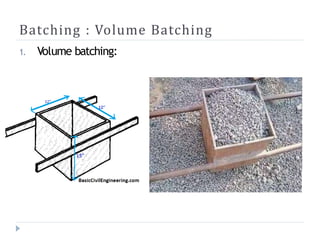
1. Volume Batching:
⦁ Volume batching is not a good method for proportioning the
material because of the difficulty it offers to measure
granular material in terms of volume.
⦁ Volume of moist sand in a loose condition weighs much less
than the same volume of dry compacted sand.
⦁ The effect of bulking should be consider for moist fine
aggregate.
⦁ For unimportant concrete or for any small job,concrete may
be batched by volume.
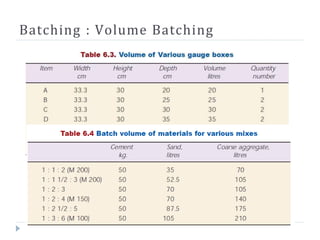
Batching : Volume Batching
1. Volume batching:
Batching : Volume Batching
Batching :
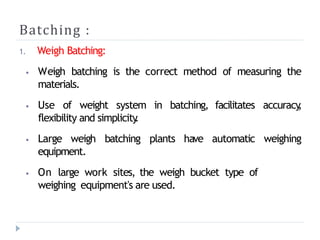
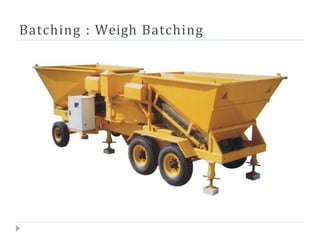
1. Weigh Batching:
⦁ Weigh batching is the correct method of measuring the
materials.
⦁ Use of weight system in batching, facilitates accuracy
,
flexibility and simplicity
.
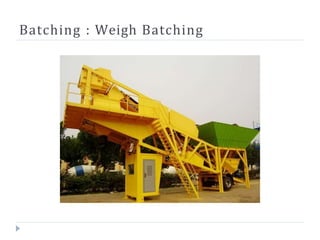
⦁ Large weigh batching plants have automatic weighing
equipment.
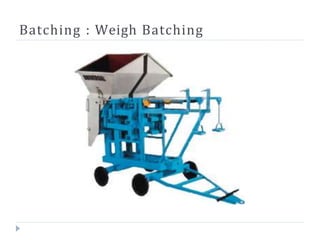
⦁ On large work sites, the weigh bucket type of
weighing equipment's are used.
Batching : Weigh Batching
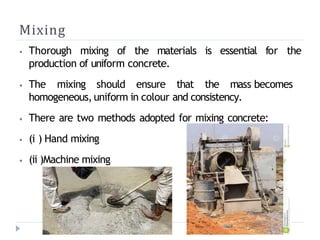
Mixing
⦁ Thorough mixing of the materials is essential for the
production of uniform concrete.
⦁ The mixing should ensure that the mass becomes
homogeneous,uniform in colour and consistency.
⦁ There are two methods adopted for mixing concrete:
⦁ (i ) Hand mixing
⦁ (ii )Machine mixing
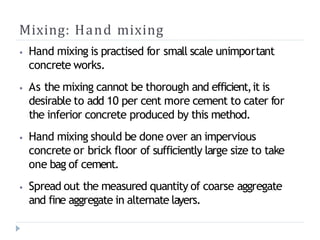
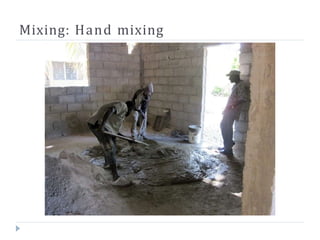
Mixing: Hand mixing
⦁ Hand mixing is practised for small scale unimportant
concrete works.
⦁ As the mixing cannot be thorough and efficient,it is
desirable to add 10 per cent more cement to cater for
the inferior concrete produced by this method.
⦁ Hand mixing should be done over an impervious
concrete or brick floor of sufficiently large size to take
one bag of cement.
⦁ Spread out the measured quantity of coarse aggregate
and fine aggregate in alternate layers.
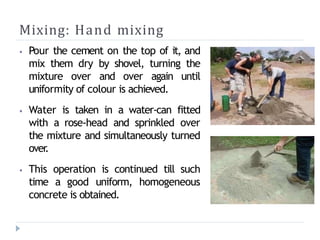
Mixing: Hand mixing
⦁ Pour the cement on the top of it, and
mix them dry by shovel, turning the
mixture over and over again until
uniformity of colour is achieved.
⦁ Water is taken in a water-can fitted
with a rose-head and sprinkled over
the mixture and simultaneously turned
over
.
⦁ This operation is continued till such
time a good uniform, homogeneous
concrete is obtained.
Mixing: Hand mixing
Mixing: Machine Mixing
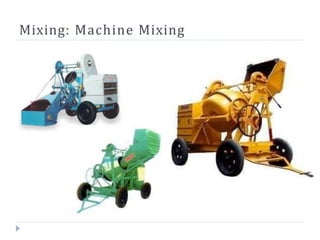
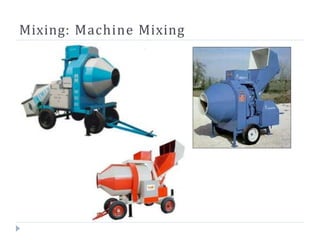
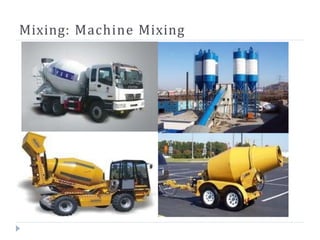
⦁ Mixing of concrete is almost invariably carried out by machine,
for reinforced concrete work and for medium or large scale
mass concrete work.
⦁ Machine mixing is not only efficient,but also economical,when
the quantity of concrete to be produced is large.
⦁ They can be classified as batch-mixers and continuous mixers.
⦁ Batch mixers produce concrete,batch by batch with time
interval,whereas continuous mixers produce concrete
continuously without stoppage till such time the plant is
working.
Mixing: Machine Mixing
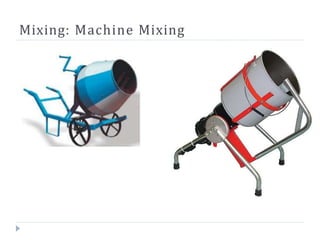
⦁ In normal concrete work,it is the batch mixers that are used.
Batch mixer may be of pan type or drum type.
⦁ The drum type may be further classified as tilting,non-tilting,
reversing or forced action type.
⦁ As per I.S.1791–1985, concrete mixers are designated by a
number representing its nominal mixed batch capacity in litres.
The following are the standardized sizes of three types:
⦁ a.Tilting:85T
,100T
,140T
,200T
⦁ b.Non-Tilting:200 NT
,280 NT
,375 NT
,500 NT
,1000 NT
⦁ c.Reversing:200 R,280 R,375 R,500 R and 1000 R
Mixing: Machine Mixing

Fresh Concrete Batching, Mixing,.pptx

  • 1.
    Fresh Concrete: Batching,Mixing, Transportation, Placing
  • 2.
    Process of Manufactureof Concrete ⦁ It is interesting to note that the ingredients of good concrete and bad concrete are the same. ⦁ If meticulous care is not exercised, and good rules are not observed,the resultant concrete is going to be of bad quality . ⦁ With the same material if intense care is taken to exercise control at every stage,it will result in good concrete. are: ⦁ The various stages of manufacture of concrete (a ) Batching (b) Mixing (c ) Transporting (d ) Placing (e) Compacting (f ) Curing (g) Finishing.
  • 4.
    Batching : 1. VolumeBatching: ⦁ Volume batching is not a good method for proportioning the material because of the difficulty it offers to measure granular material in terms of volume. ⦁ Volume of moist sand in a loose condition weighs much less than the same volume of dry compacted sand. ⦁ The effect of bulking should be consider for moist fine aggregate. ⦁ For unimportant concrete or for any small job,concrete may be batched by volume.
  • 5.
    Batching : VolumeBatching 1. Volume batching:
  • 6.
  • 7.
    Batching : 1. WeighBatching: ⦁ Weigh batching is the correct method of measuring the materials. ⦁ Use of weight system in batching, facilitates accuracy , flexibility and simplicity . ⦁ Large weigh batching plants have automatic weighing equipment. ⦁ On large work sites, the weigh bucket type of weighing equipment's are used.
  • 8.
  • 9.
  • 10.
  • 11.
    Mixing ⦁ Thorough mixingof the materials is essential for the production of uniform concrete. ⦁ The mixing should ensure that the mass becomes homogeneous,uniform in colour and consistency. ⦁ There are two methods adopted for mixing concrete: ⦁ (i ) Hand mixing ⦁ (ii )Machine mixing
  • 12.
    Mixing: Hand mixing ⦁Hand mixing is practised for small scale unimportant concrete works. ⦁ As the mixing cannot be thorough and efficient,it is desirable to add 10 per cent more cement to cater for the inferior concrete produced by this method. ⦁ Hand mixing should be done over an impervious concrete or brick floor of sufficiently large size to take one bag of cement. ⦁ Spread out the measured quantity of coarse aggregate and fine aggregate in alternate layers.
  • 13.
    Mixing: Hand mixing ⦁Pour the cement on the top of it, and mix them dry by shovel, turning the mixture over and over again until uniformity of colour is achieved. ⦁ Water is taken in a water-can fitted with a rose-head and sprinkled over the mixture and simultaneously turned over . ⦁ This operation is continued till such time a good uniform, homogeneous concrete is obtained.
  • 14.
  • 15.
    Mixing: Machine Mixing ⦁Mixing of concrete is almost invariably carried out by machine, for reinforced concrete work and for medium or large scale mass concrete work. ⦁ Machine mixing is not only efficient,but also economical,when the quantity of concrete to be produced is large. ⦁ They can be classified as batch-mixers and continuous mixers. ⦁ Batch mixers produce concrete,batch by batch with time interval,whereas continuous mixers produce concrete continuously without stoppage till such time the plant is working.
  • 16.
    Mixing: Machine Mixing ⦁In normal concrete work,it is the batch mixers that are used. Batch mixer may be of pan type or drum type. ⦁ The drum type may be further classified as tilting,non-tilting, reversing or forced action type. ⦁ As per I.S.1791–1985, concrete mixers are designated by a number representing its nominal mixed batch capacity in litres. The following are the standardized sizes of three types: ⦁ a.Tilting:85T ,100T ,140T ,200T ⦁ b.Non-Tilting:200 NT ,280 NT ,375 NT ,500 NT ,1000 NT ⦁ c.Reversing:200 R,280 R,375 R,500 R and 1000 R
  • 17.
  • 18.
  • 19.
  • 20.