Cement : Physical Properties and
Types of Cement
Lecture No. 3
Field Testing
a) Open the bag and take agood look at the cement.
There should not be any visible lumps. The colour
of the cement should normally be greenish grey.
b) Thrust your hand into the cement bag.It must
give you acool feeling. There should not be any
lump inside.
c) Take apinch of cement and feel-between the
fingers. It should give asmooth and not agritty
feeling.
d) Take ahandful of cement and throw it on abucket
full of water,the particles should float for some time
before they sink.
Physical Properties of Cement
1. SettingTime
2. Soundness
3. Fineness
4. Strength
Setting Time
Cement paste setting time is affected by anumber of
items including: cement fineness, water-cement ratio,
chemical content (especially gypsum content) and
admixtures.
For construction purposes, the initial set must not be
too soon and the final set must not be too late.
Normally, two setting times are defined:
Initial set. Occurs when the paste begins to
stiffen considerably.
Final set. Occurs when the cement has hardened to
the point at which it can sustain some load.
Setting is mainly caused by C3A and C3S and results
in temperature rise in the cement paste.
Setting Time : Setting time
Initial setting time is regarded as the time
elapsed between the moment that the water is
added to the cement, to the time that the paste
starts losing its plasticity.
The final setting time is the time elapsed between
the moment the water is added to the cement, and
the time when the paste has completely lost its
plasticity and has attained sufficient firmness to
resist certain definite pressure.
Setting Time : Consistency
The consistency is measured by the Vicat apparatus
using a10mm diameterplunger.
A trial paste of cement and water is mixed and placed
in the mould having an inside diameter of 70mm at
the base and 60mm at the top, and aheight of 40mm.
The plunger is then brought into contact with the top
surface of the paste and released. Under the action of
its weight the plunger will penetrate the paste.The
depth depending on the consistency.
Setting Time : Consistency
When the plunger penetrates the paste to apoint
5 to 7mm from the bottom of the mould.The
paste is considered to be at “normal consistency”.
The water content of the paste is expressed as a
percentage by weight of dry cement.The usual
range of values being between 26% and 33%.
Setting Time : Consistency
Setting Time : Setting time
The setting time test is conducted by using the same
Vicat apparatus, except that a 1mm diameter needle
is used for penetration.
The test is started about 15 minutes after placing the
cement paste (which has normal consistency) into the
mould.Trials for penetration of the needle are made.
The finalsetting time is defined as the length of time
between the penetration of the paste and the time when
the needle(with annular ring) no longer sinks visibly into
the paste.
The initial setting time is defined as the length of time
between the penetration of the paste and the time when
the needle penetrates 25mm into the cement paste.
Soundness
When referring to Portland cement, "soundness"
refers to the ability of hardened cement paste to
retain its volume after setting without delayed
expansion. This expansion is caused by excessive
amounts of free lime (CaO) or magnesia (MgO).
Most Portland cement specifications limit magnesia
content and expansion.
The cement paste should not undergo large changes in
volume after it has been set. However, when excessive
amounts of free CaO or MgO are present in the
cement, these oxides can slowly hydrate and cause the
expansion of the hardened cement paste.
Soundness is defined as the volume stability of
the cement paste.
Soundness: Le Chatelier Test
IS prescribe aSoundness Test conducted by using
the Le Chatelier apparatus. The apparatus consists
of asmall brass cylinder split along its generatrix.
o Two indicators with pointed ends are attached to the
cylinder on either side of the split.
Soundness: Le Chatelier Test
The cylinder (which is open on both ends) is placed
on a glass plate filled with cement paste of normal
consistency, and covered with another glass plate.
The whole assembly is then immersed in water at 20
± 1oC for 24 hours. At the end of that period the
distance between the indicator points is
measured.The mould is then immersed in water
again and brought to aboil. After boiling for one
hour the mould is removed from the water, after
cooling, the distance between the indicator points is
measured again.
This increase represents the expansion of the
cement paste for Portland cements, expansion is
limited to 10mm.
Fineness
Fineness, or particle size of Portland cement affects
Hydration rate and thus the rate of strength
gain.The smaller the particle size, the greater the
surface area-to- volume ratio, and thus, the more
area available for water- cement interaction per unit
volume.The effects of greater fineness on strength
are generally seen during the first seven days.
When the cement particles are coarser, hydration
starts on the surface of the particles. So the coarser
particles maynot be completely hydrated.This
causeslow strength and low durability.
For arapid development of strength ahigh
fineness is necessary.
Fineness : Blaine air-permeability Test
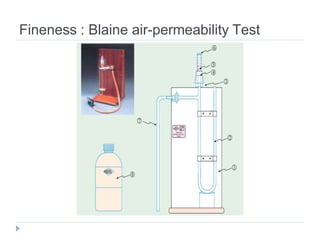
There are various methods for determining the
fineness of cement particles.The Blaine air-
permeability method is the most commonly used
method.
In the Blaine air-permeability method, given volume
of air is passed through aprepared sample of
definite density.
The number and size of the pores in asample of
given density is afunction of the particles and their
size distribution and determines the rate of air flow
through the sample. Calculations are made and
the fineness is expressed in terms of cm2/gor
m2/kg
Fineness : Blaine air-permeability Test
Strength
Cement paste strength is typically defined in three
ways: compressive, tensile, and flexural. These
strengths can be affected by anumber of items
including water-cement ratio, cement-fine aggregate
ratio, type and grading of fine aggregate, curing
conditions, size and shape of specimen, loading
conditions, and age.
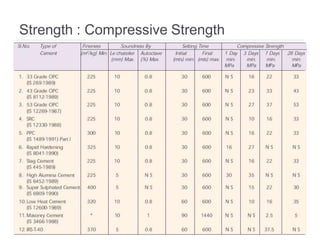
Strength : Compressive Strength
The cement paste (consisting of 1 part cement+3 parts
standard sand+ water,by weight) is placed in 7cm molds.
And the specimens are water cured for various ages for
testing.
The mortar specimens taken out of the mould are
subjected to compression to determine the strength.
The compressive strength test is conducted on mortar
cubes.
After finding the breaking load in compression, Pmax,
Compressive Strength is calculated by the = Pmax /A,
where A=50cm2.
The average of the results found by testing six specimens
is the compressive strength of the mortar cubes.
Strength : Compressive Strength
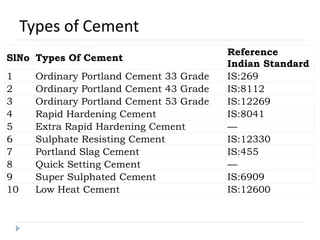
SlNo Types Of Cement
Reference
Indian Standard
1 Ordinary Portland Cement 33 Grade IS:269
2 Ordinary Portland Cement 43 Grade IS:8112
3 Ordinary Portland Cement 53 Grade IS:12269
4 Rapid Hardening Cement IS:8041
5 Extra Rapid Hardening Cement —
6 Sulphate Resisting Cement IS:12330
7 Portland Slag Cement IS:455
8 Quick Setting Cement —
9 Super Sulphated Cement IS:6909
10 Low Heat Cement IS:12600
Types of Cement
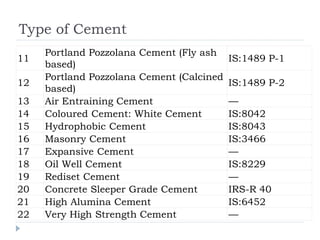
Type of Cement
11
Portland Pozzolana Cement (Fly ash
based)
IS:1489 P-1
12
Portland Pozzolana Cement (Calcined
based)
IS:1489 P-2
13 Air Entraining Cement —
14 Coloured Cement: White Cement IS:8042
15 Hydrophobic Cement IS:8043
16 Masonry Cement IS:3466
17 Expansive Cement —
18 Oil Well Cement IS:8229
19 Rediset Cement —
20 Concrete Sleeper Grade Cement IRS-R 40
21 High Alumina Cement IS:6452
22 Very High Strength Cement —
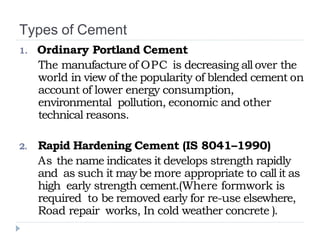
Types of Cement
1. Ordinary Portland Cement
The manufacture of OPC is decreasing all over the
world in view of the popularity of blended cement on
account of lower energy consumption,
environmental pollution, economic and other
technical reasons.
2. Rapid Hardening Cement (IS 8041–1990)
As the name indicates it develops strength rapidly
and as such it maybe more appropriate to call it as
high early strength cement.(Where formwork is
required to be removed early for re-use elsewhere,
Road repair works, In cold weather concrete ).
Types of Cement
3. Sulphate Resisting Cement (IS 12330–1988)
To remedy the sulphate attack, the use of cement with
low C3A content is found to be effective.(Concrete to
be used in marine condition, in foundation and
basement, where soil is infested with sulphates;
construction of sewage treatment works).
4. Portland Slag Cement (PSC) (IS 455–1989)
Portland slag cement is obtained by mixing Portland
cement clinker, gypsum and granulated blast furnace
slag. ( Reduced heat of hydration, Refinement of pore
structure, Reduced permeability)
Types of Cement
5. Quick Setting Cement
The early setting property is brought out by reducing the
gypsum content at the time of clinker grinding. It is used
mostly in under water construction where pumping is
involved.
6. Low Heat Cement – IS 12600: 1989
Formation of cracks in large body of concrete due to heat of
hydration has focussed the attention of the concrete which
produces less heat,at alow rate during the hydration
process. A low-heat evolution is achieved by reducing the
contents of C3S and C3A which are the compounds
evolving the maximum heat of hydration and increasing
C2S.
Types of Cement
7. Portland Pozzolana Cement – IS 1489 (Part I)
The history of pozzolanic material goes back to
Roman’s time.Portland Pozzolana cement (PPC) is
manufactured by the inter grinding of OPC clinker
with 10 to 25 per cent of pozzolanic material.A
pozzolanic material is essentially asilicious or
aluminous material which while in itselfpossessing no
cementitious properties, which will,in finely divided
form and in the presence of water,react with calcium
hydroxide.The pozzolanic materials generally used for
manufacture of PPC are calcined clay(IS 1489 part 2
of 1991) or flyash (IS 1489 part I of 1991).
Types of Cement
7. Portland Pozzolana Cement – IS 1489 (PartI)
 In PPC, costly clinker is replaced by
cheaper pozzolanic material - Hence
economical.
 Soluble calcium hydroxide is converted into
insoluble cementitious products resulting in
improvement of permeability. Hence it offers,
alround durability characteristics, particularly
in hydraulic structures and marine
construction.
 It generates reduced heat of hydration and that
too at alow rate.
 Reduction in permeability of PPC offers many
other alround advantages.
Types of Cement
8. Coloured Cement: White Cement – IS 8042:
1989
For manufacturing various coloured cements either
white cement or grey Portland cement is used as a
base.The use of white cement as abase is costly.With
the use of grey cement only red or brown cement
can be produced.
9. Oil Well Cement – IS 8229: 1986
It is likely that ifoil is struck, oil or gas mayescape
through the space between the steel casing and rock
formation. Cement slurry is used to seal off the
annular space between steel casing and rock strata
and also to seal off any other fissures or cavities in
the sedimentary rock layer.
Cement  Physical Properties.pptx

Cement Physical Properties.pptx

  • 1.
    Cement : PhysicalProperties and Types of Cement Lecture No. 3
  • 2.
    Field Testing a) Openthe bag and take agood look at the cement. There should not be any visible lumps. The colour of the cement should normally be greenish grey. b) Thrust your hand into the cement bag.It must give you acool feeling. There should not be any lump inside. c) Take apinch of cement and feel-between the fingers. It should give asmooth and not agritty feeling. d) Take ahandful of cement and throw it on abucket full of water,the particles should float for some time before they sink.
  • 3.
    Physical Properties ofCement 1. SettingTime 2. Soundness 3. Fineness 4. Strength
  • 4.
    Setting Time Cement pastesetting time is affected by anumber of items including: cement fineness, water-cement ratio, chemical content (especially gypsum content) and admixtures. For construction purposes, the initial set must not be too soon and the final set must not be too late. Normally, two setting times are defined: Initial set. Occurs when the paste begins to stiffen considerably. Final set. Occurs when the cement has hardened to the point at which it can sustain some load. Setting is mainly caused by C3A and C3S and results in temperature rise in the cement paste.
  • 5.
    Setting Time :Setting time Initial setting time is regarded as the time elapsed between the moment that the water is added to the cement, to the time that the paste starts losing its plasticity. The final setting time is the time elapsed between the moment the water is added to the cement, and the time when the paste has completely lost its plasticity and has attained sufficient firmness to resist certain definite pressure.
  • 6.
    Setting Time :Consistency The consistency is measured by the Vicat apparatus using a10mm diameterplunger. A trial paste of cement and water is mixed and placed in the mould having an inside diameter of 70mm at the base and 60mm at the top, and aheight of 40mm. The plunger is then brought into contact with the top surface of the paste and released. Under the action of its weight the plunger will penetrate the paste.The depth depending on the consistency.
  • 7.
    Setting Time :Consistency When the plunger penetrates the paste to apoint 5 to 7mm from the bottom of the mould.The paste is considered to be at “normal consistency”. The water content of the paste is expressed as a percentage by weight of dry cement.The usual range of values being between 26% and 33%.
  • 8.
    Setting Time :Consistency
  • 9.
    Setting Time :Setting time The setting time test is conducted by using the same Vicat apparatus, except that a 1mm diameter needle is used for penetration. The test is started about 15 minutes after placing the cement paste (which has normal consistency) into the mould.Trials for penetration of the needle are made. The finalsetting time is defined as the length of time between the penetration of the paste and the time when the needle(with annular ring) no longer sinks visibly into the paste. The initial setting time is defined as the length of time between the penetration of the paste and the time when the needle penetrates 25mm into the cement paste.
  • 10.
    Soundness When referring toPortland cement, "soundness" refers to the ability of hardened cement paste to retain its volume after setting without delayed expansion. This expansion is caused by excessive amounts of free lime (CaO) or magnesia (MgO). Most Portland cement specifications limit magnesia content and expansion. The cement paste should not undergo large changes in volume after it has been set. However, when excessive amounts of free CaO or MgO are present in the cement, these oxides can slowly hydrate and cause the expansion of the hardened cement paste. Soundness is defined as the volume stability of the cement paste.
  • 11.
    Soundness: Le ChatelierTest IS prescribe aSoundness Test conducted by using the Le Chatelier apparatus. The apparatus consists of asmall brass cylinder split along its generatrix. o Two indicators with pointed ends are attached to the cylinder on either side of the split.
  • 12.
    Soundness: Le ChatelierTest The cylinder (which is open on both ends) is placed on a glass plate filled with cement paste of normal consistency, and covered with another glass plate. The whole assembly is then immersed in water at 20 ± 1oC for 24 hours. At the end of that period the distance between the indicator points is measured.The mould is then immersed in water again and brought to aboil. After boiling for one hour the mould is removed from the water, after cooling, the distance between the indicator points is measured again. This increase represents the expansion of the cement paste for Portland cements, expansion is limited to 10mm.
  • 13.
    Fineness Fineness, or particlesize of Portland cement affects Hydration rate and thus the rate of strength gain.The smaller the particle size, the greater the surface area-to- volume ratio, and thus, the more area available for water- cement interaction per unit volume.The effects of greater fineness on strength are generally seen during the first seven days. When the cement particles are coarser, hydration starts on the surface of the particles. So the coarser particles maynot be completely hydrated.This causeslow strength and low durability. For arapid development of strength ahigh fineness is necessary.
  • 14.
    Fineness : Blaineair-permeability Test There are various methods for determining the fineness of cement particles.The Blaine air- permeability method is the most commonly used method. In the Blaine air-permeability method, given volume of air is passed through aprepared sample of definite density. The number and size of the pores in asample of given density is afunction of the particles and their size distribution and determines the rate of air flow through the sample. Calculations are made and the fineness is expressed in terms of cm2/gor m2/kg
  • 15.
    Fineness : Blaineair-permeability Test
  • 16.
    Strength Cement paste strengthis typically defined in three ways: compressive, tensile, and flexural. These strengths can be affected by anumber of items including water-cement ratio, cement-fine aggregate ratio, type and grading of fine aggregate, curing conditions, size and shape of specimen, loading conditions, and age.
  • 17.
    Strength : CompressiveStrength The cement paste (consisting of 1 part cement+3 parts standard sand+ water,by weight) is placed in 7cm molds. And the specimens are water cured for various ages for testing. The mortar specimens taken out of the mould are subjected to compression to determine the strength. The compressive strength test is conducted on mortar cubes. After finding the breaking load in compression, Pmax, Compressive Strength is calculated by the = Pmax /A, where A=50cm2. The average of the results found by testing six specimens is the compressive strength of the mortar cubes.
  • 18.
  • 19.
    SlNo Types OfCement Reference Indian Standard 1 Ordinary Portland Cement 33 Grade IS:269 2 Ordinary Portland Cement 43 Grade IS:8112 3 Ordinary Portland Cement 53 Grade IS:12269 4 Rapid Hardening Cement IS:8041 5 Extra Rapid Hardening Cement — 6 Sulphate Resisting Cement IS:12330 7 Portland Slag Cement IS:455 8 Quick Setting Cement — 9 Super Sulphated Cement IS:6909 10 Low Heat Cement IS:12600 Types of Cement
  • 20.
    Type of Cement 11 PortlandPozzolana Cement (Fly ash based) IS:1489 P-1 12 Portland Pozzolana Cement (Calcined based) IS:1489 P-2 13 Air Entraining Cement — 14 Coloured Cement: White Cement IS:8042 15 Hydrophobic Cement IS:8043 16 Masonry Cement IS:3466 17 Expansive Cement — 18 Oil Well Cement IS:8229 19 Rediset Cement — 20 Concrete Sleeper Grade Cement IRS-R 40 21 High Alumina Cement IS:6452 22 Very High Strength Cement —
  • 21.
    Types of Cement 1.Ordinary Portland Cement The manufacture of OPC is decreasing all over the world in view of the popularity of blended cement on account of lower energy consumption, environmental pollution, economic and other technical reasons. 2. Rapid Hardening Cement (IS 8041–1990) As the name indicates it develops strength rapidly and as such it maybe more appropriate to call it as high early strength cement.(Where formwork is required to be removed early for re-use elsewhere, Road repair works, In cold weather concrete ).
  • 22.
    Types of Cement 3.Sulphate Resisting Cement (IS 12330–1988) To remedy the sulphate attack, the use of cement with low C3A content is found to be effective.(Concrete to be used in marine condition, in foundation and basement, where soil is infested with sulphates; construction of sewage treatment works). 4. Portland Slag Cement (PSC) (IS 455–1989) Portland slag cement is obtained by mixing Portland cement clinker, gypsum and granulated blast furnace slag. ( Reduced heat of hydration, Refinement of pore structure, Reduced permeability)
  • 23.
    Types of Cement 5.Quick Setting Cement The early setting property is brought out by reducing the gypsum content at the time of clinker grinding. It is used mostly in under water construction where pumping is involved. 6. Low Heat Cement – IS 12600: 1989 Formation of cracks in large body of concrete due to heat of hydration has focussed the attention of the concrete which produces less heat,at alow rate during the hydration process. A low-heat evolution is achieved by reducing the contents of C3S and C3A which are the compounds evolving the maximum heat of hydration and increasing C2S.
  • 24.
    Types of Cement 7.Portland Pozzolana Cement – IS 1489 (Part I) The history of pozzolanic material goes back to Roman’s time.Portland Pozzolana cement (PPC) is manufactured by the inter grinding of OPC clinker with 10 to 25 per cent of pozzolanic material.A pozzolanic material is essentially asilicious or aluminous material which while in itselfpossessing no cementitious properties, which will,in finely divided form and in the presence of water,react with calcium hydroxide.The pozzolanic materials generally used for manufacture of PPC are calcined clay(IS 1489 part 2 of 1991) or flyash (IS 1489 part I of 1991).
  • 25.
    Types of Cement 7.Portland Pozzolana Cement – IS 1489 (PartI)  In PPC, costly clinker is replaced by cheaper pozzolanic material - Hence economical.  Soluble calcium hydroxide is converted into insoluble cementitious products resulting in improvement of permeability. Hence it offers, alround durability characteristics, particularly in hydraulic structures and marine construction.  It generates reduced heat of hydration and that too at alow rate.  Reduction in permeability of PPC offers many other alround advantages.
  • 26.
    Types of Cement 8.Coloured Cement: White Cement – IS 8042: 1989 For manufacturing various coloured cements either white cement or grey Portland cement is used as a base.The use of white cement as abase is costly.With the use of grey cement only red or brown cement can be produced. 9. Oil Well Cement – IS 8229: 1986 It is likely that ifoil is struck, oil or gas mayescape through the space between the steel casing and rock formation. Cement slurry is used to seal off the annular space between steel casing and rock strata and also to seal off any other fissures or cavities in the sedimentary rock layer.