CONCEPT OF ASHRAYA – ASHRAYI BHAVA
DR.SARANYA SASI MD(AYU)
ASSISTANT PROFESSOR SSRAMC & H INCHAL BELGAUM
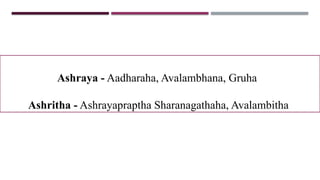
Ashraya - Aadharaha, Avalambhana, Gruha
Ashritha - Ashrayapraptha Sharanagathaha, Avalambitha
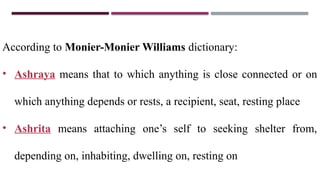
According to Monier-Monier Williams dictionary:
• Ashraya means that to which anything is close connected or on
which anything depends or rests, a recipient, seat, resting place
• Ashrita means attaching one’s self to seeking shelter from,
depending on, inhabiting, dwelling on, resting on
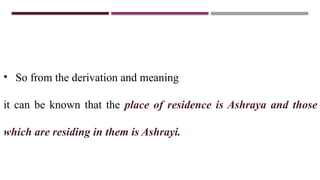
• So from the derivation and meaning
it can be known that the place of residence is Ashraya and those
which are residing in them is Ashrayi.
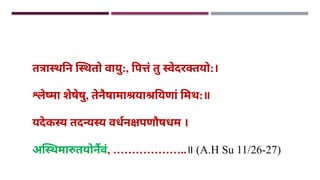
तत्रास्थनि स्थितो वायु:, पित्तं तु स्वेदरक्तयो:।
श्लेष्मा शेषेषु, ​
तेनैषामाश्रयाश्रयिणां मिथ:॥
यदेकस्य तदन्यस्य वर्धनक्षपणौषधम ।
अस्थिमारुतयोर्नैवं, ………………..॥ (A.H Su 11/26-27)
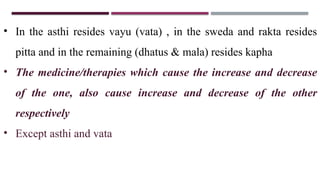
• In the asthi resides vayu (vata) , in the sweda and rakta resides
pitta and in the remaining (dhatus & mala) resides kapha
• The medicine/therapies which cause the increase and decrease
of the one, also cause increase and decrease of the other
respectively
• Except asthi and vata
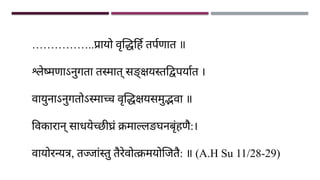
……………..प्रायो वृद्धिर्हि तर्पणात ॥
श्लेष्मणाऽनुगता तस्मात् सङ्क्षयस्तद्विपर्यात ।
वायुनाऽनुगतोऽस्माच्च वृद्धिक्षयसमुद्भवा ॥
विकारान् साधयेच्छीघ्रं क्रमाल्लङघनबृंहणै:।
​
वायोरन्यत्र, तज्जांस्तु तैरेवोत्क्रमयोजितै: ॥ (A.H Su 11/28-29)
• The increase is usually due to tarpana (more nutrition) which is
followed later on with increase of kapha
• Whereas, the decrease of dosha dhatu mala is due to loss of
nutrition which is followed , later with increase of vayu
• Hence the disease arising from increase and decrease of the
ashraya and ashrayi should be treated quick by adopting langhana
& brihmana methods respectively
• In case of vayu by the other ways, its diseases treated with the
same therapies but in the opposite order
• Increase of vata by adopting brahmana therapy and its decrease by
adopting langhana therapy
• The relationship between vata and asthi has not been properly
understood, each of the modern scholars has his own
interpretation but no view is found satisfactory so far
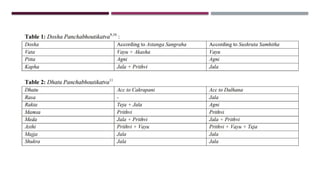
• On comparison of Dosha and Dhatu Panchabhoutikatva i.e. in
Vata and Asthi Vayu Mahabhootha is present, in Pitta and Rakta
Agni Mahabhoota is present and predominance of Agni can be
seen in Pitta and Rakta.
• In case of Kapha, it is composed of Jala and Prithvi
Mahabhootha, Jala Mahabhoota is also found in Rasa, Meda,
Majja and Shukra Dhatus. Prithvi Mahabhootha is found in
Mamsa, Medha Dhatus
• Thus due to these similarities in Panchabhouthika composition,
the Doshas take Ashraya in the Dhatus.
HOW THE DOSHAAND DHATU ARE HAVING THE
ASHRAYAASHRAYI SAMBHANDHA.
For Vata and Asthi
• Deha Chalana Karma of Vata can be considered opposite of the
Dehadharana Karma of Asthi
• Sira Snayu Chalana Karma of Vata can be considered opposite to the
Sira Snayu Nibhandana Karma of Asthi
• Understanding of Ashraya Ashrayi Sambhandha is important because
they have a working principle and they work in a way synchronized.
For example: Vata and Asthi,
• Asthi is made up of Prithvi Mahabhootha which makes it hard
tissue and supports the body frame.
• As Vata is present in Asthi, due to its Laghutva, Vayu keeps the
Asthi light, if Vayu was not present in the bones it would have
been difficult to carry our own bodies.
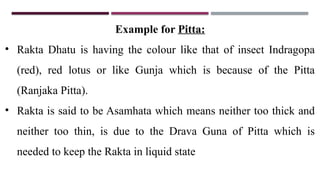
Example for Pitta:
• Rakta Dhatu is having the colour like that of insect Indragopa
(red), red lotus or like Gunja which is because of the Pitta
(Ranjaka Pitta).
• Rakta is said to be Asamhata which means neither too thick and
neither too thin, is due to the Drava Guna of Pitta which is
needed to keep the Rakta in liquid state
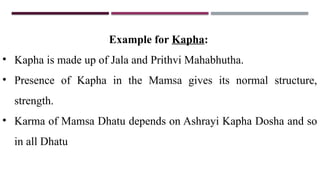
Example for Kapha:
• Kapha is made up of Jala and Prithvi Mahabhutha.
• Presence of Kapha in the Mamsa gives its normal structure,
strength.
• Karma of Mamsa Dhatu depends on Ashrayi Kapha Dosha and so
in all Dhatu
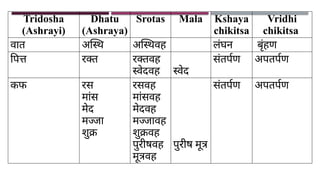
Tridosha
(Ashrayi)
Dhatu
(Ashraya)
Srotas Mala Kshaya
chikitsa
Vridhi
chikitsa
वात अस्थि अस्थिवह लंघन बृंहण
पित्त रक्त रक्तवह
स्वेदवह स्वेद
संतर्पण अपतर्पण
कफ रस
मांस
मेद
मज्जा
शुक्र
रसवह
मांसवह
मेदवह
मज्जावह
शुक्रवह
पुरीषवह
मूत्रवह
पुरीष मूत्र
संतर्पण अपतर्पण
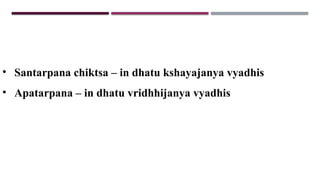
• Santarpana chiktsa – in dhatu kshayajanya vyadhis
• Apatarpana – in dhatu vridhhijanya vyadhis
ASHRAYAASHRAYI SAMBHANDHA OF VATA & ASTHI
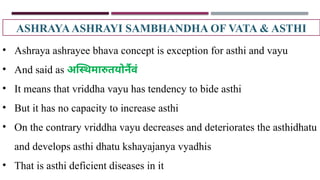
• Ashraya ashrayee bhava concept is exception for asthi and vayu
• And said as अस्थिमारुतयोर्नैवं
• It means that vriddha vayu has tendency to bide asthi
• But it has no capacity to increase asthi
• On the contrary vriddha vayu decreases and deteriorates the asthidhatu
and develops asthi dhatu kshayajanya vyadhis
• That is asthi deficient diseases in it
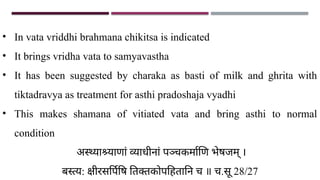
• In vata vriddhi brahmana chikitsa is indicated
• It brings vridha vata to samyavastha
• It has been suggested by charaka as basti of milk and ghrita with
tiktadravya as treatment for asthi pradoshaja vyadhi
• This makes shamana of vitiated vata and bring asthi to normal
condition
अस्थ्याश्र्याणां व्याधीनां पञ्चकर्माणि भेषजम् ।
बस्त्य: क्षीरसर्पिषि तिक्तकोपहितानि च ॥ च.सू 28/27
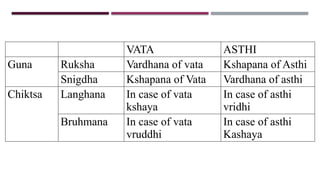
VATA ASTHI
Guna Ruksha Vardhana of vata Kshapana of Asthi
Snigdha Kshapana of Vata Vardhana of asthi
Chiktsa Langhana In case of vata
kshaya
In case of asthi
vridhi
Bruhmana In case of vata
vruddhi
In case of asthi
Kashaya
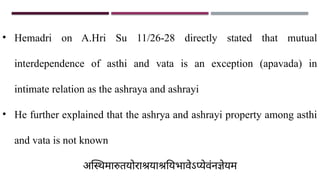
• Hemadri on A.Hri Su 11/26-28 directly stated that mutual
interdependence of asthi and vata is an exception (apavada) in
intimate relation as the ashraya and ashrayi
• He further explained that the ashrya and ashrayi property among asthi
and vata is not known
अस्थिमारुतयोराश्रयाश्रयिभावेऽप्येवंनज्ञेयम

Ashrayaashrayeebhava (NCISM Syllabus)pptx

  • 1.
    CONCEPT OF ASHRAYA– ASHRAYI BHAVA DR.SARANYA SASI MD(AYU) ASSISTANT PROFESSOR SSRAMC & H INCHAL BELGAUM
  • 3.
    Ashraya - Aadharaha,Avalambhana, Gruha Ashritha - Ashrayapraptha Sharanagathaha, Avalambitha
  • 4.
    According to Monier-MonierWilliams dictionary: • Ashraya means that to which anything is close connected or on which anything depends or rests, a recipient, seat, resting place • Ashrita means attaching one’s self to seeking shelter from, depending on, inhabiting, dwelling on, resting on
  • 5.
    • So fromthe derivation and meaning it can be known that the place of residence is Ashraya and those which are residing in them is Ashrayi.
  • 6.
    तत्रास्थनि स्थितो वायु:,पित्तं तु स्वेदरक्तयो:। श्लेष्मा शेषेषु, ​ तेनैषामाश्रयाश्रयिणां मिथ:॥ यदेकस्य तदन्यस्य वर्धनक्षपणौषधम । अस्थिमारुतयोर्नैवं, ………………..॥ (A.H Su 11/26-27)
  • 7.
    • In theasthi resides vayu (vata) , in the sweda and rakta resides pitta and in the remaining (dhatus & mala) resides kapha • The medicine/therapies which cause the increase and decrease of the one, also cause increase and decrease of the other respectively • Except asthi and vata
  • 8.
    ……………..प्रायो वृद्धिर्हि तर्पणात॥ श्लेष्मणाऽनुगता तस्मात् सङ्क्षयस्तद्विपर्यात । वायुनाऽनुगतोऽस्माच्च वृद्धिक्षयसमुद्भवा ॥ विकारान् साधयेच्छीघ्रं क्रमाल्लङघनबृंहणै:। ​ वायोरन्यत्र, तज्जांस्तु तैरेवोत्क्रमयोजितै: ॥ (A.H Su 11/28-29)
  • 9.
    • The increaseis usually due to tarpana (more nutrition) which is followed later on with increase of kapha • Whereas, the decrease of dosha dhatu mala is due to loss of nutrition which is followed , later with increase of vayu • Hence the disease arising from increase and decrease of the ashraya and ashrayi should be treated quick by adopting langhana & brihmana methods respectively
  • 10.
    • In caseof vayu by the other ways, its diseases treated with the same therapies but in the opposite order • Increase of vata by adopting brahmana therapy and its decrease by adopting langhana therapy • The relationship between vata and asthi has not been properly understood, each of the modern scholars has his own interpretation but no view is found satisfactory so far
  • 12.
    • On comparisonof Dosha and Dhatu Panchabhoutikatva i.e. in Vata and Asthi Vayu Mahabhootha is present, in Pitta and Rakta Agni Mahabhoota is present and predominance of Agni can be seen in Pitta and Rakta. • In case of Kapha, it is composed of Jala and Prithvi Mahabhootha, Jala Mahabhoota is also found in Rasa, Meda, Majja and Shukra Dhatus. Prithvi Mahabhootha is found in Mamsa, Medha Dhatus
  • 13.
    • Thus dueto these similarities in Panchabhouthika composition, the Doshas take Ashraya in the Dhatus.
  • 14.
    HOW THE DOSHAANDDHATU ARE HAVING THE ASHRAYAASHRAYI SAMBHANDHA. For Vata and Asthi • Deha Chalana Karma of Vata can be considered opposite of the Dehadharana Karma of Asthi • Sira Snayu Chalana Karma of Vata can be considered opposite to the Sira Snayu Nibhandana Karma of Asthi
  • 15.
    • Understanding ofAshraya Ashrayi Sambhandha is important because they have a working principle and they work in a way synchronized.
  • 16.
    For example: Vataand Asthi, • Asthi is made up of Prithvi Mahabhootha which makes it hard tissue and supports the body frame. • As Vata is present in Asthi, due to its Laghutva, Vayu keeps the Asthi light, if Vayu was not present in the bones it would have been difficult to carry our own bodies.
  • 17.
    Example for Pitta: •Rakta Dhatu is having the colour like that of insect Indragopa (red), red lotus or like Gunja which is because of the Pitta (Ranjaka Pitta). • Rakta is said to be Asamhata which means neither too thick and neither too thin, is due to the Drava Guna of Pitta which is needed to keep the Rakta in liquid state
  • 18.
    Example for Kapha: •Kapha is made up of Jala and Prithvi Mahabhutha. • Presence of Kapha in the Mamsa gives its normal structure, strength. • Karma of Mamsa Dhatu depends on Ashrayi Kapha Dosha and so in all Dhatu
  • 19.
    Tridosha (Ashrayi) Dhatu (Ashraya) Srotas Mala Kshaya chikitsa Vridhi chikitsa वातअस्थि अस्थिवह लंघन बृंहण पित्त रक्त रक्तवह स्वेदवह स्वेद संतर्पण अपतर्पण कफ रस मांस मेद मज्जा शुक्र रसवह मांसवह मेदवह मज्जावह शुक्रवह पुरीषवह मूत्रवह पुरीष मूत्र संतर्पण अपतर्पण
  • 20.
    • Santarpana chiktsa– in dhatu kshayajanya vyadhis • Apatarpana – in dhatu vridhhijanya vyadhis
  • 21.
    ASHRAYAASHRAYI SAMBHANDHA OFVATA & ASTHI • Ashraya ashrayee bhava concept is exception for asthi and vayu • And said as अस्थिमारुतयोर्नैवं • It means that vriddha vayu has tendency to bide asthi • But it has no capacity to increase asthi • On the contrary vriddha vayu decreases and deteriorates the asthidhatu and develops asthi dhatu kshayajanya vyadhis • That is asthi deficient diseases in it
  • 22.
    • In vatavriddhi brahmana chikitsa is indicated • It brings vridha vata to samyavastha • It has been suggested by charaka as basti of milk and ghrita with tiktadravya as treatment for asthi pradoshaja vyadhi • This makes shamana of vitiated vata and bring asthi to normal condition अस्थ्याश्र्याणां व्याधीनां पञ्चकर्माणि भेषजम् । बस्त्य: क्षीरसर्पिषि तिक्तकोपहितानि च ॥ च.सू 28/27
  • 23.
    VATA ASTHI Guna RukshaVardhana of vata Kshapana of Asthi Snigdha Kshapana of Vata Vardhana of asthi Chiktsa Langhana In case of vata kshaya In case of asthi vridhi Bruhmana In case of vata vruddhi In case of asthi Kashaya
  • 24.
    • Hemadri onA.Hri Su 11/26-28 directly stated that mutual interdependence of asthi and vata is an exception (apavada) in intimate relation as the ashraya and ashrayi • He further explained that the ashrya and ashrayi property among asthi and vata is not known अस्थिमारुतयोराश्रयाश्रयिभावेऽप्येवंनज्ञेयम