In ayurveda rasa denotes many meanings
1. Shad rasam – taste of food (रस आस्वादने )
2. In rasasatra – parada
3. First dhatu
ETYMOLOGY
• रस्यते रस अच् I
• यद् द्रवं सकलं देहं रसतीतत रस स्मृत: II
DERIVATION
• तत्र रस गतौ धातु: |अहरह्र्गच्छ्तत इतत रस: || (su. su 14/14)
• सतत सन्चरण शीलो द्रवो धातु: इतत रस शब्दार्थ: |
• Derived from gati dhatu – to move
• One which moves or circulates continuously
• पूवथस्याहार पररणाम धातो यं तं रस इत्याचक्षते (cha.sa)
• Rasa dhatu is the product of previously digested food
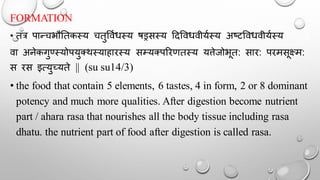
FORMATION
• तत्र पान्चभौततकस्य चतुर्वथधस्य षड्रसस्य ददर्वधवीयथस्य अष्टर्वधवीयथस्य
वा अनेकगुण्सस्योपयुक्र्स्याहारस्य सम्यक्पररणतस्य यत्तेजोभूत: सार: परमसूक्ष्म:
स रस इत्युच्यते || (su su14/3)
• the food that contain 5 elements, 6 tastes, 4 in form, 2 or 8 dominant
potency and much more qualities. After digestion become nutrient
part / ahara rasa that nourishes all the body tissue including rasa
dhatu. the nutrient part of food after digestion is called rasa.
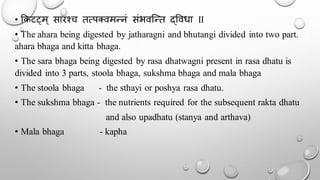
• ककटट्म् सारश्च तत्पक्वमन्नं संभवन्न्त द्र्वधा II
• The ahara being digested by jatharagni and bhutangi divided into two part.
ahara bhaga and kitta bhaga.
• The sara bhaga being digested by rasa dhatwagni present in rasa dhatu is
divided into 3 parts, stoola bhaga, sukshma bhaga and mala bhaga
• The stoola bhaga - the sthayi or poshya rasa dhatu.
• The sukshma bhaga - the nutrients required for the subsequent rakta dhatu
and also upadhatu (stanya and arthava)
• Mala bhaga - kapha
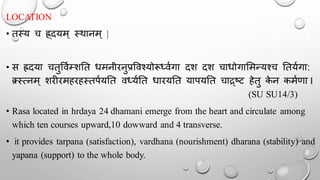
LOCATION
• तस्य च ह्र्दयम् स्र्ानम् |
• स ह्रदया चतुर्वथम्शतत धमनीरनुप्रर्वश्योरूर्धवथगा दश दश चाधोगाममन्यश्च ततयथगा:
क्र्स्स्त्नम् शरीरमहरहस्तपथयतत वर्धयथतत धारयतत यापयतत चाद्र्षष्ट हेतु क
े न कमथणा I
(SU SU14/3)
• Rasa located in hrdaya 24 dhamani emerge from the heart and circulate among
which ten courses upward,10 dowward and 4 transverse.
• it provides tarpana (satisfaction), vardhana (nourishment) dharana (stability) and
yapana (support) to the whole body.
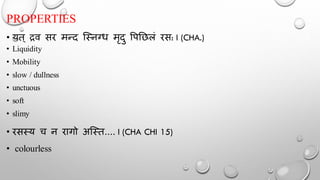
PROPERTIES
• यत् द्रव सर मन्द न्स्नग्ध मृदु र्पतिलं रस: I (CHA.)
• Liquidity
• Mobility
• slow / dullness
• unctuous
• soft
• slimy
• रसस्य च न रागो अन्स्त.... I (CHA CHI 15)
• colourless
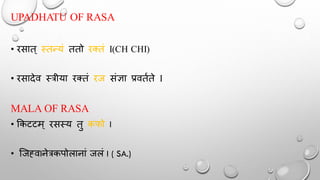
UPADHATU OF RASA
• रसात् स्तन्यं ततो रक्तं I(CH CHI)
• रसादेव स्त्रीया रक्तं रज संज्ञा प्रवतथते I
MALA OF RASA
• ककटटम् रसस्य तु कफो I
• न्जह्वIनेत्रकपोलानां जलं I ( SA.)
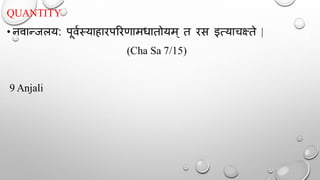
QUANTITY
• नवान्जलय: पूवथस्याहारपररणामधातोयम ् त रस इत्याचक्ष्ते |
(Cha Sa 7/15)
9 Anjali
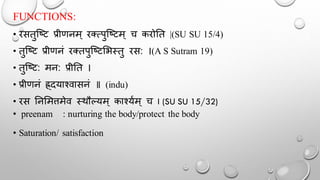
FUNCTIONS:
• रसतुन्ष्ट प्रीणनम् रक्त्पुन्ष्टम् च करोतत |(SU SU 15/4)
• तुन्ष्ट प्रीणनं रक्तपुन्ष्टमभस्तु रस: ।(A S Sutram 19)
• तुन्ष्ट: मन: प्रीतत ।
• प्रीणनं ह्र्दयाश्वासनं ॥ (indu)
• रस तनममत्तमेव स्र्ौल्यम् काश्यथम् च I (SU SU 15/32)
• preenam : nurturing the body/protect the body
• Saturation/ satisfaction
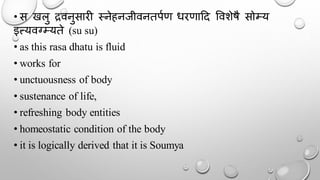
• स खलु द्रवनुसारी स्नेहनजीवनतपथण धरणादद र्वशेषै सोम्य
इत्यवग्म्यते (su su)
• as this rasa dhatu is fluid
• works for
• unctuousness of body
• sustenance of life,
• refreshing body entities
• homeostatic condition of the body
• it is logically derived that it is Soumya
RASA SAMVAHANA
• circulation of rada dhatu
• well controlled circulation of rada dhatu.
• rasa samvahana is also called as rasa vikshepana
• तस्य ह्रदयं स्र्ानं…..
• व्यानेन रसधातुदहथ र्वक्षेपोचचत कमथणा I
• युगपत् सवथतोअजस्रं देहे र्वक्षक्षप्यते सदा II
• circulates with the help of vyana vayu
• रसस्तु ह्रदयं यातत समIनमरुतेररत SA SA
• under the control of samana vayau, rasa enters hrdaya.
स(रस) श्ब्दाचचथ जल सन्तानवदणुना र्वशेषेणानुधावत्येवं शरीरं क
े वलं ॥
(su su14/13)
movements are explained with the help of
• shabda - it moves in oblique direction
• Agni – it travels in upward direction
• Jala – it travels in downward direction
RASA DHATU KSHAYA
• रसे रौक्ष्यम ् भ्रम: शोषो ग्लातन: शब्दासदहष्णुता । (AH SU 11/17)
• Dryness, tiredness, emaciation & intolerance to sound
RASA DHATU VRDDHI
• रसो अर्प श्लेष्मवत ्| (AH SU 11/18)
• श्लेष्मान्ग्न सदन प्रसेकालस्य गौरवम ् |
श्वैत्यशौत्यश्लर्ान्गत्वम ् श्वासकासातततनद्रता II
• whitish discolouration of the body
• feeling of abnormal coldness
• sluggish digestion
• salivation
• lack of enthusiasm to do work
• Heaviness,feeling of looseness, dyspnoea, cough &excessive sleep
• RASA VIKARA
अश्रधाचारुचचश्चास्यवैरस्यमरसन्जता |
ह्र्ल्लासो गौरवम् तन्त्रा सांड्गमदोज्वरः तमः |
पाण्सडुत्वम् स्रोतसाम् रोधःक्लैब्यम् सादः क्र्स्शान्ड्ग्ता |
नाशो अग्ने अयर्ाकालम् वलयःपमलतातन च |
रस प्रदोषजा रोगा II
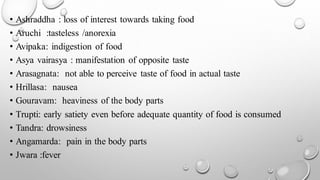
• Ashraddha : loss of interest towards taking food
• Aruchi :tasteless /anorexia
• Avipaka: indigestion of food
• Asya vairasya : manifestation of opposite taste
• Arasagnata: not able to perceive taste of food in actual taste
• Hrillasa: nausea
• Gouravam: heaviness of the body parts
• Trupti: early satiety even before adequate quantity of food is consumed
• Tandra: drowsiness
• Angamarda: pain in the body parts
• Jwara :fever
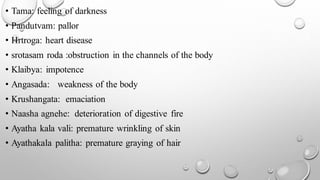
• Tama: feeling of darkness
• Pandutvam: pallor
• Hrtroga: heart disease
• srotasam roda :obstruction in the channels of the body
• Klaibya: impotence
• Angasada: weakness of the body
• Krushangata: emaciation
• Naasha agnehe: deterioration of digestive fire
• Ayatha kala vali: premature wrinkling of skin
• Ayathakala palitha: premature graying of hair
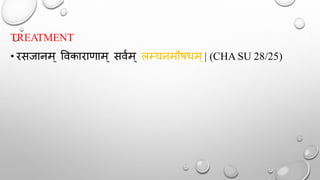
TREATMENT
• रसजानम ् र्वकाराणाम ् सवथम ् लम्घनमौषधम ्| (CHA SU 28/25)
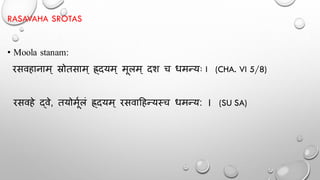
RASAVAHA SROTAS
• Moola stanam:
रसवहानाम् स्रोतसाम् ह्र्दयम् मूलम् दश च धमन्यः I (CHA. VI 5/8)
रसवहे द्वे, तयोमूथलं ह्र्दयम् रसवादहन्यस्च धमन्य: । (SU SA)
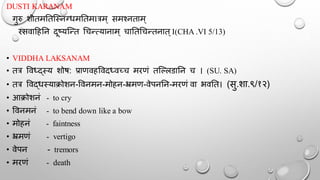
DUSTI KARANAM
गुरु शीतमततन्स्नग्धमततमIत्रम् समश्नताम्
रसवादहतन दूष्यन्न्त चचन्त्यानाम् चाततचचन्तनात्I(CHA .VI 5/13)
• VIDDHA LAKSANAM
• तत्र र्वर्धद्स्य शोष: प्राणवहर्वदर्धवच्च मरणं तन्ल्लडातन च । (SU. SA)
• तत्र र्वद्धस्याक्रोशन-र्वनमन-मोहन-भ्रमण-वेपनतन-मरणं वा भवतत। (सु.शा.९/१२)
• आक्रोशनं - to cry
• र्वनमनं - to bend down like a bow
• मोहनं - faintness
• भ्रमणं - vertigo
• वेपन - tremors
• मरणं - death
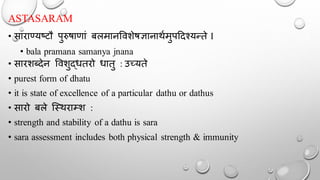
ASTASARAM
• साराण्सयष्टौ पुरुषाणां बलमानर्वशेषज्ञानार्थमुपददश्यन्ते I
• bala pramana samanya jnana
• सारशब्देन र्वशुद्धतरो धातु : उच्यते
• purest form of dhatu
• it is state of excellence of a particular dathu or dathus
• सारो बले न्स्र्राम्श :
• strength and stability of a dathu is sara
• sara assessment includes both physical strength & immunity
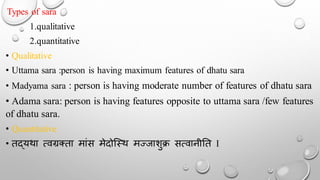
Types of sara
1.qualitative
2.quantitative
• Qualitative
• Uttama sara :person is having maximum features of dhatu sara
• Madyama sara : person is having moderate number of features of dhatu sara
• Adama sara: person is having features opposite to uttama sara /few features
of dhatu sara.
• Quantitative
• तद्यर्ा त्वग्रक्ता मांस मेदोन्स्र् मज्जाशुक्र सत्वानीतत I
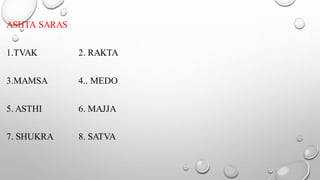
ASHTA SARAS
1.TVAK 2. RAKTA
3.MAMSA 4.. MEDO
5. ASTHI 6. MAJJA
7. SHUKRA 8. SATVA
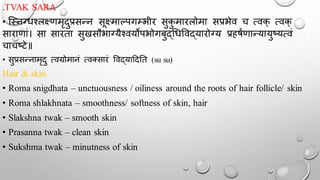
.TVAK SARA
• न्स्नग्धश्लक्ष्णमृदुप्रसन्न सूक्ष्माल्पगम्भीर सुक
ु मारलोमा सप्रभेव च त्वक् त्वक्
साराणां। सा सारता सुखसौभाग्यैश्वयोपभोगबुद्चधर्वद्यारोग्य प्रहषथणान्यायुष्यत्वं
चाचष्टे॥
• सुप्रसन्नामृदु त्वग्रोमानं त्वक्सारं र्वद्याददतत (su su)
Hair & skin
• Roma snigdhata – unctuousness / oiliness around the roots of hair follicle/ skin
• Roma shlakhnata – smoothness/ softness of skin, hair
• Slakshna twak – smooth skin
• Prasanna twak – clean skin
• Sukshma twak – minutness of skin
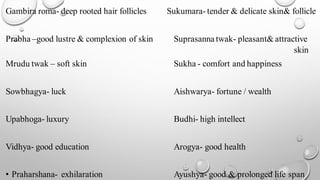
Gambira roma- deep rooted hair follicles Sukumara- tender & delicate skin& follicle
Prabha –good lustre & complexion of skin Suprasanna twak- pleasant& attractive
skin
Mrudu twak – soft skin Sukha - comfort and happiness
Sowbhagya- luck Aishwarya- fortune / wealth
Upabhoga- luxury Budhi- high intellect
Vidhya- good education Arogya- good health
• Praharshana- exhilaration Ayushya- good & prolonged life span
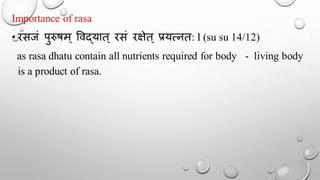
Importance of rasa
• रसजं पुरुषम ् र्वद्यात् रसं रक्षेत् प्रयत्नत: I (su su 14/12)
as rasa dhatu contain all nutrients required for body - living body
is a product of rasa.
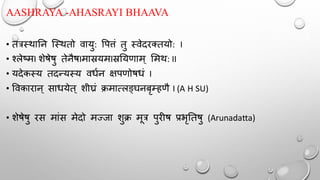
AASHRAYA -AHASRAYI BHAAVA
• तत्रस्र्ातन न्स्र्तो वायु: र्पत्तं तु स्वेदरक्तयो: I
• श्लेष्मI शेषेषु तेनैषIमास्रयमIस्रतयणाम् ममर्: II
• यदेकस्य तदन्यस्य वधथन क्षपणोषधं I
• र्वकारान् साधयेत् शीघ्रं क्रमात्लङ्घनबृम्हणै I (A H SU)
• शेषेषु रस मांस मेदो मज्जा शुक्र मूत्र पुरीष प्रभृततषु (Arunadatta)
• The human body is made up of doshas dhatus and malas.
• while doshas predominantly contribute towards various functions.
• the dhatus form the structural components of the body.
• Mala gets eliminated from the body to keep the body healthy.
• but the doshas that are interrelated within our system work in synchronization.
• doshas have their abode in the dhatus and operate from there.
• asraya sambhanda - the inseparable relationship of abode and resident.
• here the dhatus are abodes and doshas living in them are residents.
• thus, dhatus and malas are ashrayas and doshas are ashrayis
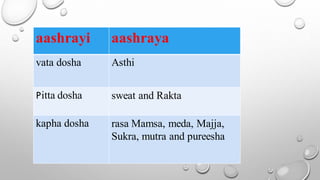
• vata dosa located in the Asthi
• pitta dosa located in sweat and rakta
• kapha dosha located in rasa Mamsa, meda, Majja, Sukra, mutra and pureesha.
• doshas have found their places in their dhatus and malas which form their asrayas
• Importance:
• ashrayas & ashrayis have inseparable relationship & work in a synchronized way.
• normalcy and morbidity of asraya and asrayi affect mutually.
• it helps in planning appropriate treatment.
• it helps to understand the stages of diseases.
aashrayi aashraya
vata dosha Asthi
Pitta dosha sweat and Rakta
kapha dosha rasa Mamsa, meda, Majja,
Sukra, mutra and pureesha
HRDAYA
• हरतत ददातत यापयतत इतत हृदयं II
• that which procures, gives and maintains is hrdaya
• Hri- harati to take back
• Da- dadati to give
• Ya- yamyati to control
POSITION OF HEART
• द्वारमामाशयस्य च I
• सत्वददधाम ह्रदयं स्तनोर: कोष्टम्मर्धयगं II
• hrdaya faces towards the opening of stomach
• it is the seat of satva/ mind
• situated in between stana, uras and kosta
Functioning of hrdaya
• पुण्सडरीक
े ण सदृशम् ह्रदयं स्यादधोमुखं
• जाग्रतस्तद्र्वकसतत स्वपतात्स्च तनमीलतत
• hrdaya is similar to an inverted pundarika flower (white lotus) which blooms
when awake and close up during sleep.
Embryological development of hrdaya
• शोणणता कफ प्रसादजम् हृदयम्
• hrdaya is formed from sara part of shonita and kapha
Rasa dhatu  kriya sharir

Rasa dhatu kriya sharir

  • 2.
    In ayurveda rasadenotes many meanings 1. Shad rasam – taste of food (रस आस्वादने ) 2. In rasasatra – parada 3. First dhatu
  • 3.
    ETYMOLOGY • रस्यते रसअच् I • यद् द्रवं सकलं देहं रसतीतत रस स्मृत: II
  • 4.
    DERIVATION • तत्र रसगतौ धातु: |अहरह्र्गच्छ्तत इतत रस: || (su. su 14/14) • सतत सन्चरण शीलो द्रवो धातु: इतत रस शब्दार्थ: | • Derived from gati dhatu – to move • One which moves or circulates continuously • पूवथस्याहार पररणाम धातो यं तं रस इत्याचक्षते (cha.sa) • Rasa dhatu is the product of previously digested food
  • 5.
    FORMATION • तत्र पान्चभौततकस्यचतुर्वथधस्य षड्रसस्य ददर्वधवीयथस्य अष्टर्वधवीयथस्य वा अनेकगुण्सस्योपयुक्र्स्याहारस्य सम्यक्पररणतस्य यत्तेजोभूत: सार: परमसूक्ष्म: स रस इत्युच्यते || (su su14/3) • the food that contain 5 elements, 6 tastes, 4 in form, 2 or 8 dominant potency and much more qualities. After digestion become nutrient part / ahara rasa that nourishes all the body tissue including rasa dhatu. the nutrient part of food after digestion is called rasa.
  • 6.
    • ककटट्म् सारश्चतत्पक्वमन्नं संभवन्न्त द्र्वधा II • The ahara being digested by jatharagni and bhutangi divided into two part. ahara bhaga and kitta bhaga. • The sara bhaga being digested by rasa dhatwagni present in rasa dhatu is divided into 3 parts, stoola bhaga, sukshma bhaga and mala bhaga • The stoola bhaga - the sthayi or poshya rasa dhatu. • The sukshma bhaga - the nutrients required for the subsequent rakta dhatu and also upadhatu (stanya and arthava) • Mala bhaga - kapha
  • 7.
    LOCATION • तस्य चह्र्दयम् स्र्ानम् | • स ह्रदया चतुर्वथम्शतत धमनीरनुप्रर्वश्योरूर्धवथगा दश दश चाधोगाममन्यश्च ततयथगा: क्र्स्स्त्नम् शरीरमहरहस्तपथयतत वर्धयथतत धारयतत यापयतत चाद्र्षष्ट हेतु क े न कमथणा I (SU SU14/3) • Rasa located in hrdaya 24 dhamani emerge from the heart and circulate among which ten courses upward,10 dowward and 4 transverse. • it provides tarpana (satisfaction), vardhana (nourishment) dharana (stability) and yapana (support) to the whole body.
  • 8.
    PROPERTIES • यत् द्रवसर मन्द न्स्नग्ध मृदु र्पतिलं रस: I (CHA.) • Liquidity • Mobility • slow / dullness • unctuous • soft • slimy • रसस्य च न रागो अन्स्त.... I (CHA CHI 15) • colourless
  • 9.
    UPADHATU OF RASA •रसात् स्तन्यं ततो रक्तं I(CH CHI) • रसादेव स्त्रीया रक्तं रज संज्ञा प्रवतथते I MALA OF RASA • ककटटम् रसस्य तु कफो I • न्जह्वIनेत्रकपोलानां जलं I ( SA.)
  • 10.
    QUANTITY • नवान्जलय: पूवथस्याहारपररणामधातोयम् त रस इत्याचक्ष्ते | (Cha Sa 7/15) 9 Anjali
  • 11.
    FUNCTIONS: • रसतुन्ष्ट प्रीणनम्रक्त्पुन्ष्टम् च करोतत |(SU SU 15/4) • तुन्ष्ट प्रीणनं रक्तपुन्ष्टमभस्तु रस: ।(A S Sutram 19) • तुन्ष्ट: मन: प्रीतत । • प्रीणनं ह्र्दयाश्वासनं ॥ (indu) • रस तनममत्तमेव स्र्ौल्यम् काश्यथम् च I (SU SU 15/32) • preenam : nurturing the body/protect the body • Saturation/ satisfaction
  • 12.
    • स खलुद्रवनुसारी स्नेहनजीवनतपथण धरणादद र्वशेषै सोम्य इत्यवग्म्यते (su su) • as this rasa dhatu is fluid • works for • unctuousness of body • sustenance of life, • refreshing body entities • homeostatic condition of the body • it is logically derived that it is Soumya
  • 13.
    RASA SAMVAHANA • circulationof rada dhatu • well controlled circulation of rada dhatu. • rasa samvahana is also called as rasa vikshepana • तस्य ह्रदयं स्र्ानं….. • व्यानेन रसधातुदहथ र्वक्षेपोचचत कमथणा I • युगपत् सवथतोअजस्रं देहे र्वक्षक्षप्यते सदा II • circulates with the help of vyana vayu • रसस्तु ह्रदयं यातत समIनमरुतेररत SA SA • under the control of samana vayau, rasa enters hrdaya.
  • 14.
    स(रस) श्ब्दाचचथ जलसन्तानवदणुना र्वशेषेणानुधावत्येवं शरीरं क े वलं ॥ (su su14/13) movements are explained with the help of • shabda - it moves in oblique direction • Agni – it travels in upward direction • Jala – it travels in downward direction
  • 15.
    RASA DHATU KSHAYA •रसे रौक्ष्यम ् भ्रम: शोषो ग्लातन: शब्दासदहष्णुता । (AH SU 11/17) • Dryness, tiredness, emaciation & intolerance to sound RASA DHATU VRDDHI • रसो अर्प श्लेष्मवत ्| (AH SU 11/18) • श्लेष्मान्ग्न सदन प्रसेकालस्य गौरवम ् | श्वैत्यशौत्यश्लर्ान्गत्वम ् श्वासकासातततनद्रता II • whitish discolouration of the body • feeling of abnormal coldness • sluggish digestion • salivation • lack of enthusiasm to do work • Heaviness,feeling of looseness, dyspnoea, cough &excessive sleep
  • 16.
    • RASA VIKARA अश्रधाचारुचचश्चास्यवैरस्यमरसन्जता| ह्र्ल्लासो गौरवम् तन्त्रा सांड्गमदोज्वरः तमः | पाण्सडुत्वम् स्रोतसाम् रोधःक्लैब्यम् सादः क्र्स्शान्ड्ग्ता | नाशो अग्ने अयर्ाकालम् वलयःपमलतातन च | रस प्रदोषजा रोगा II
  • 17.
    • Ashraddha :loss of interest towards taking food • Aruchi :tasteless /anorexia • Avipaka: indigestion of food • Asya vairasya : manifestation of opposite taste • Arasagnata: not able to perceive taste of food in actual taste • Hrillasa: nausea • Gouravam: heaviness of the body parts • Trupti: early satiety even before adequate quantity of food is consumed • Tandra: drowsiness • Angamarda: pain in the body parts • Jwara :fever
  • 18.
    • Tama: feelingof darkness • Pandutvam: pallor • Hrtroga: heart disease • srotasam roda :obstruction in the channels of the body • Klaibya: impotence • Angasada: weakness of the body • Krushangata: emaciation • Naasha agnehe: deterioration of digestive fire • Ayatha kala vali: premature wrinkling of skin • Ayathakala palitha: premature graying of hair
  • 19.
    TREATMENT • रसजानम ्र्वकाराणाम ् सवथम ् लम्घनमौषधम ्| (CHA SU 28/25)
  • 20.
    RASAVAHA SROTAS • Moolastanam: रसवहानाम् स्रोतसाम् ह्र्दयम् मूलम् दश च धमन्यः I (CHA. VI 5/8) रसवहे द्वे, तयोमूथलं ह्र्दयम् रसवादहन्यस्च धमन्य: । (SU SA)
  • 21.
    DUSTI KARANAM गुरु शीतमततन्स्नग्धमततमIत्रम्समश्नताम् रसवादहतन दूष्यन्न्त चचन्त्यानाम् चाततचचन्तनात्I(CHA .VI 5/13) • VIDDHA LAKSANAM • तत्र र्वर्धद्स्य शोष: प्राणवहर्वदर्धवच्च मरणं तन्ल्लडातन च । (SU. SA) • तत्र र्वद्धस्याक्रोशन-र्वनमन-मोहन-भ्रमण-वेपनतन-मरणं वा भवतत। (सु.शा.९/१२) • आक्रोशनं - to cry • र्वनमनं - to bend down like a bow • मोहनं - faintness • भ्रमणं - vertigo • वेपन - tremors • मरणं - death
  • 22.
    ASTASARAM • साराण्सयष्टौ पुरुषाणांबलमानर्वशेषज्ञानार्थमुपददश्यन्ते I • bala pramana samanya jnana • सारशब्देन र्वशुद्धतरो धातु : उच्यते • purest form of dhatu • it is state of excellence of a particular dathu or dathus • सारो बले न्स्र्राम्श : • strength and stability of a dathu is sara • sara assessment includes both physical strength & immunity
  • 23.
    Types of sara 1.qualitative 2.quantitative •Qualitative • Uttama sara :person is having maximum features of dhatu sara • Madyama sara : person is having moderate number of features of dhatu sara • Adama sara: person is having features opposite to uttama sara /few features of dhatu sara. • Quantitative • तद्यर्ा त्वग्रक्ता मांस मेदोन्स्र् मज्जाशुक्र सत्वानीतत I
  • 24.
    ASHTA SARAS 1.TVAK 2.RAKTA 3.MAMSA 4.. MEDO 5. ASTHI 6. MAJJA 7. SHUKRA 8. SATVA
  • 25.
    .TVAK SARA • न्स्नग्धश्लक्ष्णमृदुप्रसन्नसूक्ष्माल्पगम्भीर सुक ु मारलोमा सप्रभेव च त्वक् त्वक् साराणां। सा सारता सुखसौभाग्यैश्वयोपभोगबुद्चधर्वद्यारोग्य प्रहषथणान्यायुष्यत्वं चाचष्टे॥ • सुप्रसन्नामृदु त्वग्रोमानं त्वक्सारं र्वद्याददतत (su su) Hair & skin • Roma snigdhata – unctuousness / oiliness around the roots of hair follicle/ skin • Roma shlakhnata – smoothness/ softness of skin, hair • Slakshna twak – smooth skin • Prasanna twak – clean skin • Sukshma twak – minutness of skin
  • 26.
    Gambira roma- deeprooted hair follicles Sukumara- tender & delicate skin& follicle Prabha –good lustre & complexion of skin Suprasanna twak- pleasant& attractive skin Mrudu twak – soft skin Sukha - comfort and happiness Sowbhagya- luck Aishwarya- fortune / wealth Upabhoga- luxury Budhi- high intellect Vidhya- good education Arogya- good health • Praharshana- exhilaration Ayushya- good & prolonged life span
  • 27.
    Importance of rasa •रसजं पुरुषम ् र्वद्यात् रसं रक्षेत् प्रयत्नत: I (su su 14/12) as rasa dhatu contain all nutrients required for body - living body is a product of rasa.
  • 28.
    AASHRAYA -AHASRAYI BHAAVA •तत्रस्र्ातन न्स्र्तो वायु: र्पत्तं तु स्वेदरक्तयो: I • श्लेष्मI शेषेषु तेनैषIमास्रयमIस्रतयणाम् ममर्: II • यदेकस्य तदन्यस्य वधथन क्षपणोषधं I • र्वकारान् साधयेत् शीघ्रं क्रमात्लङ्घनबृम्हणै I (A H SU) • शेषेषु रस मांस मेदो मज्जा शुक्र मूत्र पुरीष प्रभृततषु (Arunadatta)
  • 29.
    • The humanbody is made up of doshas dhatus and malas. • while doshas predominantly contribute towards various functions. • the dhatus form the structural components of the body. • Mala gets eliminated from the body to keep the body healthy. • but the doshas that are interrelated within our system work in synchronization. • doshas have their abode in the dhatus and operate from there. • asraya sambhanda - the inseparable relationship of abode and resident. • here the dhatus are abodes and doshas living in them are residents. • thus, dhatus and malas are ashrayas and doshas are ashrayis
  • 30.
    • vata dosalocated in the Asthi • pitta dosa located in sweat and rakta • kapha dosha located in rasa Mamsa, meda, Majja, Sukra, mutra and pureesha. • doshas have found their places in their dhatus and malas which form their asrayas • Importance: • ashrayas & ashrayis have inseparable relationship & work in a synchronized way. • normalcy and morbidity of asraya and asrayi affect mutually. • it helps in planning appropriate treatment. • it helps to understand the stages of diseases.
  • 31.
    aashrayi aashraya vata doshaAsthi Pitta dosha sweat and Rakta kapha dosha rasa Mamsa, meda, Majja, Sukra, mutra and pureesha
  • 32.
    HRDAYA • हरतत ददाततयापयतत इतत हृदयं II • that which procures, gives and maintains is hrdaya • Hri- harati to take back • Da- dadati to give • Ya- yamyati to control POSITION OF HEART • द्वारमामाशयस्य च I • सत्वददधाम ह्रदयं स्तनोर: कोष्टम्मर्धयगं II • hrdaya faces towards the opening of stomach • it is the seat of satva/ mind • situated in between stana, uras and kosta
  • 33.
    Functioning of hrdaya •पुण्सडरीक े ण सदृशम् ह्रदयं स्यादधोमुखं • जाग्रतस्तद्र्वकसतत स्वपतात्स्च तनमीलतत • hrdaya is similar to an inverted pundarika flower (white lotus) which blooms when awake and close up during sleep. Embryological development of hrdaya • शोणणता कफ प्रसादजम् हृदयम् • hrdaya is formed from sara part of shonita and kapha