S T E PSolar Technology for Energy Production
 Hafiz Talha C.E.O
 Tayyab Ali Executive Member
 Khurram Shahzad Executive Member
 H.M.Sajid Iqbal Executive Member
 Naveed Sattar Executive Member
 Moneeb Mustafa Executive Member
Energy crises in Pakistan
what are the solutions?
Why we use solar energy?
Electricity Rates
Pakistan is sunshine state
Introduction to solar Energy
What is a Photovoltaic Cell?
Types of PV
Basic parts of PV solar system
What is Solar thermal?
Solar plants all over the world.
Solar in Pakistan at present
Domestic and Agriculture
Packages
Future Plans
Contents
3
Energy Crisis in Pakistan
 The shortfall of electricity has reached 3220 mega watt (MW), while electricity
production has remained 9630 MW.
 Due to the increasing shortfall, the unannounced load-shedding hours have increased
manifold.
 In urban areas people face 6 to 8 hours load-shedding while in rural areas the power
supply cut has reached more than 10 to 14 hours. (increase in Peak demand season)
 The current demand of electricity is 12,850 MW, while hydro power production is
2820 MW; thermal resources produce 1800 MW; production through independent
power producers (IIPs) is 5030 MW, which amounts total production of 9630 MW
Solutions???
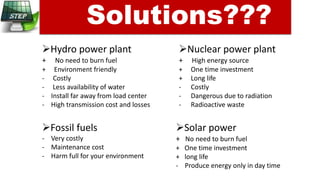
Hydro power plant
+ No need to burn fuel
+ Environment friendly
- Costly
- Less availability of water
- Install far away from load center
- High transmission cost and losses
Fossil fuels
- Very costly
- Maintenance cost
- Harm full for your environment
Nuclear power plant
+ High energy source
+ One time investment
+ Long life
- Costly
- Dangerous due to radiation
- Radioactive waste
Solar power
+ No need to burn fuel
+ One time investment
+ long life
- Produce energy only in day time
Cost saving
Improved availability and quality of power
Environmental friendly
Start with small system and expand it over time
Long life
Insulates roof from direct sunlight
Good efficiency
Job opportunities
Peace of mind
Good solution for remote areas
Why we use Solar Energy??
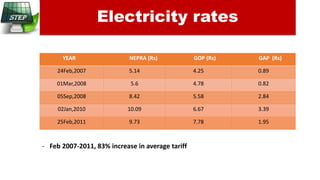
Electricity rates
YEAR NEPRA (Rs) GOP (Rs) GAP (Rs)
24Feb,2007 5.14 4.25 0.89
01Mar,2008 5.6 4.78 0.82
05Sep,2008 8.42 5.58 2.84
02Jan,2010 10.09 6.67 3.39
25Feb,2011 9.73 7.78 1.95
- Feb 2007-2011, 83% increase in average tariff
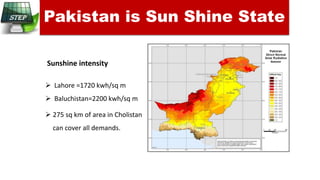
Pakistan is Sun Shine State
Sunshine intensity
 Lahore =1720 kwh/sq m
 Baluchistan=2200 kwh/sq m
 275 sq km of area in Cholistan
can cover all demands.
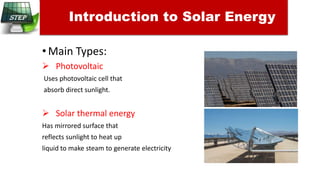
•Main Types:
 Photovoltaic
Uses photovoltaic cell that
absorb direct sunlight.
 Solar thermal energy
Has mirrored surface that
reflects sunlight to heat up
liquid to make steam to generate electricity
Introduction to Solar Energy
Is a device of generating electrical power by converting solar
radiation into direct current
Materials presently used for photovoltaic includes
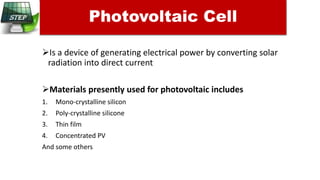
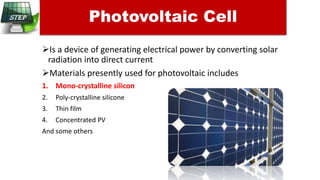
1. Mono-crystalline silicon
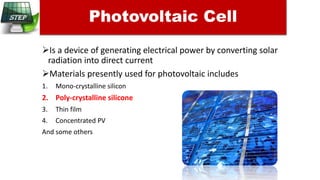
2. Poly-crystalline silicone
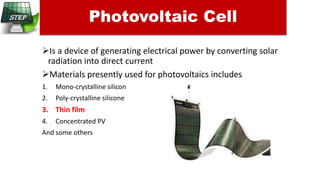
3. Thin film
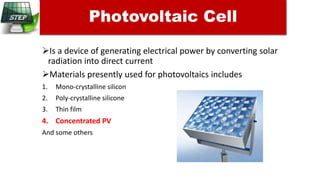
4. Concentrated PV
And some others
Photovoltaic Cell
Is a device of generating electrical power by converting solar
radiation into direct current
Materials presently used for photovoltaic includes
1. Mono-crystalline silicon
2. Poly-crystalline silicone
3. Thin film
4. Concentrated PV
And some others
Photovoltaic Cell
Is a device of generating electrical power by converting solar
radiation into direct current
Materials presently used for photovoltaic includes
1. Mono-crystalline silicon
2. Poly-crystalline silicone
3. Thin film
4. Concentrated PV
And some others
Photovoltaic Cell
Is a device of generating electrical power by converting solar
radiation into direct current
Materials presently used for photovoltaics includes
1. Mono-crystalline silicon
2. Poly-crystalline silicone
3. Thin film
4. Concentrated PV
And some others
Photovoltaic Cell
Is a device of generating electrical power by converting solar
radiation into direct current
Materials presently used for photovoltaics includes
1. Mono-crystalline silicon
2. Poly-crystalline silicone
3. Thin film
4. Concentrated PV
And some others
Photovoltaic Cell
Photovoltaic Cell
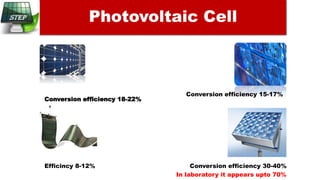
Conversion efficiency 18-22%
Conversion efficiency 15-17%
Efficincy 8-12% Conversion efficiency 30-40%
In laboratory it appears upto 70%
PV panels
Charge controller
PWM(80-85%)
MPPT(95%)
Inverters
Inverters are used to convert DC in to AC.
Mostly sin wave inverters are used.
Batteries
Basic parts of PV system
In solar thermal we use the heat of sun to generate electrical energy
It is called CSP (concentrated solar power)
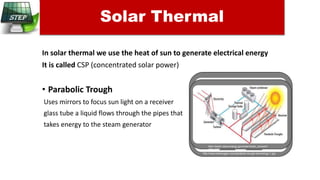
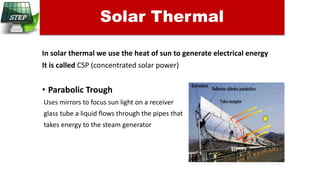
• Parabolic Trough
Uses mirrors to focus sun light on a receiver
glass tube a liquid flows through the pipes that
takes energy to the steam generator
Solar Thermal
http://www.treehugger.com/parabolic-trough-technology-1.jpg
http://www1.eere.energy.gov/solar/linear_concentr
ators.html
In solar thermal we use the heat of sun to generate electrical energy
It is called CSP (concentrated solar power)
• Parabolic Trough
Uses mirrors to focus sun light on a receiver
glass tube a liquid flows through the pipes that
takes energy to the steam generator
Solar Thermal
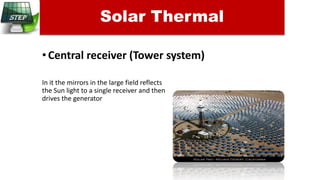
•Central receiver (Tower system)
In it the mirrors in the large field reflects
the Sun light to a single receiver and then
drives the generator
Solar Thermal
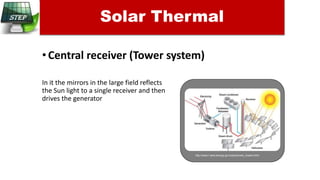
•Central receiver (Tower system)
In it the mirrors in the large field reflects
the Sun light to a single receiver and then
drives the generator
Solar Thermal
http://www1.eere.energy.gov/solar/power_towers.html
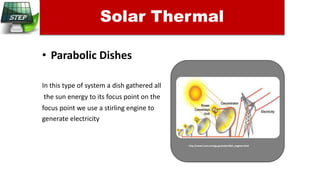
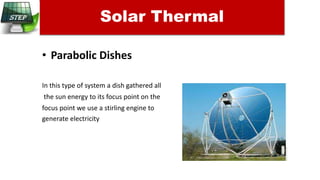
• Parabolic Dishes
In this type of system a dish gathered all
the sun energy to its focus point on the
focus point we use a stirling engine to
generate electricity
Solar Thermal
http://www1.eere.energy.gov/solar/dish_engines.html
• Parabolic Dishes
In this type of system a dish gathered all
the sun energy to its focus point on the
focus point we use a stirling engine to
generate electricity
Solar Thermal
Solar plants all over the world.
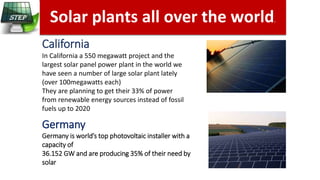
California
In California a 550 megawatt project and the
largest solar panel power plant in the world we
have seen a number of large solar plant lately
(over 100megawatts each)
They are planning to get their 33% of power
from renewable energy sources instead of fossil
fuels up to 2020
Germany
Germany is world’s top photovoltaic installer with a
capacity of
36.152 GW and are producing 35% of their need by
solar
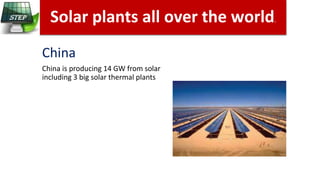
China
China is producing 14 GW from solar
including 3 big solar thermal plants
Solar plants all over the world.
oia
Pakistan
Around 22 solar power projects having a cumulative
capacity of 772.99 MW are in different stages of
development and can achieve commercial operation by
2015-16
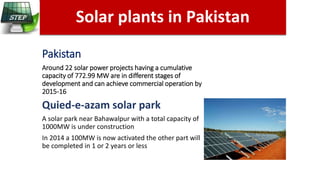
Quied-e-azam solar park
A solar park near Bahawalpur with a total capacity of
1000MW is under construction
In 2014 a 100MW is now activated the other part will
be completed in 1 or 2 years or less
Solar plants in Pakistan
n California
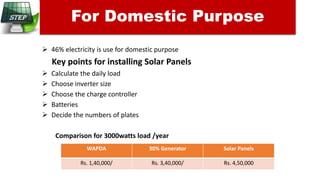
 46% electricity is use for domestic purpose
Key points for installing Solar Panels
 Calculate the daily load
 Choose inverter size
 Choose the charge controller
 Batteries
 Decide the numbers of plates
Comparison for 3000watts load /year
For Domestic Purpose
WAPDA 30% Generator Solar Panels
Rs. 1,40,000/ Rs. 3,40,000/ Rs. 4,50,000
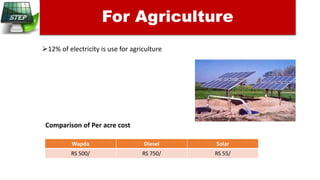
12% of electricity is use for agriculture
Comparison of Per acre cost
For Agriculture
Wapda Diesel Solar
RS 500/ RS 750/ RS 55/
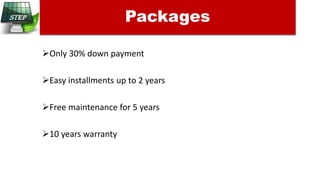
Only 30% down payment
Easy installments up to 2 years
Free maintenance for 5 years
10 years warranty
Packages
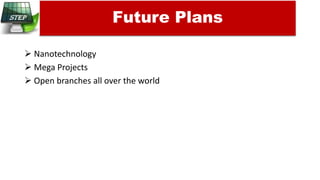
 Nanotechnology
 Mega Projects
 Open branches all over the world
Future Plans
STEP(Solar Technology for Energy Production)

STEP(Solar Technology for Energy Production)

  • 1.
    S T EPSolar Technology for Energy Production
  • 2.
     Hafiz TalhaC.E.O  Tayyab Ali Executive Member  Khurram Shahzad Executive Member  H.M.Sajid Iqbal Executive Member  Naveed Sattar Executive Member  Moneeb Mustafa Executive Member
  • 3.
    Energy crises inPakistan what are the solutions? Why we use solar energy? Electricity Rates Pakistan is sunshine state Introduction to solar Energy What is a Photovoltaic Cell? Types of PV Basic parts of PV solar system What is Solar thermal? Solar plants all over the world. Solar in Pakistan at present Domestic and Agriculture Packages Future Plans Contents 3
  • 4.
    Energy Crisis inPakistan  The shortfall of electricity has reached 3220 mega watt (MW), while electricity production has remained 9630 MW.  Due to the increasing shortfall, the unannounced load-shedding hours have increased manifold.  In urban areas people face 6 to 8 hours load-shedding while in rural areas the power supply cut has reached more than 10 to 14 hours. (increase in Peak demand season)  The current demand of electricity is 12,850 MW, while hydro power production is 2820 MW; thermal resources produce 1800 MW; production through independent power producers (IIPs) is 5030 MW, which amounts total production of 9630 MW
  • 5.
    Solutions??? Hydro power plant +No need to burn fuel + Environment friendly - Costly - Less availability of water - Install far away from load center - High transmission cost and losses Fossil fuels - Very costly - Maintenance cost - Harm full for your environment Nuclear power plant + High energy source + One time investment + Long life - Costly - Dangerous due to radiation - Radioactive waste Solar power + No need to burn fuel + One time investment + long life - Produce energy only in day time
  • 6.
    Cost saving Improved availabilityand quality of power Environmental friendly Start with small system and expand it over time Long life Insulates roof from direct sunlight Good efficiency Job opportunities Peace of mind Good solution for remote areas Why we use Solar Energy??
  • 7.
    Electricity rates YEAR NEPRA(Rs) GOP (Rs) GAP (Rs) 24Feb,2007 5.14 4.25 0.89 01Mar,2008 5.6 4.78 0.82 05Sep,2008 8.42 5.58 2.84 02Jan,2010 10.09 6.67 3.39 25Feb,2011 9.73 7.78 1.95 - Feb 2007-2011, 83% increase in average tariff
  • 8.
    Pakistan is SunShine State Sunshine intensity  Lahore =1720 kwh/sq m  Baluchistan=2200 kwh/sq m  275 sq km of area in Cholistan can cover all demands.
  • 9.
    •Main Types:  Photovoltaic Usesphotovoltaic cell that absorb direct sunlight.  Solar thermal energy Has mirrored surface that reflects sunlight to heat up liquid to make steam to generate electricity Introduction to Solar Energy
  • 10.
    Is a deviceof generating electrical power by converting solar radiation into direct current Materials presently used for photovoltaic includes 1. Mono-crystalline silicon 2. Poly-crystalline silicone 3. Thin film 4. Concentrated PV And some others Photovoltaic Cell
  • 11.
    Is a deviceof generating electrical power by converting solar radiation into direct current Materials presently used for photovoltaic includes 1. Mono-crystalline silicon 2. Poly-crystalline silicone 3. Thin film 4. Concentrated PV And some others Photovoltaic Cell
  • 12.
    Is a deviceof generating electrical power by converting solar radiation into direct current Materials presently used for photovoltaic includes 1. Mono-crystalline silicon 2. Poly-crystalline silicone 3. Thin film 4. Concentrated PV And some others Photovoltaic Cell
  • 13.
    Is a deviceof generating electrical power by converting solar radiation into direct current Materials presently used for photovoltaics includes 1. Mono-crystalline silicon 2. Poly-crystalline silicone 3. Thin film 4. Concentrated PV And some others Photovoltaic Cell
  • 14.
    Is a deviceof generating electrical power by converting solar radiation into direct current Materials presently used for photovoltaics includes 1. Mono-crystalline silicon 2. Poly-crystalline silicone 3. Thin film 4. Concentrated PV And some others Photovoltaic Cell
  • 15.
    Photovoltaic Cell Conversion efficiency18-22% Conversion efficiency 15-17% Efficincy 8-12% Conversion efficiency 30-40% In laboratory it appears upto 70%
  • 16.
    PV panels Charge controller PWM(80-85%) MPPT(95%) Inverters Invertersare used to convert DC in to AC. Mostly sin wave inverters are used. Batteries Basic parts of PV system
  • 17.
    In solar thermalwe use the heat of sun to generate electrical energy It is called CSP (concentrated solar power) • Parabolic Trough Uses mirrors to focus sun light on a receiver glass tube a liquid flows through the pipes that takes energy to the steam generator Solar Thermal http://www.treehugger.com/parabolic-trough-technology-1.jpg http://www1.eere.energy.gov/solar/linear_concentr ators.html
  • 18.
    In solar thermalwe use the heat of sun to generate electrical energy It is called CSP (concentrated solar power) • Parabolic Trough Uses mirrors to focus sun light on a receiver glass tube a liquid flows through the pipes that takes energy to the steam generator Solar Thermal
  • 19.
    •Central receiver (Towersystem) In it the mirrors in the large field reflects the Sun light to a single receiver and then drives the generator Solar Thermal
  • 20.
    •Central receiver (Towersystem) In it the mirrors in the large field reflects the Sun light to a single receiver and then drives the generator Solar Thermal http://www1.eere.energy.gov/solar/power_towers.html
  • 21.
    • Parabolic Dishes Inthis type of system a dish gathered all the sun energy to its focus point on the focus point we use a stirling engine to generate electricity Solar Thermal http://www1.eere.energy.gov/solar/dish_engines.html
  • 22.
    • Parabolic Dishes Inthis type of system a dish gathered all the sun energy to its focus point on the focus point we use a stirling engine to generate electricity Solar Thermal
  • 23.
    Solar plants allover the world. California In California a 550 megawatt project and the largest solar panel power plant in the world we have seen a number of large solar plant lately (over 100megawatts each) They are planning to get their 33% of power from renewable energy sources instead of fossil fuels up to 2020 Germany Germany is world’s top photovoltaic installer with a capacity of 36.152 GW and are producing 35% of their need by solar
  • 24.
    China China is producing14 GW from solar including 3 big solar thermal plants Solar plants all over the world. oia
  • 25.
    Pakistan Around 22 solarpower projects having a cumulative capacity of 772.99 MW are in different stages of development and can achieve commercial operation by 2015-16 Quied-e-azam solar park A solar park near Bahawalpur with a total capacity of 1000MW is under construction In 2014 a 100MW is now activated the other part will be completed in 1 or 2 years or less Solar plants in Pakistan n California
  • 26.
     46% electricityis use for domestic purpose Key points for installing Solar Panels  Calculate the daily load  Choose inverter size  Choose the charge controller  Batteries  Decide the numbers of plates Comparison for 3000watts load /year For Domestic Purpose WAPDA 30% Generator Solar Panels Rs. 1,40,000/ Rs. 3,40,000/ Rs. 4,50,000
  • 27.
    12% of electricityis use for agriculture Comparison of Per acre cost For Agriculture Wapda Diesel Solar RS 500/ RS 750/ RS 55/
  • 28.
    Only 30% downpayment Easy installments up to 2 years Free maintenance for 5 years 10 years warranty Packages
  • 29.
     Nanotechnology  MegaProjects  Open branches all over the world Future Plans