Developing and Sharing
    ^
Case Studies as a Key Component of

           Knowledge Sharing


                                         Harold M. Bell, PMP
                               Advanced Planning and Analysis Division
                                     Office of the Chief Engineer
        Used with Permission


                                          February 9, 2010
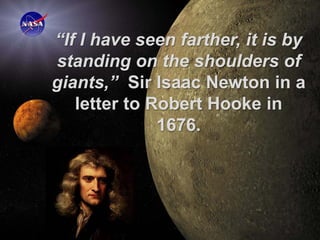
“If I have seen farther, it is by
standing on the shoulders of
giants,” Sir Isaac Newton in a
   letter to Robert Hooke in
              1676.


                                Page 2
Agenda
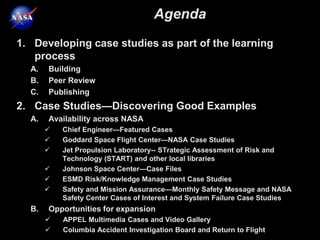
1. Developing case studies as part of the learning
   process
  A.   Building
  B.   Peer Review
  C.   Publishing
2. Case Studies—Discovering Good Examples
  A.   Availability across NASA
          Chief Engineer—Featured Cases
          Goddard Space Flight Center—NASA Case Studies
          Jet Propulsion Laboratory-- STrategic Assessment of Risk and
           Technology (START) and other local libraries
          Johnson Space Center—Case Files
          ESMD Risk/Knowledge Management Case Studies
          Safety and Mission Assurance—Monthly Safety Message and NASA
           Safety Center Cases of Interest and System Failure Case Studies
  B.   Opportunities for expansion
          APPEL Multimedia Cases and Video Gallery
          Columbia Accident Investigation Board and Return to Flight
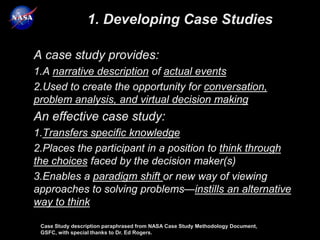
1. Developing Case Studies

A case study provides:
1.A narrative description of actual events
2.Used to create the opportunity for conversation,
problem analysis, and virtual decision making
An effective case study:
1.Transfers specific knowledge
2.Places the participant in a position to think through
the choices faced by the decision maker(s)
3.Enables a paradigm shift or new way of viewing
approaches to solving problems—instills an alternative
way to think

 Case Study description paraphrased from NASA Case Study Methodology Document,
 GSFC, with special thanks to Dr. Ed Rogers.
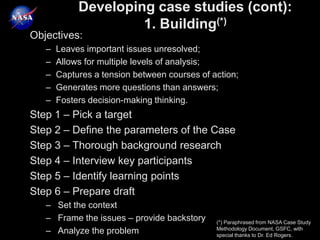
Developing case studies (cont):
                     1. Building(*)
Objectives:
   –   Leaves important issues unresolved;
   –   Allows for multiple levels of analysis;
   –   Captures a tension between courses of action;
   –   Generates more questions than answers;
   –   Fosters decision-making thinking.
Step 1 – Pick a target
Step 2 – Define the parameters of the Case
Step 3 – Thorough background research
Step 4 – Interview key participants
Step 5 – Identify learning points
Step 6 – Prepare draft
   – Set the context
   – Frame the issues – provide backstory     (*) Paraphrased from NASA Case Study
                                              Methodology Document, GSFC, with
   – Analyze the problem                      special thanks to Dr. Ed Rogers.
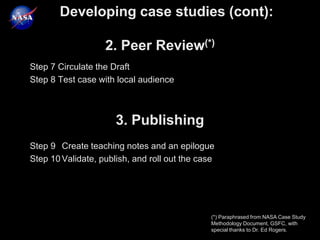
Developing case studies (cont):

                   2. Peer Review(*)
Step 7 Circulate the Draft
Step 8 Test case with local audience


                      3. Publishing
Step 9 Create teaching notes and an epilogue
Step 10 Validate, publish, and roll out the case


                                               (*) Paraphrased from NASA Case Study
                                               Methodology Document, GSFC, with
                                               special thanks to Dr. Ed Rogers.
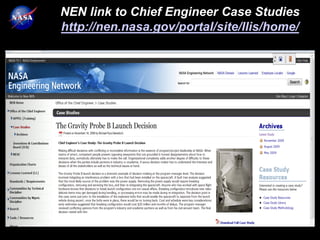
NEN link to Chief Engineer Case Studies
http://nen.nasa.gov/portal/site/llis/home/
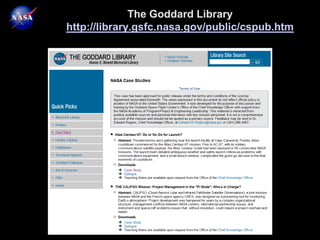
The Goddard Library
http://library.gsfc.nasa.gov/public/cspub.htm
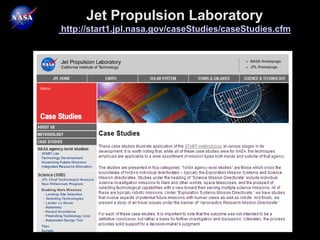
Jet Propulsion Laboratory
http://start1.jpl.nasa.gov/caseStudies/caseStudies.cfm
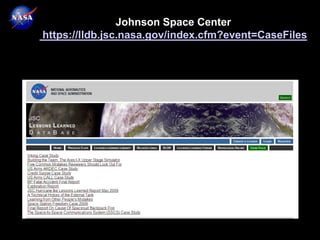
Johnson Space Center
https://lldb.jsc.nasa.gov/index.cfm?event=CaseFiles
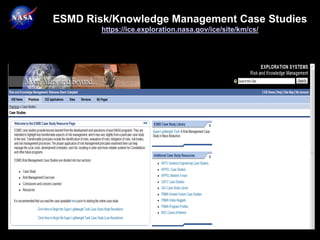
ESMD Risk/Knowledge Management Case Studies
        https://ice.exploration.nasa.gov/ice/site/km/cs/
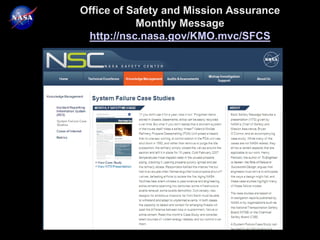
Office of Safety and Mission Assurance
           Monthly Message
 http://nsc.nasa.gov/KMO.mvc/SFCS
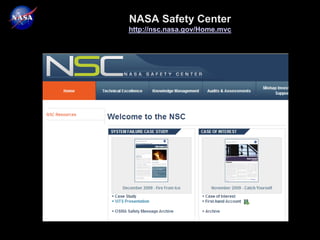
NASA Safety Center
http://nsc.nasa.gov/Home.mvc
Opportunities for Expansion

• Office of the Chief Engineer adds Case Studies:
  –   Chief Engineer features a new case study each quarter
  –   APPEL plans to initiate about 10 new case studies annually
  –   Centers strongly encouraged to recommend topics and drafts
  –   Professional staff available through APPEL for development, editing and
      formatting.

• NASA Safety Center adds Case Studies
  – Chief of Safety and Mission Assurance features a monthly message and
    presents at the Administrators ViTS
  – NSC prepares case studies by drawing from mishap reports and industry
    events

• Centers and Mission Directorates create
  knowledge sharing materials as well
Opportunities for Expansion (cont)


Case Studies do not always have to
         be in written form

– APPEL Multimedia Case Studies and Video Gallery

 http://www.nasa.gov/offices/oce/appel/knowledge/publications/case_studies.html

     http://www.nasa.gov/offices/oce/appel/knowledge/multimedia/index.html


– Graphic and Video interactive presentation

                  Matt Mellis Columbia Accident Investigation
                               Example Follows
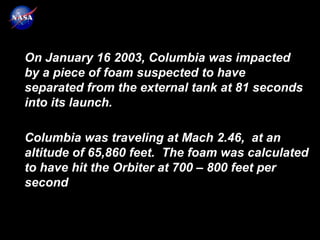
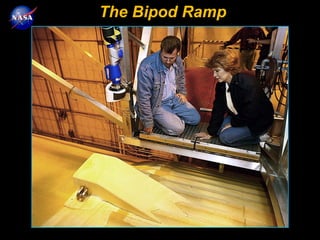
On January 16 2003, Columbia was impacted
by a piece of foam suspected to have
separated from the external tank at 81 seconds
into its launch.

Columbia was traveling at Mach 2.46, at an
altitude of 65,860 feet. The foam was calculated
to have hit the Orbiter at 700 – 800 feet per
second
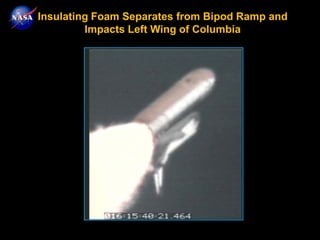
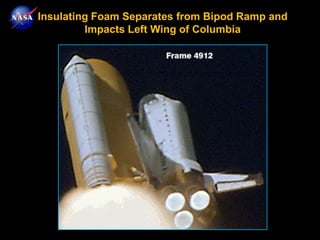
Insulating Foam Separates from Bipod Ramp and
         Impacts Left Wing of Columbia
Insulating Foam Separates from Bipod Ramp and
         Impacts Left Wing of Columbia
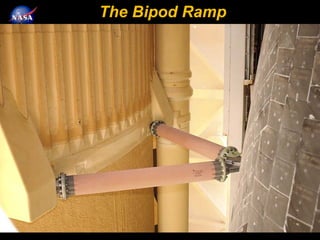
The Bipod Ramp
The Bipod Ramp
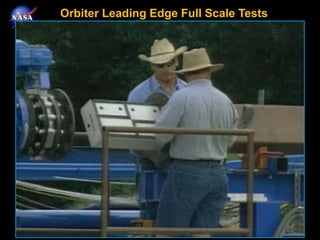
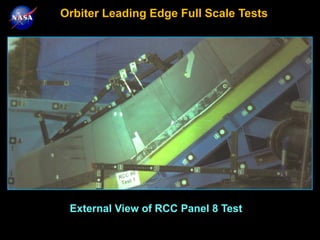
Orbiter Leading Edge Full Scale Tests


 External View of RCC Panel 8 Test
Opportunities for Expansion (cont)


OCE and OSMA jointly Issued a letter to
 encourage NASA leadership to support
 our employees in documenting lessons
   and increasing knowledge sharing
 across the workforce. It is a “must do”.


   http://nen.nasa.gov/nenfileupload/files/lessons_learned_ltr_from_Mike_R.pdf
Page 25
Page 26
Importance of developing and sharing Case
         Studies as key component of Knowledge Sharing

Synopsis: This presentation identifies the myriad of sources in developing Case Studies
and Lessons Learned in NASA, some of the databases where they are stored and best
practices for developing materials to ensure quality of product and discovery of
materials.

Abstract: The need to leverage the experience gained (both successful and less than
successful) has never been more important to NASA as major new robotic and manned
space flight initiatives loom large in our future. Knowledge sharing is often founded on
well written, high value lessons learned from NASA’s robotic and human spaceflight
missions. Lessons and related case study work play a significant role in retention of
historical knowledge and serve to bridge across generations especially as many older
employees retire. NASA needs to continue to document specific major operational
lessons learned in such a way that the lessons learned can serve as a source to facilitate
training for the next generation of space workers. We have unparalleled access to data
not only with NASA but from other Government Agencies and scientific databases. This
session will emphasize the importance of timely preparation and submission of high
quality lessons learned and case studies, sources of information for creation,
submission, archival, and identification of best practices for broad discovery of the
material once made available for use. The session will also include some thought on
OCE’s consideration for adding an annual data call to all NASA centers to develop
approximately 10 additional cases per year specifically focused on, but not limited to,
human space flight knowledge sharing and professional development.

Hal bell

  • 1.
    Developing and Sharing ^ Case Studies as a Key Component of Knowledge Sharing Harold M. Bell, PMP Advanced Planning and Analysis Division Office of the Chief Engineer Used with Permission February 9, 2010
  • 2.
    “If I haveseen farther, it is by standing on the shoulders of giants,” Sir Isaac Newton in a letter to Robert Hooke in 1676. Page 2
  • 3.
    Agenda 1. Developing casestudies as part of the learning process A. Building B. Peer Review C. Publishing 2. Case Studies—Discovering Good Examples A. Availability across NASA  Chief Engineer—Featured Cases  Goddard Space Flight Center—NASA Case Studies  Jet Propulsion Laboratory-- STrategic Assessment of Risk and Technology (START) and other local libraries  Johnson Space Center—Case Files  ESMD Risk/Knowledge Management Case Studies  Safety and Mission Assurance—Monthly Safety Message and NASA Safety Center Cases of Interest and System Failure Case Studies B. Opportunities for expansion  APPEL Multimedia Cases and Video Gallery  Columbia Accident Investigation Board and Return to Flight
  • 4.
    1. Developing CaseStudies A case study provides: 1.A narrative description of actual events 2.Used to create the opportunity for conversation, problem analysis, and virtual decision making An effective case study: 1.Transfers specific knowledge 2.Places the participant in a position to think through the choices faced by the decision maker(s) 3.Enables a paradigm shift or new way of viewing approaches to solving problems—instills an alternative way to think Case Study description paraphrased from NASA Case Study Methodology Document, GSFC, with special thanks to Dr. Ed Rogers.
  • 5.
    Developing case studies(cont): 1. Building(*) Objectives: – Leaves important issues unresolved; – Allows for multiple levels of analysis; – Captures a tension between courses of action; – Generates more questions than answers; – Fosters decision-making thinking. Step 1 – Pick a target Step 2 – Define the parameters of the Case Step 3 – Thorough background research Step 4 – Interview key participants Step 5 – Identify learning points Step 6 – Prepare draft – Set the context – Frame the issues – provide backstory (*) Paraphrased from NASA Case Study Methodology Document, GSFC, with – Analyze the problem special thanks to Dr. Ed Rogers.
  • 6.
    Developing case studies(cont): 2. Peer Review(*) Step 7 Circulate the Draft Step 8 Test case with local audience 3. Publishing Step 9 Create teaching notes and an epilogue Step 10 Validate, publish, and roll out the case (*) Paraphrased from NASA Case Study Methodology Document, GSFC, with special thanks to Dr. Ed Rogers.
  • 7.
    NEN link toChief Engineer Case Studies http://nen.nasa.gov/portal/site/llis/home/
  • 8.
  • 9.
  • 10.
  • 11.
    ESMD Risk/Knowledge ManagementCase Studies https://ice.exploration.nasa.gov/ice/site/km/cs/
  • 12.
    Office of Safetyand Mission Assurance Monthly Message http://nsc.nasa.gov/KMO.mvc/SFCS
  • 13.
  • 14.
    Opportunities for Expansion •Office of the Chief Engineer adds Case Studies: – Chief Engineer features a new case study each quarter – APPEL plans to initiate about 10 new case studies annually – Centers strongly encouraged to recommend topics and drafts – Professional staff available through APPEL for development, editing and formatting. • NASA Safety Center adds Case Studies – Chief of Safety and Mission Assurance features a monthly message and presents at the Administrators ViTS – NSC prepares case studies by drawing from mishap reports and industry events • Centers and Mission Directorates create knowledge sharing materials as well
  • 15.
    Opportunities for Expansion(cont) Case Studies do not always have to be in written form – APPEL Multimedia Case Studies and Video Gallery http://www.nasa.gov/offices/oce/appel/knowledge/publications/case_studies.html http://www.nasa.gov/offices/oce/appel/knowledge/multimedia/index.html – Graphic and Video interactive presentation Matt Mellis Columbia Accident Investigation Example Follows
  • 16.
    On January 162003, Columbia was impacted by a piece of foam suspected to have separated from the external tank at 81 seconds into its launch. Columbia was traveling at Mach 2.46, at an altitude of 65,860 feet. The foam was calculated to have hit the Orbiter at 700 – 800 feet per second
  • 17.
    Insulating Foam Separatesfrom Bipod Ramp and Impacts Left Wing of Columbia
  • 18.
    Insulating Foam Separatesfrom Bipod Ramp and Impacts Left Wing of Columbia
  • 19.
  • 20.
  • 21.
    Orbiter Leading EdgeFull Scale Tests
  • 22.
    Orbiter Leading EdgeFull Scale Tests External View of RCC Panel 8 Test
  • 23.
    Opportunities for Expansion(cont) OCE and OSMA jointly Issued a letter to encourage NASA leadership to support our employees in documenting lessons and increasing knowledge sharing across the workforce. It is a “must do”. http://nen.nasa.gov/nenfileupload/files/lessons_learned_ltr_from_Mike_R.pdf
  • 24.
  • 25.
  • 26.
    Importance of developingand sharing Case Studies as key component of Knowledge Sharing Synopsis: This presentation identifies the myriad of sources in developing Case Studies and Lessons Learned in NASA, some of the databases where they are stored and best practices for developing materials to ensure quality of product and discovery of materials. Abstract: The need to leverage the experience gained (both successful and less than successful) has never been more important to NASA as major new robotic and manned space flight initiatives loom large in our future. Knowledge sharing is often founded on well written, high value lessons learned from NASA’s robotic and human spaceflight missions. Lessons and related case study work play a significant role in retention of historical knowledge and serve to bridge across generations especially as many older employees retire. NASA needs to continue to document specific major operational lessons learned in such a way that the lessons learned can serve as a source to facilitate training for the next generation of space workers. We have unparalleled access to data not only with NASA but from other Government Agencies and scientific databases. This session will emphasize the importance of timely preparation and submission of high quality lessons learned and case studies, sources of information for creation, submission, archival, and identification of best practices for broad discovery of the material once made available for use. The session will also include some thought on OCE’s consideration for adding an annual data call to all NASA centers to develop approximately 10 additional cases per year specifically focused on, but not limited to, human space flight knowledge sharing and professional development.