Arthur B. Chmielewski
                                            Project Manager
                                       Jet Propulsion Laboratory
                                   California Institute of Technology


            Presentation at the 7th NASA Project Management Challenge
                                  February 9, 2010
Used with permission
Copyright 2010 California Institute of Technology                       1
Many results presented here are based on the research
conducted by Dr. David Ullman of Robust Decisions Inc. for the
Space Technology 6 mission.

McRisk studies were conducted by Charles Garner, JPL


                                                                 2
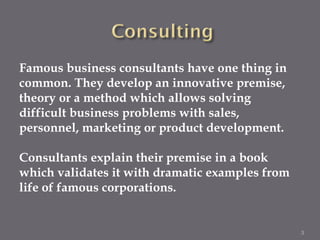
Famous business consultants have one thing in
common. They develop an innovative premise,
theory or a method which allows solving
difficult business problems with sales,
personnel, marketing or product development.

Consultants explain their premise in a book
which validates it with dramatic examples from
life of famous corporations.


                                                 3
We NASA managers, highly technically oriented, feel that the
world of business consulting - marketing, sales or mergers -
does not overlap with ours.

   • Can the method of selection of TV commercials for
   American Idol help with vacuum testing of a deep space
   probe?
   • Could iPod sales be related to cost estimating for an
   asteroid lander?

Not only is the answer to these questions “yes” but the wisdom
of top business consultants may be critical in the fight against
the biggest aerospace plague:


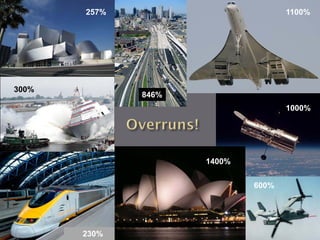
                                                             5
257%                                 1100%


300%
              846%
                                            1000%


                             1400%


                                     600%


       230%          1400%                     6
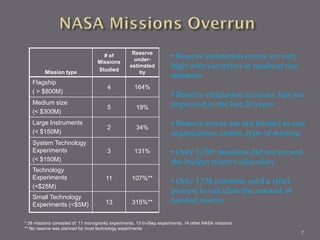
# of           Reserve
                                                      under-            • Reserve estimation errors are very
                                    Missions
                                    Studied
                                                    estimated           high with exception of medium size
          Mission type                                  by
                                                                        missions
   Flagship
                                         4            164%
   ( > $800M)
                                                                        • Reserve estimation accuracy has not
   Medium size
                                         5             19%              improved in the last 20 years
   (< $300M)
   Large Instruments
                                         2             34%
                                                                        • Reserve errors are not limited to one
   (< $150M)                                                            organization, center, type of mission
   System Technology
   Experiments                           3            131%              • Only 3/38* missions did not exceed
   (< $150M)                                                            the budget reserve allocation
   Technology
   Experiments                          11           107%**
                                                                        • Only 1/38 missions used a strict
   (<$25M)
                                                                        process to calculate the amount of
   Small Technology
   Experiments (<$5M)                   13           315%**             needed reserve

* 38 missions consisted of: 11 microgravity experiments, 13 In-Step experiments, 14 other NASA missions
** No reserve was planned for most technology experiments
                                                                                                               7
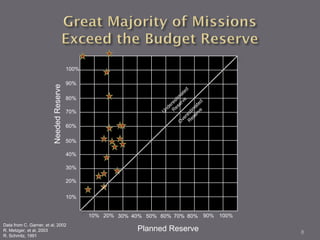
100%

                                          90%
                         Needed Reserve


                                          80%

                                          70%

                                          60%

                                          50%

                                          40%

                                          30%

                                          20%


                                          10%


                                                 10% 20% 30% 40% 50% 60% 70% 80% 90% 100%
Data from C. Garner, et al, 2002
R. Metzger, et al, 2003                                       Planned Reserve               8
R. Schmitz, 1991
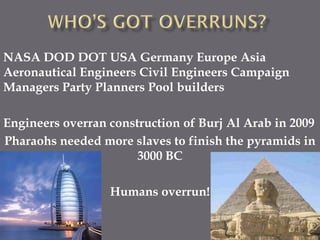
NASA DOD DOT USA Germany Europe Asia
Aeronautical Engineers Civil Engineers Campaign
Managers Party Planners Pool builders

Engineers overran construction of Burj Al Arab in 2009
Pharaohs needed more slaves to finish the pyramids in
                       3000 BC

                  Humans overrun!


                                                   9
    BUT WHY?

    THESE ARE THE USUAL POST-MORTEM
     ANSWERS:
         Poor communication
         Underestimated challenges
         Funding interruption
         Bad things happened
         Unknown unknowns popped up
         Requirements not well understood
         Reserves not adequate
         Initial cost estimates not accurate
         Strategic misrepresentation of cost*
* A real phrase from a DOD cost analysis report
                                                  10
   We use data bases for cost estimates
   We have cost reviews
   We manage risks
   We use processes
   We use earned value
   We use parametric studies
   We try and try and try and…

              …WE STILL OVERRUN!
                                           11
Every overrun occurs at the end of the project but
  originates years earlier with the first entry into
  the Excel preliminary cost estimate spreadsheet.

  This first entry is frequently wrong because its
  author is under influence of many mostly
  subconscious psychological factors.

  If we could understand the psychology of cost
  estimates, then maybe we could improve their
  accuracy!

                                                       12
   NASA scientists and engineers know well that
    psychology does not play any role in their
    precise, factual, highly technical cost estimating
    based on precise facts.
   That is a great news because according to top
    consultants psychology plays a major role in
    business at every level. Let’s look at the
    psychological effects we are immune to.


                                                   13
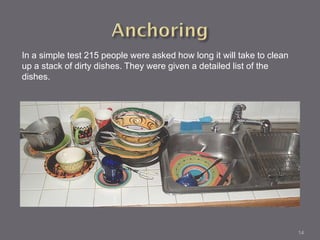
In a simple test 215 people were asked how long it will take to clean
up a stack of dirty dishes. They were given a detailed list of the
dishes.


                                                                        14
One group was asked:

The kitchen needs to be clean. Estimate how many
 minutes it will take you?

Another group was asked:

The kitchen needs to be clean in 15 min. Estimate how
 many minutes it will take you?


                                                        15
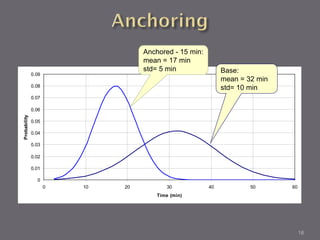
Anchored - 15 min:
                                   mean = 17 min
                                   std= 5 min                Base:
              0.09
                                                             mean = 32 min
              0.08                                           std= 10 min
              0.07

              0.06
Probability


              0.05

              0.04

              0.03

              0.02

              0.01

                0
                     0   10   20          30            40           50      60
                                       Time (min)


                                                                                  16
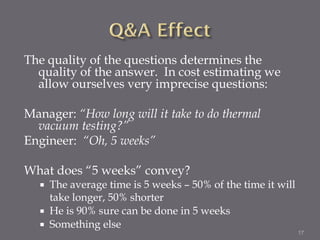
The quality of the questions determines the
  quality of the answer. In cost estimating we
  allow ourselves very imprecise questions:

Manager: “How long will it take to do thermal
  vacuum testing?”
Engineer: “Oh, 5 weeks”

What does “5 weeks” convey?
     The average time is 5 weeks – 50% of the time it will
      take longer, 50% shorter
     He is 90% sure can be done in 5 weeks
     Something else
                                                              17
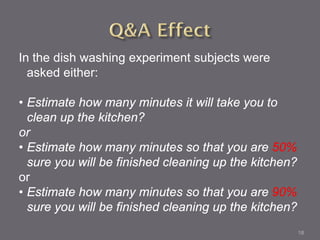
In the dish washing experiment subjects were
  asked either:

• Estimate how many minutes it will take you to
  clean up the kitchen?
or
• Estimate how many minutes so that you are 50%
  sure you will be finished cleaning up the kitchen?
or
• Estimate how many minutes so that you are 90%
  sure you will be finished cleaning up the kitchen?
                                                       18
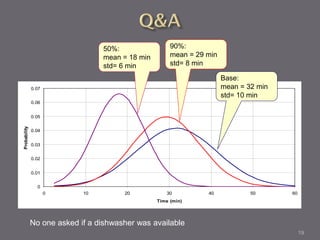
50%:                 90%:
                                 mean = 18 min        mean = 29 min
                                 std= 6 min           std= 8 min

                                                                      Base:
              0.07                                                    mean = 32 min
                                                                      std= 10 min
              0.06


              0.05
Probability


              0.04


              0.03


              0.02


              0.01


                0
                     0      10         20           30          40            50      60
                                                 Time (min)


              No one asked if a dishwasher was available
                                                                                           19
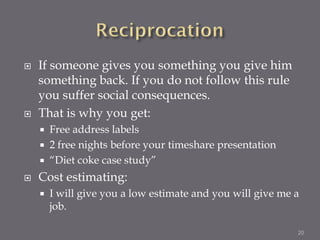
   If someone gives you something you give him
    something back. If you do not follow this rule
    you suffer social consequences.
   That is why you get:
       Free address labels
       2 free nights before your timeshare presentation
       “Diet coke case study”
   Cost estimating:
       I will give you a low estimate and you will give me a
        job.

                                                            20
   My second offer is so much better than the first
    that it cannot be declined.
       The zoo trip study


   Cost estimating:
       After the initial cost estimate is too high “scrub” the
        costs and, voila, get a much lower number
       Identify descopes to feel better about strained cost
        estimate


                                                                  21
   There is a desire within human beings to be consistent
    with their actions, beliefs and attitudes. It is easier and
    quicker to make decisions based on our past conduct.
       Timeshare salesmen ask first if you like vacations
       Wii case study
   In cost estimating the engineer is first asked to give a
    quick estimate. When asked later to revise it produces
    a similar result.


                                                                  22
   We conclude correctness by watching accepted
    practices. This especially applies under conditions of
    uncertainty and similarity.
       4/5 dentist recommend this gum for patients who chew gum
       “I like football and I switched to ATT.”


   In cost estimating we frequently hear:
       “Everybody in our section does cost estimating that way.”
       “We normally do not list any programmatic risks.”
       “The last mission had only 1 FTE for electronics.”


                                                                    23
   We like people who are similar to us. Liking
    greatly increases compliance. It is
    subconscious.
       Tiger Woods sells Buicks
       Student fund raisers
       Car ads with models
   Cost estimating:
       Is the cost estimate affected by who requests it and
        how the request is made?
       Is it affected by who will be your boss on the project
        and if you like her?
                                                                 24
   Subjects comply with requests from the
    perceived authority. An authority possesses a
    high level of knowledge and experience and
    may benefit the subject.
       Robert Young, MD Sanka commercials
   Cost estimating:
       The manager asks: “Can you see if my $250k bogey
        is a good estimate for this radiation test?”
       Would a cost estimate request from the Center
        Director produce a different value than from a
        colleague?
                                                           25
   People assign more value to anything when it
    is scarcer. This principle also applies to
    information.
       Limited, final release of a Disney movie
       Only 50 tickets remain…
   In cost estimating:
       How does instrument development compare for a
        competed award vs. internal development
       How does the cost estimate compare when the
        engineer is swamped with jobs vs. worried about no
        new assignment on the horizon?
                                                             26
   People get a lot of comfort from detailed plans.
    The more detail, the more comfort and feeling
    of accomplishment and safety.
   Trouble is that plans rarely work and need to
    be updated so frequently that instead of project
    guidance they become project drag.
   Costs:
       Elaborate plans can increase costs
       Guiding principles are better than plans
       Simple laws frequently are better than processes

                                                           27
   Managers tend to be fascinated with how to do
    things, how to change things, how to develop
    processes. Frequently “hows” take precedence
    of “whats”. What is our business, what is our
    product, what is our uniqueness.
       Home Depot’s labor cutting initiative
       McDonalds – the largest leasing company
   In costing:
       We focus on following a process
       We miss What is the meaning of each number and
        What are the assumptions
                                                         28
   Companies trust their experienced personnel to
    develop similar products.
       Bad experiences are short term, good memories are
        long term due to location in different parts of brain
       XBOX 360 vs. Zoom vs. iPod case study
   In developing cost estimates experts assume
    that old experiences are applicable
       “Heritage”, “small modification”, “off-the-shelf” are
        frequently words of doom


                                                                29
   Complex human psychology is at play in cost
    estimating
   The effect of psychology on cost is rarely
    acknowledged and thus pervasive
   Psychological effects are subconscious and
    hard to correct
   Psychological effects skew initial cost inputs
    which build up with the number of estimators
    and subsystems

                                                     30
31
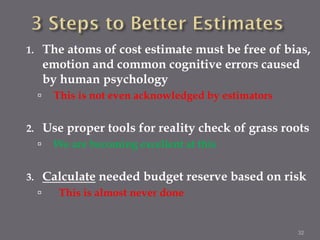
1.       The atoms of cost estimate must be free of bias,
         emotion and common cognitive errors caused
         by human psychology
          This is not even acknowledged by estimators


2.       Use proper tools for reality check of grass roots
          We are becoming excellent at this


3.       Calculate needed budget reserve based on risk
           This is almost never done


                                                         32
   JPL and Robust Decisions Inc. are developing a
    software tool which calculates budget reserve based on
    risk.
   The tool removes the effects of human psychology by
    asking precise cost questions from a menu of “worry
    generators”.
   The tool has been validated by 6 NASA instrument
    developments.
   We would welcome the opportunity to use it on your
    mission.


                                                         33
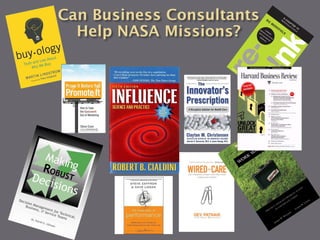
Making Robust Decisions, David G. Ullman
Wired to Care, Dev Patnaik
Work Wanted, James W. Walker, Linda H. Lewis
Influence: Science and Practice, Robert Cialdini
The Three Laws of Performance, Steve Zaffron, Dave Logan
Buyology: Truth and Lies about Why We Buy, Martin Lindstrom, Paco Underhill
The Innovator’s Prescription, Clayton M. Christensen, Jerome H. Grossman, J.
    Wong
Prove It before You Promote It, Steve Cuno, Michael Shermer
Harvard Business Review, Jan-Dec 2009
Rethink: A Business Manifesto for Cutting Costs and Boosting Innovation, Ric
    Merrifield


                                                                        34

Art c

  • 1.
    Arthur B. Chmielewski Project Manager Jet Propulsion Laboratory California Institute of Technology Presentation at the 7th NASA Project Management Challenge February 9, 2010 Used with permission Copyright 2010 California Institute of Technology 1
  • 2.
    Many results presentedhere are based on the research conducted by Dr. David Ullman of Robust Decisions Inc. for the Space Technology 6 mission. McRisk studies were conducted by Charles Garner, JPL 2
  • 3.
    Famous business consultantshave one thing in common. They develop an innovative premise, theory or a method which allows solving difficult business problems with sales, personnel, marketing or product development. Consultants explain their premise in a book which validates it with dramatic examples from life of famous corporations. 3
  • 5.
    We NASA managers,highly technically oriented, feel that the world of business consulting - marketing, sales or mergers - does not overlap with ours. • Can the method of selection of TV commercials for American Idol help with vacuum testing of a deep space probe? • Could iPod sales be related to cost estimating for an asteroid lander? Not only is the answer to these questions “yes” but the wisdom of top business consultants may be critical in the fight against the biggest aerospace plague: 5
  • 6.
    257% 1100% 300% 846% 1000% 1400% 600% 230% 1400% 6
  • 7.
    # of Reserve under- • Reserve estimation errors are very Missions Studied estimated high with exception of medium size Mission type by missions Flagship 4 164% ( > $800M) • Reserve estimation accuracy has not Medium size 5 19% improved in the last 20 years (< $300M) Large Instruments 2 34% • Reserve errors are not limited to one (< $150M) organization, center, type of mission System Technology Experiments 3 131% • Only 3/38* missions did not exceed (< $150M) the budget reserve allocation Technology Experiments 11 107%** • Only 1/38 missions used a strict (<$25M) process to calculate the amount of Small Technology Experiments (<$5M) 13 315%** needed reserve * 38 missions consisted of: 11 microgravity experiments, 13 In-Step experiments, 14 other NASA missions ** No reserve was planned for most technology experiments 7
  • 8.
    100% 90% Needed Reserve 80% 70% 60% 50% 40% 30% 20% 10% 10% 20% 30% 40% 50% 60% 70% 80% 90% 100% Data from C. Garner, et al, 2002 R. Metzger, et al, 2003 Planned Reserve 8 R. Schmitz, 1991
  • 9.
    NASA DOD DOTUSA Germany Europe Asia Aeronautical Engineers Civil Engineers Campaign Managers Party Planners Pool builders Engineers overran construction of Burj Al Arab in 2009 Pharaohs needed more slaves to finish the pyramids in 3000 BC Humans overrun! 9
  • 10.
    BUT WHY?  THESE ARE THE USUAL POST-MORTEM ANSWERS:  Poor communication  Underestimated challenges  Funding interruption  Bad things happened  Unknown unknowns popped up  Requirements not well understood  Reserves not adequate  Initial cost estimates not accurate  Strategic misrepresentation of cost* * A real phrase from a DOD cost analysis report 10
  • 11.
    We use data bases for cost estimates  We have cost reviews  We manage risks  We use processes  We use earned value  We use parametric studies  We try and try and try and… …WE STILL OVERRUN! 11
  • 12.
    Every overrun occursat the end of the project but originates years earlier with the first entry into the Excel preliminary cost estimate spreadsheet. This first entry is frequently wrong because its author is under influence of many mostly subconscious psychological factors. If we could understand the psychology of cost estimates, then maybe we could improve their accuracy! 12
  • 13.
    NASA scientists and engineers know well that psychology does not play any role in their precise, factual, highly technical cost estimating based on precise facts.  That is a great news because according to top consultants psychology plays a major role in business at every level. Let’s look at the psychological effects we are immune to. 13
  • 14.
    In a simpletest 215 people were asked how long it will take to clean up a stack of dirty dishes. They were given a detailed list of the dishes. 14
  • 15.
    One group wasasked: The kitchen needs to be clean. Estimate how many minutes it will take you? Another group was asked: The kitchen needs to be clean in 15 min. Estimate how many minutes it will take you? 15
  • 16.
    Anchored - 15min: mean = 17 min std= 5 min Base: 0.09 mean = 32 min 0.08 std= 10 min 0.07 0.06 Probability 0.05 0.04 0.03 0.02 0.01 0 0 10 20 30 40 50 60 Time (min) 16
  • 17.
    The quality ofthe questions determines the quality of the answer. In cost estimating we allow ourselves very imprecise questions: Manager: “How long will it take to do thermal vacuum testing?” Engineer: “Oh, 5 weeks” What does “5 weeks” convey?  The average time is 5 weeks – 50% of the time it will take longer, 50% shorter  He is 90% sure can be done in 5 weeks  Something else 17
  • 18.
    In the dishwashing experiment subjects were asked either: • Estimate how many minutes it will take you to clean up the kitchen? or • Estimate how many minutes so that you are 50% sure you will be finished cleaning up the kitchen? or • Estimate how many minutes so that you are 90% sure you will be finished cleaning up the kitchen? 18
  • 19.
    50%: 90%: mean = 18 min mean = 29 min std= 6 min std= 8 min Base: 0.07 mean = 32 min std= 10 min 0.06 0.05 Probability 0.04 0.03 0.02 0.01 0 0 10 20 30 40 50 60 Time (min) No one asked if a dishwasher was available 19
  • 20.
    If someone gives you something you give him something back. If you do not follow this rule you suffer social consequences.  That is why you get:  Free address labels  2 free nights before your timeshare presentation  “Diet coke case study”  Cost estimating:  I will give you a low estimate and you will give me a job. 20
  • 21.
    My second offer is so much better than the first that it cannot be declined.  The zoo trip study  Cost estimating:  After the initial cost estimate is too high “scrub” the costs and, voila, get a much lower number  Identify descopes to feel better about strained cost estimate 21
  • 22.
    There is a desire within human beings to be consistent with their actions, beliefs and attitudes. It is easier and quicker to make decisions based on our past conduct.  Timeshare salesmen ask first if you like vacations  Wii case study  In cost estimating the engineer is first asked to give a quick estimate. When asked later to revise it produces a similar result. 22
  • 23.
    We conclude correctness by watching accepted practices. This especially applies under conditions of uncertainty and similarity.  4/5 dentist recommend this gum for patients who chew gum  “I like football and I switched to ATT.”  In cost estimating we frequently hear:  “Everybody in our section does cost estimating that way.”  “We normally do not list any programmatic risks.”  “The last mission had only 1 FTE for electronics.” 23
  • 24.
    We like people who are similar to us. Liking greatly increases compliance. It is subconscious.  Tiger Woods sells Buicks  Student fund raisers  Car ads with models  Cost estimating:  Is the cost estimate affected by who requests it and how the request is made?  Is it affected by who will be your boss on the project and if you like her? 24
  • 25.
    Subjects comply with requests from the perceived authority. An authority possesses a high level of knowledge and experience and may benefit the subject.  Robert Young, MD Sanka commercials  Cost estimating:  The manager asks: “Can you see if my $250k bogey is a good estimate for this radiation test?”  Would a cost estimate request from the Center Director produce a different value than from a colleague? 25
  • 26.
    People assign more value to anything when it is scarcer. This principle also applies to information.  Limited, final release of a Disney movie  Only 50 tickets remain…  In cost estimating:  How does instrument development compare for a competed award vs. internal development  How does the cost estimate compare when the engineer is swamped with jobs vs. worried about no new assignment on the horizon? 26
  • 27.
    People get a lot of comfort from detailed plans. The more detail, the more comfort and feeling of accomplishment and safety.  Trouble is that plans rarely work and need to be updated so frequently that instead of project guidance they become project drag.  Costs:  Elaborate plans can increase costs  Guiding principles are better than plans  Simple laws frequently are better than processes 27
  • 28.
    Managers tend to be fascinated with how to do things, how to change things, how to develop processes. Frequently “hows” take precedence of “whats”. What is our business, what is our product, what is our uniqueness.  Home Depot’s labor cutting initiative  McDonalds – the largest leasing company  In costing:  We focus on following a process  We miss What is the meaning of each number and What are the assumptions 28
  • 29.
    Companies trust their experienced personnel to develop similar products.  Bad experiences are short term, good memories are long term due to location in different parts of brain  XBOX 360 vs. Zoom vs. iPod case study  In developing cost estimates experts assume that old experiences are applicable  “Heritage”, “small modification”, “off-the-shelf” are frequently words of doom 29
  • 30.
    Complex human psychology is at play in cost estimating  The effect of psychology on cost is rarely acknowledged and thus pervasive  Psychological effects are subconscious and hard to correct  Psychological effects skew initial cost inputs which build up with the number of estimators and subsystems 30
  • 31.
  • 32.
    1. The atoms of cost estimate must be free of bias, emotion and common cognitive errors caused by human psychology  This is not even acknowledged by estimators 2. Use proper tools for reality check of grass roots  We are becoming excellent at this 3. Calculate needed budget reserve based on risk  This is almost never done 32
  • 33.
    JPL and Robust Decisions Inc. are developing a software tool which calculates budget reserve based on risk.  The tool removes the effects of human psychology by asking precise cost questions from a menu of “worry generators”.  The tool has been validated by 6 NASA instrument developments.  We would welcome the opportunity to use it on your mission. 33
  • 34.
    Making Robust Decisions,David G. Ullman Wired to Care, Dev Patnaik Work Wanted, James W. Walker, Linda H. Lewis Influence: Science and Practice, Robert Cialdini The Three Laws of Performance, Steve Zaffron, Dave Logan Buyology: Truth and Lies about Why We Buy, Martin Lindstrom, Paco Underhill The Innovator’s Prescription, Clayton M. Christensen, Jerome H. Grossman, J. Wong Prove It before You Promote It, Steve Cuno, Michael Shermer Harvard Business Review, Jan-Dec 2009 Rethink: A Business Manifesto for Cutting Costs and Boosting Innovation, Ric Merrifield 34