The computer helps the learner in performing
routine work tasks. It can function as a
typewriter, a calculator, a drawing canvas, a
filing system, and the like. Software programs
include word processors, graphic design,
packages, presentation software, databases,
spreadsheets and telecommunication/internet
tools.
•The roles of the computer and student that
we see in traditional computr-aided instruction
are reversed. The computer becomes the
“learner” while the students become “teacher”.
Multimedia combines multiple forms of visual
and audio information to create a multi-
sensory presentation.Multimedia is a
combination of different media types into a
single delivery system under computer control,
such as:
* Video- videotape, videodisc and DVD
* Graphics- slides, filmstrips and
transparencies
* Audio- audiotapes and audio CD's
*Text- book and computer screen
* Real objects and Models- tools, plants or
artifacts
The chief advantage of the computer is
interactivity. The learner is involved as it
required to respond.
Research literature also states that student
like working, with computers because
computers;
1. are infinitely patient, never get tired,
frustrated and or angry
2. never forget to correct or praise and do
not embarrass students who make mistakes
3. are self-paced, individualize learning, and
allow students to work privately
4. make it possible to expirement with
different options
5. are excellent for dill and practice and give
immediate feedback
6. are more objective than teachers
7. free teachers for more meaningful contact
with students
8. are impartial to race or ethnicity
9. are great motivators, fun and entertaining
10. give a sense of control over learning
11. call for using sight, hearing and touch
12. teach in small increments
13. help improve spelling and build proficiency
in computer use
14. make laborious activities easy
15. work rapidly- cloder to the rate of human
thought.
Purchase and maintenance of computers could
be costly.
Some CAI programs are simply electronic
versions of pen-and-paper exercises.
Some software compatible to a computer may
not be compatible to other computer units.
Limited range of objectives is attained by
computers .
Effective classroom management cannot be
assured in classes with limited computer units.
Each students should have fair access to equipment.
Employ tandem or pair techniques in computer use.
For students who have computers at home, they may be encouraged to
extend developing skills.
Preview and critique the software prior to actual use and encourage
student evaluation.
If a television is connected to the computer make sure that the
television is already set up.
Make instructions and explanations very brief.
Classroom discipline should be maintained inside the computer laboratory.
Websites and links in the internet which are used as reference shouls
be reviewedbefore directing students to access them.
It shows a student how to begin in his/her
work and guides him/her in using tools
such as textbooks, dictionaries, and
supplementary materials.
It offers encouragement, seldom found in
a textbook.
It fills in the gap left where the textbooks
does not say what the author wants to do.
Lockwood (1998) presents the distinctive
features of modules, namely;
1. Individual Learning
2. Self-paced Learning
3. Private Learning
4. Availability at any time
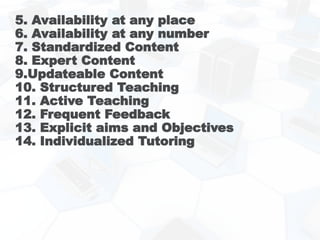
5. Availability at any place
6. Availability at any number
7. Standardized Content
8. Expert Content
9.Updateable Content
10. Structured Teaching
11. Active Teaching
12. Frequent Feedback
13. Explicit aims and Objectives
14. Individualized Tutoring
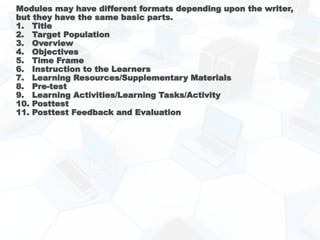
Modules may have different formats depending upon the writer,
but they have the same basic parts.
1. Title
2. Target Population
3. Overview
4. Objectives
5. Time Frame
6. Instruction to the Learners
7. Learning Resources/Supplementary Materials
8. Pre-test
9. Learning Activities/Learning Tasks/Activity
10. Posttest
11. Posttest Feedback and Evaluation
In writing modules, one can
be guided by the following
tips.
In planning the module
1.Ascertain the need for the
module.
2.Have a syllabus/course
content guide at hand for
the sequence of topics.
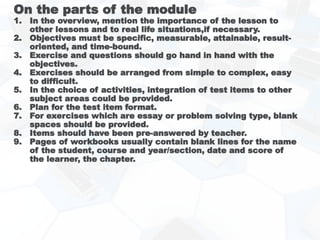
On the parts of the module
1. In the overview, mention the importance of the lesson to
other lessons and to real life situations,if necessary.
2. Objectives must be specific, measurable, attainable, result-
oriented, and time-bound.
3. Exercise and questions should go hand in hand with the
objectives.
4. Exercises should be arranged from simple to complex, easy
to difficult.
5. In the choice of activities, integration of test items to other
subject areas could be provided.
6. Plan for the test item format.
7. For exercises which are essay or problem solving type, blank
spaces should be provided.
8. Items should have been pre-answered by teacher.
9. Pages of workbooks usually contain blank lines for the name
of the student, course and year/section, date and score of
the learner, the chapter.
In writing the module
1.Put yourself in the place of
students
2.Write in a way that comes
naturally. Be clear.
3.Work from an outline.
4.Revise and rewrite. Do not
overwrite. Do not explain too
much

Computers in education

  • 3.
    The computer helpsthe learner in performing routine work tasks. It can function as a typewriter, a calculator, a drawing canvas, a filing system, and the like. Software programs include word processors, graphic design, packages, presentation software, databases, spreadsheets and telecommunication/internet tools. •The roles of the computer and student that we see in traditional computr-aided instruction are reversed. The computer becomes the “learner” while the students become “teacher”.
  • 4.
    Multimedia combines multipleforms of visual and audio information to create a multi- sensory presentation.Multimedia is a combination of different media types into a single delivery system under computer control, such as: * Video- videotape, videodisc and DVD * Graphics- slides, filmstrips and transparencies * Audio- audiotapes and audio CD's *Text- book and computer screen * Real objects and Models- tools, plants or artifacts
  • 5.
    The chief advantageof the computer is interactivity. The learner is involved as it required to respond. Research literature also states that student like working, with computers because computers; 1. are infinitely patient, never get tired, frustrated and or angry 2. never forget to correct or praise and do not embarrass students who make mistakes 3. are self-paced, individualize learning, and allow students to work privately 4. make it possible to expirement with different options 5. are excellent for dill and practice and give immediate feedback
  • 6.
    6. are moreobjective than teachers 7. free teachers for more meaningful contact with students 8. are impartial to race or ethnicity 9. are great motivators, fun and entertaining 10. give a sense of control over learning 11. call for using sight, hearing and touch 12. teach in small increments 13. help improve spelling and build proficiency in computer use 14. make laborious activities easy 15. work rapidly- cloder to the rate of human thought.
  • 7.
    Purchase and maintenanceof computers could be costly. Some CAI programs are simply electronic versions of pen-and-paper exercises. Some software compatible to a computer may not be compatible to other computer units. Limited range of objectives is attained by computers . Effective classroom management cannot be assured in classes with limited computer units.
  • 8.
    Each students shouldhave fair access to equipment. Employ tandem or pair techniques in computer use. For students who have computers at home, they may be encouraged to extend developing skills. Preview and critique the software prior to actual use and encourage student evaluation. If a television is connected to the computer make sure that the television is already set up. Make instructions and explanations very brief. Classroom discipline should be maintained inside the computer laboratory. Websites and links in the internet which are used as reference shouls be reviewedbefore directing students to access them.
  • 10.
    It shows astudent how to begin in his/her work and guides him/her in using tools such as textbooks, dictionaries, and supplementary materials. It offers encouragement, seldom found in a textbook. It fills in the gap left where the textbooks does not say what the author wants to do. Lockwood (1998) presents the distinctive features of modules, namely; 1. Individual Learning 2. Self-paced Learning 3. Private Learning 4. Availability at any time
  • 11.
    5. Availability atany place 6. Availability at any number 7. Standardized Content 8. Expert Content 9.Updateable Content 10. Structured Teaching 11. Active Teaching 12. Frequent Feedback 13. Explicit aims and Objectives 14. Individualized Tutoring
  • 12.
    Modules may havedifferent formats depending upon the writer, but they have the same basic parts. 1. Title 2. Target Population 3. Overview 4. Objectives 5. Time Frame 6. Instruction to the Learners 7. Learning Resources/Supplementary Materials 8. Pre-test 9. Learning Activities/Learning Tasks/Activity 10. Posttest 11. Posttest Feedback and Evaluation
  • 13.
    In writing modules,one can be guided by the following tips. In planning the module 1.Ascertain the need for the module. 2.Have a syllabus/course content guide at hand for the sequence of topics.
  • 14.
    On the partsof the module 1. In the overview, mention the importance of the lesson to other lessons and to real life situations,if necessary. 2. Objectives must be specific, measurable, attainable, result- oriented, and time-bound. 3. Exercise and questions should go hand in hand with the objectives. 4. Exercises should be arranged from simple to complex, easy to difficult. 5. In the choice of activities, integration of test items to other subject areas could be provided. 6. Plan for the test item format. 7. For exercises which are essay or problem solving type, blank spaces should be provided. 8. Items should have been pre-answered by teacher. 9. Pages of workbooks usually contain blank lines for the name of the student, course and year/section, date and score of the learner, the chapter.
  • 15.
    In writing themodule 1.Put yourself in the place of students 2.Write in a way that comes naturally. Be clear. 3.Work from an outline. 4.Revise and rewrite. Do not overwrite. Do not explain too much