Computer-Aided
Assembly Planning
Richard Farr
capacify.wordpress.com
Contents
Quick recap of assembly.
The assembly planning activity.
Computer-based representation of constraints.
Assembly sequence generation and illustration.
Criteria for assembly sequence evaluation.
Conclusions and questions.
capacify.wordpress.com
Define the assembly planning task.
Appreciate the usefulness of Computer-Aided
Assembly Planning (CAAP).
Understand the requirements in assembly
modelling.
Be able to reason about an assembly with
geometric and technological constraints.
Know how to evaluate alternative sequences.
Learning Objectives
capacify.wordpress.com
What is Assembly?
The process of combining components into sub-
assemblies or finished products.
It can form a significant part of the overall
manufacturing process.
It has been estimated that it can account for
between 25 to 75 % of production costs and 40 to
60 % of production throughput time.
capacify.wordpress.com
What is Assembly Planning?
“The act of preparing the detailed instructions for
the assembly of a product.”
Assembly Planning includes...
Evaluating the processes and operations that
might be employed.
Selecting tooling and fixtures, etc.
Determining the sequence of operations.
capacify.wordpress.com
Why?
Most products are assemblies.
Process planning only addresses the operations
that produce individual components.
Very few companies have design control over
every component they use.
Assembly planning allows us to anticipate
problems and solve them before they happen for
real on the factory floor.
capacify.wordpress.com
Why Computer-Aided Assembly
Planning?
The planning task is time-consuming and prone to
errors.
The time cost of planning.
Engineers cannot examine all the possible plans.
Computerised tools can ensure that no good
assembly plan has been overlooked.
CAAP allows the flexibility to handle changes in
available equipment.
capacify.wordpress.com
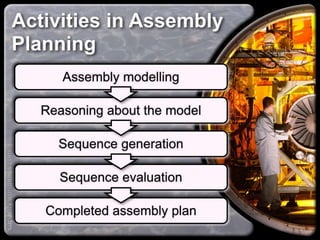
Activities in Assembly Planning
Assembly modelling
Reasoning about the model
Sequence generation
Sequence evaluation
Completed assembly plan
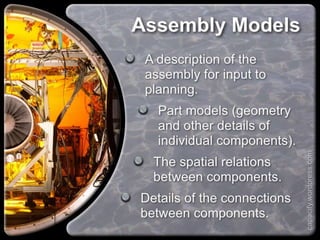
Assembly Models
A description of the assembly
for input to planning.
Part models (geometry and
other details of individual
components).
The spatial relations
between components.
Details of the connections
between components.
capacify.wordpress.com
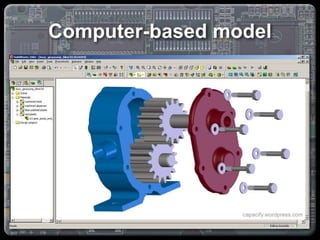
Computer-based model
capacify.wordpress.com
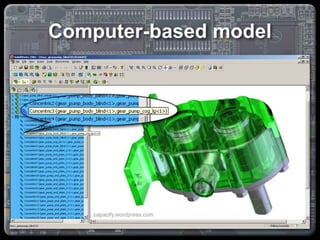
Computer-based model
capacify.wordpress.com
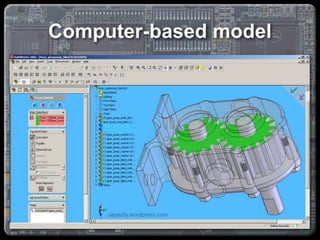
Computer-based model
capacify.wordpress.com
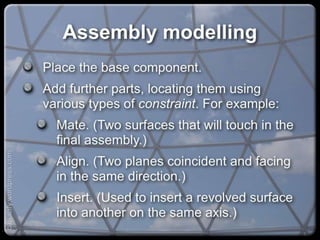
Assembly modelling
Place the base component.
Add further parts, locating them using various
types of constraint. For example:
Mate. (Two surfaces that will touch in the
final assembly.)
Align. (Two planes coincident and facing in
the same direction.)
Insert. (Used to insert a revolved surface into
another on the same axis.)
capacify.wordpress.com
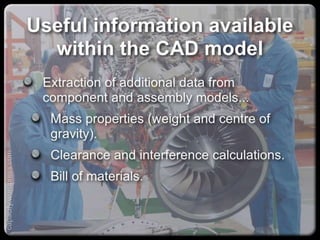
Useful information available within
the CAD model
Extraction of additional data from component
and assembly models...
Mass properties (weight and centre of
gravity).
Clearance and interference calculations.
Bill of materials.
capacify.wordpress.com
Reasoning about the Assembly
Model
Aim: to determine information not held within
the assembly model itself.
Main task: to identify precedence constraints:
Geometric constraints.
Technological constraints.
capacify.wordpress.com
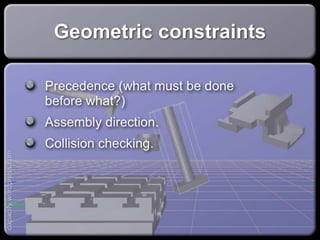
Geometric constraints
Precedence (what must be done before
what?)
Assembly direction.
Collision checking.
capacify.wordpress.com
Technological constraints
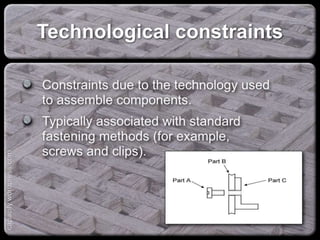
Constraints due to the technology used to
assemble components.
Typically associated with standard
fastening methods (for example, screws
and clips).
capacify.wordpress.com
The Problem
Like all manufacturing planning tasks, time is
limited and experts are in short supply.
The magnitude of the job: how many assembly
sequences must be evaluated?
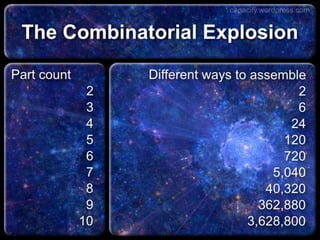
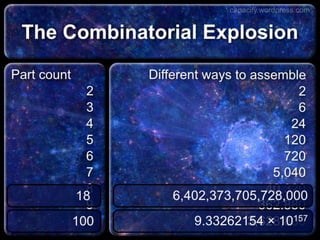
The number of potential sequences rises
exponentially with the number of parts in the
assembly.
“The Combinatorial Explosion...”
capacify.wordpress.com
The Combinatorial Explosion
capacify.wordpress.com
9.33262154 × 10157100
6,402,373,705,728,00018
The Combinatorial Explosion
capacify.wordpress.com
Sequence Generation Problem
Fortunately, not all combinations are possible.
Some can be eliminated early, because they are
physically impossible.
Let’s use a simple example to see how possible
assembly sequences can be found.
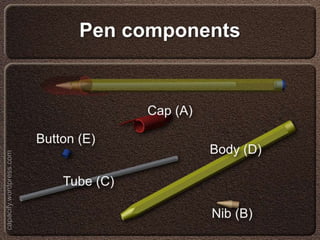
A ballpoint pen has five components (we’ll call
them body, nib, tube, cap and button).
How many assembly sequences?
capacify.wordpress.com
Pen components
capacify.wordpress.com
What
happens
when you
assemble
things in
the wrong
order?
capacify.wordpress.com
BodyTube
Button
Cap
Nib
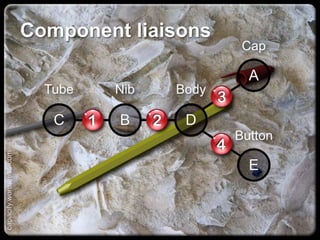
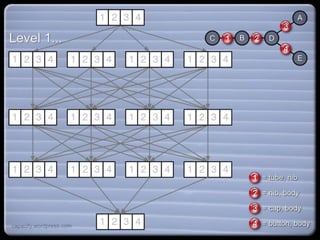
Component liaisons
capacify.wordpress.com
= tube, nib
= nib, body
= cap, body
= button, body
Level 1...
capacify.wordpress.com
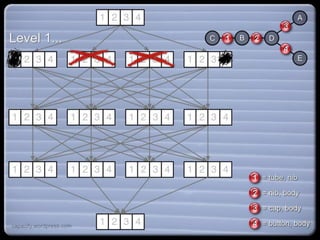
= tube, nib
= nib, body
= cap, body
= button, body
Level 2...
capacify.wordpress.com
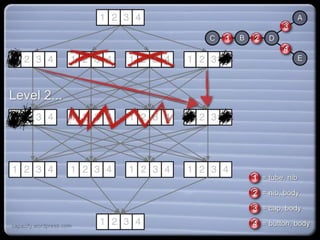
= tube, nib
= nib, body
= cap, body
= button, body
Level 3...
capacify.wordpress.com
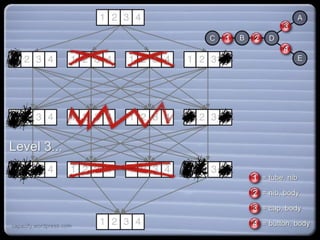
= tube, nib
= nib, body
= cap, body
= button, body
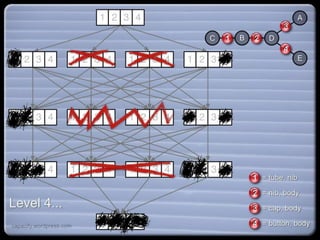
Level 4...
capacify.wordpress.com
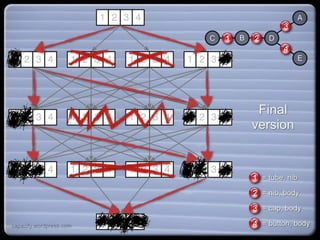
= tube, nib
= nib, body
= cap, body
= button, body
Final
version
capacify.wordpress.com
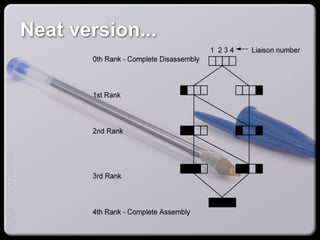
Neat version...
capacify.wordpress.com
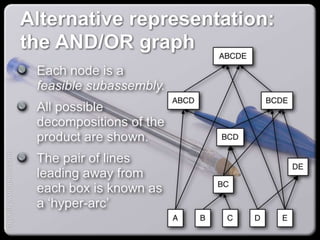
Alternative representation: the
AND/OR graph
Each node is a feasible
subassembly.
All possible
decompositions of the
product are shown.
The pair of lines leading
away from each box is
known as a ‘hyper-arc’
capacify.wordpress.com
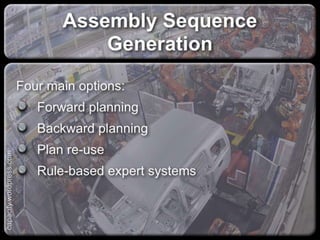
Assembly Sequence Generation
Four main options:
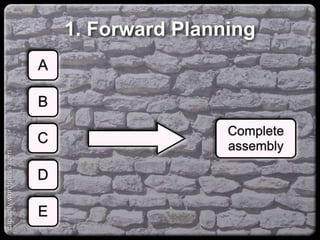
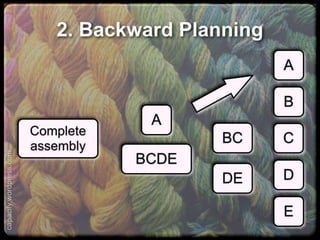
Forward planning
Backward planning
Plan re-use
Rule-based expert systems
capacify.wordpress.com
AA
BB
CC
DD
EE
C
Complete
assembly
1. Forward Planning
capacify.wordpress.com
AA
BB
CC
DD
EE
C
Complete
assembly
2. Backward Planning
BBCDE
BBC
DDE
AA
capacify.wordpress.com
3. Plan re-use
The process of generating complete sequences
from scratch can be avoided by reusing previously
created plans.
Similar to the hybrid approach in CAPP, this uses an
expert system technique known as ‘Case-Based
Reasoning’ (CBR).
Aims to solve new problems by using knowledge
gained from solving similar problems in the past.
This knowledge is held in the form of problem
solutions or ‘cases’ held in a database.
capacify.wordpress.com
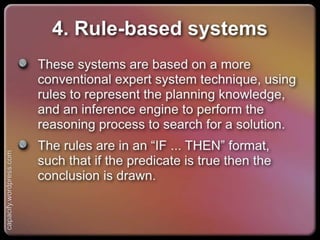
4. Rule-based systems
These systems are based on a more conventional
expert system technique, using rules to
represent the planning knowledge, and an
inference engine to perform the reasoning
process to search for a solution.
The rules are in an “IF ... THEN” format, such
that if the predicate is true then the conclusion
is drawn.
capacify.wordpress.com
Sequence Evaluation
Even after assessing geometric and technological
constraints, many feasible sequences might
remain.
Additional criteria are used to find an optimum
sequences – or at least, a set of alternatives that
are “good enough”.
Additional criteria (sometimes called strategic
constraints) can be:
Qualitative or quantitative.
Product, technology or company specific.
capacify.wordpress.com
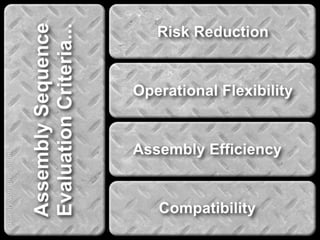
Risk Reduction
Operational Flexibility
Assembly Efficiency
Compatibility
AssemblySequence
EvaluationCriteria...
capacify.wordpress.com
Risk Reduction Strategy...
Fit valuable components as late as possible.
Fit fragile components as late as possible.
Perform irreversible operations as late as
possible.
Perform precise adjustments as late as possible,
and watch out for dependencies between
tolerances.
capacify.wordpress.com
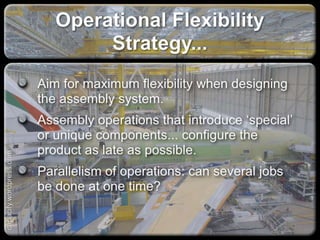
Operational Flexibility Strategy...
Aim for maximum flexibility when designing the
assembly system.
Assembly operations that introduce ‘special’ or
unique components... configure the product as
late as possible.
Parallelism of operations: can several jobs be
done at one time?
capacify.wordpress.com
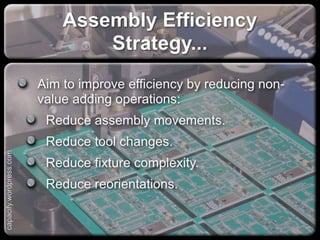
Assembly Efficiency Strategy...
Aim to improve efficiency by reducing non-value
adding operations:
Reduce assembly movements.
Reduce tool changes.
Reduce fixture complexity.
Reduce reorientations.
capacify.wordpress.com
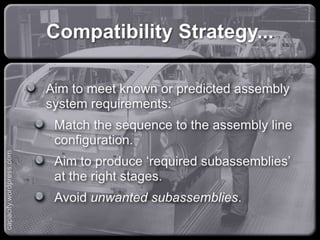
Compatibility Strategy...
Aim to meet known or predicted assembly
system requirements:
Match the sequence to the assembly line
configuration.
Aim to produce ‘required subassemblies’ at
the right stages.
Avoid unwanted subassemblies.
capacify.wordpress.com
In summary
An important concurrent engineering activity,
particularly when viewed in the context of
globalisation.
Assembly has a considerable influence over
product cost, time and quality.
Computer-Aided Assembly planning is necessary, in
order to deal with the huge number of
permutations that are possible.
capacify.wordpress.com
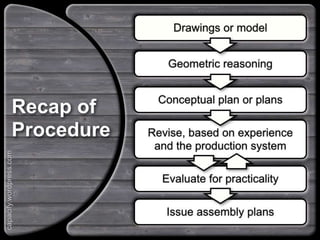
Recap of
Procedure
Drawings or model
Geometric reasoning
Conceptual plan or plans
Revise, based on experience
and the production system
Evaluate for practicality
Issue assembly plans
capacify.wordpress.com
Define Assembly Planning.
Draw a flowchart showing the typical manual
assembly planning activity.
What are the problems with manual assembly
planning?
Why does CAAP offer a valuable alternative?
Review Questions (1)
capacify.wordpress.com
Review Questions (2)
Describe four different techniques for assembly
sequence generation.
Explain the two methods used to represent assembly
sequences pictorially. Choose a product of four to five
components and represent it using each method.
(Refer to the ballpoint pen assembly example.)
List the four categories of sequence evaluation criteria,
and describe the effect each has on sequence
selection.
capacify.wordpress.com
Further information from Richard Farr can be found
on Capacify, the Sustainable Supply Chain blog
http://capacify.wordpress.com
On Twitter: @Capacified

Computer-Aided Assembly Planning

  • 1.
  • 2.
    Contents Quick recap ofassembly. The assembly planning activity. Computer-based representation of constraints. Assembly sequence generation and illustration. Criteria for assembly sequence evaluation. Conclusions and questions. capacify.wordpress.com
  • 3.
    Define the assemblyplanning task. Appreciate the usefulness of Computer-Aided Assembly Planning (CAAP). Understand the requirements in assembly modelling. Be able to reason about an assembly with geometric and technological constraints. Know how to evaluate alternative sequences. Learning Objectives capacify.wordpress.com
  • 4.
    What is Assembly? Theprocess of combining components into sub- assemblies or finished products. It can form a significant part of the overall manufacturing process. It has been estimated that it can account for between 25 to 75 % of production costs and 40 to 60 % of production throughput time. capacify.wordpress.com
  • 5.
    What is AssemblyPlanning? “The act of preparing the detailed instructions for the assembly of a product.” Assembly Planning includes... Evaluating the processes and operations that might be employed. Selecting tooling and fixtures, etc. Determining the sequence of operations. capacify.wordpress.com
  • 6.
    Why? Most products areassemblies. Process planning only addresses the operations that produce individual components. Very few companies have design control over every component they use. Assembly planning allows us to anticipate problems and solve them before they happen for real on the factory floor. capacify.wordpress.com
  • 7.
    Why Computer-Aided Assembly Planning? Theplanning task is time-consuming and prone to errors. The time cost of planning. Engineers cannot examine all the possible plans. Computerised tools can ensure that no good assembly plan has been overlooked. CAAP allows the flexibility to handle changes in available equipment. capacify.wordpress.com
  • 8.
    capacify.wordpress.com Activities in AssemblyPlanning Assembly modelling Reasoning about the model Sequence generation Sequence evaluation Completed assembly plan
  • 9.
    Assembly Models A descriptionof the assembly for input to planning. Part models (geometry and other details of individual components). The spatial relations between components. Details of the connections between components. capacify.wordpress.com
  • 10.
  • 11.
  • 12.
  • 13.
    Assembly modelling Place thebase component. Add further parts, locating them using various types of constraint. For example: Mate. (Two surfaces that will touch in the final assembly.) Align. (Two planes coincident and facing in the same direction.) Insert. (Used to insert a revolved surface into another on the same axis.) capacify.wordpress.com
  • 14.
    Useful information availablewithin the CAD model Extraction of additional data from component and assembly models... Mass properties (weight and centre of gravity). Clearance and interference calculations. Bill of materials. capacify.wordpress.com
  • 15.
    Reasoning about theAssembly Model Aim: to determine information not held within the assembly model itself. Main task: to identify precedence constraints: Geometric constraints. Technological constraints. capacify.wordpress.com
  • 16.
    Geometric constraints Precedence (whatmust be done before what?) Assembly direction. Collision checking. capacify.wordpress.com
  • 17.
    Technological constraints Constraints dueto the technology used to assemble components. Typically associated with standard fastening methods (for example, screws and clips). capacify.wordpress.com
  • 18.
    The Problem Like allmanufacturing planning tasks, time is limited and experts are in short supply. The magnitude of the job: how many assembly sequences must be evaluated? The number of potential sequences rises exponentially with the number of parts in the assembly. “The Combinatorial Explosion...” capacify.wordpress.com
  • 19.
  • 20.
    9.33262154 × 10157100 6,402,373,705,728,00018 TheCombinatorial Explosion capacify.wordpress.com
  • 21.
    Sequence Generation Problem Fortunately,not all combinations are possible. Some can be eliminated early, because they are physically impossible. Let’s use a simple example to see how possible assembly sequences can be found. A ballpoint pen has five components (we’ll call them body, nib, tube, cap and button). How many assembly sequences? capacify.wordpress.com
  • 22.
  • 23.
    What happens when you assemble things in thewrong order? capacify.wordpress.com
  • 24.
  • 26.
    = tube, nib =nib, body = cap, body = button, body Level 1... capacify.wordpress.com
  • 27.
    = tube, nib =nib, body = cap, body = button, body Level 2... capacify.wordpress.com
  • 28.
    = tube, nib =nib, body = cap, body = button, body Level 3... capacify.wordpress.com
  • 29.
    = tube, nib =nib, body = cap, body = button, body Level 4... capacify.wordpress.com
  • 30.
    = tube, nib =nib, body = cap, body = button, body Final version capacify.wordpress.com
  • 31.
  • 32.
    Alternative representation: the AND/ORgraph Each node is a feasible subassembly. All possible decompositions of the product are shown. The pair of lines leading away from each box is known as a ‘hyper-arc’ capacify.wordpress.com
  • 33.
    Assembly Sequence Generation Fourmain options: Forward planning Backward planning Plan re-use Rule-based expert systems capacify.wordpress.com
  • 34.
  • 35.
  • 36.
    3. Plan re-use Theprocess of generating complete sequences from scratch can be avoided by reusing previously created plans. Similar to the hybrid approach in CAPP, this uses an expert system technique known as ‘Case-Based Reasoning’ (CBR). Aims to solve new problems by using knowledge gained from solving similar problems in the past. This knowledge is held in the form of problem solutions or ‘cases’ held in a database. capacify.wordpress.com
  • 37.
    4. Rule-based systems Thesesystems are based on a more conventional expert system technique, using rules to represent the planning knowledge, and an inference engine to perform the reasoning process to search for a solution. The rules are in an “IF ... THEN” format, such that if the predicate is true then the conclusion is drawn. capacify.wordpress.com
  • 38.
    Sequence Evaluation Even afterassessing geometric and technological constraints, many feasible sequences might remain. Additional criteria are used to find an optimum sequences – or at least, a set of alternatives that are “good enough”. Additional criteria (sometimes called strategic constraints) can be: Qualitative or quantitative. Product, technology or company specific. capacify.wordpress.com
  • 39.
    Risk Reduction Operational Flexibility AssemblyEfficiency Compatibility AssemblySequence EvaluationCriteria... capacify.wordpress.com
  • 40.
    Risk Reduction Strategy... Fitvaluable components as late as possible. Fit fragile components as late as possible. Perform irreversible operations as late as possible. Perform precise adjustments as late as possible, and watch out for dependencies between tolerances. capacify.wordpress.com
  • 41.
    Operational Flexibility Strategy... Aimfor maximum flexibility when designing the assembly system. Assembly operations that introduce ‘special’ or unique components... configure the product as late as possible. Parallelism of operations: can several jobs be done at one time? capacify.wordpress.com
  • 42.
    Assembly Efficiency Strategy... Aimto improve efficiency by reducing non-value adding operations: Reduce assembly movements. Reduce tool changes. Reduce fixture complexity. Reduce reorientations. capacify.wordpress.com
  • 43.
    Compatibility Strategy... Aim tomeet known or predicted assembly system requirements: Match the sequence to the assembly line configuration. Aim to produce ‘required subassemblies’ at the right stages. Avoid unwanted subassemblies. capacify.wordpress.com
  • 44.
    In summary An importantconcurrent engineering activity, particularly when viewed in the context of globalisation. Assembly has a considerable influence over product cost, time and quality. Computer-Aided Assembly planning is necessary, in order to deal with the huge number of permutations that are possible. capacify.wordpress.com
  • 45.
    Recap of Procedure Drawings ormodel Geometric reasoning Conceptual plan or plans Revise, based on experience and the production system Evaluate for practicality Issue assembly plans capacify.wordpress.com
  • 46.
    Define Assembly Planning. Drawa flowchart showing the typical manual assembly planning activity. What are the problems with manual assembly planning? Why does CAAP offer a valuable alternative? Review Questions (1) capacify.wordpress.com
  • 47.
    Review Questions (2) Describefour different techniques for assembly sequence generation. Explain the two methods used to represent assembly sequences pictorially. Choose a product of four to five components and represent it using each method. (Refer to the ballpoint pen assembly example.) List the four categories of sequence evaluation criteria, and describe the effect each has on sequence selection. capacify.wordpress.com
  • 48.
    Further information fromRichard Farr can be found on Capacify, the Sustainable Supply Chain blog http://capacify.wordpress.com On Twitter: @Capacified

Editor's Notes