© Oxford University Press 2011
Computer NetworksComputer Networks
Bhushan Trivedi, Director, MCA
Programme, at the GLS Institute of
Computer Technology, Ahmadabad
© Oxford University Press 2011
Chapter 1Chapter 1
Introduction to computerIntroduction to computer
networksnetworks
© Oxford University Press 2011
Questions to be answered
• How is a file downloaded
• How do emails reach their intended
recipients?
• How does a wired and a wireless connection
work the same?
• How is receipt of new data (for example a new
antivirus update), handled and by whom?
© Oxford University Press 2011
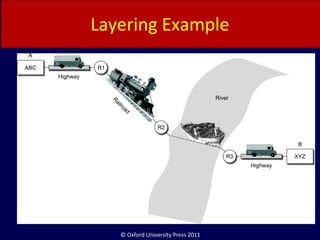
Layering Example
© Oxford University Press 2011
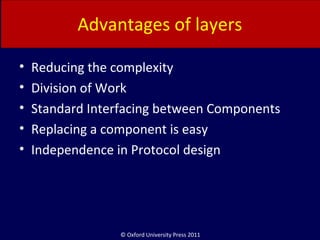
Advantages of layers
• Reducing the complexity
• Division of Work
• Standard Interfacing between Components
• Replacing a component is easy
• Independence in Protocol design
© Oxford University Press 2011
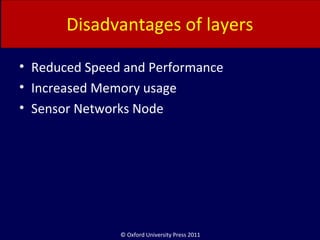
Disadvantages of layers
• Reduced Speed and Performance
• Increased Memory usage
• Sensor Networks Node
© Oxford University Press 2011
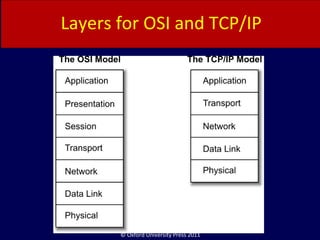
Layers for OSI and TCP/IP
© Oxford University Press 2011
Connection Oriented vs
Connectionless
• Connection establishment
• Complete line occupied or not
• Multiplexing
• Robustness of the connection
• Cost of the connection
• Quality of service
• Order of delivery
© Oxford University Press 2011
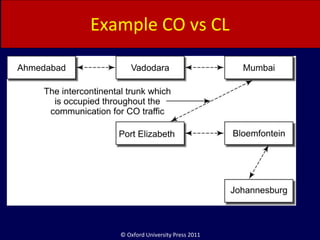
Example CO vs CL
© Oxford University Press 2011
OSI and TCP IP difference
• OSI has seven layers, TCP/IP has five layers.
• The OSI was connection-oriented, TCP/IP
model was connectionless
• The TCP/IP provided a choice (TCP or UDP) to
the customers.
• TCP/IP describes an existing set of protocols
The OSI model was more general
© Oxford University Press 2011
OSI and TCP IP difference
• OSI model distinguishes between an interface
and a protocol TCP IP does not
• The OSI model clearly mentions the physical
and data link layers.
• The Internet provides both, connection
oriented service over connectionless transfer
and connectionless service over
connectionless transfers,
© Oxford University Press 2011
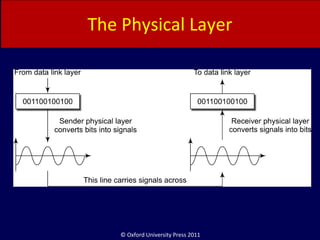
The Physical Layer
© Oxford University Press 2011
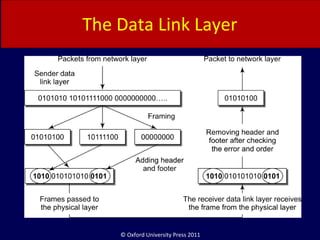
The Data Link Layer
© Oxford University Press 2011
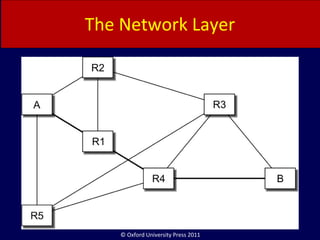
The Network Layer
© Oxford University Press 2011
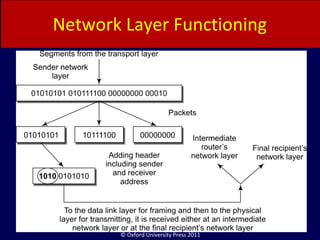
Network Layer Functioning
© Oxford University Press 2011
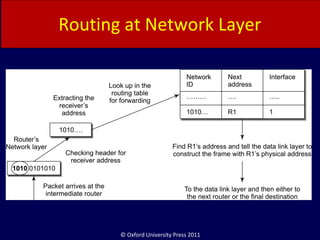
Routing at Network Layer
© Oxford University Press 2011
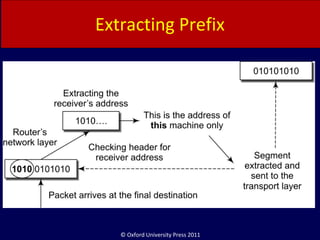
Extracting Prefix
© Oxford University Press 2011
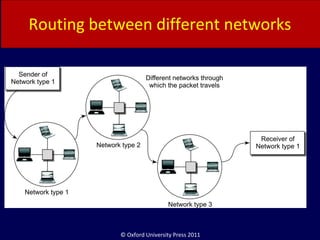
Routing between different networks
© Oxford University Press 2011
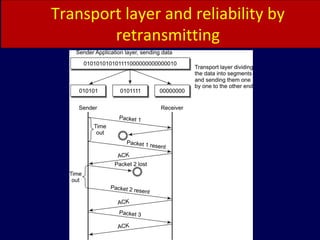
Transport layer and reliability by
retransmitting
© Oxford University Press 2011
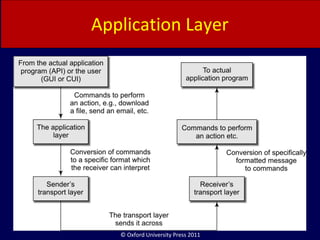
Application Layer
© Oxford University Press 2011
Other
• Distributed Systems
– WWW
• Peer to peer networks
• Client server networks
© Oxford University Press 2011
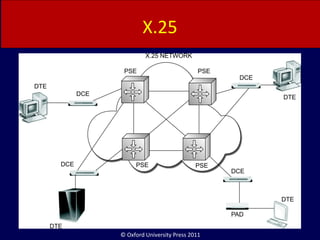
X.25
© Oxford University Press 2011
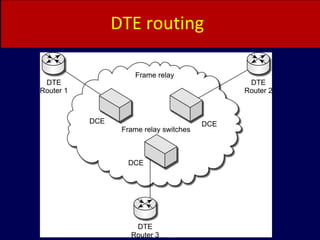
DTE routing

computer networks layers

  • 1.
    © Oxford UniversityPress 2011 Computer NetworksComputer Networks Bhushan Trivedi, Director, MCA Programme, at the GLS Institute of Computer Technology, Ahmadabad
  • 2.
    © Oxford UniversityPress 2011 Chapter 1Chapter 1 Introduction to computerIntroduction to computer networksnetworks
  • 3.
    © Oxford UniversityPress 2011 Questions to be answered • How is a file downloaded • How do emails reach their intended recipients? • How does a wired and a wireless connection work the same? • How is receipt of new data (for example a new antivirus update), handled and by whom?
  • 4.
    © Oxford UniversityPress 2011 Layering Example
  • 5.
    © Oxford UniversityPress 2011 Advantages of layers • Reducing the complexity • Division of Work • Standard Interfacing between Components • Replacing a component is easy • Independence in Protocol design
  • 6.
    © Oxford UniversityPress 2011 Disadvantages of layers • Reduced Speed and Performance • Increased Memory usage • Sensor Networks Node
  • 7.
    © Oxford UniversityPress 2011 Layers for OSI and TCP/IP
  • 8.
    © Oxford UniversityPress 2011 Connection Oriented vs Connectionless • Connection establishment • Complete line occupied or not • Multiplexing • Robustness of the connection • Cost of the connection • Quality of service • Order of delivery
  • 9.
    © Oxford UniversityPress 2011 Example CO vs CL
  • 10.
    © Oxford UniversityPress 2011 OSI and TCP IP difference • OSI has seven layers, TCP/IP has five layers. • The OSI was connection-oriented, TCP/IP model was connectionless • The TCP/IP provided a choice (TCP or UDP) to the customers. • TCP/IP describes an existing set of protocols The OSI model was more general
  • 11.
    © Oxford UniversityPress 2011 OSI and TCP IP difference • OSI model distinguishes between an interface and a protocol TCP IP does not • The OSI model clearly mentions the physical and data link layers. • The Internet provides both, connection oriented service over connectionless transfer and connectionless service over connectionless transfers,
  • 12.
    © Oxford UniversityPress 2011 The Physical Layer
  • 13.
    © Oxford UniversityPress 2011 The Data Link Layer
  • 14.
    © Oxford UniversityPress 2011 The Network Layer
  • 15.
    © Oxford UniversityPress 2011 Network Layer Functioning
  • 16.
    © Oxford UniversityPress 2011 Routing at Network Layer
  • 17.
    © Oxford UniversityPress 2011 Extracting Prefix
  • 18.
    © Oxford UniversityPress 2011 Routing between different networks
  • 19.
    © Oxford UniversityPress 2011 Transport layer and reliability by retransmitting
  • 20.
    © Oxford UniversityPress 2011 Application Layer
  • 21.
    © Oxford UniversityPress 2011 Other • Distributed Systems – WWW • Peer to peer networks • Client server networks
  • 22.
    © Oxford UniversityPress 2011 X.25
  • 23.
    © Oxford UniversityPress 2011 DTE routing