http://www.myassignmenthelpers.com/
support@myassignmenthelpers.com
Computer network
A collection of computing devices connected in
order to communicate and share resources
Connections between computing devices can be
physical using wires or cables or wireless using
radio waves or infrared signals
Node (host)
Any device on a network
Data transfer rate (bandwidth)
The speed with which data is moved from one
place to another on a network
2
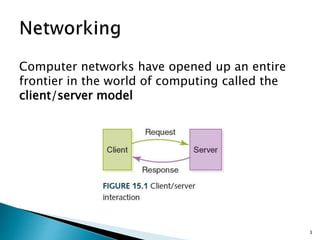
Computer networks have opened up an entire
frontier in the world of computing called the
client/server model
3
Protocol
A set of rules that defines how data is formatted and
processed on a network
File server
A computer dedicated to storing and managing files
for network users
Web server
A computer dedicated to responding to requests for
web pages
P2P model
A decentralized approach that shares resources and
responsibilities among many “peer” computers
4
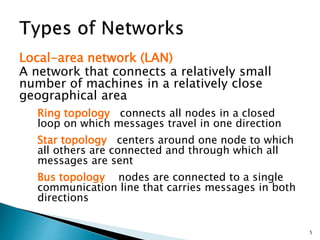
Local-area network (LAN)
A network that connects a relatively small
number of machines in a relatively close
geographical area
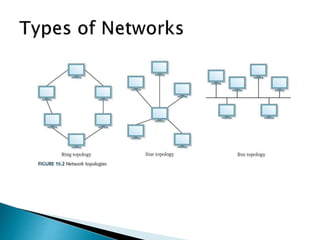
Ring topology connects all nodes in a closed
loop on which messages travel in one direction
Star topology centers around one node to which
all others are connected and through which all
messages are sent
Bus topology nodes are connected to a single
communication line that carries messages in both
directions
5
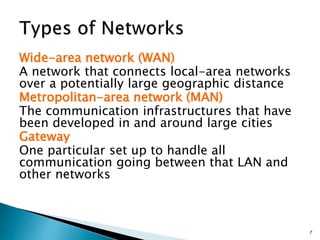
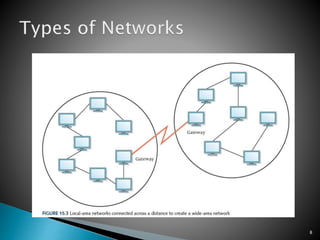
Wide-area network (WAN)
A network that connects local-area networks
over a potentially large geographic distance
Metropolitan-area network (MAN)
The communication infrastructures that have
been developed in and around large cities
Gateway
One particular set up to handle all
communication going between that LAN and
other networks
7
8
Various technologies available to connect a home
computer to the Internet
Phone modem converts computer data into an analog
audio signal for transfer over a telephone line, and
then a modem at the destination converts it back
again into data
Digital subscriber line (DSL) uses regular copper
phone lines to transfer digital data to and from the
phone company’s central office
Cable modem uses the same line that your cable TV
signals come in on to transfer the data back and forth
9
Broadband
A connection in which transfer speeds are
faster than 768 kilobits per second
◦ DSL connections and cable modems are
broadband connections
◦ The speed for downloads (getting data from the
Internet to your home computer) may not be the
same as uploads (sending data from your home
computer to the Internet)
10
Packet
A unit of data sent across a network
Router
A network device that directs a packet between
networks toward its final destination
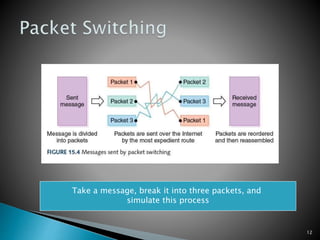
Packet switching
Messages are divided into fixed-sized, numbered
packets; packets are individually routed to their
destination, then reassembled
12
Take a message, break it into three packets, and
simulate this process
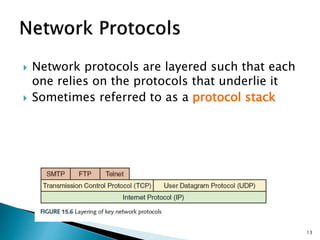
 Network protocols are layered such that each
one relies on the protocols that underlie it
 Sometimes referred to as a protocol stack
13
Transmission Control Protocol (TCP)
Software that breaks messages into packets,
hands them off to the IP software for delivery,
and then orders and reassembles the packets
at their destination
Internet Protocol (IP)
Software that deals with the routing of
packets through the maze of interconnected
networks to their final destination
14
User Datagram Protocol (UDP)
An alternative to TCP that is faster but less
reliable
Ping
A program used to test whether a particular
network computer is active and reachable
Traceroute
A program that shows the route a packet
takes across the Internet
15
Other protocols build on TCP/IP protocol suite
Simple Mail Transfer Protocol (SMTP) used to
specify transfer of electronic mail
File Transfer Protocol (FTP) allows a user to
transfer files to and from another computer
Telnet used to log onto one computer from
another
Hyper Text Transfer Protocol (http) allows
exchange of Web documents
16
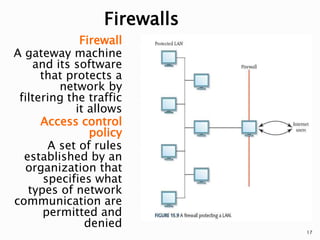
Firewalls
Firewall
A gateway machine
and its software
that protects a
network by
filtering the traffic
it allows
Access control
policy
A set of rules
established by an
organization that
specifies what
types of network
communication are
permitted and
denied
17

Computer network assignment help

  • 1.
  • 2.
    Computer network A collectionof computing devices connected in order to communicate and share resources Connections between computing devices can be physical using wires or cables or wireless using radio waves or infrared signals Node (host) Any device on a network Data transfer rate (bandwidth) The speed with which data is moved from one place to another on a network 2
  • 3.
    Computer networks haveopened up an entire frontier in the world of computing called the client/server model 3
  • 4.
    Protocol A set ofrules that defines how data is formatted and processed on a network File server A computer dedicated to storing and managing files for network users Web server A computer dedicated to responding to requests for web pages P2P model A decentralized approach that shares resources and responsibilities among many “peer” computers 4
  • 5.
    Local-area network (LAN) Anetwork that connects a relatively small number of machines in a relatively close geographical area Ring topology connects all nodes in a closed loop on which messages travel in one direction Star topology centers around one node to which all others are connected and through which all messages are sent Bus topology nodes are connected to a single communication line that carries messages in both directions 5
  • 7.
    Wide-area network (WAN) Anetwork that connects local-area networks over a potentially large geographic distance Metropolitan-area network (MAN) The communication infrastructures that have been developed in and around large cities Gateway One particular set up to handle all communication going between that LAN and other networks 7
  • 8.
  • 9.
    Various technologies availableto connect a home computer to the Internet Phone modem converts computer data into an analog audio signal for transfer over a telephone line, and then a modem at the destination converts it back again into data Digital subscriber line (DSL) uses regular copper phone lines to transfer digital data to and from the phone company’s central office Cable modem uses the same line that your cable TV signals come in on to transfer the data back and forth 9
  • 10.
    Broadband A connection inwhich transfer speeds are faster than 768 kilobits per second ◦ DSL connections and cable modems are broadband connections ◦ The speed for downloads (getting data from the Internet to your home computer) may not be the same as uploads (sending data from your home computer to the Internet) 10
  • 11.
    Packet A unit ofdata sent across a network Router A network device that directs a packet between networks toward its final destination Packet switching Messages are divided into fixed-sized, numbered packets; packets are individually routed to their destination, then reassembled
  • 12.
    12 Take a message,break it into three packets, and simulate this process
  • 13.
     Network protocolsare layered such that each one relies on the protocols that underlie it  Sometimes referred to as a protocol stack 13
  • 14.
    Transmission Control Protocol(TCP) Software that breaks messages into packets, hands them off to the IP software for delivery, and then orders and reassembles the packets at their destination Internet Protocol (IP) Software that deals with the routing of packets through the maze of interconnected networks to their final destination 14
  • 15.
    User Datagram Protocol(UDP) An alternative to TCP that is faster but less reliable Ping A program used to test whether a particular network computer is active and reachable Traceroute A program that shows the route a packet takes across the Internet 15
  • 16.
    Other protocols buildon TCP/IP protocol suite Simple Mail Transfer Protocol (SMTP) used to specify transfer of electronic mail File Transfer Protocol (FTP) allows a user to transfer files to and from another computer Telnet used to log onto one computer from another Hyper Text Transfer Protocol (http) allows exchange of Web documents 16
  • 17.
    Firewalls Firewall A gateway machine andits software that protects a network by filtering the traffic it allows Access control policy A set of rules established by an organization that specifies what types of network communication are permitted and denied 17