Lecture#12
Computer Communications
& Networks CS-576
Network Edge
 An edge device provides an entry point into the enterprise.
The devices which make up a network and provide access
to it. For example routers, routing switches, multiplexers,
WAN & MAN.
What is Internet
 A Nuts and Bolts Description
 End systems
 Communication Links, Bandwidth
 Routers, Packet
 ISPs
 Protocols, TCP/IP
 Internet Standards, RFCs
 A service Description
 Distributed Applications
 Connection Oriented Reliable Service
 Connectionless Unreliable Service
 What is a protocol?
Internet
 Two ways to describe the Internet
 Nuts and Bolts View
 The basic hardware and software components
 Service Oriented View
 The networking infrastructure that provides services to
distributed applications
Nuts and Bolt View
 Hosts or End Systems
 Computing Devices such as PCs, PDAs (Personal Digital Assistants),
TVs, servers, mobile computers, automobiles, etc. connected to the
Internet are called hosts or end systems.
 Communication links
 End systems are connected together by communication links.
 Communication links are made up of different types of media, including
twisted pair, coaxial cable, fiber optics, and radio spectrum.
 Bandwidth
 Different links can transmit data at different rates.
 The link transmission rate is often called the bandwidth (i.e, the width
of the band) of the link which is measured in bits per second (bps).
Cont.
 Routers
 End systems are not directly connected to each other via a single
communication link. They are indirectly connected to each through
intermediate switching devices known as routers.
 A router receives chunk of information from one of its incoming
communication link and forwards it to one of its outgoing
communication link.
 Packets
 The chunk of information is called packet.
 Route or Path
 The path that the packet takes from the sending end system, through
a series of communication links and routers, to the receiving end
system is known as a route or path.
 Packet switching
 It allows multiple communicating end systems to share a path, or
parts of path at the same time.
Cont.
 Internet Service Providers (ISPs)
 End systems access the Internet through the Internet Service
Providers (ISPs).
 The different ISPs provide a variety of different types of network
access to the end systems, including 56Kbps dial up modem access,
cable modem or DSL, high speed LAN access, and wireless access.
 Protocols
 End systems, routers, and other pieces of the Internet, run protocols
that control the sending and receiving of information within the
Internet.
 TCP (Transmission Control Protocol) and IP (Internet protocol) are
two of the most important protocols in the Internet.
Cont.
 Internet Standards
 At the technical and development level, the Internet is made possible
through creation, testing, and implementation of Internet Standards.
 These standards are developed by Internet Engineering Task Force
(IETF).
 RFCs
 The IETF standards documents are called RFCs (Request for
comments).
 RFCs started out as general request for comments (hence the name)
to resolve architecture problems of the Internet.
 They define protocols such as TCP, IP, HTTP, SMTP.
Network Core
 Switched Networks:
 Circuit Switched Networks
 Packet Switched Networks.
Service Oriented View
 Distributed Applications
 The Internet allows distributed applications running on its end
systems to exchange data with each other.
 These applications include remote login, electronic mail, web
surfing, instant messaging, audio and video streaming, Internet
telephony, distributed games, peer-to-peer (P2P) file sharing, and
much more.
 Communication Services
 Connection oriented reliable service
 Connectionless unreliable service
Cont.
 Internet Provides two services to its distributed
applications:
 Connection Oriented Reliable Service
 It guarantees that data transmitted from a sender to a receiver will
eventually be delivered to the receiver in order and in its entirety.
 Connectionless Unreliable Service
 It does not make any guarantees about eventual delivery.
 Distributed applications makes use of one or the other (but not
both) of these two services.
Connection Oriented Services
 Reliable Data Transfer
 Using acknowledgements & retransmissions
 Flow Control
 sender won’t overwhelm receiver
 Congestion Control
 senders “slow down sending rate” when network congested
 TCP
 Applications using TCP are:
 HTTP (Web), FTP (file transfer), Telnet (remote login), SMTP
(email)
Connectionless Services
 Unreliable Data Transfer
 no flow control
 no congestion control
 Fast
 connectionless
 UDP
 Applications using UDP are:
 multimedia, videoconferencing, DNS, Internet telephony
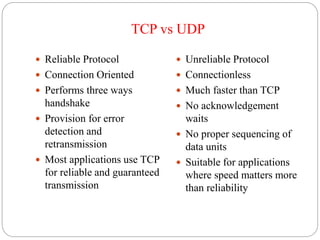
TCP vs UDP
 Reliable Protocol
 Connection Oriented
 Performs three ways
handshake
 Provision for error
detection and
retransmission
 Most applications use TCP
for reliable and guaranteed
transmission
 Unreliable Protocol
 Connectionless
 Much faster than TCP
 No acknowledgement
waits
 No proper sequencing of
data units
 Suitable for applications
where speed matters more
than reliability
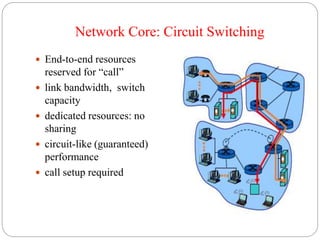
Network Core: Circuit Switching
 End-to-end resources
reserved for “call”
 link bandwidth, switch
capacity
 dedicated resources: no
sharing
 circuit-like (guaranteed)
performance
 call setup required
Circuit Switching
 Switched circuits allow data connections that can be
initiated when needed and terminated when communication
is complete
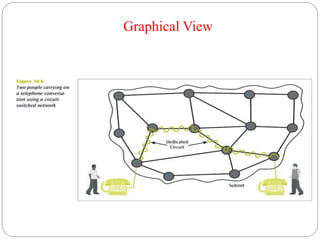
 Circuit switched network - a network in which a dedicated
circuit is established between sender and receiver and all
data passes over this circuit.
 The telephone system is a common example.
 The connection is dedicated until one party or another
terminates the connection.
Graphical View
Cont.
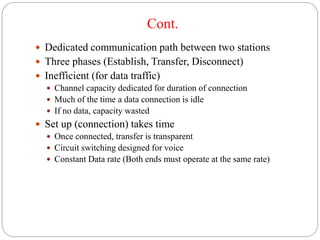
 Dedicated communication path between two stations
 Three phases (Establish, Transfer, Disconnect)
 Inefficient (for data traffic)
 Channel capacity dedicated for duration of connection
 Much of the time a data connection is idle
 If no data, capacity wasted
 Set up (connection) takes time
 Once connected, transfer is transparent
 Circuit switching designed for voice
 Constant Data rate (Both ends must operate at the same rate)
Cont.
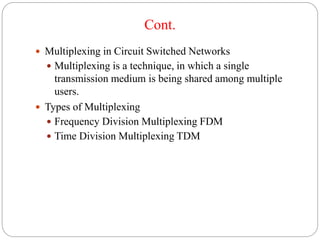
 Multiplexing in Circuit Switched Networks
 Multiplexing is a technique, in which a single
transmission medium is being shared among multiple
users.
 Types of Multiplexing
 Frequency Division Multiplexing FDM
 Time Division Multiplexing TDM
Network Core: Packet Switching
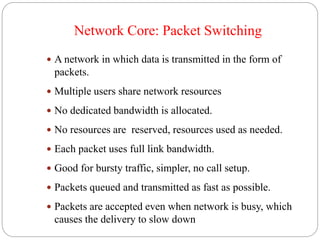
 A network in which data is transmitted in the form of
packets.
 Multiple users share network resources
 No dedicated bandwidth is allocated.
 No resources are reserved, resources used as needed.
 Each packet uses full link bandwidth.
 Good for bursty traffic, simpler, no call setup.
 Packets queued and transmitted as fast as possible.
 Packets are accepted even when network is busy, which
causes the delivery to slow down
Graphical View
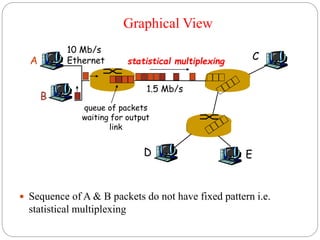
 Sequence of A & B packets do not have fixed pattern i.e.
statistical multiplexing
A
B
C
10 Mb/s
Ethernet
1.5 Mb/s
D E
statistical multiplexing
queue of packets
waiting for output
link
Cont.
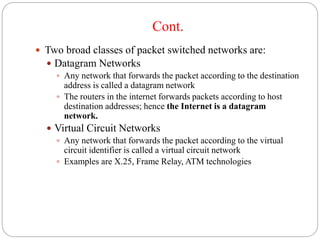
 Two broad classes of packet switched networks are:
 Datagram Networks
 Any network that forwards the packet according to the destination
address is called a datagram network
 The routers in the internet forwards packets according to host
destination addresses; hence the Internet is a datagram
network.
 Virtual Circuit Networks
 Any network that forwards the packet according to the virtual
circuit identifier is called a virtual circuit network
 Examples are X.25, Frame Relay, ATM technologies
Packet Switching: Datagram
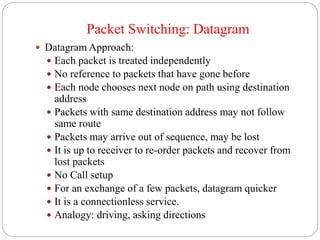
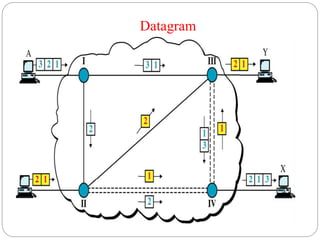
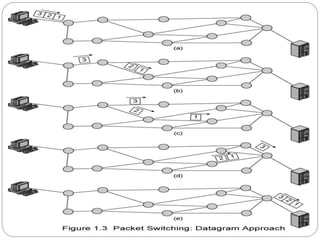
 Datagram Approach:
 Each packet is treated independently
 No reference to packets that have gone before
 Each node chooses next node on path using destination
address
 Packets with same destination address may not follow
same route
 Packets may arrive out of sequence, may be lost
 It is up to receiver to re-order packets and recover from
lost packets
 No Call setup
 For an exchange of a few packets, datagram quicker
 It is a connectionless service.
 Analogy: driving, asking directions
Datagram
Packet Switching: Virtual Circuit
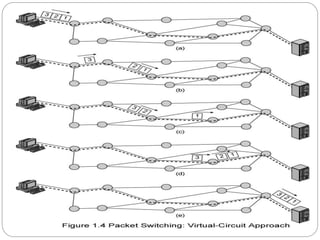
 Virtual circuit packet switched network create a logical
path through the subnet
 Call request and call accept packets establish a virtual
connection
 Virtual route remains fixed through the call.
 All packets from one connection follow this path.
 Each packet contains a virtual circuit identifier instead of
destination address to determines the next hop
 Not a dedicated path
 No routing decisions required for each packet
Network Taxonomy
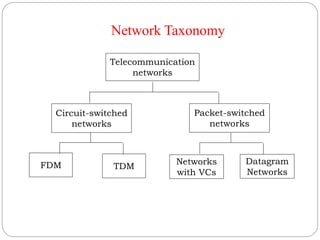
Telecommunication
networks
Circuit-switched
networks
FDM TDM
Packet-switched
networks
Networks
with VCs
Datagram
Networks

Lecture 12

  • 1.
  • 2.
    Network Edge  Anedge device provides an entry point into the enterprise. The devices which make up a network and provide access to it. For example routers, routing switches, multiplexers, WAN & MAN.
  • 3.
    What is Internet A Nuts and Bolts Description  End systems  Communication Links, Bandwidth  Routers, Packet  ISPs  Protocols, TCP/IP  Internet Standards, RFCs  A service Description  Distributed Applications  Connection Oriented Reliable Service  Connectionless Unreliable Service  What is a protocol?
  • 4.
    Internet  Two waysto describe the Internet  Nuts and Bolts View  The basic hardware and software components  Service Oriented View  The networking infrastructure that provides services to distributed applications
  • 5.
    Nuts and BoltView  Hosts or End Systems  Computing Devices such as PCs, PDAs (Personal Digital Assistants), TVs, servers, mobile computers, automobiles, etc. connected to the Internet are called hosts or end systems.  Communication links  End systems are connected together by communication links.  Communication links are made up of different types of media, including twisted pair, coaxial cable, fiber optics, and radio spectrum.  Bandwidth  Different links can transmit data at different rates.  The link transmission rate is often called the bandwidth (i.e, the width of the band) of the link which is measured in bits per second (bps).
  • 6.
    Cont.  Routers  Endsystems are not directly connected to each other via a single communication link. They are indirectly connected to each through intermediate switching devices known as routers.  A router receives chunk of information from one of its incoming communication link and forwards it to one of its outgoing communication link.  Packets  The chunk of information is called packet.  Route or Path  The path that the packet takes from the sending end system, through a series of communication links and routers, to the receiving end system is known as a route or path.  Packet switching  It allows multiple communicating end systems to share a path, or parts of path at the same time.
  • 7.
    Cont.  Internet ServiceProviders (ISPs)  End systems access the Internet through the Internet Service Providers (ISPs).  The different ISPs provide a variety of different types of network access to the end systems, including 56Kbps dial up modem access, cable modem or DSL, high speed LAN access, and wireless access.  Protocols  End systems, routers, and other pieces of the Internet, run protocols that control the sending and receiving of information within the Internet.  TCP (Transmission Control Protocol) and IP (Internet protocol) are two of the most important protocols in the Internet.
  • 8.
    Cont.  Internet Standards At the technical and development level, the Internet is made possible through creation, testing, and implementation of Internet Standards.  These standards are developed by Internet Engineering Task Force (IETF).  RFCs  The IETF standards documents are called RFCs (Request for comments).  RFCs started out as general request for comments (hence the name) to resolve architecture problems of the Internet.  They define protocols such as TCP, IP, HTTP, SMTP.
  • 9.
    Network Core  SwitchedNetworks:  Circuit Switched Networks  Packet Switched Networks.
  • 10.
    Service Oriented View Distributed Applications  The Internet allows distributed applications running on its end systems to exchange data with each other.  These applications include remote login, electronic mail, web surfing, instant messaging, audio and video streaming, Internet telephony, distributed games, peer-to-peer (P2P) file sharing, and much more.  Communication Services  Connection oriented reliable service  Connectionless unreliable service
  • 11.
    Cont.  Internet Providestwo services to its distributed applications:  Connection Oriented Reliable Service  It guarantees that data transmitted from a sender to a receiver will eventually be delivered to the receiver in order and in its entirety.  Connectionless Unreliable Service  It does not make any guarantees about eventual delivery.  Distributed applications makes use of one or the other (but not both) of these two services.
  • 12.
    Connection Oriented Services Reliable Data Transfer  Using acknowledgements & retransmissions  Flow Control  sender won’t overwhelm receiver  Congestion Control  senders “slow down sending rate” when network congested  TCP  Applications using TCP are:  HTTP (Web), FTP (file transfer), Telnet (remote login), SMTP (email)
  • 13.
    Connectionless Services  UnreliableData Transfer  no flow control  no congestion control  Fast  connectionless  UDP  Applications using UDP are:  multimedia, videoconferencing, DNS, Internet telephony
  • 14.
    TCP vs UDP Reliable Protocol  Connection Oriented  Performs three ways handshake  Provision for error detection and retransmission  Most applications use TCP for reliable and guaranteed transmission  Unreliable Protocol  Connectionless  Much faster than TCP  No acknowledgement waits  No proper sequencing of data units  Suitable for applications where speed matters more than reliability
  • 15.
    Network Core: CircuitSwitching  End-to-end resources reserved for “call”  link bandwidth, switch capacity  dedicated resources: no sharing  circuit-like (guaranteed) performance  call setup required
  • 16.
    Circuit Switching  Switchedcircuits allow data connections that can be initiated when needed and terminated when communication is complete  Circuit switched network - a network in which a dedicated circuit is established between sender and receiver and all data passes over this circuit.  The telephone system is a common example.  The connection is dedicated until one party or another terminates the connection.
  • 17.
  • 18.
    Cont.  Dedicated communicationpath between two stations  Three phases (Establish, Transfer, Disconnect)  Inefficient (for data traffic)  Channel capacity dedicated for duration of connection  Much of the time a data connection is idle  If no data, capacity wasted  Set up (connection) takes time  Once connected, transfer is transparent  Circuit switching designed for voice  Constant Data rate (Both ends must operate at the same rate)
  • 19.
    Cont.  Multiplexing inCircuit Switched Networks  Multiplexing is a technique, in which a single transmission medium is being shared among multiple users.  Types of Multiplexing  Frequency Division Multiplexing FDM  Time Division Multiplexing TDM
  • 20.
    Network Core: PacketSwitching  A network in which data is transmitted in the form of packets.  Multiple users share network resources  No dedicated bandwidth is allocated.  No resources are reserved, resources used as needed.  Each packet uses full link bandwidth.  Good for bursty traffic, simpler, no call setup.  Packets queued and transmitted as fast as possible.  Packets are accepted even when network is busy, which causes the delivery to slow down
  • 21.
    Graphical View  Sequenceof A & B packets do not have fixed pattern i.e. statistical multiplexing A B C 10 Mb/s Ethernet 1.5 Mb/s D E statistical multiplexing queue of packets waiting for output link
  • 22.
    Cont.  Two broadclasses of packet switched networks are:  Datagram Networks  Any network that forwards the packet according to the destination address is called a datagram network  The routers in the internet forwards packets according to host destination addresses; hence the Internet is a datagram network.  Virtual Circuit Networks  Any network that forwards the packet according to the virtual circuit identifier is called a virtual circuit network  Examples are X.25, Frame Relay, ATM technologies
  • 23.
    Packet Switching: Datagram Datagram Approach:  Each packet is treated independently  No reference to packets that have gone before  Each node chooses next node on path using destination address  Packets with same destination address may not follow same route  Packets may arrive out of sequence, may be lost  It is up to receiver to re-order packets and recover from lost packets  No Call setup  For an exchange of a few packets, datagram quicker  It is a connectionless service.  Analogy: driving, asking directions
  • 24.
  • 26.
    Packet Switching: VirtualCircuit  Virtual circuit packet switched network create a logical path through the subnet  Call request and call accept packets establish a virtual connection  Virtual route remains fixed through the call.  All packets from one connection follow this path.  Each packet contains a virtual circuit identifier instead of destination address to determines the next hop  Not a dedicated path  No routing decisions required for each packet
  • 28.

Editor's Notes

  • #10 Link: Physical Link Channel: A portion of the path that carries Transmission b/w a given pair of devices. one path can have many channels
  • #12 TX transmit from the server. RX  Received to the server.