Discrete Structure & Theory of Logic . Unit 2
G L Bajaj Group of Intitutions, Mathura | Compiled By: Nandini Sharma Page 1
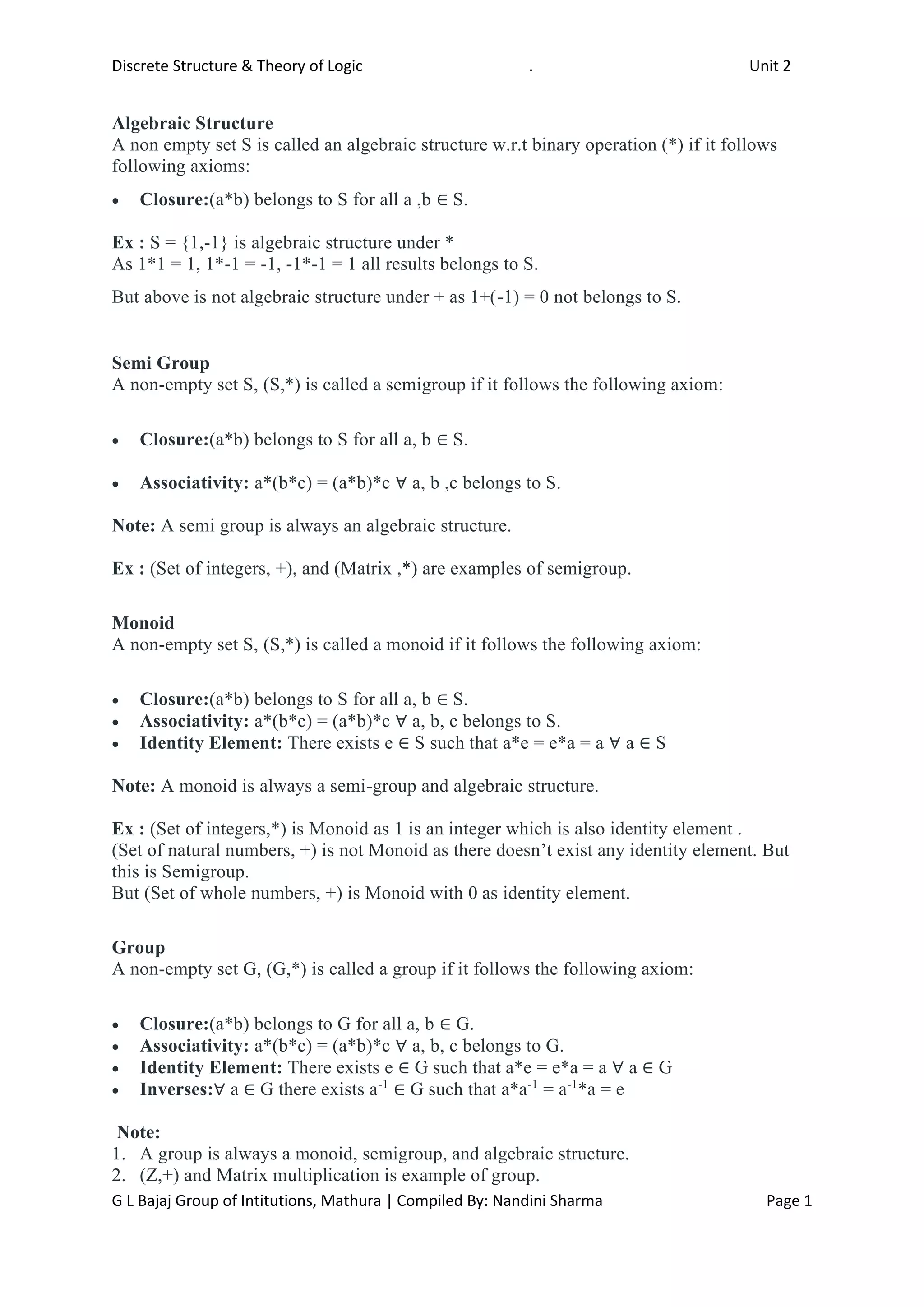
Algebraic Structure
A non empty set S is called an algebraic structure w.r.t binary operation (*) if it follows
following axioms:
• Closure:(a*b) belongs to S for all a ,b ∈ S.
Ex : S = {1,-1} is algebraic structure under *
As 1*1 = 1, 1*-1 = -1, -1*-1 = 1 all results belongs to S.
But above is not algebraic structure under + as 1+(-1) = 0 not belongs to S.
Semi Group
A non-empty set S, (S,*) is called a semigroup if it follows the following axiom:
• Closure:(a*b) belongs to S for all a, b ∈ S.
• Associativity: a*(b*c) = (a*b)*c ∀ a, b ,c belongs to S.
Note: A semi group is always an algebraic structure.
Ex : (Set of integers, +), and (Matrix ,*) are examples of semigroup.
Monoid
A non-empty set S, (S,*) is called a monoid if it follows the following axiom:
• Closure:(a*b) belongs to S for all a, b ∈ S.
• Associativity: a*(b*c) = (a*b)*c ∀ a, b, c belongs to S.
• Identity Element: There exists e ∈ S such that a*e = e*a = a ∀ a ∈ S
Note: A monoid is always a semi-group and algebraic structure.
Ex : (Set of integers,*) is Monoid as 1 is an integer which is also identity element .
(Set of natural numbers, +) is not Monoid as there doesn’t exist any identity element. But
this is Semigroup.
But (Set of whole numbers, +) is Monoid with 0 as identity element.
Group
A non-empty set G, (G,*) is called a group if it follows the following axiom:
• Closure:(a*b) belongs to G for all a, b ∈ G.
• Associativity: a*(b*c) = (a*b)*c ∀ a, b, c belongs to G.
• Identity Element: There exists e ∈ G such that a*e = e*a = a ∀ a ∈ G
• Inverses:∀ a ∈ G there exists a-1
∈ G such that a*a-1
= a-1
*a = e
Note:
1. A group is always a monoid, semigroup, and algebraic structure.
2. (Z,+) and Matrix multiplication is example of group.
Discrete Structure & Theory of Logic . Unit 2
G L Bajaj Group of Intitutions, Mathura | Compiled By: Nandini Sharma Page 1
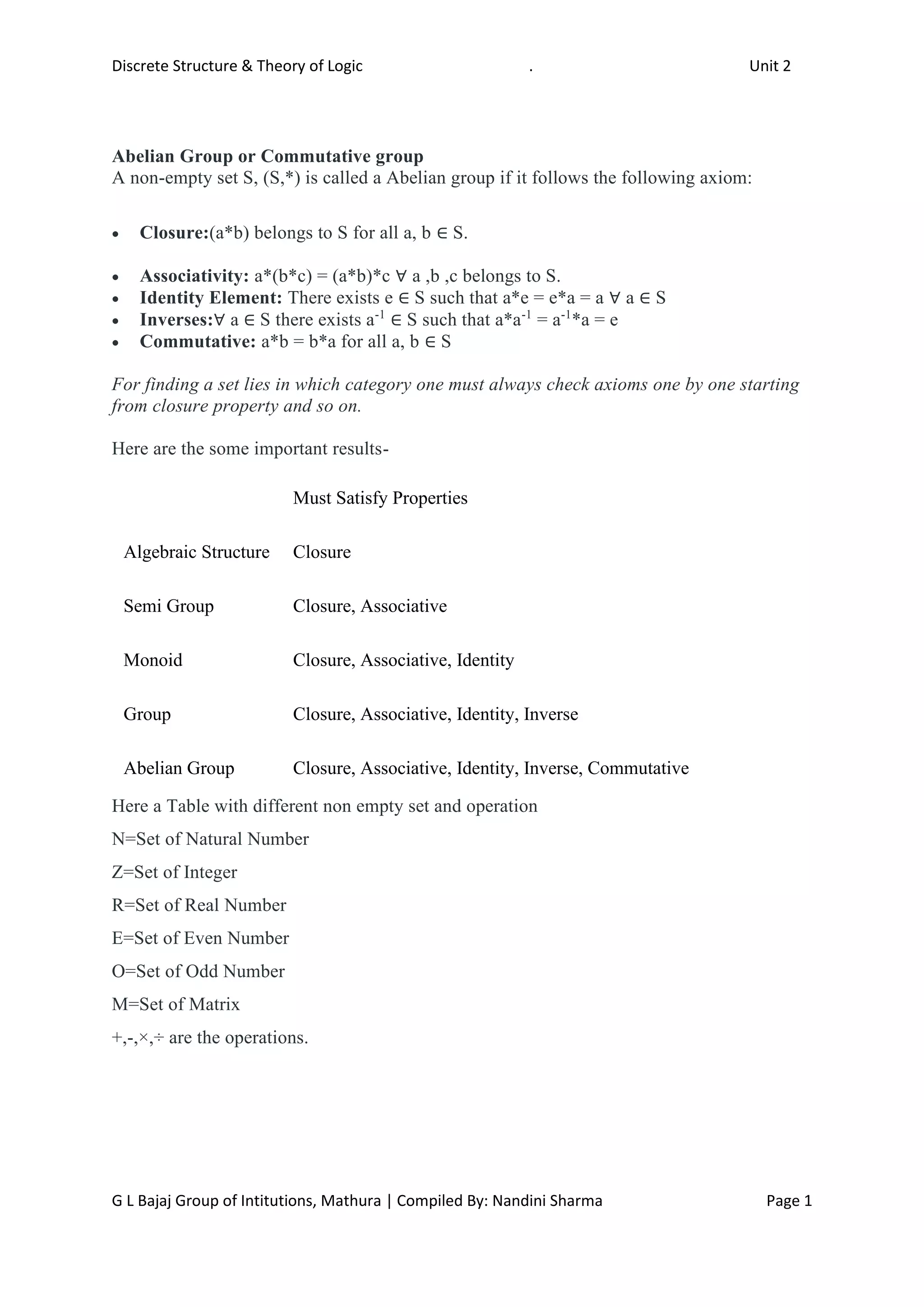
Abelian Group or Commutative group
A non-empty set S, (S,*) is called a Abelian group if it follows the following axiom:
• Closure:(a*b) belongs to S for all a, b ∈ S.
• Associativity: a*(b*c) = (a*b)*c ∀ a ,b ,c belongs to S.
• Identity Element: There exists e ∈ S such that a*e = e*a = a ∀ a ∈ S
• Inverses:∀ a ∈ S there exists a-1
∈ S such that a*a-1
= a-1
*a = e
• Commutative: a*b = b*a for all a, b ∈ S
For finding a set lies in which category one must always check axioms one by one starting
from closure property and so on.
Here are the some important results-
Must Satisfy Properties
Algebraic Structure Closure
Semi Group Closure, Associative
Monoid Closure, Associative, Identity
Group Closure, Associative, Identity, Inverse
Abelian Group Closure, Associative, Identity, Inverse, Commutative
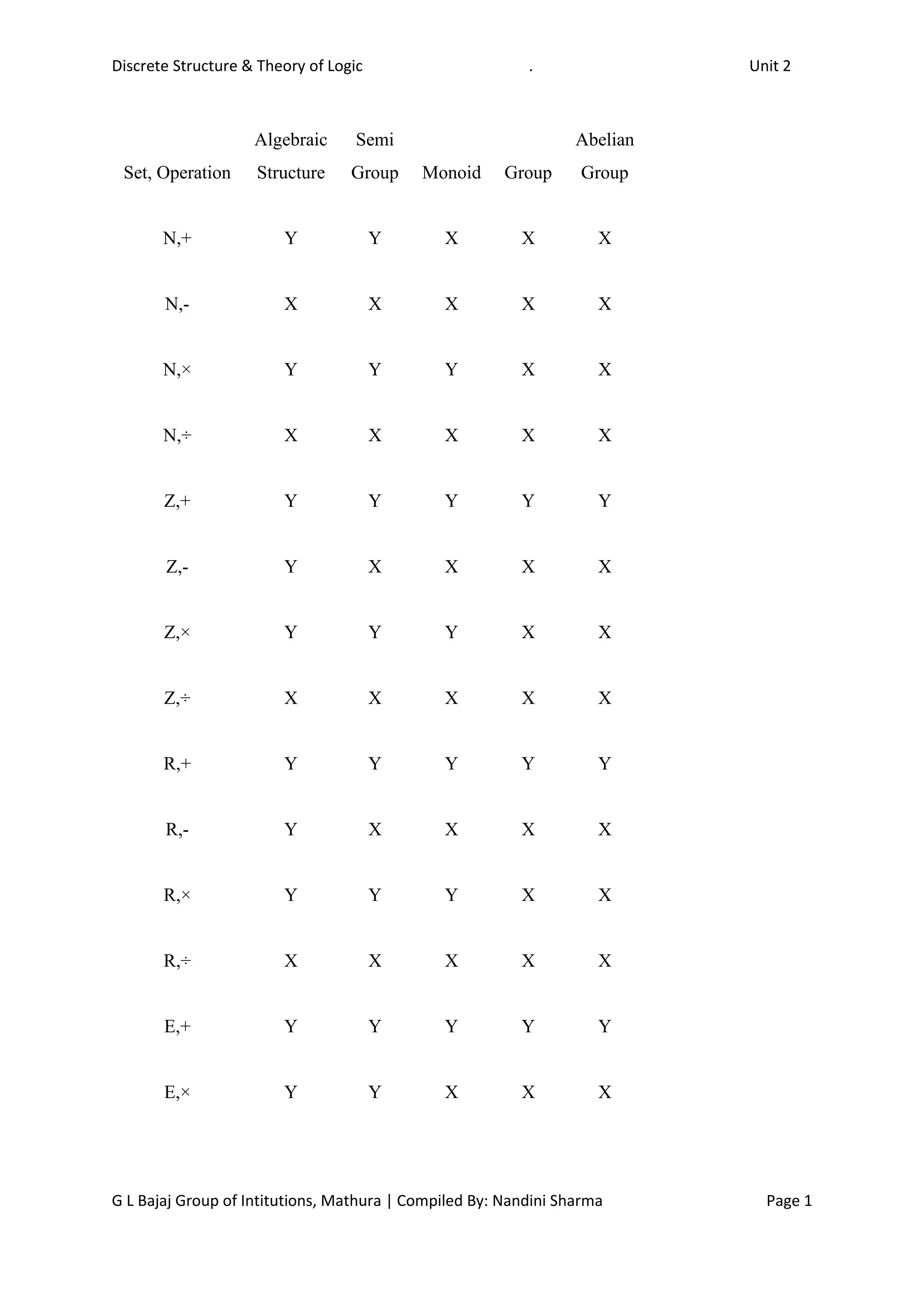
Here a Table with different non empty set and operation
N=Set of Natural Number
Z=Set of Integer
R=Set of Real Number
E=Set of Even Number
O=Set of Odd Number
M=Set of Matrix
+,-,×,÷ are the operations.
Discrete Structure & Theory of Logic . Unit 2
G L Bajaj Group of Intitutions, Mathura | Compiled By: Nandini Sharma Page 1
Set, Operation
Algebraic
Structure
Semi
Group Monoid Group
Abelian
Group
N,+ Y Y X X X
N,- X X X X X
N,× Y Y Y X X
N,÷ X X X X X
Z,+ Y Y Y Y Y
Z,- Y X X X X
Z,× Y Y Y X X
Z,÷ X X X X X
R,+ Y Y Y Y Y
R,- Y X X X X
R,× Y Y Y X X
R,÷ X X X X X
E,+ Y Y Y Y Y
E,× Y Y X X X
Discrete Structure & Theory of Logic . Unit 2
G L Bajaj Group of Intitutions, Mathura | Compiled By: Nandini Sharma Page 1
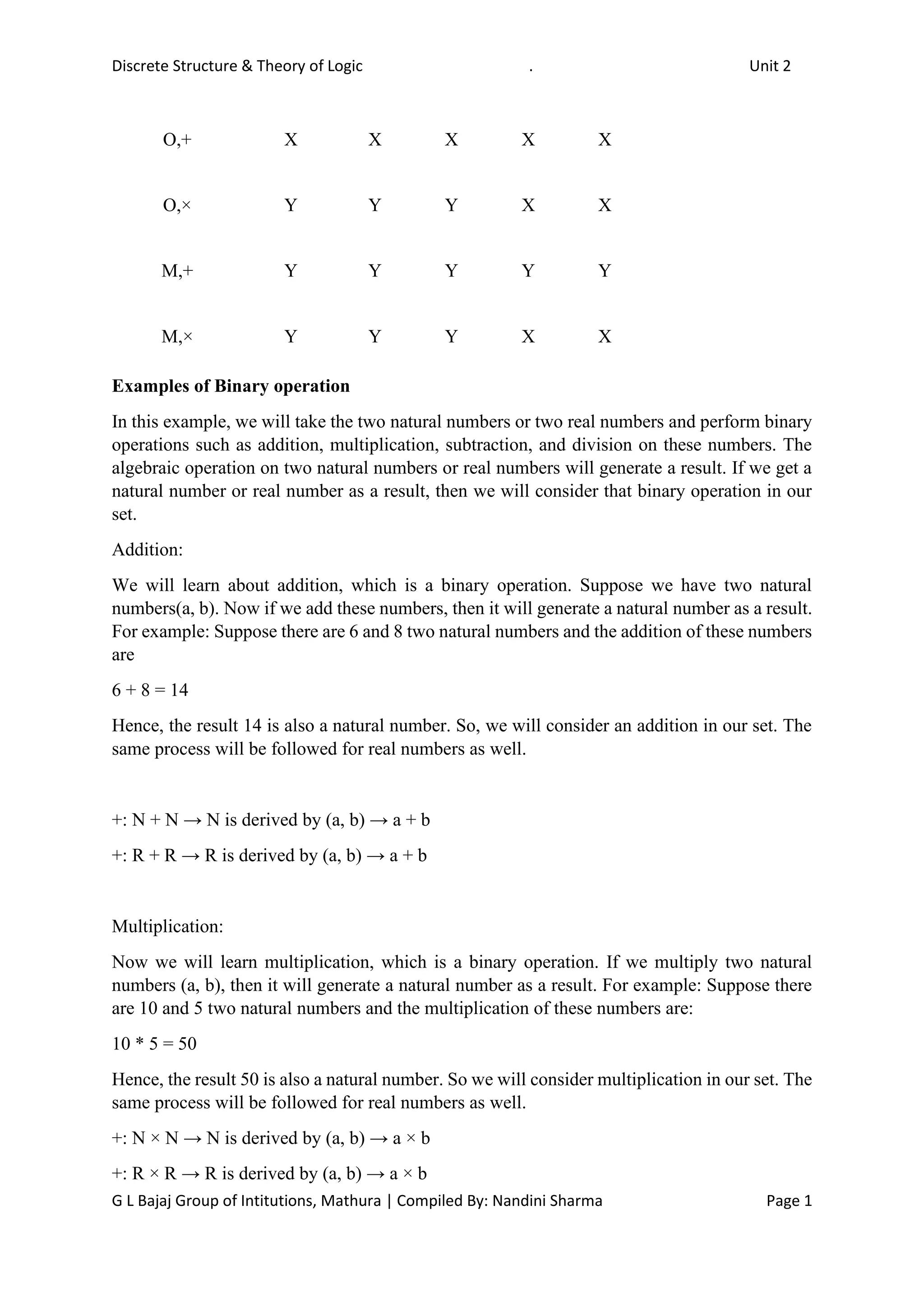
O,+ X X X X X
O,× Y Y Y X X
M,+ Y Y Y Y Y
M,× Y Y Y X X
Examples of Binary operation
In this example, we will take the two natural numbers or two real numbers and perform binary
operations such as addition, multiplication, subtraction, and division on these numbers. The
algebraic operation on two natural numbers or real numbers will generate a result. If we get a
natural number or real number as a result, then we will consider that binary operation in our
set.
Addition:
We will learn about addition, which is a binary operation. Suppose we have two natural
numbers(a, b). Now if we add these numbers, then it will generate a natural number as a result.
For example: Suppose there are 6 and 8 two natural numbers and the addition of these numbers
are
6 + 8 = 14
Hence, the result 14 is also a natural number. So, we will consider an addition in our set. The
same process will be followed for real numbers as well.
+: N + N → N is derived by (a, b) → a + b
+: R + R → R is derived by (a, b) → a + b
Multiplication:
Now we will learn multiplication, which is a binary operation. If we multiply two natural
numbers (a, b), then it will generate a natural number as a result. For example: Suppose there
are 10 and 5 two natural numbers and the multiplication of these numbers are:
10 * 5 = 50
Hence, the result 50 is also a natural number. So we will consider multiplication in our set. The
same process will be followed for real numbers as well.
+: N × N → N is derived by (a, b) → a × b
+: R × R → R is derived by (a, b) → a × b
Discrete Structure & Theory of Logic . Unit 2
G L Bajaj Group of Intitutions, Mathura | Compiled By: Nandini Sharma Page 1
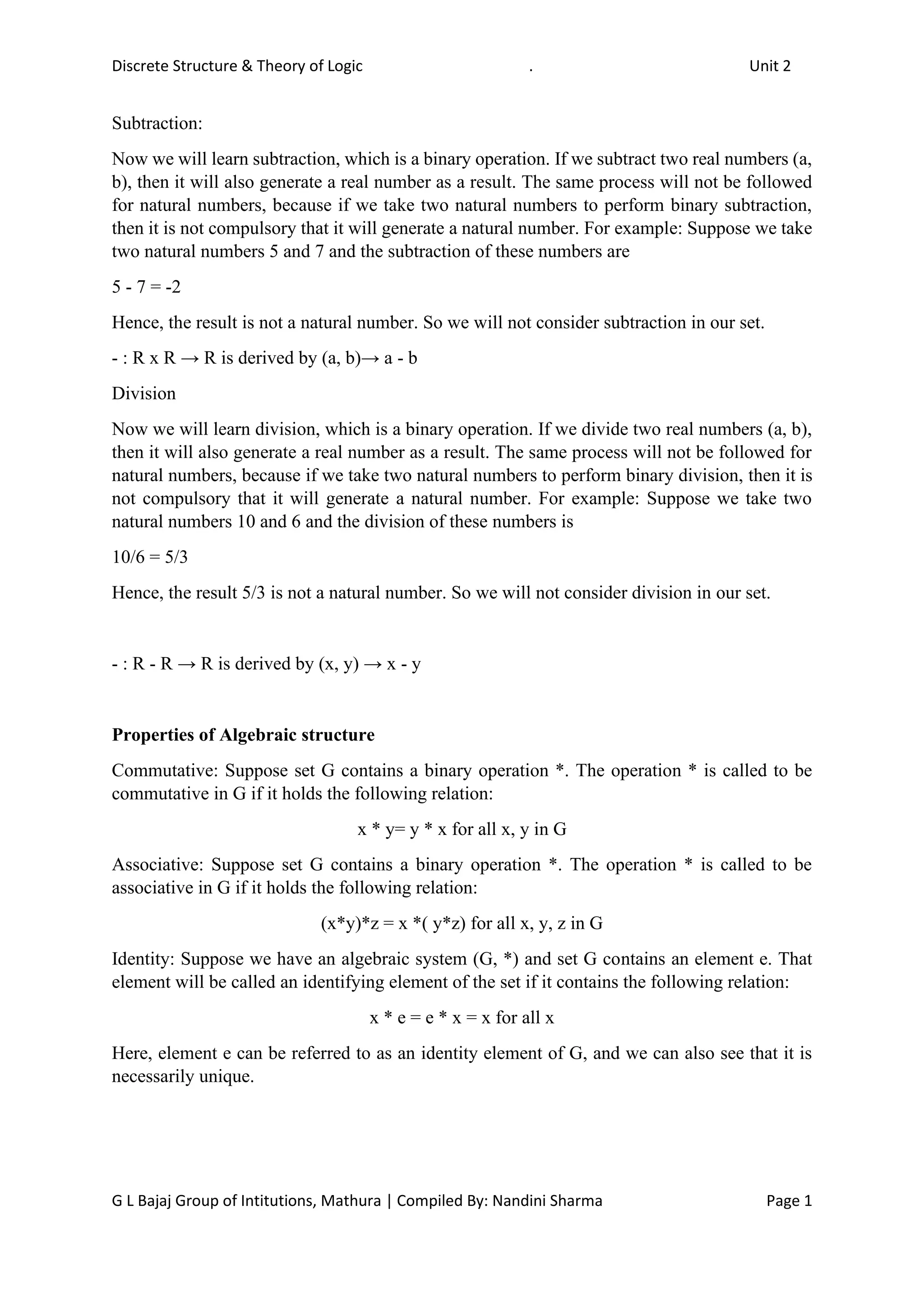
Subtraction:
Now we will learn subtraction, which is a binary operation. If we subtract two real numbers (a,
b), then it will also generate a real number as a result. The same process will not be followed
for natural numbers, because if we take two natural numbers to perform binary subtraction,
then it is not compulsory that it will generate a natural number. For example: Suppose we take
two natural numbers 5 and 7 and the subtraction of these numbers are
5 - 7 = -2
Hence, the result is not a natural number. So we will not consider subtraction in our set.
- : R x R → R is derived by (a, b)→ a - b
Division
Now we will learn division, which is a binary operation. If we divide two real numbers (a, b),
then it will also generate a real number as a result. The same process will not be followed for
natural numbers, because if we take two natural numbers to perform binary division, then it is
not compulsory that it will generate a natural number. For example: Suppose we take two
natural numbers 10 and 6 and the division of these numbers is
10/6 = 5/3
Hence, the result 5/3 is not a natural number. So we will not consider division in our set.
- : R - R → R is derived by (x, y) → x - y
Properties of Algebraic structure
Commutative: Suppose set G contains a binary operation *. The operation * is called to be
commutative in G if it holds the following relation:
x * y= y * x for all x, y in G
Associative: Suppose set G contains a binary operation *. The operation * is called to be
associative in G if it holds the following relation:
(x*y)*z = x *( y*z) for all x, y, z in G
Identity: Suppose we have an algebraic system (G, *) and set G contains an element e. That
element will be called an identifying element of the set if it contains the following relation:
x * e = e * x = x for all x
Here, element e can be referred to as an identity element of G, and we can also see that it is
necessarily unique.
Discrete Structure & Theory of Logic . Unit 2
G L Bajaj Group of Intitutions, Mathura | Compiled By: Nandini Sharma Page 1
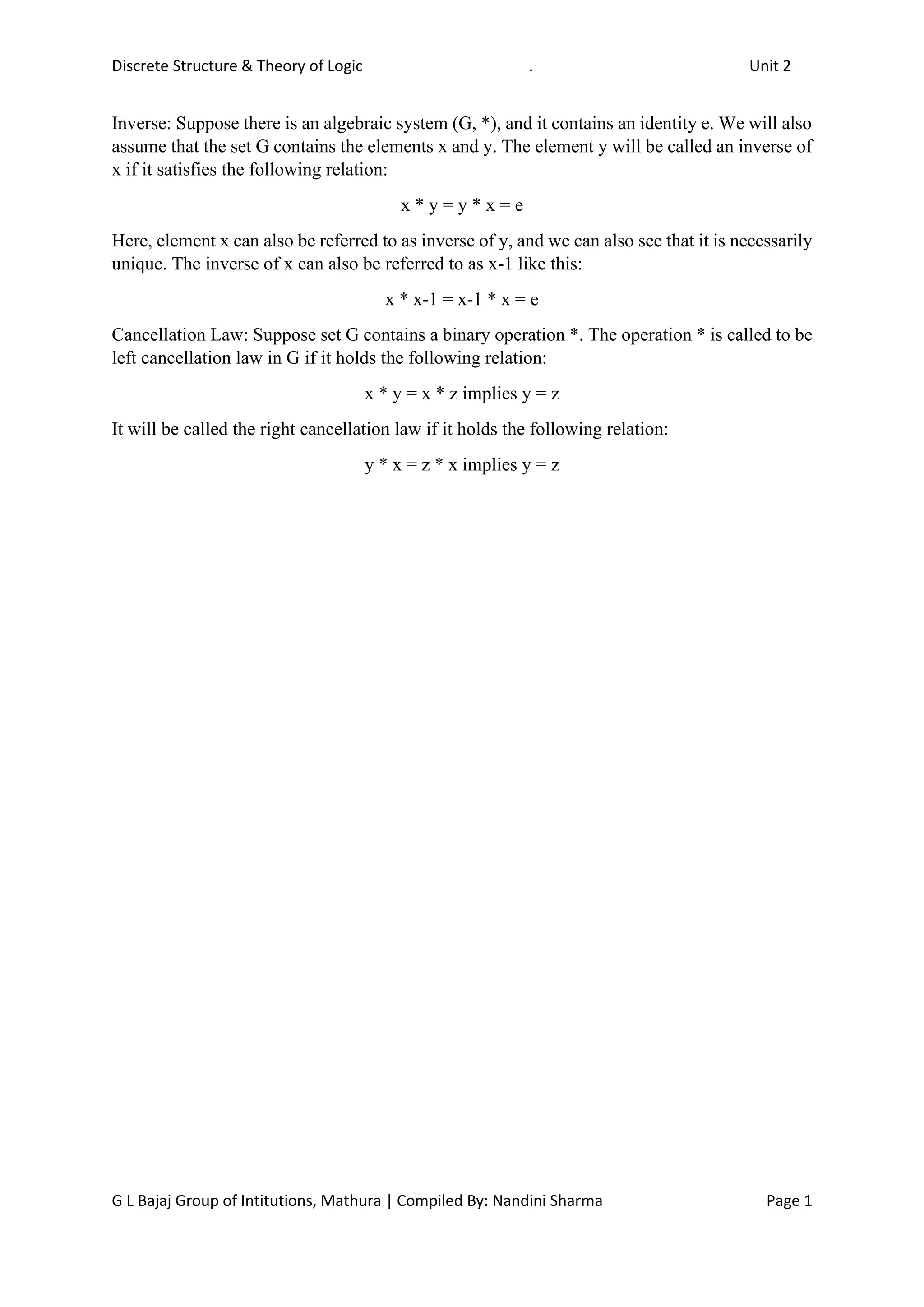
Inverse: Suppose there is an algebraic system (G, *), and it contains an identity e. We will also
assume that the set G contains the elements x and y. The element y will be called an inverse of
x if it satisfies the following relation:
x * y = y * x = e
Here, element x can also be referred to as inverse of y, and we can also see that it is necessarily
unique. The inverse of x can also be referred to as x-1 like this:
x * x-1 = x-1 * x = e
Cancellation Law: Suppose set G contains a binary operation *. The operation * is called to be
left cancellation law in G if it holds the following relation:
x * y = x * z implies y = z
It will be called the right cancellation law if it holds the following relation:
y * x = z * x implies y = z

Algebraic Structure

  • 1.
    Discrete Structure &Theory of Logic . Unit 2 G L Bajaj Group of Intitutions, Mathura | Compiled By: Nandini Sharma Page 1 Algebraic Structure A non empty set S is called an algebraic structure w.r.t binary operation (*) if it follows following axioms: • Closure:(a*b) belongs to S for all a ,b ∈ S. Ex : S = {1,-1} is algebraic structure under * As 1*1 = 1, 1*-1 = -1, -1*-1 = 1 all results belongs to S. But above is not algebraic structure under + as 1+(-1) = 0 not belongs to S. Semi Group A non-empty set S, (S,*) is called a semigroup if it follows the following axiom: • Closure:(a*b) belongs to S for all a, b ∈ S. • Associativity: a*(b*c) = (a*b)*c ∀ a, b ,c belongs to S. Note: A semi group is always an algebraic structure. Ex : (Set of integers, +), and (Matrix ,*) are examples of semigroup. Monoid A non-empty set S, (S,*) is called a monoid if it follows the following axiom: • Closure:(a*b) belongs to S for all a, b ∈ S. • Associativity: a*(b*c) = (a*b)*c ∀ a, b, c belongs to S. • Identity Element: There exists e ∈ S such that a*e = e*a = a ∀ a ∈ S Note: A monoid is always a semi-group and algebraic structure. Ex : (Set of integers,*) is Monoid as 1 is an integer which is also identity element . (Set of natural numbers, +) is not Monoid as there doesn’t exist any identity element. But this is Semigroup. But (Set of whole numbers, +) is Monoid with 0 as identity element. Group A non-empty set G, (G,*) is called a group if it follows the following axiom: • Closure:(a*b) belongs to G for all a, b ∈ G. • Associativity: a*(b*c) = (a*b)*c ∀ a, b, c belongs to G. • Identity Element: There exists e ∈ G such that a*e = e*a = a ∀ a ∈ G • Inverses:∀ a ∈ G there exists a-1 ∈ G such that a*a-1 = a-1 *a = e Note: 1. A group is always a monoid, semigroup, and algebraic structure. 2. (Z,+) and Matrix multiplication is example of group.
  • 2.
    Discrete Structure &Theory of Logic . Unit 2 G L Bajaj Group of Intitutions, Mathura | Compiled By: Nandini Sharma Page 1 Abelian Group or Commutative group A non-empty set S, (S,*) is called a Abelian group if it follows the following axiom: • Closure:(a*b) belongs to S for all a, b ∈ S. • Associativity: a*(b*c) = (a*b)*c ∀ a ,b ,c belongs to S. • Identity Element: There exists e ∈ S such that a*e = e*a = a ∀ a ∈ S • Inverses:∀ a ∈ S there exists a-1 ∈ S such that a*a-1 = a-1 *a = e • Commutative: a*b = b*a for all a, b ∈ S For finding a set lies in which category one must always check axioms one by one starting from closure property and so on. Here are the some important results- Must Satisfy Properties Algebraic Structure Closure Semi Group Closure, Associative Monoid Closure, Associative, Identity Group Closure, Associative, Identity, Inverse Abelian Group Closure, Associative, Identity, Inverse, Commutative Here a Table with different non empty set and operation N=Set of Natural Number Z=Set of Integer R=Set of Real Number E=Set of Even Number O=Set of Odd Number M=Set of Matrix +,-,×,÷ are the operations.
  • 3.
    Discrete Structure &Theory of Logic . Unit 2 G L Bajaj Group of Intitutions, Mathura | Compiled By: Nandini Sharma Page 1 Set, Operation Algebraic Structure Semi Group Monoid Group Abelian Group N,+ Y Y X X X N,- X X X X X N,× Y Y Y X X N,÷ X X X X X Z,+ Y Y Y Y Y Z,- Y X X X X Z,× Y Y Y X X Z,÷ X X X X X R,+ Y Y Y Y Y R,- Y X X X X R,× Y Y Y X X R,÷ X X X X X E,+ Y Y Y Y Y E,× Y Y X X X
  • 4.
    Discrete Structure &Theory of Logic . Unit 2 G L Bajaj Group of Intitutions, Mathura | Compiled By: Nandini Sharma Page 1 O,+ X X X X X O,× Y Y Y X X M,+ Y Y Y Y Y M,× Y Y Y X X Examples of Binary operation In this example, we will take the two natural numbers or two real numbers and perform binary operations such as addition, multiplication, subtraction, and division on these numbers. The algebraic operation on two natural numbers or real numbers will generate a result. If we get a natural number or real number as a result, then we will consider that binary operation in our set. Addition: We will learn about addition, which is a binary operation. Suppose we have two natural numbers(a, b). Now if we add these numbers, then it will generate a natural number as a result. For example: Suppose there are 6 and 8 two natural numbers and the addition of these numbers are 6 + 8 = 14 Hence, the result 14 is also a natural number. So, we will consider an addition in our set. The same process will be followed for real numbers as well. +: N + N → N is derived by (a, b) → a + b +: R + R → R is derived by (a, b) → a + b Multiplication: Now we will learn multiplication, which is a binary operation. If we multiply two natural numbers (a, b), then it will generate a natural number as a result. For example: Suppose there are 10 and 5 two natural numbers and the multiplication of these numbers are: 10 * 5 = 50 Hence, the result 50 is also a natural number. So we will consider multiplication in our set. The same process will be followed for real numbers as well. +: N × N → N is derived by (a, b) → a × b +: R × R → R is derived by (a, b) → a × b
  • 5.
    Discrete Structure &Theory of Logic . Unit 2 G L Bajaj Group of Intitutions, Mathura | Compiled By: Nandini Sharma Page 1 Subtraction: Now we will learn subtraction, which is a binary operation. If we subtract two real numbers (a, b), then it will also generate a real number as a result. The same process will not be followed for natural numbers, because if we take two natural numbers to perform binary subtraction, then it is not compulsory that it will generate a natural number. For example: Suppose we take two natural numbers 5 and 7 and the subtraction of these numbers are 5 - 7 = -2 Hence, the result is not a natural number. So we will not consider subtraction in our set. - : R x R → R is derived by (a, b)→ a - b Division Now we will learn division, which is a binary operation. If we divide two real numbers (a, b), then it will also generate a real number as a result. The same process will not be followed for natural numbers, because if we take two natural numbers to perform binary division, then it is not compulsory that it will generate a natural number. For example: Suppose we take two natural numbers 10 and 6 and the division of these numbers is 10/6 = 5/3 Hence, the result 5/3 is not a natural number. So we will not consider division in our set. - : R - R → R is derived by (x, y) → x - y Properties of Algebraic structure Commutative: Suppose set G contains a binary operation *. The operation * is called to be commutative in G if it holds the following relation: x * y= y * x for all x, y in G Associative: Suppose set G contains a binary operation *. The operation * is called to be associative in G if it holds the following relation: (x*y)*z = x *( y*z) for all x, y, z in G Identity: Suppose we have an algebraic system (G, *) and set G contains an element e. That element will be called an identifying element of the set if it contains the following relation: x * e = e * x = x for all x Here, element e can be referred to as an identity element of G, and we can also see that it is necessarily unique.
  • 6.
    Discrete Structure &Theory of Logic . Unit 2 G L Bajaj Group of Intitutions, Mathura | Compiled By: Nandini Sharma Page 1 Inverse: Suppose there is an algebraic system (G, *), and it contains an identity e. We will also assume that the set G contains the elements x and y. The element y will be called an inverse of x if it satisfies the following relation: x * y = y * x = e Here, element x can also be referred to as inverse of y, and we can also see that it is necessarily unique. The inverse of x can also be referred to as x-1 like this: x * x-1 = x-1 * x = e Cancellation Law: Suppose set G contains a binary operation *. The operation * is called to be left cancellation law in G if it holds the following relation: x * y = x * z implies y = z It will be called the right cancellation law if it holds the following relation: y * x = z * x implies y = z