COMPUTER GRAPHICS
IT Elective 2
ARNEL S. LLEMIT
Instructor
Introduction to Computer Graphics
It is the use of computers to
create and manipulate
pictures on a display device.
It comprises of software
techniques to create, store,
modify, represent pictures.
2
IT Elec 2
Why use computer graphics?
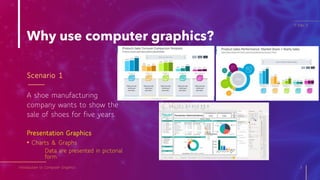
Scenario 1
A shoe manufacturing
company wants to show the
sale of shoes for five years.
Introduction to Computer Graphics 3
IT Elec 2
Presentation Graphics
• Charts & Graphs
Data are presented in pictorial
form
Why use computer graphics?
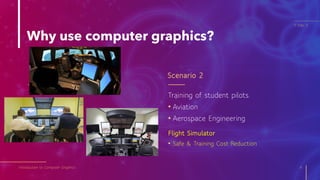
Scenario 2
Introduction to Computer Graphics 4
IT Elec 2
Training of student pilots.
• Aviation
• Aerospace Engineering
Flight Simulator
• Safe & Training Cost Reduction
5
IT Elec 2
Various applications of computer graphics and its importance
Introduction to Computer Graphics
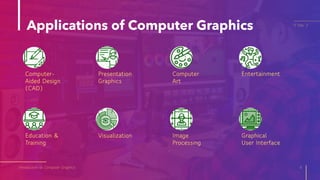
Applications of Computer Graphics
Computer-
Aided Design
(CAD)
Introduction to Computer Graphics 6
IT Elec 2
Presentation
Graphics
Computer
Art
Entertainment
Education &
Training
Visualization Image
Processing
Graphical
User Interface
Computer
Aided
Design
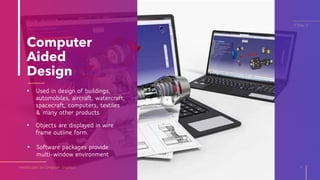
• Used in design of buildings,
automobiles, aircraft, watercraft,
spacecraft, computers, textiles
& many other products
Introduction to Computer Graphics 7
IT Elec 2
• Objects are displayed in wire
frame outline form.
• Software packages provide
multi-window environment
Computer
Aided
Design
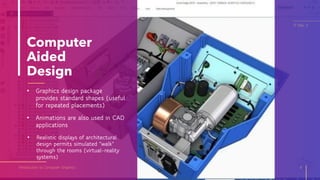
• Graphics design package
provides standard shapes (useful
for repeated placements)
Introduction to Computer Graphics 8
IT Elec 2
• Animations are also used in CAD
applications
• Realistic displays of architectural
design permits simulated “walk”
through the rooms (virtual-reality
systems)
Presentation Graphics
Introduction to Computer Graphics 9
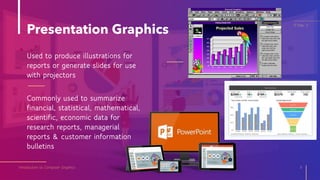
Used to produce illustrations for
reports or generate slides for use
with projectors
Commonly used to summarize
financial, statistical, mathematical,
scientific, economic data for
research reports, managerial
reports & customer information
bulletins
IT Elec 2
Computer Art
Introduction to Computer Graphics 10
IT Elec 2
Computer Art
Introduction to Computer Graphics 11
IT Elec 2
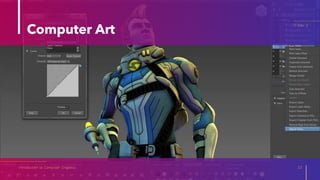
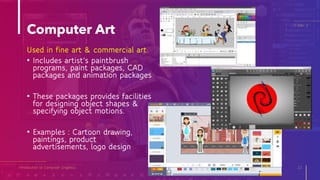
Used in fine art & commercial art
• Includes artist’s paintbrush
programs, paint packages, CAD
packages and animation packages
• These packages provides facilities
for designing object shapes &
specifying object motions.
• Examples : Cartoon drawing,
paintings, product
advertisements, logo design
Computer Art
Introduction to Computer Graphics 12
IT Elec 2
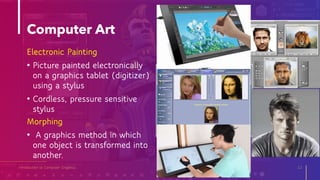
Electronic Painting
• Picture painted electronically
on a graphics tablet (digitizer)
using a stylus
• Cordless, pressure sensitive
stylus
Morphing
• A graphics method in which
one object is transformed into
another.
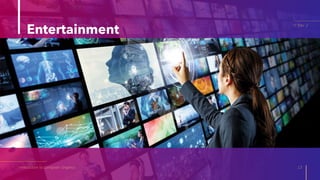
Entertainment
Introduction to Computer Graphics 13
IT Elec 2
Entertainment
Introduction to Computer Graphics 14
IT Elec 2
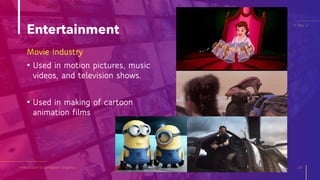
Movie Industry
• Used in motion pictures, music
videos, and television shows.
• Used in making of cartoon
animation films
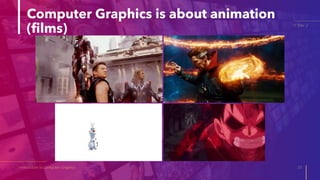
Computer Graphics is about animation
(films)
Introduction to Computer Graphics 15
IT Elec 2
Entertainment
Introduction to Computer Graphics 16
IT Elec 2
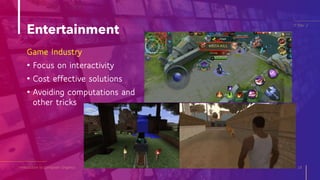
Game Industry
• Focus on interactivity
• Cost effective solutions
• Avoiding computations and
other tricks
Education
& Training
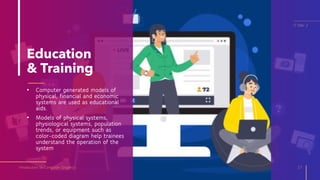
• Computer generated models of
physical, financial and economic
systems are used as educational
aids.
• Models of physical systems,
physiological systems, population
trends, or equipment such as
color-coded diagram help trainees
understand the operation of the
system
Introduction to Computer Graphics 17
IT Elec 2
Education
& Training
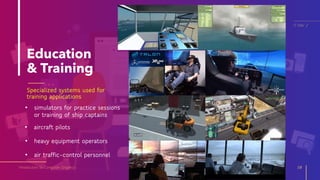
Specialized systems used for
training applications
Introduction to Computer Graphics 18
IT Elec 2
18
• simulators for practice sessions
or training of ship captains
• aircraft pilots
• heavy equipment operators
• air traffic-control personnel
Visualization
Introduction to Computer Graphics 19
IT Elec 2
Visualization
Introduction to Computer Graphics 20
IT Elec 2
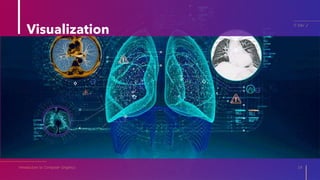
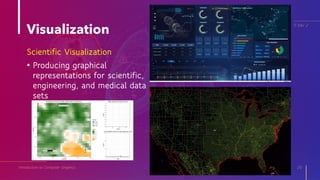
Scientific Visualization
• Producing graphical
representations for scientific,
engineering, and medical data
sets
Visualization
Introduction to Computer Graphics 21
IT Elec 2
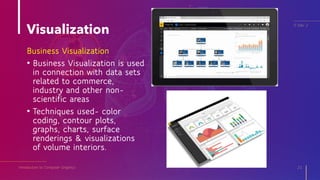
Business Visualization
• Business Visualization is used
in connection with data sets
related to commerce,
industry and other non-
scientific areas
• Techniques used- color
coding, contour plots,
graphs, charts, surface
renderings & visualizations
of volume interiors.
Image Processing
Introduction to Computer Graphics 22
IT Elec 2
Introduction to Computer Graphics 23
IT Elec 2
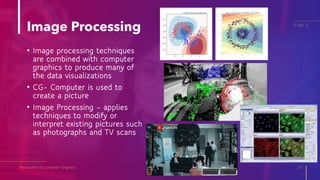
• Image processing techniques
are combined with computer
graphics to produce many of
the data visualizations
• CG- Computer is used to
create a picture
• Image Processing – applies
techniques to modify or
interpret existing pictures such
as photographs and TV scans
Image Processing
Introduction to Computer Graphics 24
IT Elec 2
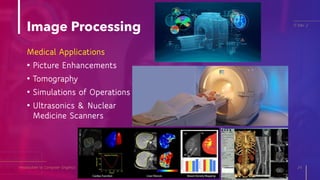
Medical Applications
• Picture Enhancements
• Tomography
• Simulations of Operations
• Ultrasonics & Nuclear
Medicine Scanners
Image Processing
Introduction to Computer Graphics 25
IT Elec 2
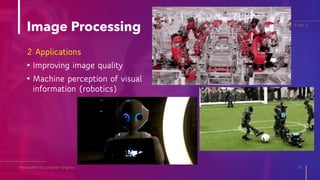
2 Applications
• Improving image quality
• Machine perception of visual
information (robotics)
Image Processing
Introduction to Computer Graphics 26
IT Elec 2
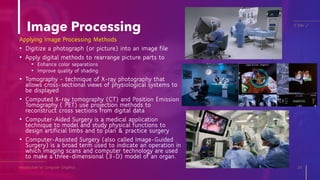
Applying Image Processing Methods
• Digitize a photograph (or picture) into an image file
• Apply digital methods to rearrange picture parts to
• Enhance color separations
• Improve quality of shading
• Tomography – technique of X-ray photography that
allows cross-sectional views of physiological systems to
be displayed
• Computed X-ray tomography (CT) and Position Emission
Tomography ( PET) use projection methods to
reconstruct cross sections from digital data
• Computer-Aided Surgery is a medical application
technique to model and study physical functions to
design artificial limbs and to plan & practice surgery
• Computer-Assisted Surgery (also called Image-Guided
Surgery) is a broad term used to indicate an operation in
which imaging scans and computer technology are used
to make a three-dimensional (3-D) model of an organ.
Image Processing
Graphical User Interfaces
Introduction to Computer Graphics 27
IT Elec 2
Introduction to Computer Graphics 28
IT Elec 2
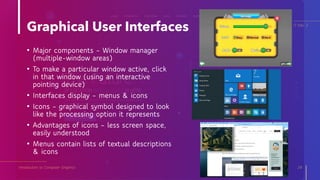
• Major components – Window manager
(multiple-window areas)
• To make a particular window active, click
in that window (using an interactive
pointing device)
• Interfaces display – menus & icons
• Icons – graphical symbol designed to look
like the processing option it represents
• Advantages of icons – less screen space,
easily understood
• Menus contain lists of textual descriptions
& icons
Graphical User Interfaces
Introduction to Computer Graphics 29
IT Elec 2
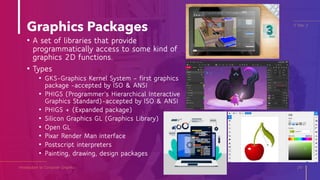
• A set of libraries that provide
programmatically access to some kind of
graphics 2D functions.
• Types
• GKS-Graphics Kernel System – first graphics
package -accepted by ISO & ANSI
• PHIGS (Programmer’s Hierarchical Interactive
Graphics Standard)-accepted by ISO & ANSI
• PHIGS + (Expanded package)
• Silicon Graphics GL (Graphics Library)
• Open GL
• Pixar Render Man interface
• Postscript interpreters
• Painting, drawing, design packages
Graphics Packages
End of Presentation
Introduction to Computer Graphics
IT Elec 2

Introduction to Computer Graphics

  • 1.
    COMPUTER GRAPHICS IT Elective2 ARNEL S. LLEMIT Instructor
  • 2.
    Introduction to ComputerGraphics It is the use of computers to create and manipulate pictures on a display device. It comprises of software techniques to create, store, modify, represent pictures. 2 IT Elec 2
  • 3.
    Why use computergraphics? Scenario 1 A shoe manufacturing company wants to show the sale of shoes for five years. Introduction to Computer Graphics 3 IT Elec 2 Presentation Graphics • Charts & Graphs Data are presented in pictorial form
  • 4.
    Why use computergraphics? Scenario 2 Introduction to Computer Graphics 4 IT Elec 2 Training of student pilots. • Aviation • Aerospace Engineering Flight Simulator • Safe & Training Cost Reduction
  • 5.
    5 IT Elec 2 Variousapplications of computer graphics and its importance Introduction to Computer Graphics
  • 6.
    Applications of ComputerGraphics Computer- Aided Design (CAD) Introduction to Computer Graphics 6 IT Elec 2 Presentation Graphics Computer Art Entertainment Education & Training Visualization Image Processing Graphical User Interface
  • 7.
    Computer Aided Design • Used indesign of buildings, automobiles, aircraft, watercraft, spacecraft, computers, textiles & many other products Introduction to Computer Graphics 7 IT Elec 2 • Objects are displayed in wire frame outline form. • Software packages provide multi-window environment
  • 8.
    Computer Aided Design • Graphics designpackage provides standard shapes (useful for repeated placements) Introduction to Computer Graphics 8 IT Elec 2 • Animations are also used in CAD applications • Realistic displays of architectural design permits simulated “walk” through the rooms (virtual-reality systems)
  • 9.
    Presentation Graphics Introduction toComputer Graphics 9 Used to produce illustrations for reports or generate slides for use with projectors Commonly used to summarize financial, statistical, mathematical, scientific, economic data for research reports, managerial reports & customer information bulletins IT Elec 2
  • 10.
    Computer Art Introduction toComputer Graphics 10 IT Elec 2
  • 11.
    Computer Art Introduction toComputer Graphics 11 IT Elec 2 Used in fine art & commercial art • Includes artist’s paintbrush programs, paint packages, CAD packages and animation packages • These packages provides facilities for designing object shapes & specifying object motions. • Examples : Cartoon drawing, paintings, product advertisements, logo design
  • 12.
    Computer Art Introduction toComputer Graphics 12 IT Elec 2 Electronic Painting • Picture painted electronically on a graphics tablet (digitizer) using a stylus • Cordless, pressure sensitive stylus Morphing • A graphics method in which one object is transformed into another.
  • 13.
  • 14.
    Entertainment Introduction to ComputerGraphics 14 IT Elec 2 Movie Industry • Used in motion pictures, music videos, and television shows. • Used in making of cartoon animation films
  • 15.
    Computer Graphics isabout animation (films) Introduction to Computer Graphics 15 IT Elec 2
  • 16.
    Entertainment Introduction to ComputerGraphics 16 IT Elec 2 Game Industry • Focus on interactivity • Cost effective solutions • Avoiding computations and other tricks
  • 17.
    Education & Training • Computergenerated models of physical, financial and economic systems are used as educational aids. • Models of physical systems, physiological systems, population trends, or equipment such as color-coded diagram help trainees understand the operation of the system Introduction to Computer Graphics 17 IT Elec 2
  • 18.
    Education & Training Specialized systemsused for training applications Introduction to Computer Graphics 18 IT Elec 2 18 • simulators for practice sessions or training of ship captains • aircraft pilots • heavy equipment operators • air traffic-control personnel
  • 19.
  • 20.
    Visualization Introduction to ComputerGraphics 20 IT Elec 2 Scientific Visualization • Producing graphical representations for scientific, engineering, and medical data sets
  • 21.
    Visualization Introduction to ComputerGraphics 21 IT Elec 2 Business Visualization • Business Visualization is used in connection with data sets related to commerce, industry and other non- scientific areas • Techniques used- color coding, contour plots, graphs, charts, surface renderings & visualizations of volume interiors.
  • 22.
    Image Processing Introduction toComputer Graphics 22 IT Elec 2
  • 23.
    Introduction to ComputerGraphics 23 IT Elec 2 • Image processing techniques are combined with computer graphics to produce many of the data visualizations • CG- Computer is used to create a picture • Image Processing – applies techniques to modify or interpret existing pictures such as photographs and TV scans Image Processing
  • 24.
    Introduction to ComputerGraphics 24 IT Elec 2 Medical Applications • Picture Enhancements • Tomography • Simulations of Operations • Ultrasonics & Nuclear Medicine Scanners Image Processing
  • 25.
    Introduction to ComputerGraphics 25 IT Elec 2 2 Applications • Improving image quality • Machine perception of visual information (robotics) Image Processing
  • 26.
    Introduction to ComputerGraphics 26 IT Elec 2 Applying Image Processing Methods • Digitize a photograph (or picture) into an image file • Apply digital methods to rearrange picture parts to • Enhance color separations • Improve quality of shading • Tomography – technique of X-ray photography that allows cross-sectional views of physiological systems to be displayed • Computed X-ray tomography (CT) and Position Emission Tomography ( PET) use projection methods to reconstruct cross sections from digital data • Computer-Aided Surgery is a medical application technique to model and study physical functions to design artificial limbs and to plan & practice surgery • Computer-Assisted Surgery (also called Image-Guided Surgery) is a broad term used to indicate an operation in which imaging scans and computer technology are used to make a three-dimensional (3-D) model of an organ. Image Processing
  • 27.
    Graphical User Interfaces Introductionto Computer Graphics 27 IT Elec 2
  • 28.
    Introduction to ComputerGraphics 28 IT Elec 2 • Major components – Window manager (multiple-window areas) • To make a particular window active, click in that window (using an interactive pointing device) • Interfaces display – menus & icons • Icons – graphical symbol designed to look like the processing option it represents • Advantages of icons – less screen space, easily understood • Menus contain lists of textual descriptions & icons Graphical User Interfaces
  • 29.
    Introduction to ComputerGraphics 29 IT Elec 2 • A set of libraries that provide programmatically access to some kind of graphics 2D functions. • Types • GKS-Graphics Kernel System – first graphics package -accepted by ISO & ANSI • PHIGS (Programmer’s Hierarchical Interactive Graphics Standard)-accepted by ISO & ANSI • PHIGS + (Expanded package) • Silicon Graphics GL (Graphics Library) • Open GL • Pixar Render Man interface • Postscript interpreters • Painting, drawing, design packages Graphics Packages
  • 30.
    End of Presentation Introductionto Computer Graphics IT Elec 2