

COMPUTER ASSISTED LEARNING
DEFINITION
Computer assisted instruction is also called computer based learning and
computer-based training , uses computers to aid in the delivery of multimedia
packages for learning and teaching
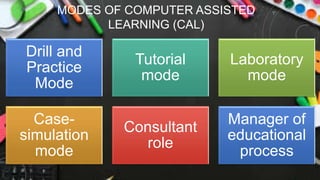
MODES OF COMPUTER ASSISTED
LEARNING (CAL)
Drill and
Practice
Mode
Tutorial
mode
Laboratory
mode
Case-
simulation
mode
Consultant
role
Manager of
educational
process
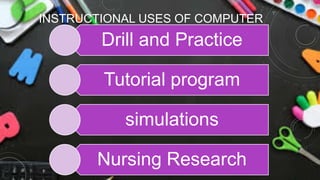
INSTRUCTIONAL USES OF COMPUTER
Drill and Practice
Tutorial program
simulations
Nursing Research
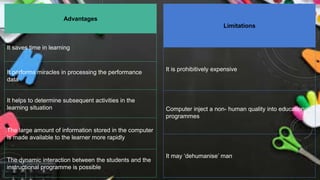
Advantages
It saves time in learning
It performs miracles in processing the performance
data
It helps to determine subsequent activities in the
learning situation
The large amount of information stored in the computer
is made available to the learner more rapidly
The dynamic interaction between the students and the
instructional programme is possible
Limitations
It is prohibitively expensive
Computer inject a non- human quality into educational
programmes
It may ‘dehumanise’ man
MICRO TEACHING
DEFINITION
Clift et al Bush (1968) Allen
Microteaching is a procedure
which reduces the teaching
situation simpler and more
controlled encounter achieved
by limiting the practice
teaching to as specific skill and
reducing teaching time and
class size
Microteaching as a teacher education
techniques which allows teachers to
apply well-defined teaching skills toa
carefully prepared lesson in a planned
series of five to ten minutes encounters
with a small group of real classroom
students, often with an opportunity to
observe the performance on videotape
Microteaching as a scaled
down teaching encounter in
class size and class time
• The number of students is
from 5-10 students
• The duration of period ranges
from 5-20 minutes
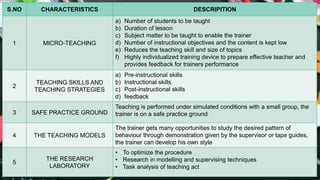
S.NO CHARACTERISTICS DESCRIPITION
1 MICRO-TEACHING
a) Number of students to be taught
b) Duration of lesson
c) Subject matter to be taught to enable the trainer
d) Number of instructional objectives and the content is kept low
e) Reduces the teaching skill and size of topics
f) Highly individualized training device to prepare effective teacher and
provides feedback for trainers performance
2
TEACHING SKILLS AND
TEACHING STRATEGIES
a) Pre-instructional skills
b) Instructional skills
c) Post-instructional skills
d) feedback
3 SAFE PRACTICE GROUND
Teaching is performed under simulated conditions with a small group, the
trainer is on a safe practice ground
4 THE TEACHING MODELS
The trainer gets many opportunities to study the desired pattern of
behaviour through demonstration given by the supervisor or tape guides,
the trainer can develop his own style
5
THE RESEARCH
LABORATORY
• To optimize the procedure
• Research in modelling and supervising techniques
• Task analysis of teaching act
PRINCIPLES
1.Enforcement
2.Practice and drill
3.Continuity
4.Microscopic supervision
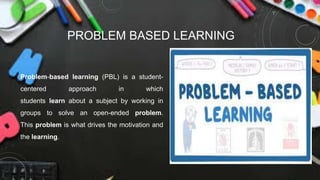
PROBLEM BASED LEARNING
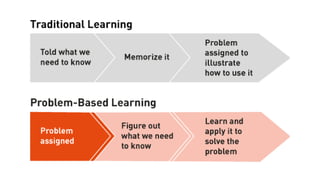
Problem-based learning (PBL) is a student-
centered approach in which
students learn about a subject by working in
groups to solve an open-ended problem.
This problem is what drives the motivation and
the learning.
DEFINITION
• Problem based learning is a conception of knowledge, understanding and
education that is profoundly different from the more usual concept underlying
subject- based learning.
Margetson (1991)
• Problem based learning can be explained as ” the learning that results from
process of working towards the understanding or resolution of a problem”
Barrows (1980)
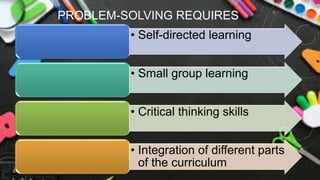
PROBLEM-SOLVING REQUIRES
• Self-directed learning
• Small group learning
• Critical thinking skills
• Integration of different parts
of the curriculum
SAVIN-BADEN 1996 LISTED 3 KEY REASONS FOR
PBL
First reason was
developing skills and more
specifically clinical
reasoning skills
Second reason was that
learning should take place
in ‘context’ for the students
Final reason was the
promotion of self- directed
learning
PROFESSIONAL BEHAVIOURS IN PBL
Respect
Responsibility
Self-awareness/ Self-evaluation
Communication skills

methods of teaching part-5 computer assisted learning, micro teaching and problem based learning

  • 1.
  • 2.
    DEFINITION Computer assisted instructionis also called computer based learning and computer-based training , uses computers to aid in the delivery of multimedia packages for learning and teaching
  • 3.
    MODES OF COMPUTERASSISTED LEARNING (CAL) Drill and Practice Mode Tutorial mode Laboratory mode Case- simulation mode Consultant role Manager of educational process
  • 4.
    INSTRUCTIONAL USES OFCOMPUTER Drill and Practice Tutorial program simulations Nursing Research
  • 5.
    Advantages It saves timein learning It performs miracles in processing the performance data It helps to determine subsequent activities in the learning situation The large amount of information stored in the computer is made available to the learner more rapidly The dynamic interaction between the students and the instructional programme is possible Limitations It is prohibitively expensive Computer inject a non- human quality into educational programmes It may ‘dehumanise’ man
  • 6.
  • 7.
    DEFINITION Clift et alBush (1968) Allen Microteaching is a procedure which reduces the teaching situation simpler and more controlled encounter achieved by limiting the practice teaching to as specific skill and reducing teaching time and class size Microteaching as a teacher education techniques which allows teachers to apply well-defined teaching skills toa carefully prepared lesson in a planned series of five to ten minutes encounters with a small group of real classroom students, often with an opportunity to observe the performance on videotape Microteaching as a scaled down teaching encounter in class size and class time
  • 8.
    • The numberof students is from 5-10 students • The duration of period ranges from 5-20 minutes
  • 9.
    S.NO CHARACTERISTICS DESCRIPITION 1MICRO-TEACHING a) Number of students to be taught b) Duration of lesson c) Subject matter to be taught to enable the trainer d) Number of instructional objectives and the content is kept low e) Reduces the teaching skill and size of topics f) Highly individualized training device to prepare effective teacher and provides feedback for trainers performance 2 TEACHING SKILLS AND TEACHING STRATEGIES a) Pre-instructional skills b) Instructional skills c) Post-instructional skills d) feedback 3 SAFE PRACTICE GROUND Teaching is performed under simulated conditions with a small group, the trainer is on a safe practice ground 4 THE TEACHING MODELS The trainer gets many opportunities to study the desired pattern of behaviour through demonstration given by the supervisor or tape guides, the trainer can develop his own style 5 THE RESEARCH LABORATORY • To optimize the procedure • Research in modelling and supervising techniques • Task analysis of teaching act
  • 10.
  • 11.
    PROBLEM BASED LEARNING Problem-basedlearning (PBL) is a student- centered approach in which students learn about a subject by working in groups to solve an open-ended problem. This problem is what drives the motivation and the learning.
  • 12.
    DEFINITION • Problem basedlearning is a conception of knowledge, understanding and education that is profoundly different from the more usual concept underlying subject- based learning. Margetson (1991) • Problem based learning can be explained as ” the learning that results from process of working towards the understanding or resolution of a problem” Barrows (1980)
  • 15.
    PROBLEM-SOLVING REQUIRES • Self-directedlearning • Small group learning • Critical thinking skills • Integration of different parts of the curriculum
  • 16.
    SAVIN-BADEN 1996 LISTED3 KEY REASONS FOR PBL First reason was developing skills and more specifically clinical reasoning skills Second reason was that learning should take place in ‘context’ for the students Final reason was the promotion of self- directed learning
  • 17.
    PROFESSIONAL BEHAVIOURS INPBL Respect Responsibility Self-awareness/ Self-evaluation Communication skills