POSTNATAL ASSESSMENT &
MANAGEMENT
SUBMITTEDTO: DR.HARLEEN KAUR
(PROFESSOR,OBGNURSING)
SUBMITTEDBY: AMAN SHARMA
BSC NURSING 4TH YEAR
INTRODUCTION:-
Examination of a postnatal mother and
early identification of complication is one
of the important responsibility of a nurse
in the postnatal area. Adequate postnatal
examination is necessary for planning the
care of postnatal mother.
DEFINITION/MEANING:-
Postnatal care includes systematic
examination of mother and the baby
and the appropriate advice given to
the mother during postpartum period.
Postnatal assessment is an important
component of postnatal care.
PURPOSE:
1)To assess the health statusof the mother and institute therapy to rectify
the defect if any.
2) To detect and treat at the earliest any gynaecological condition arising out
of obstetriclegacy.
3) To impart family planning guidance.
AIMS:
1. Demonstrate understanding of the normal and expected postpartum
changes.
2. Conduct thorough assessmentsto identify signs and symptoms of
problems before they become serious complications.
3. Initiate appropriate interventions when problems do occur.
4. Prevent problems by teaching the woman appropriate ways to care for
herself and her newborn.
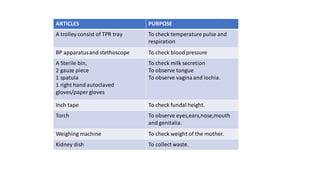
ARTICLES PURPOSE
A trolley consist of TPR tray To check temperature pulse and
respiration
BP apparatusand stethoscope To check blood pressure
A Sterile bin,
2 gauze piece
1 spatula
1 right hand autoclaved
gloves/paper gloves
To check milk secretion
To observe tongue
To observe vaginaand lochia.
Inch tape To check fundal height.
Torch To observe eyes,ears,nose,mouth
and genitalia.
Weighing machine To check weight of the mother.
Kidney dish To collect waste.
ASSESSMENT
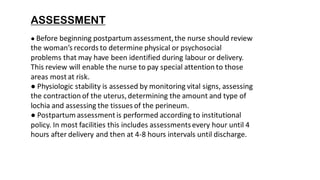
● Before beginning postpartum assessment,the nurse should review
the woman’s records to determine physical or psychosocial
problems that may have been identified during labour or delivery.
This review will enable the nurse to pay special attention to those
areas most at risk.
● Physiologic stability is assessed by monitoring vital signs, assessing
the contraction of the uterus, determining the amount and type of
lochia and assessing the tissues of the perineum.
● Postpartum assessment is performed according to institutional
policy. In most facilities this includes assessmentsevery hour until 4
hours after delivery and then at 4-8 hours intervals until discharge.
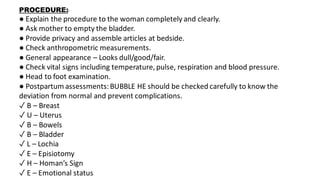
PROCEDURE:-
● Explain the procedure to the woman completely and clearly.
● Ask mother to empty the bladder.
● Provide privacy and assemble articles at bedside.
● Check anthropometric measurements.
● General appearance – Looks dull/good/fair.
● Check vital signs including temperature, pulse, respiration and blood pressure.
● Head to foot examination.
● Postpartum assessments:BUBBLE HE should be checked carefully to know the
deviation from normal and prevent complications.
✓ B – Breast
✓ U – Uterus
✓ B – Bowels
✓ B – Bladder
✓ L – Lochia
✓ E – Episiotomy
✓ H – Homan’s Sign
✓ E – Emotional status
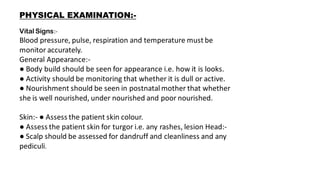
PHYSICAL EXAMINATION:-
Vital Signs:-
Blood pressure, pulse, respiration and temperature must be
monitor accurately.
General Appearance:-
● Body build should be seen for appearance i.e. how it is looks.
● Activity should be monitoring that whether it is dull or active.
● Nourishment should be seen in postnatalmother that whether
she is well nourished, under nourished and poor nourished.
Skin:- ● Assess the patient skin colour.
● Assess the patient skin for turgor i.e. any rashes, lesion Head:-
● Scalp should be assessed for dandruff and cleanliness and any
pediculi.
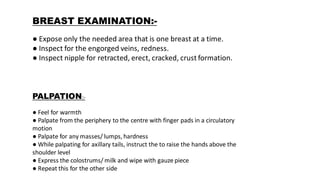
BREAST EXAMINATION:-
● Expose only the needed area that is one breast at a time.
● Inspect for the engorged veins, redness.
● Inspect nipple for retracted, erect, cracked, crust formation.
PALPATION:-
● Feel for warmth
● Palpate from the periphery to the centre with finger pads in a circulatory
motion
● Palpate for any masses/ lumps, hardness
● While palpating for axillary tails, instruct the to raise the hands above the
shoulder level
● Express the colostrums/ milk and wipe with gauze piece
● Repeat this for the other side
GENITALIA :
Inspect for vulval oedema, hematoma and lacerations.
LOCHIA –
➢The amount and characteristics of the lochia are
assessed each time the fundus is checked. Immediately
after delivery this drainage is red and contains blood,
small clots and tissue fragments.
➢In case of uterine atony increases blood loss. So,
general condition should be checked by monitoring
vital signs.
➢ The amount of lochia described as scant, light,
moderate or heavy.
EPISIOTOMY:
The woman should be positioned in lithotomyposition
and good room light or flash light is needed to visualize
the stitches/suture line adequately.
REEDA should be observed,
R – Redness
E – Edema
E – Ecchymosis
D – Discharges
A – Approximationof suture line
RECTUM: Inspect for hemorroids.
EXTREMITIES:
● Any congenital abnormalities syndactyly/polydactyl
● Capillary refill
Examination of the perineum
✓ Position client in lithotomy/ dorsal recumbent
position.
✓ Drape the client.
✓ Put the light on.
✓ Wash hands.
✓ Wear gloves
✓ Examine the perineum for-
● Condition of episiotomy wound( REEDA)
● Colour and amount of lochia.
● Condition of perineum
● Number of pads changed/day
RECORDING:-
● Record the findings in nurse’s record with date and
time.
● Vital signs record in the vital signs chart.
PERINEAL CARE:-
Perineal care is washing down of external genitilia and
perinea under a aseptic precaution.
PURPOSES
1.To clean the perineum in preoperative
preparation for a antiseptic action.
2. To deodourize the perineum.
3. To stimulate circulation and thus reliving the
pain, inflammation and congestion.
4. To promote healing by preventing infection.
5. To enhance comfort.
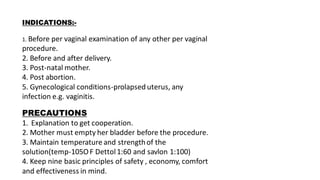
INDICATIONS:-
1. Before per vaginal examination of any other per vaginal
procedure.
2. Before and after delivery.
3. Post-natal mother.
4. Post abortion.
5. Gynecological conditions-prolapsed uterus, any
infection e.g. vaginitis.
PRECAUTIONS
1. Explanation to get cooperation.
2. Mother must empty her bladder before the procedure.
3. Maintain temperature and strengthof the
solution(temp-105OF Dettol1:60 and savlon 1:100)
4. Keep nine basic principles of safety , economy, comfort
and effectiveness in mind.
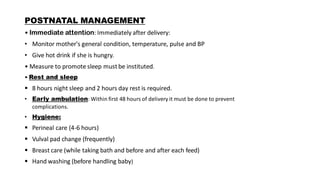
POSTNATAL MANAGEMENT
• Immediate attention: Immediately after delivery:
• Monitor mother's general condition, temperature, pulse and BP
• Give hot drink if she is hungry.
• Measure to promote sleep mustbe instituted.
• Rest and sleep
▪ 8 hours night sleep and 2 hours day rest is required.
• Early ambulation: Within first 48 hours of delivery it must be done to prevent
complications.
• Hygiene:
▪ Perineal care (4-6 hours)
▪ Vulval pad change (frequently)
▪ Breast care (while taking bath and before and after each feed)
▪ Hand washing (before handling baby)
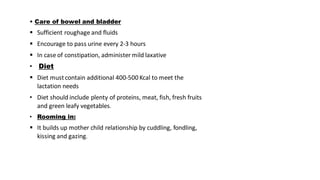
• Care of bowel and bladder
▪ Sufficient roughage and fluids
▪ Encourage to pass urine every 2-3 hours
▪ In case of constipation, administer mild laxative
• Diet
▪ Diet mustcontain additional 400-500 Kcal to meet the
lactation needs
• Diet should include plenty of proteins, meat, fish, fresh fruits
and green leafy vegetables.
• Rooming in:
▪ It builds up mother child relationship by cuddling, fondling,
kissing and gazing.
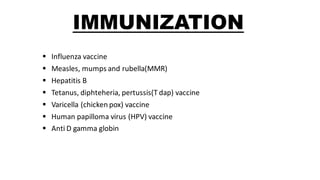
IMMUNIZATION
▪ Influenza vaccine
▪ Measles, mumps and rubella(MMR)
▪ Hepatitis B
▪ Tetanus, diphteheria, pertussis(T dap) vaccine
▪ Varicella (chicken pox) vaccine
▪ Human papilloma virus (HPV) vaccine
▪ Anti D gamma globin
SUMMARY
Introduction
Definition
Purpose
Aim
Assessment
Postnatal management
Immunization
THANK YOU

POSTNATAL ASSESSMENT ^0 MANAGEMENT aman.pdf

  • 1.
    POSTNATAL ASSESSMENT & MANAGEMENT SUBMITTEDTO:DR.HARLEEN KAUR (PROFESSOR,OBGNURSING) SUBMITTEDBY: AMAN SHARMA BSC NURSING 4TH YEAR
  • 2.
    INTRODUCTION:- Examination of apostnatal mother and early identification of complication is one of the important responsibility of a nurse in the postnatal area. Adequate postnatal examination is necessary for planning the care of postnatal mother.
  • 3.
    DEFINITION/MEANING:- Postnatal care includessystematic examination of mother and the baby and the appropriate advice given to the mother during postpartum period. Postnatal assessment is an important component of postnatal care.
  • 4.
    PURPOSE: 1)To assess thehealth statusof the mother and institute therapy to rectify the defect if any. 2) To detect and treat at the earliest any gynaecological condition arising out of obstetriclegacy. 3) To impart family planning guidance. AIMS: 1. Demonstrate understanding of the normal and expected postpartum changes. 2. Conduct thorough assessmentsto identify signs and symptoms of problems before they become serious complications. 3. Initiate appropriate interventions when problems do occur. 4. Prevent problems by teaching the woman appropriate ways to care for herself and her newborn.
  • 5.
    ARTICLES PURPOSE A trolleyconsist of TPR tray To check temperature pulse and respiration BP apparatusand stethoscope To check blood pressure A Sterile bin, 2 gauze piece 1 spatula 1 right hand autoclaved gloves/paper gloves To check milk secretion To observe tongue To observe vaginaand lochia. Inch tape To check fundal height. Torch To observe eyes,ears,nose,mouth and genitalia. Weighing machine To check weight of the mother. Kidney dish To collect waste.
  • 6.
    ASSESSMENT ● Before beginningpostpartum assessment,the nurse should review the woman’s records to determine physical or psychosocial problems that may have been identified during labour or delivery. This review will enable the nurse to pay special attention to those areas most at risk. ● Physiologic stability is assessed by monitoring vital signs, assessing the contraction of the uterus, determining the amount and type of lochia and assessing the tissues of the perineum. ● Postpartum assessment is performed according to institutional policy. In most facilities this includes assessmentsevery hour until 4 hours after delivery and then at 4-8 hours intervals until discharge.
  • 7.
    PROCEDURE:- ● Explain theprocedure to the woman completely and clearly. ● Ask mother to empty the bladder. ● Provide privacy and assemble articles at bedside. ● Check anthropometric measurements. ● General appearance – Looks dull/good/fair. ● Check vital signs including temperature, pulse, respiration and blood pressure. ● Head to foot examination. ● Postpartum assessments:BUBBLE HE should be checked carefully to know the deviation from normal and prevent complications. ✓ B – Breast ✓ U – Uterus ✓ B – Bowels ✓ B – Bladder ✓ L – Lochia ✓ E – Episiotomy ✓ H – Homan’s Sign ✓ E – Emotional status
  • 8.
    PHYSICAL EXAMINATION:- Vital Signs:- Bloodpressure, pulse, respiration and temperature must be monitor accurately. General Appearance:- ● Body build should be seen for appearance i.e. how it is looks. ● Activity should be monitoring that whether it is dull or active. ● Nourishment should be seen in postnatalmother that whether she is well nourished, under nourished and poor nourished. Skin:- ● Assess the patient skin colour. ● Assess the patient skin for turgor i.e. any rashes, lesion Head:- ● Scalp should be assessed for dandruff and cleanliness and any pediculi.
  • 9.
    BREAST EXAMINATION:- ● Exposeonly the needed area that is one breast at a time. ● Inspect for the engorged veins, redness. ● Inspect nipple for retracted, erect, cracked, crust formation. PALPATION:- ● Feel for warmth ● Palpate from the periphery to the centre with finger pads in a circulatory motion ● Palpate for any masses/ lumps, hardness ● While palpating for axillary tails, instruct the to raise the hands above the shoulder level ● Express the colostrums/ milk and wipe with gauze piece ● Repeat this for the other side
  • 10.
    GENITALIA : Inspect forvulval oedema, hematoma and lacerations. LOCHIA – ➢The amount and characteristics of the lochia are assessed each time the fundus is checked. Immediately after delivery this drainage is red and contains blood, small clots and tissue fragments. ➢In case of uterine atony increases blood loss. So, general condition should be checked by monitoring vital signs. ➢ The amount of lochia described as scant, light, moderate or heavy.
  • 11.
    EPISIOTOMY: The woman shouldbe positioned in lithotomyposition and good room light or flash light is needed to visualize the stitches/suture line adequately. REEDA should be observed, R – Redness E – Edema E – Ecchymosis D – Discharges A – Approximationof suture line RECTUM: Inspect for hemorroids. EXTREMITIES: ● Any congenital abnormalities syndactyly/polydactyl ● Capillary refill
  • 12.
    Examination of theperineum ✓ Position client in lithotomy/ dorsal recumbent position. ✓ Drape the client. ✓ Put the light on. ✓ Wash hands. ✓ Wear gloves ✓ Examine the perineum for- ● Condition of episiotomy wound( REEDA) ● Colour and amount of lochia. ● Condition of perineum ● Number of pads changed/day RECORDING:- ● Record the findings in nurse’s record with date and time. ● Vital signs record in the vital signs chart.
  • 13.
    PERINEAL CARE:- Perineal careis washing down of external genitilia and perinea under a aseptic precaution. PURPOSES 1.To clean the perineum in preoperative preparation for a antiseptic action. 2. To deodourize the perineum. 3. To stimulate circulation and thus reliving the pain, inflammation and congestion. 4. To promote healing by preventing infection. 5. To enhance comfort.
  • 14.
    INDICATIONS:- 1. Before pervaginal examination of any other per vaginal procedure. 2. Before and after delivery. 3. Post-natal mother. 4. Post abortion. 5. Gynecological conditions-prolapsed uterus, any infection e.g. vaginitis. PRECAUTIONS 1. Explanation to get cooperation. 2. Mother must empty her bladder before the procedure. 3. Maintain temperature and strengthof the solution(temp-105OF Dettol1:60 and savlon 1:100) 4. Keep nine basic principles of safety , economy, comfort and effectiveness in mind.
  • 15.
    POSTNATAL MANAGEMENT • Immediateattention: Immediately after delivery: • Monitor mother's general condition, temperature, pulse and BP • Give hot drink if she is hungry. • Measure to promote sleep mustbe instituted. • Rest and sleep ▪ 8 hours night sleep and 2 hours day rest is required. • Early ambulation: Within first 48 hours of delivery it must be done to prevent complications. • Hygiene: ▪ Perineal care (4-6 hours) ▪ Vulval pad change (frequently) ▪ Breast care (while taking bath and before and after each feed) ▪ Hand washing (before handling baby)
  • 16.
    • Care ofbowel and bladder ▪ Sufficient roughage and fluids ▪ Encourage to pass urine every 2-3 hours ▪ In case of constipation, administer mild laxative • Diet ▪ Diet mustcontain additional 400-500 Kcal to meet the lactation needs • Diet should include plenty of proteins, meat, fish, fresh fruits and green leafy vegetables. • Rooming in: ▪ It builds up mother child relationship by cuddling, fondling, kissing and gazing.
  • 17.
    IMMUNIZATION ▪ Influenza vaccine ▪Measles, mumps and rubella(MMR) ▪ Hepatitis B ▪ Tetanus, diphteheria, pertussis(T dap) vaccine ▪ Varicella (chicken pox) vaccine ▪ Human papilloma virus (HPV) vaccine ▪ Anti D gamma globin
  • 18.
  • 19.