
UNIT-XI
INFECTION CONTROL
DEFINITION
Infection- the entry and development or multiplication of a
disease-producing agent from one living body to another.
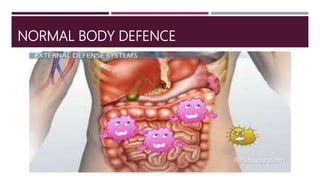
NORMAL BODY DEFENCE
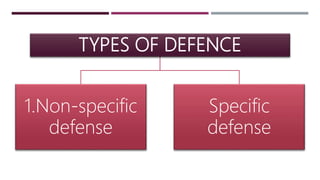
TYPES OF DEFENCE
1.Non-specific
defense
Specific
defense
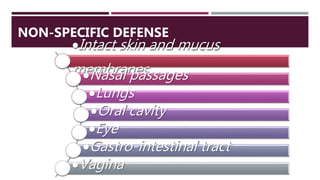
Intact skin and mucus
membranesNasal passages
Lungs
Oral cavity
Eye
Gastro-intestinal tract
Vagina
NON-SPECIFIC DEFENSE
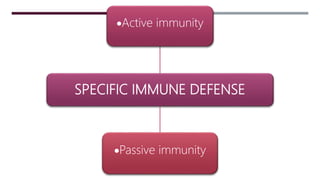
SPECIFIC IMMUNE DEFENSE
Active immunity
Passive immunity
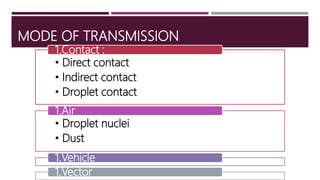
MODE OF TRANSMISSION
• Direct contact
• Indirect contact
• Droplet contact
1.Contact :
• Droplet nuclei
• Dust
1.Air
1.Vehicle
1.Vector
infection control

infection control

Editor's Notes

  • #4 NORMAL BODY DEFENCE: The first line of defence (or outside defence system) includes physical and chemical barriers that are always ready and prepared to defend the body from infection. These include your skin, tears, mucus, cilia, stomach acid, urine flow, ‘friendly’ bacteria and white blood cells called neutrophils. Pathogenic (disease-causing) microorganisms must make it past this first line of defence. If this defence is broken, the second line of defence within your body is activated.
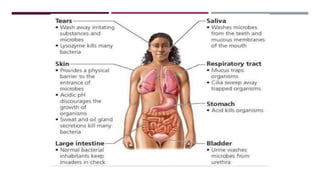
  • #5 Skin The skin is the largest organ of your body. It acts as a barrier between invaders (pathogens) and your body. Skin forms a waterproof mechanical barrier. Microorganisms that live all over your skin can’t get through your skin unless it’s broken. Tears, mucus and saliva Your nose, mouth and eyes are obvious entry points for pathogens. However, tears, mucus and saliva contain an enzyme that breaks down the cell wall of many bacteria. Those that are not killed immediately are trapped in mucus and swallowed. Special cells line and protect the nose, throat and other passages within your body. The inner lining of your gut and lungs also produces mucus to trap invading pathogens. Cilia Very fine hairs (cilia) lining your windpipe move mucus and trapped particles away from your lungs. Particles can be bacteria or material such as dust or smoke. Stomach acid Stomach acid kills bacteria and parasites that have been swallowed. Urine flow Your urine flow flushes out pathogens from the bladder area. ‘Friendly’ (beneficial) bacteria You have beneficial bacteria growing on your skin, in your bowel and other places in the body (such as the mouth and the gut) that stop other harmful bacteria from taking over. Neutrophils These are white blood cells that can find, kill and ingest pathogens seeking an entrance into the body.
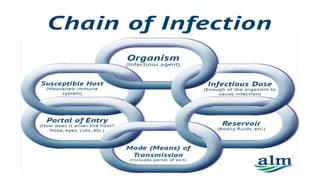
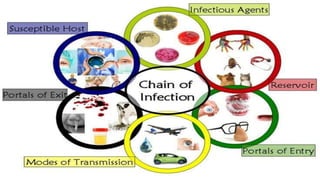
  • #9 CHAIN OF INFECTION: An infection is an invasion of the body by pathogens An infectious agent or pathogens A reservoir or source for pathogen growth A portal of exit from the reservoir A mode of transmission A portal of entry to host A susceptible host