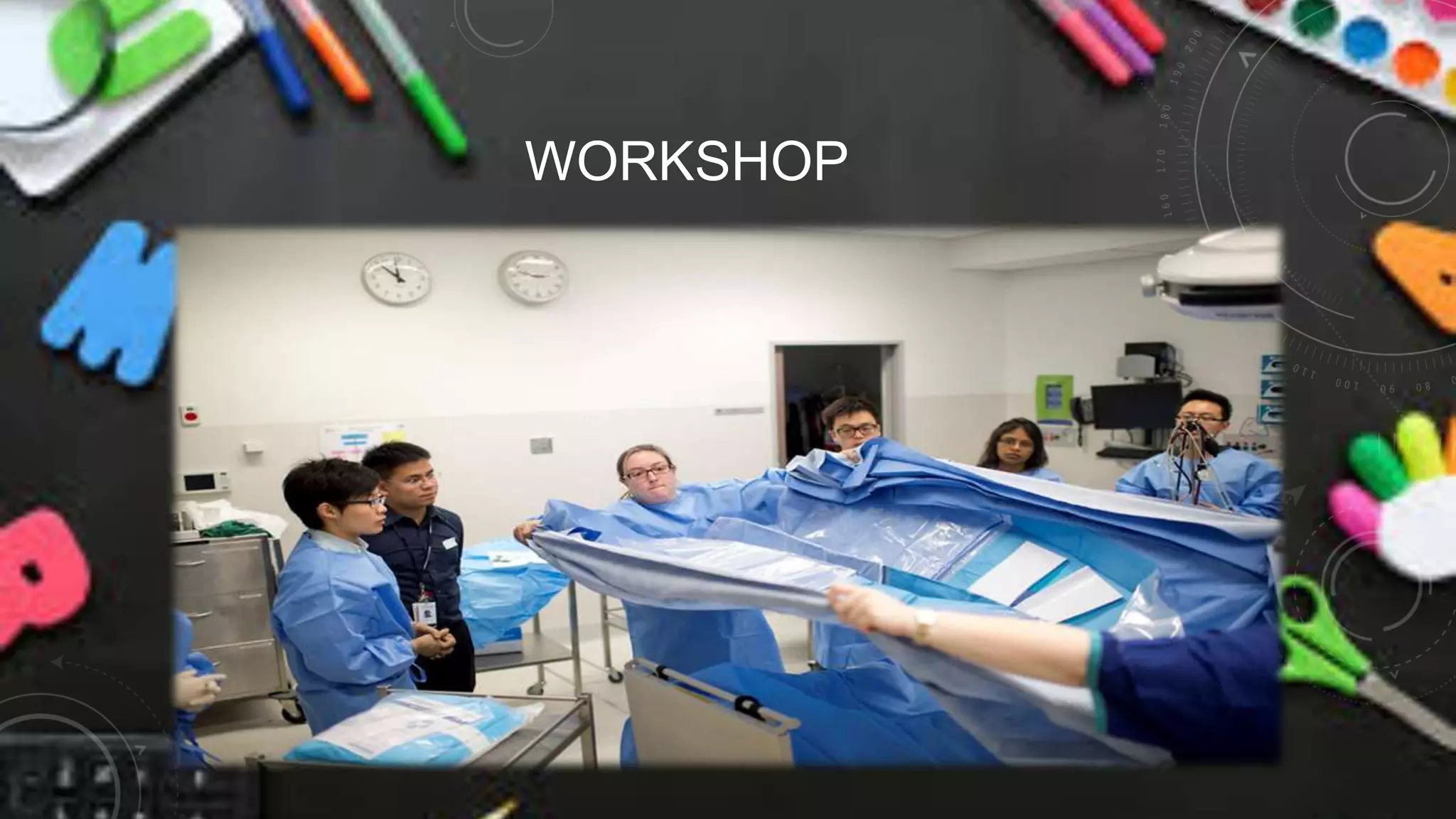
WORKSHOP
DEFINITION
Workshop is a large number of people belonging to a particular discipline or allied
disciplines collect together to take up specific issues and problems for making
recommendation for future action
GUILBERT
PURPOSES
• Allows a group of individuals to meet over an extended period of time, in a variety of
sessions
• Gives individuals opportunity to receive help from other participants and resource people
• Provides learning situations based on interests and needs of participants
• Gives individuals in the group a chance to workout their own specific programs
• Provides group learning situations for the participants
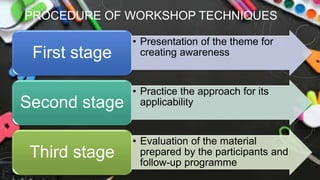
PROCEDURE OF WORKSHOP TECHNIQUES
• Presentation of the theme for
creating awarenessFirst stage
• Practice the approach for its
applicabilitySecond stage
• Evaluation of the material
prepared by the participants and
follow-up programme
Third stage
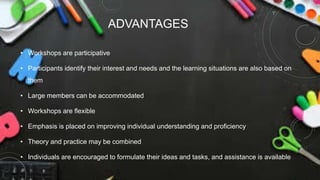
ADVANTAGES
• Workshops are participative
• Participants identify their interest and needs and the learning situations are also based on
them
• Large members can be accommodated
• Workshops are flexible
• Emphasis is placed on improving individual understanding and proficiency
• Theory and practice may be combined
• Individuals are encouraged to formulate their ideas and tasks, and assistance is available
EXHIBITION
DEFINITION
Exhibits or exhibitions are planned display of models, specimens, charts, poster,
etc. presented to the public view for instruction, competition, advertising or
entertainment
types
Home made
exhibition
Nutrition
exhibition
Ready made
exhibition
Planetarium
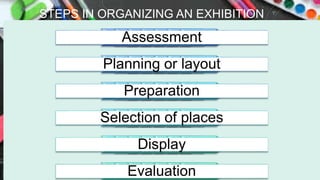
Assessment
Planning or layout
Preparation
Selection of places
Display
Evaluation
STEPS IN ORGANIZING AN EXHIBITION
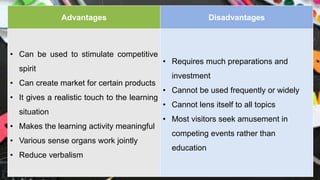
Advantages Disadvantages
• Can be used to stimulate competitive
spirit
• Can create market for certain products
• It gives a realistic touch to the learning
situation
• Makes the learning activity meaningful
• Various sense organs work jointly
• Reduce verbalism
• Requires much preparations and
investment
• Cannot be used frequently or widely
• Cannot lens itself to all topics
• Most visitors seek amusement in
competing events rather than
education
PROGRAMMED INSTRUCTION
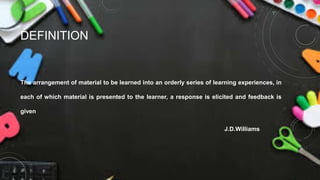
DEFINITION
The arrangement of material to be learned into an orderly series of learning experiences, in
each of which material is presented to the learner, a response is elicited and feedback is
given
J.D.Williams
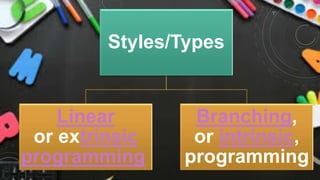
Styles/Types
Linear
or extrinsic
programming
Branching,
or intrinsic,
programming
• LINEAR PROGRAMMING immediately reinforces student responses that approach the learning goal.
Responses that do not lead toward the goal go unreinforced. Each bit of learning is presented in a “frame,” and
a student who has made a correct response proceeds to the next frame. All students work through the same
sequence, and a low rate of error is necessary to ensure continued positive reinforcement of correct responses.
• BRANCHING, OR INTRINSIC, PROGRAMMING, was initially developed in conjunction with the use of an
electronic training device for military personnel. This technique provides the student a piece of information,
presents a situation requiring a multiple choice or recognition response, and on the basis of that choice instructs
the student to proceed to another frame, where he or she learns if the choice was correct, and if not, why not. A
student who responded incorrectly will either be returned to the original frame, or routed through a subprogram
designed to remedy the deficiency indicated by the wrong choice. A student who selects correctly advances to
the next frame in the program. This process is repeated at each step throughout the program, and a student
may be exposed to differing amounts of material depending upon errors made
CHARACTERISTICS
• It is a part of instructional technology and not an A.V.Aid
• It is a strategy of teaching and learning
• It is a strategy for modification of behaviour of learners and nor a
solution to educational problems
PROGRAMMED INSTRUCTION MATERIALS
1. The teaching machine
2. The programmed textbook
3. The scrambled textbook
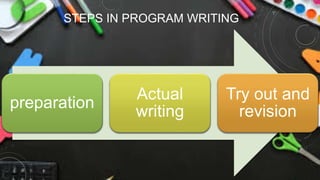
STEPS IN PROGRAM WRITING
preparation
Actual
writing
Try out and
revision
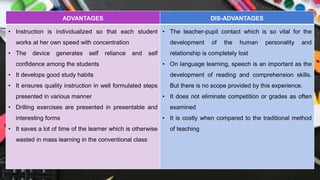
ADVANTAGES DIS-ADVANTAGES
• Instruction is individualized so that each student
works at her own speed with concentration
• The device generates self reliance and self
confidence among the students
• It develops good study habits
• It ensures quality instruction in well formulated steps
presented in various manner
• Drilling exercises are presented in presentable and
interesting forms
• It saves a lot of time of the learner which is otherwise
wasted in mass learning in the conventional class
• The teacher-pupil contact which is so vital for the
development of the human personality and
relationship is completely lost
• On language learning, speech is an important as the
development of reading and comprehension skills.
But there is no scope provided by this experience.
• It does not eliminate competition or grades as often
examined
• It is costly when compared to the traditional method
of teaching

methods of teaching part-4 "workshop,exhibition and programmed instruction "

  • 1.
  • 2.
    DEFINITION Workshop is alarge number of people belonging to a particular discipline or allied disciplines collect together to take up specific issues and problems for making recommendation for future action GUILBERT
  • 3.
    PURPOSES • Allows agroup of individuals to meet over an extended period of time, in a variety of sessions • Gives individuals opportunity to receive help from other participants and resource people • Provides learning situations based on interests and needs of participants • Gives individuals in the group a chance to workout their own specific programs • Provides group learning situations for the participants
  • 4.
    PROCEDURE OF WORKSHOPTECHNIQUES • Presentation of the theme for creating awarenessFirst stage • Practice the approach for its applicabilitySecond stage • Evaluation of the material prepared by the participants and follow-up programme Third stage
  • 5.
    ADVANTAGES • Workshops areparticipative • Participants identify their interest and needs and the learning situations are also based on them • Large members can be accommodated • Workshops are flexible • Emphasis is placed on improving individual understanding and proficiency • Theory and practice may be combined • Individuals are encouraged to formulate their ideas and tasks, and assistance is available
  • 6.
  • 7.
    DEFINITION Exhibits or exhibitionsare planned display of models, specimens, charts, poster, etc. presented to the public view for instruction, competition, advertising or entertainment
  • 8.
  • 9.
    Assessment Planning or layout Preparation Selectionof places Display Evaluation STEPS IN ORGANIZING AN EXHIBITION
  • 10.
    Advantages Disadvantages • Canbe used to stimulate competitive spirit • Can create market for certain products • It gives a realistic touch to the learning situation • Makes the learning activity meaningful • Various sense organs work jointly • Reduce verbalism • Requires much preparations and investment • Cannot be used frequently or widely • Cannot lens itself to all topics • Most visitors seek amusement in competing events rather than education
  • 11.
  • 12.
    DEFINITION The arrangement ofmaterial to be learned into an orderly series of learning experiences, in each of which material is presented to the learner, a response is elicited and feedback is given J.D.Williams
  • 14.
  • 15.
    • LINEAR PROGRAMMINGimmediately reinforces student responses that approach the learning goal. Responses that do not lead toward the goal go unreinforced. Each bit of learning is presented in a “frame,” and a student who has made a correct response proceeds to the next frame. All students work through the same sequence, and a low rate of error is necessary to ensure continued positive reinforcement of correct responses. • BRANCHING, OR INTRINSIC, PROGRAMMING, was initially developed in conjunction with the use of an electronic training device for military personnel. This technique provides the student a piece of information, presents a situation requiring a multiple choice or recognition response, and on the basis of that choice instructs the student to proceed to another frame, where he or she learns if the choice was correct, and if not, why not. A student who responded incorrectly will either be returned to the original frame, or routed through a subprogram designed to remedy the deficiency indicated by the wrong choice. A student who selects correctly advances to the next frame in the program. This process is repeated at each step throughout the program, and a student may be exposed to differing amounts of material depending upon errors made
  • 16.
    CHARACTERISTICS • It isa part of instructional technology and not an A.V.Aid • It is a strategy of teaching and learning • It is a strategy for modification of behaviour of learners and nor a solution to educational problems
  • 17.
    PROGRAMMED INSTRUCTION MATERIALS 1.The teaching machine 2. The programmed textbook 3. The scrambled textbook
  • 18.
    STEPS IN PROGRAMWRITING preparation Actual writing Try out and revision
  • 19.
    ADVANTAGES DIS-ADVANTAGES • Instructionis individualized so that each student works at her own speed with concentration • The device generates self reliance and self confidence among the students • It develops good study habits • It ensures quality instruction in well formulated steps presented in various manner • Drilling exercises are presented in presentable and interesting forms • It saves a lot of time of the learner which is otherwise wasted in mass learning in the conventional class • The teacher-pupil contact which is so vital for the development of the human personality and relationship is completely lost • On language learning, speech is an important as the development of reading and comprehension skills. But there is no scope provided by this experience. • It does not eliminate competition or grades as often examined • It is costly when compared to the traditional method of teaching