Register Transfer Languages
(RTL)
BY
Ziyad
What is Register Transfer
Language?
register transfer language (RTL) is a kind of
intermediate representation (IR) that is very
close to assembly language, such as that which
is used in a compiler. It is used to describe
data flow at the register-transfer level of an
architecture. Academic papers and textbooks
often use a form of RTL as an architecture-
neutral assembly language.
What is Register Transfer
Language?
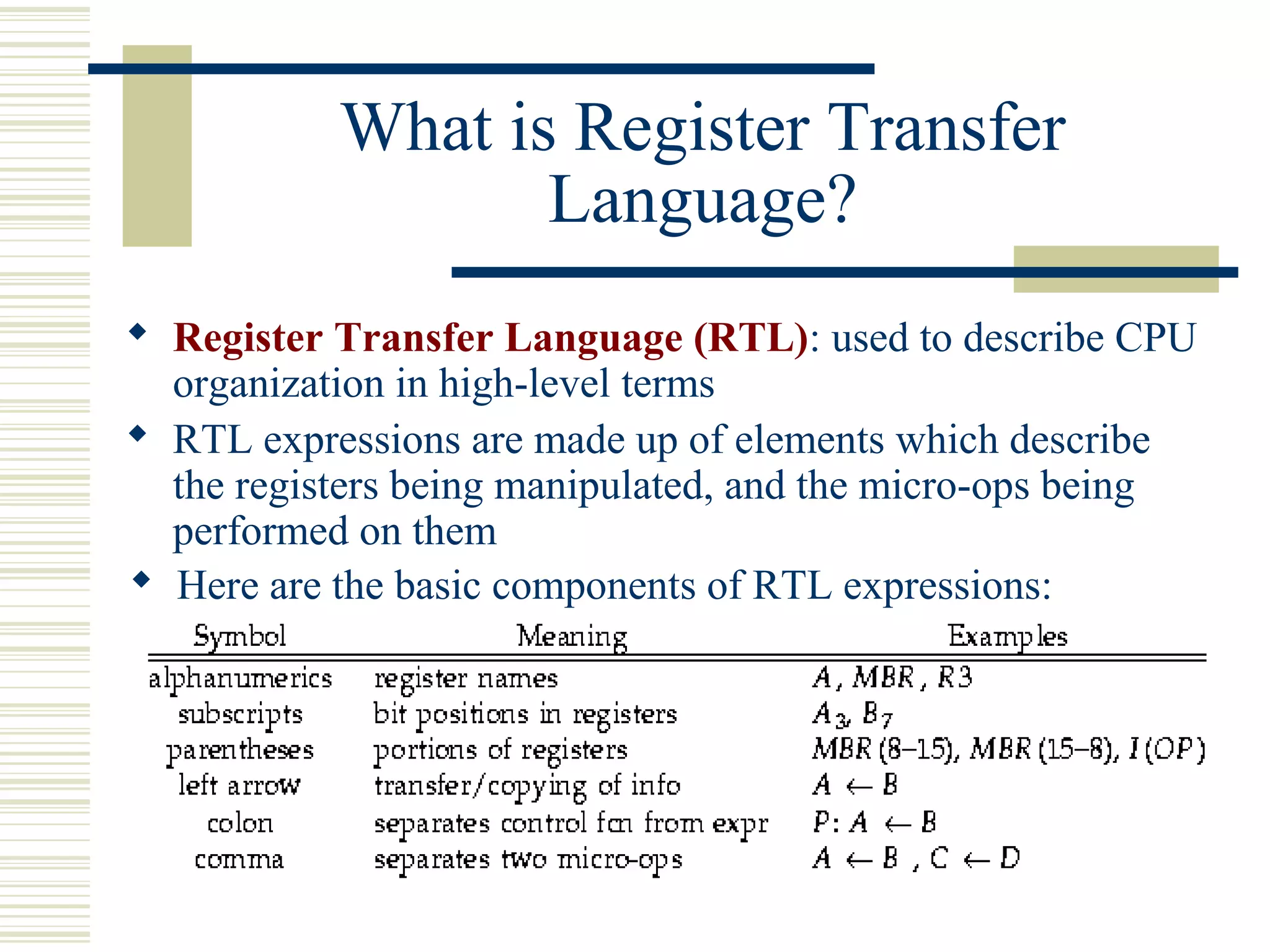
 Register Transfer Language (RTL): used to describe CPU
organization in high-level terms
 RTL expressions are made up of elements which describe
the registers being manipulated, and the micro-ops being
performed on them
 Here are the basic components of RTL expressions:
Instruction execution cycle:
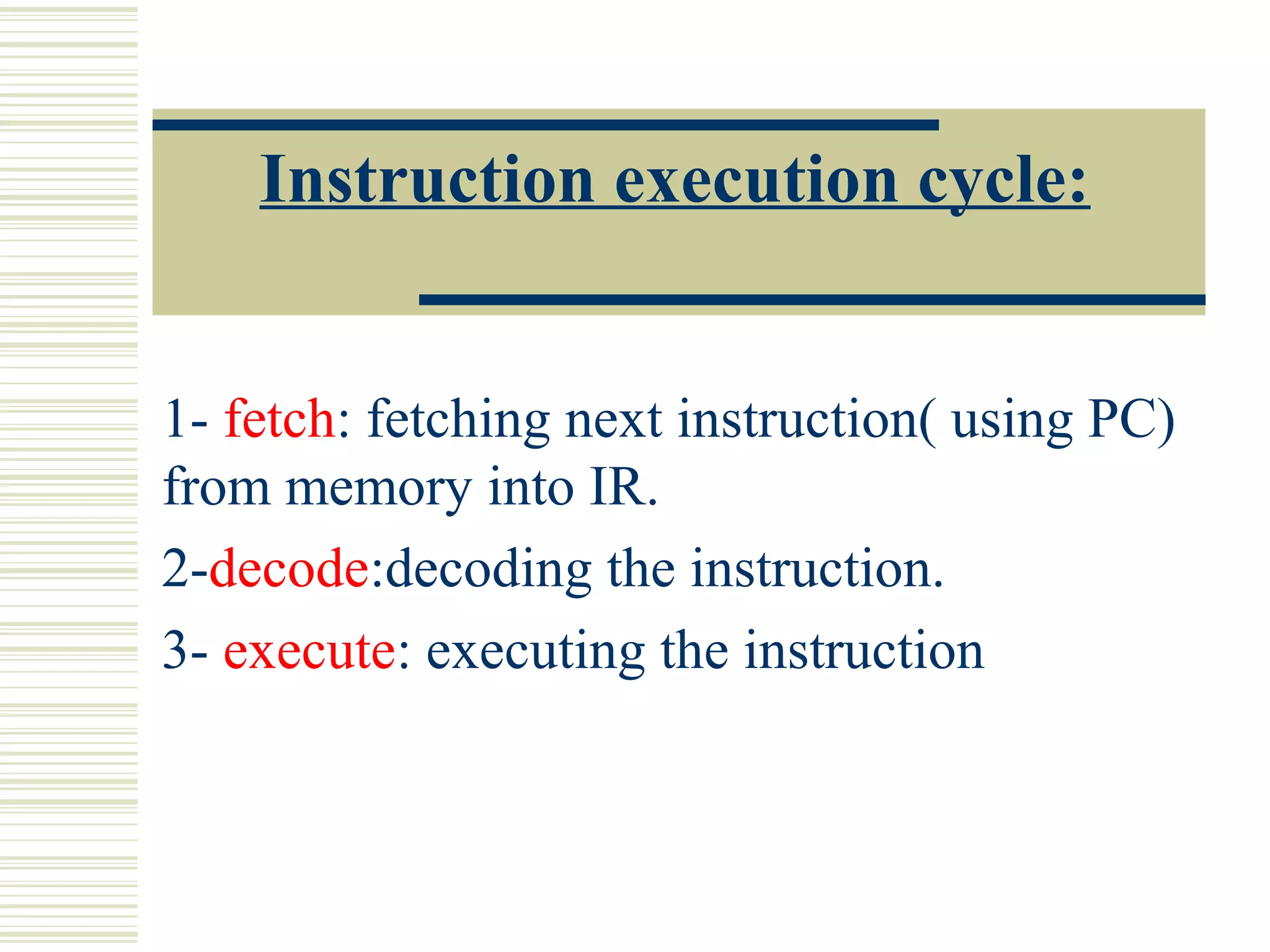
1- fetch: fetching next instruction( using PC)
from memory into IR.
2-decode:decoding the instruction.
3- execute: executing the instruction
Memory Access Registers:
Two registers are essential in memory write
and read operations: the memory data
register (MDR) and memory address register
(MAR). The MDR and MAR are
used exclusively by the CPU and are not
directly accessible to programmers
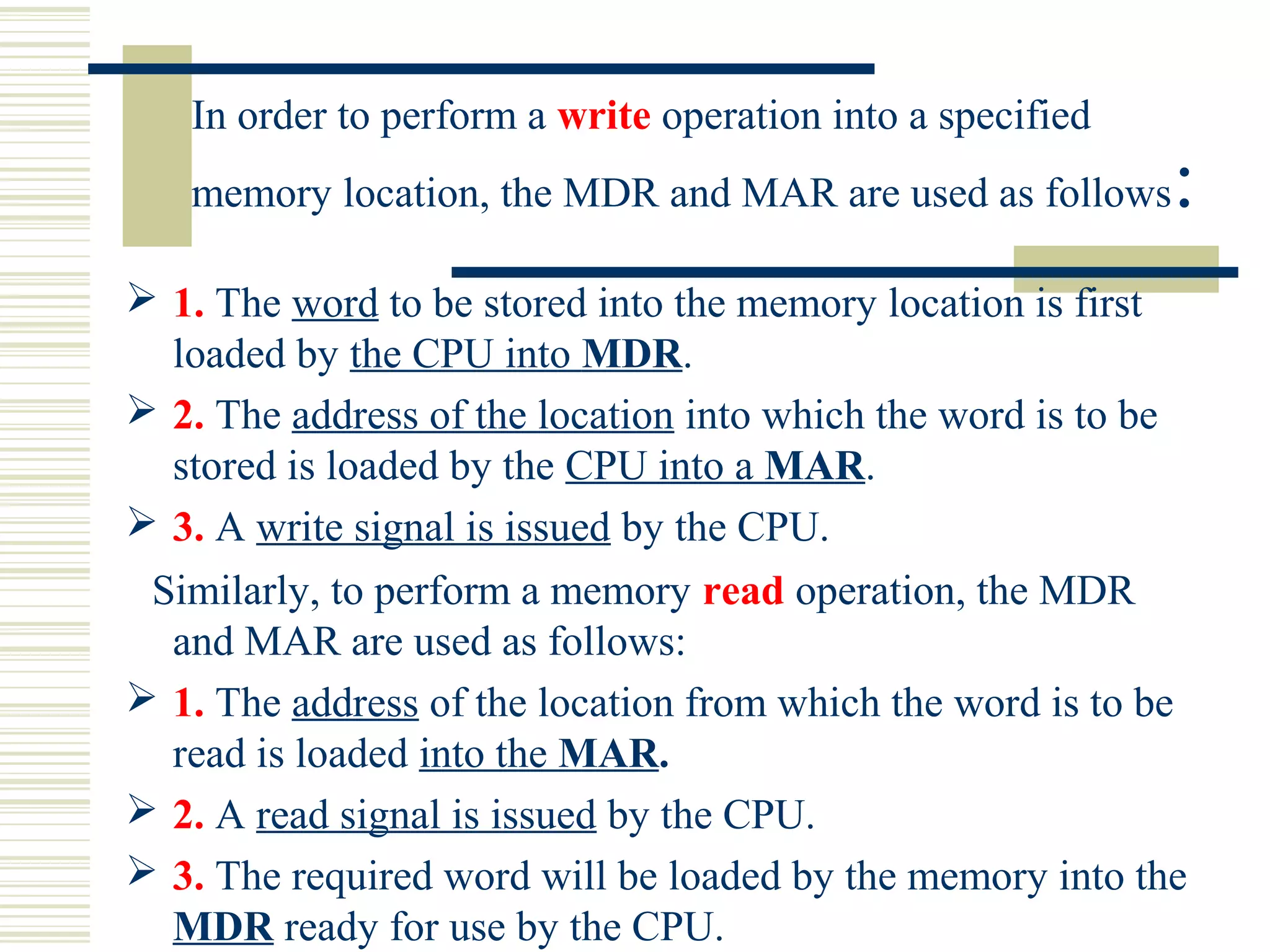
In order to perform a write operation into a specified
memory location, the MDR and MAR are used as follows:
 1. The word to be stored into the memory location is first
loaded by the CPU into MDR.
 2. The address of the location into which the word is to be
stored is loaded by the CPU into a MAR.
 3. A write signal is issued by the CPU.
Similarly, to perform a memory read operation, the MDR
and MAR are used as follows:
 1. The address of the location from which the word is to be
read is loaded into the MAR.
 2. A read signal is issued by the CPU.
 3. The required word will be loaded by the memory into the
MDR ready for use by the CPU.
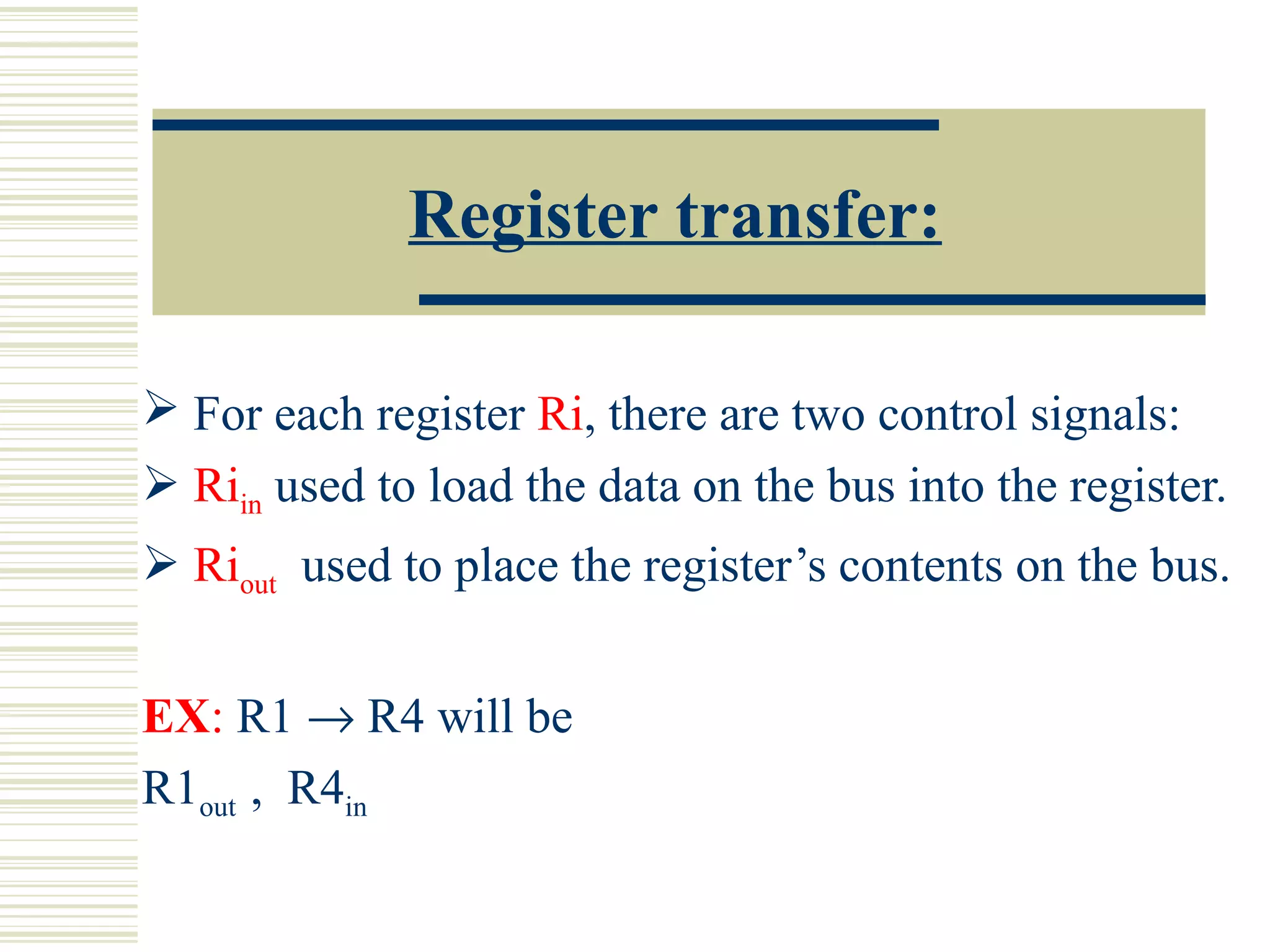
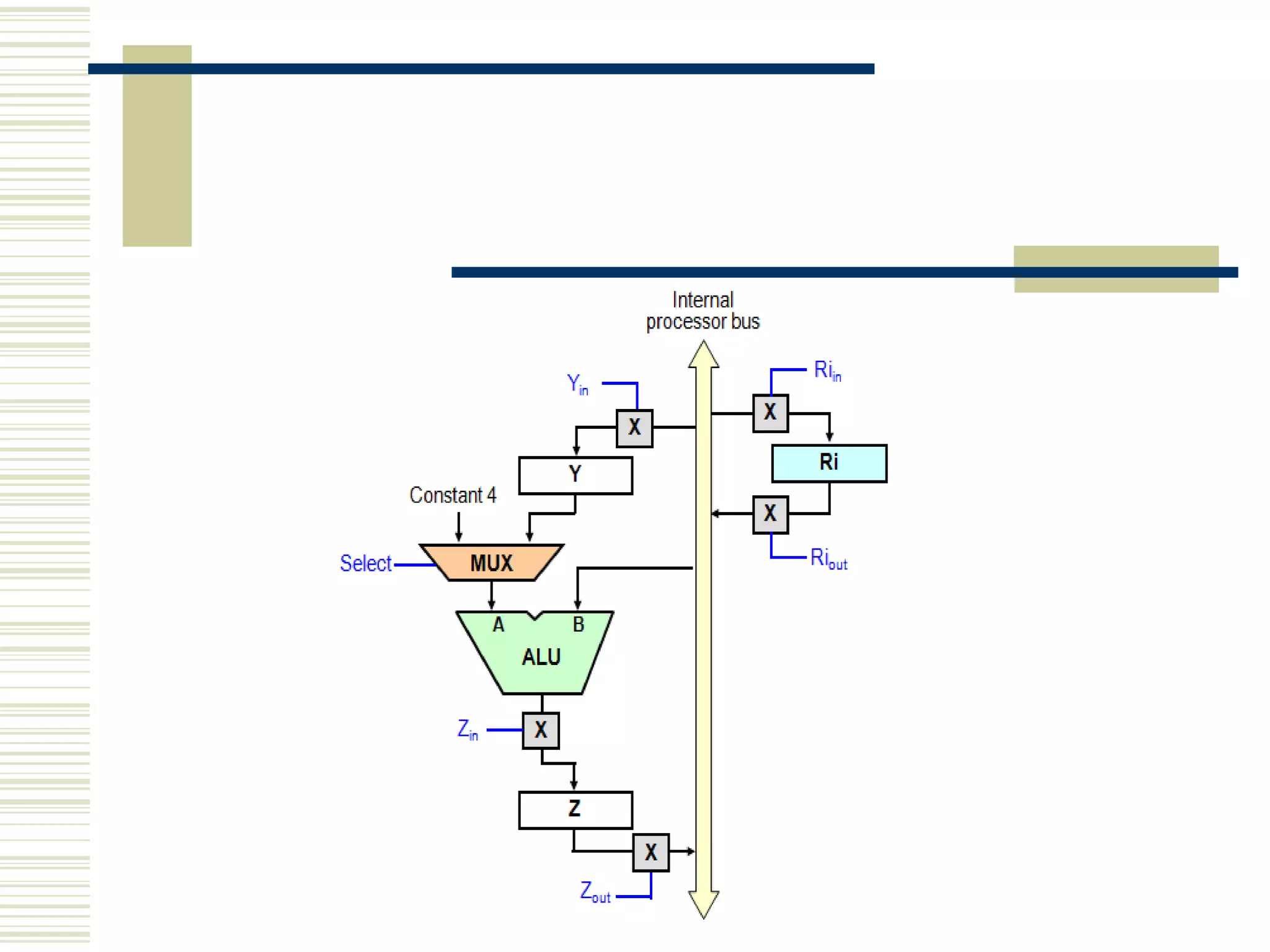
Register transfer:
 For each register Ri, there are two control signals:
 Riin used to load the data on the bus into the register.
 Riout used to place the register’s contents on the bus.
EX: R1 → R4 will be
R1out , R4in
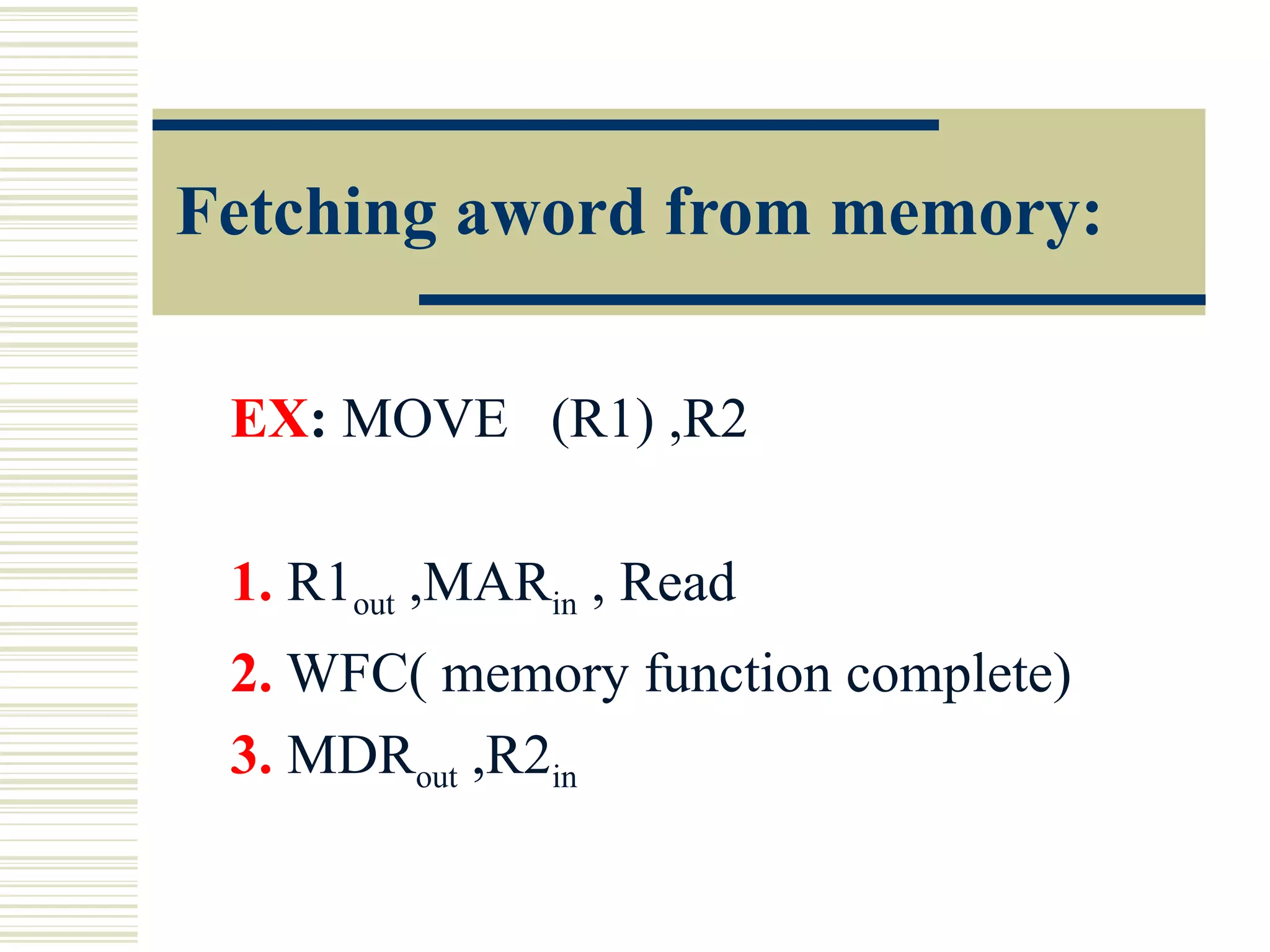
Fetching aword from memory:
EX: MOVE (R1) ,R2
1. R1out ,MARin , Read
2. WFC( memory function complete)
3. MDRout ,R2in
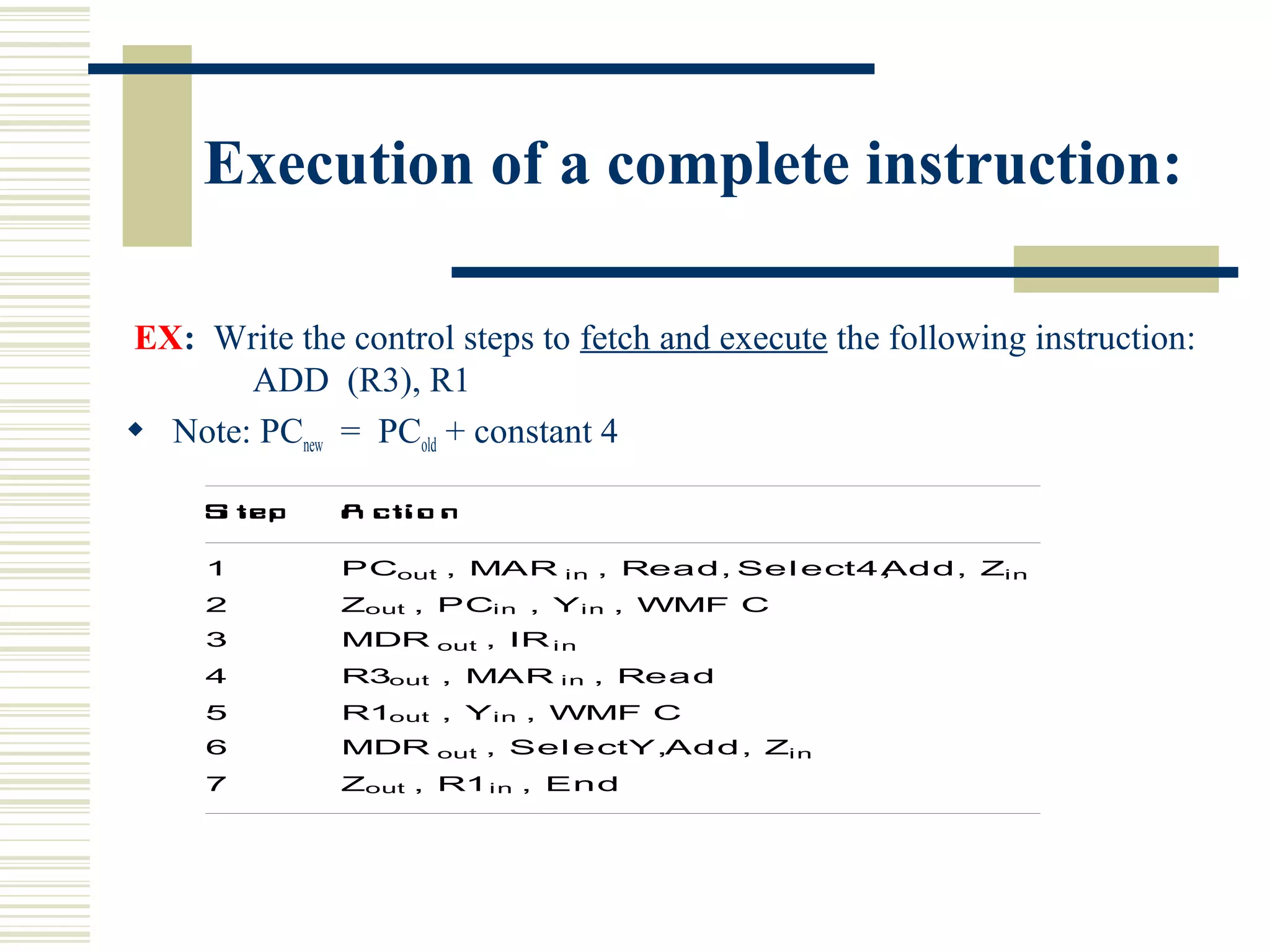
Execution of a complete instruction:
EX: Write the control steps to fetch and execute the following instruction:
ADD (R3), R1
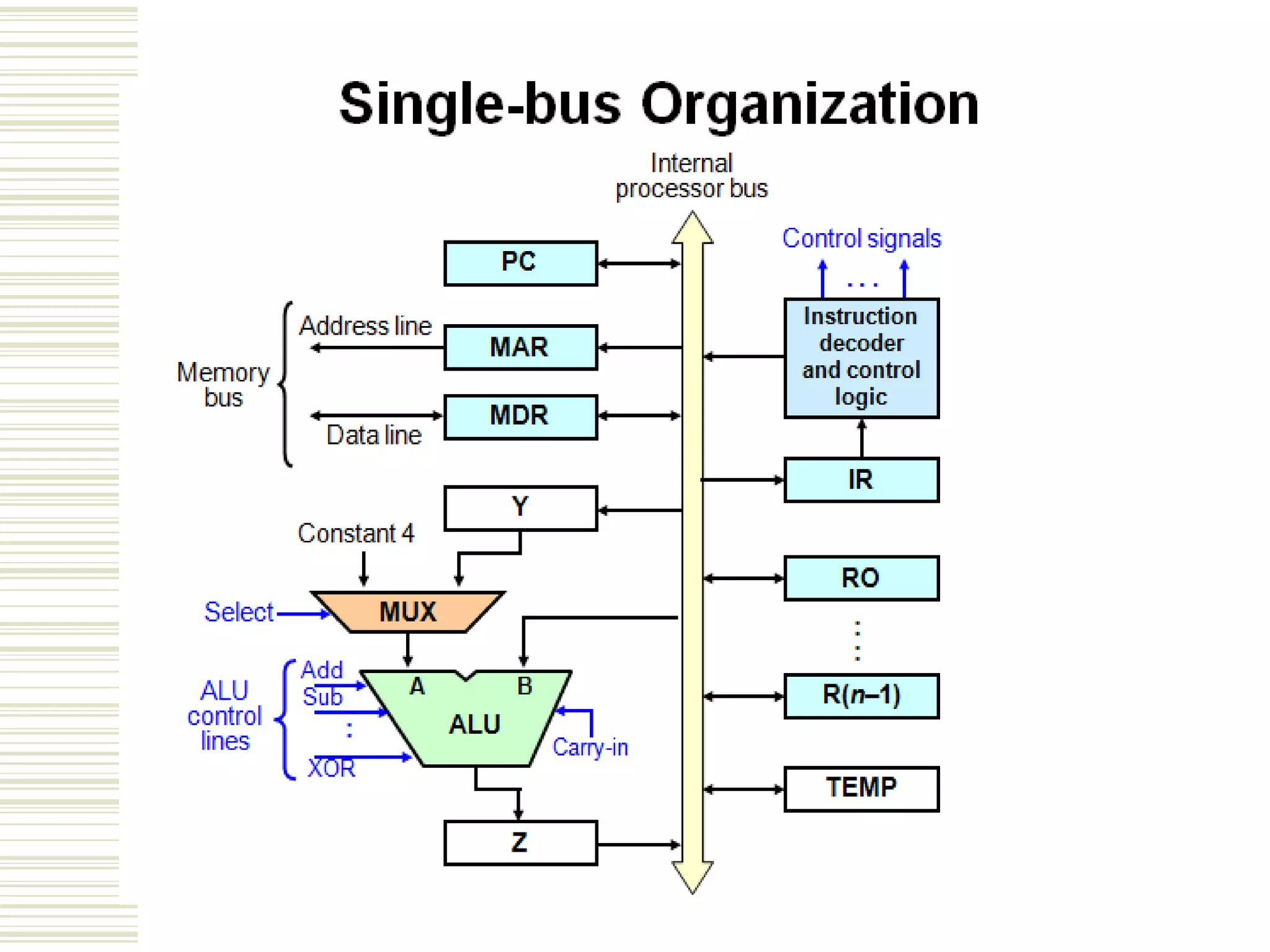
 Note: PCnew = PCold + constant 4
S te p A c ti o n
1 PCout , MAR in , Read, Sel ect4,Add, Zin
2 Zout , PCin , Yin , WMF C
3 MDR out , IR in
4 R3out , MAR in , Read
5 R1out , Yin , WMF C
6 MDR out , Sel ectY,Add, Zin
7 Zout , R1in , End
gure 7.6. Control sequencefor executi onof the instructi on Add (R3),R1.
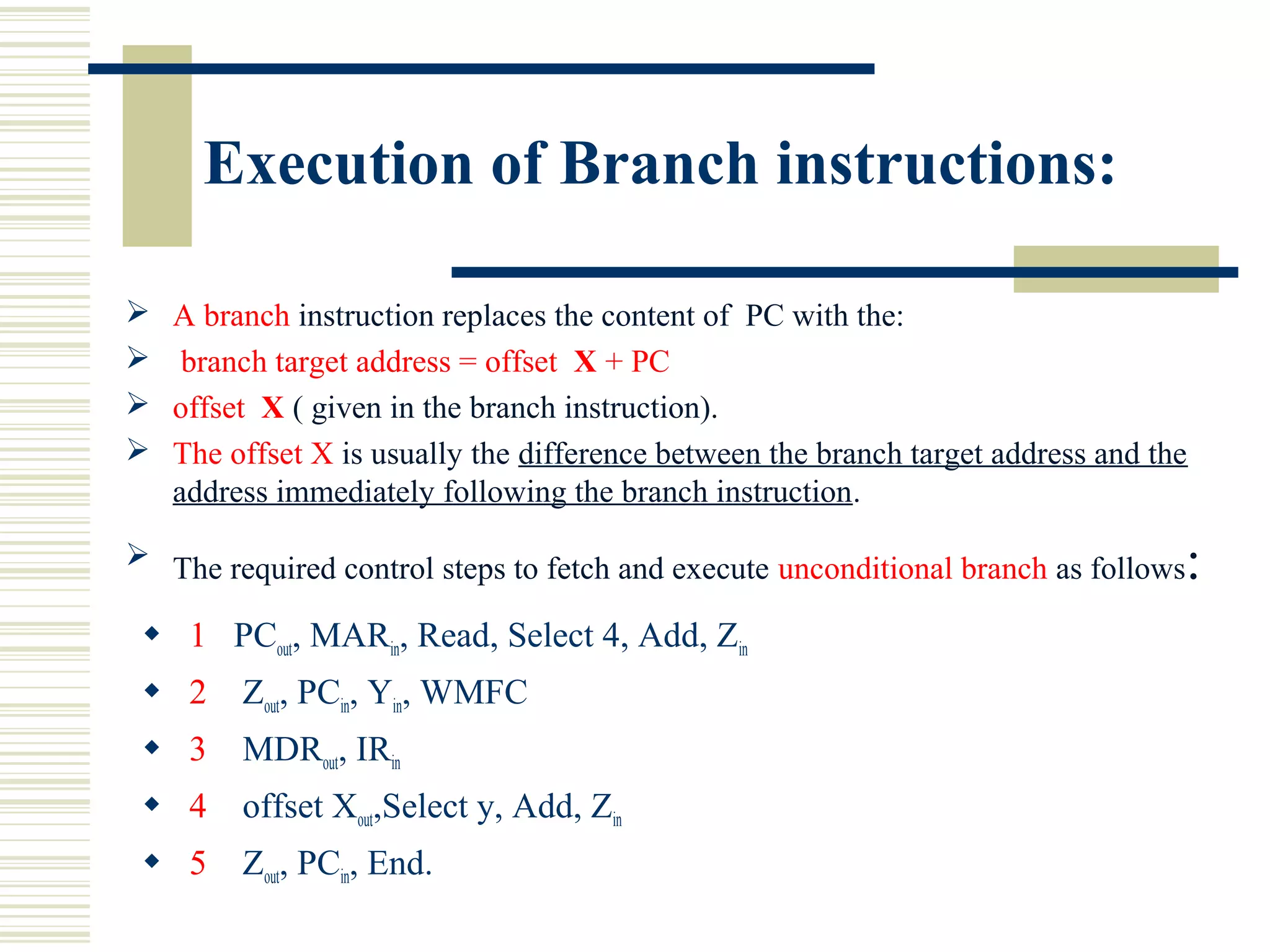
Execution of Branch instructions:
 A branch instruction replaces the content of PC with the:
 branch target address = offset X + PC
 offset X ( given in the branch instruction).
 The offset X is usually the difference between the branch target address and the
address immediately following the branch instruction.
 The required control steps to fetch and execute unconditional branch as follows:
 1 PCout, MARin, Read, Select 4, Add, Zin
 2 Zout, PCin, Yin, WMFC
 3 MDRout, IRin
 4 offset Xout,Select y, Add, Zin
 5 Zout, PCin, End.
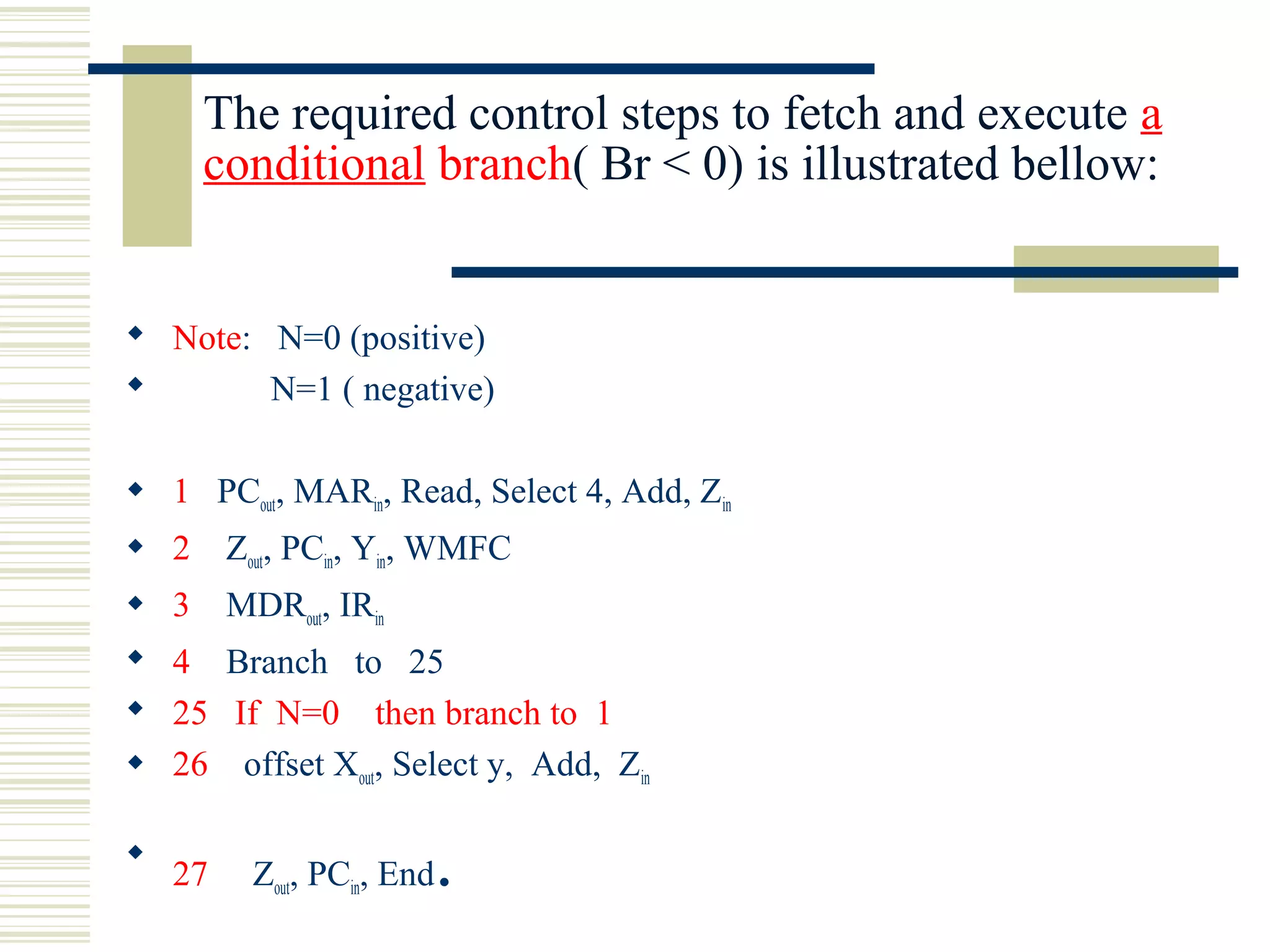
The required control steps to fetch and execute a
conditional branch( Br < 0) is illustrated bellow:
 Note: N=0 (positive)
 N=1 ( negative)
 1 PCout, MARin, Read, Select 4, Add, Zin
 2 Zout, PCin, Yin, WMFC
 3 MDRout, IRin
 4 Branch to 25
 25 If N=0 then branch to 1
 26 offset Xout, Select y, Add, Zin

27 Zout, PCin, End.
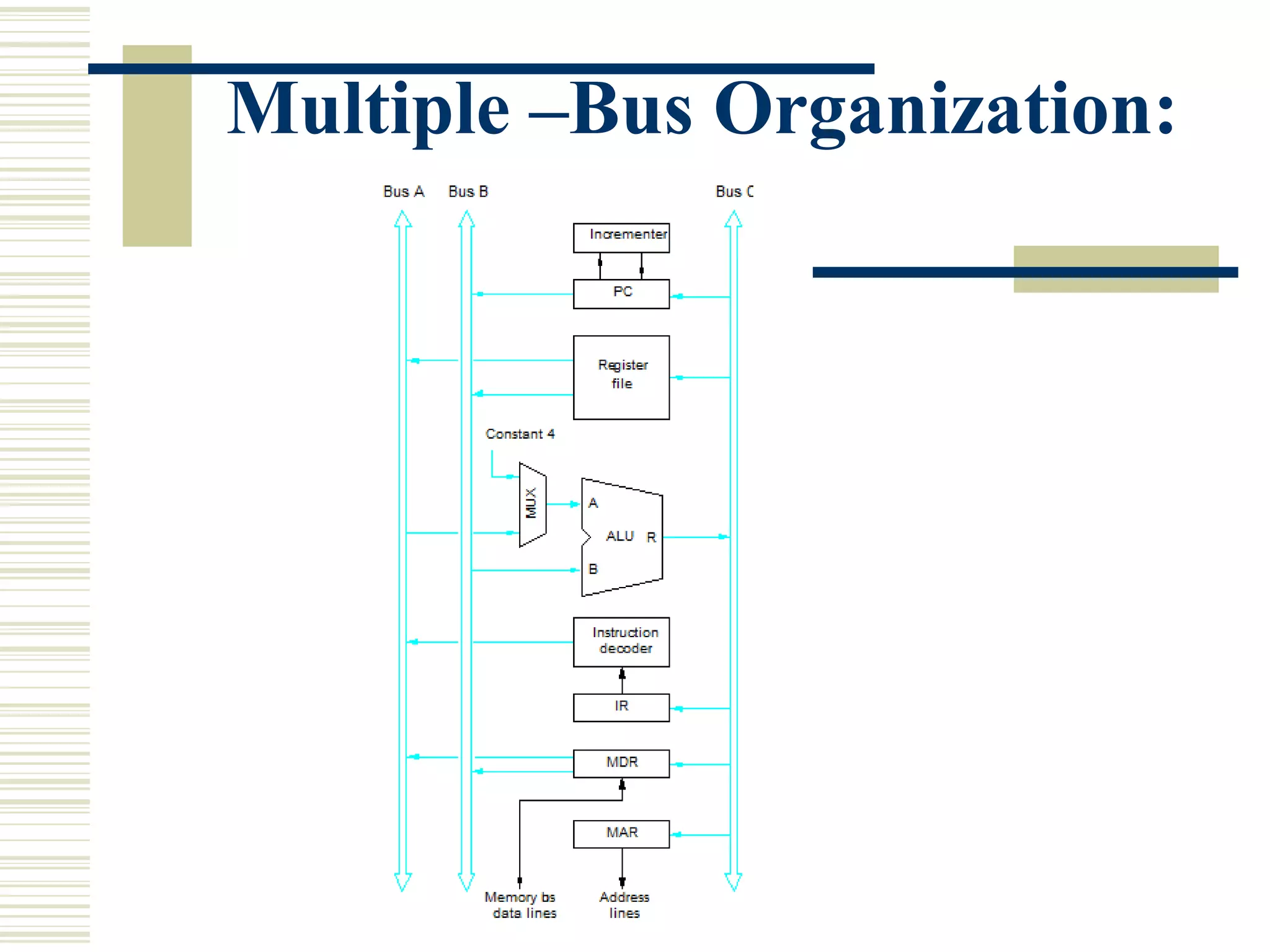
Multiple –Bus Organization:
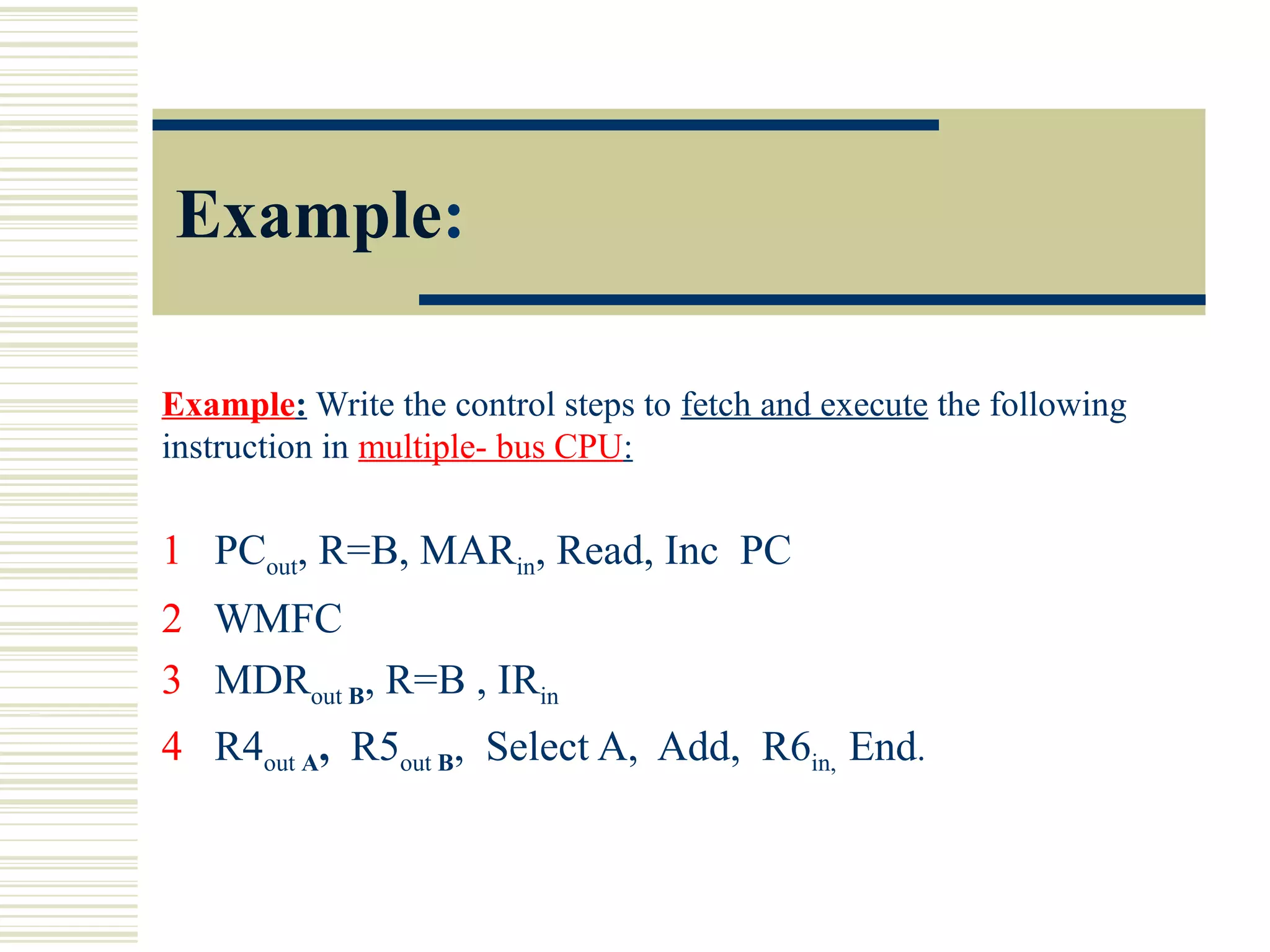
Example:
Example: Write the control steps to fetch and execute the following
instruction in multiple- bus CPU:
1 PCout, R=B, MARin, Read, Inc PC
2 WMFC
3 MDRout B, R=B , IRin
4 R4out A, R5out B, Select A, Add, R6in, End.
Example:
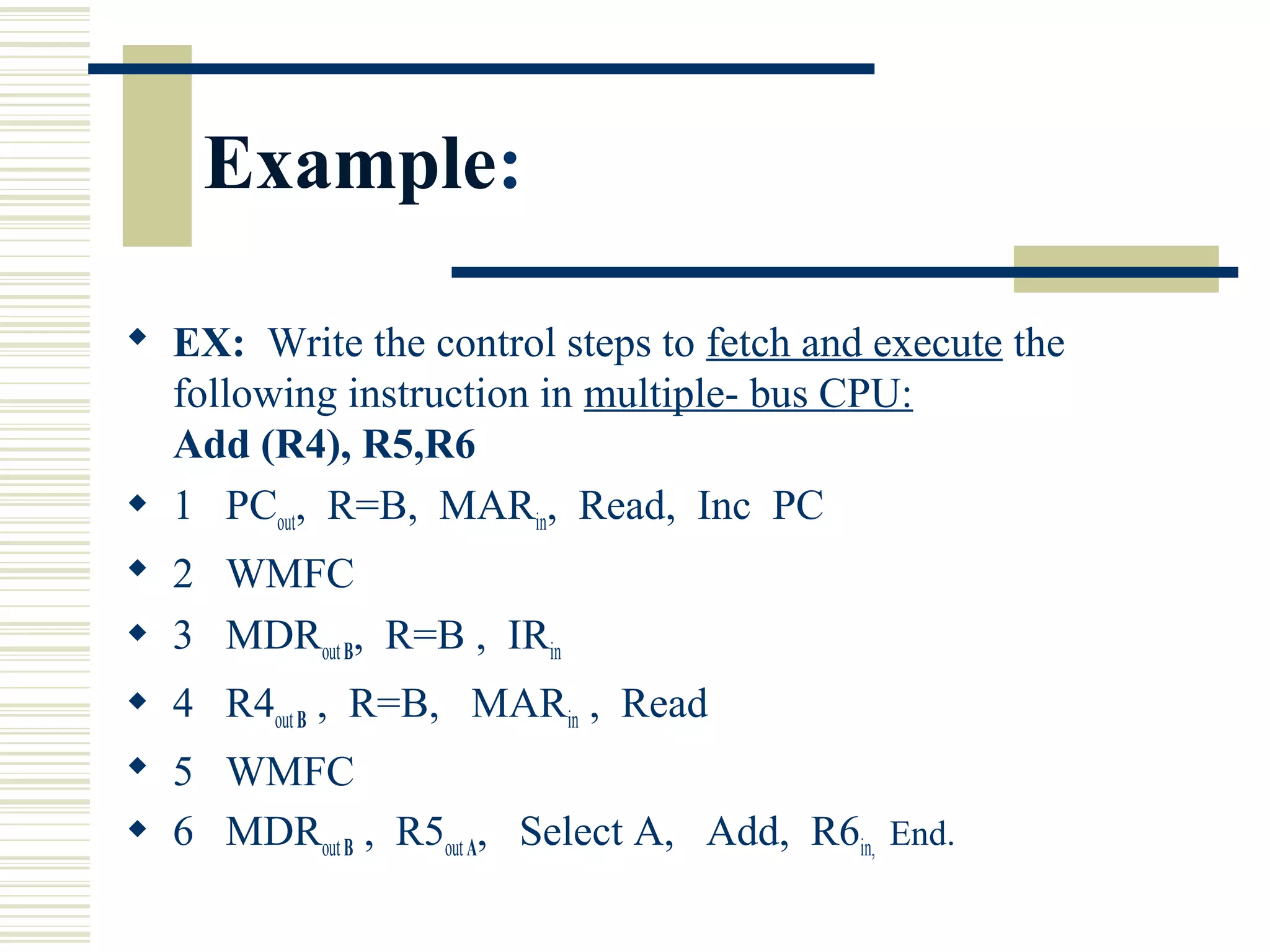
 EX: Write the control steps to fetch and execute the
following instruction in multiple- bus CPU:
Add (R4), R5,R6
 1 PCout, R=B, MARin, Read, Inc PC
 2 WMFC
 3 MDRoutB, R=B , IRin
 4 R4outB , R=B, MARin , Read
 5 WMFC
 6 MDRoutB , R5out A, Select A, Add, R6in, End.
Thank you

Computer architecture register transfer languages rtl

  • 1.
  • 2.
    What is RegisterTransfer Language? register transfer language (RTL) is a kind of intermediate representation (IR) that is very close to assembly language, such as that which is used in a compiler. It is used to describe data flow at the register-transfer level of an architecture. Academic papers and textbooks often use a form of RTL as an architecture- neutral assembly language.
  • 3.
    What is RegisterTransfer Language?  Register Transfer Language (RTL): used to describe CPU organization in high-level terms  RTL expressions are made up of elements which describe the registers being manipulated, and the micro-ops being performed on them  Here are the basic components of RTL expressions:
  • 4.
    Instruction execution cycle: 1-fetch: fetching next instruction( using PC) from memory into IR. 2-decode:decoding the instruction. 3- execute: executing the instruction
  • 5.
    Memory Access Registers: Tworegisters are essential in memory write and read operations: the memory data register (MDR) and memory address register (MAR). The MDR and MAR are used exclusively by the CPU and are not directly accessible to programmers
  • 6.
    In order toperform a write operation into a specified memory location, the MDR and MAR are used as follows:  1. The word to be stored into the memory location is first loaded by the CPU into MDR.  2. The address of the location into which the word is to be stored is loaded by the CPU into a MAR.  3. A write signal is issued by the CPU. Similarly, to perform a memory read operation, the MDR and MAR are used as follows:  1. The address of the location from which the word is to be read is loaded into the MAR.  2. A read signal is issued by the CPU.  3. The required word will be loaded by the memory into the MDR ready for use by the CPU.
  • 8.
    Register transfer:  Foreach register Ri, there are two control signals:  Riin used to load the data on the bus into the register.  Riout used to place the register’s contents on the bus. EX: R1 → R4 will be R1out , R4in
  • 10.
    Fetching aword frommemory: EX: MOVE (R1) ,R2 1. R1out ,MARin , Read 2. WFC( memory function complete) 3. MDRout ,R2in
  • 11.
    Execution of acomplete instruction: EX: Write the control steps to fetch and execute the following instruction: ADD (R3), R1  Note: PCnew = PCold + constant 4 S te p A c ti o n 1 PCout , MAR in , Read, Sel ect4,Add, Zin 2 Zout , PCin , Yin , WMF C 3 MDR out , IR in 4 R3out , MAR in , Read 5 R1out , Yin , WMF C 6 MDR out , Sel ectY,Add, Zin 7 Zout , R1in , End gure 7.6. Control sequencefor executi onof the instructi on Add (R3),R1.
  • 12.
    Execution of Branchinstructions:  A branch instruction replaces the content of PC with the:  branch target address = offset X + PC  offset X ( given in the branch instruction).  The offset X is usually the difference between the branch target address and the address immediately following the branch instruction.  The required control steps to fetch and execute unconditional branch as follows:  1 PCout, MARin, Read, Select 4, Add, Zin  2 Zout, PCin, Yin, WMFC  3 MDRout, IRin  4 offset Xout,Select y, Add, Zin  5 Zout, PCin, End.
  • 13.
    The required controlsteps to fetch and execute a conditional branch( Br < 0) is illustrated bellow:  Note: N=0 (positive)  N=1 ( negative)  1 PCout, MARin, Read, Select 4, Add, Zin  2 Zout, PCin, Yin, WMFC  3 MDRout, IRin  4 Branch to 25  25 If N=0 then branch to 1  26 offset Xout, Select y, Add, Zin  27 Zout, PCin, End.
  • 14.
  • 15.
    Example: Example: Write thecontrol steps to fetch and execute the following instruction in multiple- bus CPU: 1 PCout, R=B, MARin, Read, Inc PC 2 WMFC 3 MDRout B, R=B , IRin 4 R4out A, R5out B, Select A, Add, R6in, End.
  • 16.
    Example:  EX: Writethe control steps to fetch and execute the following instruction in multiple- bus CPU: Add (R4), R5,R6  1 PCout, R=B, MARin, Read, Inc PC  2 WMFC  3 MDRoutB, R=B , IRin  4 R4outB , R=B, MARin , Read  5 WMFC  6 MDRoutB , R5out A, Select A, Add, R6in, End.
  • 17.