U.Sakthiswari
 Design and control of animation sequences are handled with a
set of animation outlines.
 A general purpose language, such as C,Lips,Pascal,or FORTRAN,
is often used to program the animation functions, but several
specialized animation languages have been developed.
 Animation functions include a graphics editor, a key frame
generator, an in-between generator,and standard graphics
routines.
 The graphics editor allows us to design and modify object
shapes, using spline surface, constractive solid geometry
methods, or other representation schemes.
 A typical task in an animation specification is scene
description.
 This includes the positioning of objects and light sources,
defining the photometric parameters, and setting the
camera parameters (position, orientation, and less
characteristics).
 Another standard function is action specification. This
involves the layout of motion paths for the object and
camera.
 And we need the usual graphics routines: viewing and
perspective transformations, geometric transformations to
generate object movements
 As a function of accelerations or kinematic path
specification, visible-surface identification, and the surface
rendering operations.
 Key-frame systems are specialized animation languages
designed simply to generate the in-betweens from the user-
specified key frames.
 Usually ,each object in the scene is defined as a set of rigid
bodies connected at the joints and with a limited number
of degrees of freedom
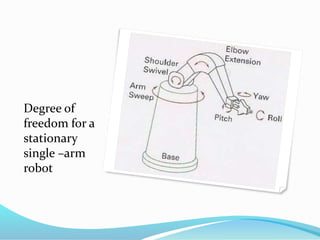
 As an example, the single-arm robot in has six degrees of
freedom, which are called arm sweep, shoulder swivel,
elbow extension, pitch, yaw, and roll.
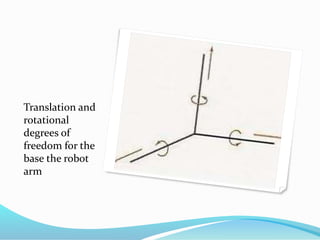
 We can extend the number of degrees of freedom
for this robot arm to nine by allowing three-
dimensional translations for the base
 If we also allow base rotations, the robot arm
canhave a total of 12 degrees of freedom.
 The human boby, in comparsion,has over 200
degrees of freedom.
Degree of
freedom for a
stationary
single –arm
robot
Parameterized system
 Parameterized systems allow object-motion
characteristics to be specified as part of the object
definitions.
 The adjustable parameters control such object
characteristics as
 degrees of freedom
 motion limitations
 allowable shape changes.
Translation and
rotational
degrees of
freedom for the
base the robot
arm
 Scripting systems allow object specifications and
animation sequences to be defined with a user-input
script.
 From the script, a library of various objects and
motions can be constructed
Thank you

computer animation languages-N.Kavitha.pptx

  • 1.
  • 2.
     Design andcontrol of animation sequences are handled with a set of animation outlines.  A general purpose language, such as C,Lips,Pascal,or FORTRAN, is often used to program the animation functions, but several specialized animation languages have been developed.  Animation functions include a graphics editor, a key frame generator, an in-between generator,and standard graphics routines.  The graphics editor allows us to design and modify object shapes, using spline surface, constractive solid geometry methods, or other representation schemes.
  • 3.
     A typicaltask in an animation specification is scene description.  This includes the positioning of objects and light sources, defining the photometric parameters, and setting the camera parameters (position, orientation, and less characteristics).  Another standard function is action specification. This involves the layout of motion paths for the object and camera.  And we need the usual graphics routines: viewing and perspective transformations, geometric transformations to generate object movements  As a function of accelerations or kinematic path specification, visible-surface identification, and the surface rendering operations.
  • 4.
     Key-frame systemsare specialized animation languages designed simply to generate the in-betweens from the user- specified key frames.  Usually ,each object in the scene is defined as a set of rigid bodies connected at the joints and with a limited number of degrees of freedom  As an example, the single-arm robot in has six degrees of freedom, which are called arm sweep, shoulder swivel, elbow extension, pitch, yaw, and roll.
  • 5.
     We canextend the number of degrees of freedom for this robot arm to nine by allowing three- dimensional translations for the base  If we also allow base rotations, the robot arm canhave a total of 12 degrees of freedom.  The human boby, in comparsion,has over 200 degrees of freedom.
  • 6.
    Degree of freedom fora stationary single –arm robot
  • 7.
    Parameterized system  Parameterizedsystems allow object-motion characteristics to be specified as part of the object definitions.  The adjustable parameters control such object characteristics as  degrees of freedom  motion limitations  allowable shape changes.
  • 8.
  • 9.
     Scripting systemsallow object specifications and animation sequences to be defined with a user-input script.  From the script, a library of various objects and motions can be constructed
  • 10.