A
SEMINAR PRESENTATION
ON
ROLE OF COMPUTATIONAL CHEMISTRY IN DRUG DESIGN
BY
AKINLOLU DAMILOLA GRACE
CHE/2018/1032
SUPERVISED BY: DR. SOHDEINDE K.O
OUTLINES OF PRESENTATION
 DEFINITION
 OVERVIEW
 COMPUTATIONAL METHODS FOR SBDD
 FORCE FIELD-BASED APPROACHES FOR SBDD
 VIRTUAL SCREENING AND MOLECULAR DOCKING FOR DRUG DISCOVERY
 COMPUTATIONAL DE NOVO DESIGN OF DRUG-LIKE MOLECULES
 MOLECULAR DYNAMICS FOR SBDD
 QUANTUM MECHANICS FOR SBDD
 LIGAND-BASED DRUG DESIGN APPROACHES
 CONCLUSIONS AND PERSPECTIVE
The impact of computational chemistry on drug discovery has been intensified
in the last few decades by the rapid development of faster architectures and
better algorithms for time-affordable high-level computations. Several
theoretical methods that were once prohibitive for effective drug discovery are
now increasingly used for hit identification and lead generation. Recently, for
example, CPU-intensive and GPU-based free energy perturbation (FEP)
calculations have been applied to accurately estimate the binding free energy of
closely related chemical analogs, generating very promising results for lead
generation and optimization.
INTRODUCTION
DEFINITION
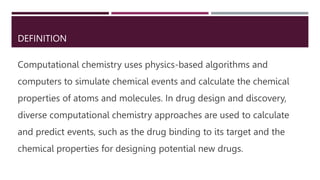
Computational chemistry uses physics-based algorithms and
computers to simulate chemical events and calculate the chemical
properties of atoms and molecules. In drug design and discovery,
diverse computational chemistry approaches are used to calculate
and predict events, such as the drug binding to its target and the
chemical properties for designing potential new drugs.
OVERVIEW
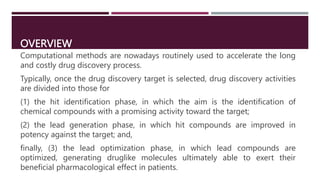
Computational methods are nowadays routinely used to accelerate the long
and costly drug discovery process.
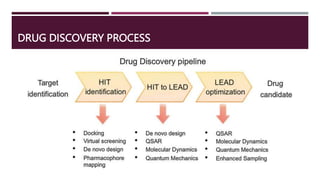
Typically, once the drug discovery target is selected, drug discovery activities
are divided into those for
(1) the hit identification phase, in which the aim is the identification of
chemical compounds with a promising activity toward the target;
(2) the lead generation phase, in which hit compounds are improved in
potency against the target; and,
finally, (3) the lead optimization phase, in which lead compounds are
optimized, generating druglike molecules ultimately able to exert their
beneficial pharmacological effect in patients.
DRUG DISCOVERY PROCESS
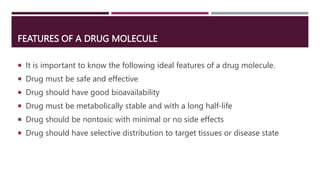
FEATURES OF A DRUG MOLECULE
 It is important to know the following ideal features of a drug molecule.
 Drug must be safe and effective
 Drug should have good bioavailability
 Drug must be metabolically stable and with a long half-life
 Drug should be nontoxic with minimal or no side effects
 Drug should have selective distribution to target tissues or disease state
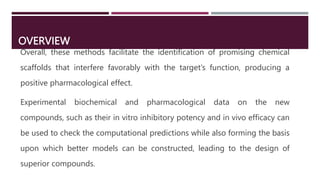
OVERVIEW
Overall, these methods facilitate the identification of promising chemical
scaffolds that interfere favorably with the target’s function, producing a
positive pharmacological effect.
Experimental biochemical and pharmacological data on the new
compounds, such as their in vitro inhibitory potency and in vivo efficacy can
be used to check the computational predictions while also forming the basis
upon which better models can be constructed, leading to the design of
superior compounds.
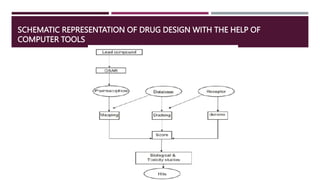
SCHEMATIC REPRESENTATION OF DRUG DESIGN WITH THE HELP OF
COMPUTER TOOLS
HOW TO DESIGN A DRUG?
At the onset, it is important to know what features an “ideal” drug should have.
The drug
 must be safe and effective
 should be well absorbed orally and bioavailable
 metabolically stable and with a long half-life
 nontoxic with minimal or no side effects
 should have selective distribution to target tissues
DRUG DESIGN BASED ON BIOINFORMATICS TOOLS
 The processes of designing a new drug using bioinformatics tools have opened a new area of research.
However, computational techniques assist one in searching drug target and designing drug in silico, but
it is time-consuming and expensive. Bioinformatics tools can provide information about potential targets
that include nucleotide and protein sequencing information, homologs, mapping information, gene and
protein expression data, function prediction, pathway information, disease associations, variants,
structural information and taxonomic distribution among others. This means that time, effort and money
can be saved in characterization of different targets. The field of bioinformatics has become a major part
of the drug discovery pipeline, playing a key role for validating drug targets.
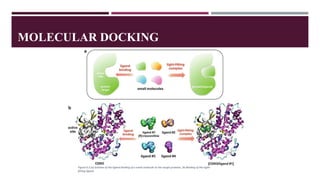
MOLECULAR DOCKING
Figure 0.2 (a) Scheme of the ligand binding of a small molecule to the target proteins. (b) Binding of the tight-
fitting ligand
THANKS FOR LISTENING

computational chemistry

  • 1.
    A SEMINAR PRESENTATION ON ROLE OFCOMPUTATIONAL CHEMISTRY IN DRUG DESIGN BY AKINLOLU DAMILOLA GRACE CHE/2018/1032 SUPERVISED BY: DR. SOHDEINDE K.O
  • 2.
    OUTLINES OF PRESENTATION DEFINITION  OVERVIEW  COMPUTATIONAL METHODS FOR SBDD  FORCE FIELD-BASED APPROACHES FOR SBDD  VIRTUAL SCREENING AND MOLECULAR DOCKING FOR DRUG DISCOVERY  COMPUTATIONAL DE NOVO DESIGN OF DRUG-LIKE MOLECULES  MOLECULAR DYNAMICS FOR SBDD  QUANTUM MECHANICS FOR SBDD  LIGAND-BASED DRUG DESIGN APPROACHES  CONCLUSIONS AND PERSPECTIVE
  • 3.
    The impact ofcomputational chemistry on drug discovery has been intensified in the last few decades by the rapid development of faster architectures and better algorithms for time-affordable high-level computations. Several theoretical methods that were once prohibitive for effective drug discovery are now increasingly used for hit identification and lead generation. Recently, for example, CPU-intensive and GPU-based free energy perturbation (FEP) calculations have been applied to accurately estimate the binding free energy of closely related chemical analogs, generating very promising results for lead generation and optimization. INTRODUCTION
  • 4.
    DEFINITION Computational chemistry usesphysics-based algorithms and computers to simulate chemical events and calculate the chemical properties of atoms and molecules. In drug design and discovery, diverse computational chemistry approaches are used to calculate and predict events, such as the drug binding to its target and the chemical properties for designing potential new drugs.
  • 5.
    OVERVIEW Computational methods arenowadays routinely used to accelerate the long and costly drug discovery process. Typically, once the drug discovery target is selected, drug discovery activities are divided into those for (1) the hit identification phase, in which the aim is the identification of chemical compounds with a promising activity toward the target; (2) the lead generation phase, in which hit compounds are improved in potency against the target; and, finally, (3) the lead optimization phase, in which lead compounds are optimized, generating druglike molecules ultimately able to exert their beneficial pharmacological effect in patients.
  • 6.
  • 7.
    FEATURES OF ADRUG MOLECULE  It is important to know the following ideal features of a drug molecule.  Drug must be safe and effective  Drug should have good bioavailability  Drug must be metabolically stable and with a long half-life  Drug should be nontoxic with minimal or no side effects  Drug should have selective distribution to target tissues or disease state
  • 8.
    OVERVIEW Overall, these methodsfacilitate the identification of promising chemical scaffolds that interfere favorably with the target’s function, producing a positive pharmacological effect. Experimental biochemical and pharmacological data on the new compounds, such as their in vitro inhibitory potency and in vivo efficacy can be used to check the computational predictions while also forming the basis upon which better models can be constructed, leading to the design of superior compounds.
  • 9.
    SCHEMATIC REPRESENTATION OFDRUG DESIGN WITH THE HELP OF COMPUTER TOOLS
  • 10.
    HOW TO DESIGNA DRUG? At the onset, it is important to know what features an “ideal” drug should have. The drug  must be safe and effective  should be well absorbed orally and bioavailable  metabolically stable and with a long half-life  nontoxic with minimal or no side effects  should have selective distribution to target tissues
  • 11.
    DRUG DESIGN BASEDON BIOINFORMATICS TOOLS  The processes of designing a new drug using bioinformatics tools have opened a new area of research. However, computational techniques assist one in searching drug target and designing drug in silico, but it is time-consuming and expensive. Bioinformatics tools can provide information about potential targets that include nucleotide and protein sequencing information, homologs, mapping information, gene and protein expression data, function prediction, pathway information, disease associations, variants, structural information and taxonomic distribution among others. This means that time, effort and money can be saved in characterization of different targets. The field of bioinformatics has become a major part of the drug discovery pipeline, playing a key role for validating drug targets.
  • 12.
    MOLECULAR DOCKING Figure 0.2(a) Scheme of the ligand binding of a small molecule to the target proteins. (b) Binding of the tight- fitting ligand
  • 13.