By-
Kratika Nigam
COMPUTATIONAL
INTELLIGENCE IN
WIRELESS
SENSOR
NETWORKS
Wireless Sensor Networks
1-What is Wireless Sensor Network?
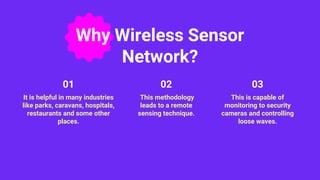
2-Why Wireless Sensor Network?
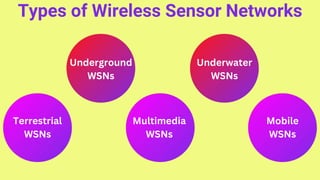
3-Types of Wireless Sensor Network
4-Applications of WSN.
5-Challanges in WSN
6-Computing Intelligence
7-Fuzzy sets
8- Reinforcement Learning
9- Neural Networks
10- CI based solutions for WSN challenges
Content
Content
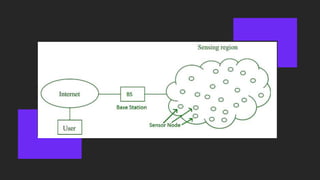
• A Wireless sensor network is a network of distributed autonomous devices that can sense or
monitor physical or environmental conditions cooperatively.
• WSNs consist of a large number of small, inexpensive, disposable and autonomous sensor nodes
that are generally deployed in an ad hoc (without any fixed infrastructures) manner in vast
geographical areas for remote operations.
• Typically, sensor nodes are grouped in clusters, and each cluster has a node that acts as the
cluster head.
• All nodes forward their sensor data to the cluster head, which in turn routes it to a specialized node
called sink node (or base station) through a multi-hop wireless communication
What is WSN?
Why Wireless Sensor
Network?
It is helpful in many industries
like parks, caravans, hospitals,
restaurants and some other
places.
01
This methodology
leads to a remote
sensing technique.
02
This is capable of
monitoring to security
cameras and controlling
loose waves.
03
Terrestrial
WSNs
Underground
WSNs
Multimedia
WSNs
Underwater
WSNs
Mobile
WSNs
Types of Wireless Sensor Networks
A
P
P
L
I
C
A
T
I
O
N
S
Disaster Relief Operation Military Application
Environment Application Home Application
Network Design Deployment of sensors Security
Challenges of WSN
How to
overcome these
challenges?
Computational Intelligence (CI) can be
defining as a analyzing of adaptive
mechanisms to enable or facilitate intelligent
behavior in complex and changing
environment.
It is a sub-branch of Artificial
Intelligence (AI) which mainly
emphases on those AI paradigms
that exhibit an ability to learn and
adapt to new situations, to
generalize, abstract, and discover
Computational
Intelligence
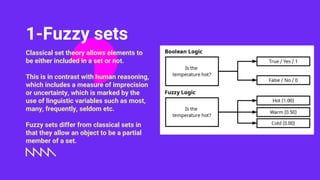
Classical set theory allows elements to
be either included in a set or not.
This is in contrast with human reasoning,
which includes a measure of imprecision
or uncertainty, which is marked by the
use of linguistic variables such as most,
many, frequently, seldom etc.
Fuzzy sets differ from classical sets in
that they allow an object to be a partial
member of a set.
1-Fuzzy sets
• Reinforcement Learning is a feedback-based Machine learning
technique in which an agent learns to behave in an environment by
performing the actions and seeing the results of actions. For each
good action, the agent gets positive feedback, and for each bad
action, the agent gets negative feedback or penalty.
• In Reinforcement Learning, the agent learns automatically using
feedbacks without any labeled data, unlike supervised learning.
• Since there is no labeled data, so the agent is bound to learn by its
experience only.
• RL solves a specific type of problem where decision making is
sequential, and the goal is long-term, such as game-playing, robotics,
etc.
2- Reinforcement Learning
Approaches To
Implement
Reinforcement
Learning
• Value Based
• Policy Based
• Model-based
There are mainly three ways to
implement reinforcement-learning in
ML, which are:
HOW DOES
REINFORCEMENT
LEARNING WORK?
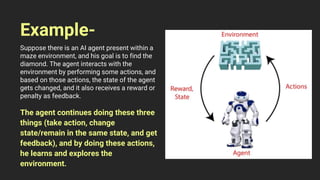
The agent continues doing these three
things (take action, change
state/remain in the same state, and get
feedback), and by doing these actions,
he learns and explores the
environment.
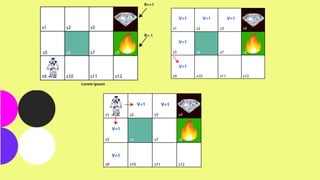
Suppose there is an AI agent present within a
maze environment, and his goal is to find the
diamond. The agent interacts with the
environment by performing some actions, and
based on those actions, the state of the agent
gets changed, and it also receives a reward or
penalty as feedback.
Example-
The key-elements used in Bellman equations are:
• Action performed by the agent is referred to as "a"
• State occurred by performing the action is "s."
• The reward/feedback obtained for each good and bad
action is "R."
• A discount factor is Gamma "γ."
The Bellman equation can be written as:
• V(s) = max [R(s,a) + γV(s`)]
Where,
V(s)= value calculated at a particular point.
R(s,a) = Reward at a particular state s by performing an action.
γ = Discount factor
V(s`) = The value at the previous state.
Bellman equation
Types of Reinforcement Learning
Positive Reinforcement
The positive reinforcement learning
means adding something to increase the
tendency that expected behavior would
occur again. It impacts positively on the
behavior of the agent and increases the
strength of the behavior.
Negative Reinforcement
The negative reinforcement learning is
opposite to the positive reinforcement
as it increases the tendency that the
specific behavior will occur again by
avoiding the negative condition.
Let's recognize this image
Before moving to the
next CI method ,
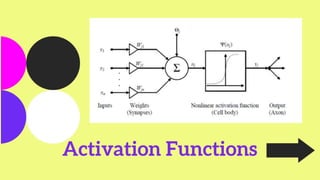
• Neural networks, also known as artificial neural
networks (ANNs) or simulated neural networks
(SNNs).
• Artificial neural networks (ANNs) are comprised of a
node layers, containing an input layer, one or more
hidden layers, and an output layer.
• Each node, or artificial neuron, connects to another
and has an associated weight and threshold.
• If the output of any individual node is above the
specified threshold value, that node is activated,
sending data to the next layer of the network.
Otherwise, no data is passed along to the next layer
of the network.
4-Neural Networks
Activation Functions
Linear Activation
Function
Heviside Step
Function
Sigmoid
Function
f(v)=a+v
= a + ∑wi xi
a->bias
CI techniques can be very helpful in the process of designing and planning the
deployments of sensor networks
CI BASED SOLUTIONS FOR
WSN CHALLENGES
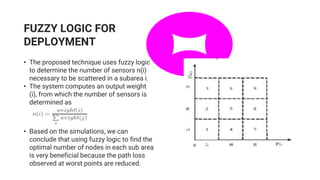
• The proposed technique uses fuzzy logic
to determine the number of sensors n(i)
necessary to be scattered in a subarea i.
• The system computes an output weight
(i), from which the number of sensors is
determined as
FUZZY LOGIC FOR
DEPLOYMENT
• Based on the simulations, we can
conclude that using fuzzy logic to find the
optimal number of nodes in each sub area
is very beneficial because the path loss
observed at worst points are reduced.
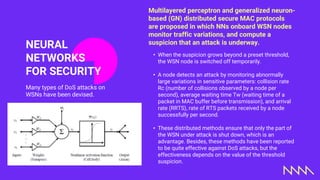
Multilayered perceptron and generalized neuron-
based (GN) distributed secure MAC protocols
are proposed in which NNs onboard WSN nodes
monitor traffic variations, and compute a
suspicion that an attack is underway.
• When the suspicion grows beyond a preset threshold,
the WSN node is switched off temporarily.
• A node detects an attack by monitoring abnormally
large variations in sensitive parameters: collision rate
Rc (number of collisions observed by a node per
second), average waiting time Tw (waiting time of a
packet in MAC buffer before transmission), and arrival
rate (RRTS), rate of RTS packets received by a node
successfully per second.
• These distributed methods ensure that only the part of
the WSN under attack is shut down, which is an
advantage. Besides, these methods have been reported
to be quite effective against DoS attacks, but the
effectiveness depends on the value of the threshold
suspicion.
NEURAL
NETWORKS
FOR SECURITY
Many types of DoS attacks on
WSNs have been devised.
References
• https://microcontrollerslab.com/wireless-sensor-
networks-wsn-applications/
• https://www.javatpoint.com/reinforcement-learning
• https://www.techopedia.com/definition/32751/evolutio
nary-algorithm
• https://in.mathworks.com/help/gads/what-is-the-
genetic-algorithm.html
• https://www.sciencedirect.com/topics/computer-
science/evolutionary-programming
• https://www.youtube.com/watch?v=EYeF2e2IKEo&t=46
s
• https://www.youtube.com/watch?v=L--IxUH4fac
Computational intelligence in wireless sensor network

Computational intelligence in wireless sensor network

  • 1.
  • 2.
    1-What is WirelessSensor Network? 2-Why Wireless Sensor Network? 3-Types of Wireless Sensor Network 4-Applications of WSN. 5-Challanges in WSN 6-Computing Intelligence 7-Fuzzy sets 8- Reinforcement Learning 9- Neural Networks 10- CI based solutions for WSN challenges Content Content
  • 3.
    • A Wirelesssensor network is a network of distributed autonomous devices that can sense or monitor physical or environmental conditions cooperatively. • WSNs consist of a large number of small, inexpensive, disposable and autonomous sensor nodes that are generally deployed in an ad hoc (without any fixed infrastructures) manner in vast geographical areas for remote operations. • Typically, sensor nodes are grouped in clusters, and each cluster has a node that acts as the cluster head. • All nodes forward their sensor data to the cluster head, which in turn routes it to a specialized node called sink node (or base station) through a multi-hop wireless communication What is WSN?
  • 5.
    Why Wireless Sensor Network? Itis helpful in many industries like parks, caravans, hospitals, restaurants and some other places. 01 This methodology leads to a remote sensing technique. 02 This is capable of monitoring to security cameras and controlling loose waves. 03
  • 6.
  • 7.
    A P P L I C A T I O N S Disaster Relief OperationMilitary Application Environment Application Home Application
  • 8.
    Network Design Deploymentof sensors Security Challenges of WSN
  • 9.
  • 10.
    Computational Intelligence (CI)can be defining as a analyzing of adaptive mechanisms to enable or facilitate intelligent behavior in complex and changing environment. It is a sub-branch of Artificial Intelligence (AI) which mainly emphases on those AI paradigms that exhibit an ability to learn and adapt to new situations, to generalize, abstract, and discover Computational Intelligence
  • 11.
    Classical set theoryallows elements to be either included in a set or not. This is in contrast with human reasoning, which includes a measure of imprecision or uncertainty, which is marked by the use of linguistic variables such as most, many, frequently, seldom etc. Fuzzy sets differ from classical sets in that they allow an object to be a partial member of a set. 1-Fuzzy sets
  • 12.
    • Reinforcement Learningis a feedback-based Machine learning technique in which an agent learns to behave in an environment by performing the actions and seeing the results of actions. For each good action, the agent gets positive feedback, and for each bad action, the agent gets negative feedback or penalty. • In Reinforcement Learning, the agent learns automatically using feedbacks without any labeled data, unlike supervised learning. • Since there is no labeled data, so the agent is bound to learn by its experience only. • RL solves a specific type of problem where decision making is sequential, and the goal is long-term, such as game-playing, robotics, etc. 2- Reinforcement Learning
  • 13.
    Approaches To Implement Reinforcement Learning • ValueBased • Policy Based • Model-based There are mainly three ways to implement reinforcement-learning in ML, which are:
  • 14.
  • 15.
    The agent continuesdoing these three things (take action, change state/remain in the same state, and get feedback), and by doing these actions, he learns and explores the environment. Suppose there is an AI agent present within a maze environment, and his goal is to find the diamond. The agent interacts with the environment by performing some actions, and based on those actions, the state of the agent gets changed, and it also receives a reward or penalty as feedback. Example-
  • 17.
    The key-elements usedin Bellman equations are: • Action performed by the agent is referred to as "a" • State occurred by performing the action is "s." • The reward/feedback obtained for each good and bad action is "R." • A discount factor is Gamma "γ." The Bellman equation can be written as: • V(s) = max [R(s,a) + γV(s`)] Where, V(s)= value calculated at a particular point. R(s,a) = Reward at a particular state s by performing an action. γ = Discount factor V(s`) = The value at the previous state. Bellman equation
  • 18.
    Types of ReinforcementLearning Positive Reinforcement The positive reinforcement learning means adding something to increase the tendency that expected behavior would occur again. It impacts positively on the behavior of the agent and increases the strength of the behavior. Negative Reinforcement The negative reinforcement learning is opposite to the positive reinforcement as it increases the tendency that the specific behavior will occur again by avoiding the negative condition.
  • 19.
    Let's recognize thisimage Before moving to the next CI method ,
  • 20.
    • Neural networks,also known as artificial neural networks (ANNs) or simulated neural networks (SNNs). • Artificial neural networks (ANNs) are comprised of a node layers, containing an input layer, one or more hidden layers, and an output layer. • Each node, or artificial neuron, connects to another and has an associated weight and threshold. • If the output of any individual node is above the specified threshold value, that node is activated, sending data to the next layer of the network. Otherwise, no data is passed along to the next layer of the network. 4-Neural Networks
  • 21.
  • 22.
  • 23.
    CI techniques canbe very helpful in the process of designing and planning the deployments of sensor networks CI BASED SOLUTIONS FOR WSN CHALLENGES
  • 24.
    • The proposedtechnique uses fuzzy logic to determine the number of sensors n(i) necessary to be scattered in a subarea i. • The system computes an output weight (i), from which the number of sensors is determined as FUZZY LOGIC FOR DEPLOYMENT • Based on the simulations, we can conclude that using fuzzy logic to find the optimal number of nodes in each sub area is very beneficial because the path loss observed at worst points are reduced.
  • 25.
    Multilayered perceptron andgeneralized neuron- based (GN) distributed secure MAC protocols are proposed in which NNs onboard WSN nodes monitor traffic variations, and compute a suspicion that an attack is underway. • When the suspicion grows beyond a preset threshold, the WSN node is switched off temporarily. • A node detects an attack by monitoring abnormally large variations in sensitive parameters: collision rate Rc (number of collisions observed by a node per second), average waiting time Tw (waiting time of a packet in MAC buffer before transmission), and arrival rate (RRTS), rate of RTS packets received by a node successfully per second. • These distributed methods ensure that only the part of the WSN under attack is shut down, which is an advantage. Besides, these methods have been reported to be quite effective against DoS attacks, but the effectiveness depends on the value of the threshold suspicion. NEURAL NETWORKS FOR SECURITY Many types of DoS attacks on WSNs have been devised.
  • 26.
    References • https://microcontrollerslab.com/wireless-sensor- networks-wsn-applications/ • https://www.javatpoint.com/reinforcement-learning •https://www.techopedia.com/definition/32751/evolutio nary-algorithm • https://in.mathworks.com/help/gads/what-is-the- genetic-algorithm.html • https://www.sciencedirect.com/topics/computer- science/evolutionary-programming • https://www.youtube.com/watch?v=EYeF2e2IKEo&t=46 s • https://www.youtube.com/watch?v=L--IxUH4fac