By: Samuel Dratwa
Samuel.dratwa@gmail.com
Artificial Intelligence
Agenda
 Introduction to AI
 ML, DL , NLP
 Neural networks
 TPU
 What telecom industry is doing with AI
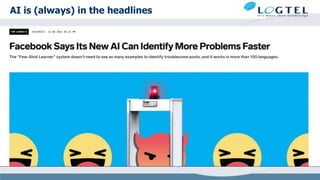
AI is (always) in the headlines
4
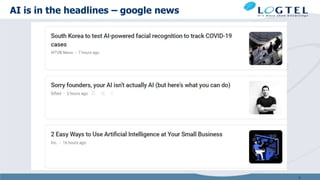
AI is in the headlines – google news
Can you give me an example ?
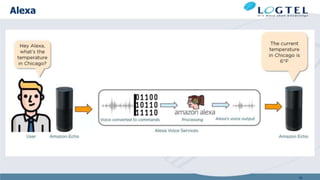
 Siri / Alexa
 Google go
 Deep Blue
 Autonomous cars
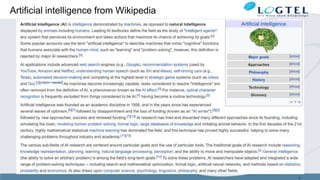
Artificial intelligence from Wikipedia
6
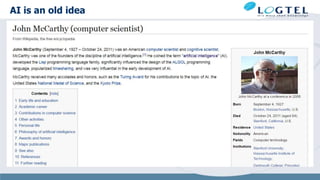
AI is an old idea
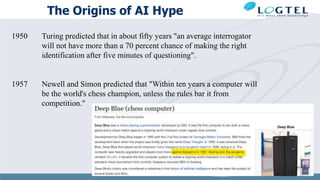
The Origins of AI Hype
1950 Turing predicted that in about fifty years "an average interrogator
will not have more than a 70 percent chance of making the right
identification after five minutes of questioning".
1957 Newell and Simon predicted that "Within ten years a computer will
be the world's chess champion, unless the rules bar it from
competition."
The Mechanical Turk
9
The Turk, aka the Mechanical Turk,
was a fake chess playing
machine constructed in the late 18th
century. From 1770 until its destruction
by fire in 1854 it was exhibited by
various owners as an automaton, though
it was eventually revealed to be an
elaborate hoax.[1] Constructed and
unveiled in 1770 by Wolfgang von
Kempelen (1734–1804) to impress
Empress Maria Theresa of Austria, the
mechanism appeared to be able to play
a strong game of chess against a human
opponent, as well as perform the knight's
tour, a puzzle that requires the player to
move a knight to occupy every square of
a chessboard exactly once.
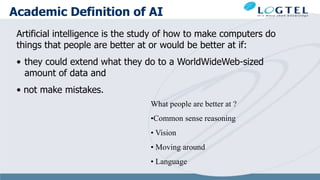
Academic Definition of AI
Artificial intelligence is the study of how to make computers do
things that people are better at or would be better at if:
• they could extend what they do to a WorldWideWeb-sized
amount of data and
• not make mistakes.
What people are better at ?
•Common sense reasoning
• Vision
• Moving around
• Language
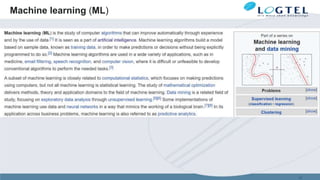
Machine learning (ML)
11
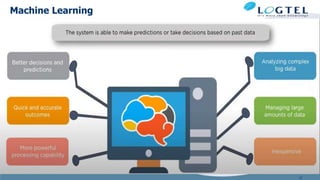
Machine Learning
12
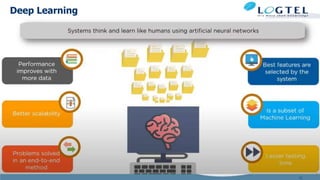
Deep Learning
13
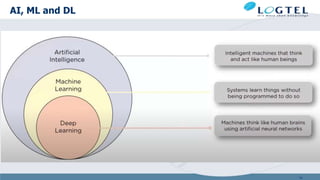
AI, ML and DL
14
Our definition
 A (self) learning software that can adopt to
new situation and interact with humans,
giving them a user experience like human.
15
Alexa
16
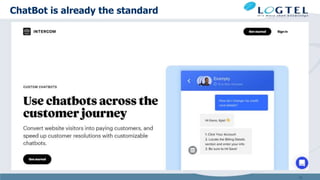
ChatBot is already the standard
17
How Can We Teach Things to Computers?
A quote from John McCarthy:
In order for a program to be capable of learning
something, it must first be capable of being told it.
What do you say ?
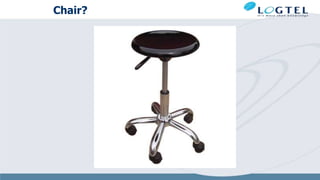
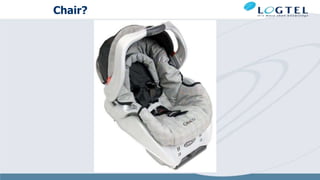
What is a Concept / idea ?
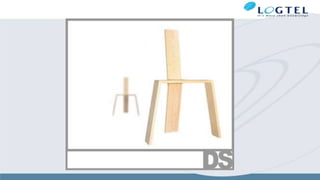
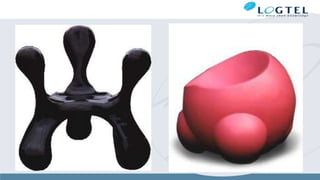
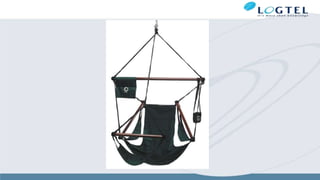
Let’s start with an easy one: chair
Chair?
Chair?
Chair?
Chair?
Chair?
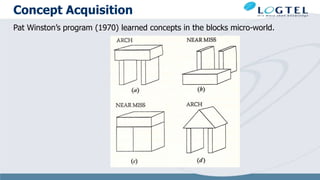
Concept Acquisition
Pat Winston’s program (1970) learned concepts in the blocks micro-world.
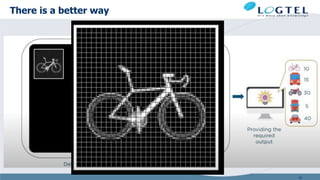
There is a better way
32
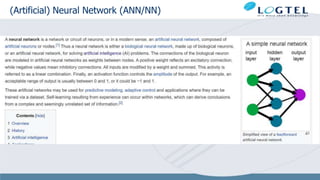
(Artificial) Neural Network (ANN/NN)
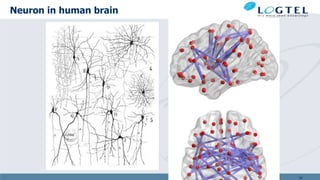
Neuron in human brain
34
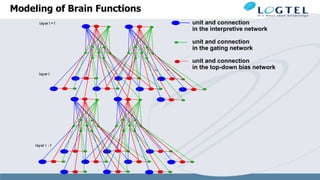
Modeling of Brain Functions
unit and connection
in the interpretive network
unit and connection
in the gating network
unit and connection
in the top-down bias network
layer l +1
layer l -1
layer l
Why Artificial Neural Networks?
There are two basic reasons why we are interested in building
artificial neural networks (ANNs):
• Biological viewpoint: ANNs can be used to replicate and
simulate components of the human brain, thereby giving us
insight into natural information processing.
• Technical viewpoint: Some problems such as character
recognition or the prediction of future states of a system require
massively parallel and adaptive processing.
How do NNs and ANNs work?
• The “building blocks” of neural networks are the
neurons.
• Basically, each neuron
 receives input from many other neurons (via synapses),
 changes its internal state (activation) based on the current input,
 sends one output signal to many other neurons, possibly
including its input neurons (recurrent network)
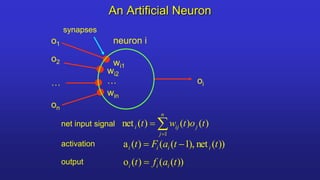
An Artificial Neuron
o1
o2
on
…
wi1
wi2
…
win



n
j
j
ij
i t
o
t
w
t
1
)
(
)
(
)
(
net
oi
neuron i
net input signal
))
(
net
),
1
(
(
)
(
a t
t
a
F
t i
i
i
i 

synapses
activation
output ))
(
(
)
(
o t
a
f
t i
i
i 
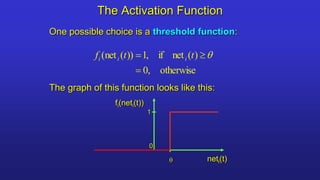
The Activation Function
One possible choice is a threshold function:


 )
(
net
if
,
1
))
(
net
( t
t
f i
i
i
otherwise
,
0

The graph of this function looks like this:
1
0

fi(neti(t))
neti(t)
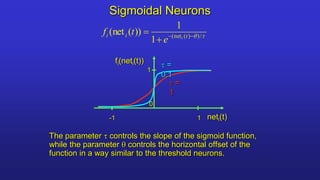
Sigmoidal Neurons
The parameter  controls the slope of the sigmoid function,
while the parameter  controls the horizontal offset of the
function in a way similar to the threshold neurons.
1
0
1
fi(neti(t))
neti(t)
-1

 /
)
)
(
net
(
1
1
))
(
net
( 


 t
i
i i
e
t
f
 =
1
 =
0.1
How do NNs and ANNs work?
• Information is transmitted as a series of electric
impulses, so-called spikes.
• The frequency and phase of these spikes
encodes the information.
• In biological systems, one neuron can be
connected to as many as 10,000 other neurons.
• Neurons of similar functionality are usually
organized in separate areas (or layers).
• Often, there is a hierarchy of interconnected
layers with the lowest layer receiving sensory input
and neurons in higher layers computing more
complex functions.
How do NNs and ANNs work?
• NNs are able to learn by adapting their
connectivity patterns so that the organism
improves its behavior in terms of reaching certain
(evolutionary) goals.
• The strength of a connection, or whether it is
excitatory or inhibitory, depends on the state of a
receiving neuron’s synapses.
• The NN achieves learning by appropriately
adapting the states of its synapses.
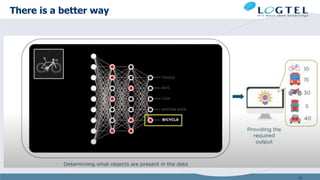
There is a better way
43
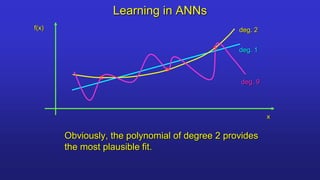
Learning in ANNs
Obviously, the polynomial of degree 2 provides
the most plausible fit.
f(x)
x
deg. 1
deg. 2
deg. 9
Copyright © 2016 LOGTEL
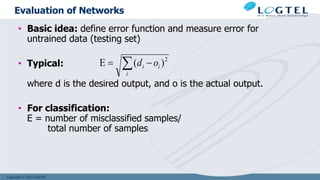
Evaluation of Networks
• Basic idea: define error function and measure error for
untrained data (testing set)
• Typical:
where d is the desired output, and o is the actual output.
• For classification:
E = number of misclassified samples/
total number of samples
 

i
i
i o
d 2
)
(
E
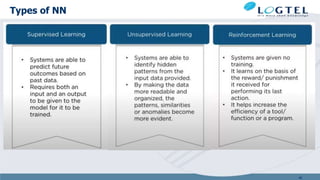
Types of NN
46
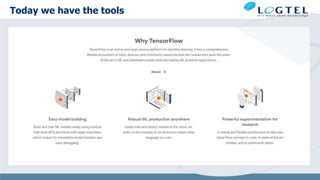
Today we have the tools
Other
approach
48
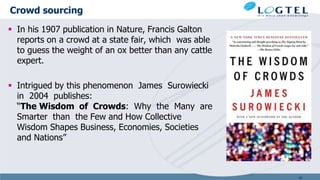
Crowd sourcing
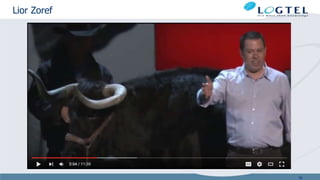
 In his 1907 publication in Nature, Francis Galton
reports on a crowd at a state fair, which was able
to guess the weight of an ox better than any cattle
expert.
 Intrigued by this phenomenon James Surowiecki
in 2004 publishes:
“The Wisdom of Crowds: Why the Many are
Smarter than the Few and How Collective
Wisdom Shapes Business, Economies, Societies
and Nations”
49
Lior Zoref
50
Crowed is not just Humans
 The crowed can be webpages (or any device)
English spelling
What’s more expensive
gold or copper
Translate
Identify
51
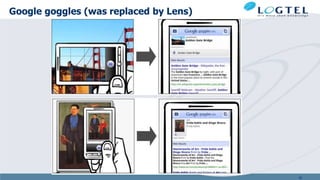
Google goggles (was replaced by Lens)
52
53
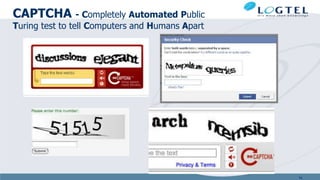
CAPTCHA - Completely Automated Public
Turing test to tell Computers and Humans Apart
54
55
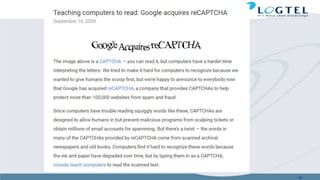
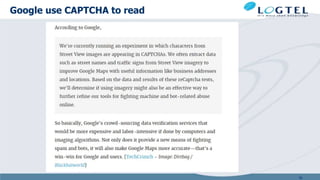
Google use CAPTCHA to read
56
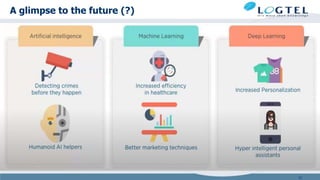
A glimpse to the future (?)
57
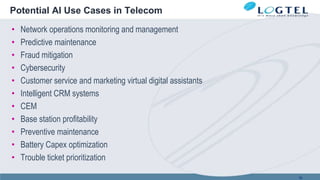
Potential AI Use Cases in Telecom
• Network operations monitoring and management
• Predictive maintenance
• Fraud mitigation
• Cybersecurity
• Customer service and marketing virtual digital assistants
• Intelligent CRM systems
• CEM
• Base station profitability
• Preventive maintenance
• Battery Capex optimization
• Trouble ticket prioritization
58
59
60
61
62
63
64

Artificial Intelligence (and the telecom industry)

  • 1.
  • 2.
    Agenda  Introduction toAI  ML, DL , NLP  Neural networks  TPU  What telecom industry is doing with AI
  • 3.
    AI is (always)in the headlines
  • 4.
    4 AI is inthe headlines – google news
  • 5.
    Can you giveme an example ?  Siri / Alexa  Google go  Deep Blue  Autonomous cars
  • 6.
  • 7.
    AI is anold idea
  • 8.
    The Origins ofAI Hype 1950 Turing predicted that in about fifty years "an average interrogator will not have more than a 70 percent chance of making the right identification after five minutes of questioning". 1957 Newell and Simon predicted that "Within ten years a computer will be the world's chess champion, unless the rules bar it from competition."
  • 9.
    The Mechanical Turk 9 TheTurk, aka the Mechanical Turk, was a fake chess playing machine constructed in the late 18th century. From 1770 until its destruction by fire in 1854 it was exhibited by various owners as an automaton, though it was eventually revealed to be an elaborate hoax.[1] Constructed and unveiled in 1770 by Wolfgang von Kempelen (1734–1804) to impress Empress Maria Theresa of Austria, the mechanism appeared to be able to play a strong game of chess against a human opponent, as well as perform the knight's tour, a puzzle that requires the player to move a knight to occupy every square of a chessboard exactly once.
  • 10.
    Academic Definition ofAI Artificial intelligence is the study of how to make computers do things that people are better at or would be better at if: • they could extend what they do to a WorldWideWeb-sized amount of data and • not make mistakes. What people are better at ? •Common sense reasoning • Vision • Moving around • Language
  • 11.
  • 12.
  • 13.
  • 14.
  • 15.
    Our definition  A(self) learning software that can adopt to new situation and interact with humans, giving them a user experience like human. 15
  • 16.
  • 17.
    ChatBot is alreadythe standard 17
  • 18.
    How Can WeTeach Things to Computers? A quote from John McCarthy: In order for a program to be capable of learning something, it must first be capable of being told it. What do you say ?
  • 19.
    What is aConcept / idea ? Let’s start with an easy one: chair
  • 21.
  • 23.
  • 28.
  • 29.
  • 30.
  • 31.
    Concept Acquisition Pat Winston’sprogram (1970) learned concepts in the blocks micro-world.
  • 32.
    There is abetter way 32
  • 33.
  • 34.
  • 35.
    Modeling of BrainFunctions unit and connection in the interpretive network unit and connection in the gating network unit and connection in the top-down bias network layer l +1 layer l -1 layer l
  • 36.
    Why Artificial NeuralNetworks? There are two basic reasons why we are interested in building artificial neural networks (ANNs): • Biological viewpoint: ANNs can be used to replicate and simulate components of the human brain, thereby giving us insight into natural information processing. • Technical viewpoint: Some problems such as character recognition or the prediction of future states of a system require massively parallel and adaptive processing.
  • 37.
    How do NNsand ANNs work? • The “building blocks” of neural networks are the neurons. • Basically, each neuron  receives input from many other neurons (via synapses),  changes its internal state (activation) based on the current input,  sends one output signal to many other neurons, possibly including its input neurons (recurrent network)
  • 38.
    An Artificial Neuron o1 o2 on … wi1 wi2 … win    n j j ij it o t w t 1 ) ( ) ( ) ( net oi neuron i net input signal )) ( net ), 1 ( ( ) ( a t t a F t i i i i   synapses activation output )) ( ( ) ( o t a f t i i i 
  • 39.
    The Activation Function Onepossible choice is a threshold function:    ) ( net if , 1 )) ( net ( t t f i i i otherwise , 0  The graph of this function looks like this: 1 0  fi(neti(t)) neti(t)
  • 40.
    Sigmoidal Neurons The parameter controls the slope of the sigmoid function, while the parameter  controls the horizontal offset of the function in a way similar to the threshold neurons. 1 0 1 fi(neti(t)) neti(t) -1   / ) ) ( net ( 1 1 )) ( net (     t i i i e t f  = 1  = 0.1
  • 41.
    How do NNsand ANNs work? • Information is transmitted as a series of electric impulses, so-called spikes. • The frequency and phase of these spikes encodes the information. • In biological systems, one neuron can be connected to as many as 10,000 other neurons. • Neurons of similar functionality are usually organized in separate areas (or layers). • Often, there is a hierarchy of interconnected layers with the lowest layer receiving sensory input and neurons in higher layers computing more complex functions.
  • 42.
    How do NNsand ANNs work? • NNs are able to learn by adapting their connectivity patterns so that the organism improves its behavior in terms of reaching certain (evolutionary) goals. • The strength of a connection, or whether it is excitatory or inhibitory, depends on the state of a receiving neuron’s synapses. • The NN achieves learning by appropriately adapting the states of its synapses.
  • 43.
    There is abetter way 43
  • 44.
    Learning in ANNs Obviously,the polynomial of degree 2 provides the most plausible fit. f(x) x deg. 1 deg. 2 deg. 9
  • 45.
    Copyright © 2016LOGTEL Evaluation of Networks • Basic idea: define error function and measure error for untrained data (testing set) • Typical: where d is the desired output, and o is the actual output. • For classification: E = number of misclassified samples/ total number of samples    i i i o d 2 ) ( E
  • 46.
  • 47.
    Today we havethe tools
  • 48.
  • 49.
    Crowd sourcing  Inhis 1907 publication in Nature, Francis Galton reports on a crowd at a state fair, which was able to guess the weight of an ox better than any cattle expert.  Intrigued by this phenomenon James Surowiecki in 2004 publishes: “The Wisdom of Crowds: Why the Many are Smarter than the Few and How Collective Wisdom Shapes Business, Economies, Societies and Nations” 49
  • 50.
  • 51.
    Crowed is notjust Humans  The crowed can be webpages (or any device) English spelling What’s more expensive gold or copper Translate Identify 51
  • 52.
    Google goggles (wasreplaced by Lens) 52
  • 53.
  • 54.
    CAPTCHA - CompletelyAutomated Public Turing test to tell Computers and Humans Apart 54
  • 55.
  • 56.
  • 57.
    A glimpse tothe future (?) 57
  • 58.
    Potential AI UseCases in Telecom • Network operations monitoring and management • Predictive maintenance • Fraud mitigation • Cybersecurity • Customer service and marketing virtual digital assistants • Intelligent CRM systems • CEM • Base station profitability • Preventive maintenance • Battery Capex optimization • Trouble ticket prioritization 58
  • 59.
  • 60.
  • 61.
  • 62.
  • 63.
  • 64.